

Recreation Area Urban Design
Recreation area urban design integrates movement, leisure, and ecology into a cohesive landscape, exemplified by a canal-side scheme that accommodates diverse activities.
 Muhammad Abdullatef - Tifa Studio10 September 20196 Mins read358

Table of Contents Show
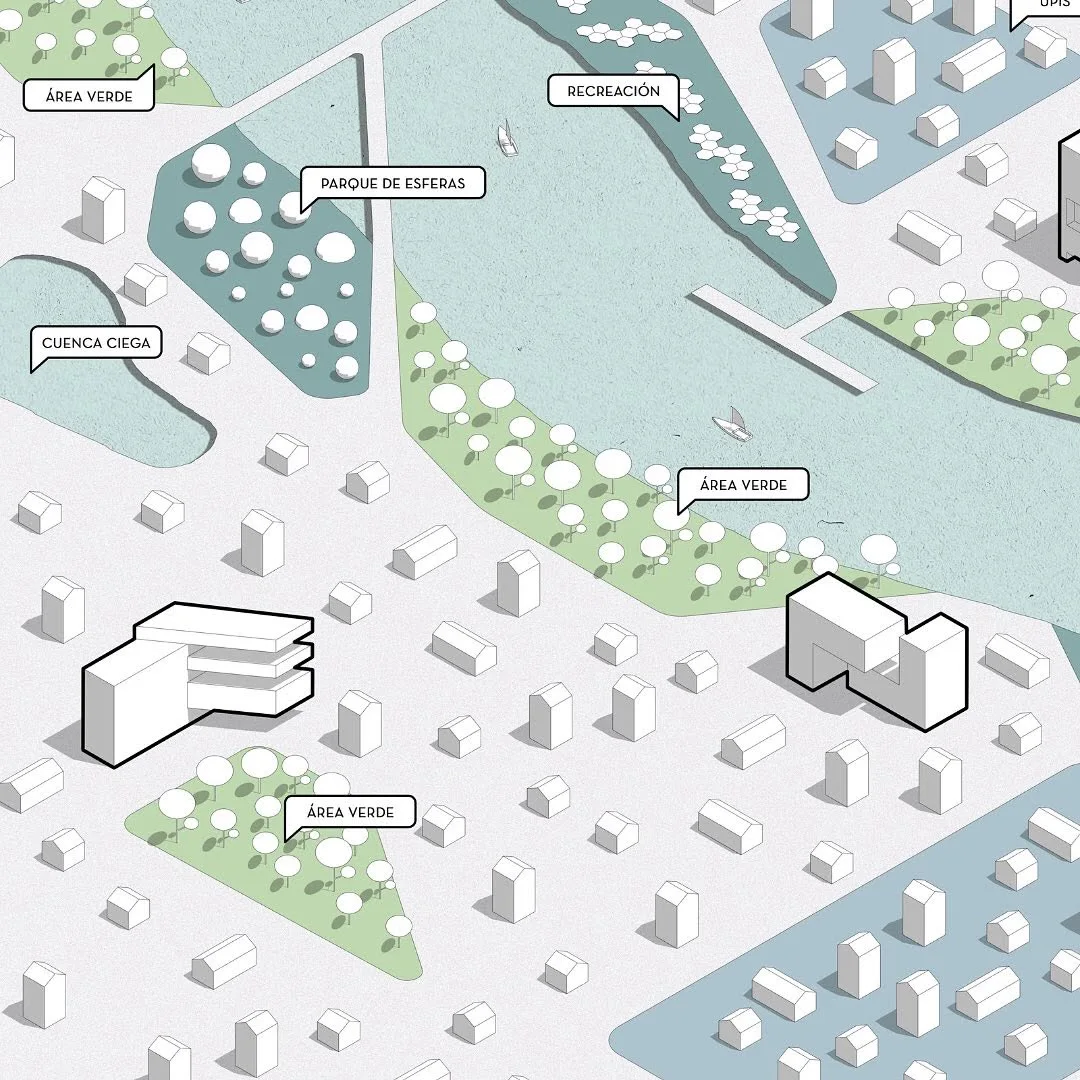
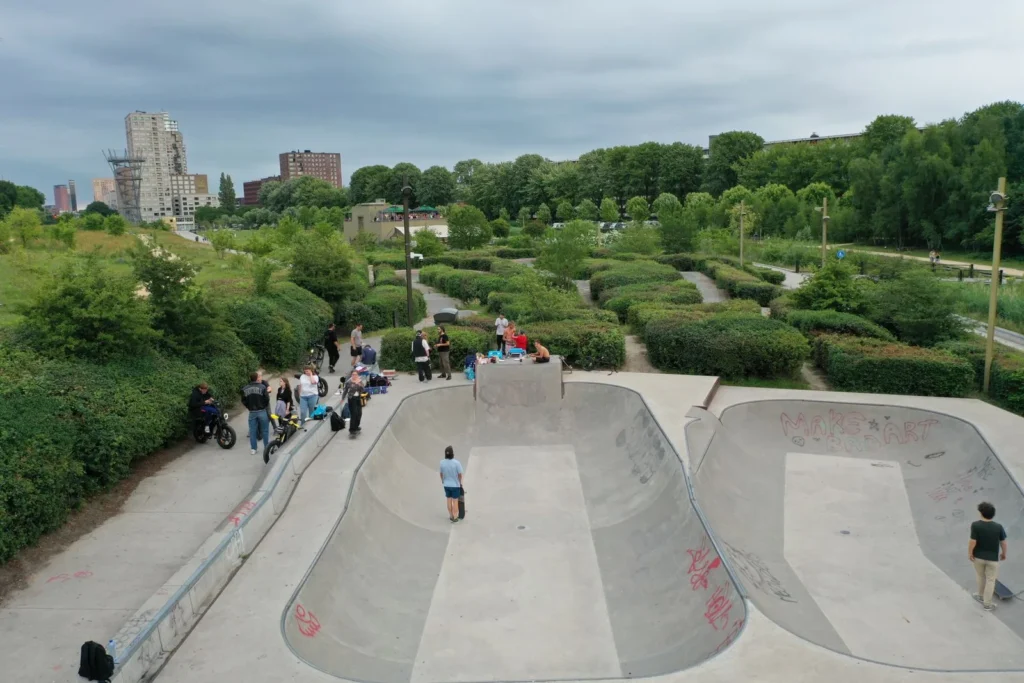
Recreation area urban design is the practice of organizing public open space so that movement, leisure, and ecology work together within one connected landscape. In the canal-side scheme described here, sports areas, hiking trails, bicycle paths, an open air cinema, skateboard tracks, hobby gardens, a gondola route, and promenade areas form a single continuous waterfront system.
The canal acts as the organizing spine of the whole plan. By threading active uses along the water, the design follows the logic of blue-green infrastructure, where water bodies and planted corridors are treated as shared assets rather than leftover edges. Activity areas are arranged so that different age groups and interests each get their own space, from quieter hobby gardens to the more energetic skateboard tracks and sports areas, while the open air cinema and gondola keep the waterfront in use well beyond daylight hours.
Planting choices respond directly to place. Within the channel, species suited to the local topography and climate were used, an approach that cuts irrigation demand and helps the landscape hold up to local conditions over time. Working with the existing terrain rather than against it lets the amphitheater steps, the scaffoldings, and the user transportation network combine cleanly inside the channel where the gondola route runs, so that level changes double as seating and circulation.

What Defines a Recreation Area in Urban Design?
A recreation area is public open space set aside primarily for leisure, exercise, and social gathering, but in good recreation area urban design it rarely does only one job. The canal scheme shows the principle clearly: a single landscape carries sport, play, culture, and movement at once. The strength of this approach is layering. By stacking compatible uses along one corridor, the design serves more people across more hours of the day without demanding more land, often the scarcest resource in a dense city. The same instinct shapes great civic settings around the world, from waterfront promenades to historic squares like Registan Square in Samarkand, where a single public space holds many overlapping uses.
Professional bodies frame this as core to the discipline. The American Society of Landscape Architects lists parks and recreation among the field’s main focus areas, describing the goal as expanding access to high quality outdoor spaces that perform in the real world and last over time. A recreation area that doubles as a route, a habitat, and a meeting place meets that standard far better than a single-purpose lawn.
🔢 Quick Numbers
- 1.8 billion adults, about 31% of the world’s adult population, were physically inactive in 2022 (World Health Organization, 2024 fact sheet).
- Regular physical activity lowers the risk of premature death by roughly 20 to 30% compared with inactivity (World Health Organization).
- After the Cheonggyecheon stream in Seoul was restored, recorded biodiversity along the corridor rose by 639% between 2003 and 2008 (City of Seoul data, Wikipedia).
How the Canal Organizes Leisure and Movement
Reading the water as connective tissue is the move that makes this plan hold together. Instead of scattering facilities across separate plots, the design lines them up along the canal so that walking from one to the next becomes part of the experience. The promenade carries strollers and families, the cycle path carries commuters and weekend riders, and the gondola adds a slower, scenic way to read the whole length of the channel. Each route reinforces the others, and none of them dead-ends into a car park.
This continuity is also what keeps the space alive. A waterfront that only offers one thing empties out the moment that activity stops. By contrast, an open air cinema fills the evening, hobby gardens draw daytime regulars, and sports areas pull a steady stream of users on weekends, so the recreation area earns attention across the full day and week.
🏗️ Real-World Example
Cheonggyecheon Stream Restoration (Seoul, 2005): Seoul tore down a raised expressway to bring back a buried stream as a linear public landscape. Recorded air temperatures along the water run 3.3 to 5.9 °C cooler than a parallel road a few blocks away, and the project won Harvard’s 2010 Veronica Rudge Green Prize in Urban Design. It is a clear precedent for treating a waterway as the spine of recreation and movement.
Zoning for Different Users
One reason the plan works is that it gives distinct activities their own territory while keeping them connected. Energetic uses such as skateboard tracks and sports areas sit apart from quieter hobby gardens, which reduces friction between people who want very different things from the same waterfront. This kind of soft zoning is a core skill in landscape planning: you separate noise, speed, and intensity without building walls, usually through distance, planting, and changes in level. Setting those relationships down early, often on an architectural site plan, is what keeps a busy program from turning into a clash of incompatible uses.
The amphitheater steps doubling as seating and circulation are a good example of letting one element solve two problems at once. A grade change that would otherwise be a barrier becomes a place to sit, watch, and move through, all without extra structure.
Climate-Responsive Planting and Heritage Trees
Choosing plants suited to the local topography and climate is not only an aesthetic decision. Species adapted to the site need less irrigation, resist local pests more readily, and require less replacement over time, which lowers long-term maintenance costs. This is the practical heart of climate-responsive landscape design, and it pays off every year the planting survives without intensive intervention.
Protecting the monumental trees on the site rather than clearing them follows the same logic. The exhibition areas in this plan were shaped around the mature trees, turning established canopy into a feature visitors gather around instead of an obstacle to be removed. Mature trees provide shade, habitat, and a sense of settled place that new planting cannot reproduce for decades, so keeping them is usually the highest-value ecological decision on any recreation site.
📐 Technical Note
For two-way shared paths that carry both pedestrians and cyclists, common design guidance such as the AASHTO Guide for the Development of Bicycle Facilities recommends a minimum width of about 3.0 metres (roughly 10 feet), with wider sections where volumes are high. Undersized waterfront paths are a frequent cause of crowding and user conflict once a route becomes popular.
Recreation as Part of the Transport Network
The continuous cycle path and promenade are what lift this project from a park into a piece of city infrastructure. Routes like these support active mobility, letting people walk or cycle between districts along a pleasant corridor instead of competing with traffic. When a leisure route also works as a safe, traffic-separated commuting corridor, it earns daily use and justifies its upkeep, so the path and promenade support the city’s wider transport direction rather than sitting idle on weekdays.
The health case is hard to ignore. According to the World Health Organization, regular physical activity cuts the risk of many chronic diseases, yet most adults fall short of recommended levels. A waterfront that makes walking and cycling the easy, attractive option does quiet public-health work simply by existing. This dual role, destination and route at once, is a reliable marker of strong recreation area urban design and a well-used urban park network.

Lessons for Similar Waterfront Projects
Designers planning their own canal or riverfront scheme can draw a few transferable principles from this one. Use the water as an organizing spine rather than an afterthought edge. Layer compatible programs to keep the space active across the day. Let topography do work by turning level changes into seating and paths. Plant for the local climate, protect existing mature trees, and connect the recreation route into the wider city so it serves commuters as well as visitors.
Adaptive waterfront projects show how far this thinking can stretch. UNStudio’s plan to turn a former factory into the RIVUS riverfront district in Cluj-Napoca takes the same logic to district scale, weaving public space, mobility, and ecology along the water. Whether the canvas is a single canal or a whole riverbank, the goal stays the same: a landscape that holds ecology, mobility, sport, and culture while still reading as one coherent place.
What This Means for Your Next Project
Your Next Step: Before sketching individual facilities, map the primary movement line through your site and decide how the water, path, and planting will share it. Once that spine is set, every sports area, garden, and gathering space can hang off a corridor that already works as both a route and a place.



Landscape Architecture Section Drawings: 12 Examples and How They Are Built
Twelve real landscape sections, from Salomon Kleiner's Weißenstein garden profile and the...
 illustrarch Editoral Team17 Mins read
Landscape Architecture Drawings: Plans, Sections and Diagrams Explained with Real Examples
Seven real landscape architecture drawings, one for each type: the Emerald Necklace...
illustrarch Editoral Team11 Mins read
Grimshaw’s Auckland City Rail Link Stations Open Weaving in Māori Design Language
Grimshaw's three City Rail Link stations open in Auckland, built with Mana...
illustrarch Editoral Team3 Mins read

Top Rated Landscape Architecture Schools in the US, Europe, and Beyond
From Harvard GSD and UC Berkeley to Wageningen University in Europe, the...
 Sinan Ozen10 Mins read


Leave a comment