

Studio Gang Architecture: Curved Timber Theater for Hudson Valley Shakespeare
Studio Gang's Samuel H. Scripps Theater Center gives Hudson Valley Shakespeare its first permanent home after 39 years under a tent. The curved mass timber structure seats 451, frames views of the Hudson Highlands, and is on track to become the first purpose-built open-air theater in the U.S. to earn LEED Platinum certification.
 Elif Ayse Sen21 May 202612 Mins read1
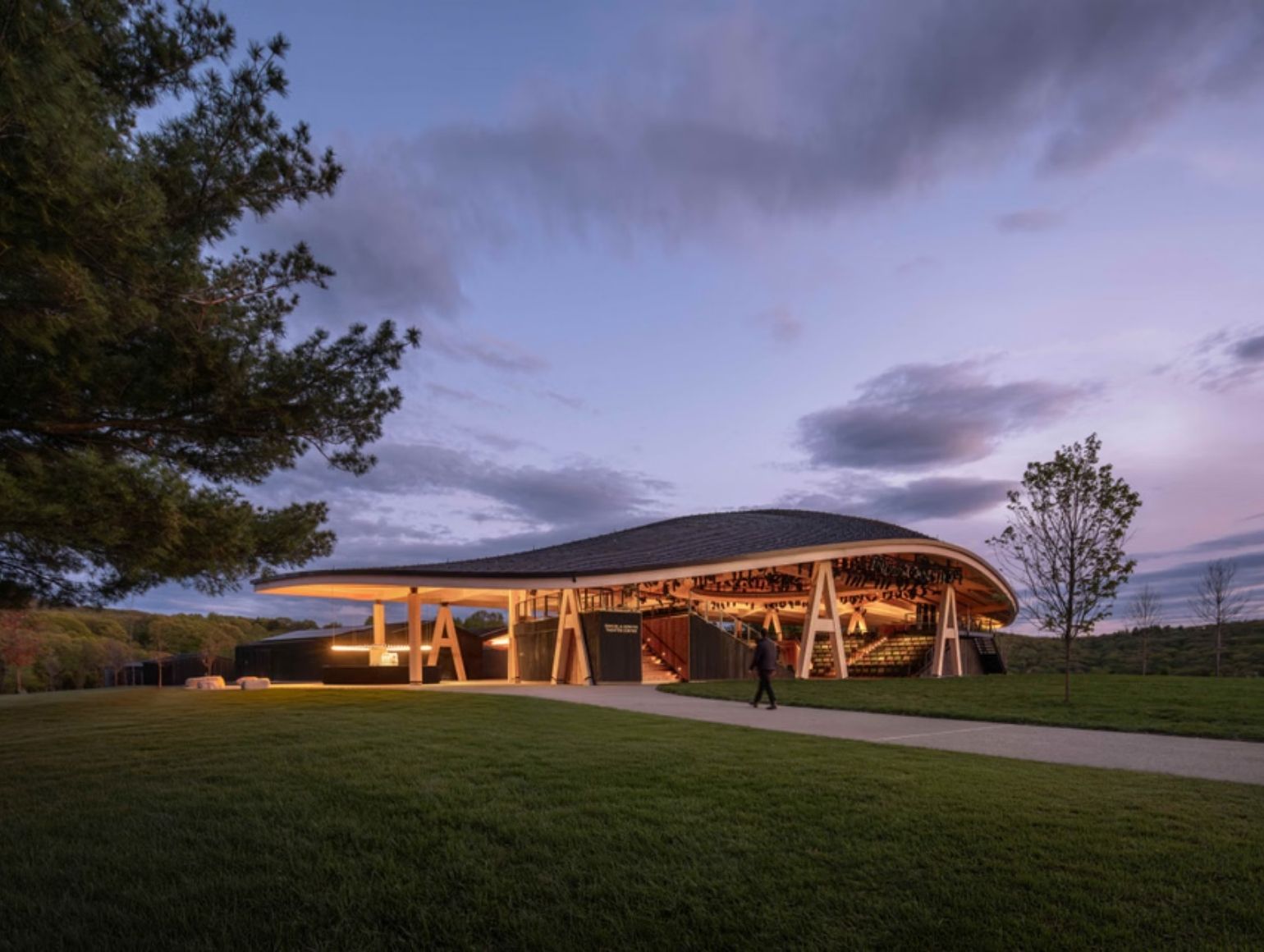
Table of Contents Show
Studio Gang architecture firm, led by founder Jeanne Gang, has completed the Samuel H. Scripps Theater Center in Garrison, New York. The 451-seat open-air venue gives Hudson Valley Shakespeare its first permanent home after 39 years of performing under a seasonal tent. Built from mass timber with a curved grid shell roof, the theater sits on a 98-acre campus overlooking the Hudson River and is targeting LEED Platinum certification.
What Is the Samuel H. Scripps Theater Center?
The Samuel H. Scripps Theater Center is the permanent home of Hudson Valley Shakespeare (HVS), a professional theater company founded in 1987 in the Hudson Valley region of New York State. Since its founding, HVS staged productions in a temporary tent at Boscobel House and Gardens. The new facility, designed by Studio Gang, replaces that tent with a purpose-built performance venue that preserves the company’s open-air tradition while adding year-round rehearsal spaces, offices, concessions, and public amenities.
The campus occupies a site that was formerly a golf course. Landscape architect Nelson Byrd Woltz transformed the property by restoring 14 acres of native grasses, planting more than 250 trees, and reintroducing wetlands. The result is a biodiverse cultural campus with picnic lawns, walking trails, and a hillside meadow approach that builds anticipation as visitors make their way up to the theater.
Construction broke ground in September 2024 after several years of planning and fundraising. The theater opened in May 2026, with its first full season set to begin in June 2026 featuring productions of As You Like It, King Lear, and Les Misérables.
Studio Gang: The Firm Behind the Design
Studio Gang is an international architecture and urban design practice founded by Jeanne Gang in Chicago in 1997. The firm now operates from offices in Chicago, New York, San Francisco, and Paris. Gang studied architecture at the University of Illinois and Harvard University, and worked under Rem Koolhaas at OMA in Rotterdam before starting her own practice.
The firm first gained wide recognition for the Aqua Tower in Chicago, an 82-story residential skyscraper completed in 2010. Its undulating concrete balconies, designed to diffuse strong winds, gave the building a rippling visual effect that set it apart from anything else on the Chicago skyline. Gang later surpassed it with the St. Regis Chicago (formerly Vista Tower), a 101-story tower completed in 2020.
Beyond high-rises, Studio Gang has built a diverse portfolio that includes the Tom Lee Park in Memphis (with SCAPE), the Richard Gilder Center for Science, Education, and Innovation at the American Museum of Natural History in New York, the Arkansas Museum of Fine Arts in Little Rock, and the Writers Theater in Glencoe, Illinois. Gang received a MacArthur Fellowship in 2011 and was named one of TIME Magazine’s 100 most influential people in 2019. She is a Professor in Practice at the Harvard Graduate School of Design.
🎓 Expert Insight
“HVSF is such a well-loved cultural institution, with a truly unique natural setting in the Hudson Valley. Our design aims to help the company build on their strengths, with low-carbon architecture that improves daily functionality and amplifies the traditions that define their open-air performances.” — Jeanne Gang, Founding Partner, Studio Gang
Gang’s comment reflects a design philosophy that treats the landscape and the existing performance culture as starting points rather than obstacles. The theater’s form grew directly from that commitment.
How the Curved Mass Timber Structure Works
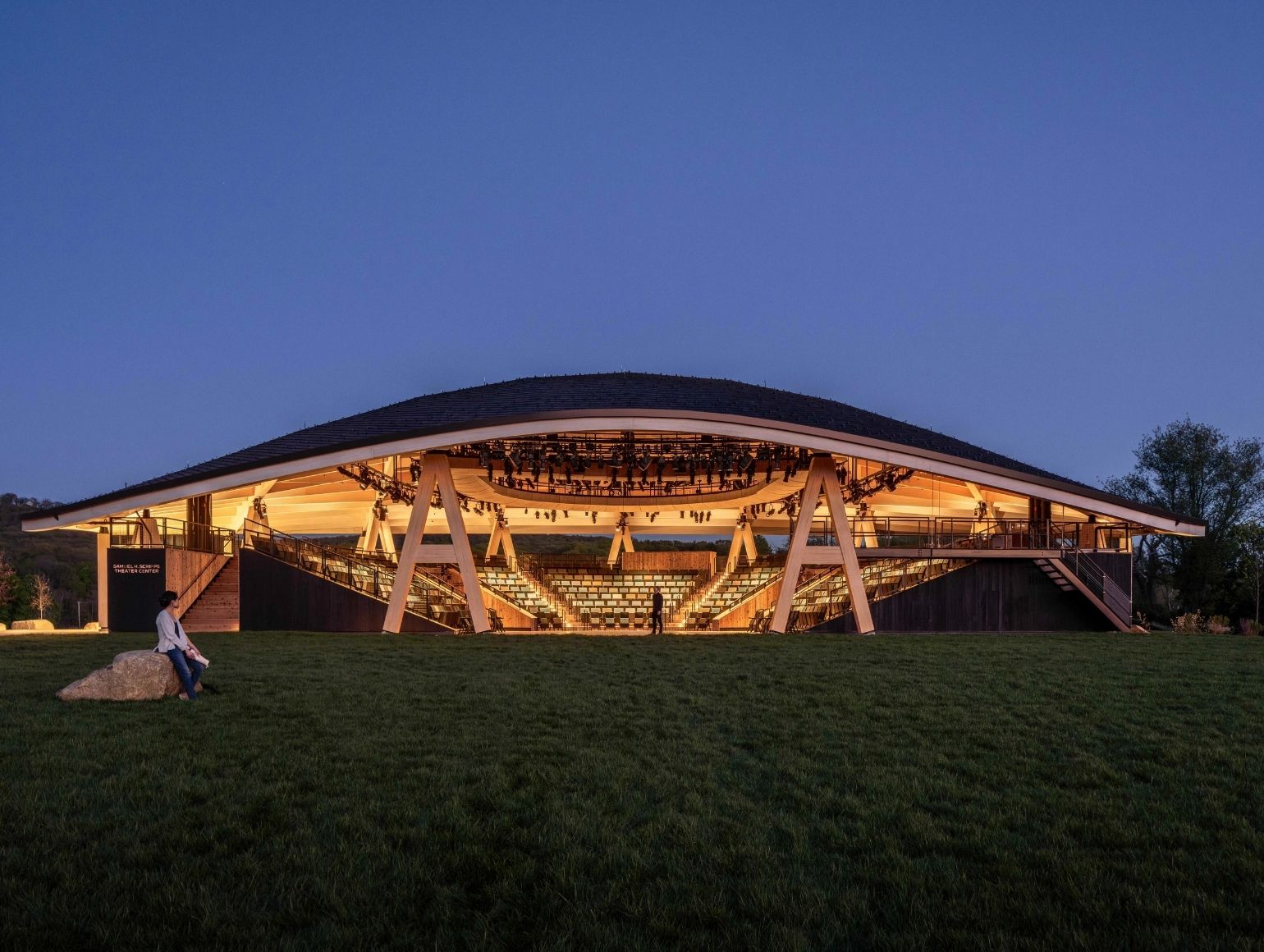
The theater’s defining feature is its curved grid shell roof, a structure that looks like a gently rolling canopy inspired by the contours of the Catskill Mountains across the river. The roof is made from glue-laminated timber (glulam), a type of engineered wood where layers of lumber are bonded together to create structural members capable of spanning long distances.
Large A-shaped timber columns rise from the ground to support the roof. Thornton Tomasetti, the structural engineering firm, worked closely with Studio Gang and timber fabricator Art Massif to design a glulam structure that could accommodate the theater’s complex array of catwalks, lighting rigs, and technical equipment. Senior project leader Teo Quintana described the roof geometry as “a series of circles arrayed around a circle,” which creates the soft, rolling profile visible from the audience below.
The main theater measures 6,800 square feet and seats 451 people in raked seating that curves to match the roof above. This curvature brings a sense of closeness between performers and audience members, even in the back rows. Circulation paths run around and through the theater so that actors can break the fourth wall and move freely among the audience without physical barriers.
📐 Technical Note
Glue-laminated timber (glulam) beams are manufactured by bonding individual lumber laminations with structural adhesives under controlled conditions. Standard glulam members can span up to 30 meters without intermediate supports, and their strength-to-weight ratio is favorable compared to steel for many spanning applications. The material also stores carbon absorbed during tree growth, giving it a lower embodied carbon footprint than steel or concrete alternatives (per EN 14080 and ANSI/APA PRG 320 standards).
The Proscenium Arch and Its Relationship to the Landscape
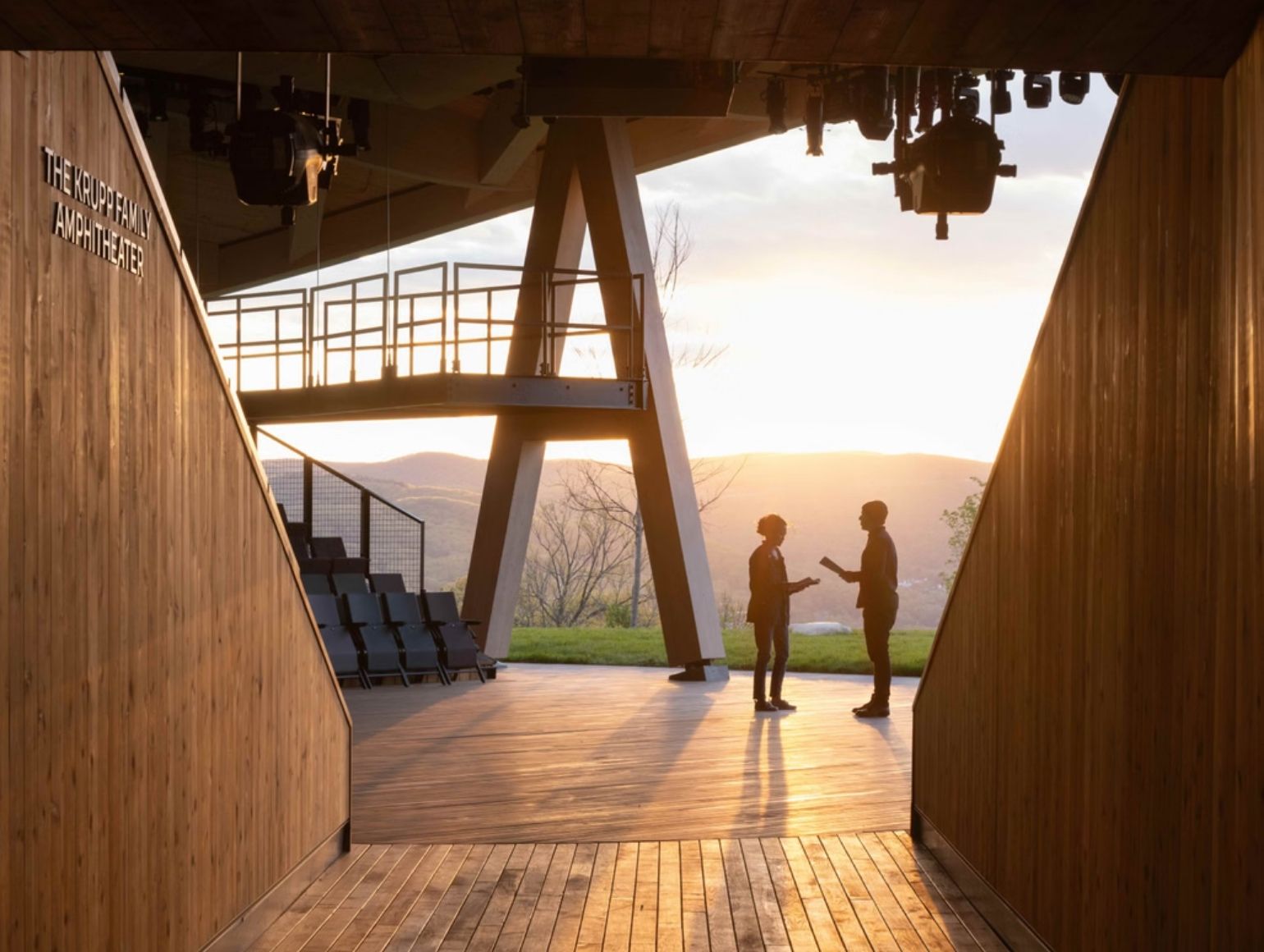
One of the boldest design decisions in the project is the orientation of the stage. The proscenium arch, the frame that defines the stage opening, faces north and is carefully aligned to capture the ridgelines of the Hudson Highlands. Audiences sitting in the theater look past the performers toward Storm King Mountain, Snake Hill, Breakneck Ridge, and the Hudson River below. Nature becomes the permanent backdrop for every performance.
This is not a new idea in theater design. Open-air stages have used landscape backdrops since the ancient Greek theaters of Epidaurus and Delphi. But the Scripps Theater Center takes it further by treating the view as something that changes with the season, the weather, and the time of day. A production of King Lear during a summer thunderstorm, for example, could gain dramatic force from real lightning and rain in the background. Jeanne Gang herself noted that the opening season timing was deliberate: staging Lear’s storm scenes with the real Hudson Valley sky behind the actors could produce genuinely unforgettable moments.
The theater is only partially enclosed. Air flows through the structure naturally, and the roof’s perimeter includes solar shading elements (brise-soleil) that help cool the space passively. The open sides mean audiences still feel the breeze, hear the birds, and experience the shift from daylight to dusk during evening performances, just as they did under the old tent.
Sustainability Strategy and LEED Platinum Ambitions
Studio Gang has stated that the Scripps Theater Center is on track to become the first purpose-built, open-air theater in the United States to achieve LEED v4 Platinum certification. The sustainability strategy touches every aspect of the project, from structural materials to site ecology.
The key environmental features include low-carbon mass timber construction (which stores carbon rather than emitting it during production), rooftop photovoltaic solar panels that generate on-site renewable energy, rainwater harvesting and reuse systems, natural ventilation and passive cooling through the roof’s design, and the landscape restoration led by Nelson Byrd Woltz. The former golf course, which required heavy irrigation and chemical maintenance, has been replaced with native grasses, wetlands, and over 250 new trees. This ecological transformation increases the region’s biodiversity and reduces the campus’s long-term resource demands.
Buro Happold served as the MEP, sustainability, and fire protection consultant for the project. Their early involvement helped the design team identify energy and water savings opportunities at the concept stage, when changes are cheapest to implement. Hudson Valley Shakespeare has also announced a goal of achieving full carbon neutrality for the campus by 2040.
💡 Pro Tip
When designing for LEED Platinum on a cultural project, engage your sustainability consultant during the earliest schematic design phase. Decisions made at this stage, such as building orientation, structural material selection, and site grading, have the largest impact on long-term energy performance and are the most expensive to change later. The Scripps Theater team credits Buro Happold’s early involvement with helping lock in passive strategies that reduced mechanical system requirements significantly.
How the Landscape Design Supports the Architecture
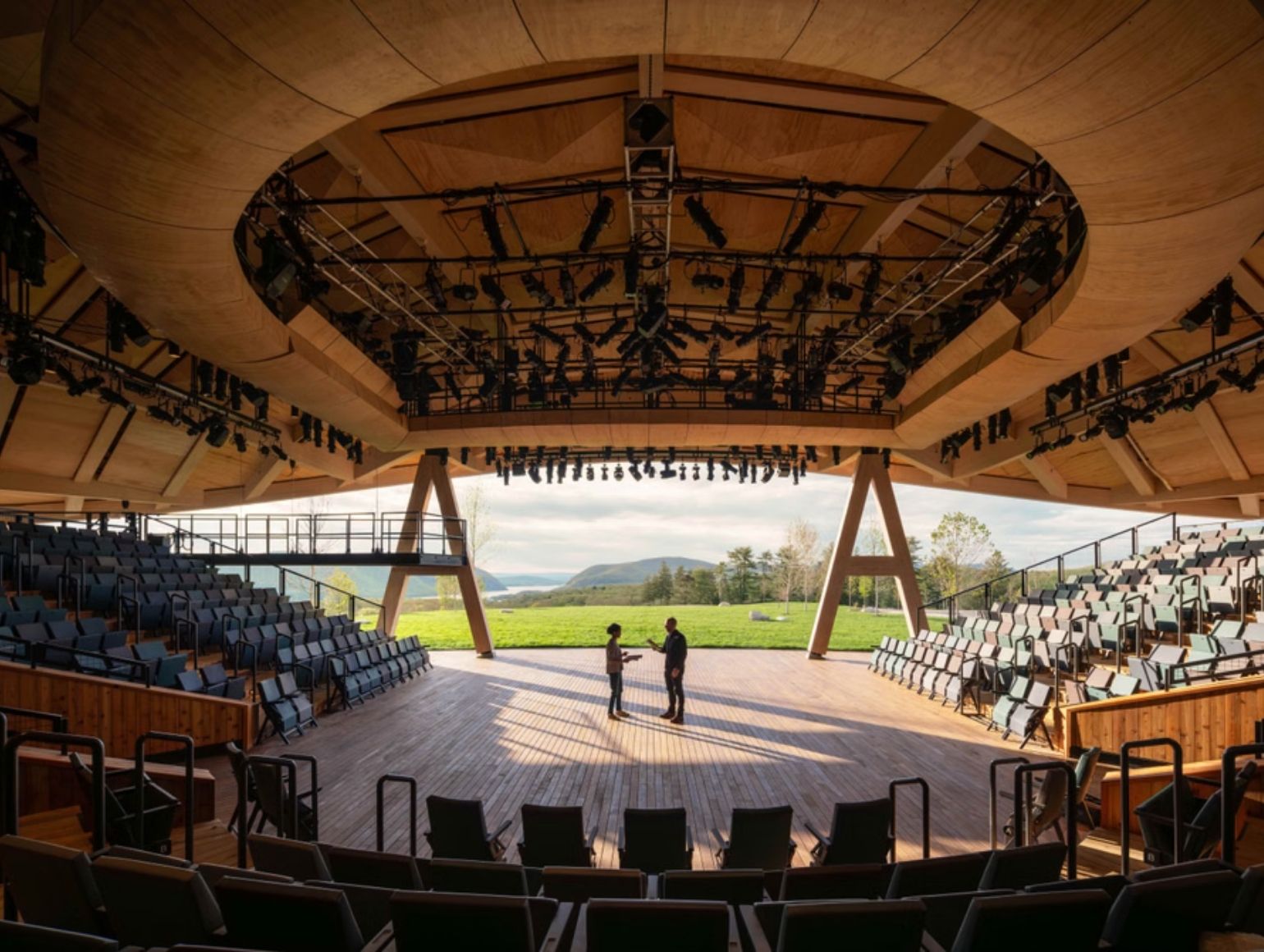
The relationship between the theater and its landscape is not accidental. Nelson Byrd Woltz Landscape Architects worked alongside Studio Gang from the start, developing a masterplan that treats the entire 98-acre site as part of the audience experience.
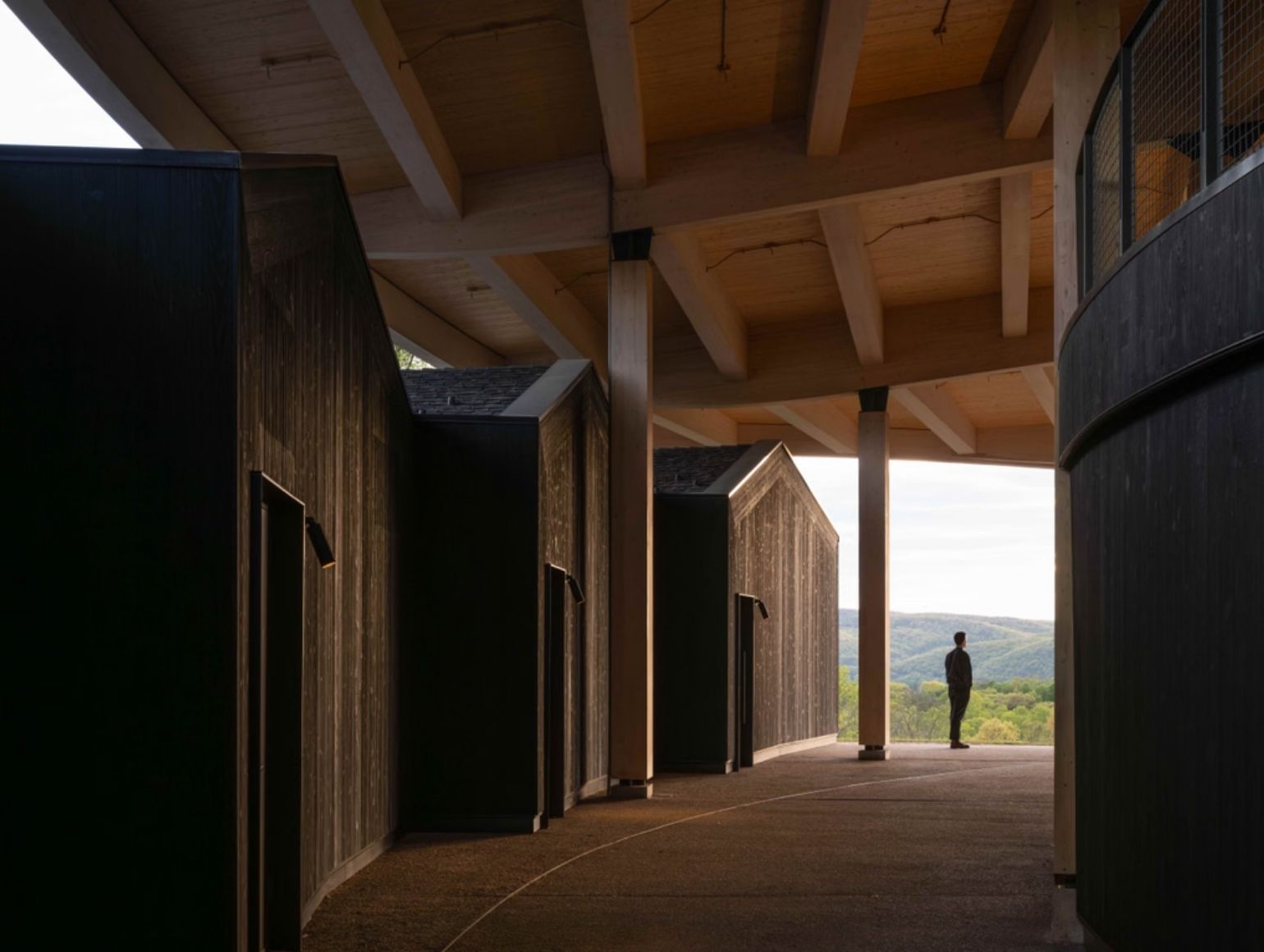
Visitors arrive and are guided by a network of accessible paths that wind up through a hillside meadow. The theater is not immediately visible on arrival. Instead, the paths build a sense of discovery, with the building gradually revealed as visitors climb the hill. Picnic lawns surround the theater plaza, encouraging people to gather before and after performances. This pre-show and post-show social space was a deliberate part of the design brief: HVS wanted to create opportunities for audiences and performers to mingle in an informal setting.
The rewilding of the former golf course was itself a significant undertaking. Nelson Byrd Woltz restored native grasslands, introduced wetland habitats, and planted trees that will mature over the coming decades. The landscape is designed to evolve. In five or ten years, the meadows will be taller, the tree canopy denser, and the ecological systems more complex. The architecture, which uses natural materials and a profile that echoes the surrounding hills, is designed to age alongside the landscape rather than against it.
📌 Did You Know?
Hudson Valley Shakespeare performed under a seasonal tent at Boscobel House and Gardens for 39 years before moving to its new permanent campus. The land for the new site was donated in 2019 by philanthropist Chris Davis. The design process and construction took six years from masterplan to opening.
The Design Team and Collaborators
A project of this complexity required a large team of specialists. Studio Gang served as both design architect and architect of record. Thornton Tomasetti provided structural engineering, with mass timber design assistance and fabrication by Art Massif, a Canadian firm specializing in large-scale engineered wood structures. Fisher Dachs Associates handled theater consulting, while Threshold Acoustics managed the acoustic and audiovisual design, a critical consideration for an open-air venue where sound must carry clearly without the benefit of enclosed walls.
Tillotson Design Associates designed the lighting, which needed to work for both theatrical productions and the ambient experience of the campus after dark. Consigli served as construction manager, coordinating the assembly of prefabricated timber elements on a hilltop site with limited access. The pavilions that house back-of-house functions (rehearsal studios, offices, concessions, restrooms) are clad in natural materials that reference the minerality of the Hudson Valley region, tying the supporting structures visually to the main theater.
Studio Gang’s Approach to Cultural Architecture
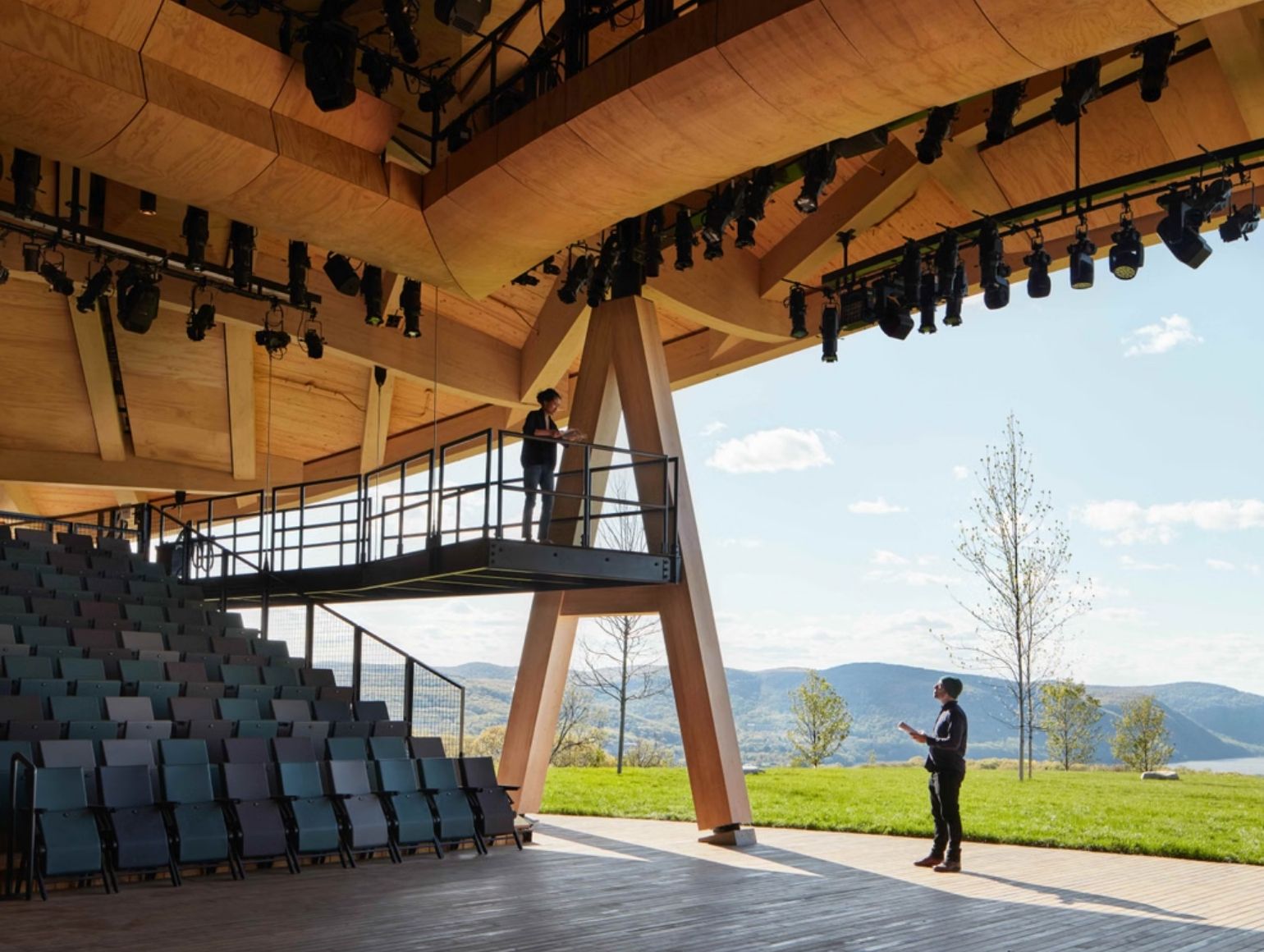
The Hudson Valley Shakespeare theater fits within a broader pattern in Studio Gang’s work. The firm has consistently taken on cultural and civic projects that are site-specific and community-driven. The Tom Lee Park project in Memphis, for example, transformed 31 acres of flat riverfront into a landscaped civic space anchored by a 16,000-square-foot timber pavilion. The Richard Gilder Center at the American Museum of Natural History in New York created a new kind of museum space, one organized around fluid, cave-like galleries that encourage exploration rather than following a fixed path.
What connects these projects is Gang’s stated philosophy of “actionable idealism,” the idea that design should do more than solve a functional problem. It should actively improve ecological conditions, social connections, and community access. At Hudson Valley Shakespeare, this shows up in the accessible paths, the restored ecology, the gathering spaces, and the theatrical design that erases the barrier between performer and audience.
The firm’s commitment to sustainable architecture is also visible in the material choices. Mass timber is not just a structural decision for Studio Gang. It is a philosophical one. Wood stores carbon, connects buildings visually to natural landscapes, and ages in a way that adds character rather than degradation. The Scripps Theater Center, the firm’s Rubenstein Treehouse at Harvard University, and the Populus hotel in Denver all demonstrate this commitment to timber as a primary structural material.
💡 Pro Tip
If you are designing an open-air performance venue, study how the proscenium orientation affects not just sightlines but also wind patterns and sun angles throughout the performance season. At the Scripps Theater, the north-facing stage avoids direct afternoon sun in the audience’s eyes during evening performances, while the open sides allow prevailing breezes to cool the space naturally. These orientation decisions are simple to make early in design but impossible to fix later.
Jeanne Gang: A Career of Ecological and Social Design
Jeanne Gang is one of the most recognized architects working today. Born in Belvidere, Illinois in 1964, she studied at the University of Illinois, ETH Zürich, and Harvard University (M.Arch with Distinction). After working at OMA under Rem Koolhaas in the mid-1990s, she returned to Chicago and founded Studio Gang in 1997.
Her career has been defined by projects that respond to their ecological and social contexts rather than imposing a signature style. The Aqua Tower used varied balcony depths to manage wind loads and create outdoor living space on every floor. The acoustically designed Writers Theater in Glencoe, Illinois, wrapped a 250-seat theater and a 99-seat theater in a wood-and-glass structure that connects to a public courtyard. The Nature Boardwalk at Lincoln Park Zoo turned a neglected pond into a thriving urban wetland with an educational pavilion.
Gang has received numerous awards, including the MacArthur Fellowship (2011), the Cooper Hewitt National Design Award for Architecture (2013), and the Charlotte Perriand Award (2023). She was named the Wall Street Journal Magazine’s Architecture Innovator of the Year in 2022 and Architectural Review’s Architect of the Year the same year. Her most recent book, The Art of Architectural Grafting (2024), presents a framework for adaptive reuse based on the horticultural concept of grafting new growth onto existing root systems.
What This Project Means for Hudson Valley Shakespeare
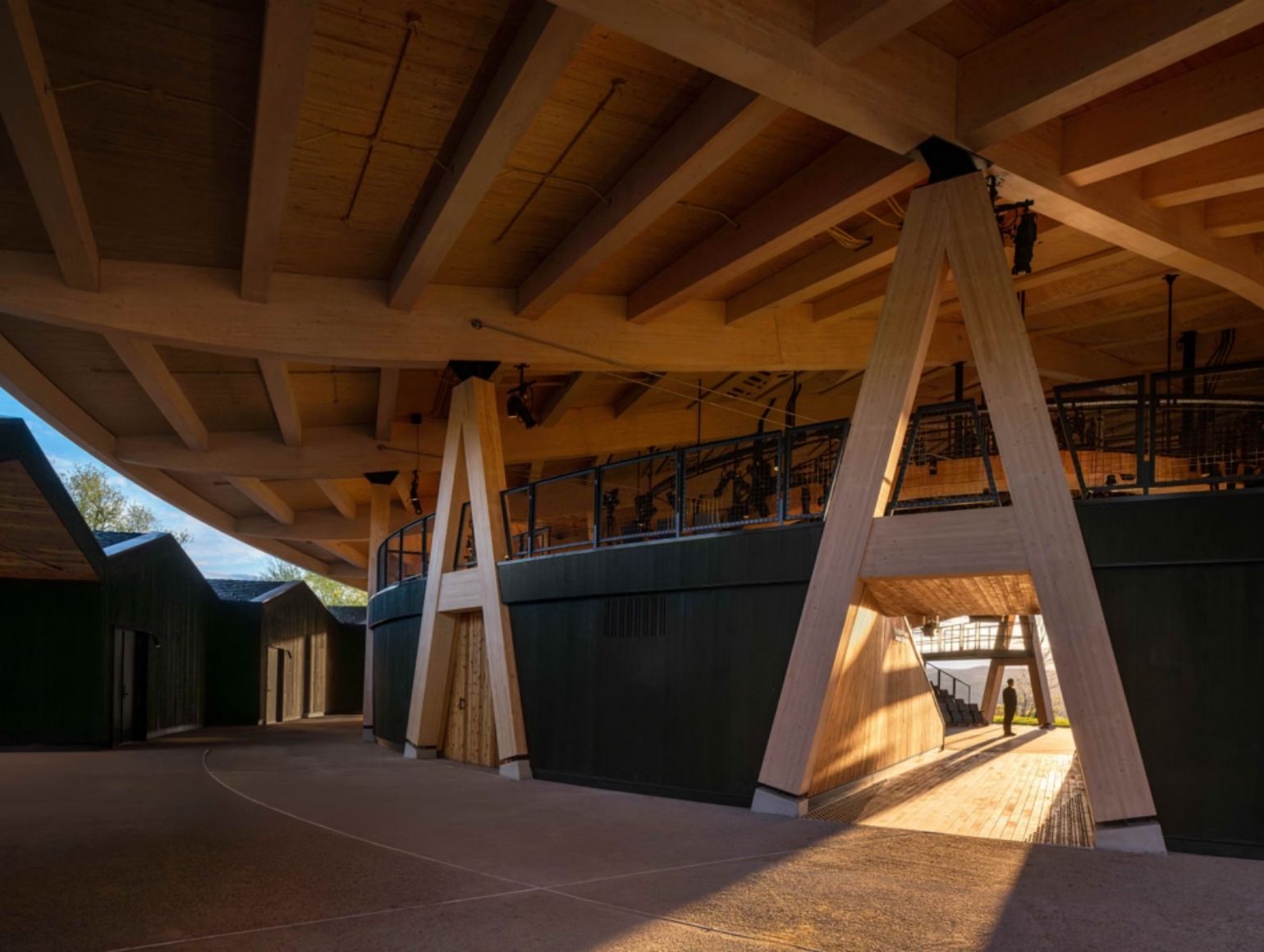
For Hudson Valley Shakespeare, the Scripps Theater Center represents a shift from seasonal festival to year-round cultural institution. The new facility provides proper rehearsal spaces, teaching areas, and administrative offices that allow the company to run educational programs, community events, and an extended performance season beyond the traditional summer months.
Artistic director Davis McCallum, who has led HVS since 2014, called the opening “a watershed moment in our evolution from a seasonal festival to a cultural anchor for the Hudson Valley.” The permanent facility also positions HVS as a destination for regional tourism, drawing audiences from New York City (roughly 60 miles south) and the broader Hudson Valley area.
The project’s broader significance lies in what it demonstrates about the intersection of green architecture, cultural programming, and landscape restoration. It is possible to build a high-performance venue from low-carbon materials, restore a degraded site to ecological health, and create a space that serves both art and community, all within a single project.
🏗️ Real-World Example
Starlight Theatre, Rock Valley College (Rockford, IL, 1997): Studio Gang’s very first commission was also an open-air theater. The Starlight Theatre, a modest outdoor performance venue in northern Illinois, established a thread that runs through Gang’s entire career: designing spaces where performance, landscape, and community overlap. Nearly three decades later, the Scripps Theater Center fulfills the same idea at a far larger scale, with advanced structural engineering and ambitious sustainability goals.
Studio Gang’s Other Notable Projects in New York
The Scripps Theater Center adds to Studio Gang’s growing body of work in New York State. In Brooklyn, the firm recently completed the Shirley Chisholm Recreation Center, a community recreation facility named after the pioneering congresswoman. In Manhattan, the Richard Gilder Center at the American Museum of Natural History (completed 2023) reorganized the museum’s circulation with a fluid, organic interior that connects previously isolated wings of the building.
Studio Gang is also responsible for high-rise residential projects in the city, contributing to Brooklyn’s skyline. These projects, along with the Hudson Valley Shakespeare theater, demonstrate how a single firm can work across scales, from intimate open-air venues to urban towers, while maintaining a consistent commitment to material honesty, ecological performance, and community engagement.
Video: Studio Gang’s Hudson Valley Shakespeare Theater Campus
This video from Hudson Valley Shakespeare provides an overview of the new campus and the vision behind the permanent theater facility in Garrison, New York.
Key Details at a Glance
Project Overview Table
The following table summarizes the essential facts about the Samuel H. Scripps Theater Center:
| Detail | Information |
|---|---|
| Project Name | Samuel H. Scripps Theater Center |
| Location | Garrison, New York |
| Design Architect | Studio Gang (Jeanne Gang) |
| Landscape Architect | Nelson Byrd Woltz |
| Structural Engineer | Thornton Tomasetti |
| Seating Capacity | 451 seats |
| Theater Area | 6,800 sq ft |
| Campus Size | 98 acres |
| Structure Type | Curved mass timber grid shell with A-frame columns |
| Sustainability Target | LEED v4 Platinum (first for a purpose-built U.S. open-air theater) |
| Groundbreaking | September 2024 |
| Opening | May 2026 |
✅ Key Takeaways
- Studio Gang architecture firm designed the Samuel H. Scripps Theater Center as the first permanent home for Hudson Valley Shakespeare, ending 39 years of tent-based performances.
- The curved mass timber grid shell roof, supported by A-frame glulam columns, responds to the rolling terrain of the Hudson Highlands and allows natural ventilation throughout the open-air venue.
- The stage’s proscenium arch frames direct views of Storm King Mountain, the Hudson River, and Breakneck Ridge, making the landscape an active part of every production.
- The project targets LEED v4 Platinum certification through low-carbon timber construction, solar panels, rainwater harvesting, and the ecological restoration of 98 acres of former golf course.
- Jeanne Gang’s design approach connects performance, ecology, and community access within a single project, continuing a thread that runs from the firm’s very first commission in 1997 to the present.
Final Thoughts
The Samuel H. Scripps Theater Center is a project that operates on multiple levels simultaneously. It is a working theater designed to support professional productions year-round. It is a landscape restoration project that replaces a monocultural golf course with native ecosystems. It is a structural engineering achievement that pushes mass timber into a new building typology. And it is a community space that invites people to gather, eat, walk, and watch performances in a setting that puts the Hudson Valley itself on stage.
Studio Gang architecture has always been about finding ways to connect buildings to their contexts, ecologically, socially, and visually. The Scripps Theater Center, with its timber shell curving over the hillside and its proscenium opening directly onto the Hudson Highlands, may be the clearest expression of that philosophy to date.
Project data and specifications are based on information published by Studio Gang, Hudson Valley Shakespeare, Thornton Tomasetti, and coverage from ArchDaily, Dezeen, and Architectural Record. Sustainability performance claims, including LEED Platinum status, are as reported by the project team and subject to final certification.




Most Beautiful Museums in the World 2026: The Prix Versailles Selection
The Prix Versailles has announced its 2026 list of the world's most...
Elif Ayse Sen11 Mins read
Venice Biennale 2026: A Guide to In Minor Keys, National Pavilions & Collateral Events
The 61st Venice Biennale opened on May 9, 2026, with In Minor...
Elif Ayse Sen12 Mins read
SOM’s Supertall Manhattan Skyscraper: 175 Park Avenue and Its Steel Lattice Structure
Permits have been filed for SOM's supertall Manhattan skyscraper at 175 Park...
Elif Ayse Sen13 Mins read
Sculpture Frank Gehry: Art That Shaped His Architecture
Frank Gehry built a parallel career as a sculptor, creating fish lamps...
Elif Ayse Sen9 Mins read


Leave a comment