

What Is a Curtain Wall in Architecture? Types, Design and Construction
Curtain walls are non-load-bearing facade systems that hang from a building's structural frame like a curtain, providing weather protection and natural light without supporting any floor or roof loads. This guide covers how curtain wall systems work, the difference between stick-built and unitized types, their role in modern high-rise design, and key technical standards architects should know.
 Furkan Sen12 May 20269 Mins read321

Table of Contents Show
A curtain wall in architecture is a non-structural exterior cladding system, typically made of aluminum frames and glass panels, that is attached to a building’s structural frame. Unlike load-bearing walls, a curtain wall carries only its own weight and transfers wind loads to the main structure, allowing architects to create large, transparent facades on high-rise buildings.
If you have ever looked up at a glass-clad office tower and wondered how such a large surface of glass stays in place without thick walls behind it, the answer is almost always a curtain wall system. This building envelope technology separates the skin of a building from its bones, giving designers freedom to wrap entire structures in glass, metal panels, or stone veneers while the steel or concrete skeleton inside handles the structural loads. Below, we break down how curtain walls work, what types exist, how they appear on architectural plans, and why they became a defining feature of modern facade design.
How a Curtain Wall System Works
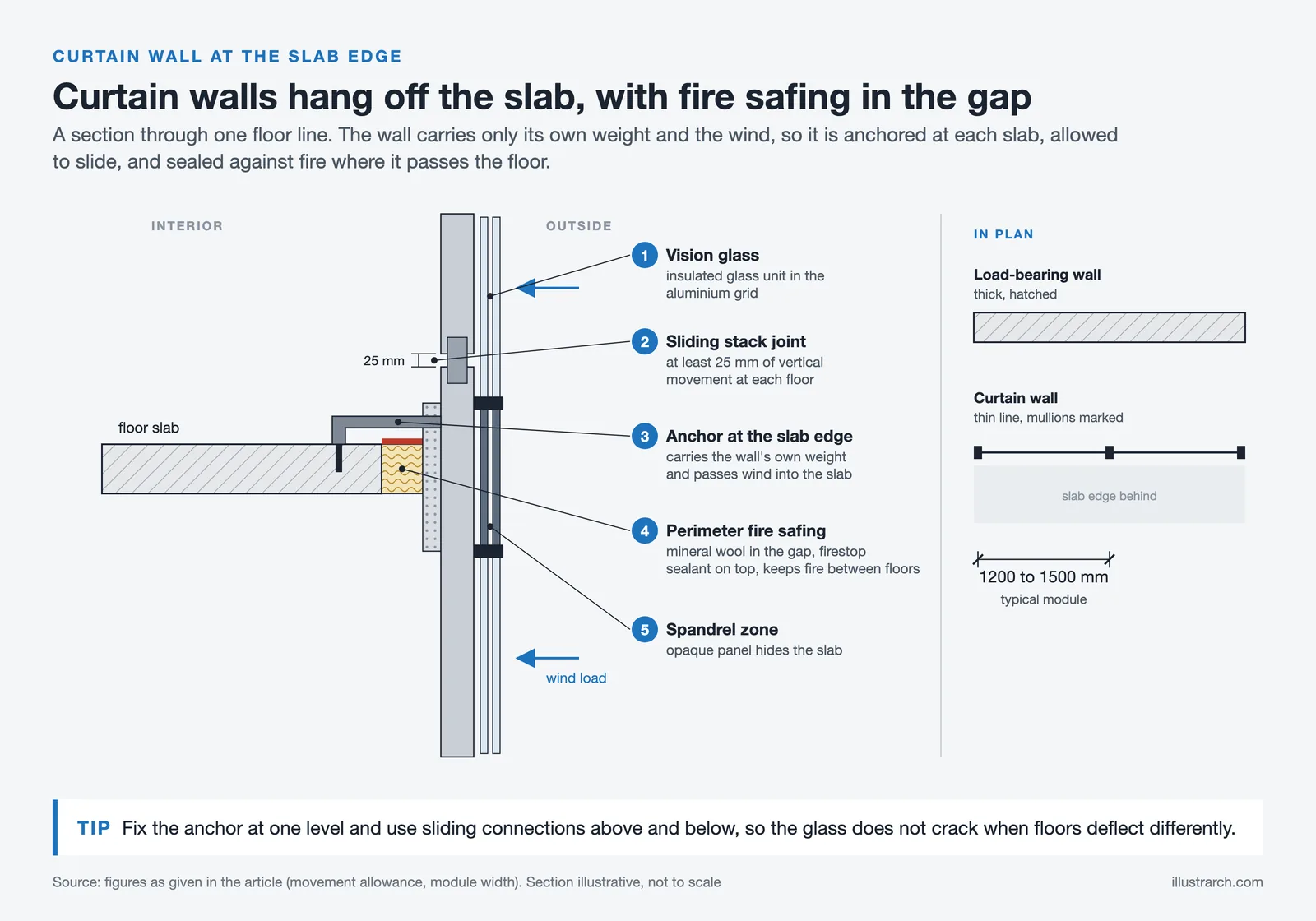
A curtain wall hangs from the edge of each floor slab, much like a curtain hangs from a rod. Aluminum mullions (vertical members) and transoms (horizontal members) form a grid that is anchored to the building’s concrete or steel structure at each floor level. Glass panels, insulated spandrel panels, or other infill materials are then set into this grid. Because the curtain wall carries no floor or roof loads, it can be made from lightweight materials and can span large areas without the thick profiles that load-bearing wall systems require.
Wind pressure is the primary lateral force acting on a curtain wall. The system must resist both positive (inward) and negative (outward, suction) wind loads and transfer them through the mullion anchors into the floor slabs. Thermal expansion, seismic drift between floors, and water penetration are the other critical performance factors that every curtain wall design must address.
💡 Pro Tip
When detailing curtain wall anchors, always design for at least 25 mm of vertical movement at each floor connection to accommodate live load deflection and thermal cycling. Fixed anchors at one level with sliding connections above and below prevent the glass from cracking under differential movement between floors.
Curtain Wall vs. Load-Bearing Wall: What Is the Difference?
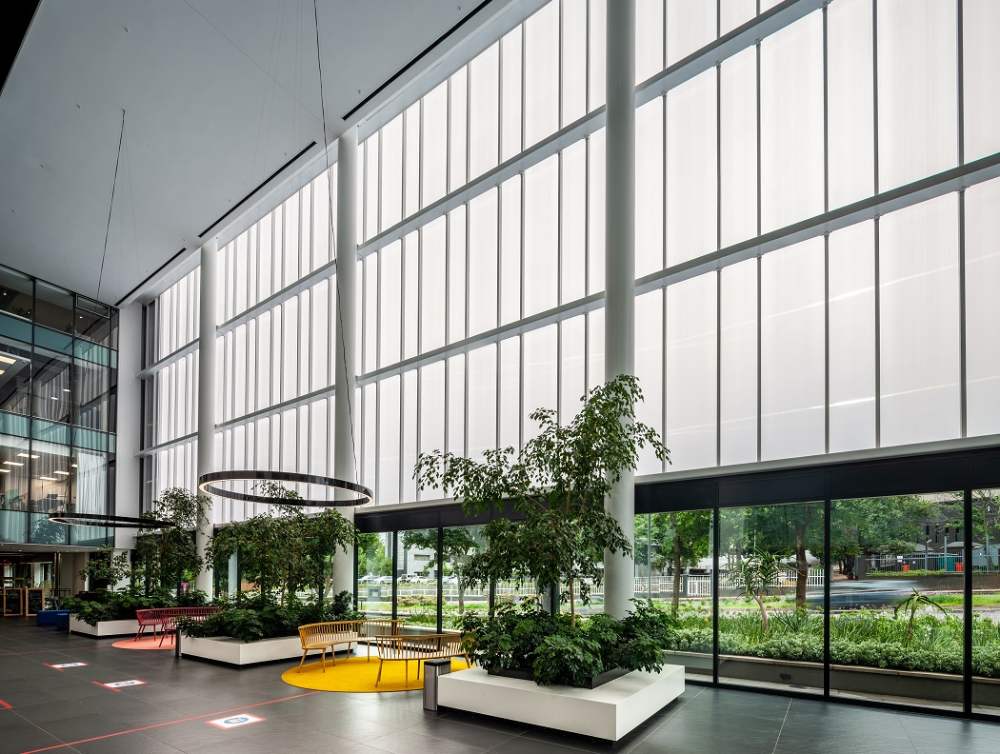
The core distinction is structural responsibility. A load-bearing wall supports the weight of floors and the roof above it and transfers those loads down to the foundation. A curtain wall supports only its own dead weight and resists lateral wind forces, passing them into the primary structure. This difference has major implications for design. Load-bearing walls must be thick and heavy, which limits window sizes and restricts floor plan flexibility. Curtain walls can be thin, light, and almost entirely transparent, which is why they became the standard envelope for commercial skyscrapers and institutional buildings from the mid-20th century onward.
Another practical distinction shows up during construction sequencing. Load-bearing walls must go up as the structure rises because they are the structure. Curtain walls, on the other hand, can be installed after the frame is complete, or even from the top down, giving contractors scheduling flexibility on complex projects.
⚠️ Common Mistake to Avoid
Many architecture students confuse curtain walls with storefront glazing systems. While both use aluminum and glass, storefronts are ground-level systems that typically span only one or two stories and are supported at the head by the structure above. Curtain walls are designed for multi-story applications, span past floor lines, and are anchored to the slab edges rather than framed into an opening.
Types of Curtain Wall Construction
Curtain wall systems are broadly divided into two construction methods: stick-built and unitized. Each has clear advantages depending on project scale, site logistics, and budget.
Stick-Built Curtain Walls
In a stick-built system, individual mullions, transoms, and glass panels are shipped to the site as separate components and assembled piece by piece on the building. This approach works well for low-to-mid-rise projects or buildings with irregular geometries where prefabrication would be difficult. Labor costs on site are higher, and installation speed is slower compared to unitized systems, but the initial material cost is often lower and design changes can be accommodated more easily during construction.
Unitized Curtain Walls
A unitized curtain wall arrives at the site as factory-assembled panels, each typically one story tall and one mullion-spacing wide. These panels are pre-glazed, sealed, and quality-checked in a controlled factory environment before being lifted into place by crane and clipped to the slab edge. High-rise towers almost exclusively use unitized systems because the installation speed is dramatically faster, often completing two to three floors per week. The factory-controlled assembly also delivers more consistent sealant application and tighter tolerances than field-assembled alternatives.
Comparison of Stick-Built vs. Unitized Systems
The following table highlights the key differences between these two curtain wall construction methods:
| Feature | Stick-Built | Unitized |
|---|---|---|
| Assembly Location | On-site, piece by piece | Factory pre-assembled |
| Ideal Building Height | Low to mid-rise (up to ~10 stories) | Mid to high-rise (10+ stories) |
| Installation Speed | Slower, weather-dependent | Faster, less weather-sensitive |
| Quality Control | Field-dependent | Factory-controlled, higher consistency |
| Cost Profile | Lower material cost, higher labor cost | Higher upfront cost, lower on-site labor |
| Design Flexibility | Easier to modify during construction | Changes are costly once production starts |
🎓 Expert Insight
“Less is more.”
Ludwig Mies van der Rohe
Mies van der Rohe helped define the glass curtain wall in high-rise architecture with buildings like 860-880 Lake Shore Drive in Chicago (1951). His insistence on expressing structure honestly and minimizing visual clutter led directly to the aluminum-and-glass curtain wall vocabulary that still dominates commercial architecture today.

Curtain Wall in Modern Architecture: Why It Became Standard

The curtain wall became the dominant facade system in modern architecture for practical reasons, not just aesthetics. Once steel-frame and reinforced-concrete construction freed exterior walls from carrying structural loads in the early 20th century, the logical next step was to make those walls as light and transparent as possible. The glass facade offered maximum daylight, reduced material weight, and allowed the building’s structure to be expressed (or concealed) as the architect chose.
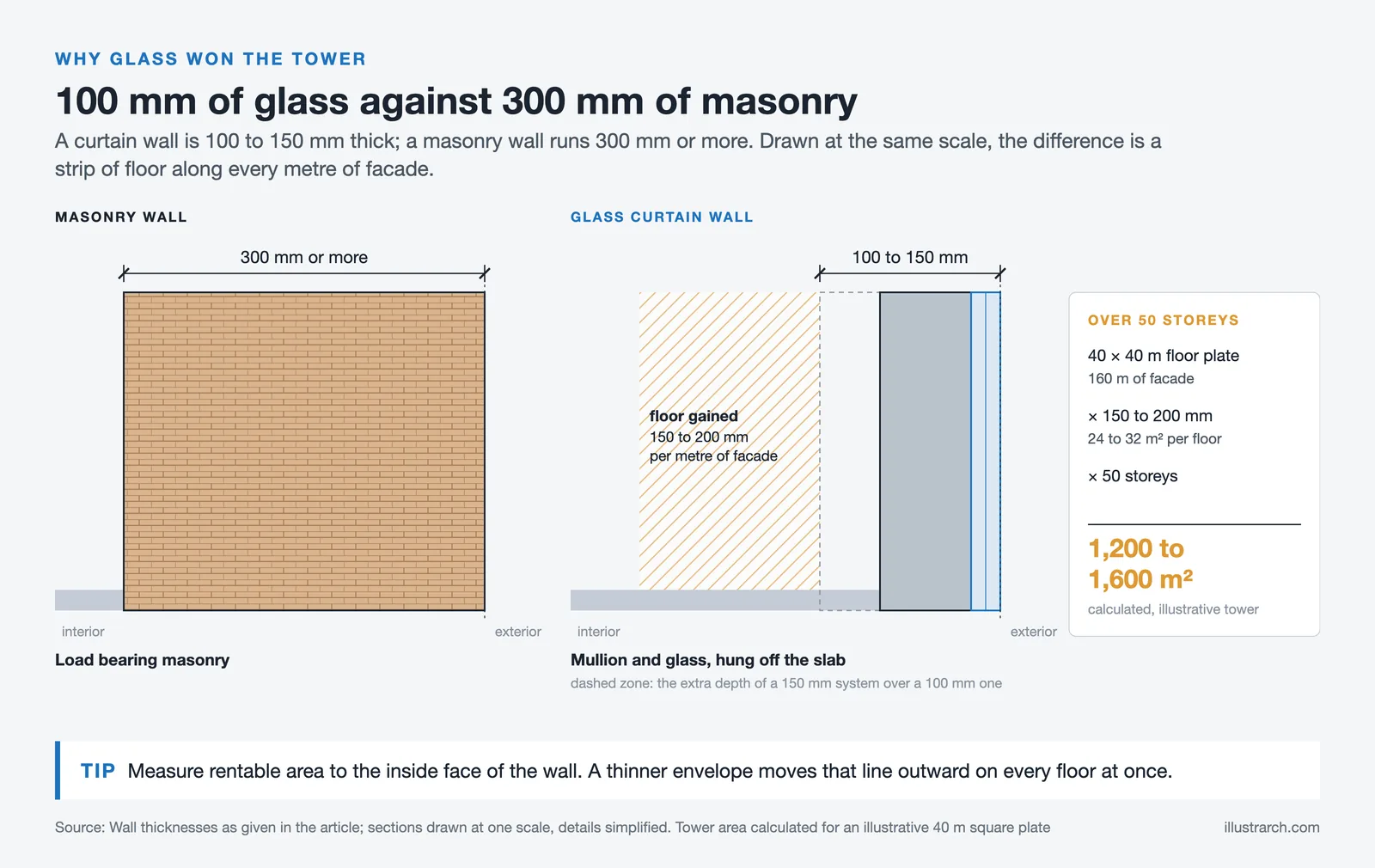
Post-war office buildings in New York and Chicago adopted curtain walls rapidly because they maximized rentable floor area. A glass curtain wall is only 100 to 150 mm thick, compared to 300 mm or more for a traditional masonry wall. Over 50 stories, that difference adds up to hundreds of square meters of usable space. The tallest buildings in the world today all rely on advanced curtain wall systems to achieve their distinctive profiles while controlling solar heat gain and energy consumption.
Curtain wall design has continued to evolve with double-skin facades, ventilated cavities, and integrated shading devices that dramatically improve energy performance. Current high-performance curtain walls combine low-emissivity coatings, argon-filled insulated glass units, and thermally broken aluminum frames to meet increasingly strict energy codes.
🏗️ Real-World Example
One World Trade Center (New York, 2014): The 541-meter tower uses a unitized curtain wall system with over 12,000 laminated glass panels. The facade integrates blast-resistant glazing on lower floors with high-performance insulated units above, achieving both security requirements and a U-value of approximately 1.4 W/m²K across the full envelope.
How Is a Curtain Wall Shown in Architectural Plan Drawings?
Understanding the architecture curtain wall in plan representation is important for both students and practicing professionals. On a floor plan, a curtain wall appears as a thin line at the building’s perimeter, distinctly different from the thick hatched lines used for structural or load-bearing walls. Mullion locations are marked as small rectangles or dots along this thin line, spaced at the module width (typically 1200 mm to 1500 mm).
In section drawings, the curtain wall is shown hanging from the slab edge with an anchor detail at each floor. The gap between the slab edge and the back of the curtain wall (the perimeter fire safing zone) is filled with mineral wool insulation and a firestop sealant. This detail is critical for compartmentation and fire safety compliance. On elevation drawings, the curtain wall grid of mullions and transoms is clearly visible, with different hatch patterns or notations distinguishing vision glass (transparent) from spandrel panels (opaque areas at floor slab zones).
📐 Technical Note
Curtain wall systems in the United States must pass ASTM E330 for structural wind load resistance, ASTM E283 for air infiltration, and ASTM E331 for water penetration. In Europe, the equivalent standard is EN 13830, which covers resistance to wind load, air permeability, watertightness, and impact resistance for curtain walling products.
Key Materials Used in Curtain Wall Design
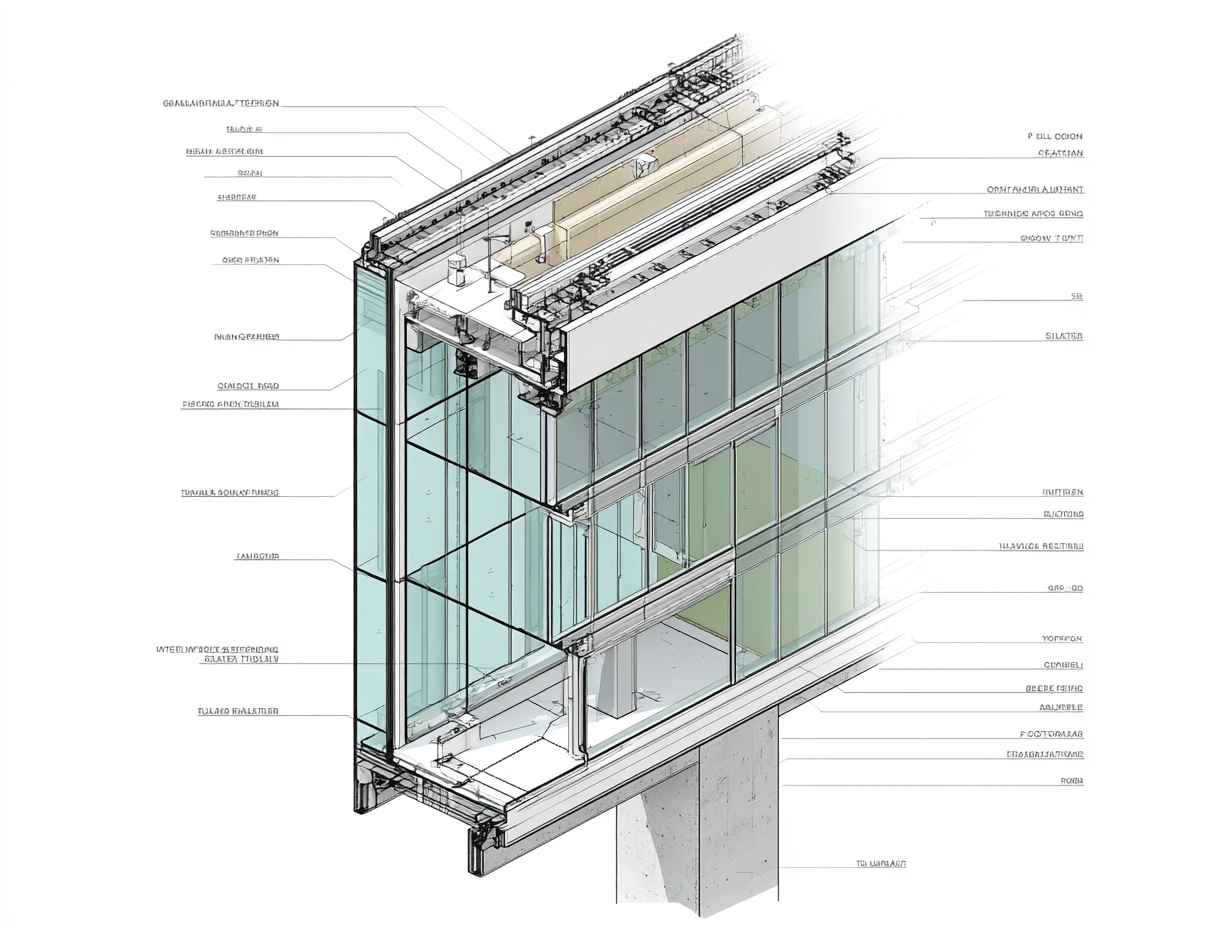
The framing material for most curtain walls is extruded aluminum. Aluminum offers a high strength-to-weight ratio, corrosion resistance, and the ability to be shaped into complex profiles through extrusion. Steel framing is used in some specialty applications where larger spans or thinner sightlines are required, though it is heavier and needs protective coatings.
For the infill panels, architects choose from a range of facade materials. Insulated glass units (IGUs) with double or triple glazing are the most common for vision areas. Spandrel zones use opaque glass, metal composite panels, stone veneer, or terracotta tiles. The choice depends on the desired appearance, thermal performance targets, and budget. Recent projects have also introduced photovoltaic glass and electrochromic (smart) glass into curtain wall systems, blending energy generation and daylight control directly into the building envelope.
💡 Pro Tip
Specify thermally broken aluminum profiles for any curtain wall project in a heating-dominated climate. A thermal break (typically a polyamide bar inserted between the interior and exterior aluminum sections) reduces heat transfer through the frame by up to 60%, preventing condensation on interior surfaces during cold weather.
Video: How Curtain Walls Are Constructed
This educational video illustrates the construction process of a curtain wall system, showing how the aluminum frame sits on the concrete slab and how glass panels are installed within the grid.
Performance Requirements for Curtain Walls
A well-designed curtain wall must satisfy several performance criteria simultaneously. Air infiltration must be controlled to prevent energy loss and occupant discomfort. Water penetration resistance is tested under both static and dynamic pressure conditions to ensure the system keeps rain out during storms. Structural adequacy under positive and negative wind loads must be demonstrated through testing to standards such as ASTM E330.
Thermal performance is increasingly important as energy codes tighten worldwide. The overall U-value of a curtain wall assembly (including both the glazing and the frame) determines how much heat transfers through the facade. Acoustic performance also matters in urban environments, where double-glazed or laminated glass configurations can reduce exterior noise transmission by 30 to 40 decibels depending on the glass makeup.
Fire safety is another key requirement. Building codes in most jurisdictions require firestopping at the perimeter slab edge behind the curtain wall to prevent fire and smoke from spreading between floors through the gap between the slab and the back of the wall. This perimeter fire barrier, typically made of mineral wool and intumescent sealant, is one of the most inspected details on any curtain wall project.
Curtain Wall Design: Balancing Aesthetics and Engineering
Curtain wall design sits at the intersection of architecture and engineering. The architect determines the visual pattern, the proportion of solid to void, the color of the framing, and the reflectivity of the glass. The facade engineer then sizes the mullions and transoms to resist the calculated wind loads, designs the anchor connections, and specifies the sealant joints to accommodate thermal movement. This collaboration is essential because a visually striking curtain wall that leaks air or water, or one that cannot handle building movement, will fail regardless of how good it looks on a rendering.
Grid patterns are the most common curtain wall expression. Regular rectangular grids of equal-sized glass panels create a clean, ordered appearance associated with commercial office buildings. Variations include offset grids, diamond patterns, and randomized panel sizes that break the repetition. Some architects use curved mullion profiles or faceted geometries to create three-dimensional facade surfaces. Each of these variations adds structural complexity and cost, but they give buildings a distinctive identity within the urban skyline. Projects like the facade design process demonstrate how material selection and grid proportions shape a building’s character.
📌 Did You Know?
The Crystal Palace, built in London for the Great Exhibition of 1851, is often considered the earliest large-scale example of curtain wall thinking. Designed by Joseph Paxton, the building used a prefabricated iron frame filled with 293,655 panes of glass, covering over 92,000 square meters. It was assembled in just five months and later relocated to Sydenham Hill, where it stood until destroyed by fire in 1936.
The Future of Curtain Wall Systems

Curtain wall technology continues to advance rapidly. Active facades with integrated sensors can now adjust shading devices in real time based on sun angle and interior temperature readings. Building-integrated photovoltaics (BIPV) are turning curtain walls into power-generating surfaces. Structural glazing techniques are reducing visible framing to create nearly frameless glass envelopes.
Sustainability concerns are also pushing manufacturers toward lower-embodied-carbon aluminum (produced using renewable energy) and recyclable sealant systems. As buildings move toward net-zero energy targets, the curtain wall is no longer just a weather barrier. It is becoming an active, responsive layer that generates energy, manages daylight, controls ventilation, and contributes to occupant comfort. For architects working on modern window and facade systems, understanding curtain wall principles is a foundational skill.
✅ Key Takeaways
- A curtain wall is a non-structural exterior cladding system that hangs from a building’s frame and transfers only wind loads to the structure.
- The two main construction types are stick-built (assembled on site) and unitized (factory pre-assembled), with unitized systems dominating high-rise projects.
- On architectural plans, curtain walls appear as thin lines at the building perimeter, clearly distinct from thick load-bearing wall representations.
- Performance testing for wind resistance (ASTM E330), air infiltration (ASTM E283), and water penetration (ASTM E331) is required before any curtain wall system can be specified.
- Modern curtain walls are evolving from passive weather barriers into active building systems that generate energy, manage daylight, and respond to environmental conditions.
Final Thoughts
The curtain wall is one of the most significant architectural elements developed in the 20th century. It freed buildings from the constraints of heavy, load-bearing exterior walls and opened the door to the transparent, light-filled towers that define city skylines around the world. For architects, engineers, and students, understanding how curtain wall systems are designed, constructed, and represented in drawings is not optional knowledge. It is central to working on any building taller than a few stories. As facade technology continues to evolve, the curtain wall will remain at the core of how we enclose and express modern architecture.








Architecture Beneath the Surface: The Crucial Role of Structural Mechanics and Geotechnical Analysis in Groundwork Design
Bold architecture depends on the ground beneath it. How numerical geotechnical analysis...
 illustrarch Editoral Team1 Mins read

Designing Exterior Concrete That Survives Freeze-Thaw Winters
Freeze-thaw cycles, not one long cold spell, are what break exterior concrete....
illustrarch Editoral Team9 Mins read
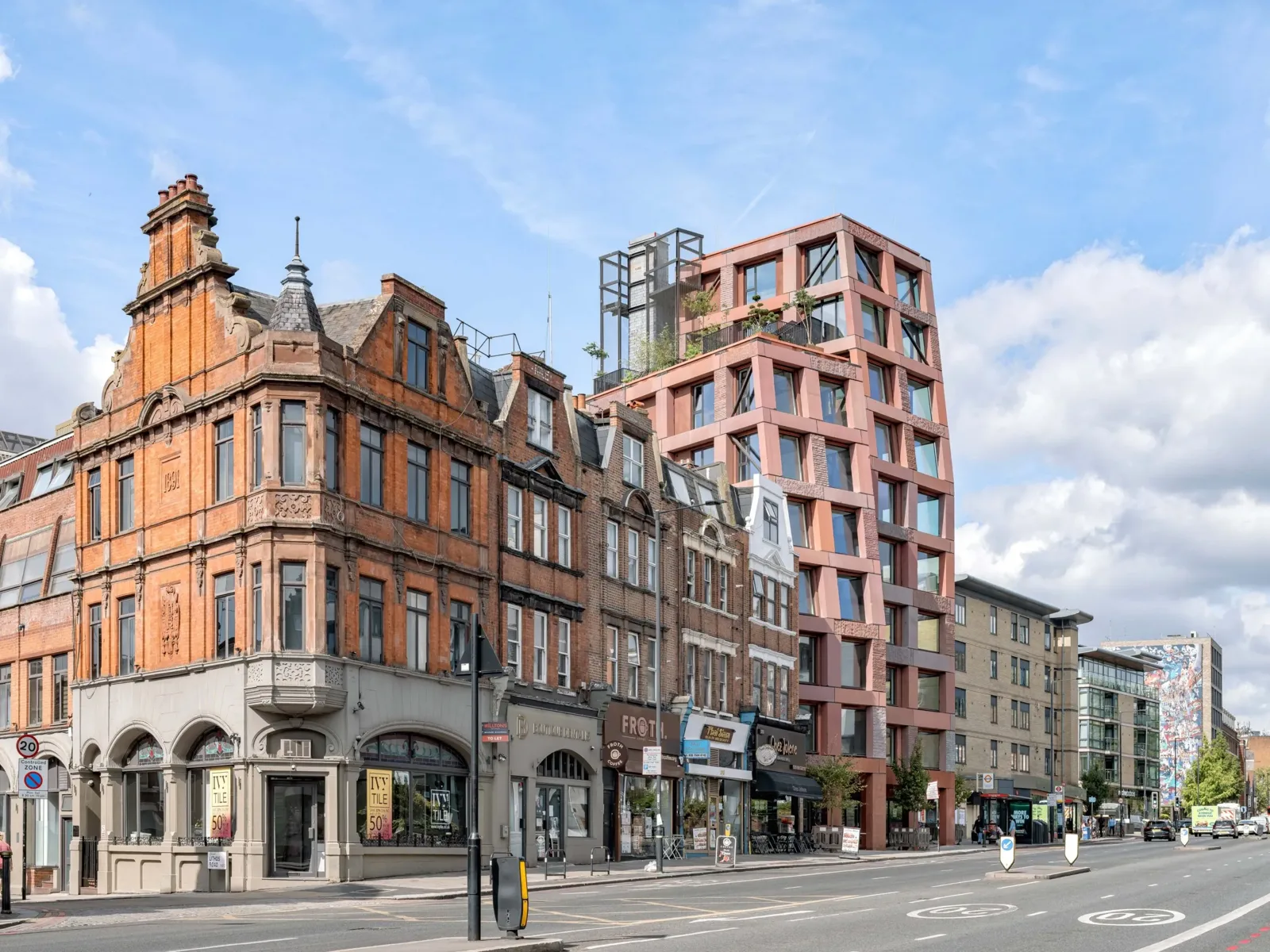
Groupwork Completes 10-Storey Loadbearing Granite Flats in London
Groupwork's Petra Heights on Finchley Road is a 10-storey block of 22...
illustrarch Editoral Team2 Mins read

What Architecture Students Should Know About Structural Glass and Guardrail Code
Glass guards look minimal, but structural behavior, safety glazing, connections and guardrail...
illustrarch Editoral Team6 Mins read


Leave a comment