

Sculpture Frank Gehry: Art That Shaped His Architecture
Frank Gehry built a parallel career as a sculptor, creating fish lamps from ColorCore plastic, animal forms in stainless steel and copper, and the iconic El Peix in Barcelona. This article traces his sculptural work from the 1980s to the 2026 posthumous exhibition at Gagosian Beverly Hills, showing how sculpture and architecture constantly fed each other in his practice.
 Elif Ayse Sen17 May 20269 Mins read160
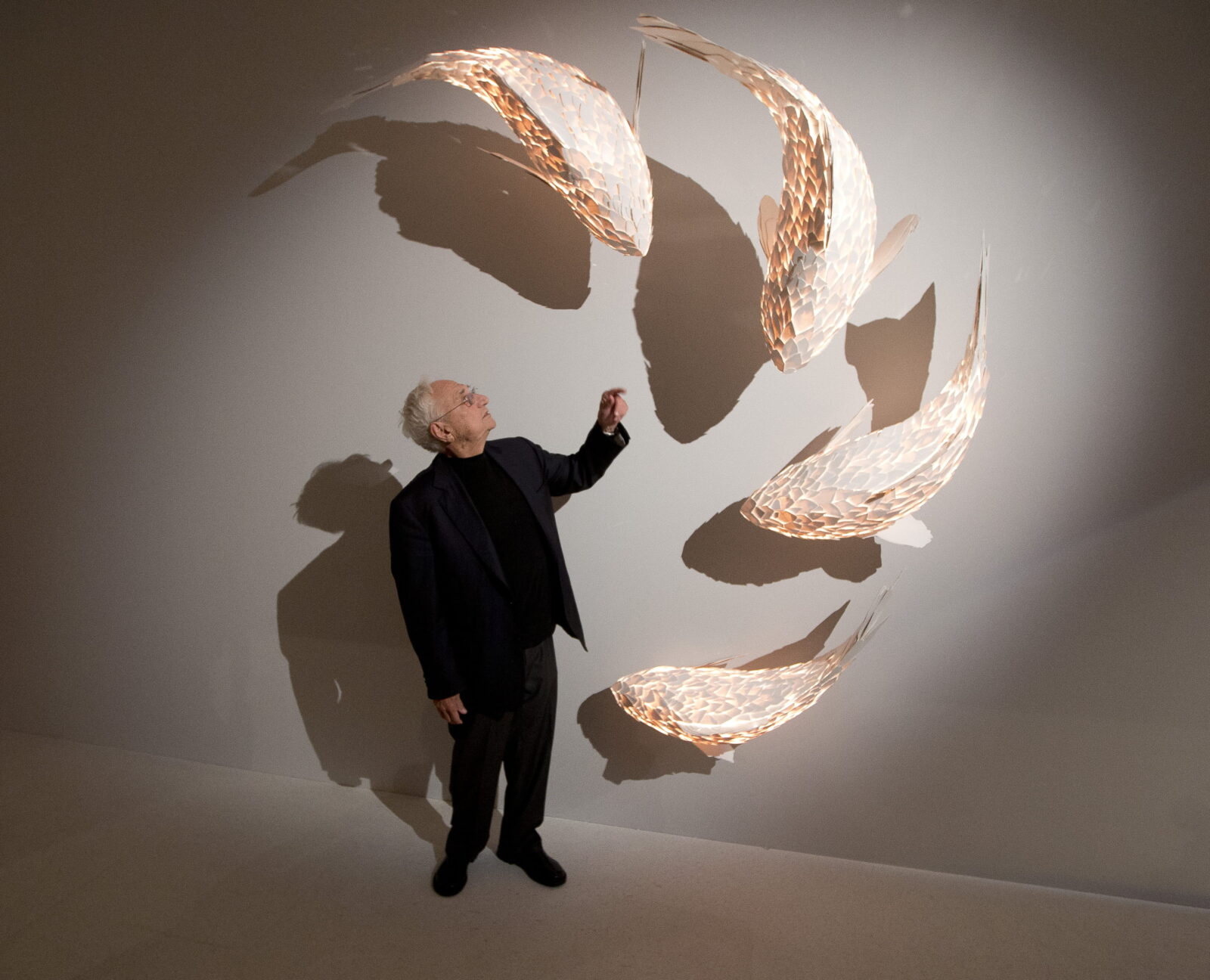
Table of Contents Show
Sculpture Frank Gehry produced over more than four decades sits at the crossroads of art and architecture, ranging from small illuminated fish forms made of ColorCore plastic to the 56-meter El Peix in Barcelona. His sculptural work reveals the design instincts behind some of the world’s most recognizable buildings, and a new posthumous exhibition at Gagosian Beverly Hills brings that relationship into full view.
Frank Gehry (1929-2025) is widely recognized for buildings like the Guggenheim Museum Bilbao and the Walt Disney Concert Hall, but his career as a sculptor ran parallel to his architectural practice from the early 1980s onward. He produced furniture, lamps, large-scale public installations and intimate works on paper, all sharing the same concern with movement, material honesty and organic form that defined his buildings. Understanding Gehry’s sculpture is essential to understanding his architecture, because the two disciplines were never truly separate in his mind.
How Frank Gehry’s Sculpture Career Began
Gehry’s path into sculpture started with a commission, not a personal project. In 1983, the Formica Corporation asked him to experiment with ColorCore, a translucent plastic laminate. Most designers given this material would have made countertops or wall panels. Gehry looked at the material’s layered edges and saw something else entirely: fish scales.
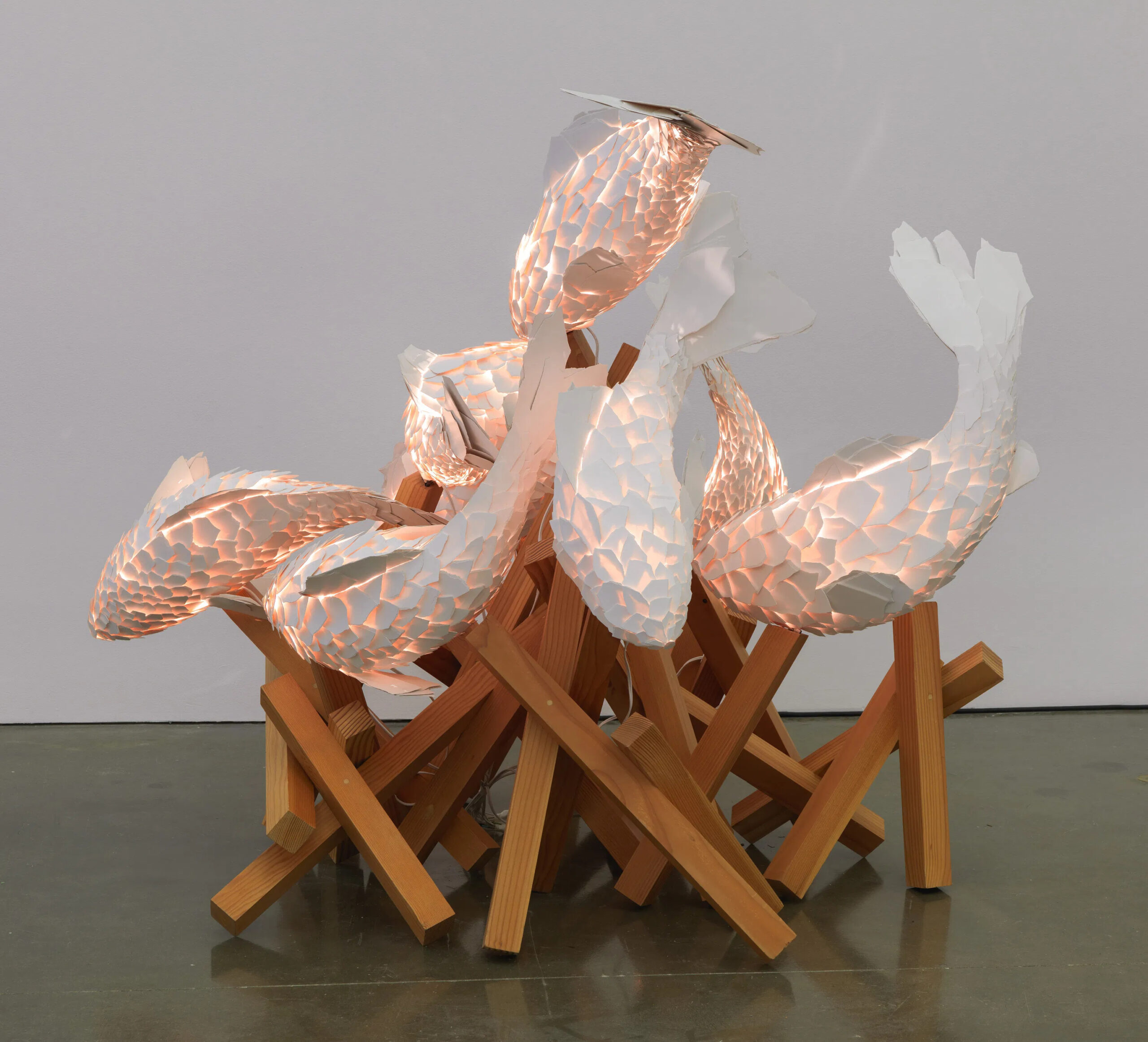
That observation launched the Fish Lamps series (1984-1986), a group of illuminated sculptural forms built on wire armatures with fragments of ColorCore arranged to resemble the overlapping scales of a living fish. The lamps glowed from within, casting fractured light patterns across gallery walls. They were not functional lighting in any practical sense. They were sculptures that happened to emit light, and they carried a strong emotional charge rooted in Gehry’s childhood memories.
Growing up in Toronto, the young Frank Goldberg (he changed his name later) would accompany his grandmother to the market every Thursday. They would bring home a live carp in a bag of water and place it in the bathtub. He would sit and watch it swim until the next day, when it became gefilte fish. That memory of a living creature in domestic space stayed with him for decades and eventually found its way into art, architecture and everything in between.
🎓 Expert Insight
“I decided the fish was the model for the future of architecture because it expressed sculptural movement.” — Frank Gehry
This statement, repeated in interviews and exhibition catalogues over several decades, captures the direct pipeline between Gehry’s sculpture practice and his architectural ambitions. The fish form gave him a language of curves and implied motion that he carried into titanium-clad buildings worldwide.
The Fish Sculpture Frank Gehry Created for Barcelona
The fish sculpture Frank Gehry designed for Barcelona is probably his most visible sculptural work and one of the best-known public artworks in Spain. Officially called El Peix (The Fish in Catalan), it was commissioned as part of the city’s transformation for the 1992 Summer Olympics.
The fish sculpture Barcelona Frank Gehry installed at the base of the Hotel Arts, facing the Mediterranean, measures 56 meters long and 35 meters high. It was made from intertwining gilded stainless steel strips supported by a metal structure. Under the Mediterranean sun, the gold-colored surface shifts appearance throughout the day, catching and refracting light in a way that makes the static form look alive.
El Peix was not just a decorative object placed at the waterfront. It served as a canopy connecting the Hotel Arts and the Barcelona Casino to the seafront, giving it a functional role alongside its artistic one. The project sat within a much larger urban redevelopment effort that reshaped Barcelona’s coastline from an industrial zone into a public leisure and tourism district.
💡 Pro Tip
If you visit El Peix in person, go at sunset. The gilded stainless steel surface catches the warm Mediterranean light at low angles, and the sculpture appears almost golden against the darkening sky. Sunrise also works well, but the surrounding area is quieter in the early morning, which makes it easier to photograph without crowds.
From a technical standpoint, El Peix was also a testing ground. Gehry’s office used early computational modeling tools to manage the complex curved geometry of the stainless steel strips. The lessons learned from fabricating this large-scale fish sculpture directly informed the digital workflows that would later produce the Guggenheim Museum Bilbao five years later. In that sense, the Barcelona fish sculpture was not just a work of art but a rehearsal for an architectural revolution.
Frank Gehry Art: Sculpture as a Design Laboratory
Gehry’s art practice operated as a low-stakes laboratory where he could test ideas before committing them to buildings. His furniture lines illustrate this clearly. The Easy Edges series (1969-1973) and the Experimental Edges series (1979-1982) used corrugated cardboard as a structural material, proving that cheap, everyday materials could produce strong, expressive forms. The bentwood furniture he later designed for Knoll (1989-1992) explored how thin, flexible strips of material could create volume and implied motion.
Each of these projects fed back into his architecture. The corrugated cardboard experiments informed his willingness to use chain-link fencing and corrugated metal on the exterior of his own Santa Monica house in 1978. The bentwood chairs anticipated the thin titanium panels he would wrap around the Guggenheim Bilbao. The fish lamps predicted the undulating profiles of the Walt Disney Concert Hall.
This relationship between Frank Gehry art work and his buildings was not metaphorical. It was practical. Gehry’s studio built rough physical models from paper, cardboard and metal scraps before any digital tools were involved. Those gestural, sculptural models were then translated into buildable geometry using CATIA software, originally developed for the aerospace industry. The result was buildings that carried the energy of a hand-made sculpture even as they achieved millimeter-level construction precision.
📌 Did You Know?
The titanium panels on the Guggenheim Bilbao are only 0.38mm thick, roughly the thickness of a credit card. Despite covering the entire building, the total weight of the titanium cladding is just 60 tons. Gehry achieved this by treating the building’s skin the way a sculptor treats a surface: as a thin membrane shaped by the structure beneath it, not as a heavy wall.
Frank Gehry Sculpture Architecture: Where the Boundaries Dissolve
The phrase “frank gehry sculpture architecture” is not just a search term. It describes a genuine category problem that critics, curators and architecture schools have debated for decades. Are Gehry’s buildings sculptures you can occupy? Are his sculptures buildings without programs? The honest answer is that the distinction was never meaningful to Gehry himself.
Consider the Standing Glass Fish (1986) at the Weisman Art Museum in Minneapolis. This gallery-scale sculpture, made of glass, steel and wood, was installed inside a building that Gehry himself designed. The building’s exterior, clad in brushed stainless steel panels, looks like a large-scale version of the fish inside it. The sculpture and the architecture share a material palette, a formal vocabulary and a concern with how light interacts with curved surfaces.
Or consider the Fondation Louis Vuitton in Paris (2014), where twelve enormous glass “sails” billow above a series of white, iceberg-like volumes. Gehry referred to the building as a vessel, a sculpture and a cloud in different interviews, never settling on a single architectural description. The building required construction techniques adapted from both shipbuilding and aerospace, disciplines that produce sculptural objects rather than conventional buildings.
A sculptured titanium form by Frank Gehry, whether it appears on a building facade or on a gallery pedestal, follows the same logic. The material is shaped to catch light, imply movement and create an emotional response. The scale changes, but the intent does not.
Frank Gehry Sculpture at Gagosian: A Timeline of Exhibitions
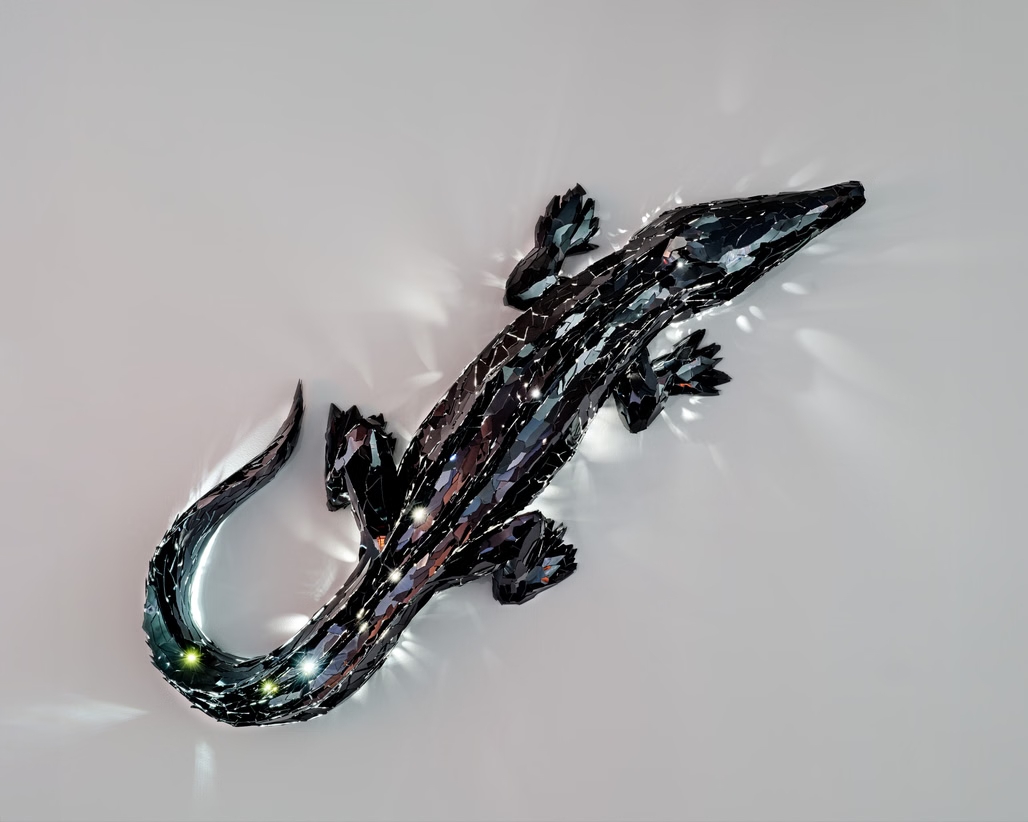
Gehry’s relationship with Gagosian Gallery stretched over more than a decade, producing several important exhibitions that treated his sculptural work as a serious artistic practice rather than an architect’s side project.
The first major presentation came in 2012 in Paris, where vintage Fish Lamp sculptures were displayed alongside newly commissioned editions. Gagosian’s founder Larry Gagosian initially proposed the show to coincide with the construction of the Fondation Louis Vuitton, which Gehry was designing nearby. Gehry agreed, and when asked if he would consider producing new editions for sale, he responded simply: “I have an idea.” That idea led to the creation of new, larger and more complex fish forms that expanded the original 1980s series into something more ambitious.
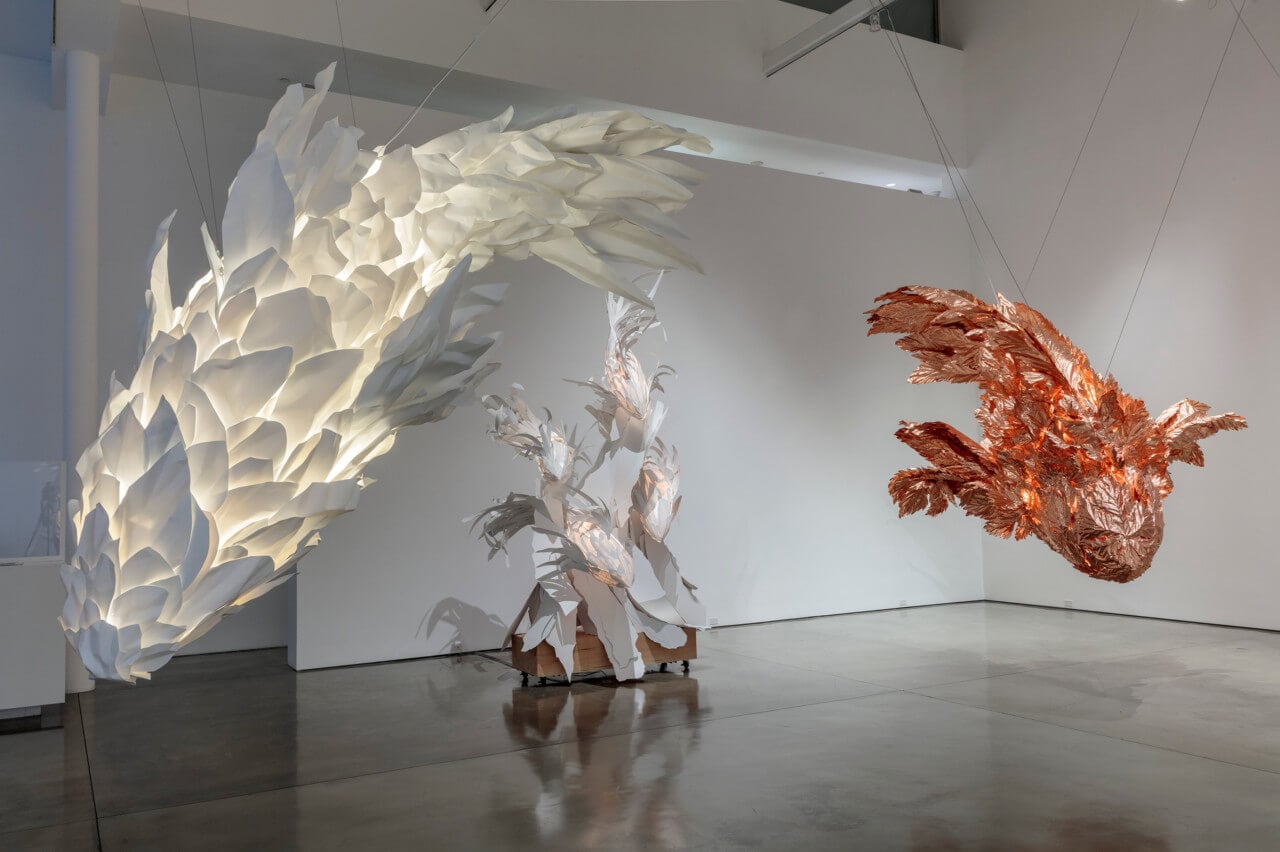
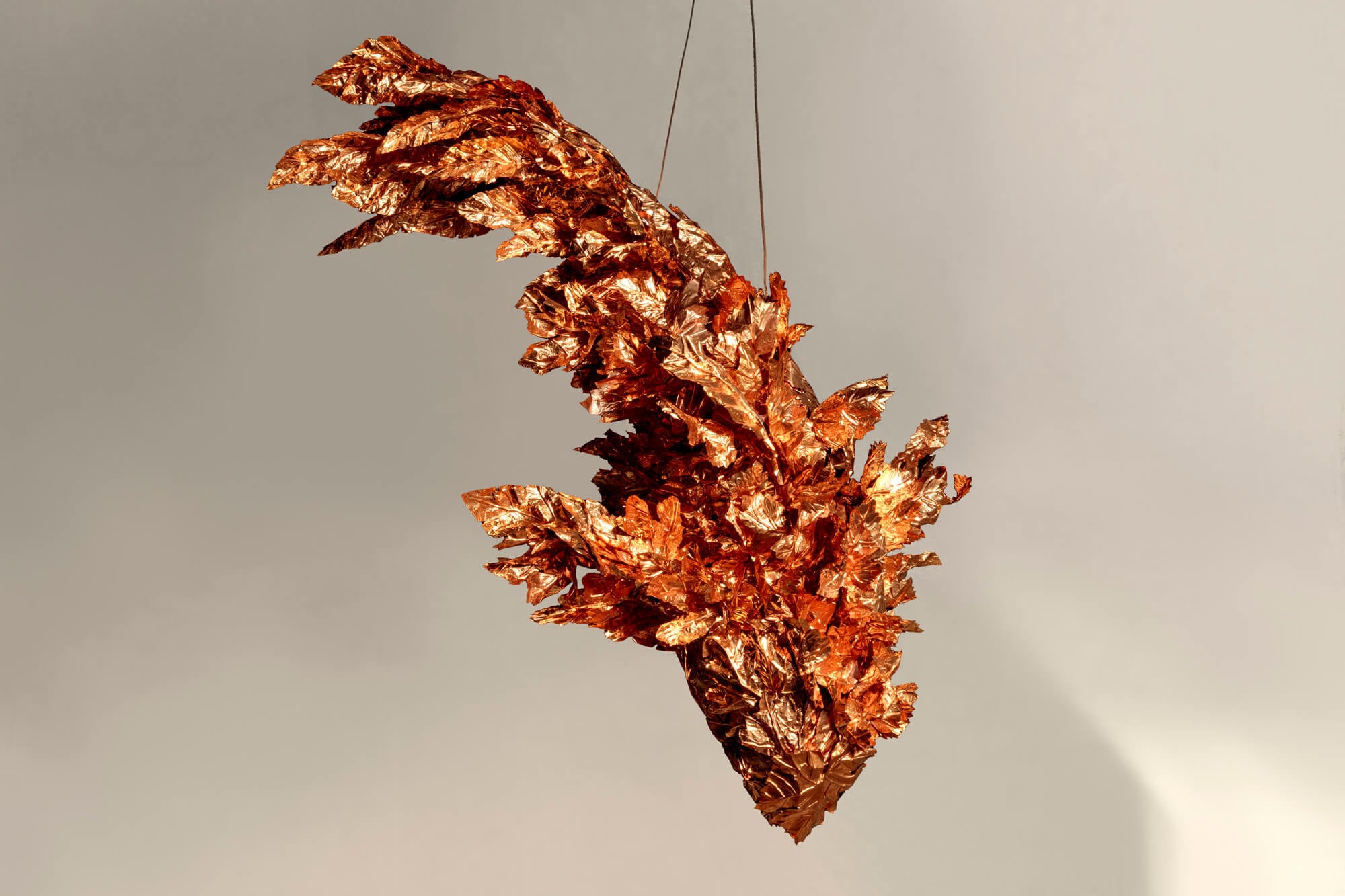
Subsequent exhibitions followed in Beverly Hills (2013, 2021), Hong Kong (2014), London, and New York (2024). The 2021 Beverly Hills show, titled “Spinning Tales,” introduced fish lamps made for the first time in polyvinyl and copper, along with an immersive installation called “Wishful Thinking” based on a scene from Alice in Wonderland. The 2024 New York show, titled “Ruminations,” featured large-scale copper fish with a new leaf-scale motif inspired by a hike Gehry took with his granddaughter, alongside a Crocodile Lamp and works on paper.
Video: Frank Gehry Ruminations at Gagosian New York
This short video by Gagosian tours the “Ruminations” exhibition at 976 Madison Avenue, New York, showing the internally illuminated copper fish sculptures and crocodile lamp alongside Gehry’s drawings.
The 2026 Posthumous Exhibition at Gagosian Beverly Hills
Frank Gehry passed away on December 5, 2025, at his home in Santa Monica, California, after a brief respiratory illness. He was 96 years old. Six months later, a new exhibition titled simply “Frank Gehry” opened at Gagosian Beverly Hills on May 14, 2026, running through June 27.
This posthumous show was organized by Deborah McLeod, senior director at Gagosian Beverly Hills, who had worked with the architect for more than a decade. The presentation was realized in collaboration with Gehry’s family and designed by the Gehry studio. It focuses on the lesser-known, non-architectural side of Gehry’s practice, featuring dozens of fish lamps, animal sculptures and works on paper.
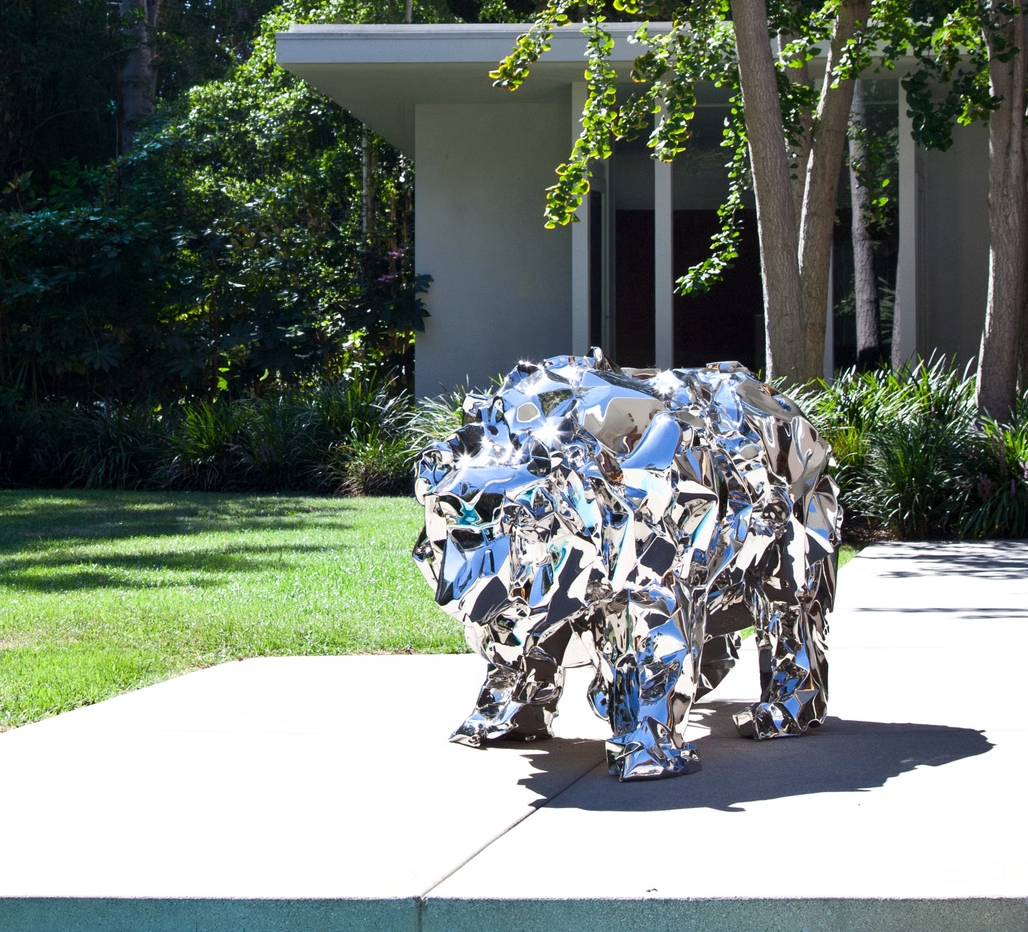
Among the works on display is Bear with Us (2014), a life-size stainless steel sculpture of a bear. Additional animal-themed works expand the scope beyond fish, showing that Gehry’s interest in organic, biomorphic forms extended across the natural world. The exhibition also includes ten ink, watercolor and acrylic works on paper that express the energetic motion of fish through spiraling black lines and patches of liquid color.
🏗️ Real-World Example
Standing Glass Fish, Weisman Art Museum (Minneapolis, 1986): This large-scale sculpture, made of glass, steel and wood, is permanently installed inside a building that Gehry himself designed. The museum’s stainless steel exterior mimics the fish form on an architectural scale. When the museum underwent renovation, the Standing Glass Fish had to be carefully removed and reinstalled, requiring a process documented in time-lapse by the museum. The piece demonstrates how Gehry treated individual sculptures and entire buildings as parts of the same creative continuum.
What Frank Gehry’s Sculpture Tells Us About His Legacy
Gehry’s sculptural practice was not a footnote to his architecture. It was a foundational part of it. The fish lamps, the furniture, the animal forms and the large-scale public installations all served as testing grounds for ideas that later appeared at building scale. This working method, moving freely between disciplines and scales, set Gehry apart from nearly every other architect of his generation.
Most architects who produce art do so as a separate activity, unrelated to their building practice. Gehry’s sculpture and architecture were locked in constant dialogue. A form tested in copper at tabletop scale might reappear in titanium wrapping an entire museum. A pattern seen on a hike with a grandchild might become the surface texture of a new lamp series. This openness to influence from outside architecture, combined with the technical ability to translate sculptural ideas into buildable structures through digital tools like CATIA, is what made his work genuinely original.
The 2026 Gagosian exhibition, along with a major retrospective at the Serralves Foundation in Porto running from May through October 2026, ensures that this sculptural dimension of Gehry’s career will receive sustained attention in the years ahead. Both exhibitions position his art not as a hobby but as a core creative practice that fed directly into the buildings the world knows best.
For architects, designers and students looking to understand Gehry’s full legacy, the message is clear: the sculpture and the architecture were always one practice. The fish swimming in his grandmother’s bathtub in Toronto eventually became a 56-meter golden landmark on Barcelona’s waterfront, and then an entire language of buildings that changed skylines from Bilbao to Los Angeles to Abu Dhabi.
✅ Key Takeaways
- Frank Gehry’s sculpture career began in 1983 with a Formica Corporation commission that led to the Fish Lamps series, rooted in childhood memories of watching carp in his grandmother’s bathtub.
- The fish sculpture in Barcelona (El Peix, 1992), measuring 56 meters long and clad in gilded stainless steel, doubled as a test for the computational design methods later used on the Guggenheim Bilbao.
- Gehry used industrial materials (ColorCore plastic, corrugated cardboard, copper, stainless steel wire) rather than traditional sculpture materials, reflecting the same experimental approach seen in his buildings.
- His sculptures and buildings shared a common design vocabulary of curved forms, implied movement and light-responsive surfaces, making his practice genuinely cross-disciplinary.
- The 2026 posthumous exhibition at Gagosian Beverly Hills and the Serralves Foundation retrospective in Porto will bring new attention to Gehry’s sculptural legacy following his death in December 2025.
Exhibition details mentioned in this article are based on publicly available information as of May 2026. Dates and details may change; check gallery websites for current schedules before visiting.

Groupwork Completes 10-Storey Loadbearing Granite Flats in London
Groupwork's Petra Heights on Finchley Road is a 10-storey block of 22...
 illustrarch Editoral Team2 Mins read
Ai Weiwei Installs 500 Cast-Iron Helmets Outside Sydney Museum
Ai Weiwei's 500 cast-iron helmets opened outside Sydney's MCA on 25 September,...
illustrarch Editoral Team2 Mins read
Isamu Noguchi at Lever House Traces Sculptor’s Decades-Long Collaboration with Bunshaft
Lever House's new exhibition pairs Noguchi sculptures with unbuilt garden designs made...
illustrarch Editoral Team2 Mins read
Relocated Maya Structures at Mexico’s Balam Tun Memory Park Face Legal Challenge
INAH archaeologists have filed a complaint against 26 officials over Balam Tun...
illustrarch Editoral Team2 Mins read


Leave a comment