

Burning Man 2026 Temple and Man Pavilion Designs Revealed
Burning Man 2026 has officially revealed its two central architectural structures: the Temple of the Moon, a parametric timber design by James Gwertzman inspired by a rare desert flower, and Cryptomeria, a Man Pavilion rooted in the ancient Japanese cedar tree. Both structures anchor the event's Axis Mundi theme on the Nevada playa.
 Elif Ayse Sen5 April 20269 Mins read353

Table of Contents Show
Burning Man 2026 has officially unveiled its two central architectural structures: the Temple of the Moon, a parametric timber design by artist James Gwertzman inspired by the rare Queen of the Night cactus flower, and Cryptomeria, a Man Pavilion conceived by designer Alexander Rose around the ancient Japanese cedar tree. Both structures anchor the event’s Axis Mundi theme, as the festival returns to Nevada’s Black Rock Desert from August 30 through September 7, 2026, expecting over 70,000 participants from more than 100 countries.
What Is Burning Man and Why Do the Temple and Man Pavilion Matter?

Burning Man is an annual week-long gathering held in Nevada’s Black Rock Desert that builds a temporary city, Black Rock City, from the ground up. Each year, tens of thousands of participants construct large-scale art installations, theme camps, and mutant vehicles around a central effigy, the Man, which is ceremonially burned at the close of the event. The gathering operates on ten guiding principles, among them Radical Self-Expression, Gifting, Decommodification, and Immediacy, principles that collectively define the culture of the playa.
Two structures stand above all others in Black Rock City. The Man Pavilion is the architectural base from which the Man effigy rises, serving as a central meeting point and spatial anchor for the entire city. The Temple, by contrast, holds a quieter role. It functions as a non-denominational space for grief, gratitude, and reflection, where participants leave messages, photographs, and personal offerings. Both structures are burned in separate ceremonies at the end of the event, a ritual that gives physical form to the idea of impermanence. For broader context on how pavilions in architecture create meaningful temporary spaces, it helps to understand how the field has developed this building type over recent decades.
📌 Did You Know?
Burning Man traces its origins to 1986, when Larry Harvey and Jerry James burned a wooden figure on Baker Beach in San Francisco. The event moved to Nevada’s Black Rock Desert in 1990, where it has grown into one of the world’s largest temporary art cities. In 2026, Burning Man Project’s Honoraria Art Grant program will fund 75 projects with $1.3 million as part of a broader $6 million annual arts investment (Burning Man Project, 2026).
Burning Man 2026 Theme: Axis Mundi

The 2026 gathering centers on the theme Axis Mundi, a Latin phrase meaning “axis of the world.” In cosmology and mythology, the Axis Mundi describes a cosmic connector between the realms of earth, sky, and underworld, a pole or tree that holds the universe in alignment. Burning Man Project describes it as an invitation to find what is at one’s core and to explore how we are connected to one another, to nature, and to the cosmos.
The theme informed not only the two central structures but also the broader art program. Out of 75 Honoraria-funded projects, 41 tree-themed proposals were submitted, with six ultimately selected. Fourteen projects plan to incorporate fire effects. The emphasis on rootedness, connection, and vertical axis runs through both the Temple and the Man Pavilion in distinct but complementary ways. Those interested in how ancient symbolic forms like trees and cosmic axes have shaped architectural history across civilizations will find clear resonances in both of this year’s designs.
Temple of the Moon: A Parametric Flower in the Desert

The 2026 Burning Man Temple is named Temple of the Moon, designed by American artist James Gwertzman with the support of the Moonlight Collective and a volunteer build crew. Gwertzman trained in theater as a set and lighting designer before spending decades in the video game industry. His recent Burning Man works, Prairie of Possibilities (2022 and 2023) and the Moonlight Library (2025, now permanently installed at Burning Man Project’s Fly Ranch property), helped form the Moonlight Collective, the community that will build the 2026 Temple.
The conceptual starting point is the Queen of the Night, known scientifically as Epiphyllum oxypetalum, a desert cactus flower that blooms for a single night before vanishing by morning. Gwertzman and architectural designer Annie Locke Scherer treated this brief, luminous bloom as a direct metaphor for Black Rock City itself: a city that rises from nothing, exists for one week, and disappears without a trace. The design was developed using parametric design methods, in which algorithmic tools do much of the generative heavy lifting, pushing the creative process well beyond what traditional drafting could achieve.
The structure takes a radial plan, with petal-like wooden forms extending outward from a central core. At the heart stands a hyperboloid column that flares at its top, edged with sharp petals evoking the stalks of a flower’s stamen. Fan-like wooden structures surround this column, providing shelter and framed entries into a mostly enclosed central chamber. Modular timber elements, straight wood pieces arranged into lattice surfaces, form sweeping curves without bending the material itself. Wood’s strength-to-weight ratio makes it particularly well suited to temporary structures of this kind, where assembly speed and material lightness are as important as structural performance.
💡 Pro Tip
The Temple of the Moon uses parametric modeling to generate complex curved petal forms from straight, standardized timber components. This is a smart approach for large-scale volunteer builds: standard parts are easy to fabricate, transport, and assemble on site, while the algorithmic logic ensures the geometry reads as fluid and organic from any vantage point. When working with volunteer crews on tight build schedules, reducing component complexity is as important as achieving the design intent.
Eight entrances correspond to different stages of the lunar cycle, reinforcing the moon-centered concept throughout the spatial sequence. The hinged petals atop the central tower open at night to admit moonlight and starlight, then close during the day to shelter visitors from desert heat. Openings within the petal forms capture shifting light conditions throughout the day, meaning the interior atmosphere changes significantly from morning to afternoon to evening.
Circulation through the Temple is designed as a winding path rather than a direct route. Visitors move inward through moments of compression and release, a deliberate pacing strategy that slows movement and heightens awareness. Alcoves and small chambers for quiet reflection radiate outward from the central core, balancing communal gathering with individual privacy. As with every Burning Man temple before it, participants will leave messages, photographs, and objects for loved ones, gradually transforming the structure into a shared, layered archive. At the end of the event, the Temple burn takes place in silence. Full renderings by Annie Locke Scherer and volunteer information are available via the Burning Man Journal.
🎓 Expert Insight
“This year’s design invites each of us to connect with ephemerality and the principle of immediacy. In a world that is always changing, the Temple of the Moon offers the opportunity for reflection while forming experiences that will transform participants beyond the event.” — Katie Hazard, Director of Art, Burning Man Project
Hazard’s framing underscores why the Temple is architecturally distinct from every other structure in Black Rock City. Where most large-scale playa art aims to energize, the Temple is designed to slow visitors down and hold space for what cannot easily be said.
Cryptomeria: The 2026 Man Pavilion

The Man Pavilion for 2026 is named Cryptomeria, designed by Alexander (Zander) Rose, a Bay Area designer and long-time Burning Man participant whose first visit to Black Rock City dates to 1996. Rose may be best known outside the playa as the original founder of the Long Now Foundation and the creative force behind the Clock of the Long Now, a 10,000-year clock project at the intersection of design, time, and civilization.
The concept draws on the Cryptomeria japonica, Japan’s national tree, and specifically on the Jōmon Sugi, an ancient specimen on Yakushima Island estimated to be between 2,170 and 7,200 years old. Rose was drawn to the open, inviting quality at the heart of the tree and to the opportunity it presented for doing something unexpected that shifts a conversation. This use of timber as the conceptual and material core of the pavilion reflects a broader pattern in contemporary architecture, where large-scale wooden structures are increasingly used to express ideas of time, rootedness, and ecological connection.
The structural design takes the form of a tree rendered at architectural scale. An outer spiral staircase carries visitors upward 60 feet to the base of the Man, while an inner spiral staircase descends, creating a double-helix form that Rose explicitly connects to DNA, the biological record of past, present, and future. The pavilion serves as both a landmark and a circulation system, something to climb through rather than simply view. For detailed documentation of previous Burning Man Man Pavilion designs, both Dezeen and ArchDaily maintain comprehensive archives going back many years.
💡 Pro Tip
The double-helix staircase in Cryptomeria is structurally ambitious for a temporary build. Achieving two interlocking spiral paths at 60-foot height with lightweight materials and a volunteer assembly crew requires careful component design. The key is breaking the spiral geometry into repeating modular sections that can be pre-fabricated, labeled, and assembled on site with minimal specialized tools. Pre-drilling all connections off-site and using standard fasteners throughout significantly reduces build time and the risk of on-playa error.
In his concept submission, Rose described the Axis Mundi not as a monument imposed from above, but as “a living alignment revealed through participation.” The pavilion is therefore designed not as a pedestal for the Man but as an environment in which visitors can place themselves within a broader cosmological frame. His background in creating artifacts that get people to think informs the restraint of the concept: the tree form is immediately legible, the experience of climbing it is physical and direct, and the connection to deep time through the Jōmon Sugi reference adds a layer of meaning available to those who look for it.
Burning Man 2026 Dates and What to Expect

Burning Man 2026 runs from August 30 through September 7 in Nevada’s Black Rock Desert, with Black Rock City constructed over the weeks preceding the event. The gathering is expected to bring together over 70,000 participants from more than 100 countries.
Beyond the Temple and Man Pavilion, the 2026 program includes 75 Honoraria-funded art projects representing artists from 15 countries and 17 U.S. states, part of Burning Man Project’s nearly $6 million in annual arts investment. The broader playa hosts roughly 400 total art installations each year, with the vast majority self-funded. Ticket registration for the Main Sale opens April 20, with tickets going on sale April 29 via the official Burning Man ticketing platform. For comparison, the 2025 event under the theme Tomorrow Today featured its own notable temporary architectural projects worth reviewing alongside this year’s designs.
🔢 Quick Numbers
- 70,000+ participants from 100+ countries expected at Burning Man 2026 (Burning Man Project, 2026)
- 75 art projects funded through the Honoraria program with $1.3 million in grants (Burning Man Project, March 2026)
- ~400 total art installations across Black Rock City each year, mostly self-funded (Burning Man Project, 2026)
- Jōmon Sugi, the tree inspiring Cryptomeria, is estimated at 2,170 to 7,200 years old (Yakushima Island, Japan)
Architecture and Impermanence: What These Designs Say About Temporary Space

Taken together, the Temple of the Moon and Cryptomeria represent two distinct approaches to temporary architecture. The Temple prioritizes sensory experience and emotional processing: its winding path, filtered light, and intimate alcoves slow the visitor and create conditions for introspection. The Man Pavilion prioritizes legibility, movement, and cosmic framing: a tree you can climb, a helix that encodes time, a structure that positions you physically within the Axis Mundi concept.
Both structures draw on natural forms interpreted through parametric or computational tools, a recurring trend in Burning Man architecture that reflects broader shifts in how designers work with complex geometry. The Queen of the Night inspires a radial, petal-driven plan executed in latticed timber. The Jōmon Sugi inspires a spiraling vertical form that turns circulation itself into the architectural experience. The wider story of how temporary buildings capture imagination through urgency and material honesty is directly relevant here: both structures compress ambition, craft, and cultural energy into a single week.
What makes Burning Man architecture particularly instructive for designers is precisely its temporary nature. There are no long-term maintenance requirements, no commercial program to satisfy, and no permanent site context to negotiate. These conditions allow designers to focus almost entirely on spatial experience, material expression, and conceptual clarity. The role of parametric thinking in producing complex geometry from simple building components is especially visible in playa builds, where fabrication and assembly logistics demand that every formal decision be both expressive and constructible. For professionals working in temporary or installation-based architecture, the Burning Man projects remain a serious and closely watched body of work, and the 2026 Temple and Man Pavilion continue that tradition.
✅ Key Takeaways
- The 2026 Burning Man Temple is called Temple of the Moon, designed by James Gwertzman with the Moonlight Collective, inspired by the Queen of the Night desert cactus flower and lunar cycles.
- The 2026 Man Pavilion is called Cryptomeria, designed by Alexander Rose, drawing on Japan’s ancient Jōmon Sugi cedar tree and featuring a 60-foot double-helix staircase.
- Both structures respond to the 2026 theme Axis Mundi, centered on cosmic connection, rootedness, and the link between earth, sky, and community.
- Burning Man 2026 takes place August 30 through September 7 in Nevada’s Black Rock Desert, with 70,000+ participants and 75 Honoraria-funded art projects expected.
- The Temple and Man Pavilion are among the most closely watched temporary architecture projects in the world, offering a clear study in how spatial experience and material craft can coexist without commercial constraints.



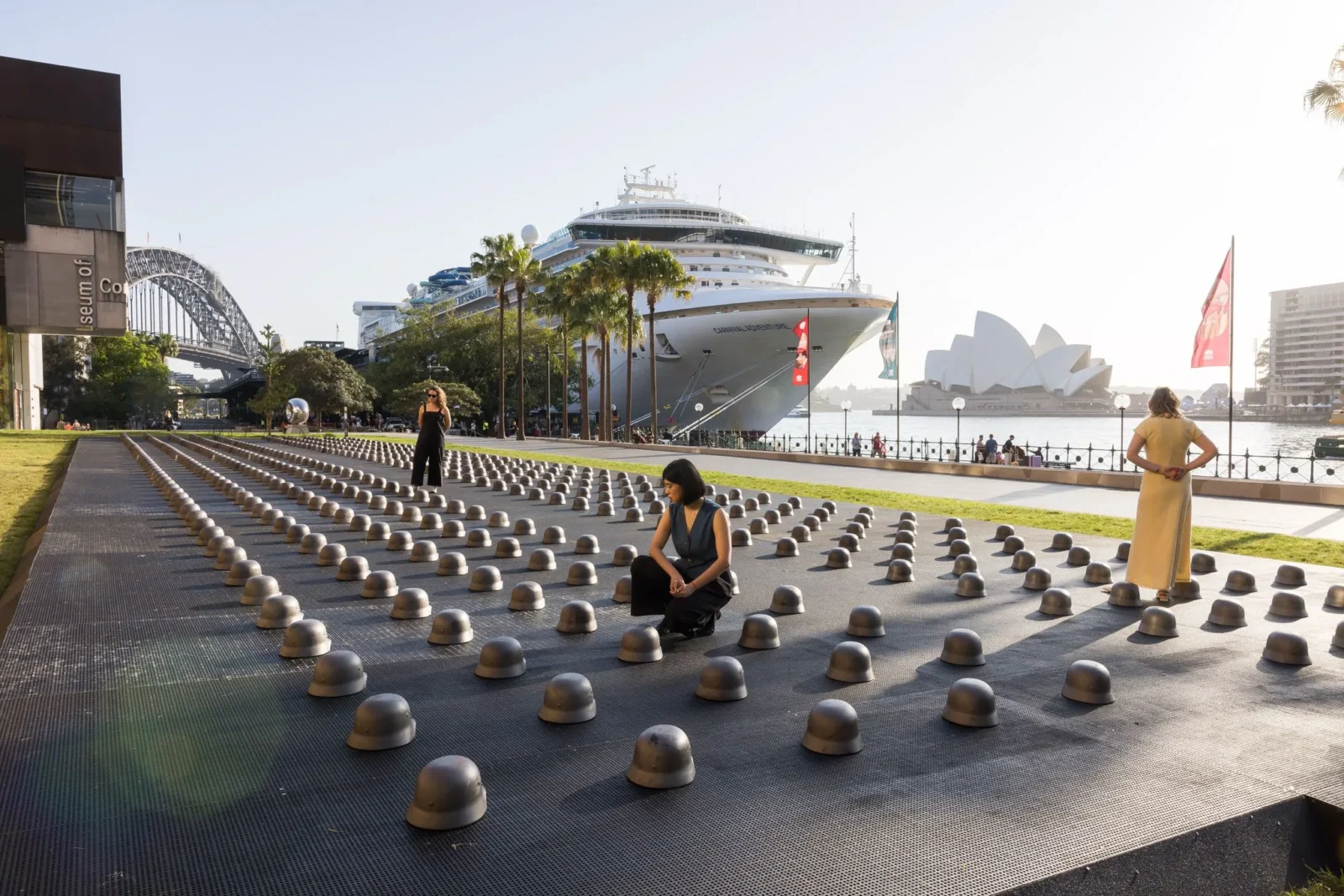
Ai Weiwei Installs 500 Cast-Iron Helmets Outside Sydney Museum
Ai Weiwei's 500 cast-iron helmets opened outside Sydney's MCA on 25 September,...
 illustrarch Editoral Team2 Mins read
Isamu Noguchi at Lever House Traces Sculptor’s Decades-Long Collaboration with Bunshaft
Lever House's new exhibition pairs Noguchi sculptures with unbuilt garden designs made...
illustrarch Editoral Team2 Mins read
Relocated Maya Structures at Mexico’s Balam Tun Memory Park Face Legal Challenge
INAH archaeologists have filed a complaint against 26 officials over Balam Tun...
illustrarch Editoral Team2 Mins read

Heather Roberge, UCLA Architecture Professor and Murmur Founder, Dies at 55
UCLA professor and Murmur founder Heather Roberge, a 2026 AIA LA Educator...
illustrarch Editoral Team2 Mins read


Leave a comment