

Shear Wall Examples in Architecture: Types, Placement and Design
A practical guide to shear walls in architecture covering concrete, steel, plywood, and masonry types. Includes real-world placement strategies, design principles, code references, a comparison with load-bearing walls, and built examples from high-rise towers to residential construction.
 Furkan Sen20 May 202611 Mins read223

Table of Contents Show
A shear wall is a vertical structural element designed to resist lateral forces such as wind and seismic loads in buildings. Shear wall examples in architecture range from reinforced concrete cores in high-rise towers to plywood-sheathed panels in residential wood-frame houses. These walls transfer horizontal forces down through the structure and into the foundation, preventing the building from racking or collapsing sideways.
Buildings experience two categories of force: gravity loads that push straight down, and lateral loads that push sideways. Columns and beams handle gravity well, but without a dedicated system to resist horizontal movement, even a modest earthquake or windstorm can cause a structure to sway beyond safe limits or fail entirely. That is where shear walls come in. They act as rigid vertical plates anchored to the foundation, absorbing lateral energy and distributing it safely into the ground. The concept applies across almost every building type, from single-story schools to supertall skyscrapers.
What Is a Shear Wall in Architecture?

A shear wall in architecture is a stiff, planar wall element that resists in-plane lateral forces. Unlike a partition wall, which simply divides space, a shear wall is part of the building’s structural system. It is designed to carry horizontal shear forces generated by wind pressure, earthquake ground motion, or unbalanced soil pressure and deliver those forces to the foundation.
The wall works by converting lateral loads into shear stresses along its length and overturning moments at its base. Properly reinforced, it can absorb significant energy before cracking or yielding. In reinforced concrete construction, the wall panel typically contains horizontal and vertical steel rebar arranged in a grid pattern. At the boundary edges, additional bars and closely spaced ties form confined zones that prevent the concrete from crushing under high compressive loads.
💡 Pro Tip
When laying out shear walls early in schematic design, position them symmetrically about the building’s center of mass. Asymmetric placement creates torsional effects during an earthquake, forcing some walls to work much harder than others and increasing the risk of localized failure.
Architects sometimes treat shear walls as constraints on open floor plans. In practice, they can be integrated into elevator cores, stairwells, and party walls without reducing usable space. The Burj Khalifa, for example, uses a Y-shaped reinforced concrete core that functions as its primary shear wall system, with the three wings bracing each other against wind loads at 828 meters.
Types of Shear Walls in Architecture

Shear wall design in architecture varies based on building material, height, seismic zone, and architectural intent. The most common types fall into four categories.
Reinforced Concrete Shear Walls
Reinforced concrete is the most widely used material for shear walls in mid-rise and high-rise construction. The wall is cast in place with steel reinforcement bars embedded inside. Concrete shear wall architecture dominates regions with high seismic activity because reinforced concrete can be detailed to absorb and dissipate earthquake energy through controlled cracking and steel yielding. According to ACI 318 (Building Code Requirements for Structural Concrete), special reinforced concrete shear walls in high seismic zones require boundary elements with closely spaced confinement reinforcing at wall ends and openings.
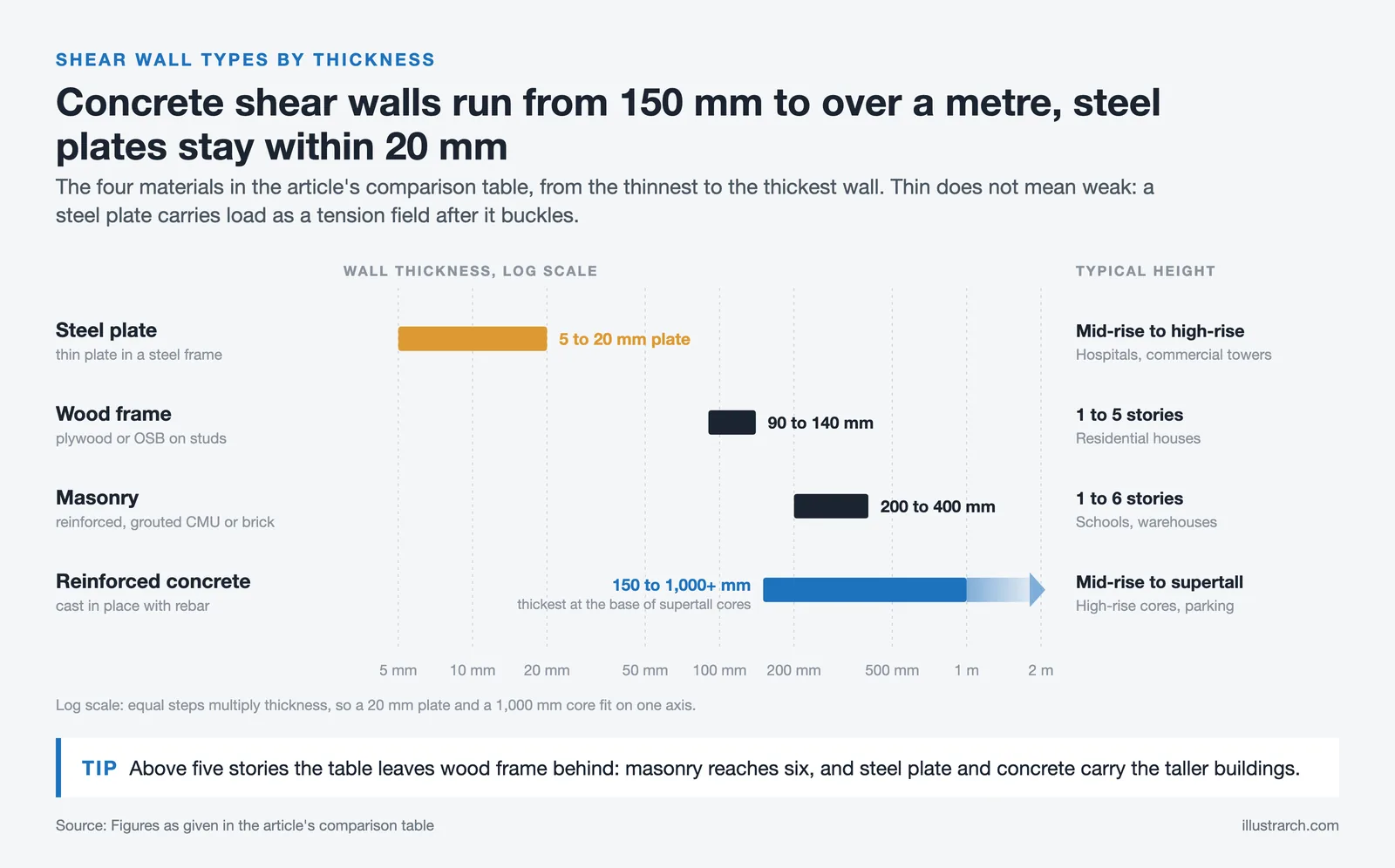
These walls typically range from 150 mm to 400 mm thick in residential and commercial buildings. In supertall towers, core wall thicknesses can exceed 1,000 mm at the base. The walls are usually arranged around the building’s central service core, forming a box or tube that resists lateral forces from any direction.
Steel Plate Shear Walls
Steel plate shear walls use thin steel panels bounded by steel columns and beams. The plate acts as a tension field, buckling under shear but continuing to carry load through diagonal tension strips that form after buckling. This system is lighter than concrete and allows faster construction, making it popular in commercial high-rise projects. The steel plate approach was used in structures such as the Los Angeles Convention Center expansion and several hospital buildings in California where post-earthquake functionality was required.
Wood-Frame (Plywood and OSB) Shear Walls
In residential and low-rise construction, plywood or oriented strand board (OSB) panels nailed to wood studs form the shear wall. The nailed connections between the panel and the framing provide the shear resistance. The spacing and size of the nails, the thickness of the panel, and the grade of the framing lumber all affect the wall’s capacity. The American Wood Council (AWC) publishes design tables for wood shear wall capacities in its Special Design Provisions for Wind and Seismic (SDPWS) standard.
Wood shear walls are cost-effective and fast to build. However, their capacity per linear meter is lower than concrete or steel, so they are best suited for buildings under four or five stories.
Masonry Shear Walls
Masonry shear walls use concrete blocks (CMU) or brick, typically reinforced with steel bars placed in the block cells and grouted solid. Masonry walls are common in schools, warehouses, and low-rise commercial buildings. Reinforced masonry can provide good lateral resistance, but the walls tend to be thicker and heavier than concrete alternatives for the same capacity.
🎓 Expert Insight
“Good seismic design is about giving the building a clear and direct load path. Shear walls work best when they are continuous from roof to foundation, with no offsets or transfers that create weak points.”
Licensed structural engineer with 20+ years of seismic design experience
This principle explains why many earthquake-resistant building codes require vertical regularity in shear wall systems. Discontinuities create stress concentrations that have been linked to partial collapses in past earthquakes.
Comparison of Shear Wall Types
The following table summarizes the key differences between the four main shear wall materials:
| Feature | Reinforced Concrete | Steel Plate | Wood Frame | Masonry |
|---|---|---|---|---|
| Typical Building Height | Mid-rise to supertall | Mid-rise to high-rise | 1 to 5 stories | 1 to 6 stories |
| Seismic Performance | Excellent with special detailing | Excellent, high ductility | Good for light structures | Good with reinforcement |
| Wall Thickness | 150 mm to 1,000+ mm | 5 mm to 20 mm plate | 90 mm to 140 mm | 200 mm to 400 mm |
| Construction Speed | Moderate (formwork + curing) | Fast (prefabricated) | Fast | Moderate |
| Relative Cost | Moderate | Higher | Lower | Moderate |
| Best Application | High-rise cores, parking structures | Hospitals, commercial towers | Residential houses | Schools, warehouses |
Shear Wall Placement in Buildings
Where you place shear walls matters as much as how you build them. Shear wall placement in buildings follows a set of structural logic that balances lateral resistance, torsional stability, and architectural functionality.
The ideal configuration places shear walls along both principal axes of the building (typically called the X and Y directions) so that the structure can resist lateral forces from any direction. Placing walls only along one axis leaves the building vulnerable to loads perpendicular to those walls.
Symmetry is critical. If the center of rigidity (the point around which the building resists twisting) does not align with the center of mass (the point through which inertial forces act), the building will twist during an earthquake. This torsional response amplifies forces on the walls farthest from the center of rotation and is one of the most common causes of damage in irregularly planned buildings.
📐 Technical Note
According to ASCE 7 (Minimum Design Loads for Buildings and Other Structures), a building is classified as torsionally irregular when the maximum story drift at one end of the structure exceeds 1.2 times the average story drift. Buildings that exceed this threshold require additional analysis and may need strengthened shear walls at the flexible edge.
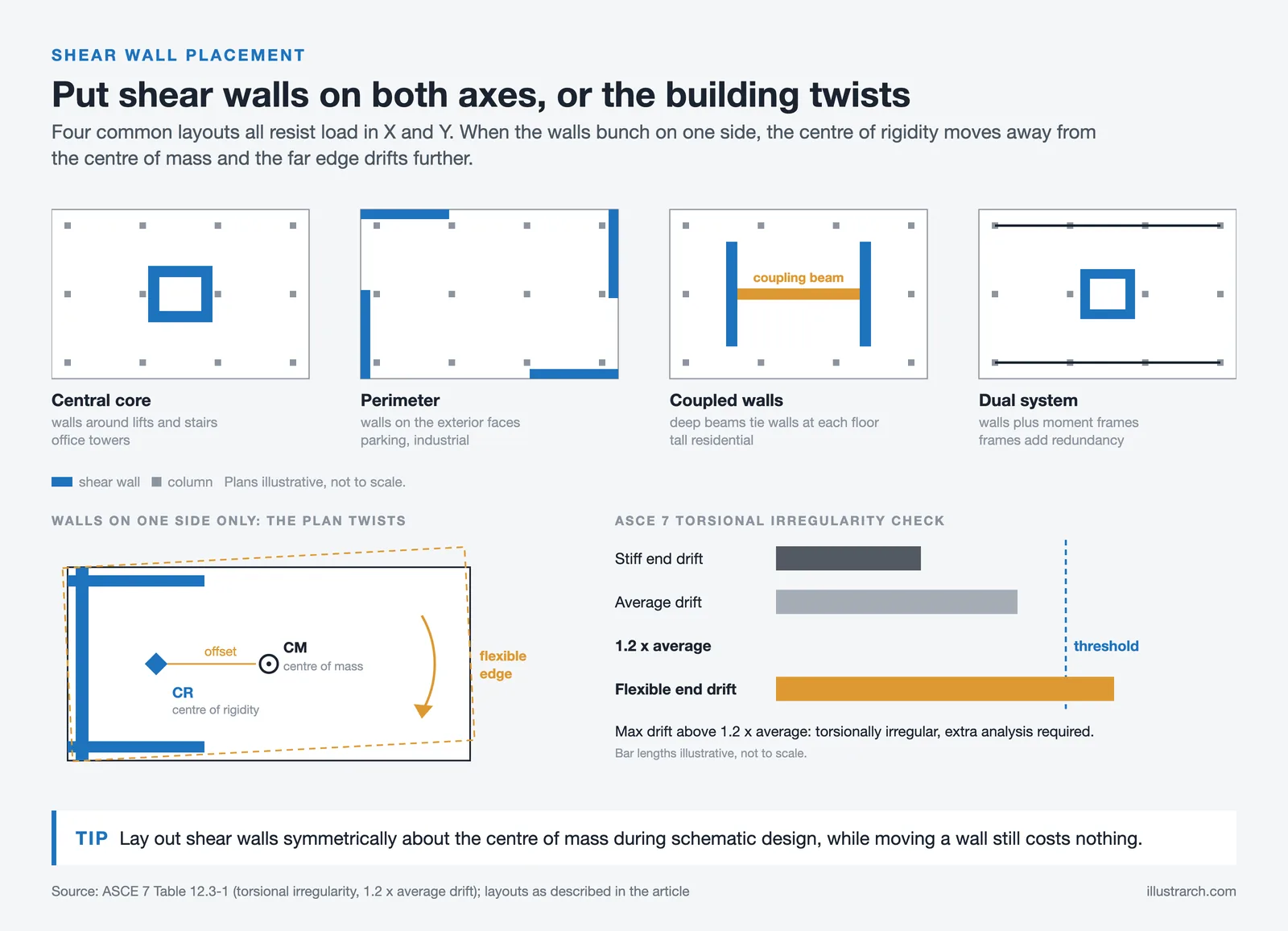
Common placement strategies include:
- Central core layout: Shear walls form a rectangular or cruciform core around elevators and stairs. This is the standard approach for office towers and vertical architecture projects.
- Perimeter wall layout: Shear walls are placed along the exterior faces, maximizing interior flexibility. This is common in parking structures and industrial buildings.
- Coupled wall layout: Two or more shear walls are connected by deep beams (coupling beams) at each floor level. The coupling beams force the walls to act together, increasing stiffness and energy dissipation. This is a preferred system for tall residential buildings where wall layout is dictated by unit plans.
- Dual system: Shear walls combine with moment-resisting frames. The frames provide redundancy, and the walls provide stiffness. Many building codes recognize dual systems with higher response modification factors, meaning they can be designed for lower seismic forces.
Shear Wall vs Load-Bearing Wall

The terms are often confused, but they describe different structural roles. A load-bearing wall carries gravity loads from floors and roofs above, transferring weight downward to the foundation. A shear wall resists lateral loads, transferring horizontal forces into the foundation. A single wall can serve both functions simultaneously, and in many concrete buildings, the core walls do exactly that.
The key distinction lies in design intent and reinforcement. A load-bearing wall needs enough compressive capacity to support the weight above it. A shear wall needs enough in-plane shear capacity and overturning resistance to handle lateral forces. A concrete wall designed only for gravity might have minimal horizontal reinforcement. The same wall designed as a shear wall will have substantial horizontal and vertical steel, plus confined boundary elements at the edges.
⚠️ Common Mistake to Avoid
Removing or cutting openings in a wall because it “looks like a partition” without checking whether it is a shear wall is one of the most dangerous renovation mistakes. Shear walls often look identical to non-structural walls on the surface. In the 1994 Northridge earthquake, several parking structures collapsed partly because weak-story conditions created by removed or interrupted shear elements went undetected.
In wood-frame residential construction, the exterior walls and certain interior walls typically serve as both load-bearing and shear walls. In steel-frame high-rises, gravity is handled by the steel frame, and a separate concrete core provides the shear wall function. Understanding the distinction helps architects communicate with structural engineers more effectively during design coordination.
Shear Wall Design Principles
Shear wall design in architecture involves balancing structural requirements with spatial planning. The structural engineer sizes and reinforces the wall, but the architect determines where it goes and how it interacts with the floor plan. A few core principles guide effective shear wall design.
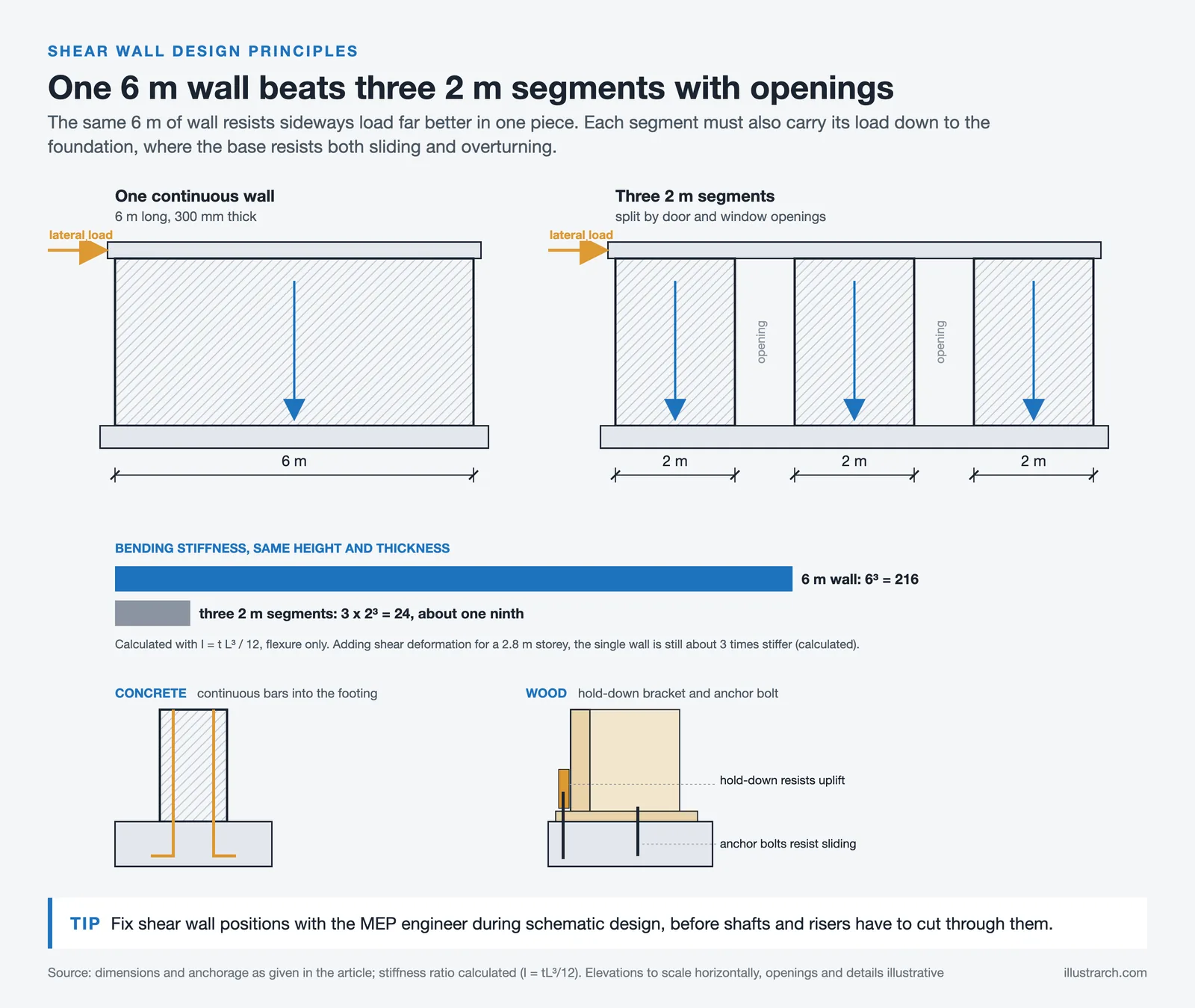
First, walls should be as long as possible in the direction they resist force. A short wall segment has low stiffness and attracts less lateral force but may not provide enough resistance. Longer walls are stiffer and more effective, but they consume more floor plan area. A 6-meter-long concrete shear wall at 300 mm thick is significantly stiffer than three 2-meter segments separated by openings.
Second, openings weaken shear walls. Doors and windows cut through the wall panel and interrupt the flow of shear forces. Small, regularly spaced openings can be accommodated with additional reinforcing around the edges. Large or irregular openings can reduce the wall’s effective capacity so much that it no longer qualifies as a shear wall under code definitions.
Third, the wall must be anchored to the foundation. At the base, a shear wall develops both horizontal sliding forces and overturning moments. The connection to the foundation resists both. In concrete construction, this means continuous reinforcement extending from the wall into the footing. In wood construction, hold-down brackets and anchor bolts secure the wall’s boundary studs to the foundation plate.
💡 Pro Tip
During schematic design, coordinate shear wall locations with the MEP engineer early. Mechanical shafts, plumbing risers, and electrical conduits frequently need to pass through walls. Discovering these clashes after structural drawings are issued leads to expensive RFIs and construction delays. Running a clash detection in BIM at the end of design development catches most conflicts.
Real-World Shear Wall Examples in Architecture

Shear wall examples in architecture appear in buildings at every scale. Here are several notable cases that illustrate different approaches to lateral force resistance.
The Taipei 101 tower in Taiwan uses a steel braced-frame core, rather than concrete shear walls, with outrigger trusses that connect the core to the perimeter mega-columns. This system allowed the 508-meter building to withstand both typhoon winds and the region’s significant seismic activity.
Japan’s Sendai Mediatheque, designed by Toyo Ito, took a radically different approach. Instead of conventional shear walls, the building uses 13 lattice-like steel tube structures that pass through each floor plate. These tubes carry both gravity and lateral loads while allowing light and air to pass through the building. The structure performed well during the 2011 Tohoku earthquake, which registered magnitude 9.0.
In residential construction, a typical single-family house in California’s seismic zone relies on plywood shear walls at each corner and along key interior lines. These walls are nailed to the framing with specific nail patterns (for example, 8d nails at 100 mm spacing along panel edges) and anchored to the foundation with steel hold-downs rated for the calculated overturning force.
🏗️ Real-World Example
Torre Reforma (Mexico City, 2016): This 246-meter office tower by LBR&A Arquitectos uses two massive reinforced concrete shear walls (each about 50 meters long) on its east and west faces, with a diagrid steel structure on the narrow south face. The design was specifically engineered for Mexico City’s extreme seismic conditions and soft clay soil. The building survived the 2017 Puebla earthquake (magnitude 7.1) without structural damage, demonstrating the effectiveness of its shear wall system.
Video: Understanding Shear Walls in Buildings
This video provides a clear visual explanation of how shear walls resist lateral forces in building structures, covering both wind and seismic load scenarios.
How Shear Walls Work With Other Structural Systems
Shear walls rarely work alone. In most buildings, they are part of a larger lateral-force-resisting system that may include moment frames, braced frames, or outrigger systems. Understanding how these elements interact is important for architects working on complex building projects where foundation and underground conditions influence structural decisions.
In a shear wall-frame interaction system, the shear wall dominates lateral resistance at the lower floors (where shear forces are highest), while the frame becomes more effective at the upper floors (where overturning deformation controls). This natural division of labor produces a more efficient structure than either system alone.
Outrigger systems extend this idea further. An outrigger truss connects the central shear wall core to perimeter columns, engaging the full width of the building in resisting overturning. The world’s tallest buildings almost universally use some form of core-plus-outrigger configuration. The outrigger floors are typically placed at mechanical levels, where the deep trusses do not interfere with occupied space.
In the curtain wall building approach, the exterior envelope carries no structural load, and the interior shear walls or braced core handle all lateral resistance. This separation allows the architect to design the facade independently from the lateral system, which is one reason glass curtain walls became dominant in commercial high-rise architecture.
📌 Did You Know?
The concept of using walls specifically to resist lateral forces dates back thousands of years. Ancient Roman concrete walls in structures like the Pantheon were not designed with modern seismic codes, but their massive thickness gave them inherent lateral stability. Modern shear wall engineering began in earnest after the 1933 Long Beach earthquake in California, which destroyed many unreinforced masonry buildings and led to the first mandatory seismic design requirements in U.S. building codes.
Shear Wall in Building Construction: Practical Considerations
Translating shear wall design from drawings to the construction site involves several practical steps that affect cost, schedule, and quality.
For concrete shear walls, the formwork is a major cost driver. Jump forms and slip forms allow continuous casting of core walls in tall buildings, with the formwork rising one floor at a time. Self-climbing formwork systems, used in projects like the structurally complex towers that rely on precise load-path documentation, can advance one floor every three to five days in optimal conditions.
Concrete placement in shear walls requires attention to consolidation. The dense reinforcement cages in boundary elements make it difficult for concrete to flow freely. Vibration is needed to eliminate voids, especially at lap splice locations where multiple bars overlap. Self-consolidating concrete (SCC) can reduce this challenge by flowing into tight spaces without mechanical vibration, though it costs more than conventional mixes.
For wood-frame shear walls, quality control during nailing is critical. Over-driven nails that break through the panel surface lose their shear capacity. Under-driven nails that stand proud may not engage the framing. Many jurisdictions require special inspection of shear wall nailing patterns, particularly in seismic design categories D through F as defined by the International Building Code (IBC).
Post-tensioned shear walls represent a newer approach gaining traction in seismic regions. Instead of relying on mild steel reinforcement to yield and absorb energy, post-tensioned walls use high-strength steel tendons that clamp the wall to the foundation. After an earthquake, the tendons pull the wall back to its original position, a behavior known as self-centering. Research programs at institutions such as the National Institute of Standards and Technology (NIST) have tested this approach and found it effective at limiting residual drift after strong ground shaking.
✅ Key Takeaways
- Shear walls resist lateral forces (wind and seismic) by transferring horizontal loads through the structure into the foundation.
- The four main types are reinforced concrete, steel plate, wood frame, and masonry, each suited to different building scales and seismic zones.
- Placement should be symmetric along both building axes to avoid torsional response during earthquakes.
- Shear walls differ from load-bearing walls in their design intent: shear walls resist horizontal forces while load-bearing walls carry vertical gravity loads. A single wall can serve both roles.
- Openings weaken shear walls and must be reinforced. Coordination with MEP systems early in design prevents costly conflicts during construction.
Technical specifications referenced in this article, including wall thicknesses and reinforcement requirements, are based on general industry standards and may vary by jurisdiction. Always consult a licensed structural engineer and local building codes for project-specific design.







Architecture Beneath the Surface: The Crucial Role of Structural Mechanics and Geotechnical Analysis in Groundwork Design
Bold architecture depends on the ground beneath it. How numerical geotechnical analysis...
 illustrarch Editoral Team1 Mins read

Designing Renovation Projects Around Debris Flow and Site Logistics
Effective renovation planning must prioritize debris flow management. Learn how to integrate...
illustrarch Editoral Team4 Mins read

How Long Does a Building Warranty Typically Last? Coverage Periods Explained
Building warranty cover is layered, not uniform: one year for finishes, two...
 Sinan Ozen5 Mins read

What Is an Architect’s Certificate of Practical Completion?
A practical breakdown of the architect's certificate of practical completion: who issues...
Sinan Ozen6 Mins read


Leave a comment