

Golden Ratio Samples in Architecture #4
This fourth installment of our Golden Ratio Samples series examines five additional buildings where the 1:1.618 proportion shapes facades, floor plans, and structural systems. From ancient Egyptian construction to Le Corbusier's Modulor system, each example includes specific dimensional analysis showing how the golden ratio organizes space across centuries.
 Elif Ayse Sen9 May 202612 Mins read154

Table of Contents Show
The golden ratio in architecture continues to surface across centuries and civilizations, connecting ancient pyramids to 20th-century housing blocks through a shared proportional language. In this fourth installment of our Golden Ratio Samples series, we examine five additional buildings where the 1:1.618 proportion shapes facades, floor plans, and structural systems in measurable ways.
From the sloped geometry of the Great Pyramid of Giza to Le Corbusier’s Modulor-driven Unité d’Habitation, these examples of the golden ratio in architecture reveal how Phi organizes space at every scale. Each building below is analyzed for specific dimensional relationships that align with or closely approximate 1.618, offering architects and students a deeper understanding of how the golden mean ratio in architecture translates from theory into built form.
The Great Pyramid of Giza: Golden Ratio in Ancient Egyptian Construction

The Great Pyramid of Giza, built around 2560 BCE, is one of the oldest structures associated with the golden ratio in architecture. While the ancient Egyptians likely did not know Phi as a formal concept, the pyramid’s geometry produces ratios remarkably close to 1.618. The relationship between the slant height of a triangular face (approximately 186.4 meters) and half the base length (approximately 115.2 meters) yields a ratio of about 1.619, nearly identical to the golden ratio.
This proportional alignment may stem from the Egyptians’ use of the seked system, a method for calculating slope angles based on horizontal displacement per unit of vertical rise. A seked of 5.5 palms per cubit produces a face angle of approximately 51.84 degrees, which corresponds to a triangle where the slant height and half-base fall into a golden ratio relationship. Whether intentional or a byproduct of practical construction methods, the result is a structure whose proportions have captivated mathematicians and architects for millennia.
📐 Technical Note
The Great Pyramid’s base measures approximately 230.4 meters on each side, with a height of 146.5 meters. The ratio of the total surface area of the four faces to the base area equals Phi (1.618). Additionally, the pyramid’s height squared (146.5² = 21,462) closely equals the area of one triangular face (21,481 m²), a geometric property unique to pyramids built at the golden ratio angle.
The precision of these measurements becomes more impressive when you consider the tools available at the time. Egyptian builders worked with ropes, plumb bobs, and wooden set squares. Yet the base of the Great Pyramid is level to within 2.1 centimeters across its entire 230-meter span. This level of accuracy suggests that the builders followed a strict proportional system, even if they expressed it differently than modern mathematicians would.
Researchers have debated whether the golden ratio appears in the Great Pyramid by design or coincidence. The mathematician Gary Meisner has documented multiple Phi-based relationships in the pyramid’s geometry using precise measurement overlays. Others, including George Markowsky, argue that the ratio is an artifact of selective measurement. Regardless of intent, the Great Pyramid remains one of the most discussed examples of the golden ratio in architecture, and its proportional system continues to influence how architects think about proportion in architectural design.
CN Tower, Toronto: The Golden Ratio in Modern Engineering

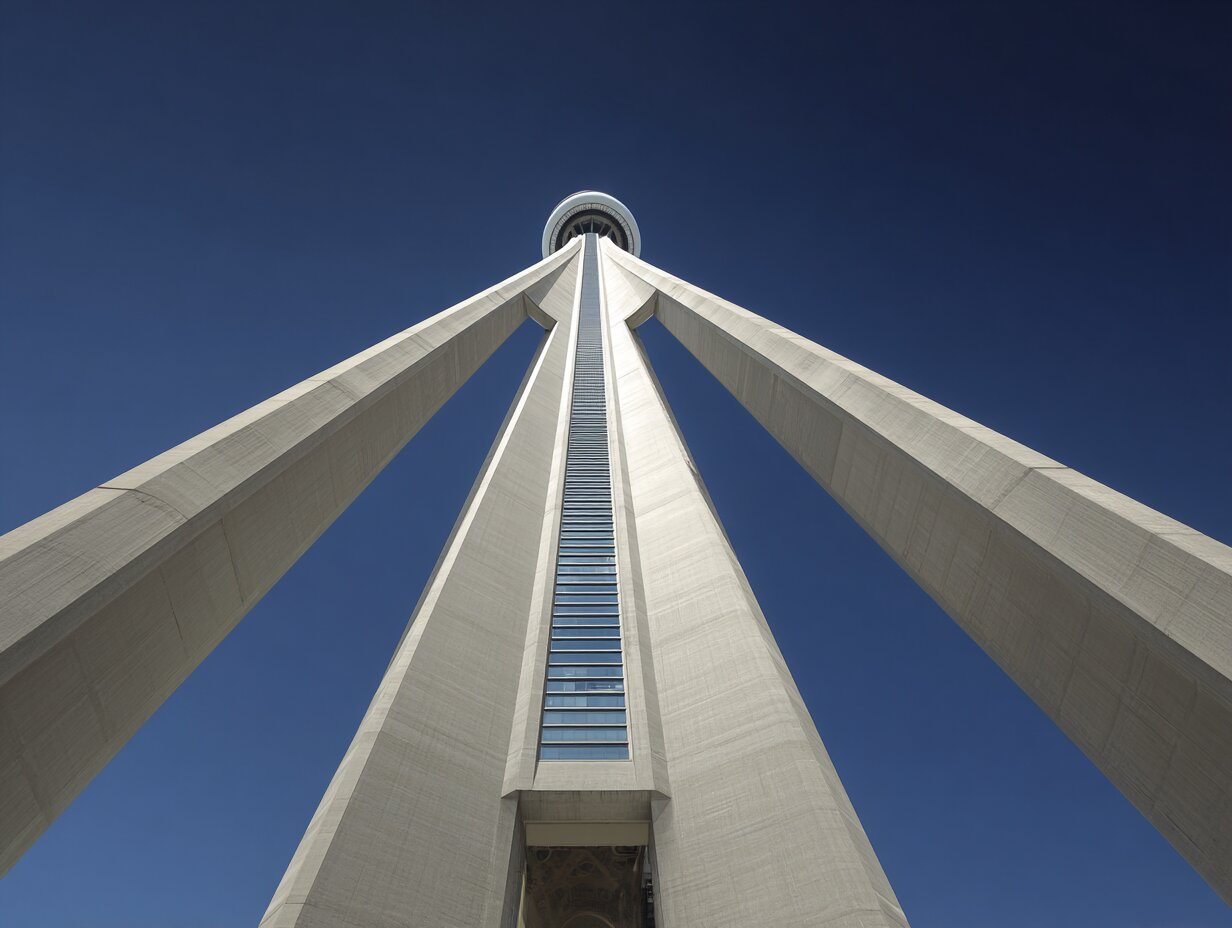
The CN Tower in Toronto, completed in 1976, stands 553.3 meters tall, making it one of the world’s most recognizable communications and observation structures. The golden ratio appears in the relationship between the tower’s main observation deck height and its total height. The observation deck sits at 346 meters, and dividing the total height by the deck height produces a ratio of approximately 1.60, close to 1.618.
A more precise golden ratio relationship emerges when you compare the height of the observation deck (346 m) to the remaining height above it (207.3 m). This yields a ratio of approximately 1.669, which, while not exact, falls within a range that produces a visually balanced vertical division. The tower’s designers at WZMH Architects used proportional analysis to determine where the main structural transitions would occur, ensuring that the tapering silhouette reads as a unified form rather than a stack of disconnected segments.
💡 Pro Tip
When designing tall, narrow structures like towers or monuments, placing the primary visual event (observation deck, canopy, setback) at approximately 62% of the total height creates a natural golden ratio division. This prevents the structure from looking top-heavy or bottom-heavy, giving it a tapering profile that the eye reads as stable and elegant.
The CN Tower also demonstrates how the golden ratio and architecture intersect at the structural level. The hexagonal concrete core that supports the tower narrows progressively as it rises, with each reduction in cross-section following a proportional step. This tapering is not purely aesthetic. It reduces wind load on the upper portions of the structure while maintaining the visual continuity of the shaft. The relationship between proportion and structural performance is a recurring theme in tall building design, and the CN Tower illustrates it at an extreme vertical scale.
The tower’s SkyPod, located at 447 meters, creates a secondary proportional division. The distance from the main observation deck to the SkyPod (101 m) and from the SkyPod to the antenna tip (106.3 m) produces a near-equal split, contrasting with the golden ratio division below. This layering of proportional systems at different scales gives the tower its distinctive silhouette, a quality that sets it apart from telecommunications structures that rely on purely functional geometry.
Chartres Cathedral: Golden Ratio in Gothic Architecture
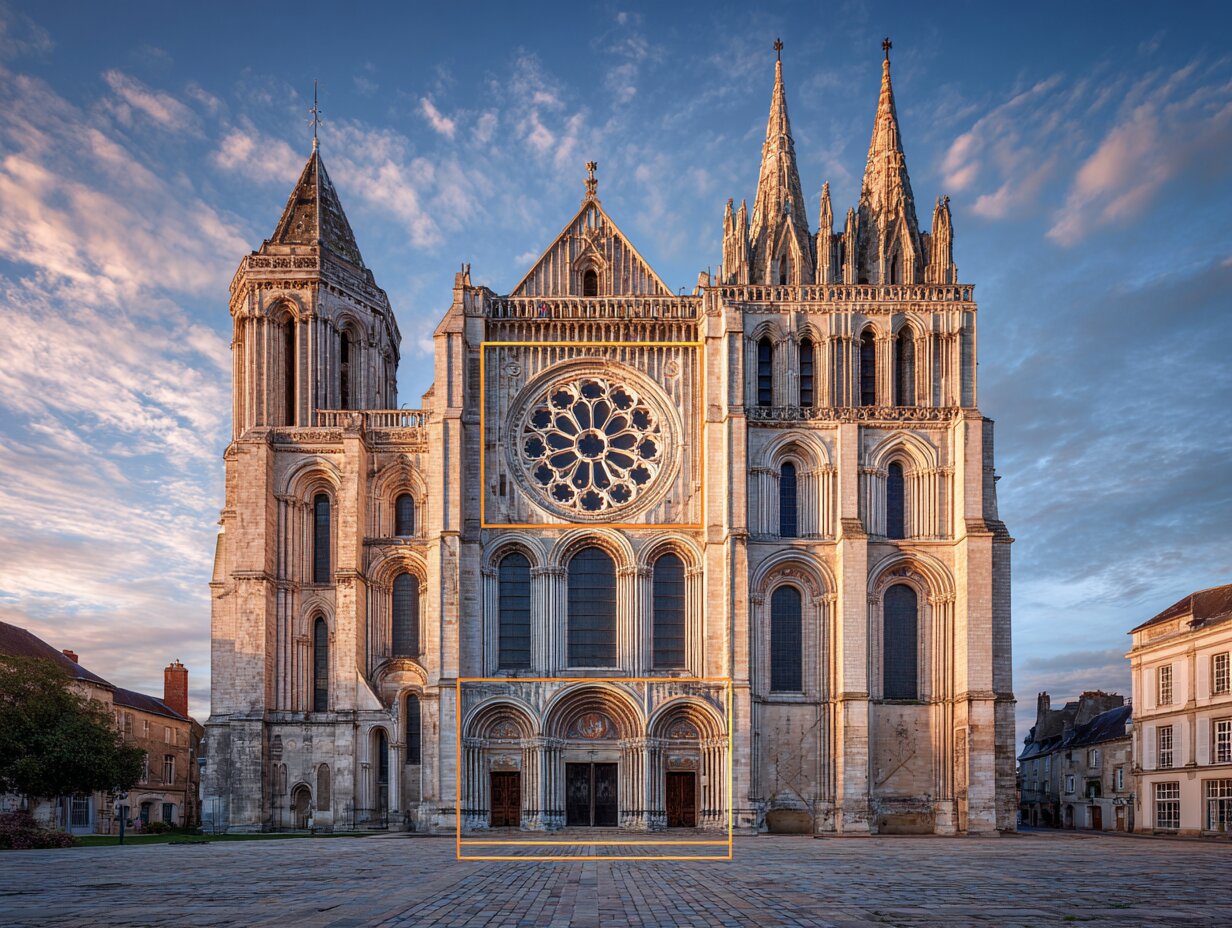
Chartres Cathedral, located about 80 kilometers southwest of Paris, was built primarily between 1194 and 1220 CE. It is one of the finest surviving examples of French Gothic architecture and contains some of the most studied proportional relationships from the medieval period. The cathedral’s west facade, its nave cross-section, and its floor plan all contain dimensions that align closely with the golden ratio of architecture.
The west facade of Chartres is organized around a series of vertical and horizontal divisions that approximate golden rectangles. The total height of the facade, measured from the ground to the base of the gable, relates to the width of the central portal zone in a ratio near 1.618. The three portals themselves are sized in proportional steps, with the central portal being the largest and the side portals progressively smaller, following a pattern consistent with Fibonacci-based scaling.
🎓 Expert Insight
“The medieval master builders used geometry as their primary design tool. Proportional systems based on the square root of two, the square root of three, and the golden section were part of their working knowledge, transmitted through lodge traditions rather than written treatises.” — Robert Bork, Professor of Art History, University of Iowa
Bork’s research on Gothic geometric design practices highlights how proportional knowledge was passed between generations of builders through practical demonstration rather than formal mathematics, explaining why golden ratio relationships appear consistently across Gothic cathedrals built by different teams.
Inside the cathedral, the nave’s cross-section reveals additional golden ratio relationships. The height of the nave arcade (the lower tier of arches) to the height of the clerestory (upper window level) approximates Phi. This vertical division is not accidental. Gothic builders used geometric constructions with compass and straightedge to determine these proportions, and the golden rectangle can be constructed with these tools alone. The result is a spatial experience where the vertical emphasis of the nave feels resolved rather than simply tall.
The famous labyrinth set into the nave floor at Chartres also contains proportional relationships linked to golden ratio geometry. The labyrinth’s diameter is approximately 12.89 meters, and its center is placed at a distance from the west wall that relates to the total nave length in a ratio approximating Phi. Whether the builders consciously applied the golden ratio or arrived at these proportions through inherited geometric methods, the consistency of the proportional system across the entire building suggests a deliberate organizational strategy.
Chartres also demonstrates how the golden ratio in architectural design from ancient times carried forward into the medieval period. The transition from Roman proportional systems to Gothic geometric methods was not a clean break. Many of the same ratios persisted, adapted to new structural technologies like pointed arches, ribbed vaults, and flying buttresses.
How Does the Golden Ratio Appear in the Lincoln Memorial?
The Lincoln Memorial in Washington, D.C., designed by Henry Bacon and completed in 1922, is a Neoclassical structure that draws heavily on Greek temple proportions. The memorial’s rectangular plan and columned exterior echo the Parthenon, and several of its dimensional relationships align with the golden ratio. The building measures approximately 57.8 meters wide and 36.1 meters deep, producing a plan ratio of about 1.60, close to 1.618.
The facade composition offers a clearer golden ratio reading. The memorial features 36 Doric columns (one for each state in the Union at the time of Lincoln’s death), arranged in a peristyle around the building. The height of the columns (13.4 meters) to the height of the attic (the section above the columns, approximately 8.3 meters) produces a ratio of about 1.61, very close to Phi. This proportional decision gives the memorial its characteristic balance between vertical emphasis and horizontal calm.
📌 Did You Know?
Henry Bacon studied at the École des Beaux-Arts in Paris, where proportional systems including the golden ratio were a core part of the curriculum. He also spent two years traveling through Greece, studying the Parthenon and other classical temples firsthand. The Lincoln Memorial’s proportional DNA can be traced directly to these classical precedents, filtered through Beaux-Arts training methods.
Bacon’s design process, documented in his correspondence and sketches held at the Library of Congress, reveals a careful attention to proportional relationships. He adjusted the memorial’s dimensions multiple times during the design phase to achieve what he described as “repose,” a quality associated with well-proportioned classical buildings. The final proportions suggest a deliberate use of golden ratio principles, consistent with the Beaux-Arts tradition that prioritized harmonic proportion as a foundation of architectural beauty.
The interior chamber housing Daniel Chester French’s seated Lincoln statue also uses proportional scaling. The statue is 5.8 meters tall, and the chamber rises to approximately 18.3 meters. The ratio of the chamber height to the statue height is about 3.15, close to Phi squared (2.618). This nested proportional relationship ensures that the statue appears neither cramped nor lost within the space, a spatial calibration that demonstrates how scale and proportion impact architecture at both the building and object level.
Unité d’Habitation, Marseille: Le Corbusier’s Modulor and the Golden Ratio
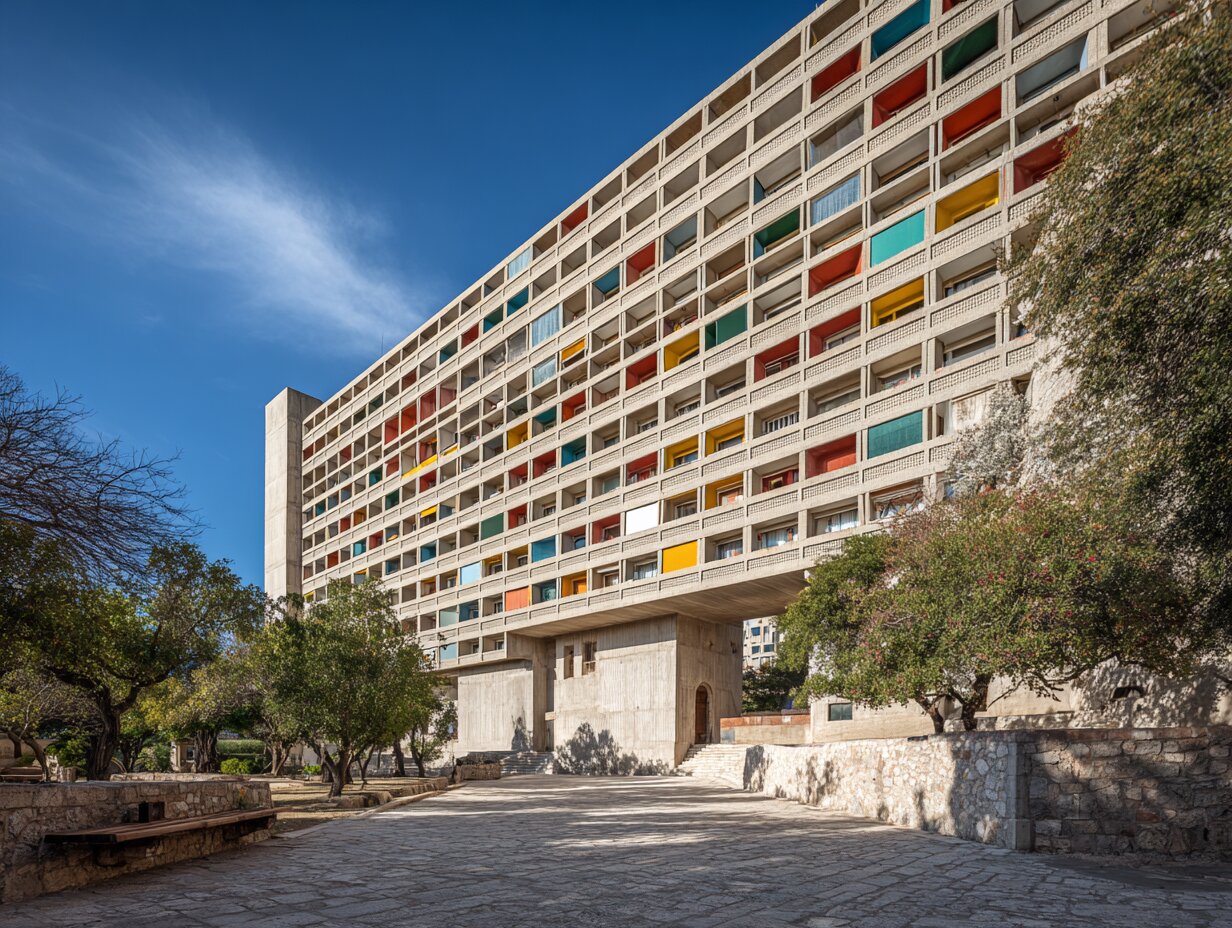
The Unité d’Habitation in Marseille, completed by Le Corbusier in 1952, is the most direct application of the golden ratio to a residential building in modern architecture. Le Corbusier designed every dimension of this 337-unit housing block using his Modulor system, a proportional scale derived from the golden ratio and the human body. Ceiling heights, apartment widths, balcony depths, corridor dimensions, and even the size of the commemorative foundation stone all follow Modulor measurements.
The Modulor consists of two numerical series, the Red and Blue series, based on a standing person’s height (1.83 meters) and their height with a raised arm (2.26 meters). These base measurements are multiplied and divided by Phi to generate a complete range of dimensions. For example, the standard ceiling height in the Unité is 2.26 meters (the raised-arm dimension), while the apartment width of 3.66 meters equals 2.26 multiplied by 1.618. This systematic approach means that every spatial proportion in the building relates back to both the human body and the golden ratio.
💡 Pro Tip
If you want to apply golden ratio proportions to residential design, start with a key human dimension (such as eye height at 1.52 m or door height at 2.13 m) and multiply by 1.618 to generate related spatial dimensions. This approach, inspired by Le Corbusier’s Modulor, connects room proportions directly to the human body, producing spaces that feel intuitively comfortable without requiring complex calculations.
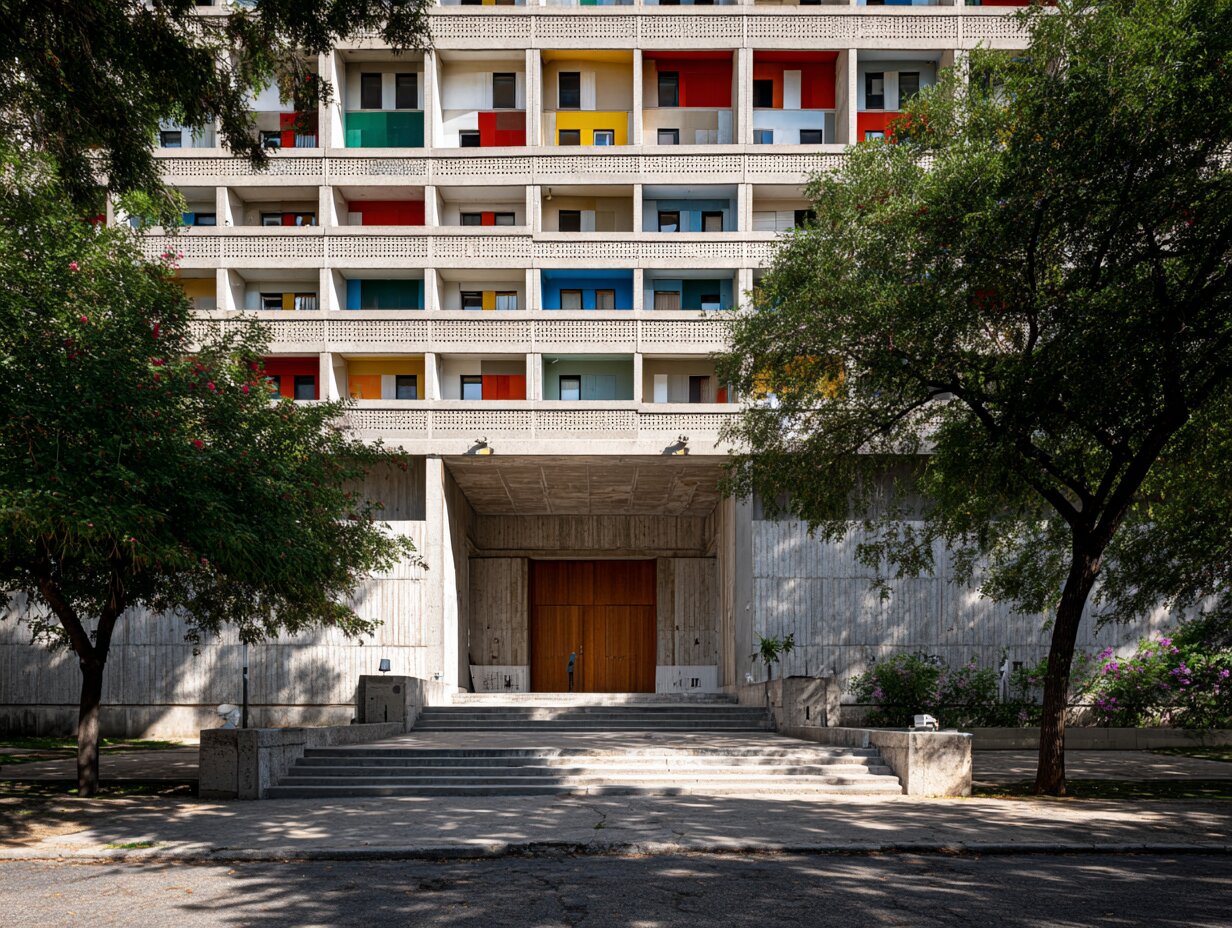
The building’s facade is one of the most visible expressions of the golden ratio in architecture. The brise-soleil (sun-shading elements) on the west facade are organized in a grid whose vertical and horizontal modules follow Modulor dimensions. Each apartment’s balcony opening measures 3.66 meters wide by 4.80 meters tall, a ratio close to 1:1.31, which is the square root of Phi. The facade reads as a composition of nested proportional rectangles rather than a repetitive grid, giving the massive building a rhythmic quality that prevents visual monotony.
🏗️ Real-World Example
Unité d’Habitation (Marseille, 1952): Le Corbusier cast Modulor measurements directly into the concrete of the building. A relief panel near the entrance displays the Modulor figure and its two numerical series, serving as both a dedication and a technical reference. The building houses 337 apartments across 18 stories, with an internal “street” of shops on the seventh and eighth floors. Every dimension, from the 1.83 m door heights to the 4.80 m double-height living rooms, derives from golden ratio relationships applied through the Modulor system.
Le Corbusier published the Modulor system in two books, Le Modulor (1948) and Modulor 2 (1955), both available through the Fondation Le Corbusier. He described the system as a “harmonious measure to the human scale, universally applicable to architecture and mechanics.” While the Modulor received mixed reviews from contemporaries (Albert Einstein reportedly told Le Corbusier it “makes the bad difficult and the good easy”), it remains the most systematic attempt to apply the golden ratio to every aspect of a building’s design.
The Unité d’Habitation proved that the golden ratio could organize not just facades and floor plans but entire communities. The building includes a rooftop gymnasium, a nursery school, and communal facilities, all dimensioned according to the same proportional system. This integration of golden ratio modern architecture principles with social housing ambitions makes the Unité one of the most significant buildings of the 20th century.
What Connects These Golden Ratio Architecture Examples?
The five buildings examined in this article span roughly 4,500 years of construction history, yet they share a common proportional thread. The Great Pyramid of Giza achieves golden ratio geometry through slope calculation. Chartres Cathedral arrives at similar proportions through compass-and-straightedge construction. The CN Tower uses proportional analysis to place its observation deck. The Lincoln Memorial inherits golden ratio principles through Beaux-Arts training. And the Unité d’Habitation applies the ratio systematically through the Modulor.
What makes these examples of the golden ratio in architecture compelling is not that they all achieve an exact 1.618 ratio. None of them do, and no built structure ever will, because construction tolerances, material behavior, and site conditions always introduce variation. The significance lies in the fact that architects across cultures and centuries have repeatedly gravitated toward proportions in the neighborhood of Phi, suggesting that this ratio corresponds to something fundamental in human visual perception.
⚠️ Common Mistake to Avoid
A frequent error in golden ratio analysis is measuring selectively to force a 1.618 result. Researchers sometimes choose starting and ending points that confirm the ratio while ignoring other dimensions that do not. A responsible analysis examines all major dimensions of a building and reports which ones approximate Phi and which ones do not, rather than presenting only the confirming evidence.
For architects working today, these examples offer a practical lesson: the golden ratio is most effective as a starting framework, not a rigid formula. Using it to set primary facade proportions, room aspect ratios, or structural bay spacing gives a project a proportional foundation that can be refined as functional requirements, structural constraints, and site conditions are addressed. The free online golden ratio calculator on illustrarch.com can help you test these proportions quickly during the early design phase.
Golden Ratio Proportions Across All Five Buildings
The following table summarizes the specific golden ratio relationships identified in each building discussed above:
| Building | Date | Measured Ratio | Where It Appears |
|---|---|---|---|
| Great Pyramid of Giza | c. 2560 BCE | 1.619 | Slant height to half-base length |
| Chartres Cathedral | 1194-1220 CE | ~1.618 | West facade height to portal zone width |
| Lincoln Memorial | 1922 | 1.60 | Plan width to depth; column to attic height |
| Unité d’Habitation | 1952 | 1.618 (by design) | All dimensions via Modulor system |
| CN Tower | 1976 | 1.60 | Total height to observation deck height |
Why the Golden Ratio Still Matters in Architecture Today

The buildings in this series, from the Parthenon and Taj Mahal in Part 1, through the Colosseum and Guggenheim Museum in Part 2, to the Pantheon and Great Mosque of Cordoba in Part 3, and now the five structures examined here, collectively demonstrate that the golden ratio is not a historical curiosity. It is a living design tool that architects continue to apply, test, and refine.
Contemporary firms like Foster + Partners and Zaha Hadid Architects use parametric software to test Phi-based proportions against structural, thermal, and daylighting constraints in real time. The golden ratio has moved from compass-and-straightedge construction to algorithmic design, but the underlying principle remains the same: proportions near 1.618 produce compositions that the human eye perceives as balanced and ordered.
For students and practicing architects looking to apply the golden ratio in their own work, the most practical approach is to begin with it during the early massing and schematic design phases. Set your primary facade within a golden rectangle. Divide floor plans using the 62/38 split derived from Phi. Place key visual events (entrance, skylight, setback) at the golden ratio point of a building’s height or length. These starting moves establish a proportional skeleton that you can adjust as the design develops. The full guide on how architects use the golden ratio in design on illustrarch.com covers seven specific methods with practical examples.
✅ Key Takeaways
- The Great Pyramid of Giza contains golden ratio geometry in its face angle, likely resulting from the Egyptian seked measurement system rather than conscious application of Phi.
- The CN Tower’s observation deck placement at approximately 62% of the total height creates a golden ratio division that contributes to the structure’s visually balanced profile.
- Chartres Cathedral demonstrates how medieval builders achieved golden ratio proportions through compass-and-straightedge geometry passed down through lodge traditions.
- The Lincoln Memorial inherits golden ratio principles from Greek temple proportions, filtered through Beaux-Arts training at the École des Beaux-Arts in Paris.
- Le Corbusier’s Unité d’Habitation is the most systematic application of the golden ratio in residential architecture, with every dimension derived from the Modulor proportional system.
Final Thoughts
The golden ratio in architecture is not a magic formula that guarantees beautiful buildings. It is a proportional framework that, when applied with judgment and sensitivity to context, helps architects create compositions that feel resolved and balanced. The five buildings examined in this article show that this framework works across scales, from the massive geometry of the Great Pyramid to the apartment-level dimensions of the Unité d’Habitation, and across time, from ancient Egypt to postwar France.
As this series has demonstrated across four installments, the golden ratio is both a historical thread connecting different architectural traditions and a practical tool for contemporary design. The best way to understand it is not through abstract mathematics but through close observation of buildings that use it well, and through hands-on experimentation in your own projects. Use the golden ratio calculator, study the precedents, and test Phi-based proportions in your next schematic design. The results may not always be exact, but they will consistently move your work toward the kind of proportional clarity that defines the best architecture across every era.







Flooring Rentals Los Angeles vs Permanent Event Flooring When a Flooring Rental in Los Angeles Makes More Sense
Creating a memorable event starts from the ground up—literally. Whether you're planning...
 illustrarch Editoral Team3 Mins read

Sustainable Landscape Design Balancing Artificial Turf Cost, Artificial Grass in Los Angeles, and Turf Installation for Modern Outdoor Spaces
Artificial grass in Los Angeles has become a practical part of sustainable...
illustrarch Editoral Team6 Mins read

Marble Feature Walls: The Interior Design Trend That Turns Any Room Into a Gallery
There is a moment in every renovation where a room stops being...
illustrarch Editoral Team3 Mins read

Planning Large Residential and Commercial Projects with Lowboy Dumpster Rentals, 6 Yard Dumpsters, and Dumpster Rentals for Less
A lowboy dumpster rental can make a surprisingly big difference when a...
illustrarch Editoral Team6 Mins read




Leave a comment