

Biomimicry Architecture vs Parametric Design
Biomimicry architecture looks to living systems for design solutions, while parametric design uses algorithms to generate form. This guide compares both approaches through definitions, real projects, tools, and the overlap between them.
 Furkan Sen25 April 20267 Mins read185
Table of Contents Show
Biomimicry architecture studies nature’s time-tested strategies to solve design problems, while parametric design uses algorithms and variable inputs to generate form. Both aim for efficient, adaptive buildings, yet one learns from 3.8 billion years of evolution and the other from computational logic. Many modern projects combine them.
What Is Biomimicry in Architecture?
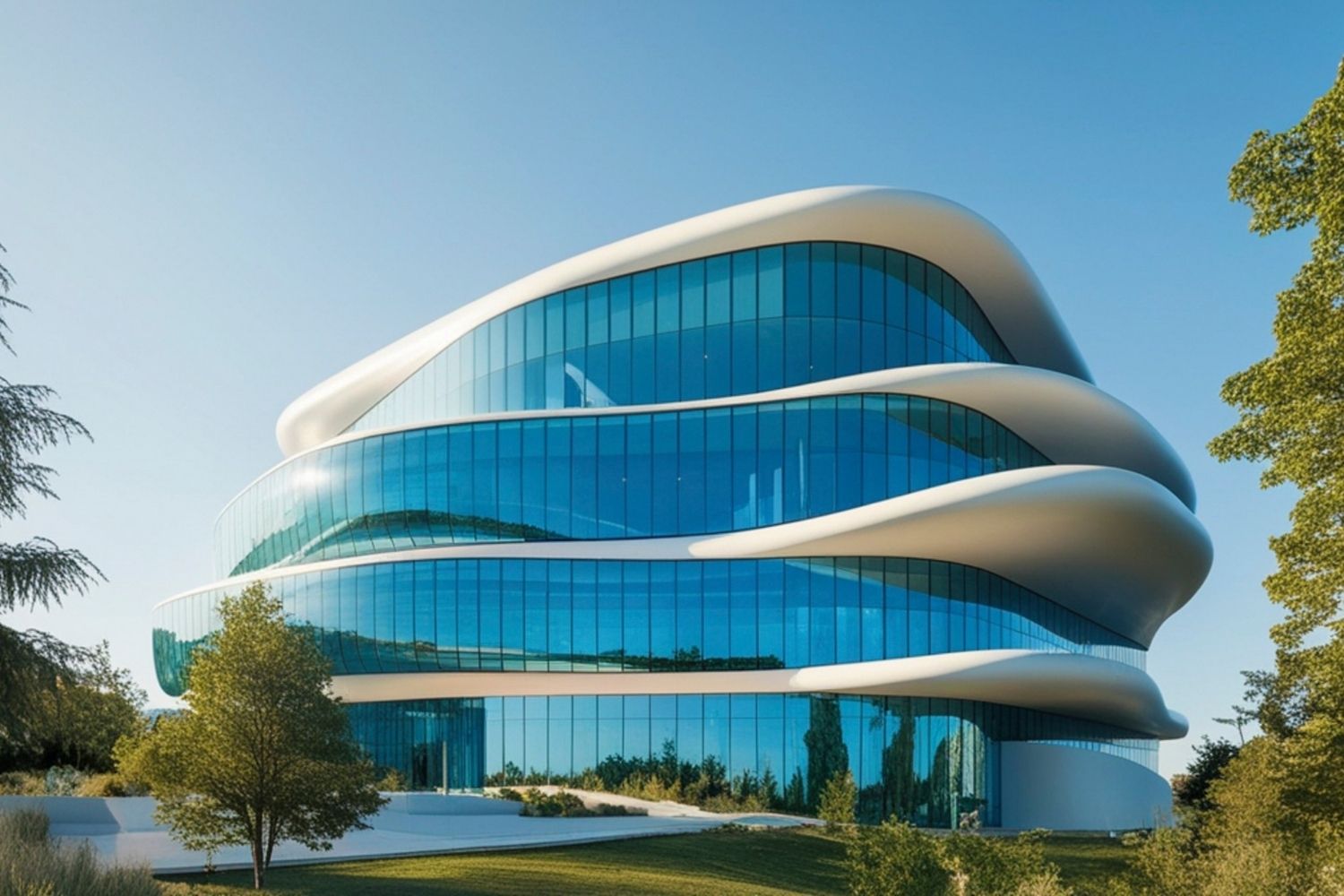
Biomimicry in architecture is the practice of studying biological systems and translating their principles into buildings. The term was popularized by biologist Janine Benyus in her 1997 book, and today the concept is carried forward by the Biomimicry Institute, which Benyus co-founded in 2006. Instead of copying the shape of a leaf or a shell, architects extract the underlying logic: how a termite mound regulates temperature, how bone distributes load, how a lotus leaf sheds water.
The goal is performance. A facade shaped by the fog-collecting ridges of a Namib beetle is not decorative, it is a water-harvesting system. A stack ventilation strategy drawn from a termite colony is not metaphor, it is an HVAC substitute. According to ArchDaily’s overview of biomimetic architecture, the approach moves past nature as visual muse and treats it as a library of working systems.
Biomimicry typically works at three levels: the organism (a single species, like a spider and its silk), the behavior (how an organism interacts with its environment, like a sunflower tracking the sun), and the ecosystem (how a forest cycles water and nutrients). Each level offers different lessons for buildings, from material choices to urban planning.
💡 Pro Tip
When using biomimicry on a project, start with the function you need to solve, not the organism you find interesting. Begin with a question like “how does nature cool a structure in dry heat?” and let that drive the biological research. Starting with a favorite animal almost always leads to literal copy-paste that fails at architectural scale.
Examples of Biomimicry in Architecture
The Eastgate Centre in Harare, Zimbabwe, designed by Mick Pearce in 1996, remains the most cited built example of biomimicry architecture. Its passive ventilation system was inspired by termite mound airflow, and according to Pearce’s own project documentation, the building uses 35% less total energy than six conventionally air-conditioned buildings in the same city, with a 10% capital cost saving over full HVAC.
Other well-known examples include the Eden Project in Cornwall, whose geodesic domes draw on soap bubble geometry, and 30 St Mary Axe (the Gherkin) in London, whose ventilation strategy was inspired by the Venus flower basket sponge. For a deeper set of references, see our guide to nature-inspired innovation in biomimicry architecture.
What Is a Parametric Design in Architecture?
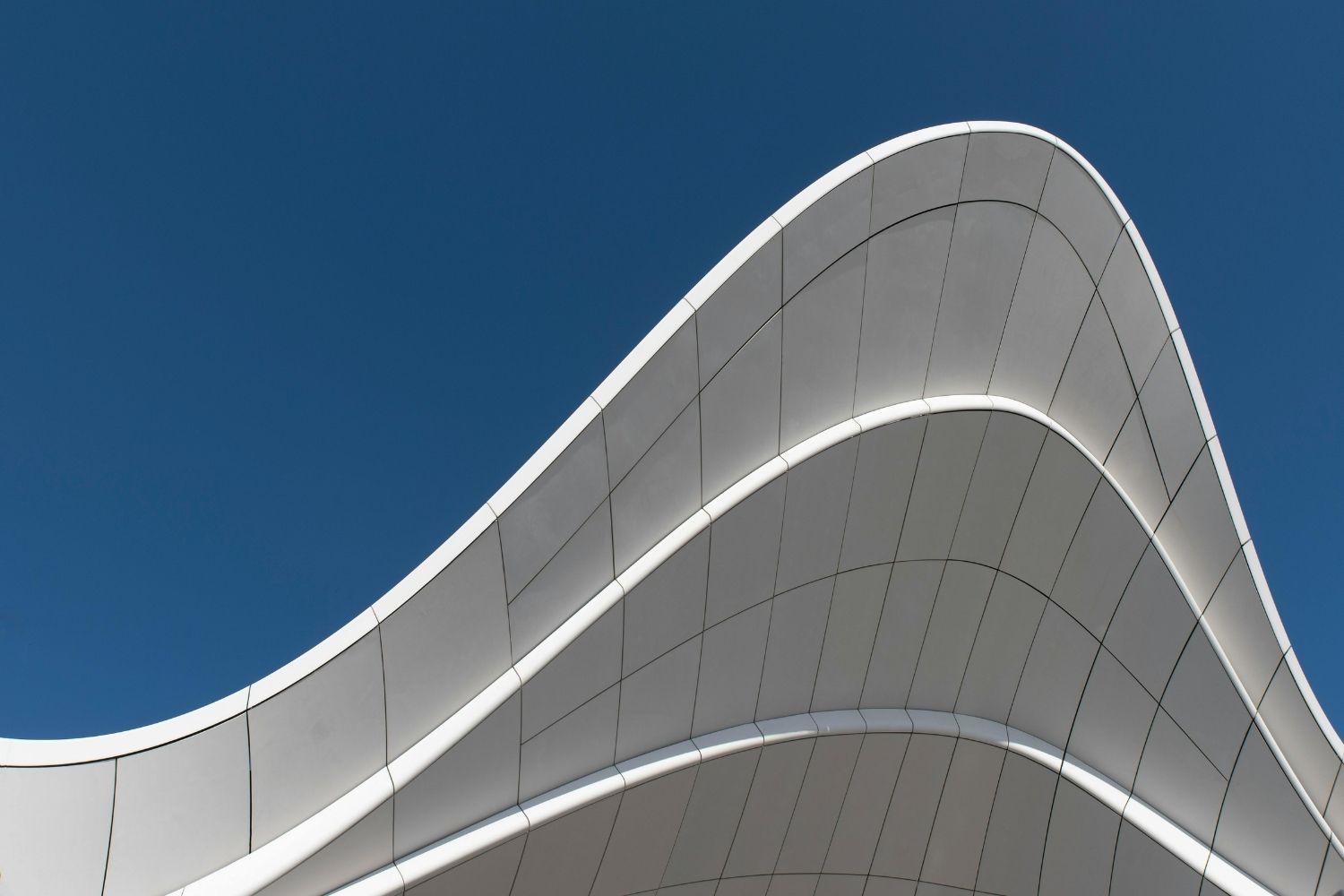
Parametric design in architecture is a computational approach where form, structure, and performance are driven by algorithms and variable inputs rather than fixed drawings. Changing one parameter, a roof span, a wind load, a sun angle, automatically updates the entire model. The designer shifts from drawing shapes to writing the rules that generate them.
The term parametricism was coined by Patrik Schumacher in his 2008 Parametricist Manifesto, presented at the 11th Venice Architecture Biennale. Schumacher, principal at Zaha Hadid Architects, argued that parametricism was the successor style to modernism. For a broader intro covering tools and history, see our definition and guide to parametric architecture.
In practice, a parametric workflow means defining relationships: the distance between facade panels responds to solar incidence, the depth of a shading fin varies with orientation, the diagonal members of a structural grid thin out where loads are low. Tools like Grasshopper for Rhino, Dynamo for Revit, and custom scripting environments have made this workflow accessible to mid-sized offices, not just large computational specialists.
Zaha Hadid and the Rise of Parametric Design
The Zaha Hadid parametric design language became the public face of parametricism. Projects like the Heydar Aliyev Center in Baku (2012) and the Guangzhou Opera House translated Suprematist drawings into buildable geometry through computational modeling. The Heydar Aliyev Center, a 57,519 square meter cultural complex, was generated through advanced parametric modeling to form a seamless envelope without visible joints, as detailed in our overview of Zaha Hadid’s most iconic buildings.
Hadid’s partner Patrik Schumacher pushed the theoretical argument further: that parametric design is not just a tool but a coherent style capable of organizing everything from furniture to entire cities. That claim is still debated, but the technical contribution is not: parametric workflows are now standard in complex projects across practices of all scales.
🎓 Expert Insight
“We pursue the parametric design paradigm all the way, penetrating into all corners of the discipline. Systematic, adaptive variation, continuous differentiation, and dynamic, parametric figuration concerns all design tasks from urbanism to the level of tectonic detail.”, Patrik Schumacher, Parametricist Manifesto, Venice Biennale 2008
Schumacher’s position frames parametricism as a total architectural language rather than a finishing tool. Critics argue this scope is overreaching, supporters argue it is the logical extension of computational practice into urban and social design.
Biomimicry vs Parametric Design: The Core Difference
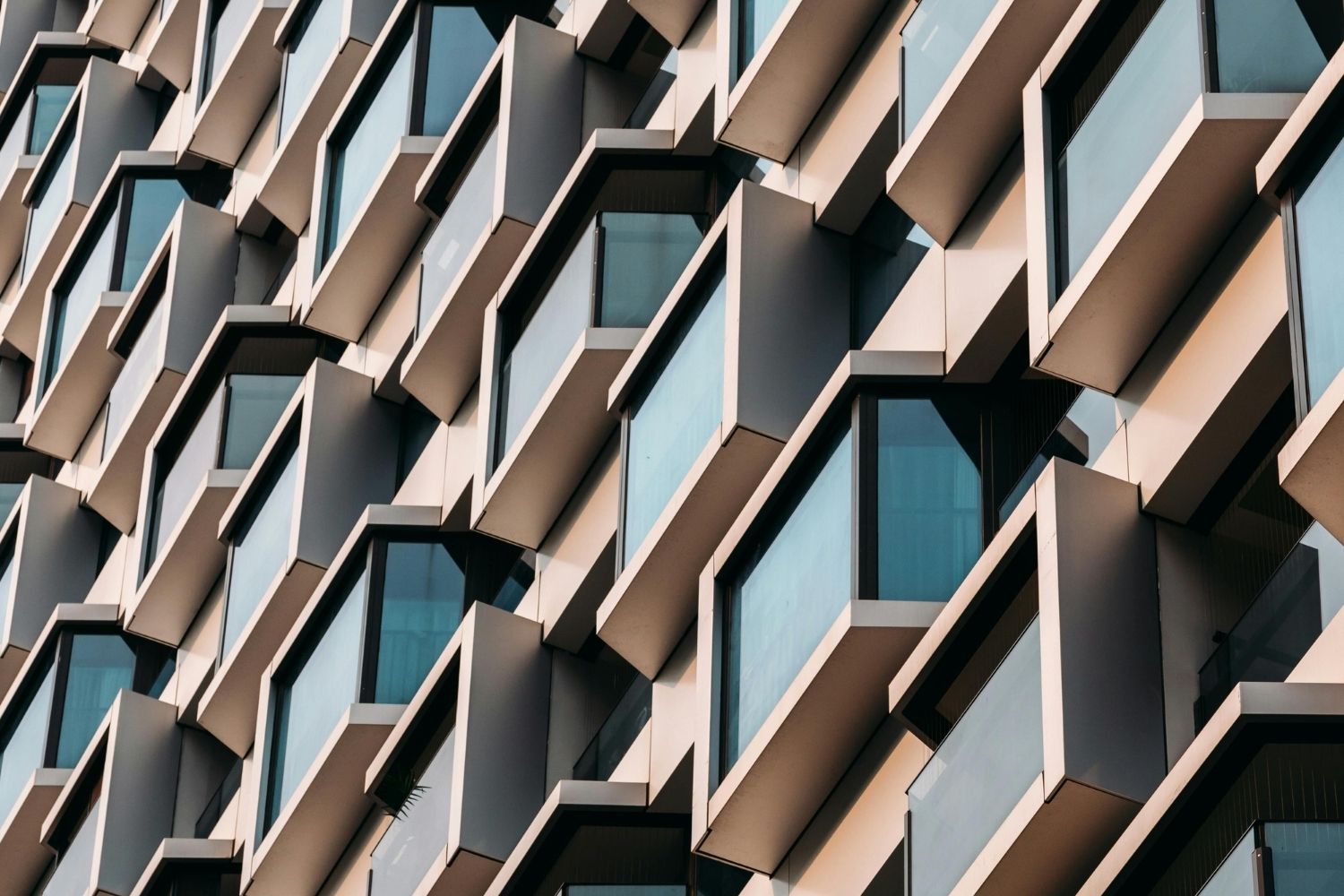
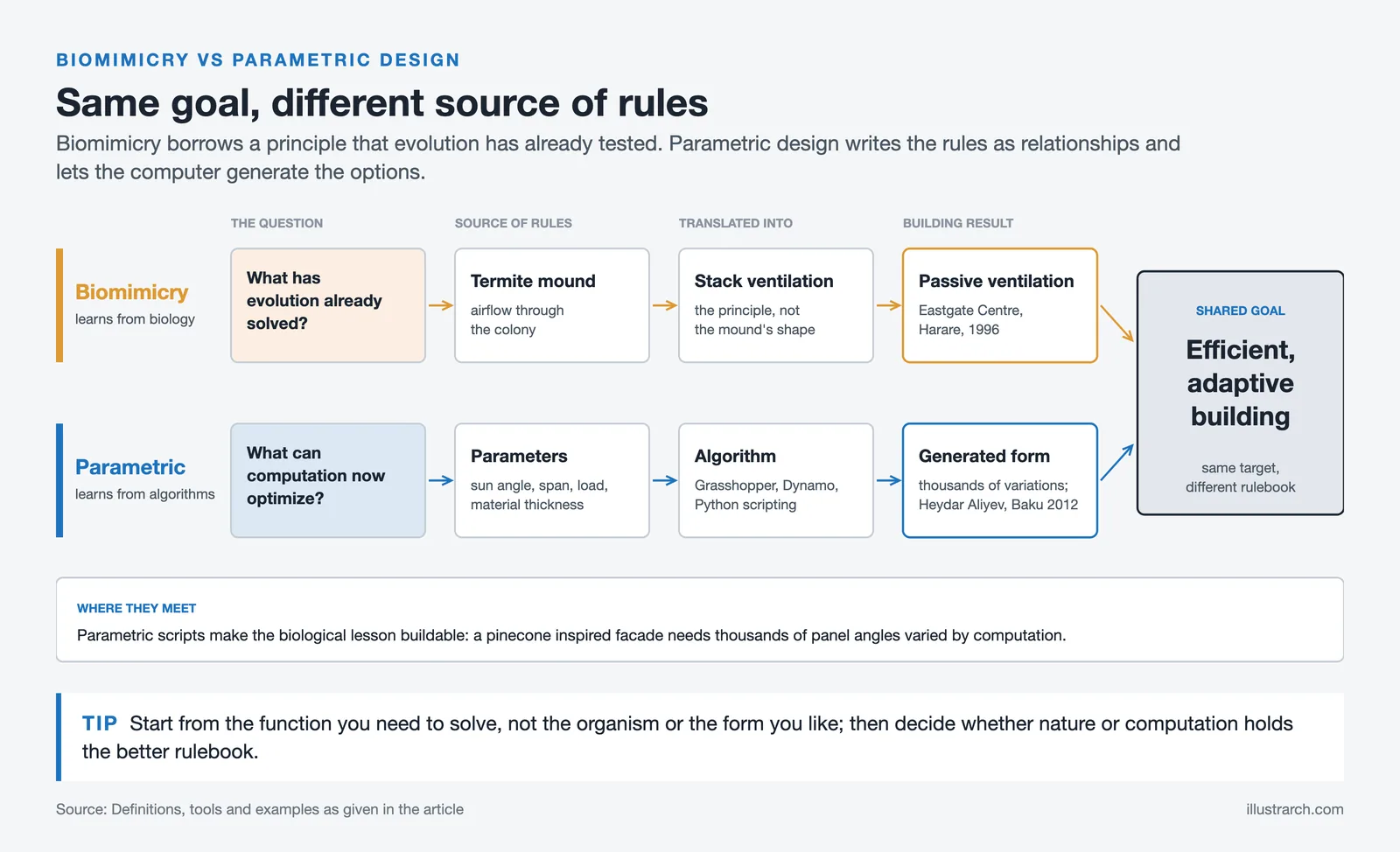
The central distinction is the source of the rules. Biomimicry draws rules from biology: the lung-like interchange of a termite mound, the branching geometry of a tree, the surface tension patterns of a soap film. The architect’s job is to identify which biological principle solves the design problem and then translate it into a building system.
Parametric design draws rules from mathematics, environmental data, and engineering constraints. The architect defines a system of relationships (sun angle, span, load, material thickness) and lets the computer generate thousands of variations. The “intelligence” lives in the algorithm and the designer’s choices, not in a biological analogue.
In short: biomimicry asks “what has evolution already solved?” Parametric design asks “what can computation now optimize?” One starts with observation of living systems, the other with mathematical modeling. They are not opposites, they are complementary, and many projects use both.
Comparison Table: Biomimicry vs Parametric Design
The table below compares the two approaches across the attributes that matter most when choosing a design methodology for a project.
| Attribute | Biomimicry Architecture | Parametric Design |
|---|---|---|
| Source of rules | Biological systems and evolution | Algorithms, data, mathematical relationships |
| Primary goal | Performance and sustainability through natural analogues | Optimization, adaptability, complex geometry |
| Typical starting point | A functional problem matched to a natural analogue | A set of parameters and design constraints |
| Common tools | AskNature database, CFD simulation, material research | Grasshopper, Dynamo, Python scripting, Rhino |
| Iconic example | Eastgate Centre, Harare (Mick Pearce, 1996) | Heydar Aliyev Center, Baku (Zaha Hadid, 2012) |
| Sustainability focus | Built into the method, closed-loop thinking | Possible but depends on what is optimized |
| Risk of misuse | Shallow copy-paste of natural forms | Complex form without performance benefit |
Video: How Computational Design Supports Biomimicry in Practice
In this Dezeen interview, Exploration Architecture founder Michael Pawlyn discusses how computational and parametric methods support biomimetic building design, a useful overview of how the two approaches intersect rather than compete.
Where the Two Approaches Overlap
In current practice, the line between biomimicry and parametric design is rarely clean. Parametric modeling is often the practical vehicle that makes biomimicry buildable at scale. A facade inspired by the scales of a pinecone (opening and closing with humidity) requires parametric modeling to vary thousands of panel angles across a complex surface. Without computation, the biological lesson stays a sketch.
The reverse is also true. Parametric models benefit from biological logic as a source of good starting rules. Dendritic (branching) structures, gradient material density, and topology optimization all borrow from how bones, trees, and shells distribute matter. When architects study these patterns and encode them into scripts, they get forms that are simultaneously computational and bio-informed.
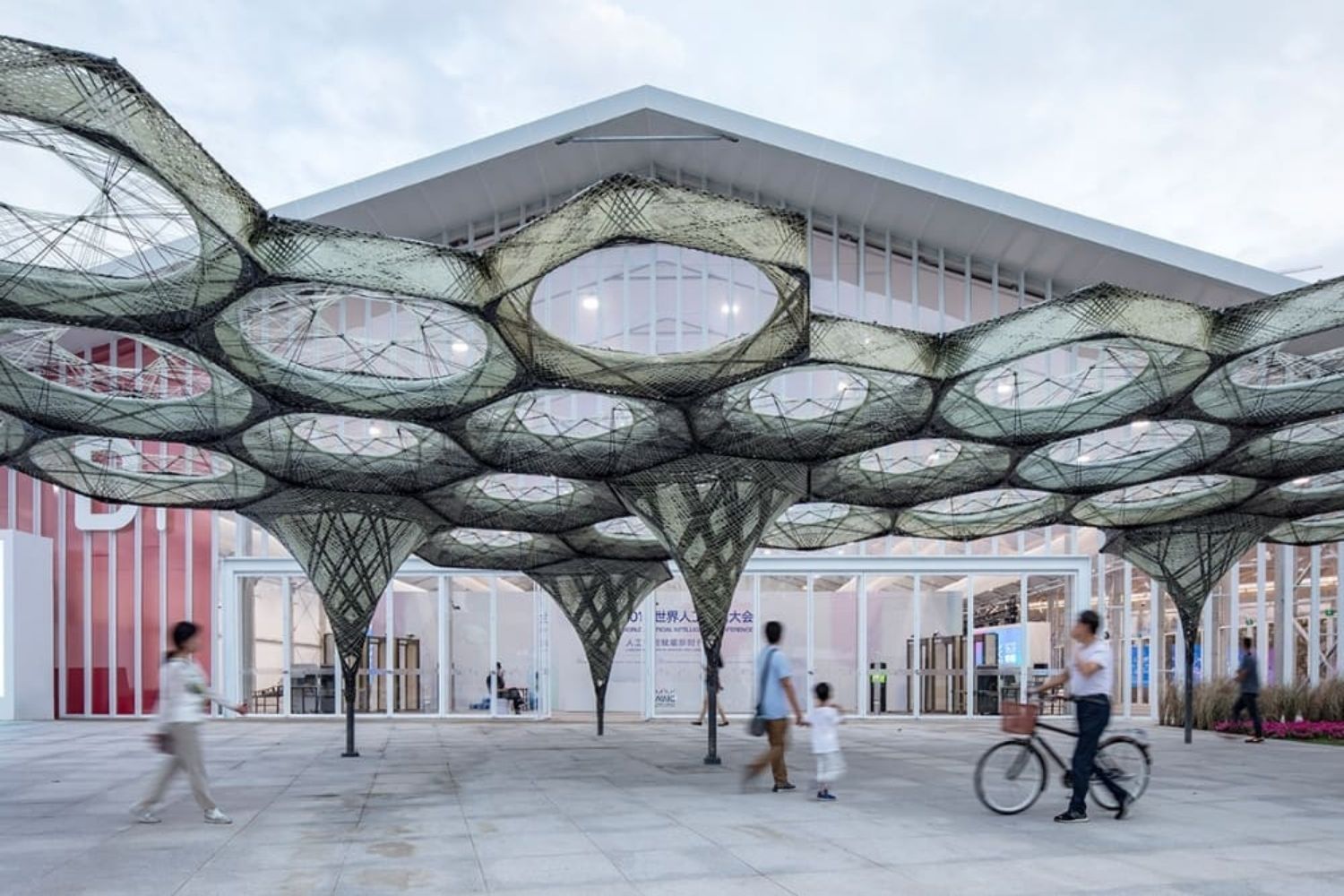
Projects like the ICD/ITKE Research Pavilions in Stuttgart have made this hybrid explicit. Their pavilions use parametric scripts based on sea urchin plate morphology or beetle elytra structures, combining biological research with computational fabrication. For more context on how organic logic enters parametric work, see our guide to the 8 principles of parametric architecture.
🏗️ Real-World Example
Eastgate Centre (Harare, 1996): Designed by Mick Pearce with Ove Arup & Partners, the 55,000 square meter shopping and office complex uses passive ventilation modeled on termite airflow, achieving 35% less total energy use than six conventional buildings in Harare with a 10% construction cost saving. It remains a benchmark for biomimicry that prioritizes working systems over sculptural mimicry.
How to Choose: Biomimicry, Parametric, or Both?
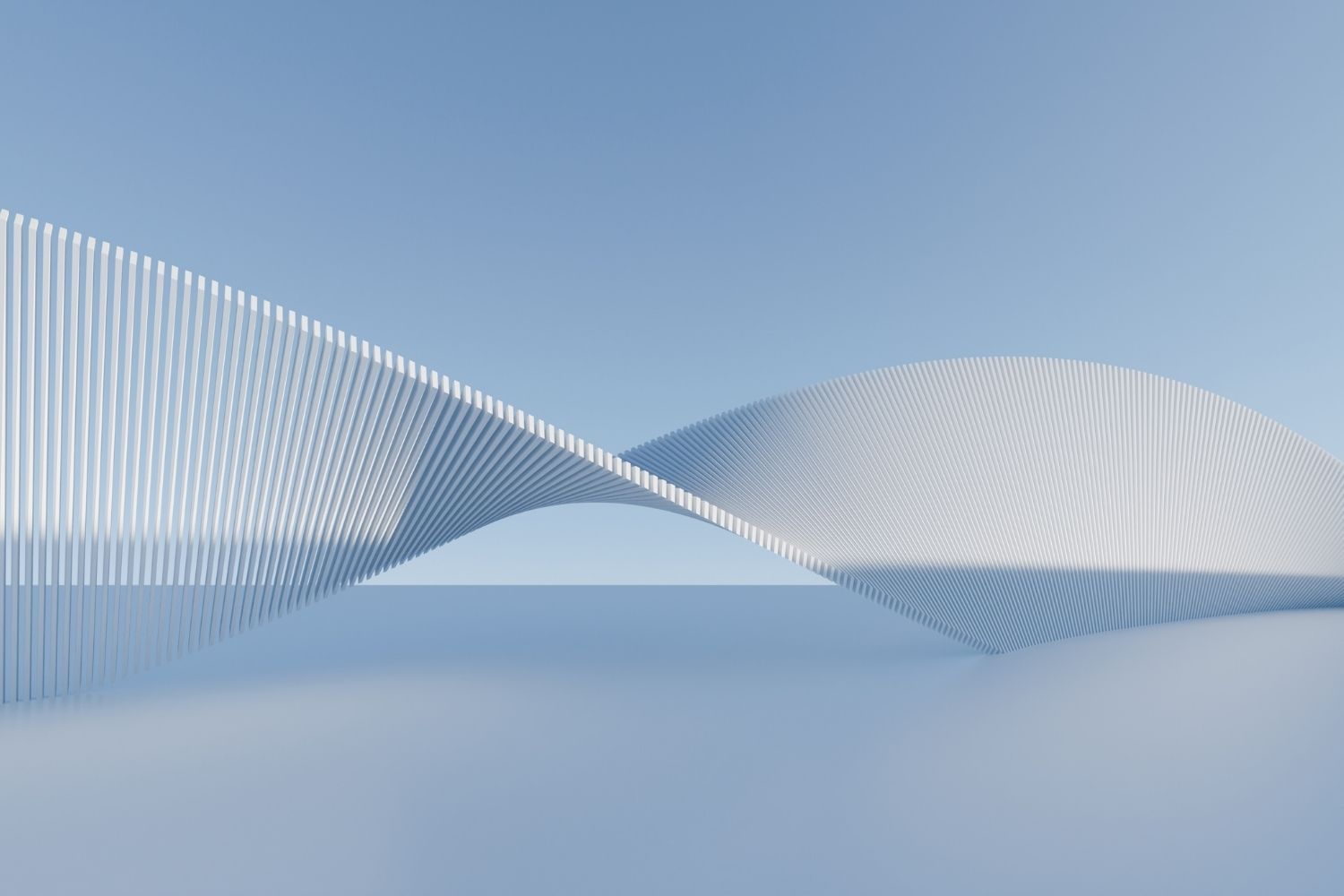
The decision usually comes down to the problem. Performance problems (ventilation, cooling, water, material efficiency) tend to respond well to biomimicry because nature has already solved them under tighter constraints than most architects face. Geometric and organizational problems (complex facades, large-span roofs, site-responsive massing, repetitive elements with variation) tend to respond well to parametric methods because computation handles combinatorial complexity better than hand-drafting.
When both kinds of problem appear in the same project (and they usually do), a combined workflow is common: start with biomimicry to choose the strategy, then use parametric tools to implement it across the building. A ventilated double-skin facade inspired by skin pore behavior, implemented through a script that varies opening sizes by orientation, is a single decision expressed through both methods.
⚖️ Pros & Cons at a Glance
✔️ Biomimicry pros: Evolution-tested logic, strong sustainability outcomes, clear performance rationale
✖️ Biomimicry cons: Risk of literal copy-paste, requires biology literacy, harder to source verified analogues
✔️ Parametric pros: Rapid iteration, handles complex geometry, integrates environmental data directly
✖️ Parametric cons: Complexity can mask poor performance, steep software learning curve, risk of form for form’s sake
Why Does This Comparison Matter in 2026?
Two pressures shape architectural practice today: the need to cut embodied and operational carbon, and the expectation that buildings respond dynamically to climate, users, and context. Biomimicry speaks directly to the first by offering closed-loop, resource-minimizing strategies. Parametric design speaks directly to the second by making responsiveness computationally tractable.
Antoni Gaudí anticipated this convergence a century ago. His hanging chain models for the Sagrada Família were an early form of physical parametric modeling, and his tree-like columns drew on botanical observation. As our analysis of Gaudí’s architecture style notes, his method prefigured both digital parametric workflows and biomimetic structural logic. What is new in 2026 is not the ambition but the tooling: generative AI, digital fabrication, and real-time environmental simulation now make both approaches far more practical than they were even five years ago.
✅ Key Takeaways
- Biomimicry architecture learns from biological systems; parametric design learns from algorithms and data.
- Biomimicry is a strategy for solving performance problems with evolution-tested logic.
- Parametric design is a methodology for managing geometric, environmental, and organizational complexity.
- The two are complementary: parametric tools often make biomimicry buildable at architectural scale.
- Choice of approach should follow the design problem, not a preference for either nature or computation.
Final Thoughts
Framing biomimicry and parametric design as rivals misses the point. One offers a library of working strategies from 3.8 billion years of evolution. The other offers a method to implement and adapt those strategies at the scale of a building or a city. The strongest contemporary projects, from Pearce’s Eastgate to Zaha Hadid’s KAPSARC, use both: biological logic as the strategic foundation, computational modeling as the technical execution. The question architects face today is not nature versus algorithm, but how to read both well enough to let each do what it does best.







Computational Design Architecture: Should Architects Learn to Code, and Which Language?
A practical look at whether architects need to write code, and which...
Furkan Sen6 Mins read
Computational Design Architecture: Should Architects Learn to Code?
Not every architect needs to become a programmer, but computational design has...
Furkan Sen6 Mins read

Top 10 Parametric Architecture Firms You Should Know in 2026
A focused look at 10 parametric architecture firms pushing the limits of...
 Sinan Ozen8 Mins read

Best Parametric Design Tools for Architects
Explore the leading parametric design tools reshaping architecture. This guide compares top...
 Elif Ayse Sen6 Mins read


Leave a comment