

Adaptive Reuse of the Michelin Factory by Kengo Kuma & Associates
Kengo Kuma & Associates has unveiled a proposal to transform the former Michelin factory in Clermont-Ferrand into a renewed cultural museum. Respecting the industrial structure of the 1960s hangar, the project introduces carefully crafted interiors, natural materials, and daylight-driven spaces while preserving the site’s architectural legacy.
 Elif Ayse Sen23 January 20263 Mins read318


Table of Contents Show
Kengo Kuma & Associates has unveiled a proposal to transform the former Michelin factory site in Clermont-Ferrand into a renewed cultural institution, redefining the relationship between industrial heritage and contemporary museum design. The project focuses on the renovation of L’Aventure Michelin, relocating the existing museum into a neighboring industrial hangar as part of the broader regeneration strategy for the Quartier des Pistes district.

Rather than treating the abandoned factory as a relic frozen in time, the design interprets it as an enduring spatial framework, one capable of accommodating new cultural programs while retaining the logic and character of its industrial past. The approach aligns with Kengo Kuma’s longstanding interest in adaptive reuse, where architecture evolves through subtle transformation rather than radical replacement.
Respecting the Logic of the 1960s Industrial Structure
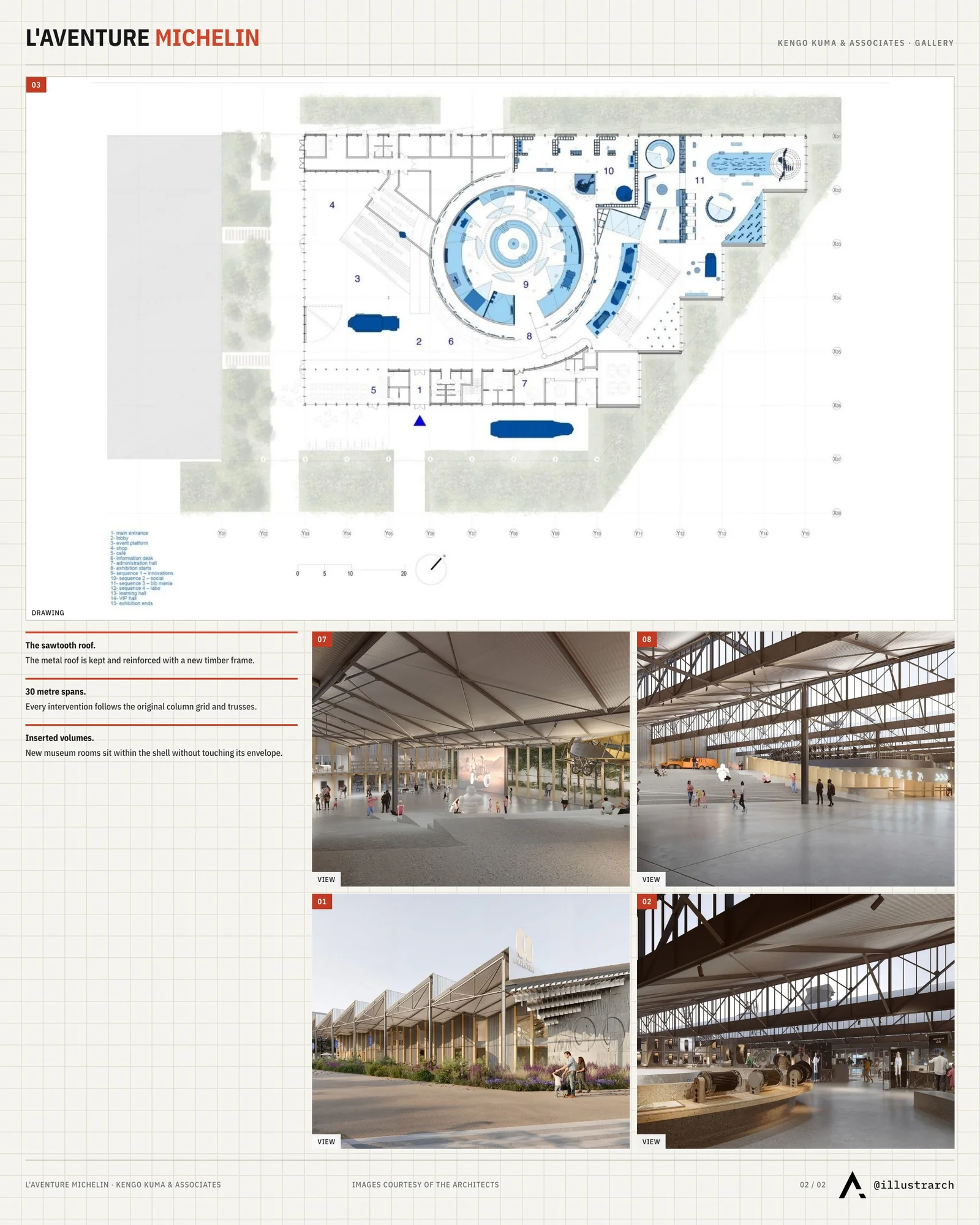
Central to the proposal is the careful restoration of the hangar’s defining sawtooth roof, a hallmark of mid-20th-century industrial architecture. The existing metal roof structure is preserved and reinforced, while a new timber framework is introduced to maintain the building’s impressive 30-meter-long spans. This hybrid structural system allows the original geometry of the factory to remain legible, ensuring continuity between past and present.
Instead of imposing a new architectural order, all interventions are precisely aligned with the original column grid and roof trusses. The factory’s structural rhythm becomes the guiding framework for the renovation, ensuring that the spatial clarity of the industrial hall is neither obscured nor diluted.
Architecture Inserted, Not Imposed
New museum spaces are conceived as crafted architectural volumes suspended within the existing shell. These insertions function as self-contained interiors, carefully positioned to minimize interference with the primary structure. By concentrating transformation within the interior, the exterior envelope and industrial identity of the building remain largely untouched.
This strategy allows the original factory to retain its monumental presence, while the new cultural program unfolds as a layered experience inside. The building becomes a container of memory, where contemporary architeture coexists with visible traces of industrial labor.
Light, Movement, and Spatial Sequence
Daylight plays a critical role in reshaping the former factory environment. Subtle roof interventions introduce narrow slits of light that filter gently into the exhibition spaces, enhancing orientation without overwhelming the industrial atmosphere. Facade openings are carefully aligned with the concrete structural grid, reinforcing the original scale and proportion of the building.
Circulation follows the logic of the former production floor. Visitors move through narrow passages between structural bays before arriving in expansive exhibition halls, where displays extend across the full width of the space. This sequence of compression and release echoes the original industrial workflow, transforming it into a spatial narrative for visitors.
Materiality Rooted in Human Scale
Inside the museum, the architectural language shifts toward tactility and warmth. Timber becomes the dominant material, appearing in screens, ceilings, railings, and interior structures. Its visible grain and joinery introduce a human-scaled counterpoint to the raw steel and concrete of the original factory.
Locally sourced bio-based panels are incorporated throughout the interior, reinforcing the project’s commitment to sustainability and regional identity. Rather than masking the industrial past, these materials sit alongside exposed structural elements, creating a dialogue between precision, softness, and durability.
A Museum Anchored in Place and Memory
The renovation maintains a strong connection to Clermont-Ferrand, the birthplace of the Michelin company. By preserving industrial traces and integrating materials rooted in local production, the project ensures that the building remains inseparable from its geographic and cultural context.
Kengo Kuma & Associates’ proposal positions the Michelin Factory Museum as more than a renovated building, it becomes a spatial bridge between industrial history and contemporary cultural life. Through restraint, repetition, and material sensitivity, the project demonstrates how architecture can honor the past while creating meaningful spaces for future public engagement.



Phinney Mini by Best Practice Architecture
Phinney Mini by Best Practice Architecture reworks a 16.5 foot wide 1907...
 illustrarch Editoral Team2 Mins read

Inhabiting the Roof by Paris Atlas
Inhabiting the Roof by Paris Atlas turns two rainwater shedding roofs on...
illustrarch Editoral Team3 Mins read

Spitfire Roastery by Nota Architects
Nota Architects breaks a coffee roasting plant in rural Jiangsu into four...
illustrarch Editoral Team2 Mins read

Heritage “Ay” Kiln Adaptive Renewal by WUGE Studio & YFS
Heritage “Ay” Kiln Adaptive Renewal by WUGE Studio + YFS reinterprets a...
 Begum Gumusel4 Mins read


Leave a comment