

MOS Architects Unveils Basket-Like Aluminium Pavilion at Art Omi
MOS Architects built an egg-shaped aluminium pavilion at Art Omi, mixing basketry, Airstream styling and a hint of the Iron Giant.
 illustrarch Editoral Team4 October 20263 Mins read1
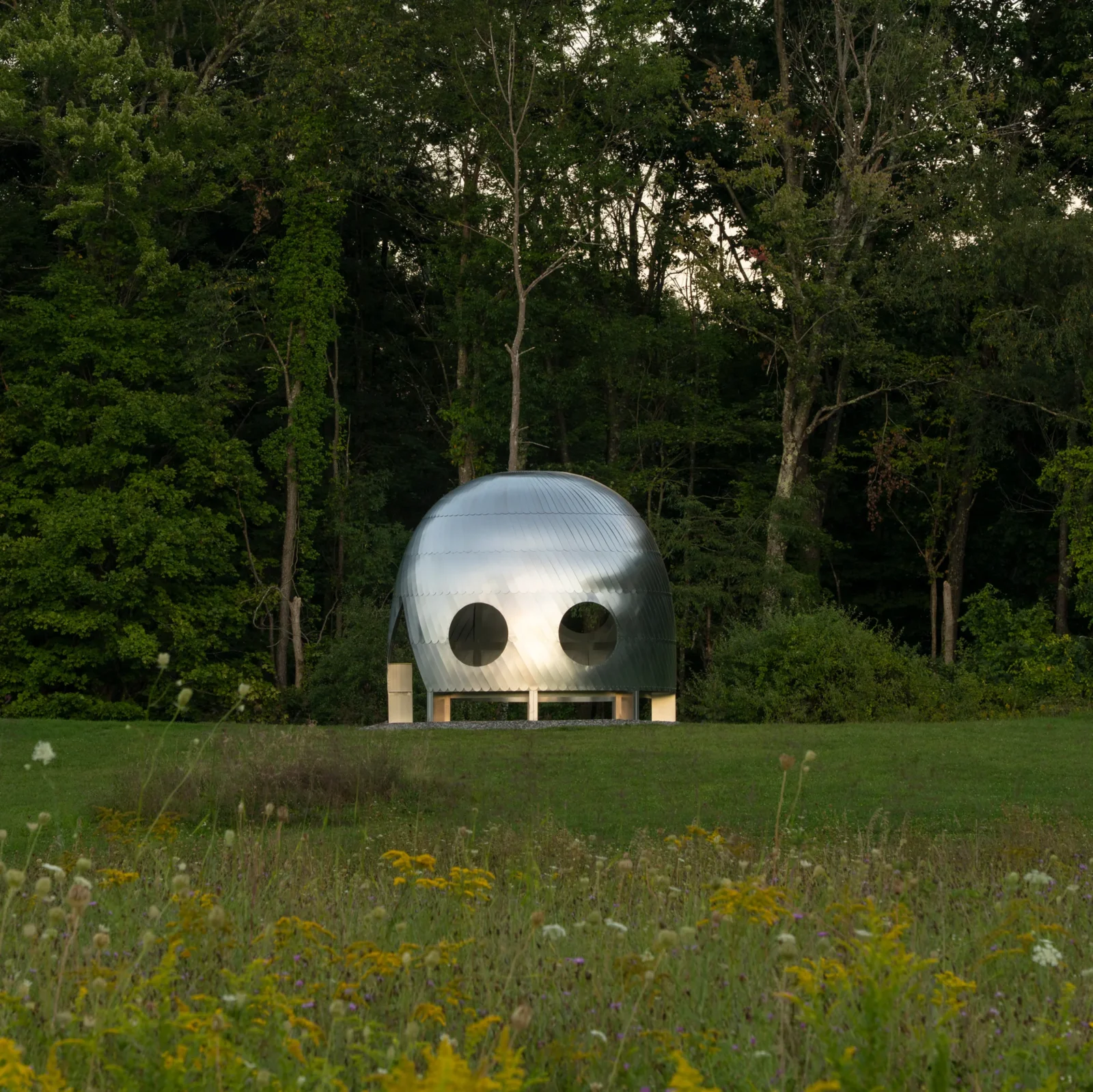
MOS Architects has installed an egg-shaped aluminium pavilion clad in shingles on the grounds of Art Omi in Upstate New York, giving visitors to the sculpture park a new place to sit, look out through a pair of round windows, and shelter from the weather.
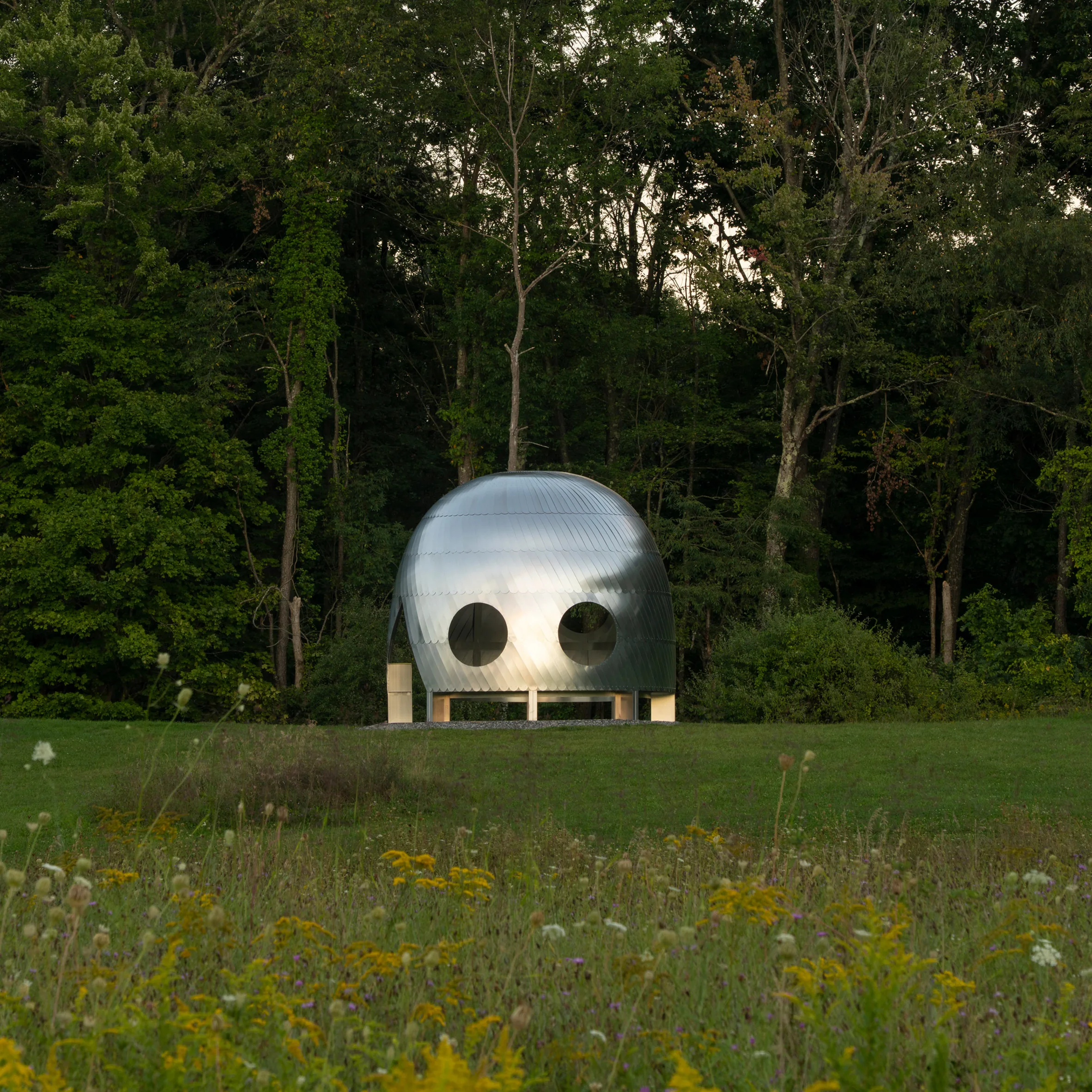
The piece, titled A Dome with Four Oculi, rests on stilts and is built from a shell that the firm has likened to a crinoline dress: a lightweight cage-like form wrapped in overlapping metal shingles. Stainless steel bolts hold the shingles in place, and the finished skin comes to roughly a quarter of an inch thick. Triangular openings cut into the sides work as doorways, while two circular portholes let light and views of the surrounding fields into the interior, which is left open at the top.
Inside A Dome with Four Oculi
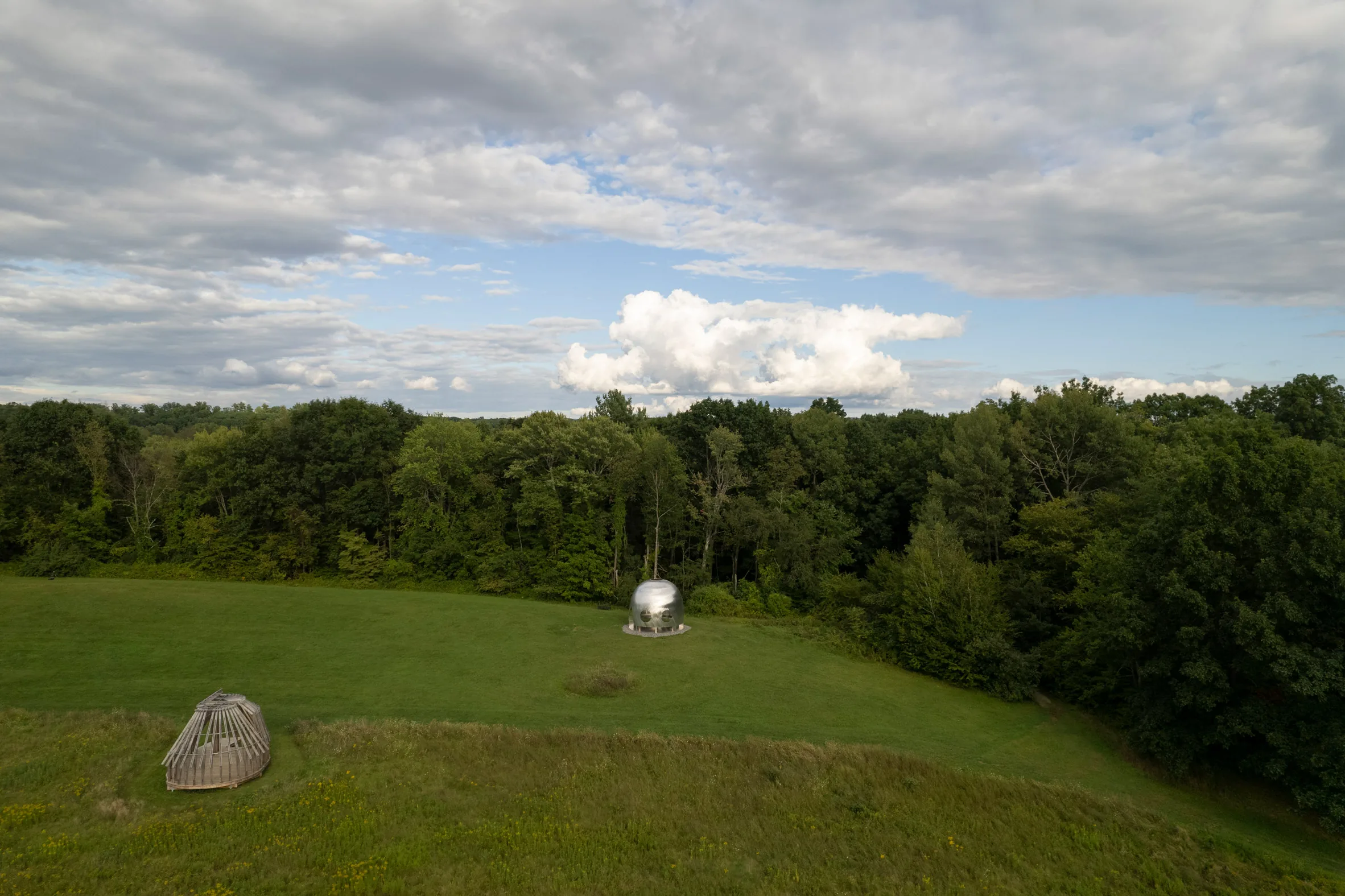
MOS co-founder Michael Meredith described the piece to Dezeen as an “upside-down basket,” a description that points to how the studio has been treating aluminium less like a heavy building material and more like a craft medium. “We’ve been working for years with folded aluminium and basically using it like paper, almost like large-scale models,” he said.
That approach also shaped how the pavilion went up. Rather than requiring specialised machinery or a lengthy build schedule, it was designed so a small crew could assemble it with ordinary tools over the course of a few days, continuing MOS’s longstanding interest in prefabricated aluminium structures that can be built quickly and cheaply at a small scale.
Basketry, Airstreams and a face like the Iron Giant
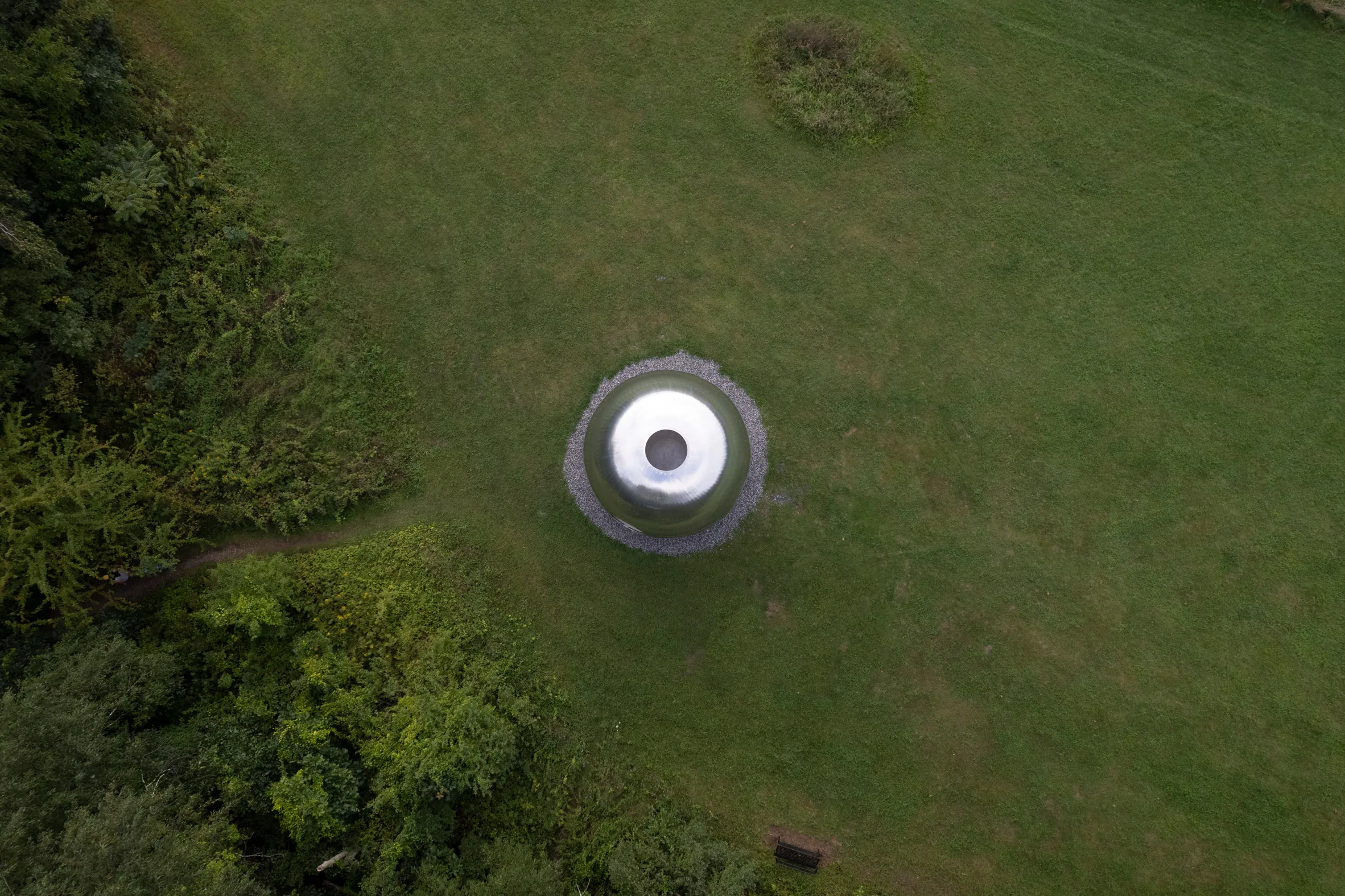
Meredith traces the pavilion’s form to two very different reference points. One is pre-industrial weaving. “There’s something of woven architecture in it, almost pre-modern,” he said. “Woven structures have an economic use of material, lighter material in this case. There’s something nomadic.”
The other reference is distinctly mid-century American: the riveted metal skin of an Airstream trailer. “But there’s Airstream trailer quality too,” Meredith said. “You can see a bunch of stuff in it.”
Seen from certain angles, the dome takes on an unexpected third identity, with a rounded, eyed silhouette that visitors have compared to the towering robot from the 1999 animated film The Iron Giant. Meredith doesn’t shy away from the comparison, or from the pavilion’s odder qualities generally. “It’s also, as everybody tells us, a little bit ridiculous,” he said, framing the work as something closer to a Buckminster Fuller dome reinterpreted through the lens of painter Philip Guston. He argues the woven logic behind the structure also makes it more adaptable than a conventional dome, since its shingled surface can be reshaped the way a woven basket can.
An aluminium pavilion built for a ‘weird moment’ in architecture
The project ties into MOS’s recent writing, including its Smaller Architecture book, which argues for small studios to use experimentation rather than scale as their calling card. Meredith frames the pavilion partly as a reaction to what he sees as an increasingly narrow, market-driven architecture culture.
“Architecture is in a weird moment in general. It used to be a more active part of cultural production,” Meredith said. “At some point, though, it sort of shifted and just feels commercial. Everything just feels like a commodity.”
He credits Art Omi with offering an alternative to that pressure. “So that’s what’s nice about Art Omi,” he said. “It’s sort of outside the system, and it gives you a chance to reflect and think about something else.”
A Dome with Four Oculi now stands among the rotating installations spread across Art Omi’s campus, where it is expected to remain on view as part of the organisation’s ongoing architecture programming.
Small pavilions are where studios test assembly ideas before they reach a building, the same logic behind prefabrication in architecture. The woven shell belongs to a longer argument about doing more with less structure.



Danish Architecture Center Marks Jan Gehl’s 90th Birthday with Cities for People Exhibition
DAC in Copenhagen celebrates Jan Gehl's 90th birthday with Cities for People,...
illustrarch Editoral Team2 Mins read
Orhan Ayyüce, Los Angeles Architecture Educator and Writer, Dies at 75
Architect, educator and Archinect writer Orhan Ayyüce, a fixture of Los Angeles...
illustrarch Editoral Team3 Mins read
Overlapping Concrete Walls and One Roof Shape a House in Okinawa
IGArchitects built Overlapping Spaces in Okinawa from reinforced concrete walls, columns and...
illustrarch Editoral Team1 Mins read
BIG Builds a Temporary City in Madrid Designed to Be Taken Apart
Bjarke Ingels Group turned a 185,000 square metre Madrid venue into Macondo...
illustrarch Editoral Team2 Mins read


Leave a comment