

Material Management Tips for Concrete Contractors
Eight practical concrete material management habits for contractors, from ordering ready-mix against verified quantities and checking every ticket at the truck to storing rebar, tracking consumables and coding each load to its pour.
 illustrarch Editoral Team16 October 20264 Mins read8

Table of Contents Show
Concrete contractors manage materials well when they order ready-mix to accurate, verified quantities, confirm mix designs before the pour, check every delivery ticket against the order at the truck, store rebar and consumables so they stay usable, and charge every load and every box of accessories to the right job and pour. Those habits reduce waste, rejected loads, and billing disputes, and they give the office a reliable picture of material cost while a project is still underway. That is what concrete material management looks like in practice.
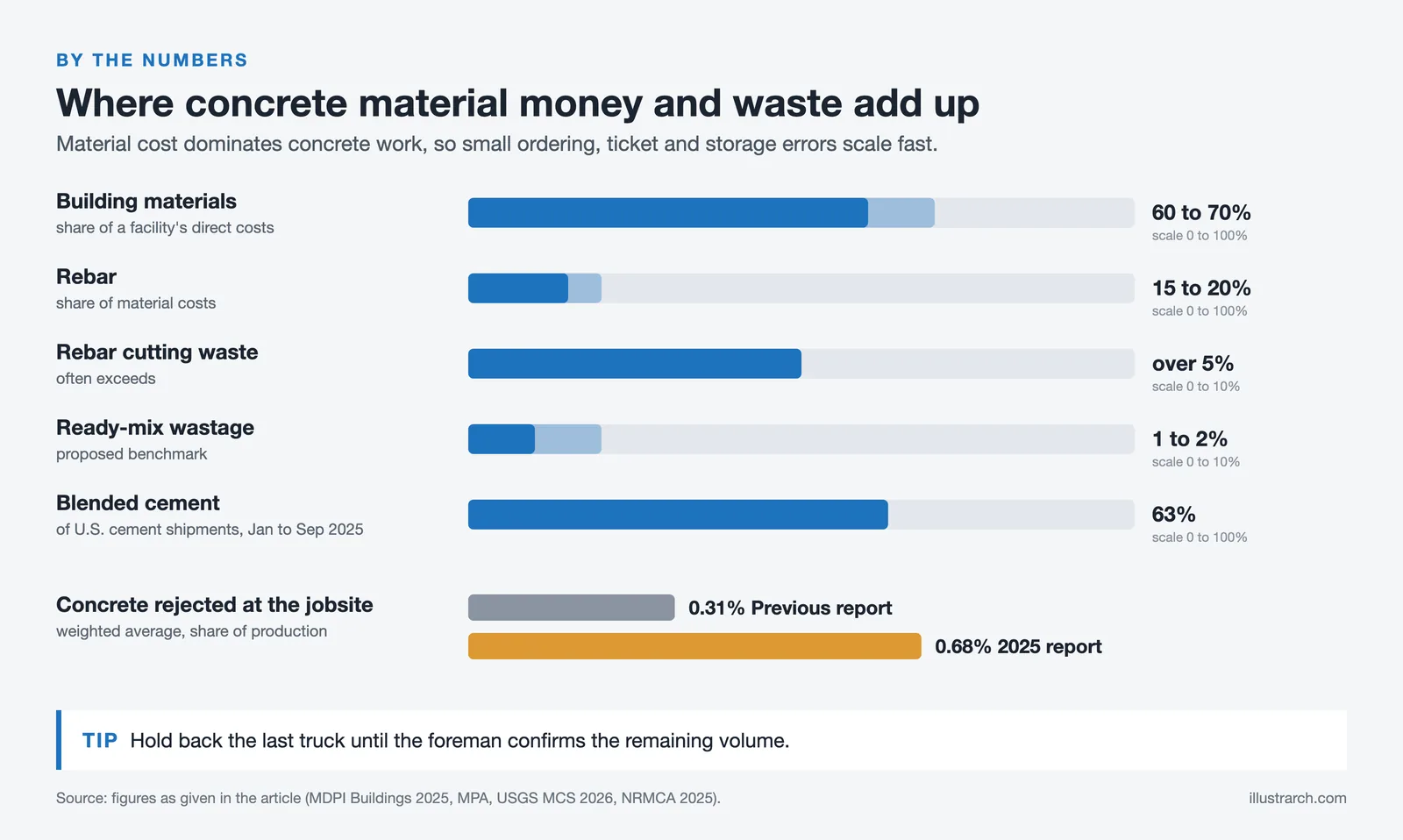
Materials are a large share of what concrete work costs. A 2025 open-access study, research on optimizing rebar supply chain management to minimize cutting waste, notes that building materials constitute 60 to 70 percent of a facility’s direct costs, with rebar contributing 15 to 20 percent of that, and that rebar waste often exceeds 5 percent. Small improvements in how those materials are ordered, received, and tracked add up quickly.
1. Order Ready-Mix Against Verified Quantities
Ordering accuracy has a direct effect on concrete waste. The Mineral Products Association report on wastage rates for blocks and ready-mixed concrete proposes a wastage rate of 1 to 2 percent for ready-mixed concrete on commercial and public projects, and notes a view that ready-mix waste rates are falling thanks to more efficient production, better client ordering, and tighter control of quantities on each pour.
Good practice starts with a takeoff that accounts for actual subgrade conditions, form deflection, and pump line volume, followed by a field check of dimensions before the order is finalized. Many contractors order the bulk of a pour in advance and hold back the final truck until the foreman confirms the remaining volume. That approach requires clear communication with the dispatcher, and it pays off in fewer partial loads returned to the plant.
2. Confirm Mix Designs and Substitutions Before the Pour
Cement supply has changed in recent years, and contractors should confirm exactly what is being delivered. According to the USGS Mineral Commodity Summaries 2026 report on cement, blended cement accounted for 63 percent of total U.S. cement shipments during the first nine months of 2025, and an estimated 95 percent of blended shipments were portland-limestone cement (Type IL). The same report estimates that 70 to 75 percent of cement sales went to ready-mixed concrete producers.
Because the cement in a given mix may differ from what a contractor used on past projects, the submitted mix design should be checked against specifications before the first pour, and any substitution proposed by the supplier should be approved in writing. Finishing crews should know in advance if setting times or finishing behavior may change.
3. Check Every Ticket at the Truck
The delivery ticket is the most important document in concrete material management. Before discharge, someone on site should confirm the mix design number, the volume on the truck, the batch time, and any water or admixture additions. Loads that do not match the order should be flagged before they go in the forms.
That ticket information is only useful if it reaches the office. Contractors that log each load against its purchase order on the day of the pour, whether through a disciplined shared log or through construction procurement and material management software, give accounting a record to reconcile the supplier’s invoice against, load by load. When tickets are collected in a truck cab and turned in days later, discrepancies in volume, extra charges for short loads, or standby time become much harder to dispute.
Rejected concrete is rising
The NRMCA 2025 Quality Benchmark Report calculated that concrete rejected at the jobsite averaged 0.68% of production, compared with 0.31% in the previous report.
4. Reduce Rejected and Returned Concrete
Rejections cost everyone. The NRMCA Quality Benchmark Report found that the weighted average of concrete rejected at the jobsite was 0.68% of production, up from 0.31% in the prior report. Common causes on the contractor side include slump or temperature outside specification by the time the truck discharges, trucks waiting too long for the pump or crew, and orders placed for the wrong mix.
Contractors can reduce rejections by confirming site readiness before trucks are dispatched, spacing deliveries to match actual placement rates, and keeping a clear record of why each rejected load was turned away. Over time, that record shows whether rejections trace back to supply, scheduling, or site conditions.
The same benchmark found that the weighted average strength increment was 36 percent, meaning delivered concrete tested well above specified strength on average. That margin is a reminder that mix designs and specifications deserve a periodic review with the supplier, particularly on large or repeat projects.
5. Store Rebar and Accessories So They Stay Usable
Reinforcing steel should be stored off the ground on dunnage, grouped by bar size and bending schedule mark, and tagged so crews can find the right bars without sorting through the pile. Rust scale, mud, and bent bars all create rework.

The same rebar study notes that effective inventory management of construction materials has been shown to enhance productivity by 6 percent, and that ensuring materials availability before work execution can boost productivity by 8 to 10 percent by preventing delays caused by shortages. For concrete crews, that means having chairs, ties, dowels, and embeds staged well before the pour so nobody is calling in an order that morning.
6. Manage Consumables Like Inventory
Form oil, curing compound, sealants, expansion joint material, vapor barrier, tie wire, and fasteners are low-cost individually but add up across many jobs. Many concrete contractors keep a warehouse or yard stock of these items. To keep that stock under control:
- Record every issue from the yard to a specific job and cost code.
- Set reorder points for high-use items so crews are not caught short.
- Check job trailers before placing a new outside order.
- Return unused material to the yard at job closeout and credit it back.
7. Code Every Purchase to the Pour
Concrete work is scheduled pour by pour, and material cost should be tracked the same way. Coding each ready-mix order, rebar delivery, and consumables issue to the job and the relevant phase makes it possible to compare actual material cost to the estimate while the project is still running. It also makes monthly supplier invoices much easier to reconcile, since each line already has a home.
8. Review Supplier Performance Regularly
Contractors that work with the same ready-mix and rebar suppliers across many projects benefit from a periodic review. Useful points to cover include on-time delivery, rejected loads and their causes, invoice accuracy, and lead times for fabricated rebar. These conversations work best when the contractor brings its own delivery and ticket records rather than relying on memory.
Better Material Control Starts on the Pour Deck
Concrete material management depends on what happens in the field: accurate quantities, checked tickets, well-stored steel, and consumables that are tracked instead of assumed. When that field information flows to purchasing and accounting the same day, contractors waste less material, dispute fewer invoices, and know where their material dollars are going on every job. Those records also make the next estimate more accurate.









From Architectural Design to Everyday Use: Why Post-Construction Inspection Matters
A building can look finished long before it works as intended. This...
illustrarch Editoral Team6 Mins read

Preventing Corrosion-Driven Accidents
Learn how to prevent corrosion-driven accidents in buildings and infrastructure, from early...
illustrarch Editoral Team2 Mins read

How One Delay Can Disrupt An Entire Jobsite
Discover how a single delay can impact your construction jobsite, causing cascading...
illustrarch Editoral Team2 Mins read

Design Build vs Design Bid Build: Understanding the Design and Build Contract
A design and build contract puts design and construction under one agreement...
 Furkan Sen5 Mins read


Leave a comment