

Floating Cities: The Future of Sustainable Urban Living
Floating cities are buoyant, engineered settlements built on water for coastal regions facing rising seas, from OCEANIX Busan to the Maldives project.
 Begum Gumusel12 April 20255 Mins read483

Table of Contents Show
Floating cities are engineered, buoyant settlements built on water to house people, infrastructure, and green systems where land is scarce or threatened by rising seas. They combine marine engineering with renewable energy and modular design, giving coastal regions a way to expand outward onto the ocean instead of pushing inland or upward.
Once treated as science fiction, the idea now sits on the desks of city planners, marine engineers, and the United Nations. Warming oceans and crowded coastlines have pushed governments to ask a practical question: if the water is coming, can urban life move with it? Prototypes in South Korea and the Maldives suggest the answer is starting to take physical form.

What Are Floating Cities?
A floating city is a permanent human settlement built on platforms that rest on water rather than reclaimed or dry land. Unlike houseboats or offshore rigs, these designs aim to support full urban functions: housing, food production, energy generation, transport, and public space. Most concepts use anchored modular platforms that rise and fall with the tide, so a storm surge lifts the structure instead of flooding it.
The appeal ties directly to where people already live. Roughly 40 percent of the world’s population lives within 100 kilometres of a coast, and many of the fastest-growing cities sit in low-lying deltas. When those cities run out of buildable land, water becomes the obvious frontier. This is why floating cities are framed less as a fantasy and more as an extension of coastal planning, closely linked to wider sustainable architecture trends.
Why Floating Cities Matter for Climate Resilience
Sea levels are projected to keep climbing through the century, and coastal defences like seawalls only buy time. Floating structures take a different approach by adapting to water levels instead of resisting them. A neighbourhood that floats does not need to predict the exact height of a future flood, because it moves with the surface it sits on. That flexibility is the core argument behind the technology.
The concept gained serious institutional weight when UN-Habitat began studying it as a tool for coastal cities under pressure. The idea is not to replace existing cities but to give crowded, sinking regions another option for growth that does not depend on draining wetlands or reclaiming land from the sea. UN-Habitat’s own account of the Busan launch lays out how the agency sees the technology fitting into coastal policy.
Retreat is the usual alternative, and it is brutal. Managed relocation forces communities to abandon homes, land, and often their entire economy, and the social cost of moving inland tends to fall hardest on the poorest residents. A city that floats offers a way to stay put on the water people already depend on, keeping fishing grounds, ports, and cultural ties within reach instead of severing them.
🎓 Expert Insight
“Floating cities can be part of our new arsenal of tools,” said Amina Mohammed, UN Deputy Secretary-General.
Speaking at the UN’s first high-level meeting on the subject, Mohammed framed floating settlements as a resilience measure, since buildings on water can rise along with the sea rather than be swallowed by it. Her remarks moved the idea from speculation into serious policy conversation.
You can read the full record of that session in the UN press release on sustainable floating cities, which set the tone for the projects that followed.
How Floating Cities Stay Afloat and Stay Green
Buoyancy usually comes from platforms built on reinforced concrete or engineered composites filled with air pockets, similar in principle to how a heavy steel ship floats. These platforms are moored to the seabed with flexible anchoring so they hold position without being rigidly fixed. Walkways and bridges connect the modules, letting a settlement grow one platform at a time.
Sustainability is designed in from the start rather than added later. Rooftop and floating solar arrays supply power, closed-loop water systems recycle rainwater and wastewater, and food comes from aquaculture and vertical farming on the platforms themselves. Because shipping materials to open water is expensive, these projects push hard on local energy and waste recovery, an approach that overlaps with many sustainability ideas in architectural design.
📌 Did You Know?
The OCEANIX Busan prototype is designed to generate 100 percent of its required operational energy on site through floating and rooftop photovoltaic panels, according to UN-Habitat. Its interconnected neighbourhoods span 6.3 hectares and are planned to house around 12,000 residents in the first phase.
Coastal habitat regeneration is part of the plan too. Some designs attach biorock and coral structures beneath the platforms to rebuild marine ecosystems, turning the underside of a city into a reef rather than dead space.

Leading Floating City Projects Around the World
Three efforts show how far the concept has moved from concept art toward buildable projects. Each takes a different angle: a UN-backed public prototype, a private housing development, and a libertarian experiment in ocean governance. The table below compares them.
Floating City Projects Compared
| Project | Key Feature | Status |
|---|---|---|
| OCEANIX Busan (South Korea) | UN-Habitat prototype by BIG and SAMOO, self-powered modular platforms | Design unveiled 2022, in development |
| Maldives Floating City | Dutch Docklands housing grid of 5,000 homes in a lagoon near Male | Under construction, phased delivery |
| Seasteading concepts | Independent floating platforms in international or host waters | Research and early pilots |
The OCEANIX Busan design, developed with the Bjarke Ingels Group, is the most detailed public model, while the Maldives project by Dutch Docklands is the closest to delivering actual homes. The Seasteading Institute takes a more experimental route, focused as much on political autonomy as on engineering. Architecture press has followed the Busan design closely, and ArchDaily’s coverage of the prototype reveal documents the collaborators and systems behind it in detail.
What separates these three from older utopian sketches is partnership. Busan pairs a national government with the UN and a named architecture firm. The Maldives grid is backed by a developer with real financing and a signed government agreement. That shift, from lone visionaries to public and private teams with budgets, is the clearest sign the concept has matured.
🏗️ Real-World Example
OCEANIX Busan (Busan, 2022): Unveiled at UN Headquarters, this prototype was designed by BIG with local firm SAMOO for the city of Busan and UN-Habitat. It uses six connected systems covering zero waste, closed-loop water, food, net-zero energy, mobility, and coastal habitat regeneration, and is planned to scale beyond its first neighbourhoods over time.
Challenges Floating Cities Still Face
The engineering is advancing faster than the economics. Building on water costs far more per square metre than building on land, and financing a project with no direct precedent is hard. Insurance, maritime law, and questions of who governs a settlement that floats in a bay or beyond territorial waters all remain unsettled.
There is also a social risk. Early floating developments could easily become luxury enclaves rather than housing for the coastal communities most exposed to flooding. UN-Habitat has stressed affordability and inclusion for exactly this reason, and it is a fair test to hold any future project against. These tensions connect to broader debates about the future of sustainable architecture and who it actually serves.
💡 Pro Tip
When assessing any floating city proposal, look past the renderings and check three practical questions: how the platforms are anchored, where the operational energy actually comes from, and which legal jurisdiction governs the site. Projects that answer all three clearly are far closer to buildable than those selling only the visuals.
Environmental impact and cost figures for floating developments are based on current project data and may change as designs are built and tested.
The Bigger Picture
Floating cities will not replace the coastlines we already know, and they were never meant to. Their real value may be simpler: proving that dense, low-carbon living can work on water, and giving vulnerable regions one more option as the sea keeps rising. Whether they scale or stay boutique will depend less on the engineering, which is largely solved, and more on whether governments treat them as public infrastructure or private spectacle.




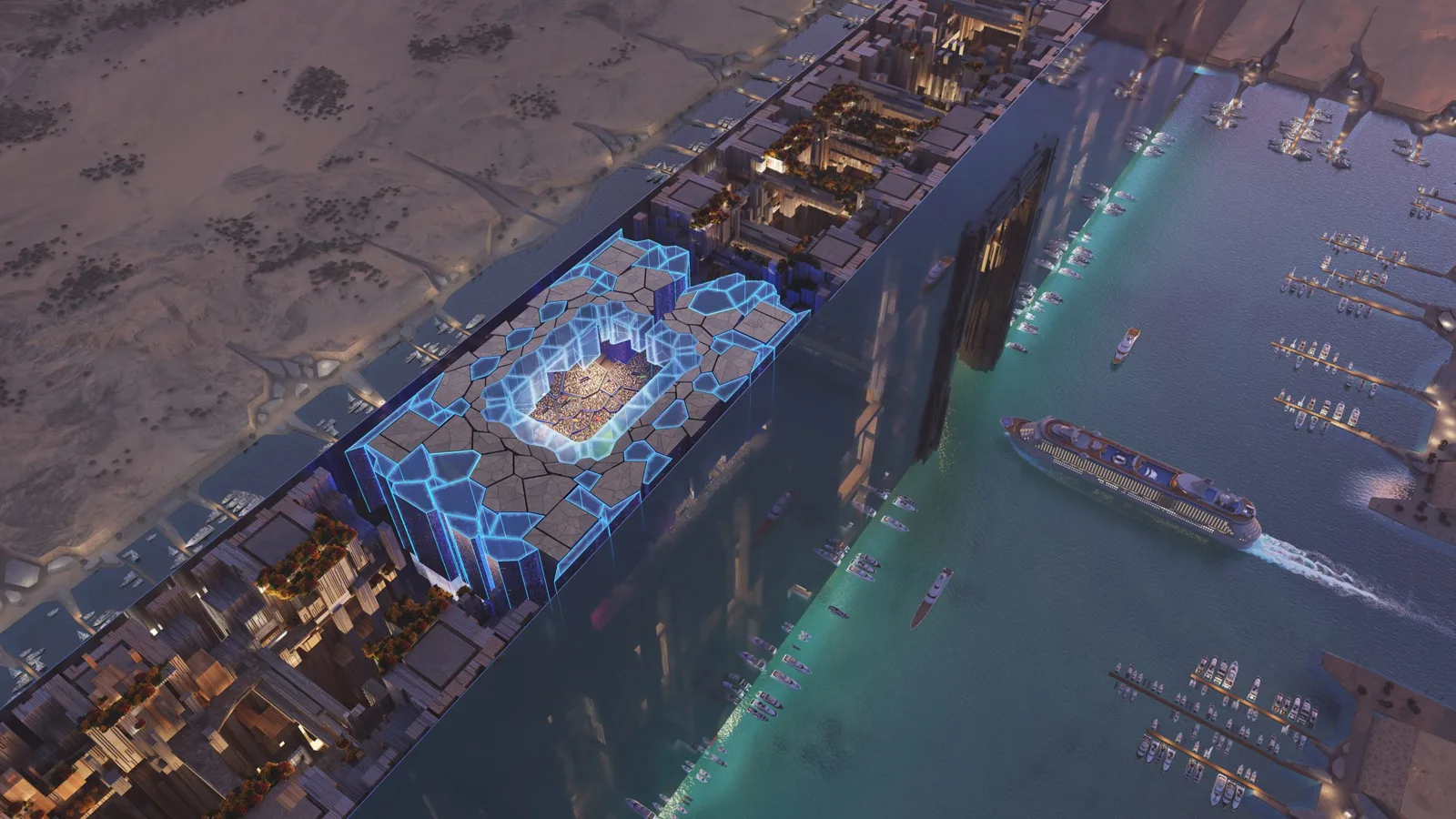
Neom Stadium, the Elevated 2034 World Cup Venue, Reportedly Shelved by Saudi Arabia
Two sources told Reuters that Saudi Arabia has put the 46,000 seat...
 illustrarch Editoral Team2 Mins read
Famous Sustainable Buildings: 6 Green Skyscrapers Leading the Future
From Milan's Bosco Verticale to Sydney's record hybrid timber tower, six green...
 Furkan Sen6 Mins read
Best Orientation for a House: Why North Orientation Matters
North orientation shapes a home's light, warmth, and running costs, and its...
Furkan Sen6 Mins read
Passive Design Architecture: A Practical Guide to Low-Energy Buildings
Passive design uses a building's orientation, form, and materials to control heat,...
Furkan Sen8 Mins read


Leave a comment