

Proportion in Architecture: Why Every Architect Should Master This Principle
Proportion in architecture governs the dimensional relationships between a building's elements and its whole, shaping visual harmony, human comfort, and structural performance. This article covers the history of proportional systems from the Parthenon to Le Corbusier's Modulor, practical application methods for modern design, and why proportional thinking is returning to the center of contemporary practice.
 Elif Ayse Sen3 May 202612 Mins read173
Table of Contents Show
Proportion in architecture is the dimensional relationship between a building’s parts and its whole, expressed through mathematical ratios that determine visual harmony, structural balance, and spatial comfort. From the Parthenon’s column spacing to Le Corbusier’s Modulor system, proportion has served as the invisible framework behind the world’s most admired structures for over 4,500 years.
Walk into a room that feels right, and you probably can’t explain why. The ceiling height seems perfect. The windows sit exactly where they should. Nothing feels cramped or wasteful. That invisible quality is proportion at work. It shapes how we experience every built space, from a private study to a cathedral nave, yet it rarely gets the attention it deserves in contemporary practice. Architects who understand proportion don’t just design buildings that look good on screen. They create spaces that feel instinctively correct to the people who use them.
At its core, proportion connects mathematics to human perception. It is the reason certain facades appear calm and ordered while others feel chaotic. And it explains why some buildings age gracefully across centuries while trendy designs lose their appeal within a decade. If you’ve been following recent conversations at events like Milan Design Week 2026 and the Salone del Mobile.Milano, you’ll notice that the design world is returning to material intelligence and archetypal form. That shift makes proportional thinking more relevant than ever.
What Is Proportion in Architecture?

Proportion refers to the relative size relationship between different elements of a building and between those elements and the structure as a whole. Think of it as a system of internal ratios. A window’s width compared to its height, a column’s diameter compared to its overall length, a room’s floor area compared to its ceiling height: all of these are proportional relationships.
The concept is closely tied to scale, but the two are not the same. Scale describes how a building relates to the human body or its surrounding environment. Proportion deals with how the building’s own components relate to each other. A skyscraper can have excellent internal proportions even at a massive scale, while a small house can feel awkward if its proportions are off.
💡 Pro Tip
When starting a facade composition, draw regulating lines early in the schematic design phase rather than trying to retrofit proportional systems onto a nearly finished elevation. Dividing the primary rectangle into a golden section or a root-two rectangle first, then aligning window heads, sill lines, and structural bays to these guides, prevents the proportional logic from feeling forced once cladding and glazing details are added.
Vitruvius, writing in the first century BCE, argued that a well-proportioned building should mirror the ratios found in the human body. His ideas shaped Western architecture for two millennia and directly influenced Renaissance thinkers like Leon Battista Alberti and Andrea Palladio, both of whom built entire design philosophies around proportional systems. The concept remains central to architectural education and practice today.
How Classical Civilizations Used Proportion

The oldest structures linked to deliberate proportional thinking include the Great Pyramid of Giza (c. 2560 BCE), whose slant height to half-base ratio approximates 1.618. Whether the Egyptian builders targeted this number deliberately or arrived at it through practical geometry remains debated, but the result is a form that has captivated observers for over four thousand years.
In ancient Greece, proportion moved from possible coincidence to documented principle. The Parthenon, completed around 438 BCE, is the most frequently cited example. Architects Ictinus and Callicrates used a consistent 9:4 ratio across the facade, governing the relationship between width and height, and between column spacing and column diameter. They also introduced optical corrections, including columns that lean slightly inward and a stylobate that curves gently upward, to counteract visual distortions. These refinements show that Greek builders understood proportion not just as abstract mathematics but as a tool for managing human perception.
📌 Did You Know?
The columns of the Parthenon are not perfectly straight. They curve outward slightly using a technique called entasis to counteract the optical illusion that perfectly straight columns appear to bow inward. This level of perceptual refinement in a structure from 438 BCE shows how deeply classical architects understood the gap between geometric proportion and how the human eye actually reads form.
Roman builders expanded the Greek vocabulary with new structural technologies like concrete, the semicircular arch, and the dome. The Pantheon’s interior, where the diameter of the dome exactly equals the height from floor to oculus, is a proportional statement of extraordinary clarity. Medieval European church builders continued the tradition, using simple geometric figures (squares, equilateral triangles, circles) to generate plan and elevation proportions that they saw as reflections of divine order.
The Golden Ratio and Its Role in Architectural Proportion
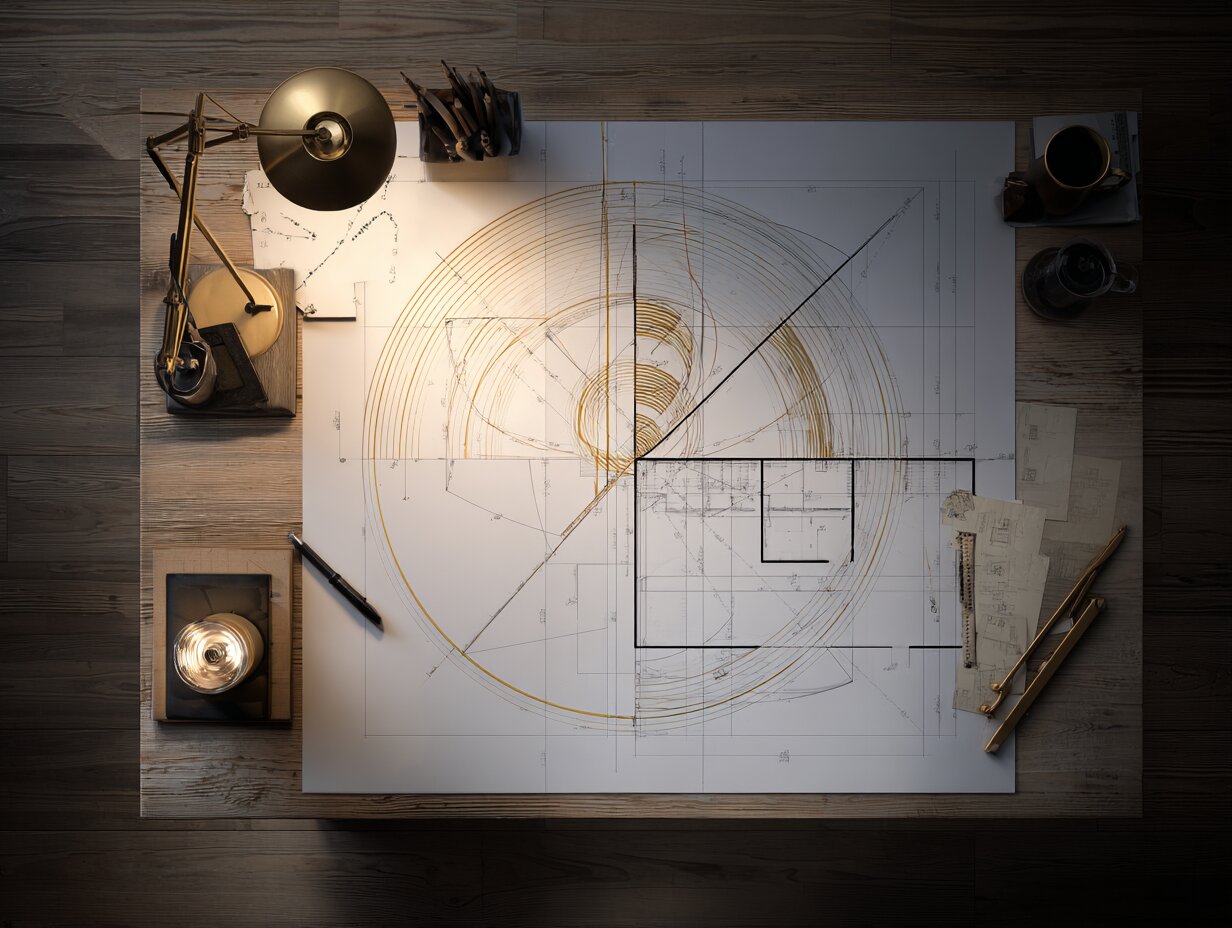
No discussion of proportion in architecture is complete without the golden ratio, approximately 1:1.618, symbolized by the Greek letter Phi. First formally described by Euclid around 300 BCE, this ratio appears throughout nature, from the spiral arrangement of sunflower seeds to the proportions of the human body. Its presence in so many natural forms is one reason spaces designed around it tend to feel intuitively pleasing.
The golden ratio has appeared in buildings across cultures and centuries: the Great Mosque of Kairouan (c. 670 CE), Notre-Dame Cathedral in Paris, the Taj Mahal, and many Renaissance-era churches and palazzos. Its influence extended into the twentieth century through Le Corbusier’s Modulor system, developed beginning in 1943, which combined golden ratio segments with human body measurements to produce two interlocking series of dimensions that architects could apply to everything from door handles to entire building facades.
🎓 Expert Insight
“A proportion’s true significance lies not in abstract ideals but in its correspondence to the constraints of human perception, movement, and cognition.” — Texas Architect Magazine, “Rethinking Proportion” (2025)
This perspective captures a shift in how contemporary architects view proportional systems. Rather than chasing a single “correct” ratio, the focus is increasingly on how proportional choices affect spatial experience, wayfinding, and psychological comfort.
It is worth noting that the golden ratio is not a magic formula. Recent scholarship, including work by architectural historian Keith Devlin, suggests that claims about the Parthenon being designed around Phi may be overstated. Many beautiful buildings achieve visual harmony without strictly following the 1.618 ratio, relying instead on alternative proportional systems like root rectangles, the 9:4 ratio, or modular grids. The golden ratio is best understood as one powerful tool among several, not as a universal rule.
Why Proportion Matters More Than Aesthetics
Proportion affects far more than how a building looks in a photograph. Its influence extends into three critical areas that directly shape project quality and user satisfaction.
Spatial Comfort and Human Experience
A room’s proportions determine whether it feels intimate or cavernous, welcoming or oppressive. Ceiling heights, corridor widths, window-to-wall ratios, and the placement of openings all contribute to an occupant’s visceral response. Research in environmental psychology consistently shows that people prefer spaces whose proportions relate to the human body. A counter at 34 to 36 inches, a handrail at 42 to 48 inches, a residential ceiling at 9 to 10 feet: these dimensions work because they connect built geometry to how people actually move, reach, and see. Get them wrong, and even expensive finishes can’t fix the discomfort.
Structural Efficiency
Proportional decisions ripple through structural systems and project budgets. A 30 to 35 foot structural grid, for instance, balances program flexibility with material efficiency. Push spans longer and structure deepens, increasing floor-to-floor heights, curtain wall area, and mechanical runs. On the facade, window-to-wall ratio, mullion spacing, and exterior shading must align with orientation and climate. Poor proportional choices here can lock in energy inefficiencies for the life of the building.
Timelessness
Buildings that rely on proportional clarity rather than stylistic novelty tend to age well. The Parthenon, the Pantheon, Palladio’s Villa Rotonda, and Le Corbusier’s Villa Savoye all share a commitment to proportional rigor that transcends their respective historical moments. This observation connects to a broader point made at the Salone del Mobile.Milano during Milan Design Week 2026, where the overarching theme of “matter” and archetypal form reflected a growing appetite for design grounded in timeless principles rather than fleeting trends.
⚠️ Common Mistake to Avoid
Many designers confuse proportion with scale. Scaling a small building up does not automatically preserve its proportions. A door that looks balanced on a single-story house may appear comically undersized on a four-story facade if the proportional relationships between door height, floor height, and overall elevation are not recalibrated. Always check proportions at every scale jump during design development.
Key Proportional Systems Architects Should Know

Throughout history, architects have used several formal systems to organize proportional relationships. Understanding these systems gives designers a vocabulary they can apply, adapt, or consciously break.
The Classical Orders
The Doric, Ionic, and Corinthian orders each prescribe specific ratios between column diameter, column height, entablature depth, and intercolumniation. These ratios produce distinctly different characters: Doric proportions feel sturdy and grounded, Ionic proportions appear more elegant, and Corinthian proportions are the most slender and decorative. The orders served as a shared proportional language across classical architecture for over two thousand years.
Le Corbusier’s Modulor
The Modulor starts with a standing person 1.83 meters tall, divides that height at the navel according to the golden ratio, then multiplies and divides the resulting segments by 1.618 to generate two measurement series (“red” and “blue”). Le Corbusier applied these dimensions to the Unite d’Habitation in Marseille (1952), where ceiling heights, apartment widths, and balcony depths all derive from Modulor calculations. The system remains the most documented attempt to build an entire architectural methodology around proportion.
Root Rectangles and the Japanese Ken Module
Root-two rectangles (1:√2) have been used across cultures, from Islamic geometric patterns to ISO paper sizes. Japanese architecture traditionally relied on the ken module (approximately 1.82 meters, or the width of a tatami mat), which governed room sizes, corridor widths, and structural bay spacing. Both systems show that proportional thinking does not require the golden ratio specifically; what matters is internal consistency.
📐 Technical Note
The most commonly used proportional ratios in Western architecture are 1:1 (square), 1:√2 (approximately 1:1.414), 1:√3 (approximately 1:1.732), 1:1.618 (golden ratio), and simple integer ratios like 2:3, 3:5, and 4:9. Each produces a different visual character. Squares feel stable but static. Golden rectangles feel balanced yet dynamic. Integer ratios offer clarity and are easy to construct on site. Choosing a ratio system early in the design process ensures dimensional consistency across plans, sections, and elevations.
How to Apply Proportion in Modern Design
Proportional thinking doesn’t require a slide rule or a copy of Vitruvius (though both help). Here are practical ways architects can integrate proportional awareness into contemporary workflows.
Start with a regulating grid. Before placing walls, windows, or structural elements, establish a proportional framework for your plan and elevation. This could be as simple as a square grid, a golden-section division of the primary rectangle, or a modular system tied to a standard panel size. The grid provides a baseline that keeps subsequent decisions coherent.
Test proportions at human eye level. Plans and sections don’t tell the whole story. Walk through your design in VR or build a physical model at a scale that lets you assess spatial proportions from the occupant’s perspective. A 1:50 section model, for example, reveals whether ceiling-to-window proportions feel right in ways that a screen can’t.
Use BIM tools to check proportional consistency. Modern software like Revit and ArchiCAD allows parametric relationships between elements. If you define a window height as a fraction of the floor-to-floor height, changes propagate automatically, preserving proportional intent even as the design evolves.
💡 Pro Tip
Study buildings you admire by measuring their proportional ratios from published drawings or photographs. Divide facade width by height, window width by window height, and solid wall area by glazing area. You’ll often find consistent ratios repeating across these measurements. Building a personal library of proportional precedents is one of the fastest ways to train your eye.
Pay attention to the proportions between solid and void. The ratio of wall to window on a facade determines its visual weight and energy performance simultaneously. A facade where openings occupy roughly 40% of the surface area (a common target for energy codes in temperate climates) can still look radically different depending on whether those openings are arranged in golden-section proportions, square proportions, or horizontal bands.
Proportion at Milan Design Week 2026 and the Future of Design
Events like the 2026 Milan Design Week and the 64th edition of Salone del Mobile.Milano offer a useful lens for understanding where proportional thinking sits in contemporary design culture. This year’s event, held April 21 to 26 at Fiera Milano Rho, welcomed over 316,000 visitors from 167 countries and featured 1,900 exhibitors from 32 countries.
The theme of the 2026 edition centered on “matter,” treating material not just as a surface but as a starting point for design. Many of the most talked-about presentations prioritized proportional clarity and material honesty over spectacle. Furniture designers returned to archetypal forms, chairs and tables whose proportions felt immediately “right” because they connected to centuries of ergonomic and aesthetic refinement. This is proportion in architecture (and design) applied at the scale of objects rather than buildings, but the underlying principle is identical: dimensions that relate logically to the human body and to each other produce lasting satisfaction.
🏗️ Real-World Example
Unite d’Habitation (Marseille, 1952): Le Corbusier applied his Modulor proportional system to every dimension of this 337-unit residential block. Ceiling heights, apartment widths, balcony depths, corridor widths, and even the dimensions of the commemorative foundation stone follow golden-ratio-derived measurements. A cast-concrete relief of the Modulor Man near the entrance makes this building a living textbook for how proportion in architecture shapes daily living.
Video: Proportions in Architecture Explained
This university lecture by architect Sebastian breaks down the major proportional systems used in architectural design, from classical orders to modern applications, in a clear and visual format.
Proportion vs. Scale: Understanding the Difference
These two terms are often used interchangeably, but they describe different things. Scale is interpretive: it describes how a building’s size and proportions read against people, neighboring structures, and context. A lobby can be physically large but still feel intimate if the details (lighting cones, furniture clusters, lowered soffits) bring the human scale forward. Conversely, a small facade can feel monumental if its articulation is tall and sparse.
Proportion, by contrast, is relational: it describes the dimensional ratios between parts. A 1:2 window ratio is a proportional statement regardless of whether the window is 30 centimeters or 3 meters tall. Proportion works within the object. Scale works between the object and its observer or context.
Architects need both. Proportion ensures internal harmony. Scale ensures the building fits its setting and connects to the people who use it. A building with perfect internal proportions but wrong scale will feel alienating. A building at appropriate scale but poor proportions will feel sloppy. The best architecture gets both right.
How Proportion Connects to Sustainability

This is an angle that many architects overlook. Proportional decisions have direct consequences for energy performance, material efficiency, and long-term adaptability.
Window-to-wall ratio is the most obvious connection. The proportion of glazing on a facade relative to opaque wall area determines solar heat gain, daylight penetration, and thermal envelope performance. Getting this ratio right for a building’s orientation and climate can reduce energy consumption significantly without requiring expensive mechanical systems.
Structural bay proportions also affect material usage. A floor plan organized around an efficient structural grid minimizes wasted material in beams, columns, and slabs. Proportional consistency across floor plates allows for standardized formwork or prefabricated elements, reducing construction waste and cost.
Finally, buildings with well-proportioned rooms and clear spatial hierarchies are easier to adapt over time. A room with balanced proportions can serve as an office, a bedroom, or a classroom without major renovation. This adaptability extends a building’s useful life, which is one of the most effective sustainability strategies available.
Training Your Eye for Proportion
Proportional sensitivity is not an innate talent. It is a skill that improves with practice. Here are specific exercises that architects at any stage of their career can use.
Sketch from observation. Stand in front of buildings you find compelling and sketch their primary proportional relationships: overall width to height, window placement relative to floor lines, solid-to-void ratios. Don’t measure. Just draw what you see. Over time, your eye will start identifying proportional patterns automatically.
Analyze floor plans on a proportional grid. Overlay a grid of squares or golden rectangles on published floor plans of buildings you admire. Note which walls, openings, and circulation paths align with the grid and which don’t. This exercise reveals how experienced architects use proportional systems as guides rather than rigid constraints.
Compare “before and after” facades. When a renovation or addition changes a building’s facade, compare the proportional relationships of the original and the updated version. Often, the difference between a successful renovation and an awkward one comes down to whether the new elements respect the original proportional logic.
Visit design principles resources and study how proportion, rhythm, balance, and emphasis work together in built projects. Understanding proportion in isolation is useful; understanding it as part of a larger composition is essential.
✅ Key Takeaways
- Proportion in architecture is the dimensional relationship between a building’s parts and its whole, distinct from scale, which relates the building to its context and the human body.
- Classical architects used proportional systems like the 9:4 ratio (Parthenon) and golden ratio (1:1.618) to produce visual harmony, a practice that continued through the Renaissance, the Modulor system, and into contemporary parametric design.
- Proportional decisions affect more than aesthetics: they influence spatial comfort, structural efficiency, energy performance, and a building’s capacity for long-term adaptation.
- Practical tools for applying proportion include regulating grids, golden-section divisions, root rectangles, modular systems, VR walkthroughs, and BIM-based parametric relationships.
- Training your eye through sketching, plan analysis, and studying built precedents is the most reliable way to develop proportional sensitivity over time.
Final Thoughts
Proportion is not a decorative add-on or an academic curiosity. It is the structural backbone of every design decision, from urban massing down to furniture placement. Buildings that get their proportions right reward occupants with spaces that feel balanced, efficient, and genuinely comfortable. Buildings that ignore proportion rely on surface treatments and stylistic gestures that rarely survive the passage of time.
The recent return to materiality and archetypal form visible at design week Milan 2026 suggests that the industry is rediscovering what classical and modernist architects understood intuitively: proportion is the foundation on which all other design qualities rest. Whether you work with digital parametric tools or pencil and trace paper, investing time in proportional thinking will improve every project you touch.
Proportional data and historical references cited in this article are based on published architectural scholarship and may vary depending on measurement methodology. Always verify specific dimensions with primary sources for academic or professional use.









Oscar Niemeyer’s Cathedral of Brasília: The Hyperboloid Concrete Hymn
The Cathedral of Brasília reads as a single gesture, yet it stood...
 Furkan Sen7 Mins read

What Technology Does a Modern Workplace Need?
A modern workplace needs more than fast computers. A framework covering network,...
 illustrarch Editoral Team8 Mins read
How Do You Choose Durable Shutters That Suit Your Budget?
Shutters can look identical in a showroom and perform very differently after...
illustrarch Editoral Team8 Mins read
How Can Window Coverings Improve Indoor and Outdoor Comfort?
Window coverings work as a home’s adjustable climate layer. A practical guide...
illustrarch Editoral Team9 Mins read




Leave a comment