

Best Resources for Aspiring Architects Today
Aspiring architects need to prioritize understanding mechanical, electrical, and plumbing systems, as they significantly impact construction budgets and project success.
 Bahattin Duran19 December 20256 Mins read218

Table of Contents Show
Architecture schools teach design theory really well. But they often skip the technical stuff that makes buildings actually work. You learn to draw beautiful plans. Then you graduate and realize nobody taught you about electrical systems or HVAC placement.
The real world hits differently than studio class. Clients want buildings that function properly and don’t cost a fortune to maintain. Learning where to find solid resources now saves you from scrambling later when you’re on a job site.
Building Services Knowledge Architects Actually Need
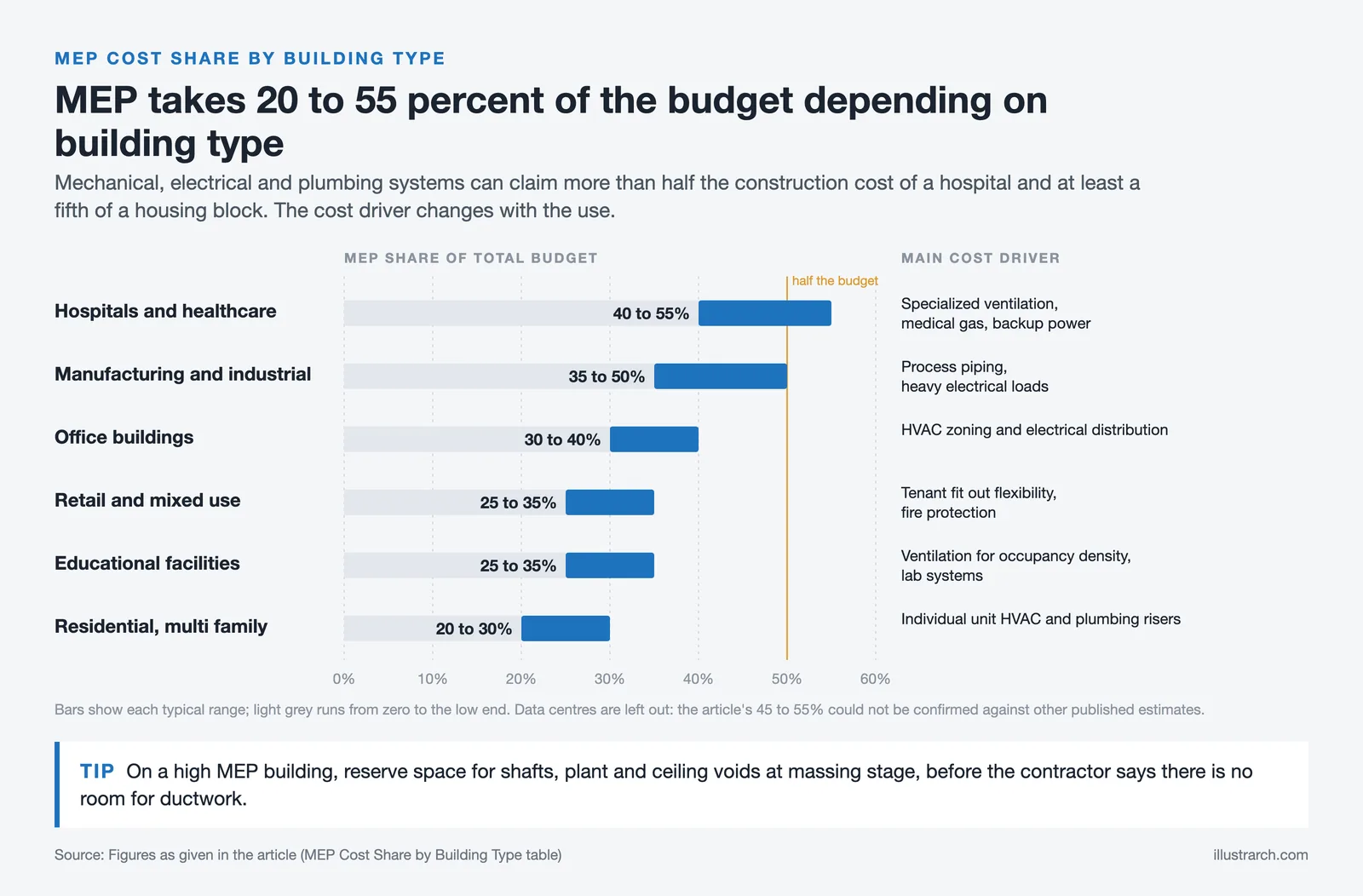
Most architecture programs barely touch MEP systems. That’s mechanical, electrical, and plumbing for anyone wondering. These systems eat up about 40 percent of construction budgets on commercial projects. You can’t design good buildings without understanding them.
Here’s what happens when architects skip this knowledge. Your beautiful design gets value-engineered into something you barely recognize. The contractor tells you there’s no room for ductwork. The electrical engineer says your lighting plan won’t work. You look unprepared in meetings.
| Building Type | Typical MEP Cost (% of Total Budget) | Primary Cost Driver |
|---|---|---|
| Office Buildings | 30-40% | HVAC zoning & electrical distribution |
| Hospitals & Healthcare | 40-55% | Specialized ventilation, medical gas, backup power |
| Residential (Multi-Family) | 20-30% | Individual unit HVAC & plumbing risers |
| Retail / Mixed-Use | 25-35% | Tenant fit-out flexibility, fire protection |
| Data Centers | 45% or more | Cooling systems, redundant power supply |
| Educational Facilities | 25-35% | Ventilation for occupancy density, lab systems |
| Manufacturing / Industrial | 35-50% | Process piping, heavy electrical loads |
Yee Group handles everything from fire alarm systems to electric vehicle charging installations. Companies like this publish case studies that show how systems actually get installed. Their technical specs reveal details that textbooks gloss over. You see real coordination challenges and how pros solve them.

CIBSE puts out free guides on building services engineering. Download their lighting guides or ventilation handbooks. The content gets technical but stays readable. You’ll learn why certain design decisions create problems downstream. Understanding load calculations and distribution systems makes you a better architect. Period.
Software Skills That Land You Jobs
Every job posting mentions Revit these days. BIM software changed how architecture offices operate. You need to think about buildings as complete systems now. Individual drawings don’t cut it anymore.
Learning Revit takes time but pays off fast. Start with basic family creation and work your way up. The software forces you to consider how pieces connect. That mindset improves your design thinking even when you’re sketching by hand.
SketchUp works great for early concepts. The interface makes sense within an hour or two. You can test spatial ideas quickly without getting bogged down in technical details. Lots of firms use it for client presentations and design development. The free version handles most students’ needs just fine.
Parametric design separates average candidates from strong ones these days. Rhino plus Grasshopper opens up complex geometry possibilities. MIT offers free Grasshopper tutorials through their open courseware. The visual programming approach works even if you’ve never coded before. You can create variations and test options way faster than manual methods.
Don’t ignore AutoCAD just because newer tools exist. Construction documentation still happens there in many offices. The 2D drafting skills translate across other programs too. Students get free licenses, so there’s no excuse not to learn it.
| Software | Best For | Annual Price | Free for Students? | Learning Curve |
|---|---|---|---|---|
| Revit | BIM, documentation, MEP coordination | ~$3,005/yr | ✅ Yes (1-year edu license) | Steep (months) |
| SketchUp Pro | Concept design, client presentations | $399/yr | ✅ Free web version + edu license | Easy (hours) |
| Rhino 8 | Complex geometry, parametric design | $995 (one-time) | 🎓 Discounted edu license | Moderate: Steep |
| Grasshopper | Visual programming, parametric modeling | Free (Rhino plugin) | ✅ Included with Rhino | Moderate |
| AutoCAD | 2D drafting, construction documents | ~$2,095/yr | ✅ Yes (1-year edu license) | Moderate |
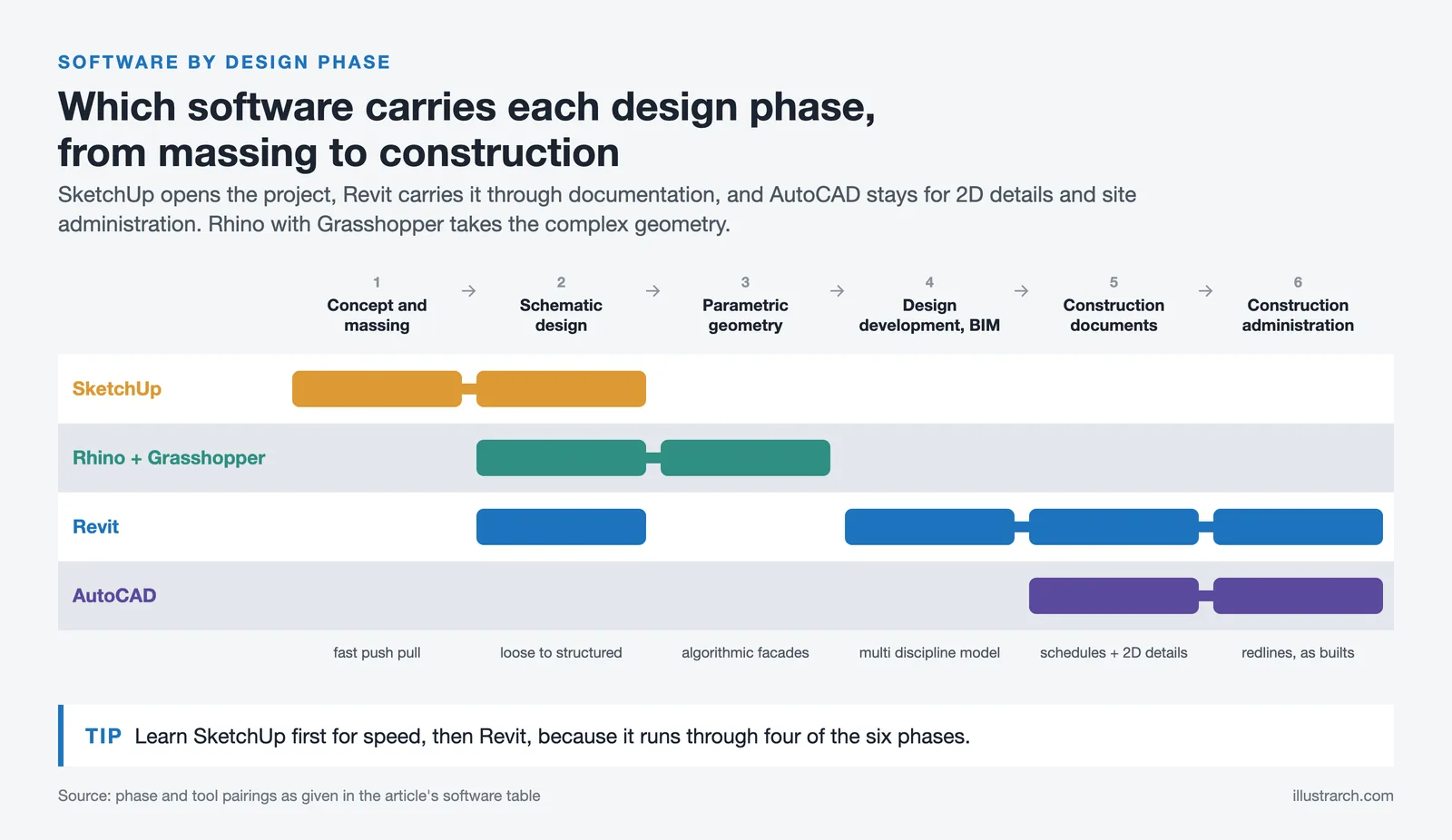
| Design Phase | Recommended Tool | Why |
|---|---|---|
| Concept & Massing | SketchUp | Fast iteration, intuitive push-pull modeling, quick client visuals |
| Schematic Design | SketchUp → Revit or Rhino | Transition from loose ideas to structured models with data |
| Complex / Parametric Geometry | Rhino + Grasshopper | Algorithmic control over curved surfaces and pattern-driven facades |
| Design Development & BIM | Revit | Parametric components, multi-discipline coordination, energy analysis |
| Construction Documentation | Revit + AutoCAD | Automated schedules from Revit; precise 2D details in AutoCAD |
| Construction Administration | AutoCAD + Revit | Redlining, as-built updates, shop drawing review |
Professional Groups Worth Joining Early
The American Institute of Architects runs way more than just award ceremonies. Their website hosts webinars on practice management and technical topics. Student memberships cost less but give you similar access. You get networking opportunities and mentorship connections too.

LEED credentials matter for most architecture careers now. The Green Associate exam covers sustainable design basics. Study materials from the Green Building Certification Institute prepare you well. Many firms list LEED accreditation as preferred in job descriptions. Getting certified early shows you’re serious about environmental performance.
NCARB handles architectural licensing across all U.S. states and territories. Their site explains experience requirements and exam content clearly. Understanding the licensing path helps you plan your career better. You can start tracking hours during school in some cases. The registration exam study guides help even before you’re eligible to test.
| Credential / Organization | What It Is | Approximate Cost | Best Time to Start |
|---|---|---|---|
| AIA Membership | Professional network, webinars, mentorship, CE events | Student: set by chapter, free at many chapters; Associate: varies by chapter | During school |
| NCARB Record (AXP + ARE) | Track experience hours, take licensing exams (6 divisions) | $105 Record + $263/division, $1,578 for all 6 (as of October 2026) | Final year of school or upon graduation |
| LEED Green Associate | Foundational green building credential from GBCI | $250 exam (student discounts available) | During school or right after |
| LEED AP BD+C | Advanced sustainability credential for design & construction | $350 exam (requires GA first) | After 1-2 years of practice |
| AIAS (Architecture Students) | Student-focused events, competitions, leadership opportunities | $55/yr national dues plus chapter dues (as of October 2026) | First year of architecture school |
| CSI (Construction Specifications) | Technical writing, specs knowledge, CDT certification | Student: $70/yr (as of October 2026) | During school or early career |
Local AIA chapters run events specifically for students:
- Portfolio reviews with practicing architects
- Construction site tours of active projects
- Lunch lectures featuring different specializations
- Networking mixers with firm principals
These gatherings beat classroom learning for understanding actual practice. You meet people who might hire you later. The advice you get reflects current market conditions. Plus free food usually.
Getting Your Hands Dirty With Real Work
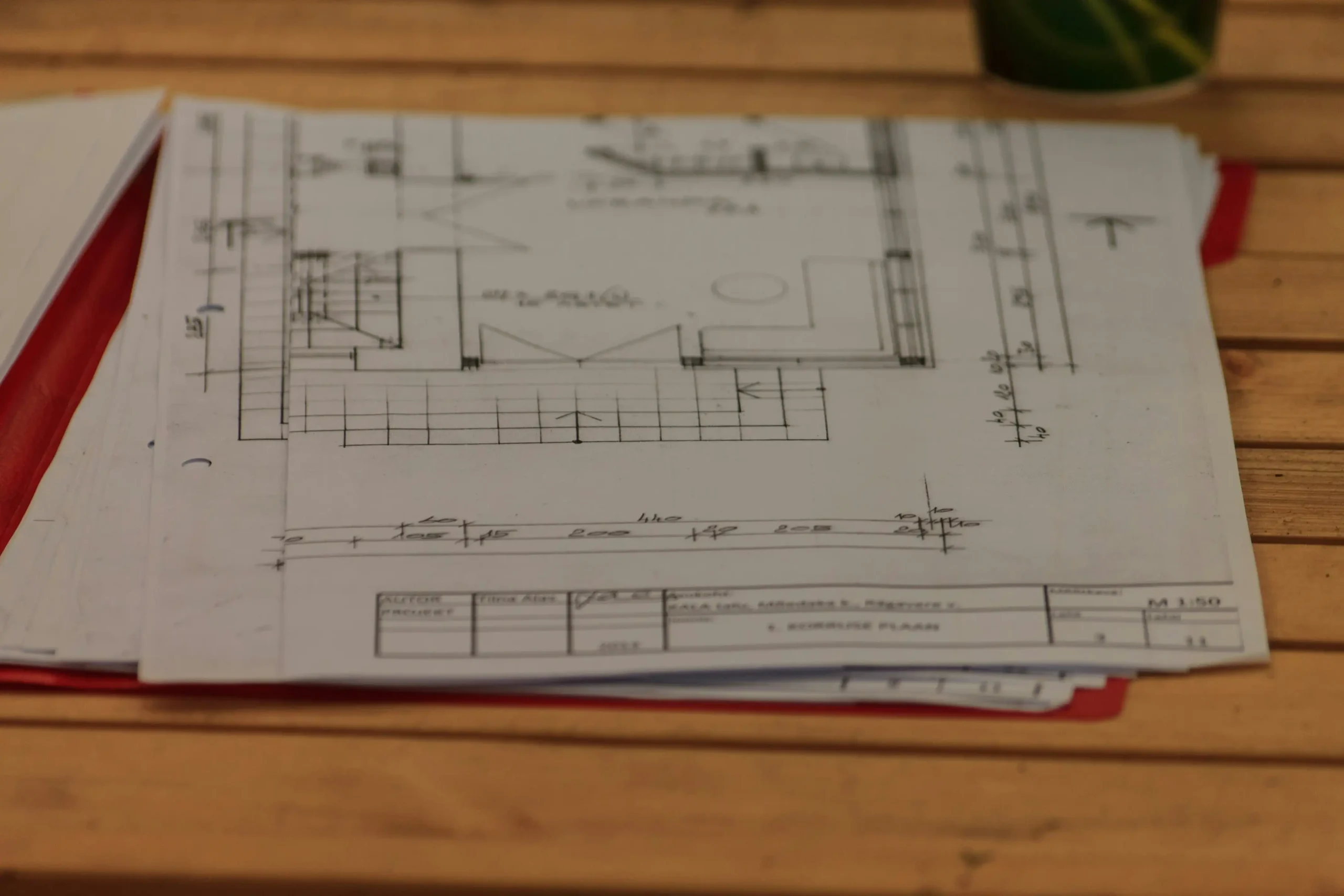
Design-build programs teach you what classroom studios can’t. You follow a project from concept through construction. Material costs become real constraints instead of abstract numbers. You see how your design decisions affect the people actually building your ideas.
Auburn’s Rural Studio pioneered this model decades ago. Students design and construct homes for communities that need them. The program reveals problems that never show up in renderings. You learn to detail connections that actually work. The experience changes how you think about drawing buildings.
Competitions push you to develop complete proposals under pressure. eVolo’s annual skyscraper competition draws thousands of entries worldwide. Regional contests often focus on local building types or specific challenges. Winning entries strengthen your portfolio significantly. Even submissions that don’t place show you can meet deadlines and follow requirements.
| Opportunity Type | Examples | Skills You Gain | Portfolio Impact |
|---|---|---|---|
| Design-Build Programs | Auburn Rural Studio, Yale Building Project, UT Design-Build | Construction detailing, budgeting, material selection, teamwork | ⭐⭐⭐⭐⭐ |
| Architecture Competitions | eVolo Skyscraper, Archiprix, RIBA competitions, d3 Housing Tomorrow | Concept development, deadline management, presentation graphics | ⭐⭐⭐⭐ |
| Summer Internships | Small/mid/large architecture firms, construction companies | Office workflows, client communication, CA, redlining | ⭐⭐⭐⭐ |
| Community Design Centers | AIAS Freedom by Design, Habitat for Humanity, local CDCs | Code research, accessibility, community engagement, built work | ⭐⭐⭐⭐⭐ |
| Study Abroad / Travel Studios | University exchange programs, Archiprix Travel Grant | Cross-cultural awareness, precedent study, sketching & documentation | ⭐⭐⭐ |
Summer internships remain the fastest path to professional knowledge:
- You see office workflows and project timelines firsthand
- Client meetings teach you communication skills that schools skip
- Construction administration shows you how drawings become buildings
- Redlining teaches you what actually matters in documentation
Look for firms that let you touch multiple project phases. Repetitive CAD work provides less than varied exposure. Even unpaid positions teach you stuff you can’t learn in school.
Community design centers tackle real projects for clients who can’t afford traditional services. These nonprofits need help with code research and presentation drawings. You contribute to meaningful work while learning accessibility requirements and community engagement. Finished projects give you actual built work for your portfolio.
Building Skills That Stick
Architecture careers demand constant learning. The resources here give you starting points. Professional growth takes years of sustained effort though. Nobody becomes a great architect by graduation.
Read technical journals regularly. Attend conferences when you can afford them. Study buildings in person whenever possible. Talk to contractors and engineers about how things actually get built. The gap between school and practice closes slowly.
Start with building systems fundamentals and the software that keeps appearing in job listings. Build relationships with practicing architects who’ll give you honest advice. Focus on resources that explain construction realities over pure theory. Licensing takes time but picking good educational resources speeds up your development significantly.







Interior Design for Commercial Spaces: Enhancing Functionality and Brand Identity
Commercial interior design has to serve brand, function and regulation at once....
 Begum Gumusel4 Mins read

What Architecture Students Should Know About Structural Glass and Guardrail Code
Glass guards look minimal, but structural behavior, safety glazing, connections and guardrail...
 illustrarch Editoral Team6 Mins read

Futuro House Production Revived in Finland After Decades-Long Hiatus
A Facebook listing for abandoned moulds led to the first new Futuro...
illustrarch Editoral Team3 Mins read
Building Your Dream Home in NSW: What You Should Know About Montgomery Homes
Montgomery Homes has been building across Sydney, Newcastle, the Hunter, Wollongong and...
illustrarch Editoral Team4 Mins read


Leave a comment