

Largest Architecture Firms in the World: Who Leads the Global Rankings?
A data-driven look at the largest architecture firms in the world ranked by revenue, architect headcount, and global project scope. Covers Gensler, Arcadis, HDR, Nikken Sekkei, Perkins&Will, and other industry leaders with current WA100 and Architectural Record data.
 Furkan Sen10 March 20268 Mins read514

Table of Contents Show
The largest architecture firms in the world are defined by revenue, the number of licensed architects they employ, and the geographic reach of their project portfolios. Gensler holds the top position globally with $1.86 billion in architecture revenue reported for 2024, followed by firms like Arcadis, HDR, and Nikken Sekkei. These firms shape skylines across every continent and set standards for design, sustainability, and urban planning.
How Are the Largest Architecture Firms Ranked?

Two major annual surveys determine which firms qualify as the largest architecture firms in the world. Building Design’s WA100 (World Architecture 100) ranks practices by the number of fee-earning architects they employ. Architectural Record’s Top 300 ranks U.S.-based firms by architecture revenue. Both surveys, published annually, offer different but complementary lenses on firm size.
According to the Architectural Record Top 300 (2025 edition), Gensler and Perkins&Will have held the top two U.S. positions for six consecutive years. On the global stage, the WA100 2025 survey by Building Design confirmed Gensler at number one, with Arcadis retaining second place after debuting on the list in 2024.
Revenue alone does not capture the full picture. Some firms, such as AECOM, generate billions in total company revenue but only a portion comes from architectural services. Others, like Foster + Partners or Zaha Hadid Architects, carry outsized creative influence relative to their headcount. The rankings below prioritize firms whose core business is architecture, using the most recent available data from both WA100 and Architectural Record sources.
Top 10 Largest Architecture Firms by Revenue and Size
The following table summarizes the leading firms based on a combination of WA100 2025 data and Architectural Record’s 2025 Top 300 list, covering architecture-specific revenue and architect headcount.
Global Architecture Firm Rankings
This comparison includes the top firms by reported architecture revenue and number of architects employed:
| Firm | Headquarters | Architecture Revenue | Architects Employed | Founded |
|---|---|---|---|---|
| Gensler | San Francisco, USA | $1.86 billion | 2,746 | 1965 |
| Arcadis | Amsterdam, Netherlands | $370M-$379M | 1,887 | 1888 |
| HDR | Omaha, USA | $700M-$799M | 1,698 | 1917 |
| Nikken Sekkei | Tokyo, Japan | $400M-$499M | 1,370 | 1900 |
| Sweco | Stockholm, Sweden | $130M-$139M | 1,342 | 1958 |
| Perkins&Will | Chicago, USA | $720 million | 885 | 1935 |
| HKS | Dallas, USA | $662 million | 752 | 1939 |
| AECOM | Dallas, USA | $340M-$349M | 1,554 | 1990 |
| Heerim Architects | Seoul, South Korea | $160M-$169M | 900 | 1970 |
| Perkins Eastman | New York, USA | $270M-$279M | 801 | 1981 |
Revenue figures for U.S. firms reflect Architectural Record’s 2025 Top 300 data (based on 2024 performance). Global revenue ranges and architect counts (fee-earning architects) come from the WA100 2025 survey published by Building Design.
Gensler: The World’s Largest Architecture Firm
Gensler has topped global architecture rankings for over a decade. The firm reported $1.86 billion in architecture revenue for 2024, according to the Architectural Record Top 300 list. With offices in 57 locations across the Americas, Europe, Greater China, Asia Pacific, and the Middle East, it operates at a scale no other pure-play architecture firm matches.
Founded in 1965 by Art Gensler in San Francisco, the firm started with corporate interior design. It expanded over the following decades into airports, urban planning, entertainment complexes, retail centers, and brand design. The Shanghai Tower, JetBlue Terminal 5 at JFK, and the Under Armour headquarters are among its most recognized projects. In 2024, the firm transitioned leadership to co-CEOs Jordan Goldstein and Elizabeth Brink, continuing its collaborative management model.
Gensler’s employee-owned structure is notable. The firm employs over 6,000 professionals globally and was named to Forbes’ list of America’s Best Large Employers in both 2024 and 2025. Its influence across multiple sectors sets it apart from competitors that specialize in fewer building types.
Arcadis and the Rise of Multidisciplinary Giants

Arcadis entered the WA100 rankings in 2024 at number
two and retained that position in 2025. The Dutch firm, originally known for engineering and consultancy services, grew its architecture practice rapidly through the acquisition and integration of IBI Group and CallisonRTKL (CRTKL). According to a February 2025 press release from Arcadis, the firm employs 1,956 architects and reports architecture fee income between $370 million and $379 million.
This trajectory reflects a broader trend in the industry: large engineering and consultancy firms acquiring established architecture practices to offer clients integrated design, engineering, and project delivery under one roof. Firms like AECOM, Jacobs, and Stantec follow a similar model. For clients managing complex infrastructure or urban development projects, this integration can reduce coordination friction. For architects, it raises questions about design autonomy within corporate structures.
How These Rankings Are Compiled, and Why They Disagree
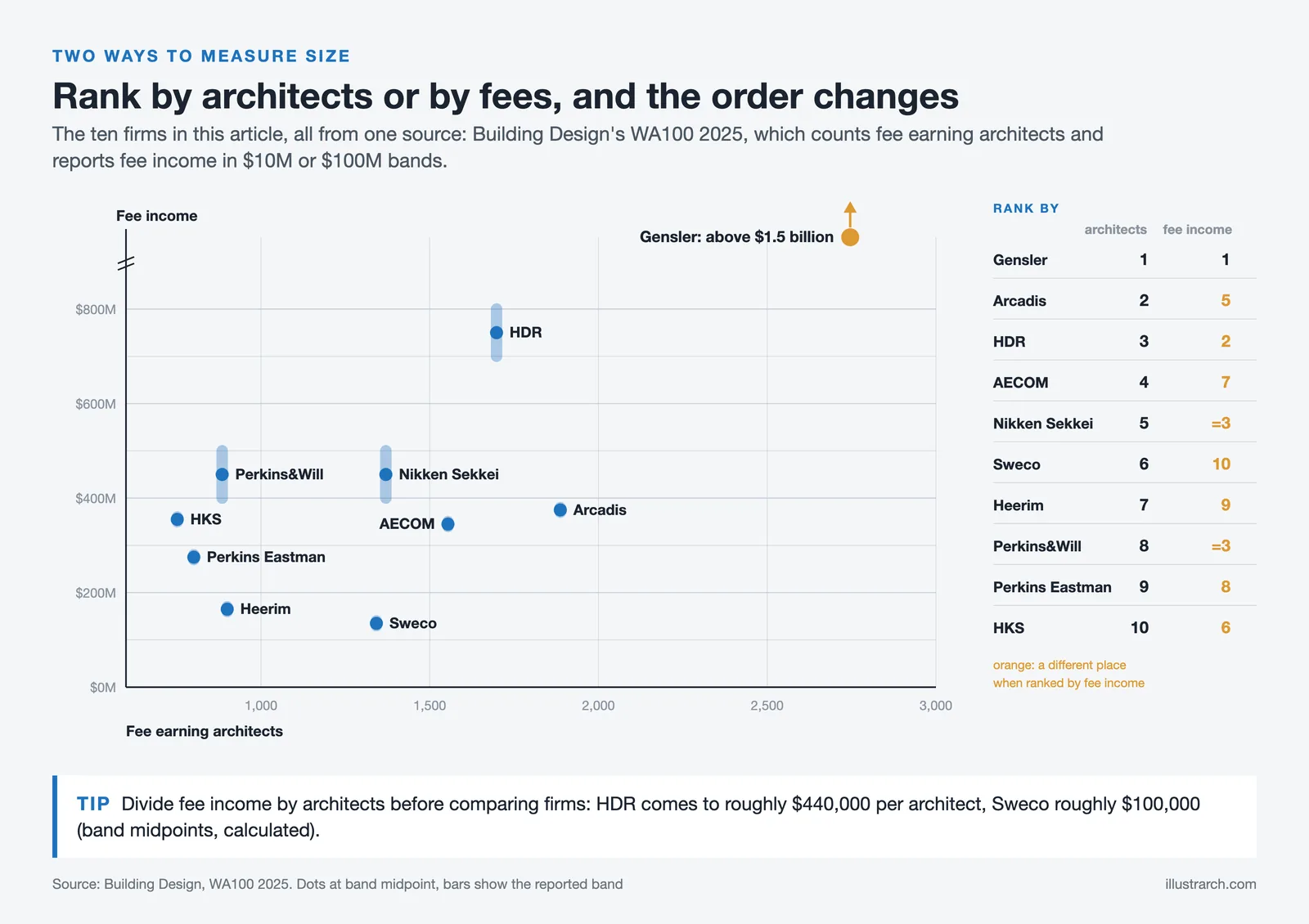
“Largest architecture firm” has more than one correct answer, because the two rankings that matter measure different things. Any list that does not say which one it is using is not telling you enough to compare it against another.
| Ranking | Published by | Measures | Covers |
|---|---|---|---|
| Top 300 Architecture Firms | Architectural Record (US) | Architecture revenue in US dollars | US-headquartered and US-earning firms |
| WA100 | Building Design (UK) | Number of qualified architects employed | Global, by headcount |
| 100 Best Architecture Firms | Archello | Editorial selection on design reputation | Global, qualitative |
| Self-reported figures | Firms themselves | Whatever the firm chooses to disclose | Varies, and is not audited |
Three consequences follow, and they explain most of the disagreement between lists:
Revenue and headcount produce different orders. A firm with high fees per architect ranks higher by revenue than by headcount, and a firm doing high-volume work in lower-cost markets ranks the other way round.
Multidisciplinary firms distort both. Practices such as Arcadis, AECOM and Jacobs earn most of their revenue from engineering and consulting. Whether their architecture arm is counted separately, and how, changes their position by many places.
Reporting is voluntary. Firms that do not submit figures do not appear, which is why some well-known practices are absent from lists that ought to include them.
The figures in the table above are drawn from the published rankings for the most recent year available at the time of writing. Rankings are annual, so check the source before quoting a number: a 2025 list and a 2026 list can differ by several positions without anything real having changed.
If you are looking for firms selected on design reputation rather than on size, that is a different question with a different answer, and our list of the best architecture firms in the world covers it.
Key Players Across Regions

North America
The United States dominates the global rankings by sheer volume. Beyond Gensler and Perkins&Will, firms like HKS ($662 million in 2024 revenue), Corgan, Populous, HDR, and CannonDesign consistently appear in the top 25 of both Architectural Record and BD+C rankings. HDR, founded in 1917 and headquartered in Omaha, employs over 10,000 people across 225+ locations. Its strength lies in healthcare, science, and civic architecture, making it one of the most diversified among the top healthcare architecture firms globally.
Perkins&Will reported $720 million in architecture revenue for 2024 and holds more LEED-accredited professionals than any other firm. In July 2024, the firm acquired Denmark-based Schmidt Hammer Lassen Architects to strengthen its European portfolio.
Asia
Nikken Sekkei, headquartered in Tokyo, has operated for over 125 years and completed more than 25,000 projects globally. It ranks among the top five largest architectural firms in the world by both fee income and architect count. The firm’s portfolio includes the Tokyo Skytree, Grand Front Osaka, and the Cairo Opera House. South Korea’s Heerim Architects & Planners advanced to sixth place in the WA100 2024 rankings, reflecting the growing influence of East Asian firms in global architecture.
Europe
Sweco, based in Stockholm, is the only European firm that appears in the global top ten by architect count (sixth in WA100 2025). With 1,342 fee-earning architects and 17,000 total employees, it covers architecture, urban planning, and infrastructure across Northern Europe. The UK remains a significant contributor to global rankings, with Foster + Partners (#20 in WA100 2024), BDP (#23), and Zaha Hadid Architects (#28) among the most prominent. The WA100 2026 edition noted that Foster + Partners saw a 55% increase in turnover and jumped 10 places in the rankings.
“Following our exciting debut on the World Architecture 100 list last year, we are proud to see Arcadis retain its ranking as one of the top global design firms in 2025.”
Mansoor Kazerouni, Global Director of Architecture and Urbanism, Arcadis
What Makes an Architecture Firm “Large”?

Size in architecture is measured differently depending on the source. The WA100 uses the number of fee-earning architects as its primary metric, which explains why some firms rank higher globally than their revenue alone would suggest. Architectural Record and BD+C focus on revenue, which favors U.S. firms operating in higher-fee markets.
Three factors separate the largest architectural firms from mid-size and boutique practices:
First, geographic diversification. Firms like Gensler and AECOM maintain offices in over 50 cities, enabling them to serve clients across regulatory environments and cultural contexts. This reach makes them attractive to multinational corporations, government agencies, and developers working across borders.
Second, sector breadth. The largest firms operate across healthcare, education, commercial, hospitality, transportation, and residential sectors simultaneously. HDR, for example, is a leader in healthcare facility design, while Populous dominates sports and entertainment venues. This diversification cushions firms against downturns in any single market.
Third, integrated service delivery. Many of the world’s largest architecture firms offer engineering, interior design, urban planning, landscape architecture, and project management alongside core architecture services. According to the American Institute of Architects (AIA), firms that integrate project management tools with design workflows report measurably fewer project overruns.
Emerging Trends Shaping the Largest Firms

Several forces are reshaping how the biggest architecture firms operate and compete.
Sustainability as a Core Service
Sustainability has moved from a marketing talking point to a revenue driver. Perkins&Will’s acquisition strategy specifically targeted firms with green building credentials. Sweco built its entire brand around sustainable urban development. The global push toward net-zero buildings, driven by regulations like the EU’s Energy Performance of Buildings Directive, is forcing even the most commercially focused firms to invest in environmental performance capabilities.
Mergers and Acquisitions
The Arcadis story is not unique. Over the past decade, consolidation through acquisitions has accelerated among the largest architecture firms. Arcadis acquired IBI Group and CallisonRTKL. Perkins&Will integrated Schmidt Hammer Lassen. Stantec has acquired dozens of smaller practices across North America and Europe. These moves expand geographic reach, add specialized talent, and create cross-selling opportunities across disciplines.
Technology Adoption
BIM (Building Information Modeling), parametric design tools, and AI-assisted workflows are standard at most top firms. Zaha Hadid Architects remains a pioneer in computational design, while Gensler has invested in proprietary research platforms. Firms that integrate technology into their daily workflows can manage larger, more complex projects with fewer errors and faster delivery times.
How to Choose Between Large and Boutique Firms
The world’s largest architecture firm is not automatically the right fit for every project. Size offers certain advantages: deep benches of specialized talent, global supply chain relationships, financial stability to weather project delays, and brand recognition that can ease permitting and stakeholder negotiations. For a 500-bed hospital or a mixed-use megadevelopment, the operational capacity of a firm like HDR or Gensler is difficult to replicate.
Boutique and mid-size firms counter with design intensity. Practices like BIG (Bjarke Ingels Group), Snohetta, and Studio Gang consistently win design awards and push creative boundaries in ways that operational scale sometimes discourages. Their smaller teams allow principals to stay closely involved with every project. When design innovation is the primary objective, a firm’s WA100 ranking matters less than its portfolio and creative philosophy.
For career-seekers, the distinction matters too. Large firms offer structured career paths, exposure to diverse project types, and international transfer opportunities. Boutique firms offer closer mentorship, earlier responsibility, and deeper involvement in the design process. Both paths can lead to a fulfilling career in architecture, and the right choice depends on your professional goals.
Ranking data and revenue figures are based on the WA100 2025 survey by Building Design and the Architectural Record Top 300 (2025 edition, based on 2024 data). Figures may vary between sources due to differing survey methodologies and reporting periods.
This ranking is based on revenue and headcount rather than on design reputation. For a selection judged on influence and built work, see our list of the best architecture firms in the world.







Futuro House Production Revived in Finland After Decades-Long Hiatus
A Facebook listing for abandoned moulds led to the first new Futuro...
 illustrarch Editoral Team3 Mins read

Building Your Dream Home in NSW: What You Should Know About Montgomery Homes
Montgomery Homes has been building across Sydney, Newcastle, the Hunter, Wollongong and...
illustrarch Editoral Team4 Mins read

Designing a Home Theater: Where Drapery Fits Into the Plan
In a media room the curtains are a performance layer, not decoration....
illustrarch Editoral Team3 Mins read

Oscar Niemeyer’s Cathedral of Brasília: The Hyperboloid Concrete Hymn
The Cathedral of Brasília reads as a single gesture, yet it stood...
Furkan Sen7 Mins read


Leave a comment