

Burj Al Arab: Inside the World’s Most Luxurious Sail-Shaped Hotel
From its artificial island foundation to the world's tallest atrium, the Burj Al Arab redefined luxury hospitality. This article covers its sail-inspired architecture by Tom Wright, duplex suite layouts, signature restaurants, and the engineering feats behind Dubai's most recognizable landmark.
 Sinan Ozen18 February 20266 Mins read435

Table of Contents Show
Few buildings anywhere on Earth are as instantly recognizable as the Burj Al Arab. Rising from an artificial island off the coast of Jumeirah Beach, this sail-shaped tower has served as Dubai’s architectural calling card since 1999. Architect Tom Wright of WS Atkins conceived it as a structure that would do for Dubai what the Opera House did for Sydney. More than two decades later, that ambition has been fulfilled.
The building’s triangular silhouette, inspired by the billowing sail of a traditional Arabian dhow, connects to the mainland via a private curving bridge. At 321 meters tall, the Burj Al Arab was the tallest hotel in the world when it opened and remains one of the most photographed structures in the Middle East. What draws visitors and architects alike is the combination of bold structural engineering, theatrical interior design, and a level of hospitality that earned the building its unofficial “seven-star” reputation.

Where Is the Burj Al Arab Located in Dubai?
The Burj Al Arab stands on a man-made island in the Jumeirah Beach area of Dubai, United Arab Emirates. The hotel sits along the Persian Gulf coastline, south of the Palm Jumeirah and north of the downtown cluster that includes the Burj Khalifa. The beachfront was historically known as Chicago Beach, named after the Chicago Bridge & Iron Company that once operated there.
Builders drove 230 concrete piles, each 40 meters long, into the seabed to create a stable foundation. A ring of large rocks protects the island from wave erosion. The result is a plot of reclaimed land that appears to float just offshore, giving the hotel an almost surreal presence against the turquoise water. For those interested in how Dubai’s architectural identity has evolved, the Burj Al Arab remains a pivotal reference point.

What Is the Burj Al Arab? Understanding the Design Concept
At its core, the Burj Al Arab is a luxury all-suite hotel operated by the Jumeirah Group. Tom Wright set out to create a structure that would become a symbol of an entire city, and the sail form was chosen for its direct connection to Dubai’s maritime heritage. The dhow, a wooden sailing vessel, played a central role in the region’s pearl diving and trading history for centuries.
The building’s plan is roughly triangular. Two wings extend from a central spine, with the space between them covered by a translucent Teflon-coated fiberglass screen that diffuses natural light while flexing under coastal wind loads. The Burj Al Arab falls under the Structural Expressionism style, where the structural system becomes the primary visual element rather than being hidden behind cladding. Six massive diagonal steel trusses, each roughly the length of a football field, form the skeleton of the building and are visible from the exterior.
Height and Structure of the Burj Al Arab
The Burj Al Arab height reaches 321 meters (1,053 feet) from ground level to the tip of its decorative mast. That makes the building about 11 meters taller than The Shard in London and roughly 60 meters shorter than the Empire State Building. The top floor sits at 197.5 meters, meaning a significant portion of the tower’s height is made up of its non-occupiable spire.
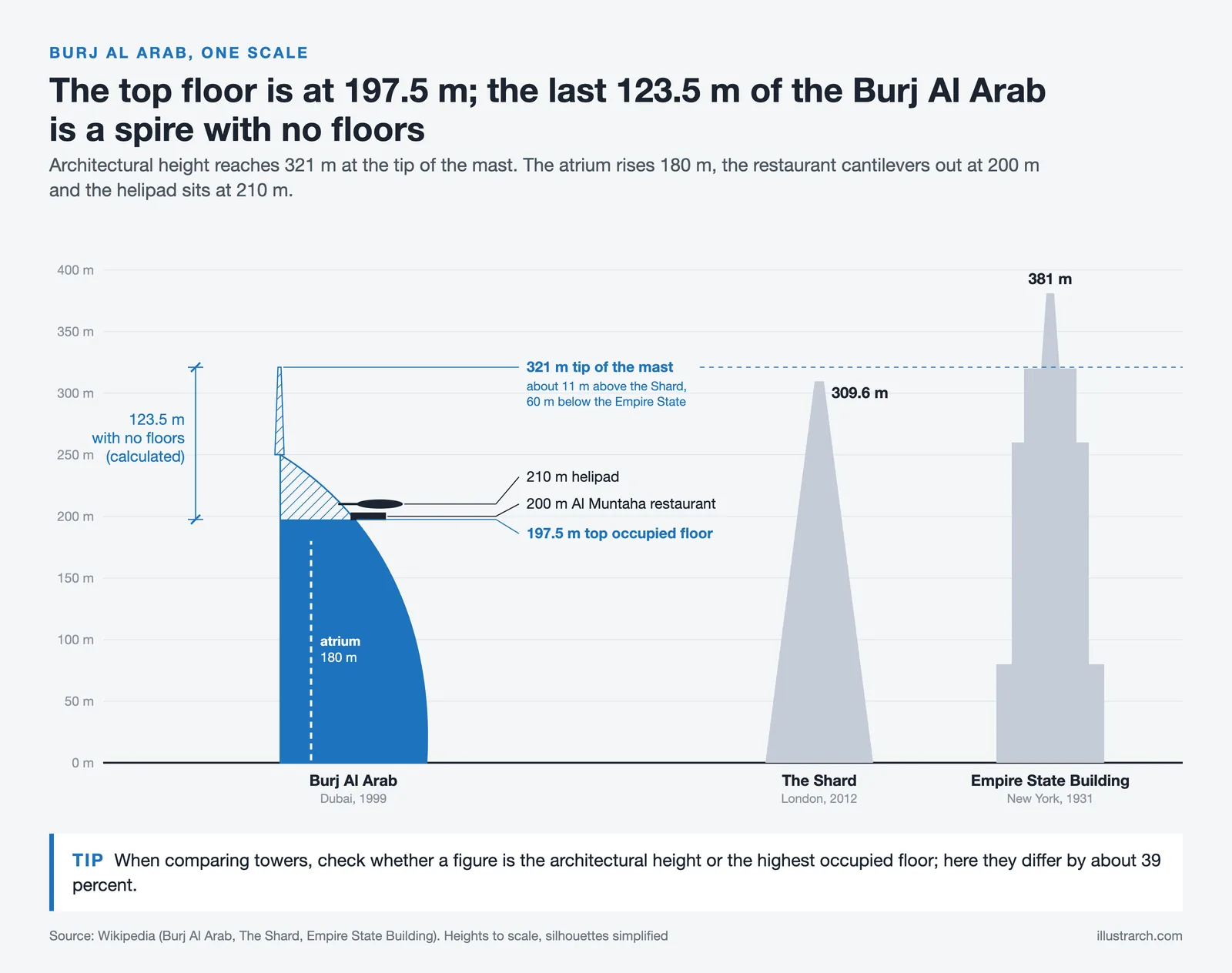
Construction began in 1994 and took five years. The building contains more than 70,000 cubic meters of concrete and 9,000 tons of steel. A helipad near the top, designed by architect Rebecca Gernon, sits 210 meters above ground. It has famously hosted a tennis match between Roger Federer and Andre Agassi. For a broader look at how skyscraper engineering has evolved, the Burj Al Arab occupies a notable place in that timeline.

Floors in the Burj Al Arab
The building has 56 floors above ground and two basement levels. Despite this count, the hotel holds only 202 suites because every guest room is a duplex spanning two stories. Each suite occupies a wedge-shaped section of the plan, with living areas on one level and bedrooms above, all oriented toward the Persian Gulf.
Dubai Burj Al Arab Inside: The Interior Experience
If the exterior channels the clean geometry of a sail, the interior tells a different story. Stepping through the entrance, guests are met by an atrium rising over 180 meters through the center of the building, making it one of the tallest hotel atriums in the world. Golden columns line the space, and a fountain at the base shoots water 42 meters into the air.
Interior designer Khuan Chew of KCA International created the hotel’s lavish palette. More than 30 types of Statuario marble cover nearly 24,000 square meters of walls and floors. Gold leaf, rich jewel tones, and custom-woven carpets fill the suites and public areas. A unique waterfall inside the atrium combines fiber optics with atomized water for a kaleidoscopic visual effect. Those studying concept-driven interior design will find the hotel’s approach to spatial drama worth examining closely.

Burj Al Arab Room Types and Suite Layout
Every accommodation in the Burj Al Arab is a suite. The 202 duplex suites range from 169 square meters (1,820 sq ft) to the Royal Suite at 780 square meters (8,400 sq ft). Each suite is assigned eight dedicated staff members with 24-hour butler service.
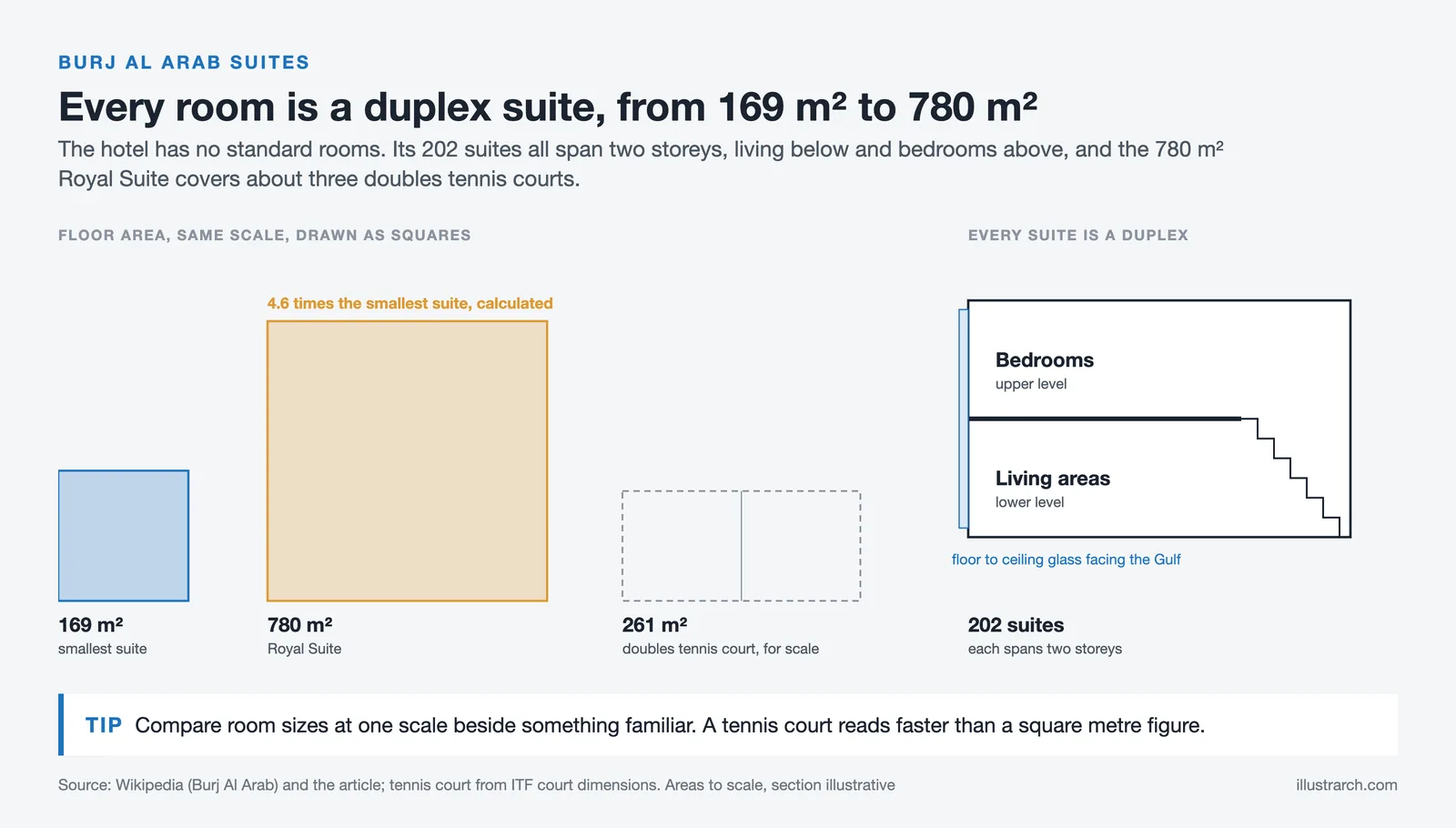
The Royal Suite features a cinema room, two master bathrooms with full-size Jacuzzis, a library, and a majlis-style lounge at rates reported between $20,000 and $25,000 per night. Every Burj Al Arab room follows the same spatial logic: living areas on the lower level, bedrooms above, and floor-to-ceiling windows facing the Arabian Gulf.
Burj Al Arab Restaurants and Dining
Dining at the Burj Al Arab is designed to be as memorable as the architecture. Al Muntaha (“The Ultimate”) sits 200 meters above the Gulf on a cantilevered platform, serving French-Italian fine dining with panoramic coastal views. Al Mahara (“Oyster”), accessed via a simulated submarine voyage, features a seawater aquarium holding roughly 990,000 liters behind 18-centimeter-thick acrylic glass.
Other Burj Al Arab restaurants include Bab Al Yam for Mediterranean cuisine, Sahn Eddar for afternoon tea in the atrium, and beachfront venue Sal. Visitors exploring the intersection of hotel design and guest experience will find that each restaurant creates its own enclosed world within the larger building.
Dubai Burj Al Arab Facts: Numbers Behind the Icon
A collection of data points illustrates the scale of the project.

Key Facts at a Glance
| Category | Detail |
|---|---|
| Location | Jumeirah Beach, Dubai, UAE |
| Architect | Tom Wright, WS Atkins |
| Height | 321 m (1,053 ft) |
| Floors | 56 above ground, 2 below |
| Suites | 202 duplex suites |
| Construction | 1994 to 1999 |
| Atrium height | Over 180 m |
| Helipad elevation | 210 m above ground |
| Structural style | Structural Expressionism |
The hotel’s famous “seven-star” label originated from a British journalist who toured the building before its opening and described it as beyond anything she had seen. The Jumeirah Group has never officially used the term. For those who enjoy studying how iconic buildings shape city identity, the Burj Al Arab offers a clear case study.
Engineering and Construction Challenges
Building on an artificial island in the Persian Gulf presented unique problems. The foundation alone took roughly three years. Workers created a ground surface above sea level using large rocks in a concrete honeycomb pattern, with compacted sand around the perimeter for erosion resistance.
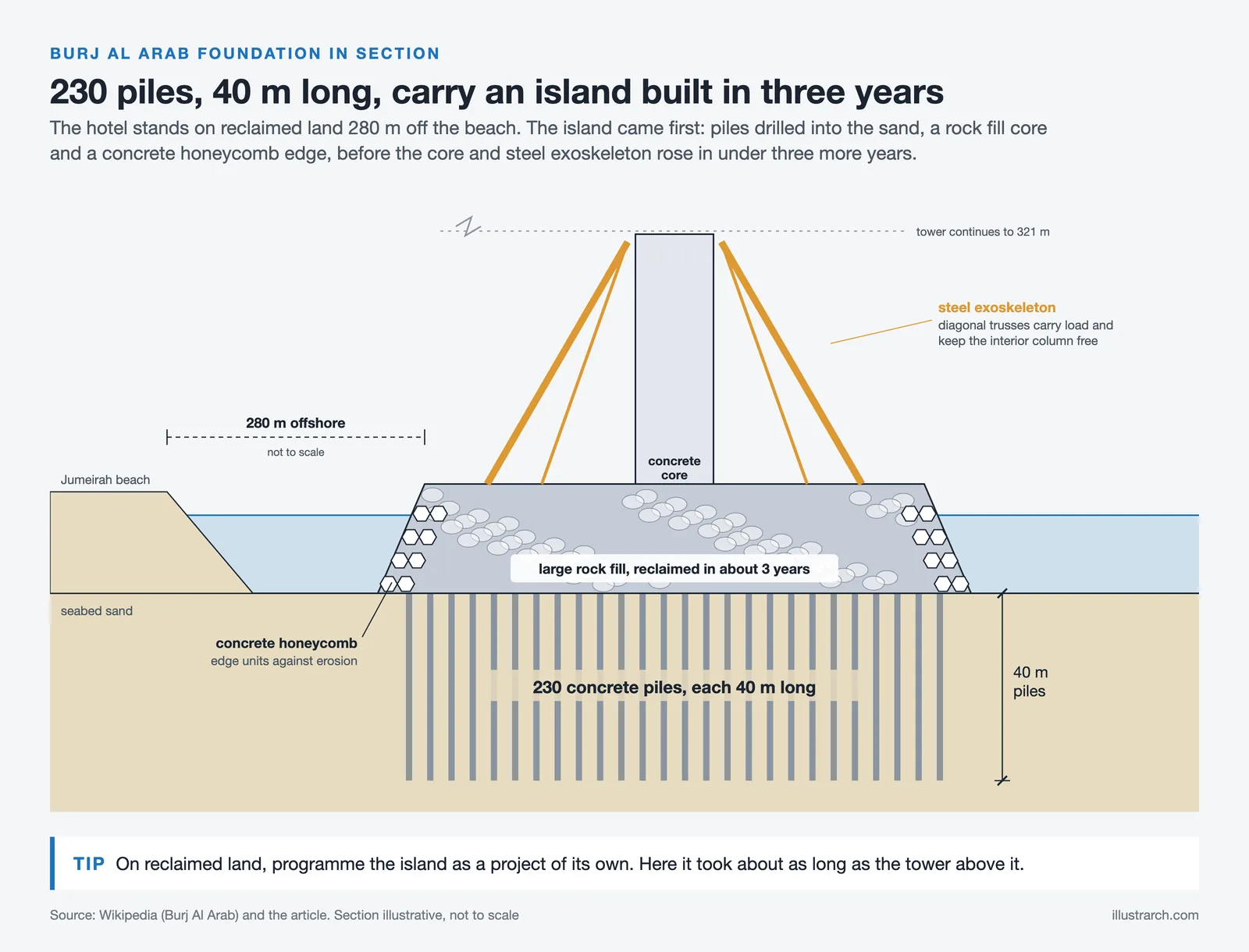
The composite structural system combines a reinforced concrete core with an external steel exoskeleton. The six diagonal mega-trusses are not decorative; they carry significant structural loads and keep the interior largely column-free. According to Britannica, the cantilevered restaurant and helipad each required specialized engineering solutions. The project demanded coordination among specialists from multiple countries, a pattern common to ambitious architecture and design projects worldwide.

The Burj Al Arab’s Place in Dubai’s Architectural Story
When the Burj Al Arab opened in December 1999, Dubai’s skyline looked very different. The Burj Khalifa would not be completed for another decade, and the Palm Jumeirah was still in planning. The hotel served as a proof of concept, showing that a Gulf city could produce architecture of global significance through a single building.
That lesson shaped what followed. The bold, icon-driven approach to Dubai’s urban development can be traced to the Burj Al Arab’s success. It established a template: commission a world-class team, build something without precedent, and let the resulting media coverage handle the marketing.
Today, the Burj Al Arab remains the most widely recognized symbol of Dubai after the Burj Khalifa. For architecture students, it raises worthwhile questions about spectacle and substance, and whether a building designed for visual impact can also contribute meaningfully to architectural discourse. Readers can explore other landmarks in this collection of the world’s most beautiful structures or browse architecture articles at Learn Architecture for further reading.
Whether you visit for afternoon tea, a helicopter arrival, or simply to admire the building from Jumeirah Beach, the Burj Al Arab rewards attention. It is simultaneously a feat of engineering, an exercise in luxury branding, and a landmark that helped put a young city on the global map.


1 Comment


Famous Buildings in Los Angeles: Icons of LA Architecture
Nine of the most famous buildings in Los Angeles profiled: architect, year,...
 illustrarch Editoral Team9 Mins read
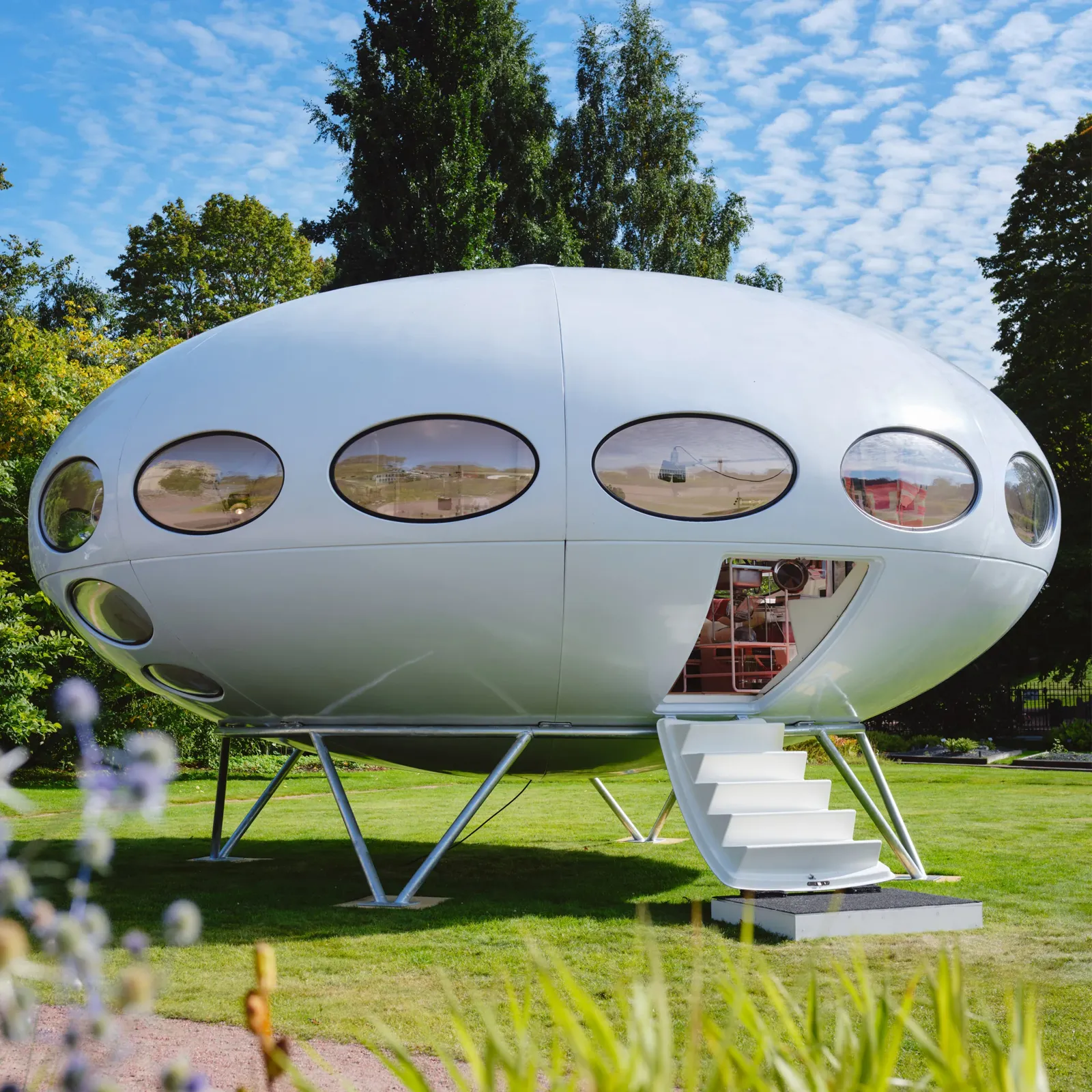
Futuro House Production Revived in Finland After Decades-Long Hiatus
A Facebook listing for abandoned moulds led to the first new Futuro...
illustrarch Editoral Team3 Mins read
Building Your Dream Home in NSW: What You Should Know About Montgomery Homes
Montgomery Homes has been building across Sydney, Newcastle, the Hunter, Wollongong and...
illustrarch Editoral Team4 Mins read
Designing a Home Theater: Where Drapery Fits Into the Plan
In a media room the curtains are a performance layer, not decoration....
illustrarch Editoral Team3 Mins read


The Burj Al Arab looks interesting. I like how it was built on an island. The design is unique, and it seems like a nice place to visit.