

Choosing Tiles for Wet Areas: What Architects Must Consider
Tiles for wet areas must meet specific performance criteria, including slip resistance, low water absorption, and durability, to ensure occupant safety and building longevity.
 Sinan Ozen12 May 20266 Mins read204

Table of Contents Show
Tiles for wet areas are surfaces specified for bathrooms, showers, pool decks, and any space exposed to standing water or repeated splashing. The right choice balances slip resistance (a wet DCOF of 0.42 or higher per ANSI A326.3), low water absorption, and durability against thermal and chemical wear. Aesthetics matter, but specification starts with safety and performance data.
Architects often treat tile selection as one of the last decisions of an interior package, yet it directly affects both occupant safety and long-term building performance. A tile that looks correct on a moodboard can fail once it meets soap, suncream, or pool chemistry. This guide breaks down what to verify before signing off on a wet-area tile schedule, drawing on current ANSI standards, ISO porosity classes, and real-world detailing experience.
What Defines a Wet Area in Architectural Practice?
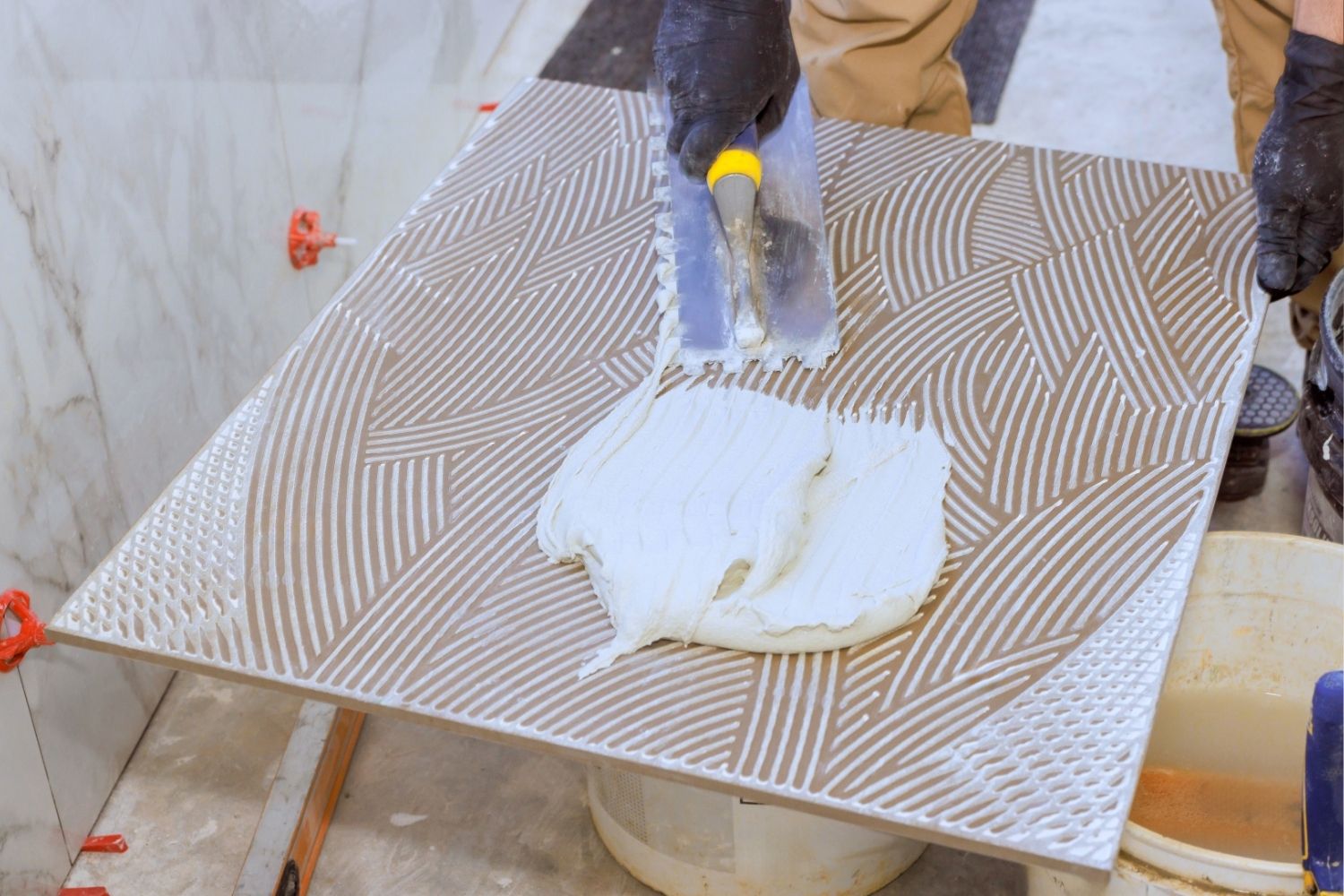
In code language, a wet area is any interior or exterior surface regularly exposed to free water, splashing, or standing moisture. The 2021 International Building Code and the TCNA Handbook treat showers, steam rooms, pool surrounds, locker room floors, and commercial kitchens as the most demanding categories. Bathrooms outside the immediate shower envelope are often classified as “damp” rather than “wet,” but in residential design most architects specify them under the same hygienic standard.
The TCNA’s ANSI A326.3 standard defines five product use classifications: Interior Dry (ID), Interior Wet (IW), Interior Wet Plus (IW+), Exterior Wet (EW), and Oils/Greases (O/G). A single project (a hotel bathhouse, for example) may need three or four classifications across its tile schedule. Decisions about ventilation, structural load, and code compliance all interlock with tile selection.
💡 Pro Tip
When writing a wet-area tile spec, always cite the product use category alongside the DCOF value (for example, “IW+ classification, wet DCOF ≥ 0.55”). Asking manufacturers for these data sheets at the request stage filters out tiles that look identical on a sample board but perform very differently on site.
How to Choose Bathroom Tiles: The Five Specification Variables
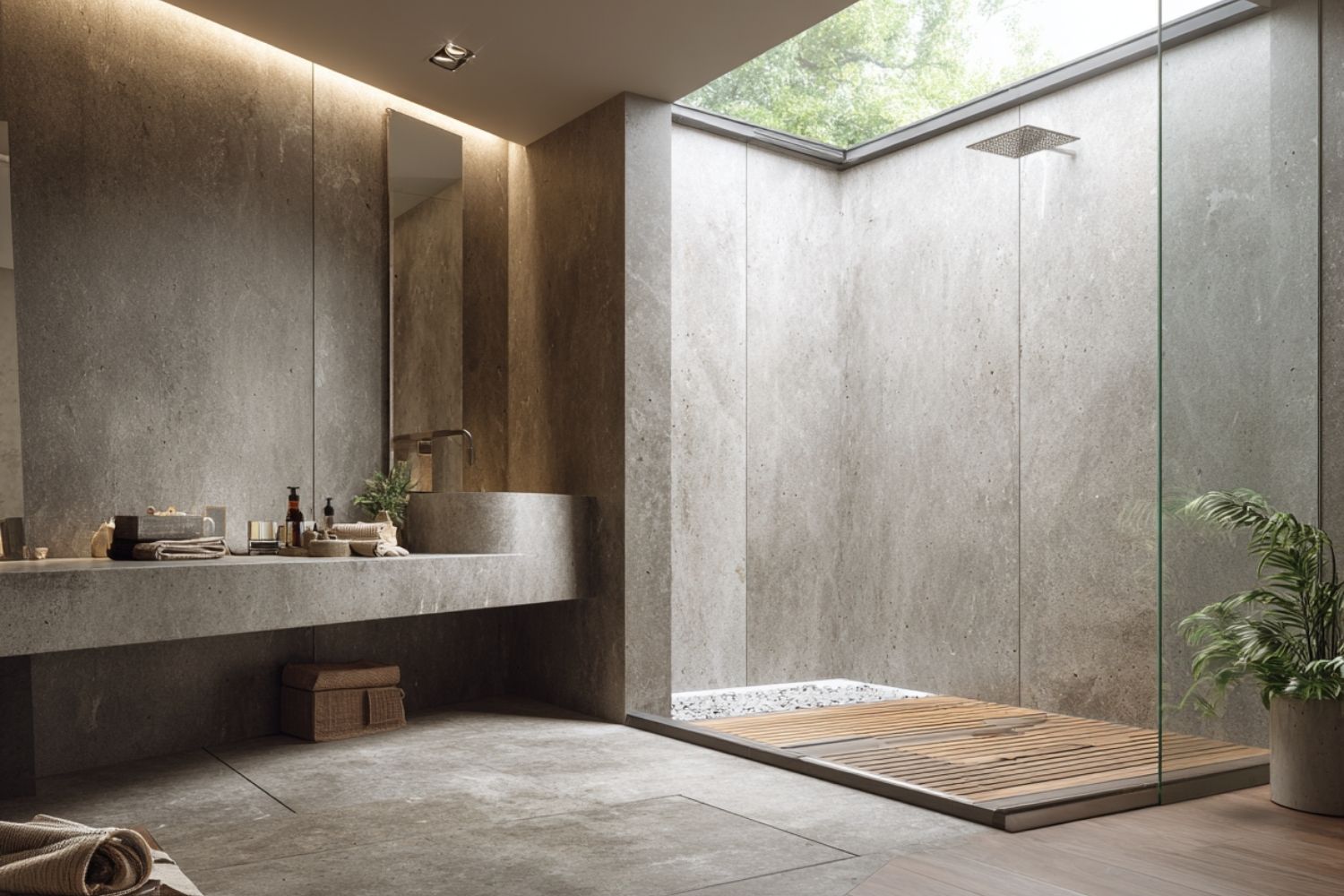
Choosing bathroom tiles starts with five technical variables that every product data sheet should answer: water absorption, slip resistance, breaking strength, frost resistance (for exterior wet zones), and chemical resistance. Aesthetics close the decision.
Water Absorption and Porosity Class
ISO 13006 classifies ceramic tiles by water absorption into four bands: Group I (≤ 3 percent), Group II (3 to 10 percent), Group III (above 10 percent), and a separate porcelain category at ≤ 0.5 percent. For shower floors, steam rooms, and any area in continuous contact with water, porcelain is the default specification. Higher-absorption tiles let water migrate into the body, causing thermal cracking, freeze damage, and microbial growth over time.
Slip Resistance and the DCOF 0.42 Threshold
The single most important number in a wet-area tile spec is the wet Dynamic Coefficient of Friction. According to the Tile Council of North America, ANSI A137.1 requires a minimum wet DCOF of 0.42 for level interior tiles intended to be walked on when wet. The figure is based on decades of European traction research and has been incorporated into the International Building Code since 2012.
That 0.42 minimum is exactly that, a minimum. Pool surrounds, ramps, locker rooms with soap residue, and barrier-free shower floors should target 0.55 or higher. The German DIN 51097 ramp test (with classifications A, B, and C for barefoot wet areas) is often specified as a secondary check.
📐 Technical Note
The DCOF AcuTest is performed using a BOT-3000E tribometer, with a Neolite sensor and a wetting agent of distilled water plus 0.05 percent sodium lauryl sulfate per ANSI A326.3. Site conditions can yield lower real-world traction than the lab number, so specifiers typically include a 0.05 to 0.10 buffer above the code minimum.
Tile Format and Grout Joint Width
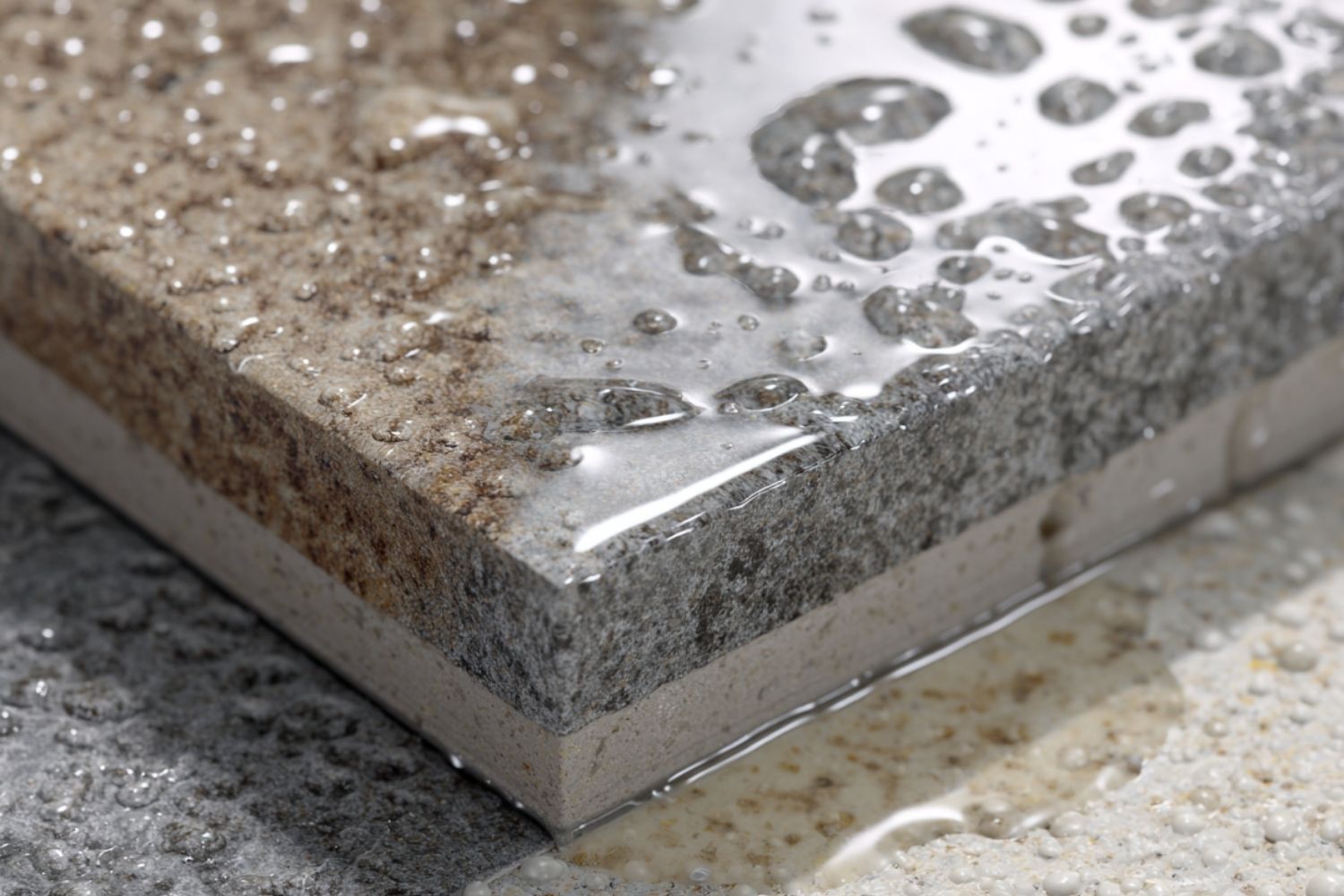
Large-format tiles (60 by 60 cm and above) reduce grout lines, which simplifies cleaning and gives a continuous visual surface. They can also reduce slip resistance unless the surface itself is textured, because grout joints contribute meaningful traction underfoot. For shower floors, the conventional approach is to use mosaic-format tiles (5 by 5 cm or smaller) so that grout density increases grip and pre-formed slopes can drain to the waste.
Choosing Pool Tile: A Different Set of Constraints
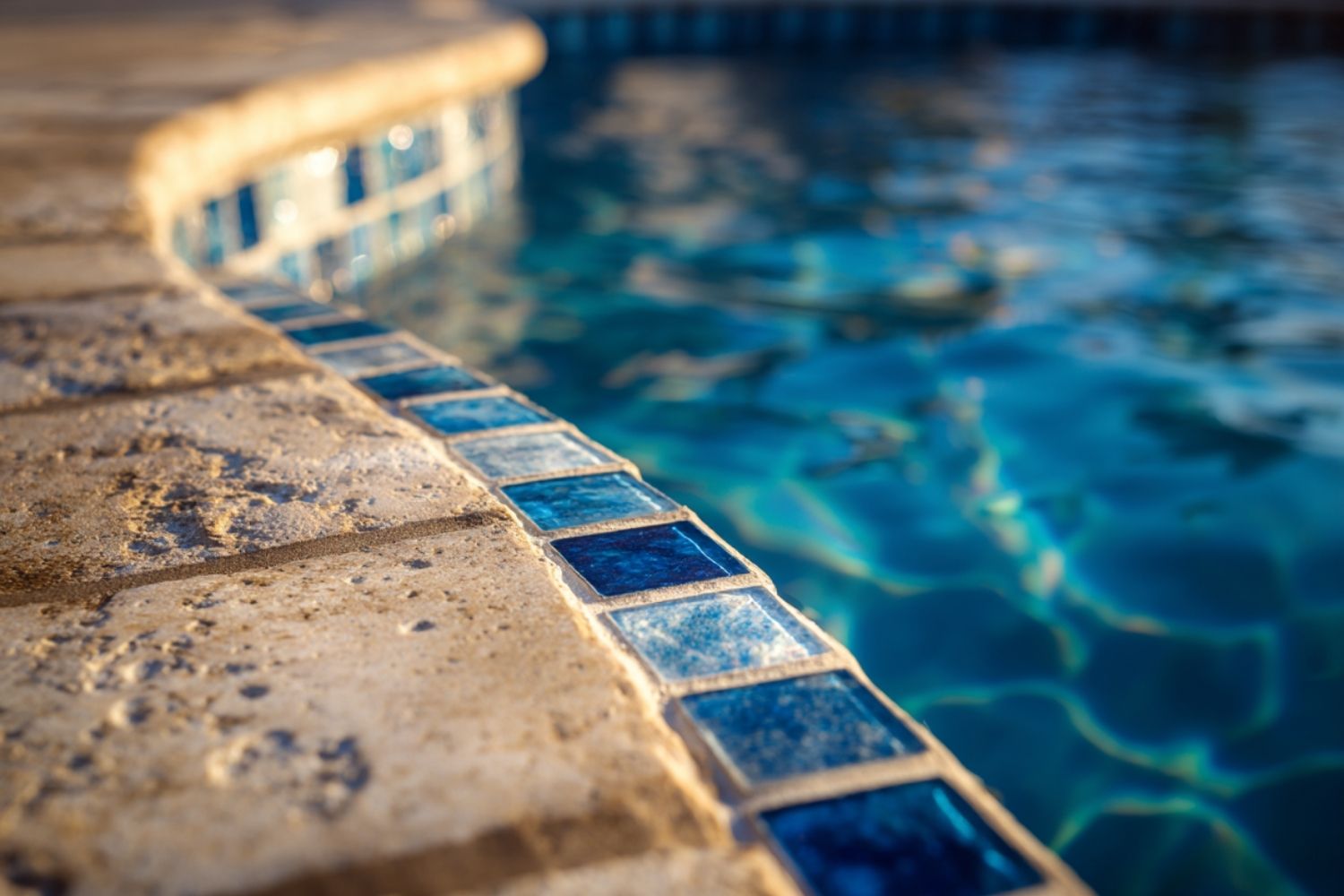
Choosing pool tile introduces variables that bathroom specifications usually skip: chlorine and salt resistance, freeze-thaw cycles for outdoor pools, and the visual behaviour of glaze under refracted water. Waterline tiles take the heaviest chemical load and need extremely low porosity, freeze-thaw certification, and a glaze that resists fading from chlorine and UV. Glass mosaics and high-grade porcelain dominate this band, paired with epoxy grout.
Pool decks are the highest-risk slip zone in any aquatic facility. The TCNA reports that the IAPMO Uniform Swimming Pool, Spa, and Hot Tub Code now incorporates a model wet DCOF requirement of 0.42 minimum for walkway surfaces intended to be walked on when wet. Most pool consultants write the spec at 0.60 or higher and pair it with a textured or structured surface finish.
🏗️ Real-World Example
Therme Vals (Switzerland, 1996, Peter Zumthor): Zumthor specified locally quarried Valser quartzite cut into 60,000 slabs of three thicknesses, all flame-finished or split-faced for traction. The detail shows that wet-area surfacing can be both architecturally singular and code-compliant when the texture is engineered into the stone face itself.
Tile Material Comparison: Porcelain, Ceramic, Stone and Glass
The four common tile bodies behave very differently in wet zones. The table below summarises the trade-offs that most often decide a specification.
| Material | Water Absorption | Best Wet-Area Use | Main Limitation |
|---|---|---|---|
| Porcelain | ≤ 0.5% | Shower floors, pool decks, steam rooms | Hard to cut on site, brittle at edges |
| Glazed Ceramic | 3-10% | Bathroom walls (not floors) | Glaze can be slippery when wet |
| Natural Stone (honed) | Varies (1-10%) | Spa floors, vanity surrounds | Requires periodic sealing, etches with acid |
| Glass Mosaic | ≈ 0% | Pool waterlines, accent walls | Slippery on floors, costly per m² |
| Quarry Tile | ≤ 5% | Commercial kitchens, back-of-house wet zones | Limited finish range, industrial appearance |
Why Is Grout Selection as Important as Tile Selection?
Grout failures cause more wet-area complaints than tile failures. Grout is the porous, replaceable layer that handles thermal expansion, water migration, and surface cleaning, and the wrong choice will undermine even the best tile spec.
Cement-based grouts are inexpensive and easy to install, but they absorb water, stain, and require sealing. Epoxy grouts (ANSI A118.3) are nearly impervious and effectively maintenance-free, which is why they dominate pool, commercial kitchen, and wet-room specifications. They cost roughly two to three times more than cement grout, so the trade-off is labour and budget against long-term performance. Grout colour also changes the perceived scale and pattern of a tile installation.
⚠️ Common Mistake to Avoid
Specifying a low-absorption porcelain tile with standard cement grout in a steam shower. The tile will perform, but the grout will absorb steam, harbour mould, and eventually fail. Steam rooms, gang showers, and salt-water pool decks should always be paired with epoxy or urethane grout.
Substrate and Waterproofing: The Layer Tile Cannot Fix
Tiles do not waterproof a wet area. Water passes through grout joints, around penetrations, and behind movement cracks within weeks of normal use. The waterproofing membrane sitting under the tile is what keeps the building dry. ANSI A118.10 and A118.12 cover the criteria for liquid-applied and sheet membranes used in tiled wet rooms.
For shower floors, a properly sloped pre-sloped pan with a bonded membrane (Schluter-Kerdi, Laticrete Hydro Ban, and similar systems) is the current standard. Pool tiling sits on a more complex assembly with cementitious slurry waterproofing, often with a chemical-resistant topcoat. Relying on tile and grout alone to keep water out is one of the most expensive failures in residential construction, often discovered only when ceiling damage appears below.
What Are the Most Common Wet-Area Tile Specification Errors?
The most common errors are: specifying a tile by appearance and only checking DCOF later; using polished porcelain on shower floors; mixing materials with incompatible coefficients of thermal expansion; ignoring movement joints at corners and around penetrations; and writing a generic “tile by others” line on the drawing set, which transfers responsibility to a contractor without the expertise to interpret it.
A clean wet-area tile spec includes the manufacturer, product code, format, finish, DCOF, ANSI A326.3 product use category, grout type, and installation standard reference. Anything less invites substitution and dispute.
✅ Key Takeaways
- Wet-area tile specification starts with performance data (DCOF, water absorption, ANSI A326.3 category), not aesthetics.
- The minimum wet DCOF for level interior wet floors is 0.42; pool decks and barrier-free showers should target 0.55 or higher.
- Porcelain (≤ 0.5 percent absorption) is the default for shower floors and pool decks; glazed ceramic belongs on walls only.
- Grout choice (cement vs epoxy) often determines long-term performance more than the tile itself.
- Tiles do not waterproof a wet area; the membrane underneath does. Always specify the waterproofing system explicitly.
Final Thoughts
Selecting tiles for wet areas is a technical decision dressed up as a design one. The aesthetic choice closes the process; the safe and durable specification opens it: porosity class, slip rating, grout system, waterproofing membrane, and movement detailing. Architects who treat tile schedules as performance documents rather than finish boards produce bathrooms and aquatic spaces that survive their warranty periods without callbacks.







Futuro House Production Revived in Finland After Decades-Long Hiatus
A Facebook listing for abandoned moulds led to the first new Futuro...
 illustrarch Editoral Team3 Mins read
Building Your Dream Home in NSW: What You Should Know About Montgomery Homes
Montgomery Homes has been building across Sydney, Newcastle, the Hunter, Wollongong and...
illustrarch Editoral Team4 Mins read
Designing a Home Theater: Where Drapery Fits Into the Plan
In a media room the curtains are a performance layer, not decoration....
illustrarch Editoral Team3 Mins read

Oscar Niemeyer’s Cathedral of Brasília: The Hyperboloid Concrete Hymn
The Cathedral of Brasília reads as a single gesture, yet it stood...
 Furkan Sen7 Mins read


Leave a comment