

Free Online Concrete & Material Calculator
Concrete Calculator
Volume, bags, cement, sand and gravel for slabs, footings, walls, columns and steps.
Reinforcement (optional)
Cost (optional)
Enter the prices you pay. The cost uses the quantities with waste.
Results
Enter values to see results
How it's calculated
Brick/Block Calculator
Calculate bricks and mortar for wall construction.
Mortar mix and bags
Grout fill and bond beams (blocks)
Cost (optional)
Enter the prices you pay. The cost uses the quantities with waste.
Results
Enter values to see results
How it's calculated
Plaster/Screed Calculator
Calculate materials for plastering and floor screed.
Cost (optional)
Enter the prices you pay. The cost uses the quantities with waste.
Results
Enter values to see results
How it's calculated
Paint Calculator
Calculate paint and primer for walls and ceilings.
Cost (optional)
Enter the prices you pay. The cost uses the quantities with waste.
Results
Enter values to see results
How it's calculated
Concrete & Material Calculator: Estimate Bags, Yards, Blocks & Cost
Whether you’re pouring a driveway, setting fence posts, or building a foundation, calculating the right amount of concrete is essential to avoid costly shortages or waste. Our free concrete calculator helps you estimate volume in cubic yards, determine how many bags you need, and calculate material costs for any project.
Understanding concrete calculations is fundamental to construction, similar to how bubble diagrams help architects plan spatial relationships, accurate material estimates ensure your project succeeds. This comprehensive guide covers formulas for slabs, footings, columns, sonotubes, and concrete block walls with real-world examples and cost data.
The calculator also has a quick paint tab. For room-by-room paint quantities with doors, windows, primer and can sizes, use our paint calculator.

Basic Concrete Calculation Formula
The foundation of all concrete calculations is the simple volume formula. Once you know the volume, you can convert to cubic yards and determine bag quantities or ready-mix needs.
Volume (cu ft) = Length (ft) × Width (ft) × Thickness (ft)📐 Essential Conversions
- Cubic Feet to Cubic Yards: Divide by 27 (1 cubic yard = 27 cubic feet)
- Inches to Feet: Divide by 12
- Cubic Yards to Cubic Meters: Multiply by 0.7646
- 1 Cubic Yard = 27 cubic feet = 46,656 cubic inches = 0.76 cubic meters
Measure Dimensions
Measure the length, width, and thickness/depth of your project area in feet. Convert any inch measurements to feet by dividing by 12.
Calculate Cubic Feet
Multiply Length × Width × Thickness to get volume in cubic feet. For irregular shapes, break into rectangles and add them together.
Convert to Cubic Yards
Divide the cubic feet by 27 to get cubic yards. This is the standard measurement for ordering ready-mix concrete.
Add Waste Factor
Add 5-10% extra for waste, spillage, and uneven subgrade. For complex shapes or inexperienced DIYers, add 10-15%.
Example: 10×10 Slab, 4 Inches Thick
• Convert thickness: 4 inches ÷ 12 = 0.333 feet
• Volume: 10 × 10 × 0.333 = 33.3 cubic feet
• Cubic yards: 33.3 ÷ 27 = 1.23 cubic yards
• With 10% waste: 1.23 × 1.10 = 1.35 cubic yards

Concrete Bag Calculator
For smaller projects where ordering a concrete truck isn’t practical, pre-mixed bags are the solution. Understanding bag yields helps you buy the right quantity without making multiple trips to the store.
Concrete Bag Yields
| Bag Size | Yield (cu ft) | Yield (cu yd) | Bags per Cubic Yard | Typical Price |
|---|---|---|---|---|
| 40 lb (Quikrete/Sakrete) | 0.30 | 0.011 | 90 | $3.50 to $5.00 |
| 50 lb | 0.375 | 0.014 | 72 | $4.00 to $5.50 |
| 60 lb (Quikrete/Sakrete) | 0.45 | 0.017 | 60 | $4.50 to $6.50 |
| 80 lb (Quikrete/Sakrete) | 0.60 | 0.022 | 45 | $5.50 to $8.00 |
Number of Bags = Total Cubic Feet ÷ Bag Yield (cu ft)Example: 10×10 Slab Using 80 lb Bags
• Volume needed: 33.3 cubic feet (from earlier calculation)
• Bags: 33.3 ÷ 0.60 = 55.5 bags
• With 10% extra: 55.5 × 1.10 = 61.05, rounded up to 62 bags of 80 lb concrete
The calculator does this for you when How will you get the concrete? is set to Pre-mixed concrete bags. It takes the yield per bag from the QUIKRETE Concrete Mix data sheet, 0.60 cu ft for an 80 lb bag, and rounds every count up: for the 10 × 10 ft slab at 4 in it shows 1.23 cu yd (33.3 cu ft), 56 bags of 80 lb, 62 with the 10% waste allowance, and 2.24 US tons of bags to carry (2.48 with waste). Change the bag size to 40, 50 or 60 lb and the count follows.

Concrete Slab Calculator
Concrete slabs are the most common residential project, used for patios, driveways, garage floors, and foundations. The thickness varies by application, affecting both material needs and cost.
Recommended Slab Thickness by Application
| Application | Minimum Thickness | Recommended | Notes |
|---|---|---|---|
| Walkway/Sidewalk | 3″ | 4″ | Light foot traffic only |
| Patio | 4″ | 4″ | Standard residential use |
| Driveway (cars) | 4″ | 4-5″ | Use 5″ for heavy vehicles |
| Driveway (trucks/RVs) | 5″ | 6″ | Requires reinforcement |
| Garage Floor | 4″ | 4-6″ | 6″ for workshops |
| Shed Foundation | 4″ | 4″ | Gravel base recommended |
| House Foundation | 6″ | 6-8″ | Requires engineering |
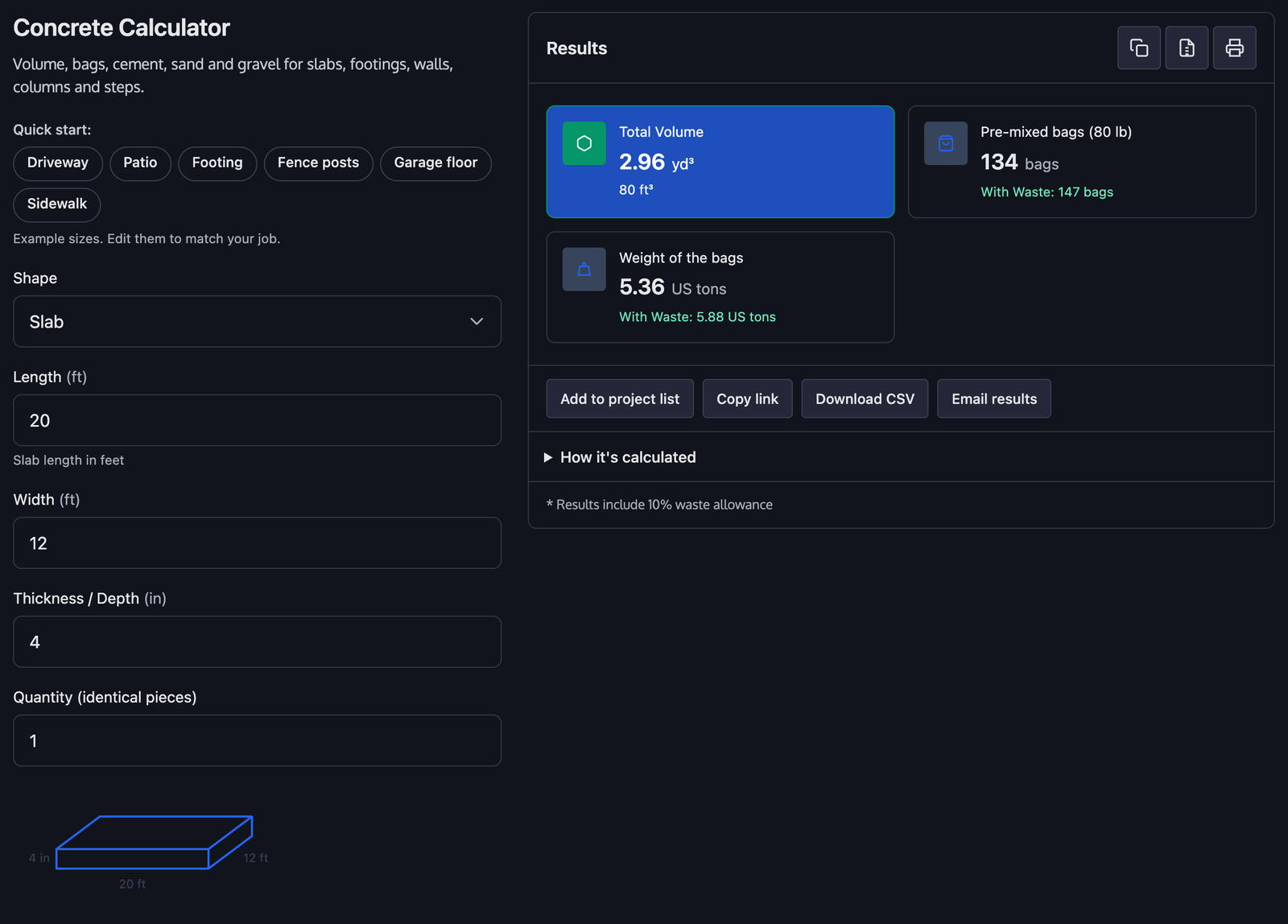
To size a slab in the calculator above, keep Shape on Slab and enter the length, width and thickness, or start from a Quick start preset. A 20 × 12 ft driveway at 4 in comes out at 2.96 cu yd (80 cu ft). With Pre-mixed concrete bags selected that is 134 bags of 80 lb, or 147 with the default 10% waste allowance.
Other slab presets: patio (12 × 12 ft), garage floor (24 × 24 ft) and sidewalk (30 × 4 ft), all 4 in thick. They open in feet and inches or in metres, depending on your browser language.
Concrete Coverage by Thickness
| Thickness | Sq Ft per Cubic Yard | 80 lb Bags per 10 Sq Ft |
|---|---|---|
| 2 inches | 162 sq ft | 1.1 bags |
| 3 inches | 108 sq ft | 1.7 bags |
| 4 inches | 81 sq ft | 2.2 bags |
| 5 inches | 65 sq ft | 2.8 bags |
| 6 inches | 54 sq ft | 3.3 bags |
| 8 inches | 40.5 sq ft | 4.4 bags |
Common Slab Sizes
| Slab Size | 4″ Thick (cu yd) | 6″ Thick (cu yd) | 80 lb Bags (4″) |
|---|---|---|---|
| 8×8 ft (64 sq ft) | 0.79 | 1.19 | 36 |
| 10×10 ft (100 sq ft) | 1.23 | 1.85 | 56 |
| 12×12 ft (144 sq ft) | 1.78 | 2.67 | 80 |
| 10×20 ft (200 sq ft) | 2.47 | 3.70 | 111 |
| 20×20 ft (400 sq ft) | 4.94 | 7.41 | 222 |
| 20×24 ft (480 sq ft) | 5.93 | 8.89 | 267 |

Concrete Footing Calculator
Footings distribute the load from walls and columns to the soil below, preventing settling and structural damage. Proper footing design is critical for resilient construction that withstands environmental stresses.
Footing Size Guidelines
| Wall Thickness | Footing Width | Footing Depth | Rule |
|---|---|---|---|
| 6 inches | 12 inches | 6 inches | Width = 2× wall |
| 8 inches | 16 inches | 8 inches | Depth = wall thickness |
| 10 inches | 20 inches | 10 inches | Standard residential |
| 12 inches | 24 inches | 12 inches | Heavy-duty |
Cubic Yards = (Length ft × Width in × Depth in) ÷ 3,888Example: Foundation Footing (30 ft long, 16″ wide, 8″ deep)
• Formula: (30 × 16 × 8) ÷ 3,888 = 3,840 ÷ 3,888
• Result: 26.7 cubic feet = 0.99 cubic yards
• For 120 linear feet (house perimeter): 3.95 cubic yards
In the calculator, choose Strip footing as the shape and enter the total length of the footing runs with the width and depth. The example above gives the same 0.99 cu yd, which is 45 bags of 80 lb pre-mixed concrete, or 49 with 10% waste.
Frost Depth Requirements
Footings must extend below the frost line to prevent heaving. Depth requirements vary by region:
| Region | Typical Frost Depth | Examples |
|---|---|---|
| Southern US | 0-12 inches | Florida, Texas, Arizona |
| Central US | 24-36 inches | Kansas, Missouri, Kentucky |
| Northern US | 36-48 inches | Minnesota, Wisconsin, Maine |
| Alaska/Mountain | 48-72+ inches | Alaska, mountain regions |

Sonotube and Fence Post Concrete Calculator
Sonotubes (cylindrical concrete forms) are used for deck posts, light poles, fence supports, and round columns. The calculation uses the cylinder volume formula.
Volume (cu ft) = π × (Diameter/24)² × Height (ft)Sonotube Concrete Requirements
| Diameter | Per Foot Height (cu ft) | 80 lb Bags per Foot | 4 ft Column (cu ft) |
|---|---|---|---|
| 6 inches | 0.20 | 0.33 | 0.79 |
| 8 inches | 0.35 | 0.58 | 1.40 |
| 10 inches | 0.55 | 0.91 | 2.18 |
| 12 inches | 0.79 | 1.31 | 3.14 |
| 14 inches | 1.07 | 1.78 | 4.28 |
| 16 inches | 1.40 | 2.33 | 5.58 |
| 18 inches | 1.77 | 2.95 | 7.07 |
| 24 inches | 3.14 | 5.24 | 12.57 |
Example: 6 Deck Posts (12″ diameter × 4 ft deep)
• Volume per post: π × (12/24)² × 4 = 3.14 × 0.25 × 4 = 3.14 cu ft
• Total for 6 posts: 3.14 × 6 = 18.84 cu ft = 0.70 cu yd
• 80 lb bags: 18.84 ÷ 0.60 = 32 bags
In the calculator, the Round column, post hole or sonotube shape does the same sum for any number of identical holes. The six deck posts above come out at 0.7 cu yd and 32 bags of 80 lb pre-mixed concrete, 35 with 10% waste. For fence posts, the Fence posts preset fills in ten 8 in holes, 3 ft deep: 0.39 cu yd, or 18 bags (20 with waste). Enter the post size as well and the square post is taken out of the hole volume, so you do not buy concrete for the space the post fills.

Cinder Block (CMU) Calculator
Concrete masonry units (CMU) or cinder blocks are essential for walls, foundations, and retaining structures. Understanding block quantities, mortar needs, and fill requirements is important for construction projects involving essential building materials.
Standard CMU Block Sizes
| Nominal Size | Actual Size | Face Area (sq ft) | Blocks per 100 sq ft |
|---|---|---|---|
| 4×8×16″ | 3⅝×7⅝×15⅝” | 0.89 | 113 |
| 6×8×16″ | 5⅝×7⅝×15⅝” | 0.89 | 113 |
| 8×8×16″ (standard) | 7⅝×7⅝×15⅝” | 0.89 | 113 |
| 10×8×16″ | 9⅝×7⅝×15⅝” | 0.89 | 113 |
| 12×8×16″ | 11⅝×7⅝×15⅝” | 0.89 | 113 |
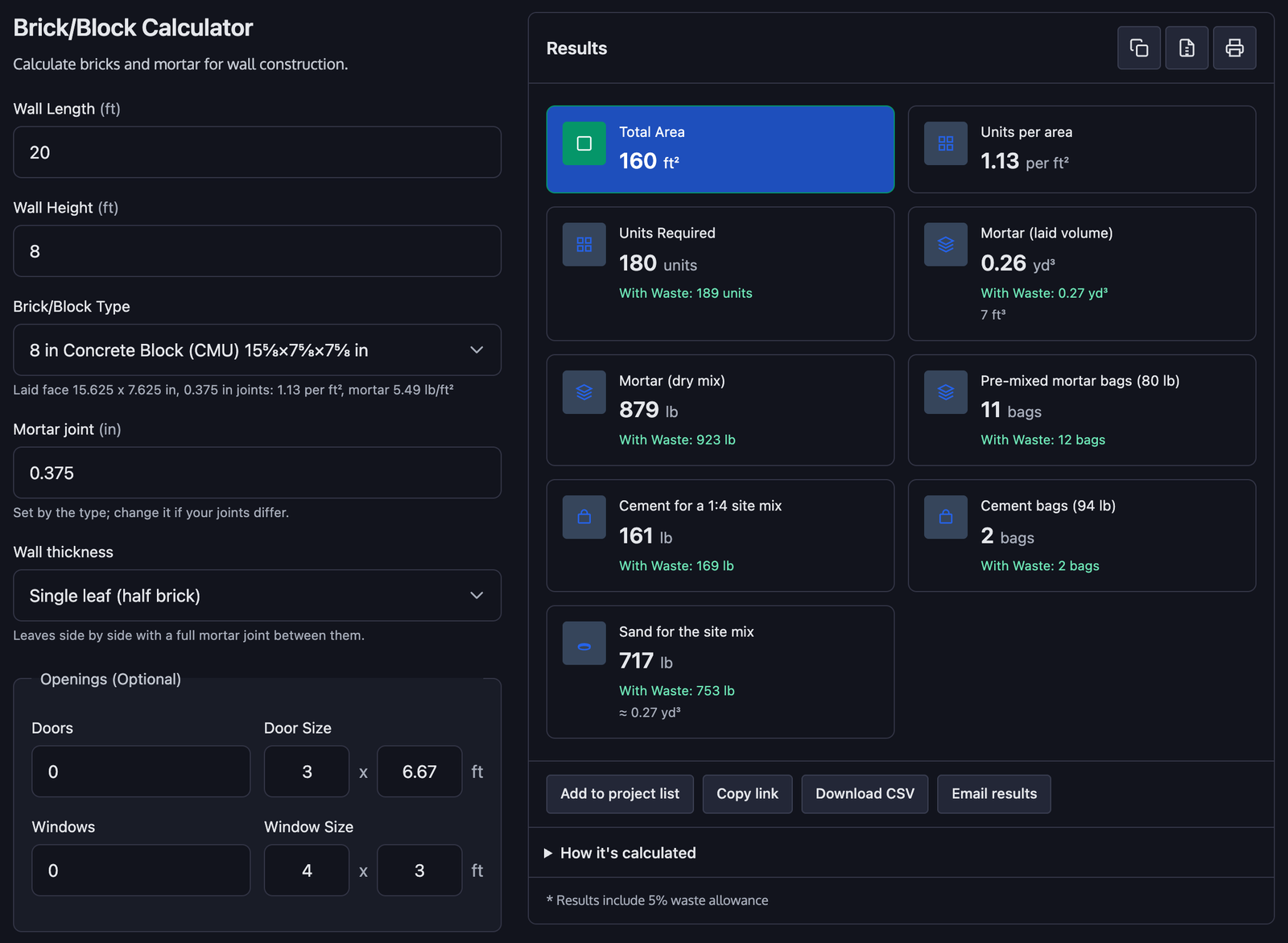
Blocks Needed = (Wall Length × Wall Height) ÷ 0.89 sq ftThe Brick/Block tab of the calculator works as a cinder block calculator. Choose 8 in Concrete Block (CMU) and enter the wall length and height: for a 20 × 8 ft wall it counts 180 blocks, 189 with the default 5% waste allowance, and 11 bags of 80 lb pre-mixed mortar (12 with waste). Doors and windows can be taken out of the wall area, and 6 in and 12 in CMU are in the same list.
Mortar & Fill Requirements
| Material | Amount per 100 Blocks | Notes |
|---|---|---|
| Mortar Mix (80 lb bags) | 8-9 bags | For standard 3/8″ joints |
| Sand (for mortar) | 1,000 lbs / 0.5 cu yd | If mixing from scratch |
| Grout/Fill (8″ blocks) | 0.8 cu yd | For fully grouted cores |
| Rebar (vertical) | Every 4 ft (16-24″ o.c.) | Check local codes |
Example: Block Wall (20 ft long × 8 ft high)
• Wall area: 20 × 8 = 160 sq ft
• Blocks: 160 ÷ 0.89 = 180 blocks
• With 5% waste: 189 blocks
• Mortar: 189 ÷ 100 × 8.5 = 16 bags (80 lb)
• Fill (if grouting): 189 × 0.008 cu yd = 1.5 cu yd
The 8 to 9 bags per 100 blocks used here is a site rule of thumb that already allows for mortar lost on the job, such as droppings and spillage. The calculator above works it out differently: it gives the mortar that fills the bed and head joints of the wall you enter and shows the figure with your waste allowance as a separate value, so its block mortar comes out lower than this rule.

Brick and Mortar Calculator
The Brick/Block tab is also a brick calculator and a mortar calculator. Pick the brick from the list, enter the wall length and height and take out the doors and windows. The calculator counts the bricks from the laid face plus the mortar joint, 1 ÷ ((length + joint) × (height + joint)), and works out the mortar that fills the bed and head joints. The wall can be a single leaf (half brick), two leaves or three, and the mortar can come as pre-mixed bags or as a cement and sand site mix from 1:3 to 1:6, or both side by side.
The list holds common sizes, the UK, German and Australian standard bricks and the US sizes of the Brick Industry Association (BIA), each with its own joint. For a single leaf wall the calculator shows:
| Brick | Size | Joint | Bricks | Mortar (dry mix) |
|---|---|---|---|---|
| US Modular | 7⅝ × 3⅝ × 2¼ in | 3/8 in | 6.86 per sq ft | 6.9 lb per sq ft |
| US Standard | 8 × 3⅝ × 2¼ in | 3/8 in | 6.55 per sq ft | 6.84 lb per sq ft |
| US Queen | 7⅝ × 2¾ × 2¾ in | 3/8 in | 5.76 per sq ft | 4.61 lb per sq ft |
| US King | 9⅝ × 2¾ × 2⅝ in | 3/8 in | 4.8 per sq ft | 4.52 lb per sq ft |
| US Norman | 11⅝ × 3⅝ × 2¼ in | 3/8 in | 4.57 per sq ft | 6.4 lb per sq ft |
| US Utility | 11⅝ × 3⅝ × 3⅝ in | 3/8 in | 3 per sq ft | 4.6 lb per sq ft |
| UK brick | 215 × 102.5 × 65 mm | 10 mm | 59.3 per m² | 35.2 kg per m² |
| German NF brick | 240 × 115 × 71 mm | 10 mm | 49.4 per m² | 36.5 kg per m² |
| Australian brick | 230 × 110 × 76 mm | 10 mm | 48.4 per m² | 33.7 kg per m² |
For the US Modular, Queen, King and Norman sizes it also gives the count in BIA Technical Note 10, which lays them to a vertical course module with slightly thicker bed joints: 675 per 100 sq ft for Modular against 686 here with 3/8 in joints both ways, so the calculator errs on the side of more brick.
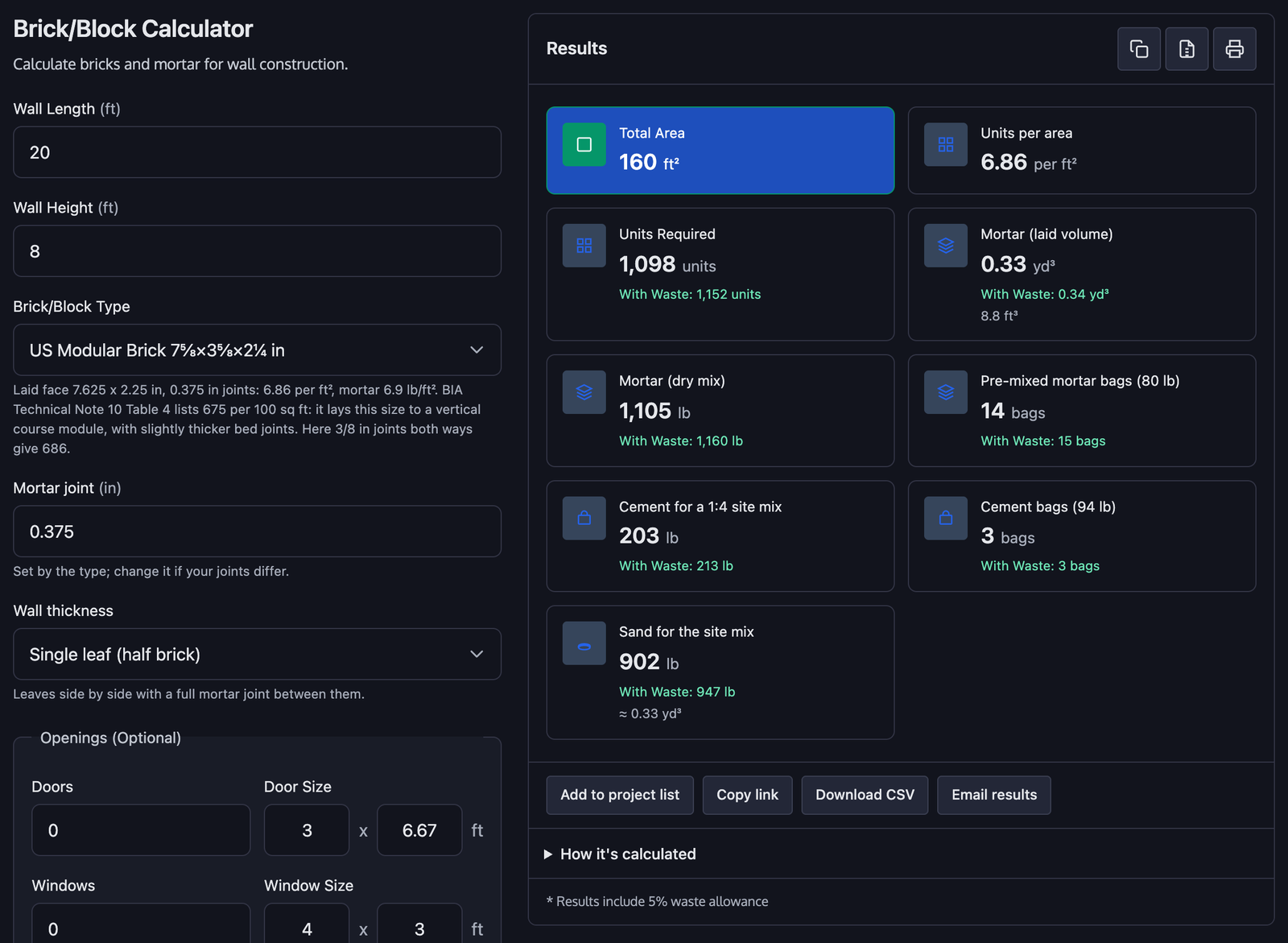
A 20 × 8 ft wall of US Modular brick takes 1,098 bricks, 1,152 with the default 5% waste, and 0.33 cu yd of laid mortar: 1,105 lb of dry mix, which is 14 bags of 80 lb pre-mixed mortar (15 with waste), or 203 lb of cement (3 bags of 94 lb) and 902 lb of sand for a 1:4 site mix. In metric, a 5 × 2.4 m wall of UK bricks takes 712 bricks (747 with waste) and 17 bags of 25 kg mortar (18 with waste). For concrete blocks, see the cinder block calculator above.
Plaster Calculator
The Plaster/Screed tab works out plaster, render and floor screed. Measure by total area, by room size (the walls, plus the ceiling if you tick it) or by a list of walls, take out the doors and windows, then pick the application: interior plaster, exterior render, floor screed, rough cast, self-leveling compound or gypsum plaster. Each type sets the bag product’s use per area and thickness and a default cement and sand mix, and the results show ready-mix bags, a cement and sand site mix, or both.
For a 14 × 12 ft room with 8 ft walls and the ceiling, interior plaster 1/2 in thick covers 584 sq ft and needs 0.9 cu yd of plaster: 51 bags of 50 lb ready-mix (56 with the 10% waste allowance), or 608 lb of cement (7 bags of 94 lb) and 1.22 US tons of sand for the 1:4 site mix.
Concrete Cost Calculator
Understanding concrete costs helps you budget accurately and choose between DIY mixing and ready-mix delivery. Prices vary by region and material choice, just as choosing the right building materials impacts overall project costs.
Ready-Mix Concrete Prices (2024-2025)
| Concrete Type | Price per Cubic Yard | PSI Rating | Best Use |
|---|---|---|---|
| Standard Mix | $150 to $180 | 2,500 PSI | Patios, sidewalks |
| Residential Mix | $160 to $195 | 3,000 PSI | Driveways, slabs |
| High-Strength | $175 to $220 | 4,000 PSI | Foundations, heavy loads |
| High-Performance | $200 to $255 | 6,000+ PSI | Commercial, structural |
| Fiber-Reinforced | $185 to $230 | 3,000+ PSI | Crack-resistant applications |
Additional Ready-Mix Costs
- Delivery Fee: $0 to $75 (typically free within 10-20 mile radius)
- Short-Load Fee: $40 to $55 per cubic yard for orders under 10 yards
- Saturday Delivery: +$100 to $200
- Waiting Time: $2 to $4 per minute after 5-7 minutes
- Pump Truck: $150 to $300+ for hard-to-reach locations
DIY vs. Ready-Mix Cost Comparison
| Factor | DIY (Bags) | Ready-Mix |
|---|---|---|
| Material Cost per Cu Yd | $250 to $360 (45 bags × $5.50-8) | $150 to $195 |
| Labor Time | 4-8 hours per yard | Pour in 30-60 minutes |
| Equipment Needed | Mixer or mixing tub | None (truck pours) |
| Best For | Under 1 cubic yard | 1+ cubic yards |
| Consistency | Variable | Factory controlled |
💰 Cost Examples by Project
- 10×10 Patio (4″): DIY: $340 (61 bags) | Ready-Mix: $220-270 + delivery
- 20×20 Driveway (4″): DIY: $1,220 (222 bags) | Ready-Mix: $990-1,220 (~5 yards)
- 8 Deck Posts (12″ × 4′): DIY: $235 (42 bags)
- 30 ft Footing (16″ × 8″): DIY: $110 (20 bags) | Ready-Mix: $100-130
Installed Concrete Costs
For professional installation, expect to pay $6-$12 per square foot, including materials, labor, and finishing:
| Project Type | Cost per Sq Ft | Typical Total |
|---|---|---|
| Basic Slab/Patio | $4 to $8 | $400 to $2,400 |
| Driveway | $6 to $15 | $2,400 to $8,600 |
| Garage Floor | $6 to $12 | $2,400 to $7,000 |
| Foundation Slab | $6 to $14 | $12,000 to $28,000 |
| Stamped/Decorative | $12 to $25 | $3,600 to $15,000 |

Project-Specific Calculators
🏠 Driveway Calculator
Standard size: 12′ × 20′ × 4″
Volume: 2.96 cubic yards
80 lb bags: 133 bags
Cost (ready-mix): $475 to $575
🪑 Patio Calculator
Standard size: 12′ × 12′ × 4″
Volume: 1.78 cubic yards
80 lb bags: 80 bags
Cost (ready-mix): $285 to $350
🏗️ Foundation Footing
Standard: 16″ wide × 8″ deep
Per 10 linear ft: 0.15 cu yd
120 ft perimeter: 1.76 cu yd
Cost: $280 to $340
📍 Fence Post Holes
Standard: 8″ diameter × 3′ deep
Per post: 1.05 cu ft
80 lb bags per post: 1.75
10 posts: 18 bags
For concrete steps, the calculator’s Steps (stairs) shape takes the number of steps, the rise, the going and the width, solid on the ground or on an inclined waist slab, with an optional top landing. If the step sizes are not fixed yet, the concrete stair calculator in our staircase tool sizes the risers and treads first and then gives the concrete volume and the formwork.

Tips for Accurate Concrete Calculations
- Always add extra: Order 5-10% more than calculated to account for waste, spillage, and uneven subgrade
- Add 1/4″ to thickness: This accounts for minor subgrade variations and ensures coverage
- Break complex shapes into rectangles: Calculate each section separately and add together
- For sloped slabs: Use average thickness: (min thickness + max thickness) ÷ 2
- Round up ready-mix orders: Most suppliers don’t sell partial yards; better to have extra than run short
- Consider weather: Hot weather requires faster placement; cold weather needs additives
- Plan for curing: Concrete reaches 70% strength in 7 days, full strength in 28 days

Frequently Asked Questions
How do I calculate yards of concrete?
Calculate cubic yards by multiplying Length × Width × Thickness (all in feet), then dividing by 27. For example, a 10×10 slab at 4 inches thick: 10 × 10 × 0.333 = 33.3 cubic feet ÷ 27 = 1.23 cubic yards. Always add 5-10% extra for waste.
How many bags of concrete do I need for a 10×10 slab?
For a 10×10 slab at 4 inches thick, you need approximately 56 bags of 80 lb concrete or 84 bags of 60 lb concrete. With 10% extra for waste, order 62 bags (80 lb). The slab requires 1.23 cubic yards of concrete.
How much does a cubic yard of concrete cost?
Ready-mix concrete costs $150 to $195 per cubic yard for standard residential mixes (3,000 PSI). The national average is approximately $180 per cubic yard. Additional fees may apply for short loads (under 10 yards), Saturday delivery, or pump trucks. A cubic yard weighs approximately 4,000 lbs.
How many 80 lb bags of concrete make 1 cubic yard?
It takes approximately 45 bags of 80 lb concrete to make 1 cubic yard. Each 80 lb bag yields about 0.60 cubic feet or 0.022 cubic yards of concrete. For 60 lb bags, you need 60 bags per yard; for 40 lb bags, you need 90 bags per yard.
How do I calculate concrete for a sonotube?
Use the cylinder formula: Volume = π × (Diameter/24)² × Height. For a 12-inch diameter tube that’s 4 feet deep: 3.14 × (0.5)² × 4 = 3.14 cubic feet. Divide by 0.60 to get 80 lb bags needed: approximately 5-6 bags per 12″ × 4′ sonotube.
How many concrete blocks do I need for a wall?
Divide the wall area by 0.89 sq ft (the face area of a standard 8×8×16 block including mortar joint). For a 20×8 foot wall: 160 sq ft ÷ 0.89 = 180 blocks. Add 5-10% for cuts and waste. You’ll also need about 8-9 bags of mortar mix per 100 blocks.
What thickness should a concrete driveway be?
Standard residential driveways should be 4 inches thick for regular car traffic. For heavy vehicles like trucks or RVs, use 5-6 inches. Commercial driveways may require 6-8 inches with reinforcement. Always use a compacted gravel base and consider wire mesh or fiber reinforcement.
Should I use bags or ready-mix concrete?
Use bags for projects under 1 cubic yard (small repairs, fence posts, small slabs). Order ready-mix for 1+ cubic yards, it’s more economical, saves significant labor (4-8 hours per yard vs. 30-60 minutes), and provides consistent quality. The break-even point is typically around 30-40 bags.
How deep should concrete footings be?
Footings must extend at least 12 inches below the frost line, which varies by region (12-72 inches depending on climate). Standard footing depth equals the wall thickness being supported. Check local building codes for specific requirements. Foundation footings typically need to rest on undisturbed soil.
How much waste factor should I add?
Add 5-10% for standard projects with level subgrade and simple shapes. Add 10-15% for irregular shapes, sloped sites, or inexperienced DIYers. For professional pours with proper preparation, 5% is usually sufficient. Some contractors add 1/4″ to the planned slab thickness instead of a percentage.

Additional Resources
Concrete Network CalculatorComprehensive calculator with cost estimates
Calculator.net Concrete ToolMultiple shape options and formulas
CalculatorSoupSlabs, footings, walls, columns, steps
Inch CalculatorYards and bag estimates with formulas
CEMEX CalculatorReady-mix concrete volume estimator
Omni Sonotube CalculatorDetailed column/tube calculations
CMU Block CalculatorBlock, mortar, and grout estimates
HomeGuide Slab Costs2026 concrete pricing data
Related Articles on Illustrarch
- Top 10 Essential Building Materials for Modern Construction
- Comparing Different Types of Building Materials: Strengths and Weaknesses
- Guide to Choosing the Right Building Materials
- Top Building Materials for Sustainable Construction
- Wood and Concrete Mix in Architecture: Benefits and Design
- The Pros and Cons of Popular Building Materials
- 7 Innovative Construction Materials
- What Are Alternative Building Materials?
- Top 5 Metals for Structural Integrity in Construction
- Resilient Architecture for Natural Disasters
- Bubble Diagram in Architecture
Tools on Illustrarch
- Bubble Diagram Maker: Plan spatial relationships for your projects
- All Architecture & Construction Tools: Browse our complete collection
Rate this tool
Was Free Online Concrete & Material Calculator useful? One tap, no sign-up.

