

Legal Guidelines for Tiny House Construction: What You Need to Know
Tiny house zoning laws control where and how you can build or park a tiny home. This guide explains permits for tiny homes, building codes like IRC Appendix Q, ADU backyard rules, off-grid compliance, and state-specific regulations including North Carolina. Includes a step-by-step legal checklist.
 Muhammad Abdullatef - Tifa Studio11 November 202538 Mins read785
Table of Contents Show
Building a tiny house is an exciting step toward simpler, more affordable living. Yet before you break ground, you need a solid grasp of the tiny house zoning laws that govern every project. From zoning regulations and building permits to off-grid compliance, each locality enforces its own rules. Getting these right from the start saves you money, time, and potential legal trouble down the line.
In this guide, we cover the essential legal requirements for tiny houses, whether you plan to place your home on a permanent foundation, keep it on wheels, or tuck it into a backyard as an accessory dwelling unit. We also look at state-specific considerations, with a focus on North Carolina, where tiny home demand is surging. If you are wondering “do I need a permit to build a tiny home?” or “can I build a tiny house on my property?”, read on for clear answers.

Understanding Tiny House Zoning Laws
Tiny house zoning laws determine where you can legally place a tiny home. Whether your jurisdiction classifies your dwelling under residential zoning or mobile/RV zoning directly affects parking, habitation rights, and permitting. Checking your local tiny home zoning laws before purchasing land or a trailer is always the first step. Zoning for tiny homes varies dramatically from one municipality to another, so a home that is perfectly legal in one city could be prohibited just across the county line.
Residential Zoning for Tiny Houses
Local governments enforce residential zoning laws that dictate where tiny houses are permissible. These laws often demand minimum square footage for dwellings, and some neighborhoods restrict non-traditional housing like tiny homes. In many suburban areas, tiny houses must comply with single-family residential zoning codes, including requirements for foundations, setbacks, and spacing between structures.
Cities such as Portland, Oregon, and Austin, Texas, have adopted more flexible zoning for tiny homes. Portland allows tiny homes in all residential zones, while Austin has facilitated tiny home projects through collaborative stakeholder engagement. Others maintain strict minimum size rules that effectively exclude most tiny house designs. Before you commit to a location, contact your local planning department to confirm whether your proposed build satisfies the zoning for tiny homes in that district. The American Planning Association offers resources to help you understand how local zoning ordinances work.
Most Common Zoning Barriers for Tiny Houses
Understanding the specific obstacles that tiny house builders face helps you plan more effectively and avoid costly surprises. The table below outlines the most frequently encountered zoning barriers across US municipalities, along with practical strategies for addressing each one.
| Zoning Barrier | How It Affects Tiny Homes | Potential Workaround |
|---|---|---|
| Minimum Square Footage | Many jurisdictions require 600–1,000+ sq ft, excluding homes under 400 sq ft | Check if Appendix Q/BB is adopted; apply for variance; look for ADU pathways |
| Single-Family Zoning Restrictions | Limits lots to one dwelling unit, preventing tiny homes as secondary structures | Apply under ADU legislation if available; explore PUD or overlay district options |
| RV Habitation Limits | THOWs classified as RVs face 30- to 180-day habitation caps | Place THOW in a designated tiny home community or RV park with full-time permits |
| Foundation Requirements | Many codes mandate permanent foundations, excluding wheeled units | Remove wheels and permanently affix chassis to foundation; pursue modular certification |
| HOA Covenants | Design standards and minimum size rules (often 1,000+ sq ft) block tiny homes | Review CC&Rs before purchasing; choose non-HOA properties; seek HOA board approval |
| Density Limitations | Restricts multiple dwellings on a single parcel, affecting tiny home communities | Apply for PUD designation; explore cottage cluster ordinances in your municipality |
| Mandatory Utility Connections | Requires municipal water/sewer hookups, limiting off-grid options | Seek rural/unincorporated land; verify whether alternative systems are accepted |
Tiny House Zoning Classification: How Your Home Is Categorized
Understanding how your tiny home is classified is essential because it determines which regulations apply. Municipalities typically categorize tiny houses into one of several legal classifications, each carrying different requirements for permitting, placement, and habitation rights. The table below summarizes the most common classifications and their implications.
| Classification | Typical Definition | Where Allowed | Key Requirement |
|---|---|---|---|
| Single-Family Dwelling | Permanent foundation, meets IRC | Residential zones (R-1, R-2, etc.) | Must meet local minimum sq ft and building codes |
| Accessory Dwelling Unit (ADU) | Secondary unit on existing lot | Most residential zones (varies by state) | Primary dwelling must exist on lot; size limits apply |
| Recreational Vehicle (RV) | On wheels, RVIA/ANSI A119.5 certified | RV parks, some private lots with zoning approval | RVIA certification; often restricted from full-time use |
| Manufactured Home | Factory-built, meets HUD code | Manufactured home parks, some residential zones | HUD label and permanent foundation placement |
| Park Model | ≤400 sq ft, built to ANSI A119.5 | RV parks, campgrounds, some residential areas | May need dual certification for permanent residence |
Mobile and RV Zoning
Mobile and RV zoning laws apply to tiny houses on wheels. These regulations determine where mobile tiny houses can be parked for extended periods. Typically, these zones are limited to RV parks or designated mobile home communities, and they may include seasonal restrictions or limited time frames for occupancy.
Several municipalities allow tiny houses to occupy designated spaces in mobile home parks, but others maintain strict prohibitions. If you plan to live in a tiny house on wheels full time, confirm that your chosen location allows year-round habitation under its RV or mobile home ordinances. For a closer look at communities that welcome small-footprint housing, see our guide to popular tiny house communities in the US.
💡 Pro Tip: If you plan to live full-time in a tiny house on wheels, ask your local zoning office two specific questions: (1) “Does this zone allow year-round RV habitation?” and (2) “Is there a maximum duration for non-permanent dwelling occupancy?” Many jurisdictions impose 180-day or even 30-day limits on RV habitation that could force you to relocate periodically.
Planned Unit Developments and Overlay Districts
Some municipalities use Planned Unit Developments (PUDs) and overlay districts to allow tiny homes in areas where standard zoning would otherwise restrict them. A PUD lets a developer incorporate mixed housing types, including tiny homes, into a single site plan with tailored standards. Overlay districts function as an additional zoning layer, permitting smaller dwellings in specific geographic areas without a full zoning rewrite. Rockledge, Florida, adopted two such districts (a redevelopment mixed-use district and a PUD zone) through a citizen-led initiative, making both tiny houses on foundations and on wheels legal within city limits. If your municipality does not currently allow tiny homes, advocating for a PUD or overlay approach at local planning meetings can be an effective strategy.
💡 Pro Tip: If your local zoning code does not accommodate tiny homes, don’t assume you are out of options. Many municipalities accept formal variance applications or conditional use permits. These processes typically require a public hearing and a fee ($200–$2,000), but they can grant you permission to build a tiny home in a zone that would not otherwise allow it. Prepare a clear presentation showing how your tiny home project benefits the community — affordable housing arguments are increasingly persuasive to local planning boards.
Building Codes and Standards for Tiny Houses
To ensure safety and legality, tiny houses must follow specific building codes. These tiny house building codes cover size, structural integrity, and utility systems. Meeting small house building codes keeps your project compliant and protects future occupants.


Minimum Size Requirements
Building codes often specify minimum size requirements for habitable spaces. The International Code Council’s International Residential Code (IRC) mandates at least 70 square feet of floor space for a single habitable room. Kitchens and bathrooms are typically excluded from this calculation. In 2018, the IRC added Appendix Q, which addresses tiny houses specifically, allowing reduced ceiling heights, smaller lofts, and alternative ladder access for dwellings of 400 square feet or less. In the 2024 IRC, this appendix has been renumbered as Appendix BB (previously Appendix AQ in the 2021 edition), and it now covers both foundation-based and movable tiny homes. Your local jurisdiction may or may not have adopted these provisions, so always verify with your building department. The Tiny Home Industry Association maintains an updated map of jurisdictions that have adopted these tiny house code provisions.
💡 Pro Tip: As of 2025, over 20 U.S. states have adopted IRC Appendix Q (now Appendix BB in the 2024 edition), including newer adopters like Wyoming, Delaware, Connecticut, and Washington. Before designing your floor plan, confirm your state’s adoption status. If your state has adopted these provisions, you gain access to lofts with no minimum ceiling height (at least 35 sq ft and 5 ft in their smallest horizontal dimension), ladder access instead of full staircases, and an egress roof access window for lofts with a sill no more than 44 in above the loft floor, all of which significantly expand your design options in compact spaces.
Structural Safety and Materials
Structural safety for tiny houses means using durable materials and following construction best practices. The IRC dictates that tiny houses must have sufficient lateral stability and vertical load-bearing capacity. Floor joists, wall studs, and roof rafters must all comply with these standards to prevent structural failure. Materials like pressure-treated lumber and fire-resistant insulation contribute to a safer living environment. If you are working with shipping container architecture, additional engineering calculations may apply.
Electrical and Plumbing Codes
Electrical and plumbing systems in tiny houses must meet specific codes to function safely. The National Electrical Code (NEC) outlines requirements for wiring, outlets, and circuit breakers. Plumbing codes, such as those in the Uniform Plumbing Code (UPC), detail the installation of water supply lines, drainage systems, and fixture specifications. Compliance with these codes minimizes risks such as electrical fires and water damage. Most jurisdictions require a licensed electrician and plumber to sign off on these installations before issuing a certificate of occupancy.
💡 Pro Tip: One of the most common inspection failures in tiny house builds involves electrical outlet spacing. The NEC requires outlets every 12 feet along any wall space and within 6 feet of every doorway in habitable rooms. In a tiny house, this can mean more outlets per square foot than a traditional home. Plan your electrical layout early in the design phase — retrofitting wiring after walls are closed is significantly more expensive and can delay your certificate of occupancy by weeks.
Tiny Home Building Codes Comparison
The table below compares the primary code frameworks that apply to tiny house construction, depending on whether your home sits on a foundation or on wheels.
| Feature | IRC (Foundation-Based) | RVIA / ANSI A119.5 (On Wheels) |
|---|---|---|
| Governing Body | International Code Council (ICC) | Recreation Vehicle Industry Association |
| Min. Habitable Room Size | 70 sq ft (IRC R304.1) | No fixed minimum |
| Ceiling Height | 6 ft 8 in (lofts: varies by code version) | 6 ft 2 in typical |
| Permit Required | Yes, local building permit | RVIA certification + local zoning approval |
| Typical Inspection | Foundation, framing, electrical, plumbing, final | Third-party RVIA inspection |
| Classification | Permanent dwelling | Recreational vehicle |
| Primary Use Case | Full-time residence, ADU | Mobility, RV parks, temporary dwelling |
| Insurance Options | Standard homeowner’s insurance | RV insurance or specialty tiny home policy |
| Financing | Traditional mortgage (if meets lender minimums) | Personal loan, RV loan, or specialty lender |
Tiny Home Certification Options
Certification plays a critical role in determining where you can place your tiny home, what insurance you can obtain, and what financing options are available to you. The right certification can open doors that would otherwise remain closed. The table below compares the major certification bodies and what each one means for your tiny home project.
| Certification | Issuing Body | Applies To | Key Benefits |
|---|---|---|---|
| RVIA Certification | Recreation Vehicle Industry Association | THOWs classified as RVs | Legal RV status; access to RV parks; RV insurance eligibility; RV loan financing |
| NOAH Certification | National Organization of Alternative Housing | THOWs and non-traditional builds | Third-party safety verification; broader insurance options; lender acceptance |
| HUD Label | U.S. Department of Housing and Urban Development | Factory-built manufactured homes | Legal manufactured home status; traditional financing available; broader zoning acceptance |
| Modular Stamp | State Dept. of Insurance (varies by state) | Factory-built homes meeting state residential code | Treated as site-built home; standard homeowner’s insurance; mortgage eligibility |
| IRC Compliance (Local) | Local building department | Site-built foundation homes | Certificate of Occupancy; treated as permanent residence; strongest legal standing |
💡 Pro Tip: If you are buying a tiny house from a builder, always ask which certification the home will carry before signing a contract. RVIA and NOAH certifications serve different purposes and are accepted differently by insurers, lenders, and zoning authorities. RVIA certification is more widely recognized for RV park placement and RV financing, while NOAH certification is often preferred by specialty tiny home insurers. The wrong certification — or no certification at all — can leave you unable to insure, finance, or legally place your home.
Permits for Tiny Homes: The Complete Permitting Process
Getting the right tiny house permit is one of the most frequently asked questions among aspiring tiny homeowners. The process varies by municipality, but the general steps remain consistent across most of the United States.
Do You Need a Permit to Build a Tiny Home?
In nearly every jurisdiction, yes, you need a permit for a tiny home that will serve as a permanent residence. A building permit for a tiny house ensures your structure meets local safety and zoning codes. Even in rural areas with relaxed oversight, most counties still require at minimum an electrical or septic permit. The only common exception involves RVIA-certified tiny houses on wheels, which may not require a building permit but still need zoning approval to park legally.
Application Procedures
Applying for tiny home permits starts with contacting your local zoning or building department. Some cities have specific zones for tiny houses (Portland and Los Angeles are well-known examples), making the process smoother. On the East Coast, Virginia has become increasingly tiny house-friendly, with buyers finding more options for tiny house for sale Virginia as local jurisdictions adapt their zoning codes. If zoning permits, acquire an application form from the local authority. Fill out the form, detailing construction specifics like dimensions, materials, and intended use. After you submit, officials review the application, which may include site inspections. Permit fees vary by location but typically range from a few hundred to several thousand dollars.

Required Documentation
Proper documentation provides verification and compliance proof. You will typically need site plans that outline the plot layout and the planned placement of your tiny house. Floor plans show the interior layout, room dimensions, and fixture placements. Electrical, plumbing, and mechanical plans may also be necessary, showing how connections and installations conform to local codes. Structural engineering reports might be requested if the build deviates from typical constructions. Proof of land ownership or a lease agreement must be included to verify legal placement. All documentation ensures the tiny house meets safety, zoning, and building standards.
Tiny Home Permit Costs and Timelines
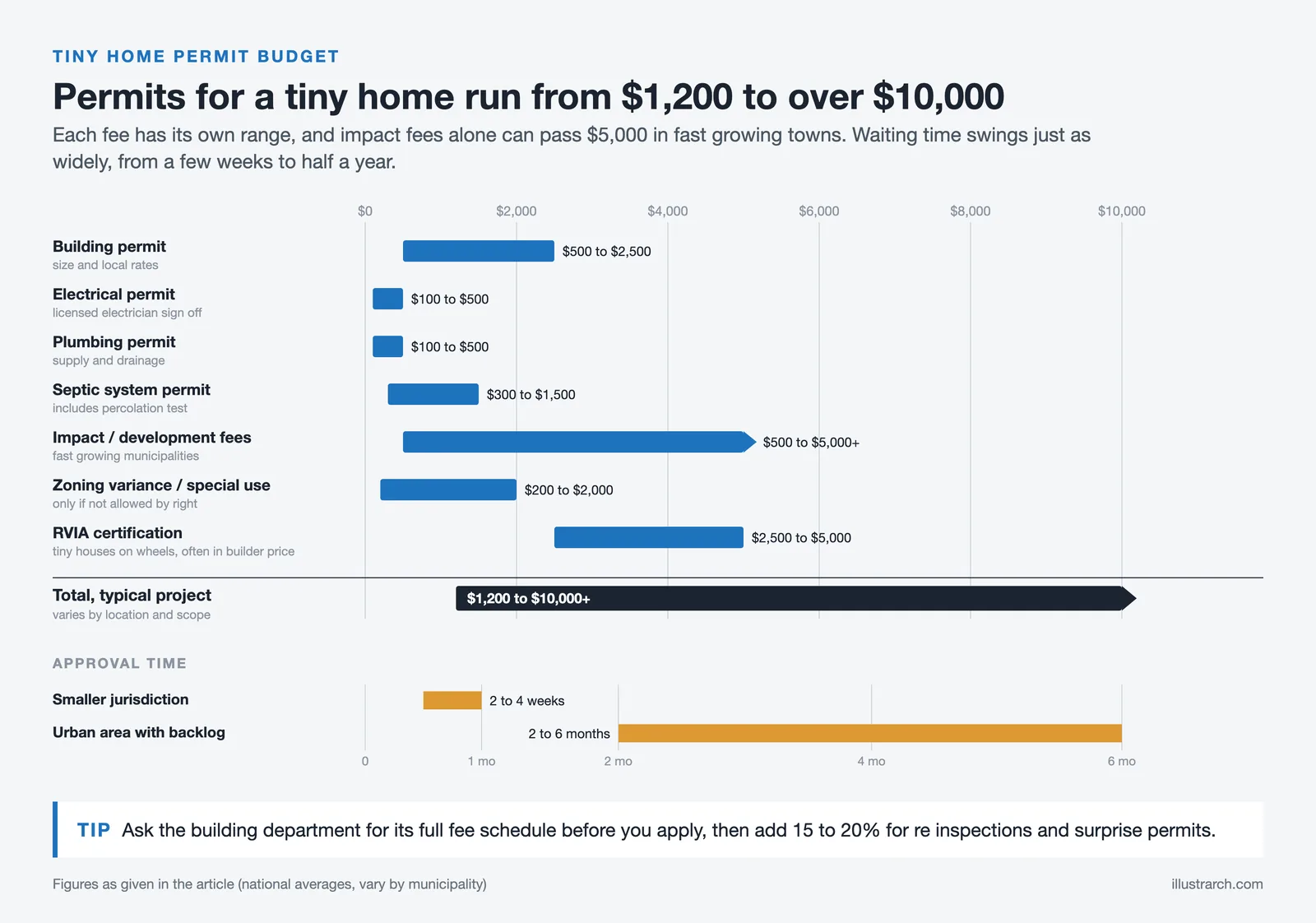
Permit costs for tiny homes vary widely depending on your municipality. In many US cities, basic building permits range from $500 to $2,500, while more complex projects involving septic, electrical, and plumbing permits can push total costs above $5,000. Processing timelines also differ: straightforward applications in smaller jurisdictions may receive approval within two to four weeks, while urban areas with heavy backlogs can take two to six months. Budgeting for both the permit fees and the wait time helps prevent frustrating delays. If your municipality charges impact fees or system development charges, these can add additional costs, especially in fast-growing areas.
Estimated Tiny Home Permit Costs by Type
The following table provides a breakdown of the typical permit and related costs you should budget for when building a tiny home. These figures are based on national averages and may vary by municipality.
| Permit / Fee Type | Estimated Cost Range | Notes |
|---|---|---|
| Building Permit | $500 – $2,500 | Based on structure size and local rates |
| Electrical Permit | $100 – $500 | Required for all wired systems; licensed electrician sign-off |
| Plumbing Permit | $100 – $500 | Covers water supply and drainage connections |
| Septic System Permit | $300 – $1,500 | Includes soil percolation test; required for off-grid builds |
| Impact / Development Fees | $500 – $5,000+ | Common in fast-growing municipalities |
| Zoning Variance / Special Use Permit | $200 – $2,000 | Only if your project does not meet current zoning by-right |
| RVIA Certification (THOWs) | $2,500 – $5,000 | Typically included in builder’s cost; required for legal RV status |
| Total Estimated Range | $1,200 – $10,000+ | Varies significantly by location and project scope |
💡 Pro Tip: When budgeting for permits, always add a 15–20% contingency buffer. Many tiny home builders encounter unexpected fees for site inspections, re-inspections after failed items, or additional permits required by specialty trades. Requesting a full fee schedule from your building department upfront — before submitting your application — gives you the clearest picture of total costs.
Can You Build a Tiny House on Your Property?
One of the most common questions is “can I build a tiny house on my property?” The answer depends on your local zoning classification and lot requirements. In areas zoned for single-family residential use, you can often build a tiny house as your primary dwelling, provided it meets minimum square footage rules. Some jurisdictions also allow tiny homes as accessory dwelling units (ADUs) in backyards, which we cover in more detail below.
If you want to put a tiny home on your property, start by requesting a zoning verification letter from your local planning office. This letter confirms what types of structures are allowed on your lot. You should also check deed restrictions, homeowner association (HOA) rules, and any overlay districts that might impose additional requirements. Rural properties with agricultural zoning tend to be more permissive, while urban and suburban lots often have stricter limits. Exploring tiny house design ideas on illustrarch.com can help you plan a home that fits both your vision and your lot’s legal constraints.
Keep in mind that even when local zoning allows tiny homes, HOA covenants can create additional barriers. Many HOAs enforce minimum square footage rules (often 1,000 square feet or more) and architectural design standards that may conflict with tiny house plans. Always review your property’s Covenants, Conditions, and Restrictions (CC&Rs) before investing in a tiny house build.
Quick Eligibility Checklist: Can You Build a Tiny Home on Your Lot?
Use this quick-reference checklist to determine whether your property is likely eligible for a tiny house before contacting your local planning office.
| Checkpoint | What to Verify | Where to Check |
|---|---|---|
| Zoning Classification | Is your lot zoned residential? Does it allow ADUs or secondary structures? | Local planning/zoning department |
| Minimum Dwelling Size | Does the municipality enforce a minimum square footage (e.g., 400–600 sq ft)? | Municipal building code / zoning ordinance |
| Setback Requirements | How far must your tiny home be from property lines, roads, and existing structures? | Zoning ordinance / site plan review |
| HOA / CC&Rs | Do covenants restrict home size, style, or secondary structures? | Property deed / HOA management office |
| Utility Access | Can you connect to water, sewer/septic, and electricity? Are off-grid alternatives accepted? | County health department / utility provider |
| Flood Zone Status | Is your lot in a FEMA-designated flood zone? Are elevated foundations required? | FEMA Flood Map Service Center |
| Appendix Q / BB Adoption | Has your jurisdiction adopted IRC tiny house provisions? | State building code office / local building dept. |
Legal Considerations for Off-Grid Tiny Houses
Living off-grid in a tiny house brings unique legal challenges, especially around utilities and environmental compliance. If you are asking “is it legal to live off the grid?”, the short answer is: it depends on your state and county. No federal law prohibits off-grid living, but local health, safety, and building codes may impose specific requirements that make it difficult in certain areas.
Water and Sewage Regulations
Off-grid tiny houses need proper water and sewage management to meet legal standards. Local health departments typically regulate water systems, requiring proof of a reliable water source. This often involves well water, rainwater collection, or water delivery services. Compliance means testing water quality periodically and ensuring it meets safety standards set by the EPA’s Safe Drinking Water Act.
Sewage disposal falls under strict regulations overseen by local environmental agencies. Options include composting toilets, incinerating toilets, or septic systems. Each method must meet criteria for waste management and environmental impact. Composting toilets require proper maintenance and disposal protocols, while septic systems must be installed by licensed professionals and inspected regularly. While perfecting the interior design of your home, don’t forget about essential systems like your septic. Mountain Septic provides professional maintenance services to ensure your system functions properly, keeping your home environment safe and efficient.
Energy and Utility Compliance
Energy compliance for off-grid tiny houses covers alternative energy sources like solar panels, wind turbines, or generators. Local building codes may specify how these systems should be installed and integrated. Solar power, the most popular choice for off-grid tiny homes, must comply with electrical codes governing panel mounting, inverter installation, and battery storage.
Utility requirements extend to backup energy solutions and emergency protocols. Even if you live off-grid, you might still need permits for generators or backup battery systems. These systems must meet safety standards so they do not pose fire hazards or other risks. Documenting compliance involves submitting installation plans and inspection reports to local authorities, which helps verify that all systems meet required standards and the tiny house is legally habitable. For ideas on integrating eco-friendly systems into small spaces, see our article on designing eco-friendly tiny homes.
Off-Grid Systems: Legal Status by Utility Type
The table below summarizes the general legal status of common off-grid utility systems across the United States. Keep in mind that local regulations can override state-level permissions, so always verify with your county before installation.
| Off-Grid System | General Legality | Common Restrictions | Permit Typically Required? |
|---|---|---|---|
| Solar Panels | Legal in all 50 states | Some states require grid-tie; mounting and electrical code compliance | Yes (electrical permit) |
| Rainwater Harvesting | Legal in most states | Colorado limits volume; some states require permits or restrict potable use | Varies by state |
| Well Water | Legal in most rural areas | Permit and periodic water quality testing required; depth regulations | Yes (well drilling permit) |
| Composting Toilet | Legal in many states | Some jurisdictions require a septic system regardless; disposal protocols vary | Varies (health dept. approval) |
| Septic System | Legal in all states | Soil percolation test; licensed installer required; regular inspection | Yes (septic permit) |
| Wind Turbine | Legal in most rural zones | Height restrictions; noise ordinances; setback from neighbors | Yes (building + electrical) |
| Propane / Generator | Legal in all states | Fuel storage limits; fire safety setbacks; noise ordinances | Sometimes (fire code compliance) |
Worst States for Off-Grid Living
Not every state welcomes off-grid lifestyles. Some of the worst states for off-grid living include those with strict municipal utility connection mandates, aggressive code enforcement, and limited rural exemptions. States like Florida and Connecticut have faced criticism for requiring grid-tied utilities in most residential areas. Hawaii’s high permitting costs and water rights complexities also create hurdles. Before committing to a location, research county-level regulations carefully, since even within “friendly” states, individual counties can vary dramatically in their enforcement.
According to multiple studies analyzing off-grid feasibility, the most challenging states also include New Jersey (which requires city water supply connections and municipal sewer hookups in many areas), New York (which enforces strict building codes with severe fines for non-compliance), and Rhode Island (where high population density and restrictive laws make self-sufficient living impractical). States with high property taxes — such as Illinois, which has the second-highest property tax rate in the nation — also undermine the financial advantages of off-grid living. In contrast, states like Iowa, Texas, and Kentucky consistently rank among the best for off-grid living due to their favorable laws, affordable land, and access to renewable energy resources.
💡 Pro Tip: Even in states considered “worst” for off-grid living, individual counties can be surprisingly permissive. Always research at the county level, not just the state level. For example, while New York State has strict building codes, some upstate rural counties take a lighter enforcement approach. A 30-minute phone call to the county building inspector can reveal more than hours of internet research.
Tiny House Zoning Regulations by State: Key Differences
Tiny house zoning regulations differ significantly from state to state. Understanding the broad patterns helps you narrow your search for a legal place to build or park your tiny home. According to multiple state-level analyses, California, Oregon, Texas, North Carolina, and Florida tend to have the most accommodating policies, though local enforcement varies within each state.
States with Favorable Tiny Home Zoning
Oregon leads in tiny-house-friendly regulation. Portland permits tiny homes in all residential zones and has streamlined permit processes. California has seen dramatic growth in ADU permitting, and recent state law updates now allow movable tiny homes on wheels to be classified as accessory dwelling units in many municipalities. Texas offers wide flexibility, especially in unincorporated areas; Spur, Texas, famously removed minimum square footage requirements entirely, though it still requires foundation placement. Maine adopted statewide construction guidelines for tiny houses, becoming a model for other states and requiring municipalities to allow ADUs. Colorado implemented a state-led certification process to help tiny homes meet local building codes.
On the other hand, states like Connecticut, New York, and parts of the Midwest lag behind in accommodating tiny homes. In these areas, strict minimum dwelling sizes and outdated zoning ordinances make tiny house placement difficult. If you are exploring the tiny house lifestyle across different regions, our overview of the tiny house movement in the USA provides additional context on regional trends.
💡 Pro Tip: When evaluating states for tiny home living, look beyond zoning laws alone. Property tax rates, land costs, and climate all impact your total cost of ownership. For example, Texas has no state income tax but property taxes average 1.6–1.8%, which can offset savings in other areas. States like Missouri and Tennessee combine favorable tiny home regulations with low overall cost of living, making them strong choices for budget-conscious tiny homeowners.
State-by-State Tiny Home Zoning Quick Reference
The following table highlights zoning approaches in selected states that are often discussed among tiny home builders.
| State | Foundation-Based Tiny Homes | Tiny Homes on Wheels | Key Notes |
|---|---|---|---|
| Oregon | Allowed in most residential zones | Allowed in all Portland residential zones | Strong ADU-friendly statewide legislation |
| Texas | Varies by city/county, generally permissive | Classified as RVs; limited to RV parks in most cities | Spur removed minimum sq ft; unincorporated areas flexible |
| California | Allowed as ADUs in most jurisdictions | Fresno allows THOWs as backyard cottages | State incentives for affordable ADU housing; THOWs may qualify as ADUs |
| North Carolina | Allowed in multiple counties; Appendix AQ adopted | Subject to local RV ordinances | Growing market in Buncombe, Chatham, and Watauga counties |
| Maine | Statewide construction guidelines for tiny homes | Treated as RVs; limited to RV parks | Progressive housing law requires municipalities to allow ADUs |
| Colorado | Varies; Walsenburg allows 120-600 sq ft homes | State certification process available | State-led certification bridging tiny homes and local codes |
| Washington | Allowed in cities adopting IRC Appendix Q | Varies by municipality | Olympia, Seattle, and Spokane have local tiny house ordinances |
| Florida | Allowed in many counties; mixed approach | Many counties classify THOWs strictly as RVs | Housing shortages pushing cities to rethink zoning; Rockledge is a model |
Tiny House Regulations in North Carolina
North Carolina has become one of the more welcoming states for tiny house living. The state has adopted the 2021 IRC with Appendix AQ, which provides building standards specifically for tiny houses of 400 square feet or less. Regulations still vary by county, however, so if you are searching for used tiny homes for sale in NC or wondering what NC counties allow tiny houses, understanding the local regulatory landscape is essential.
North Carolina Tiny Home Size Requirements
North Carolina no longer requires a total minimum square footage for a residence. However, the NC State Residential Code does specify the following minimum room sizes that every tiny home must meet. Understanding these requirements is critical before finalizing your floor plan.
| Requirement | NC State Building Code Standard |
|---|---|
| Minimum habitable room size | 70 sq ft (minimum 7 ft in one dimension) |
| Minimum total floor area (1 occupant) | 150 sq ft |
| Additional space per occupant | 75–100 sq ft (varies by county) |
| Minimum kitchen size | 50 sq ft |
| Minimum ceiling height (habitable rooms) | 7 ft |
| Minimum exterior wall height | Set by NC guidelines (see NC OSFM memo) |
| Required facilities | Kitchen sink, water closet, lavatory, bathtub or shower, washer connection |
| Minimum roof pitch | 5:12 (for homes with single predominant roofline) |
What NC Counties Allow Tiny Houses?
Several North Carolina counties have updated their ordinances to accommodate tiny homes. Buncombe County (home to Asheville) permits tiny houses as ADUs and has a growing market for tiny houses in western North Carolina. Chatham County, near the Triangle area, also allows tiny homes under certain conditions. Watauga County in the mountain region has become popular among off-grid tiny house enthusiasts.
In the eastern part of the state, New Hanover County (Wilmington) has seen growing interest, with more tiny homes for sale in Wilmington NC appearing on the market as zoning adapts. The Charlotte metro area, including Mecklenburg County, has explored ADU-friendly policies, making tiny homes for sale Charlotte NC a viable option. Buyers in the Raleigh area can also find listings, with tiny house for sale Raleigh NC searches growing year over year. Notably, Raleigh now has specific tiny home permitting guidelines that allow tiny homes in R-4, R-6, and R-10 zoning districts with an 800 square feet maximum footprint and 1,200 square feet maximum gross floor area. For budget-conscious buyers, searching for used tiny homes for sale in NC by owner can yield significant savings compared to new builds.
Burlington, located in Alamance County, is another area where the tiny home community is developing. Tiny homes for sale Burlington NC are more accessible than in larger metro areas, thanks to lower land costs and evolving local policies. The Village at Flat Rock is one of the most established tiny home communities in the state, featuring over 60 tiny homes in a wooded mountain setting. No matter which NC county you choose, always verify current North Carolina building code requirements with the local permitting office before starting construction. You can also explore the wider tiny house communities across the US for comparison.
💡 Pro Tip: In North Carolina, there are three legal pathways to get your tiny home approved as a permanent residence: (1) Build on-site with a licensed contractor and pass local inspections, (2) obtain a modular stamp through the NC Department of Insurance for factory-built units, or (3) use a HUD-labeled manufactured home. Recreational vehicles and park models are NOT permitted as permanent residences in NC unless they carry a dual registration sticker approving them as modular homes. This is the single most important distinction NC tiny home buyers need to understand.
Special Legal Scenarios
Certain situations call for extra attention to legal details. Tiny houses on wheels and backyard ADUs each come with their own set of rules.
Tiny Houses on Wheels (THOWs)
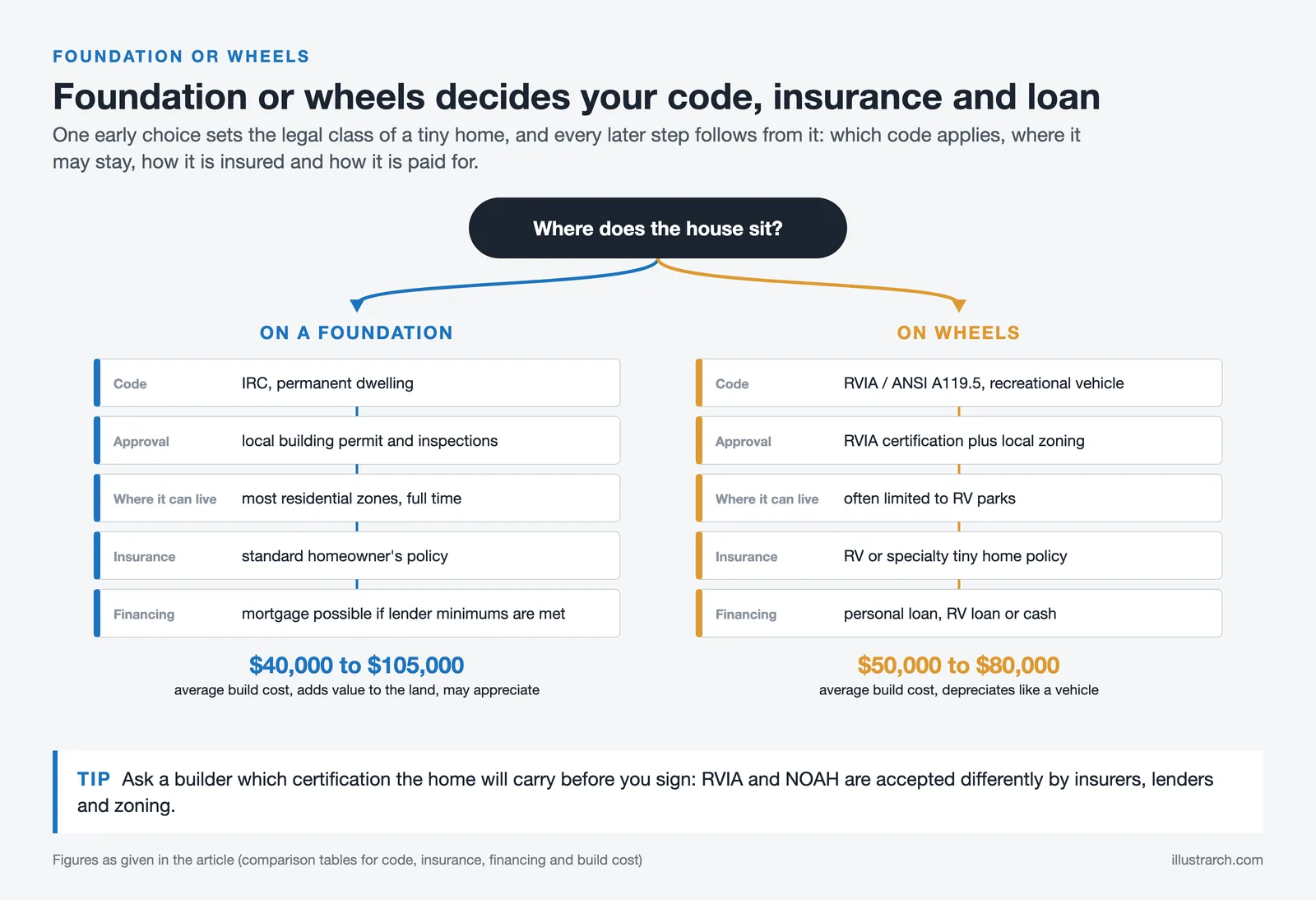
Tiny houses on wheels (THOWs) fall under the category of recreational vehicles in many jurisdictions. Zoning laws often restrict long-term habitation in RVs, so it is crucial to confirm whether local zoning ordinances allow THOWs as permanent residences. THOWs need to comply with RV standards set by the Recreation Vehicle Industry Association (RVIA). This certification ensures they meet safety and construction benchmarks. Parking regulations vary as well: some areas permit parking only in RV parks, while others allow it on private property with specific conditions such as utility hookups or distance from the property line.

If your goal is full-time habitation and fewer legal obstacles, a foundation-built tiny house is generally the safer option. THOWs classified as RVs cannot always access traditional homeowner insurance, and financing options may be more limited. For those who value mobility, however, THOWs remain an appealing choice if you choose your parking location carefully and maintain proper RVIA certification.
Foundation vs. Wheels: Side-by-Side Comparison for Prospective Buyers
Choosing between a foundation-based tiny home and a tiny house on wheels is one of the most impactful decisions you will make. The table below compares these two options across the factors that matter most to prospective tiny homeowners.
| Factor | Foundation-Based | Tiny House on Wheels (THOW) |
|---|---|---|
| Legal Classification | Permanent dwelling (IRC) | Recreational vehicle (RVIA/ANSI) |
| Full-Time Habitation | Allowed in most residential zones | Restricted in many jurisdictions; often limited to RV parks |
| Average Build Cost | $40,000 – $105,000 | $50,000 – $80,000 |
| Insurance | Standard homeowner’s policy | RV or specialty tiny home policy |
| Financing | Mortgage possible (if meets lender minimums) | Personal loan, RV loan, or cash |
| Property Value Impact | Adds value to land; may appreciate | Depreciates like a vehicle |
| Mobility | None (permanent placement) | Fully mobile; relocatable |
| Utility Connections | Standard municipal or off-grid systems | RV-style hookups (30/50 amp, hose, dump station) |
| Best For | Permanent residence, ADU, long-term investment | Flexibility, travel, temporary living arrangements |
Permit for Tiny Home in Backyard: ADU Rules
Tiny houses in backyards, often classified as accessory dwelling units (ADUs), must align with local ADU regulations. Getting a permit for a tiny home in backyard placement involves meeting rules that dictate size, placement, and permitted use. ADUs must comply with building codes similar to those for traditional homes. Property owners may face restrictions on the size of the ADU relative to the main house and the required distance from property lines.
Some jurisdictions require the property owner to live on-site, while others enforce minimum lease terms for ADU tenants. Utility hookups and sewage connections must meet municipal requirements, which often means obtaining additional permits. States like California, Oregon, and Washington have passed legislation to streamline ADU approval. If your area has not yet adopted ADU-friendly policies, consider attending local planning meetings to advocate for changes. For design inspiration that fits within typical ADU size limits, explore the tiny house collection at illustrarch.com.
Tiny Home Insurance and Financing: What You Need to Know
Securing insurance and financing for a tiny home is often more complicated than for a traditional house, and the options available to you depend heavily on how your home is classified. Understanding these financial considerations early in your planning process prevents costly surprises and ensures your investment is properly protected.
Tiny Home Insurance Options by Type
Insurance for tiny homes varies based on whether your home is on a foundation, on wheels, or used as an ADU. The table below summarizes your primary insurance options, typical annual costs, and key considerations for each category.
| Insurance Type | Best For | Estimated Annual Cost | Key Considerations |
|---|---|---|---|
| Standard Homeowner’s Insurance | Foundation-based tiny homes meeting building codes | $400 – $1,200/year | Must have Certificate of Occupancy; some insurers require minimum sq ft |
| RV Insurance | RVIA-certified tiny homes on wheels | $500 – $1,000/year | RVIA certification typically required; may not cover full-time residency |
| Specialty Tiny Home Policy | Both foundation and THOW; non-standard builds | $500 – $1,500/year | Tailored coverage including full-time use, theft, and transit protection |
| Manufactured / Mobile Home Insurance | Factory-built stationary tiny homes with HUD label | $300 – $1,000/year | Factory construction preferred; NOAH certification improves eligibility |
| Existing Homeowner’s Policy (ADU Rider) | Backyard ADUs on an already-insured property | $100 – $400/year (added to existing policy) | Coverage added as “other structure” on your existing policy; simplest option |
💡 Pro Tip: Standard RV insurance policies often exclude full-time residency coverage. If you plan to live in your THOW year-round, explicitly ask any insurer whether they cover “full-timer” use. Specialty providers like Strategic Insurance Agency and Proper Insurance offer policies specifically designed for people who use tiny homes as their primary residence, covering dwelling, personal property, liability, and even loss of use — similar to a traditional homeowner’s policy.
Tiny Home Financing Options Comparison
Financing a tiny home differs significantly from financing a traditional house. Most tiny homes do not qualify for conventional mortgages because lenders typically require a minimum property value and permanent foundation. The table below compares the most common financing paths available in 2025.
| Financing Option | Typical Loan Amount | Interest Rate Range | Requirements |
|---|---|---|---|
| Personal Loan | $1,000 – $100,000 | 6% – 36% | Good credit (660+); no collateral needed; shorter terms (1–7 years) |
| RV Loan | $10,000 – $150,000 | 5% – 12% | RVIA certification required; 10–20% down payment; credit score 660–700+ |
| Home Equity Loan / HELOC | Varies by equity | 4% – 10% | Must own a primary home with sufficient equity; best for ADU builds |
| Builder Financing | Varies by builder | 5% – 15% | Offered by some builders through partner lenders; compare terms carefully |
| Traditional Mortgage | $50,000+ | 6% – 8% | Permanent foundation required; minimum property value varies by lender; rare for tiny homes |
| Cash / Savings | N/A | 0% | No interest; no monthly payments; approximately 68% of tiny home buyers pay cash |
💡 Pro Tip: HUD rules require properties to be at least 400 square feet, on a permanent foundation, and built to HUD safety standards to qualify for FHA loans. This means most tiny homes under 400 sq ft are automatically ineligible for FHA financing. If you plan to finance your build, design your tiny home at or above 400 sq ft on a permanent foundation to maximize your lending options. Even a few extra square feet can open doors to significantly better interest rates and longer repayment terms.
Tiny House Cost Overview: What to Expect in 2025
Understanding the financial picture is essential for any tiny house project. Beyond zoning and permits, the total cost of a tiny home — including construction, land, and legal fees — directly influences which legal pathway makes the most sense for your situation. The table below provides a realistic cost overview based on current market data.
| Cost Category | Estimated Range | Key Details |
|---|---|---|
| Total Build Cost (Professional) | $30,000 – $60,000 | National average ~$45,000; luxury builds can exceed $150,000 |
| Cost per Square Foot | $150 – $400 | Higher per sq ft than traditional homes due to compact complexity |
| DIY / Kit Build | $4,000 – $30,000 | Prefab kits; requires significant labor and building knowledge |
| Land Purchase | $5,000 – $25,000+ per acre | Varies dramatically by state and proximity to metro areas |
| Foundation | $4,000 – $28,000 | Permanent foundation; ~$4–$7 per sq ft |
| Trailer (for THOW) | $4,800 – $9,000 | Custom-built trailer for tiny house on wheels |
| Permits (Total) | $1,200 – $10,000+ | See permit cost breakdown table above |
| Insurance (Annual) | $200 – $1,500/year | Depends on home type, value, location, and certification status |
| Monthly Utilities | ~$125/month | Significantly lower than traditional homes; off-grid can reduce further |
| Annual Maintenance | ~$775/year | Lower than standard homes; THOWs may cost more due to road wear |
💡 Pro Tip: The average American home costs roughly $512,800 as of 2025, while a typical tiny home averages around $45,000–$67,000 — representing approximately 87% less than a conventional house. However, tiny homes cost more per square foot ($150–$400) compared to traditional homes (~$150/sq ft) because compact spaces require more creative engineering and custom solutions. Factor this into your planning when comparing overall value.
Hidden Costs Most Tiny Home Builders Overlook
Beyond the well-known costs of construction and permits, there are several expenses that catch first-time tiny home builders by surprise. Accounting for these costs early in your budget prevents financial stress during the build process.
| Hidden Cost | Estimated Range | Why It’s Overlooked |
|---|---|---|
| Utility infrastructure (empty land) | $10,000 – $25,000 | Bringing electricity, water, and sewer to undeveloped land can cost as much as the home itself |
| Site preparation and grading | $1,500 – $5,000 | Tree clearing, grading, and drainage work often required before foundation placement |
| Driveway and access road | $2,000 – $10,000 | Rural properties may need gravel or paved access from public road to building site |
| Soil percolation / geotechnical test | $250 – $1,000 | Required for septic permits; some sites fail and need engineered systems ($15,000+) |
| Delivery / transport of prefab tiny home | $1,000 – $5,000+ | Wide-load permits, oversize transport fees, and crane placement if needed |
| Temporary housing during build | $500 – $2,000/month | Construction can take 3–6 months; plan for rent or alternative accommodation |
| Landscaping and exterior | $1,000 – $5,000 | Decks, patios, and outdoor living areas are essential for livable tiny home space |
💡 Pro Tip: Before purchasing raw land for a tiny home, always request a “utility feasibility assessment” from your local utility providers. Getting electricity, water, and sewage to an empty lot can cost $10,000–$25,000 depending on distance from existing infrastructure. In some remote rural areas, just running a power line to your property can cost $15,000–$30,000. This single cost can double your total project budget if you do not plan for it upfront.
How to Make Your Tiny House Legal: Step-by-Step Checklist
Navigating tiny house guidelines can feel overwhelming, but following a structured approach simplifies the process. Use this checklist to ensure your tiny home project stays on the right side of the law from start to finish.
Step 1: Verify zoning. Contact your local zoning or planning department and ask whether your property allows tiny homes as a primary dwelling or as an ADU. Request a zoning verification letter to confirm in writing.
Step 2: Check HOA and deed restrictions. Review your property’s CC&Rs for minimum square footage requirements, design guidelines, and any prohibitions on secondary structures.
Step 3: Determine your tiny house type. Decide whether you will build on a foundation (governed by IRC) or on wheels (governed by RVIA/ANSI standards). This choice affects which codes apply and where you can live.
Step 4: Prepare construction documents. Develop site plans, floor plans, and structural, electrical, and plumbing drawings. Hire licensed professionals if your jurisdiction requires engineered plans.
Step 5: Apply for permits. Submit your building permit application along with all required documentation. Pay any associated fees and schedule pre-construction inspections if required.
Step 6: Build to code. Follow all applicable building codes during construction. Schedule required inspections at each phase (foundation, framing, electrical, plumbing, final).
Step 7: Obtain Certificate of Occupancy. After passing the final inspection, your local authority issues a Certificate of Occupancy confirming that your tiny home is safe and legal for habitation.
Step 8: Secure insurance and financing. Contact insurance providers to obtain coverage appropriate to your tiny home type before move-in. If financing, ensure your loan terms align with your certification type (RVIA, NOAH, or IRC-compliant).
For hands-on guidance on the construction process itself, our step-by-step guide to building a tiny house covers everything from foundation to finishing touches.
💡 Pro Tip: Document every conversation with your local planning and building departments in writing. After a phone call, send a follow-up email summarizing what was discussed and any approvals given verbally. Zoning staff turnover is common, and having a written record prevents situations where a new official contradicts what you were told earlier. This paper trail is also invaluable if you ever need to appeal a decision.
Tips for Staying Compliant with Tiny Home Regulations
Keeping your tiny house project on the right side of the law requires consistent effort. Here are practical steps that help you stay compliant with tiny home regulations throughout the building process and beyond.
First, research your specific county and municipality rules before you buy land or begin design. Zoning codes change frequently, and what applied last year may not apply today. Second, hire professionals who have experience with tiny home building codes. An architect or builder familiar with your local code environment can prevent costly mistakes. Third, keep copies of all permits, inspection reports, and approval letters. These records prove your compliance if questions arise during a future sale or audit.
Fourth, join a local tiny house community or advocacy group. Organizations like the American Tiny House Association track legislative changes and offer guidance on emerging tiny house zoning laws. Fifth, if you plan to move your tiny home on wheels between states, familiarize yourself with each state’s registration, insurance, and towing requirements. A THOW that is legal in one state may face restrictions in another. For an overview of trusted builders who understand code compliance, see our roundup of the best tiny house building companies in the USA.
💡 Pro Tip: If you are moving a tiny house on wheels between states, check each state’s towing regulations before your trip. Most states require wide-load permits for homes exceeding 8.5 feet in width, and some states restrict travel to daytime hours only. Exceeding weight limits on your towing vehicle can result in roadside fines and potential damage to both the vehicle and the tiny home. Always verify maximum towing weight, axle regulations, and highway permits with each state’s Department of Transportation.
Tiny Home Market Growth and Industry Statistics (2025)
The tiny house movement has grown from a niche lifestyle choice into a recognized segment of the housing industry. Understanding the current market landscape helps prospective buyers and builders make informed decisions about timing, location, and investment.
| Statistic | Data |
|---|---|
| Tiny house movement growth (past decade) | 67% increase overall |
| Search interest growth (past 5 years) | 160% increase in tiny home searches |
| Americans considering tiny home living | 73%, especially Gen Z and Millennials |
| Average tiny home build cost | $45,000 – $67,000 |
| Median US home price (2025) | ~$396,900 – $512,800 |
| Average land price per acre (US) | ~$18,657 |
| States with IRC Appendix Q/BB adoption | 20+ states |
| Reported stress reduction after downsizing | 41% decrease |
| Tiny home buyers paying cash | ~68% |
💡 Pro Tip: The tiny house market is growing fast, but so is regulatory adaptation. More municipalities are updating their zoning codes each year to accommodate tiny homes. If your target location currently prohibits tiny houses, check back annually — many cities that were restrictive just two years ago have since adopted ADU legislation or PUD provisions that now permit tiny homes. Joining the American Tiny House Association or your state’s tiny home advocacy group keeps you informed about these changes as they happen.
Frequently Asked Questions About Tiny House Zoning Laws
What are tiny house zoning laws and why do they matter?
Tiny house zoning laws are local regulations that control where and how tiny homes can be placed, built, and occupied. They dictate whether a tiny house is allowed in residential, commercial, or mixed-use zones. These laws matter because building or parking a tiny home in violation of zoning rules can result in fines, forced removal, or inability to obtain insurance and financing. Checking zoning before buying land or a trailer protects both your investment and your right to live in your home.
Do I need a permit to build a tiny house?
In nearly every US jurisdiction, yes. A tiny house intended as a permanent residence requires a building permit. Even rural counties with lighter enforcement typically require electrical, plumbing, or septic permits. RVIA-certified tiny houses on wheels may not need a building permit, but they still need local zoning approval to be parked legally for habitation.
Can I put a tiny home in my backyard?
You can place a tiny home in your backyard in jurisdictions that allow accessory dwelling units (ADUs). States like California, Oregon, and Washington have passed statewide ADU legislation that simplifies approval. You will still need to meet setback requirements, size limits relative to your primary dwelling, and utility connection standards. Check with your local planning department and review any HOA covenants before proceeding.
What is the difference between a tiny house on a foundation and one on wheels?
A tiny house on a foundation is treated as a permanent dwelling under the IRC and requires a standard building permit. A tiny house on wheels (THOW) is typically classified as a recreational vehicle, regulated by RVIA/ANSI standards, and subject to RV zoning rules. Foundation-built tiny homes offer more stability for financing, insurance, and long-term legal occupancy, while THOWs provide mobility but face more restrictions on where they can be parked as a permanent residence.
Which states are most friendly to tiny house living?
Oregon, California, Texas, North Carolina, and Maine are frequently cited as the most accommodating states for tiny homes. Oregon’s statewide ADU legislation, California’s ADU permitting growth, Texas’s relaxed rural zoning, North Carolina’s adoption of IRC Appendix AQ, and Maine’s statewide tiny house building guidelines all contribute to their reputation. Local enforcement varies, so county-level research is always necessary.
How much does it cost to build a tiny house in 2025?
The average cost to build a tiny house in 2025 ranges from $30,000 to $60,000 for a professionally built home, with the national average at approximately $45,000. However, costs can go as low as $4,000 for a basic DIY kit or exceed $150,000 for custom luxury builds. Key cost factors include size, materials, location, labor, and whether you build on a foundation or on wheels. Permits typically add $1,200 to $10,000 or more depending on your municipality and the complexity of your utility connections.
What is IRC Appendix Q (now Appendix BB), and why does it matter for tiny homes?
IRC Appendix Q was introduced in 2018 by the International Code Council to specifically address building standards for tiny houses of 400 square feet or less. It allows relaxed requirements for ceiling heights in lofts, alternative stairway and ladder access, and modified emergency escape provisions. In the 2024 IRC edition, this appendix was renumbered as Appendix BB. Over 20 US states have adopted these provisions, which makes it significantly easier to get legal approval for tiny house construction. Always check whether your specific jurisdiction has adopted these code provisions before designing your tiny home.
Can I legally live off-grid in a tiny house?
No federal law prohibits off-grid living, but local building codes, health regulations, and zoning ordinances may impose requirements that limit your off-grid options. Common challenges include mandatory grid-tied utility connections, restrictions on composting toilets, and rainwater harvesting limitations. States like Iowa, Texas, and Missouri tend to be more permissive, while New Jersey, New York, and Connecticut are among the most restrictive. Always check county-level regulations, as enforcement can vary dramatically even within the same state.
What happens if I build a tiny house without permits?
Building without required permits can result in fines, stop-work orders, forced demolition, or inability to obtain a Certificate of Occupancy. Unpermitted structures may also be uninsurable and difficult to sell or finance. In some jurisdictions, you may be required to retroactively obtain permits and pass inspections, which often costs more than getting permits beforehand. Additionally, living in an unpermitted structure may void your homeowner’s insurance coverage entirely. Always obtain the necessary permits before starting construction.
How long does the tiny house permitting process take?
Permitting timelines vary widely depending on your jurisdiction. In smaller rural municipalities, straightforward building permit applications may be approved within two to four weeks. Urban areas with heavier backlogs can take two to six months. If your project requires a zoning variance, special use permit, or public hearing, expect the process to take significantly longer — sometimes up to 12 months. Starting your permit application as early as possible in the planning process is critical to avoiding project delays.
What type of insurance do I need for a tiny house?
The insurance you need depends on your tiny home type. Foundation-based tiny homes that meet building codes can often be covered by standard homeowner’s insurance ($400–$1,200/year). Tiny homes on wheels typically need RV insurance or a specialty tiny home policy ($500–$1,500/year). If your tiny home is a backyard ADU, it may be added to your existing homeowner’s policy as a secondary structure. RVIA or NOAH certification significantly improves your insurance options and may lower premiums. Always confirm that your policy covers full-time residency if you plan to live in the home year-round.
How do I finance a tiny home if I can’t get a mortgage?
Most tiny homes do not qualify for traditional mortgages because lenders typically require a minimum property value and permanent foundation. Common alternatives include personal loans ($1,000–$100,000 at 6–36% interest), RV loans for RVIA-certified THOWs ($10,000–$150,000 at 5–12%), home equity loans if you already own property, and builder financing offered through partner lenders. Approximately 68% of tiny home buyers pay cash. If you plan to finance, designing your home at or above 400 sq ft on a permanent foundation gives you the broadest range of lending options.
What is RVIA vs. NOAH certification, and which one do I need?
RVIA (Recreation Vehicle Industry Association) certification classifies your tiny home as a recreational vehicle, which is widely recognized for RV park placement, RV insurance, and RV financing. NOAH (National Organization of Alternative Housing) certification provides third-party safety verification and is often preferred by specialty tiny home insurers and some lenders, particularly for homes that do not fit neatly into the RV category. RVIA is the better choice if you plan to park in RV communities, while NOAH may offer more flexibility for non-traditional builds. Some builders offer both certifications — ask before you sign a contract.
Can I rent out my tiny home on Airbnb?
Renting out a tiny home on Airbnb or other short-term rental platforms is possible, but it depends on your local zoning ordinances and short-term rental regulations. Many municipalities now require specific permits or licenses for short-term rentals, and some restrict them entirely in residential zones. You will also need appropriate insurance — standard homeowner’s or RV policies typically do not cover short-term rental activity. Look into landlord or vacation rental insurance, and verify that your local jurisdiction permits short-term rentals on your property type before listing.
Building codes and zoning regulations vary by jurisdiction and change frequently. Always consult your local planning department and building authority for the most current requirements before starting construction. The information in this article is provided for general guidance and should not be taken as legal advice.
Conclusion
Understanding the legal landscape for tiny house construction is a necessary part of every successful project. Tiny house zoning laws, building permits, and tiny home regulations vary widely by location, so thorough research at the local level is essential. Whether you are building on a foundation, rolling on wheels, or adding an ADU to your backyard, each path comes with its own permitting and code requirements.
For off-grid enthusiasts, managing water sources, handling sewage responsibly, and meeting energy compliance standards are all critical to legal habitation. Buyers interested in North Carolina should explore the growing number of options across the state, from mountain communities in western NC to coastal towns like Wilmington and urban hubs like Charlotte and Raleigh.
Special scenarios like tiny houses on wheels and backyard ADUs require attention to RVIA standards and local ADU policies respectively. By staying informed, working with experienced professionals, and keeping up with changing regulations, you can turn your tiny house dream into a fully legal, comfortable reality. Browse inspiring tiny house designs to start planning a home that meets both your vision and your local tiny house guidelines.
Helpful Resources and Tools
Last updated:



5 Comments


Tiny House Water Systems: Your Complete Guide to Plumbing, Rainwater Harvesting and Off-Grid Solutions
A practical guide to designing a tiny house water system, covering PEX...
 Bahattin Duran14 Mins read
Off-Grid Tiny House Living: Complete Setup Guide for Beginners
This guide walks you through every stage of setting up an off-grid...
Bahattin Duran15 Mins read
Tiny House with Loft: Design Ideas, Plans and Building Tips for Vertical Living
A complete guide to designing and building a tiny house with loft,...
Bahattin Duran15 Mins read
8+ Best Tiny Home Communities in Michigan: Great Lakes Tiny Living Guide
Explore tiny home communities in Michigan. Great Lakes lifestyle, affordable land, and...
Bahattin Duran18 Mins read


This article gives a lot of information about tiny houses and the rules around them.
I found the legal parts interesting, but it seems like a lot of work to build a tiny house.
It’s good to know the laws before starting a tiny house. I didn’t know there were so many requirements.
This article has some useful information about tiny houses and the laws. I think it’s good to know what you need to do before building one.
I’m really confused about the zoning laws for tiny houses. The article says to check local laws before buying land, but what if those laws keep changing? How can we even keep up with that? Seems like a huge risk if you invest in a tiny home and then find out it’s not allowed!