

Gothic Architecture: 10 Cathedrals That Reach for Heaven
Gothic architecture produced some of the most ambitious buildings in human history. This guide covers ten cathedrals that defined the style, from Notre-Dame de Paris and Chartres to Cologne, Milan, Westminster Abbey, and the still-rising Sagrada Família in Barcelona.
 Furkan Sen3 May 202612 Mins read269
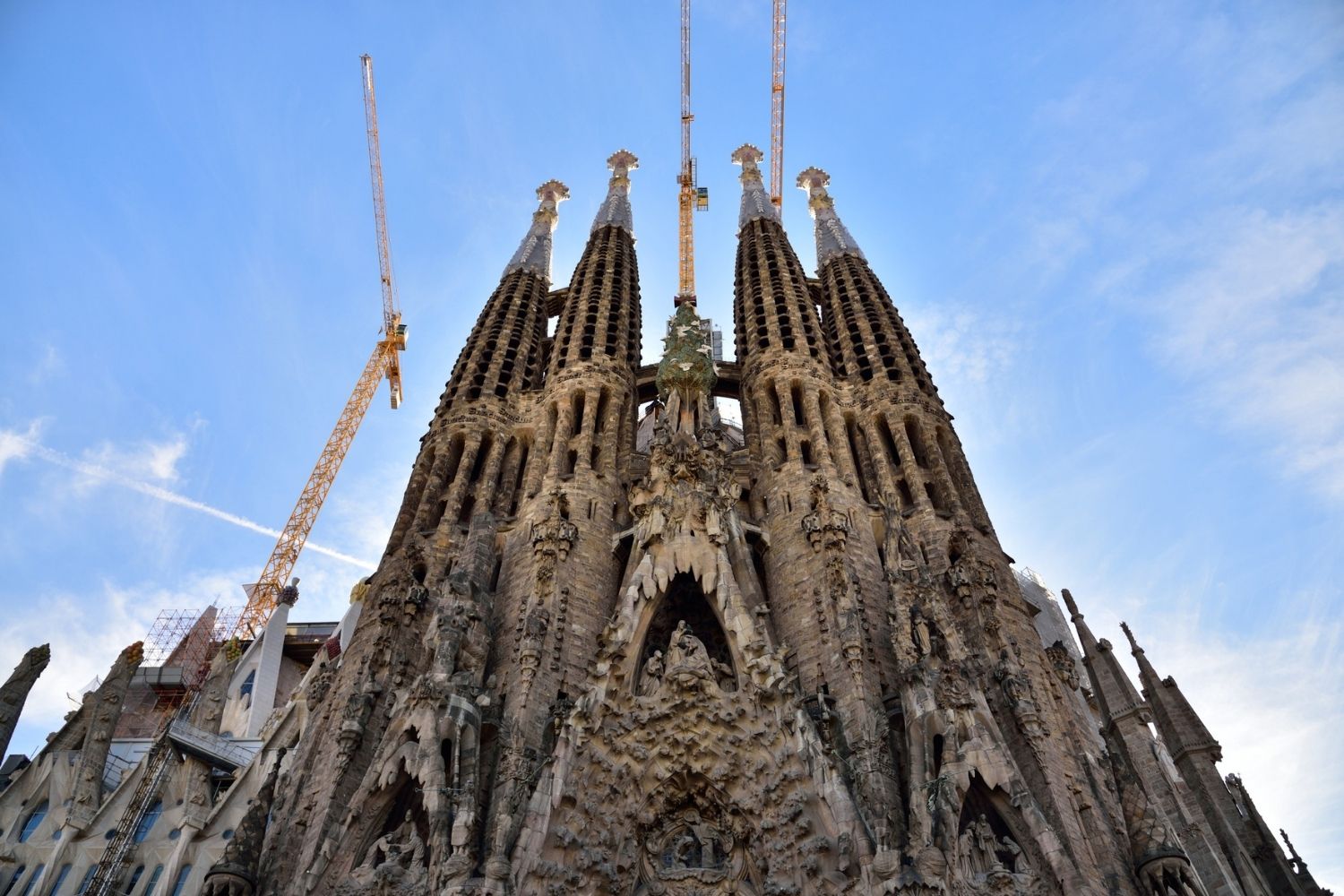
Table of Contents Show
Gothic architecture is a medieval European building style defined by pointed arches, ribbed vaults, flying buttresses, and walls filled with stained glass. It emerged in northern France around 1140 at the Abbey of Saint-Denis and dominated European church building until roughly 1500, producing cathedrals that still rank among the tallest, most luminous stone structures ever built.
The great Gothic cathedrals were not just places of worship. They were engineering experiments, civic statements, and collective projects that sometimes took six centuries to finish. This guide covers the structural logic behind the style and then walks through ten cathedrals that best show what Gothic architecture could achieve when money, faith, and craft all aligned.
What Is Gothic Architecture?
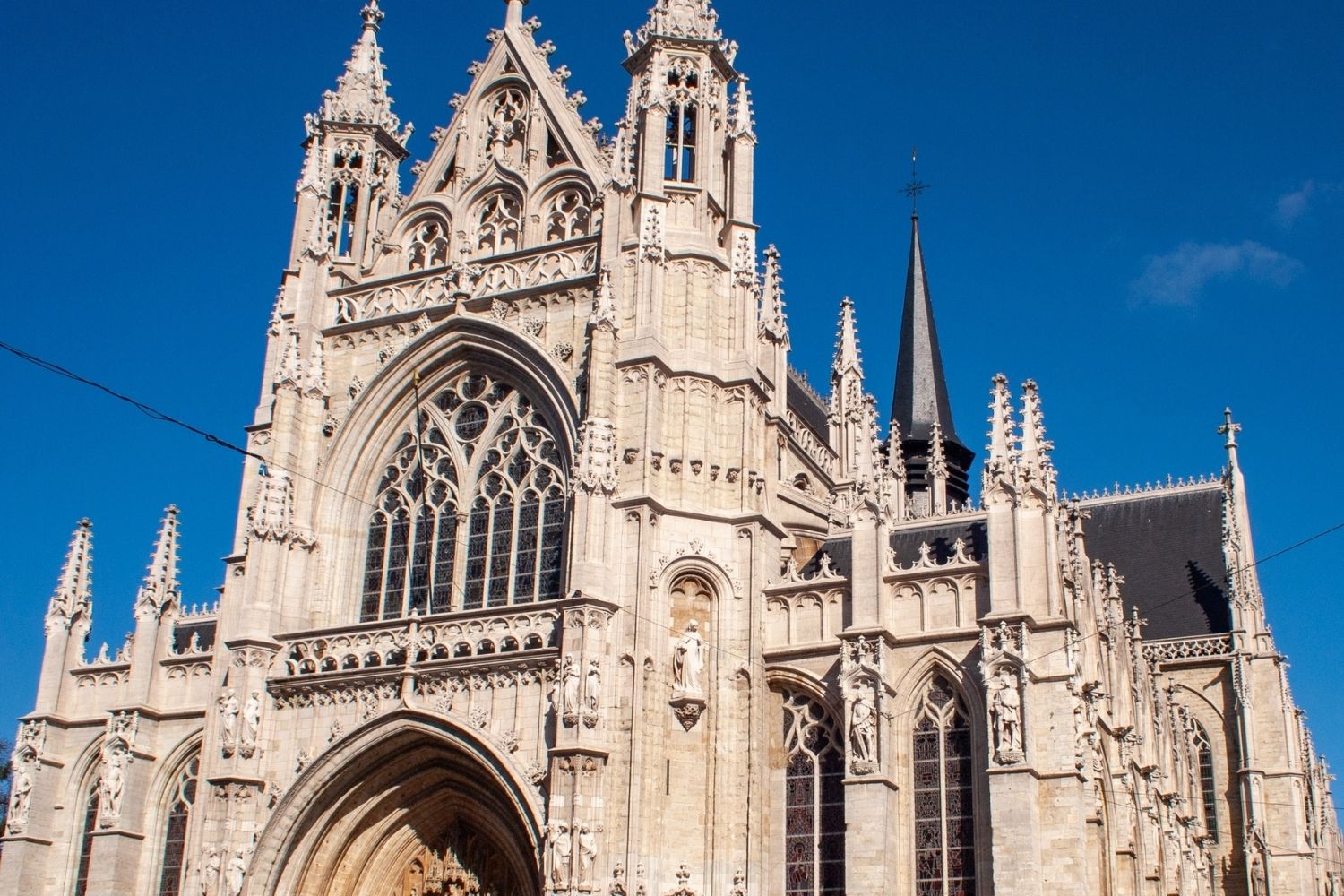
Gothic architecture is the style that followed Romanesque in medieval Europe. Where Romanesque churches relied on thick walls and small windows, Gothic builders learned to channel loads through a skeleton of pointed arches, ribbed vaults, and external flying buttresses. That shift meant the walls no longer had to carry the roof. They could be opened up with enormous windows, and the interior could climb to heights that had been impossible a generation earlier.
The term itself was coined later and not as a compliment. Italian Renaissance critics used “Gothic” in the 16th century to dismiss medieval buildings as barbaric, associating them with the Goths who had sacked Rome. The name stuck anyway, and by the 19th century it had shed its negative meaning. Today Gothic architecture is considered one of the great structural and artistic achievements of European history.
For the full arc from Romanesque to High Gothic, our history of architecture timeline sets Gothic in the wider sweep of European building.
💡 Pro Tip
When studying Gothic cathedrals in person, start at the exterior east end, where the choir and ambulatory reveal the structural logic most clearly. The flying buttresses there tell you how the loads travel before you ever step inside, and the interior reads very differently once you have seen the bones.
The Three Structural Innovations That Made Gothic Possible
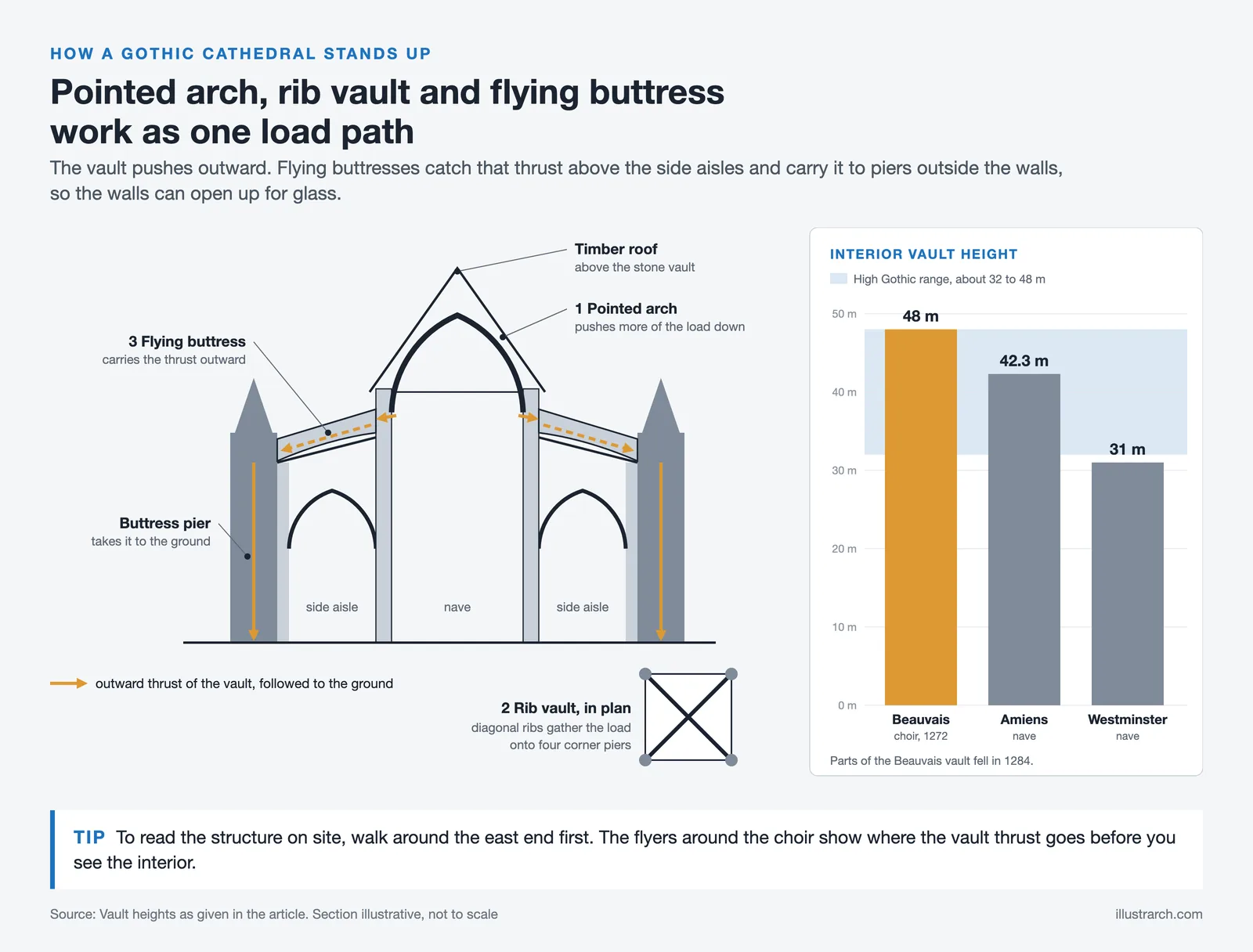
Three inventions, used together, define Gothic architecture. Each one existed earlier in some form, but the synthesis was new.
The Pointed Arch
The pointed arch distributes weight more vertically than the rounded Roman arch, which means less outward thrust and more freedom in the floor plan. Builders no longer had to line up every arch over an identical span. They could cover irregular bays, cross one aisle with another, and build vaults that turned corners without awkward geometry. The pointed arch was not European in origin. The earliest known structural use appears at the Dome of the Rock in Jerusalem, completed in 691 to 692 CE, centuries before it reached French cathedrals.
The Ribbed Vault
A ribbed vault is a stone ceiling built on a skeleton of diagonal ribs that carry most of the load. The web of stone between the ribs can be thinner and lighter because the ribs do the structural work. This made it possible to vault very wide naves in stone, replacing the flammable timber roofs of earlier churches. Notre-Dame de Paris used an early sexpartite rib vault across its nave, and later cathedrals refined the system into the four-part quadripartite vault that became standard.
The Flying Buttress
The flying buttress is an external arched support that carries the outward thrust of the vault down to a freestanding pier well away from the wall. This is what let Gothic walls become so thin and so full of glass. Notre-Dame de Paris is often credited as the first cathedral to use flying buttresses at this structural scale, though the solution appears to have been added partway through construction once the original thin walls began to crack under lateral load. Once the approach proved itself, it became standard across European Gothic building within a generation.
📐 Technical Note
High Gothic vault heights typically range from about 32 to 48 meters. Beauvais Cathedral reached 48 meters at its choir in 1272, the tallest ever attempted in Gothic construction. Parts of that vault collapsed in 1284, a failure that effectively set a ceiling on how far Gothic engineering could push stone vaulting without iron reinforcement.
How Gothic Cathedrals Evolved: Early, High, and Late Gothic
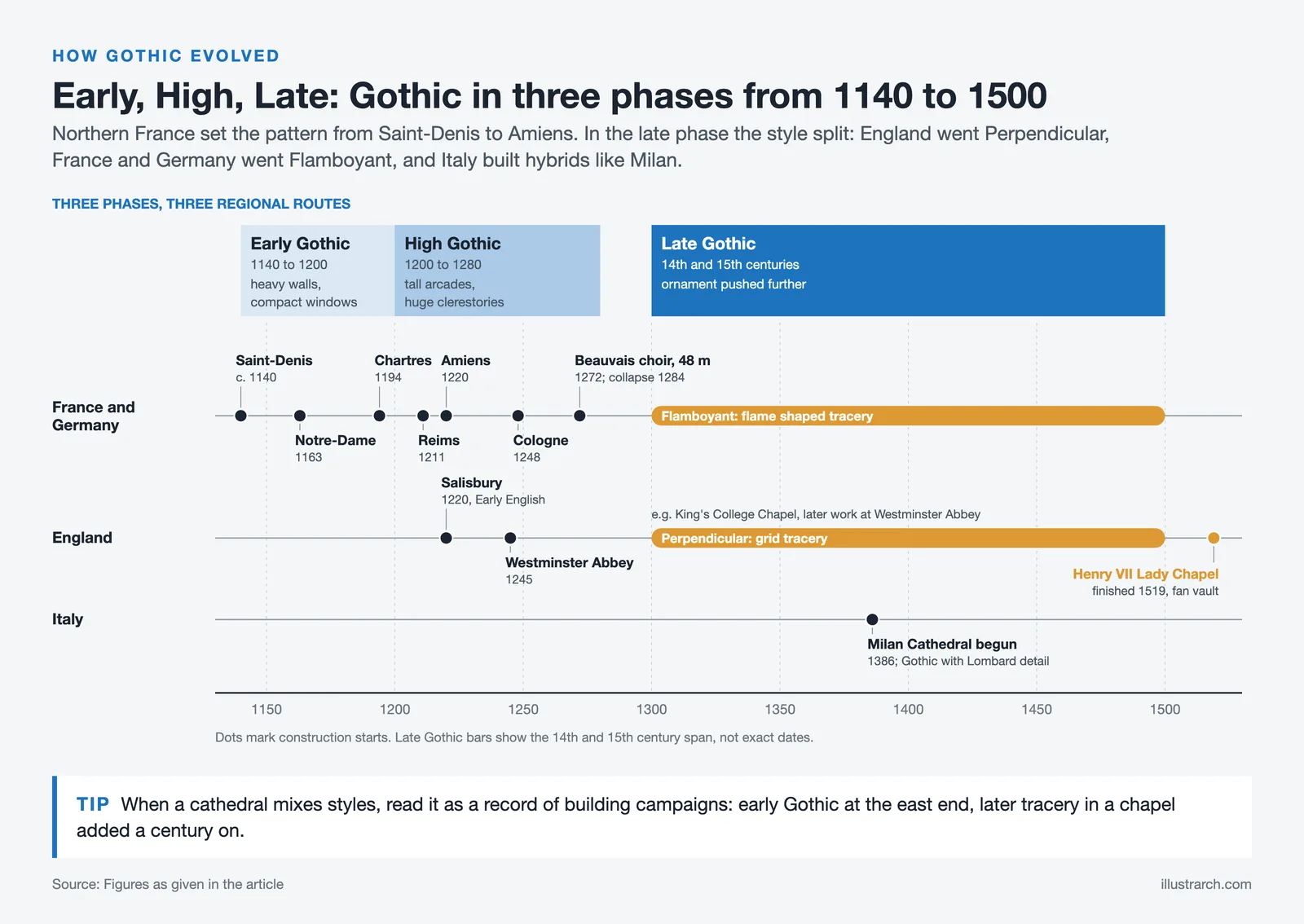
Gothic is not a single style but a sequence. Early Gothic, from roughly 1140 to 1200, kept heavy walls and compact windows. Saint-Denis and the older parts of Notre-Dame de Paris belong to this phase. High Gothic, from about 1200 to 1280, is what most people picture when they hear the word: Chartres, Reims, Amiens, and Cologne, with tall nave arcades, deep triforia, huge clerestory windows, and buttresses refined into decorative as well as structural elements.
Late Gothic, from the 14th and 15th centuries, pushed ornament further. England produced the Perpendicular style, with its flattened arches and grid-like tracery, visible in Westminster Abbey’s later work and in King’s College Chapel. France and Germany developed Flamboyant Gothic, full of flame-shaped tracery. Italy, always its own case, produced hybrids like Milan Cathedral that combined Gothic structure with Lombard and later Renaissance detailing.
🎓 Expert Insight
“Architecture should speak of its time and place, but yearn for timelessness.”
Frank Gehry
Gothic cathedrals embody exactly this. They are unmistakable products of medieval Christianity and yet their structural ideas, the externalized skeleton and the light-filled interior, still shape how architects design tall, long-span, and transparent buildings today.
10 Gothic Cathedrals That Reach for Heaven
The ten cathedrals below were chosen because each one advanced Gothic architecture in a specific way. Some set structural records, others pushed ornament or iconography, and two of them were not even finished in the medieval period. They are arranged roughly in the order their construction began.
1. Notre-Dame de Paris (France, 1163 to 1345)
Notre-Dame de Paris sits at the origin point of Gothic as an international movement. Construction began in 1163 under Bishop Maurice de Sully, using the new style that had just been worked out a few miles north at the royal Abbey of Saint-Denis. The cathedral’s sexpartite rib vaults, flying buttresses, and twin rose windows became reference points for every major Gothic project that followed. Archaeological work during the post-2019 restoration also confirmed something unexpected: Notre-Dame was the first Gothic cathedral to use iron systematically as a binding material between stones, a construction technique previously unknown at this scale.
The April 2019 fire destroyed the oak roof and spire but spared most of the stone vaulting, which is what prevented a total collapse. Notre-Dame reopened on December 7, 2024, after a restoration that cost approximately €850 million funded by 340,000 donors worldwide. For a deeper look, see our dedicated guide to Notre Dame Cathedral and its Gothic architecture and our article on how the cathedral survived the fire and what the restoration revealed.
2. Chartres Cathedral (France, 1194 to 1220)
If Notre-Dame invented the playbook, Chartres Cathedral perfected it. Rebuilt in barely twenty-six years after a fire in 1194 destroyed most of the earlier church, Chartres has the architectural unity that Paris, rebuilt and extended over two centuries, lacks. The nave uses the equilateral pointed arch, where the radius equals the span, giving the interior its characteristic balance. Its 176 original stained glass windows are the most complete medieval glazing program still in place anywhere in Europe, and the deep saturated blue of the windows is a color the site is known for internationally. Chartres was inscribed as a UNESCO World Heritage Site in 1979.
3. Reims Cathedral (France, 1211 to 1275)
Reims was the coronation church of the kings of France, which gave its builders both the budget and the political motivation to push Gothic ornament to a new level. The west facade is a dense program of sculpture built around three deep portals, and the cathedral is known for the smiling angel of Reims, one of the rare moments of visible warmth in medieval stone carving. Structurally, Reims refined Chartres’s system with slimmer piers and larger clerestory windows. The cathedral was heavily damaged by German shelling in 1914 and restored over the following decades.
4. Amiens Cathedral (France, 1220 to 1270)
Amiens is the largest Gothic cathedral in France by interior volume and reaches a nave height of 42.3 meters, second only to Beauvais among completed French cathedrals. Its plan is famously regular, with a transept that intersects the nave at exactly the middle of its length, producing one of the clearest and most legible Gothic spatial experiences in Europe. Amiens inspired later cathedrals across northern Europe, including Cologne, whose design was reportedly based on it. The cathedral has been a UNESCO World Heritage Site since 1981.
⚠️ Common Mistake to Avoid
Many visitors assume every Gothic cathedral was designed and built in one go by a single architect. Almost none of them were. Most cathedrals were worked on for 100 to 600 years across multiple campaigns, with different master masons, changing budgets, and evolving styles. The stylistic mix you see, early Gothic at the east end and flamboyant tracery in a later chapel, is the record of that long construction history.
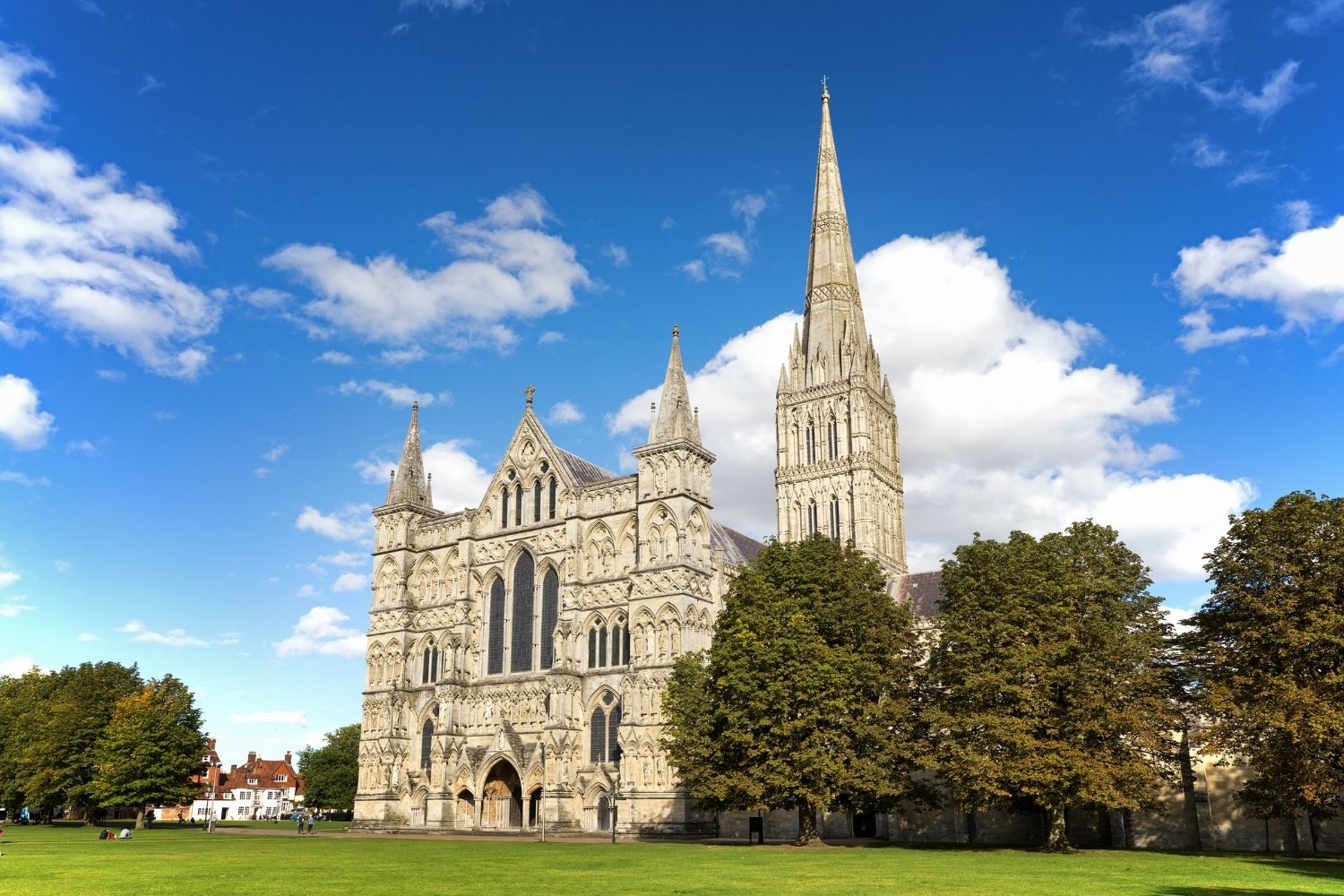
5. Salisbury Cathedral (England, 1220 to 1258)
Salisbury is the clearest example of Early English Gothic because most of it was built in under forty years, an unusually short timeline for a medieval cathedral. The result is a remarkably unified building defined by lancet windows, clustered piers, and restrained ornament. The spire, added in the early 14th century, rises to 123 meters and is the tallest in the United Kingdom. Salisbury also houses one of the four surviving original copies of the 1215 Magna Carta.
6. Westminster Abbey, London (England, 1245 onward)
Westminster Abbey is the royal church of England and the most important Gothic building in London. The current structure was begun in 1245 under Henry III, who wanted something that could rival the French royal churches, and the design reflects it. The high vault reaches 31 meters, the tallest Gothic nave in England, and the plan borrows directly from Reims and Amiens. Later centuries added the Perpendicular Gothic Henry VII Lady Chapel, finished in 1519, which contains one of the most elaborate fan vaults in existence. Westminster Abbey has hosted every English coronation since 1066 and was inscribed as a UNESCO World Heritage Site in 1987.
7. Cologne Cathedral (Germany, 1248 to 1880)
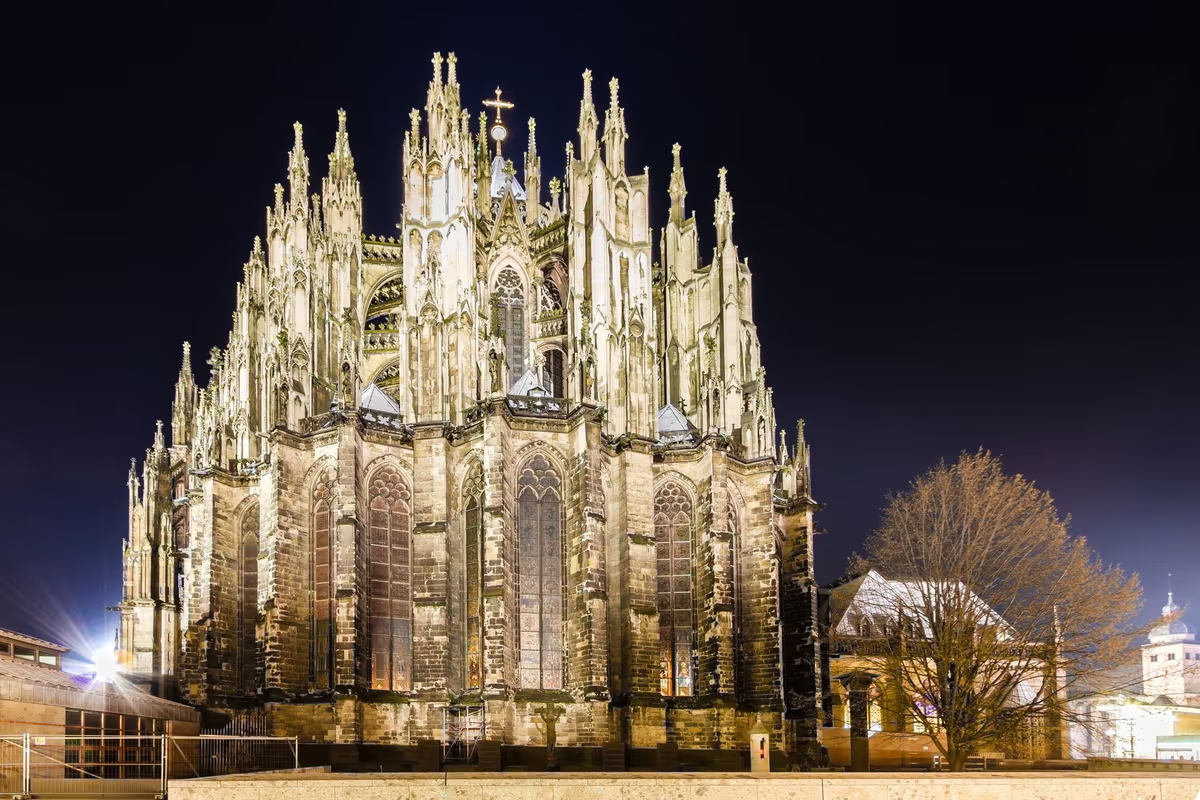
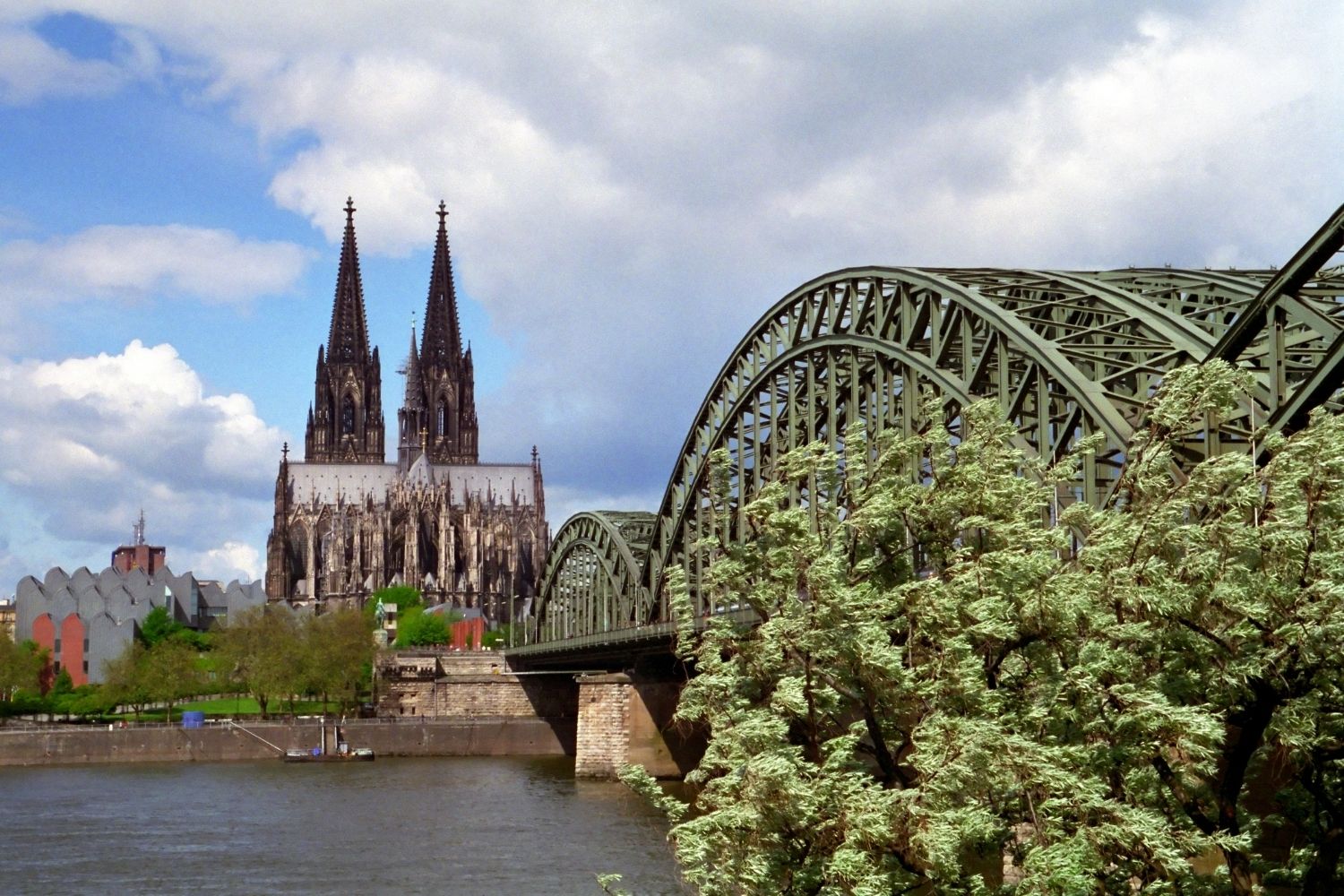
Cologne Cathedral is the largest Gothic church in northern Europe and, at 157 meters to the tip of its twin spires, it was briefly the tallest building in the world when it was finally finished in 1880. Construction began in 1248 and halted around 1560, leaving the unfinished cathedral with a medieval crane on top of the south tower for roughly three hundred years. Work resumed in the 19th century and was completed in strict adherence to the original medieval plans, which is rare.
The interior is a classic High Gothic five-aisled basilica, 144.5 meters long, 86.25 meters wide at the transept, with a nave that rises to 43.35 meters. It houses the Shrine of the Three Kings, a 12th-century reliquary by Nicholas of Verdun that is considered one of the great masterpieces of medieval goldwork. Cologne Cathedral was designated a UNESCO World Heritage Site in 1996, and the official tourism board of the city confirms that its windows cover more than 10,000 square meters, the largest window area of any church in the world. It remains Germany’s most visited landmark. For UNESCO’s own description of the site, see the UNESCO World Heritage entry for Cologne Cathedral.
8. Milan Cathedral (Italy, 1386 to 1965)
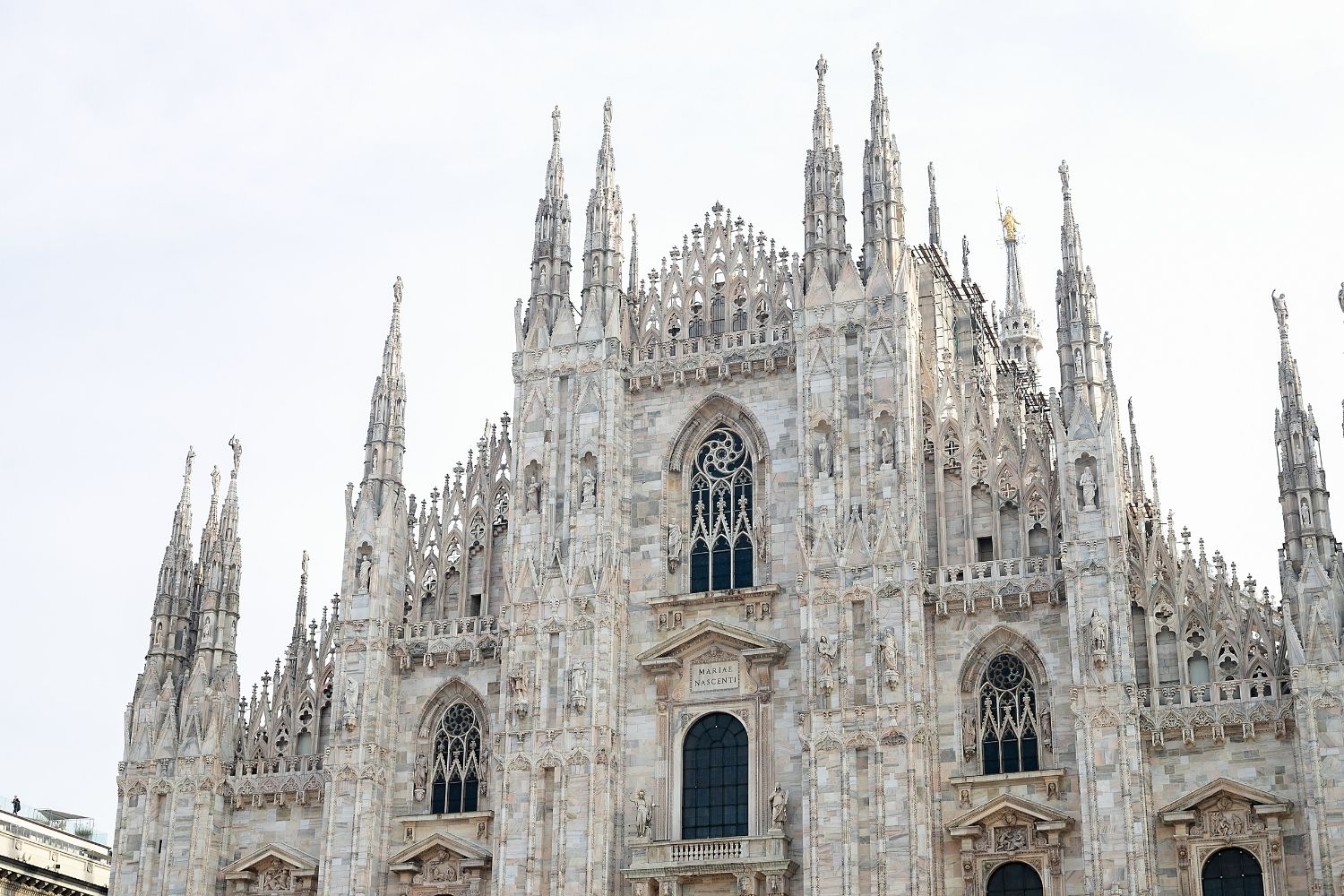
Milan Cathedral, known locally as the Duomo, is the largest church in Italy and one of the largest in the world. It is also the most unusual entry on this list because Italian builders never fully adopted the northern Gothic playbook. Construction began in 1386 under Gian Galeazzo Visconti, and the building shows Lombard, French, and later Renaissance influences all at once. The roof is a forest of 135 pinnacles, and the cathedral is clad in pink-veined Candoglia marble quarried at a site still used today. Final sculptural work continued into the 1960s, making the Duomo one of the longest cathedral construction projects ever completed.
9. St. Patrick’s Cathedral, New York (USA, 1858 to 1878)
St. Patrick’s Cathedral in New York is a Gothic Revival rather than a medieval Gothic building, but it belongs on any serious list of Gothic cathedrals because it demonstrates how powerfully the style traveled. Designed by James Renwick Jr. and built between 1858 and 1878 on Fifth Avenue in Midtown Manhattan, St. Patrick’s uses the High Gothic vocabulary, pointed arches, flying buttresses, ribbed vaulting, and twin spires, in new materials and at American urban scale. The spires rise 100 meters, and the church seats about 3,000. It is the seat of the Archbishop of New York and a National Historic Landmark.
10. Sagrada Família, Barcelona (Spain, 1882 onward)
Antoni Gaudí’s Sagrada Família is neither medieval nor a pure Gothic building. It is a late 19th and 21st-century basilica that took Gothic principles, the vertical pull, the structural skeleton, the light-filled interior, and rebuilt them around new geometry: hyperboloids, helicoids, and catenary arches drawn from nature. Gaudí took over the project in 1883 and worked on it until his death in 1926, knowing he would not see it finished. Construction still continues.
On February 20, 2026, workers placed the final piece of the cross atop the Tower of Jesus Christ, bringing the basilica to its full planned height of 172.5 meters and officially making it the tallest church in the world, surpassing Ulm Minster and Cologne Cathedral. Interior work and the Glory facade are still under construction. Our full guide covers the sacred geometry and design logic of the Sagrada Família, and for the construction milestone in detail see our report on the Sagrada Família reaching its highest point.
Gothic Cathedrals Compared: Key Dimensions and Dates
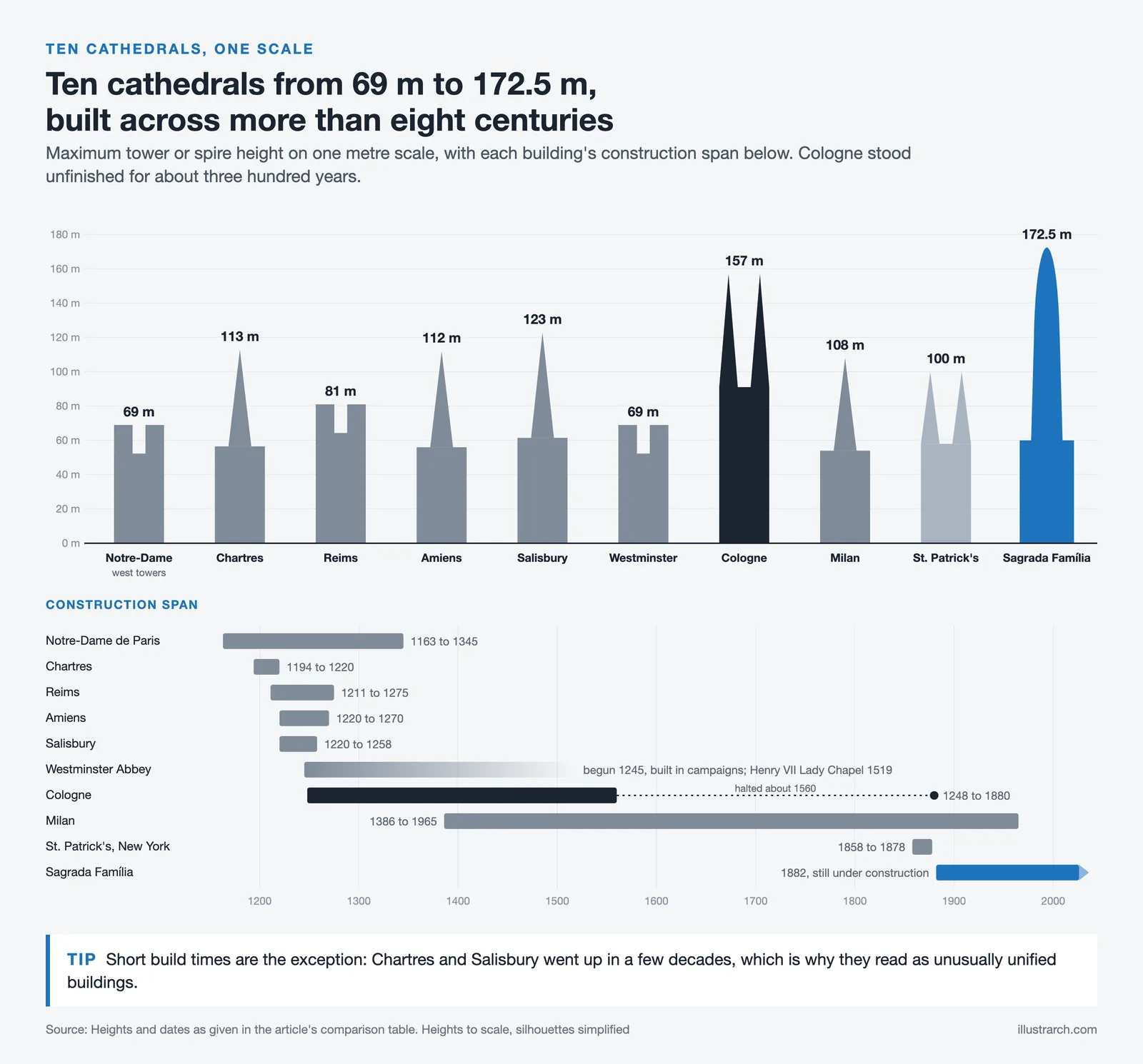
The following table puts the ten cathedrals side by side for quick reference. Heights given are the maximum tower or spire height, not the interior vault.
| Cathedral | Location | Construction | Height | Style Phase |
|---|---|---|---|---|
| Notre-Dame de Paris | Paris, France | 1163 to 1345 | 69 m (west towers) | Early to High Gothic |
| Chartres Cathedral | Chartres, France | 1194 to 1220 | 113 m | High Gothic |
| Reims Cathedral | Reims, France | 1211 to 1275 | 81 m | High Gothic |
| Amiens Cathedral | Amiens, France | 1220 to 1270 | 112 m | High Gothic |
| Salisbury Cathedral | Salisbury, UK | 1220 to 1258 | 123 m | Early English Gothic |
| Westminster Abbey | London, UK | 1245 onward | 69 m | High and Perpendicular Gothic |
| Cologne Cathedral | Cologne, Germany | 1248 to 1880 | 157 m | High Gothic |
| Milan Cathedral | Milan, Italy | 1386 to 1965 | 108 m | Late Gothic and later |
| St. Patrick’s Cathedral | New York, USA | 1858 to 1878 | 100 m | Gothic Revival |
| Sagrada Família | Barcelona, Spain | 1882 onward | 172.5 m | Gaudí Gothic, modern |
Why Does Gothic Architecture Still Matter?
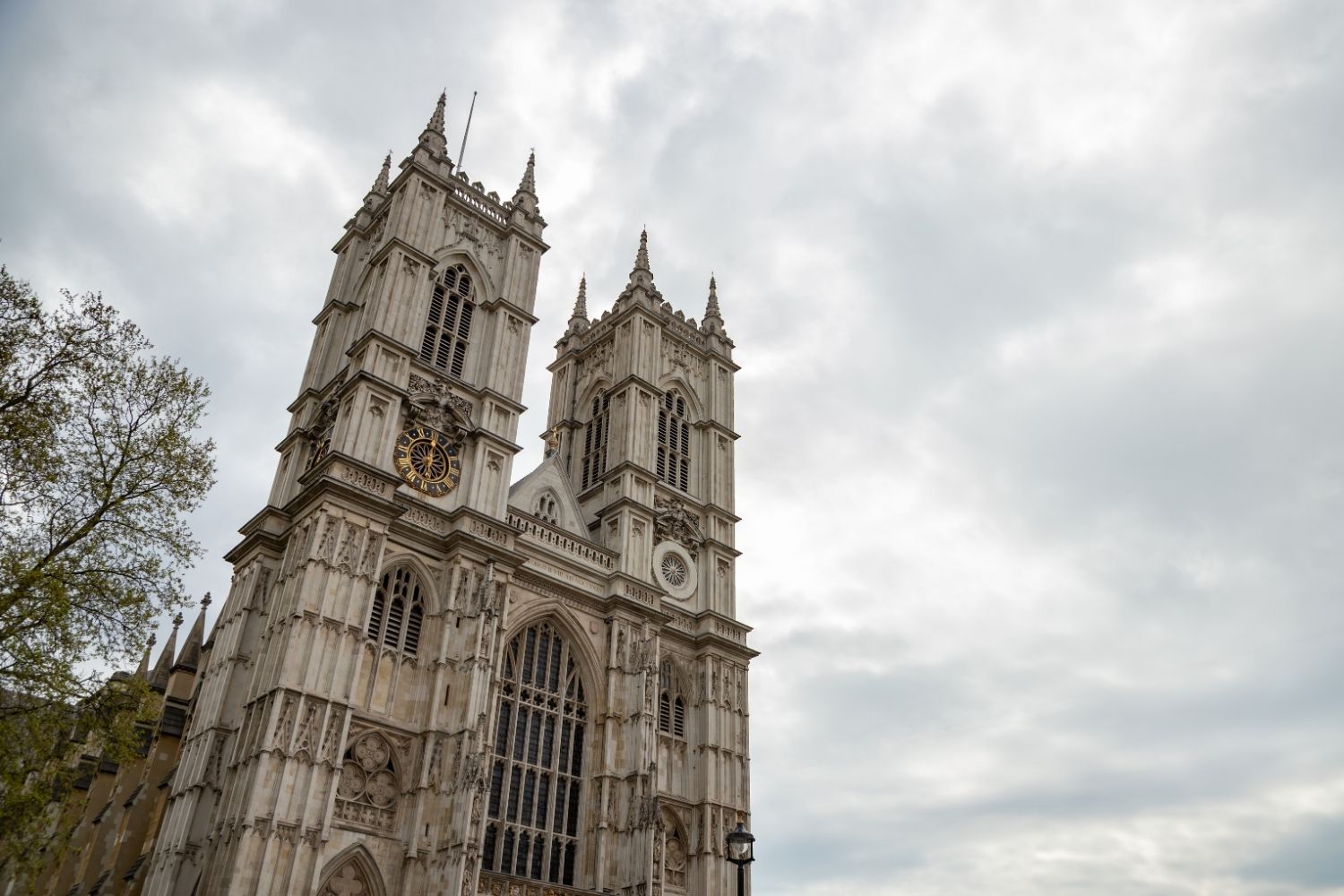
Gothic architecture matters today for three reasons. The first is structural. The idea that you can externalize a building’s structural system, flying buttresses on a cathedral, diagrid frames on a modern skyscraper, and free up the interior for flexible space is the same idea. Contemporary long-span and high-rise design still draws on that logic.
The second is material. Gothic builders designed for permanence. The 2019 Notre-Dame fire showed that 860-year-old stone vaulting could survive extreme thermal and mechanical stress. In an era of short-lived construction, the durability of medieval Gothic work is being taken seriously again, especially in conversations about embodied carbon and long-life buildings.
The third is spatial. Gothic cathedrals remain some of the most emotionally powerful interiors ever built, and that is not an accident of nostalgia. The vertical pull, the filtered colored light, the layered transparency of the nave and ambulatory are effects that modern architects like Tadao Ando and Peter Zumthor have spent careers reinterpreting in concrete, timber, and glass.
🏗️ Real-World Example
Tribune Tower (Chicago, 1925): The 36-story headquarters designed by John Mead Howells and Raymond Hood won the 1922 Chicago Tribune competition against 260 entries. Its crown was modeled on the Butter Tower of Rouen Cathedral, and the building became one of the most visible arguments that Gothic vocabulary could work at skyscraper scale. It stands as proof that Gothic architecture did not end in the Middle Ages but kept reappearing wherever architects wanted to project permanence and gravitas. For the full story, see our article on Tribune Tower’s neo-Gothic design and legacy.
Gothic Architecture and Its Hidden Influences
One detail rarely covered in introductory texts is how much Gothic architecture owes to Islamic design. The pointed arch, the hallmark of Gothic building, appeared in Islamic buildings centuries earlier. Geometric tile patterns, sophisticated daylight control, and the ribbed vault itself all traveled into European design through cultural exchange in medieval Spain, Sicily, and the Crusader states.
This does not diminish Gothic architecture. It places it correctly in a wider Mediterranean and Near Eastern building tradition that was in continuous dialogue during the centuries when Gothic cathedrals were rising in France, England, and Germany. Our article on Islamic architecture and Gothic architecture explores this exchange in detail.
For another angle on how Gothic compares structurally with other major traditions, our Gothic vs Neoclassical arches guide looks at how pointed and semicircular arches each shaped architectural identity, and our piece on Baroque vs Romanesque architecture covers what came before and after the Gothic period in European church building.
✅ Key Takeaways
- Gothic architecture emerged around 1140 at Saint-Denis and dominated European church building until roughly 1500.
- Its three defining innovations are the pointed arch, the ribbed vault, and the flying buttress, used together as one structural system.
- The style moves through Early, High, and Late phases, with regional variants including English Perpendicular and French Flamboyant Gothic.
- Notre-Dame de Paris, Chartres, Cologne, and Milan set the structural and artistic benchmarks that Gothic Revival and modern architects still reference.
- The Sagrada Família, completed in height in February 2026 at 172.5 meters, is now the tallest church in the world and extends Gothic principles into the 21st century.
Further Reading on Authoritative Sources
For primary documentation on the cathedrals covered in this guide, the UNESCO World Heritage List holds the official records for the Gothic sites mentioned, including Cologne Cathedral, Chartres, Amiens, and Westminster Abbey. For editorial coverage, Britannica’s entry on Gothic architecture provides a concise scholarly overview, and The Metropolitan Museum of Art’s Heilbrunn Timeline covers Gothic art and architecture in its wider cultural context. For ongoing coverage of the Sagrada Família’s construction, the official Sagrada Família Basilica website publishes updates from the construction foundation itself.
Gothic architecture is one of the few styles where seeing the buildings in person really does change how you understand the photographs. The cathedrals on this list are still doing the work they were built to do, and most of them are open to any visitor willing to walk in.







The Five Points of Architecture by Le Corbusier Explained
Le Corbusier published the five points of architecture in 1927: pilotis, free...
 illustrarch Editoral Team8 Mins read
What Is Minimalist Architecture? Principles, Origins, and Iconic Buildings
Minimalist architecture strips a building to its essentials so space, light and...
illustrarch Editoral Team9 Mins read

Georgian Architecture: Features, History & Examples
Georgian architecture (1714-1830) is defined by strict symmetry, classical proportion, sash windows...
illustrarch Editoral Team9 Mins read
Neoclassical Architecture: Features, History & Examples
Neoclassical architecture emerged in the mid-18th century, reviving Greek and Roman forms...
illustrarch Editoral Team8 Mins read


Leave a comment