

Ocean Vortex: Yufeng Tu’s Floating Parliament Built From Marine Waste
Ocean Vortex by Yufeng Tu turns the Pacific plastic crisis into architecture, using recycled marine debris for both structure and buoyancy. A 2026 YAC Ocean Parliament finalist, it gathers a museum, parliament, and ecological systems on one floating platform.
 Elif Ayse Sen11 June 20265 Mins read124
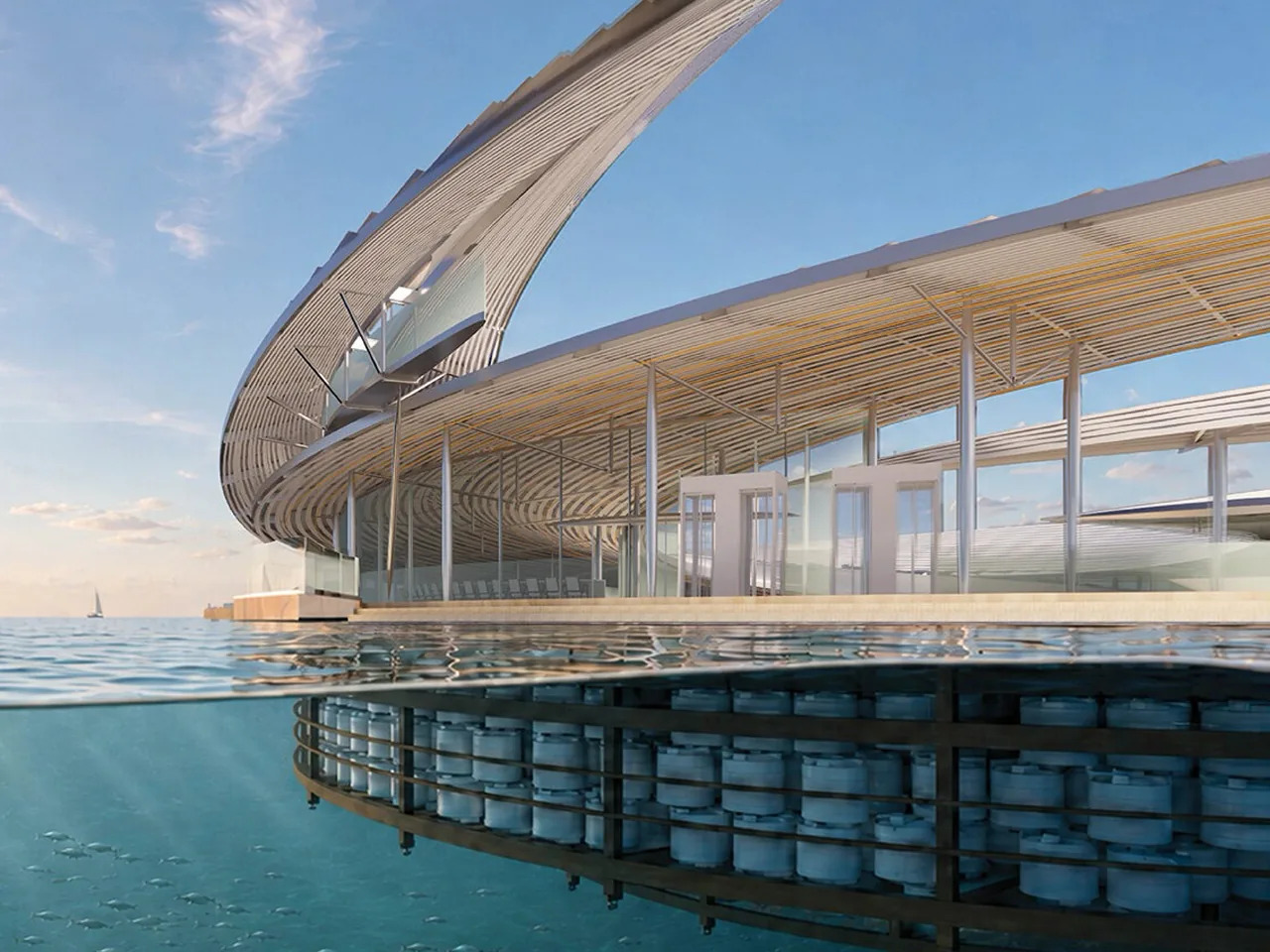
Table of Contents Show
Yufeng Tu’s Floating Parliament, called Ocean Vortex, is a speculative civic building designed for the 2026 YAC Ocean Parliament competition. It floats on the Pacific Ocean and is built largely from recycled marine waste, combining a public museum, parliamentary chambers, and ecological systems within a spiraling form that responds to ocean currents.
Most floating proposals treat the sea as a site to settle on. Ocean Vortex treats the ocean’s pollution as the reason to build and as the material to build with. Designed by architect Yufeng Tu and named a finalist in the 2026 YAC competition, the project places governance, education, and ecological repair directly inside the environment that the plastic crisis has damaged. It is one of the more pointed recent examples of floating architecture used as an argument rather than just a shelter.
What Is Ocean Vortex?
Ocean Vortex is a speculative floating parliament conceived for the Garbage Patch State, the symbolic theme behind the YAC Ocean Parliament brief. Rather than a fixed building on land, it is a self-contained platform anchored at sea, designed to draw attention to the plastic islands accumulating across the Pacific. The project earned recognition as a finalist in the 2026 YAC Ocean Parliament competition, an international call asking young designers to imagine a seat of governance for marine ecosystems.
The proposal answers a simple but uncomfortable question. If a region of the ocean has become a vast field of human waste, what kind of public institution should sit there, and what should it be made of? Tu’s answer folds the problem and the building into a single object.
📌 Did You Know?
The competition behind Ocean Vortex grows out of a real cultural project. In 2013, artist Maria Cristina Finucci founded the Garbage Patch State, a symbolic nation representing the Pacific’s plastic islands, an initiative that drew recognition from several institutional figures at the time. YAC’s Ocean Parliament brief asked architects to design a parliament for exactly that imagined state.
A Vortex Shaped by Ocean Currents
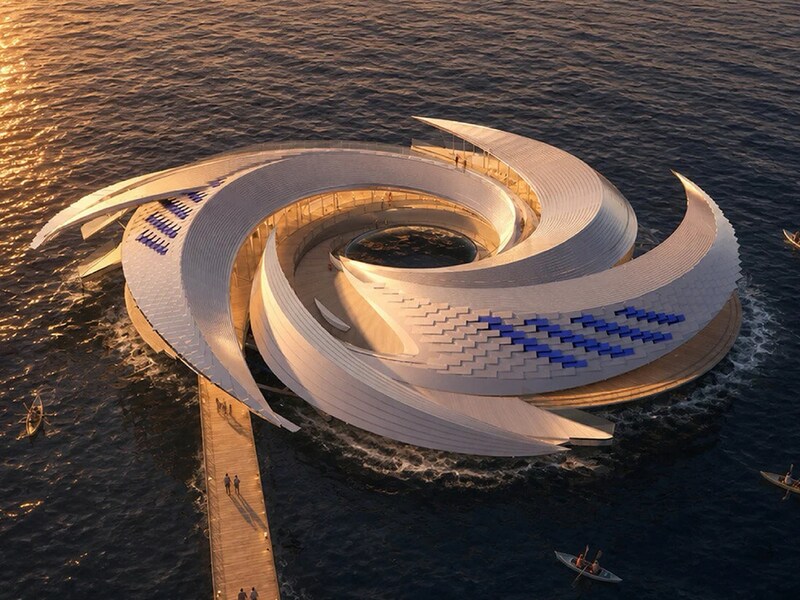
The building takes the form of a spiraling vortex resting on the water’s surface, a shape documented across the project’s published renderings. That shape is not decorative. Garbage patches form because rotating ocean currents, called gyres, pull floating debris toward a slow-moving center. Tu borrowed the same geometry, turning the mechanism that concentrates plastic into the logic that organizes the building.
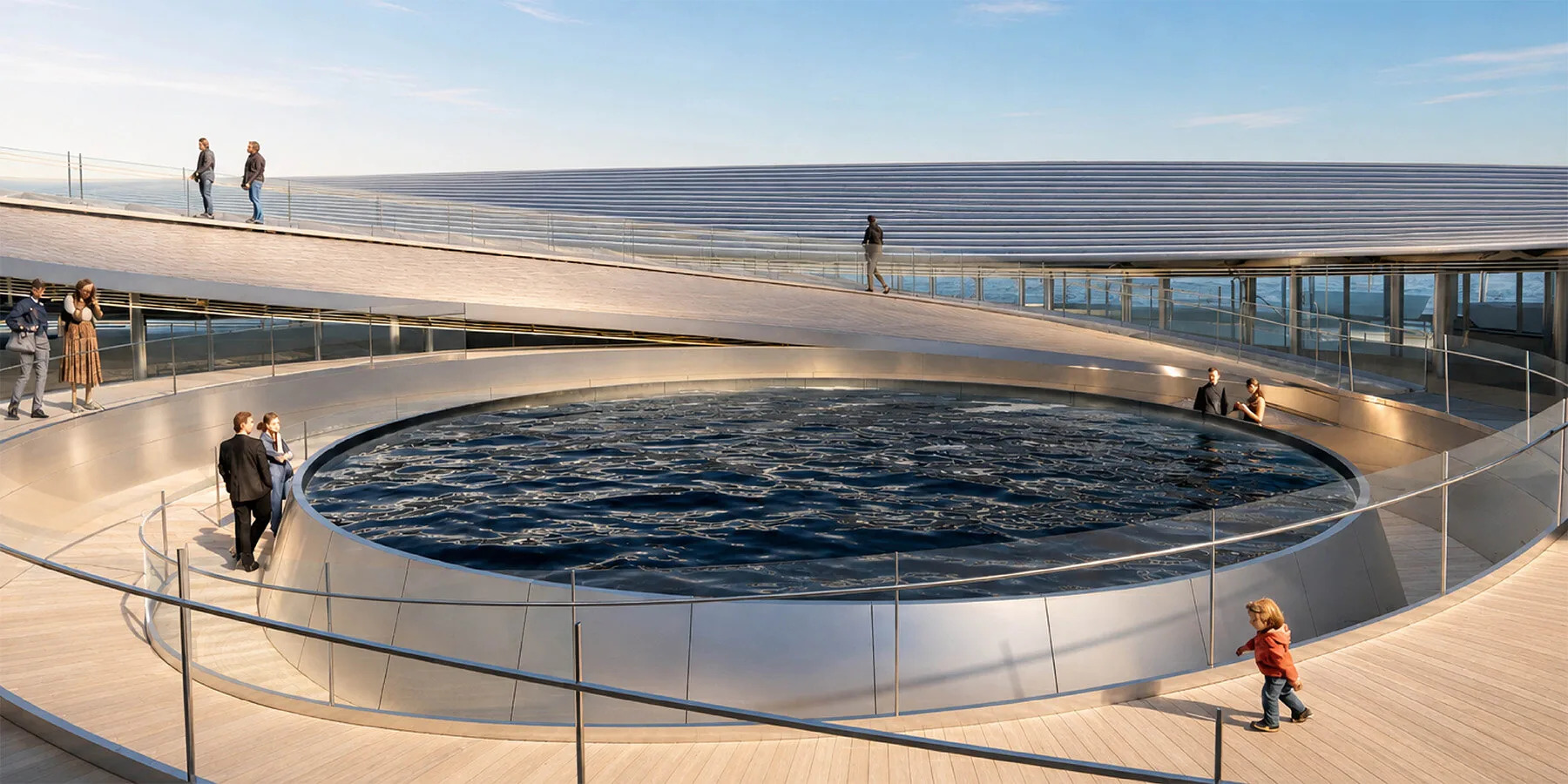
Visitors move inward along one continuous path that winds toward a central water courtyard at the core. The journey is meant to read as a passage through the crisis itself, narrowing from the open sea toward a quiet center where the consequences of marine pollution become hard to ignore. Wind, waves, and current are translated into circulation and views, giving the form a direct relationship to the forces around it. The result sits closer to manifesto than to a neutral piece of floating urban design.
Turning Marine Waste Into Structure
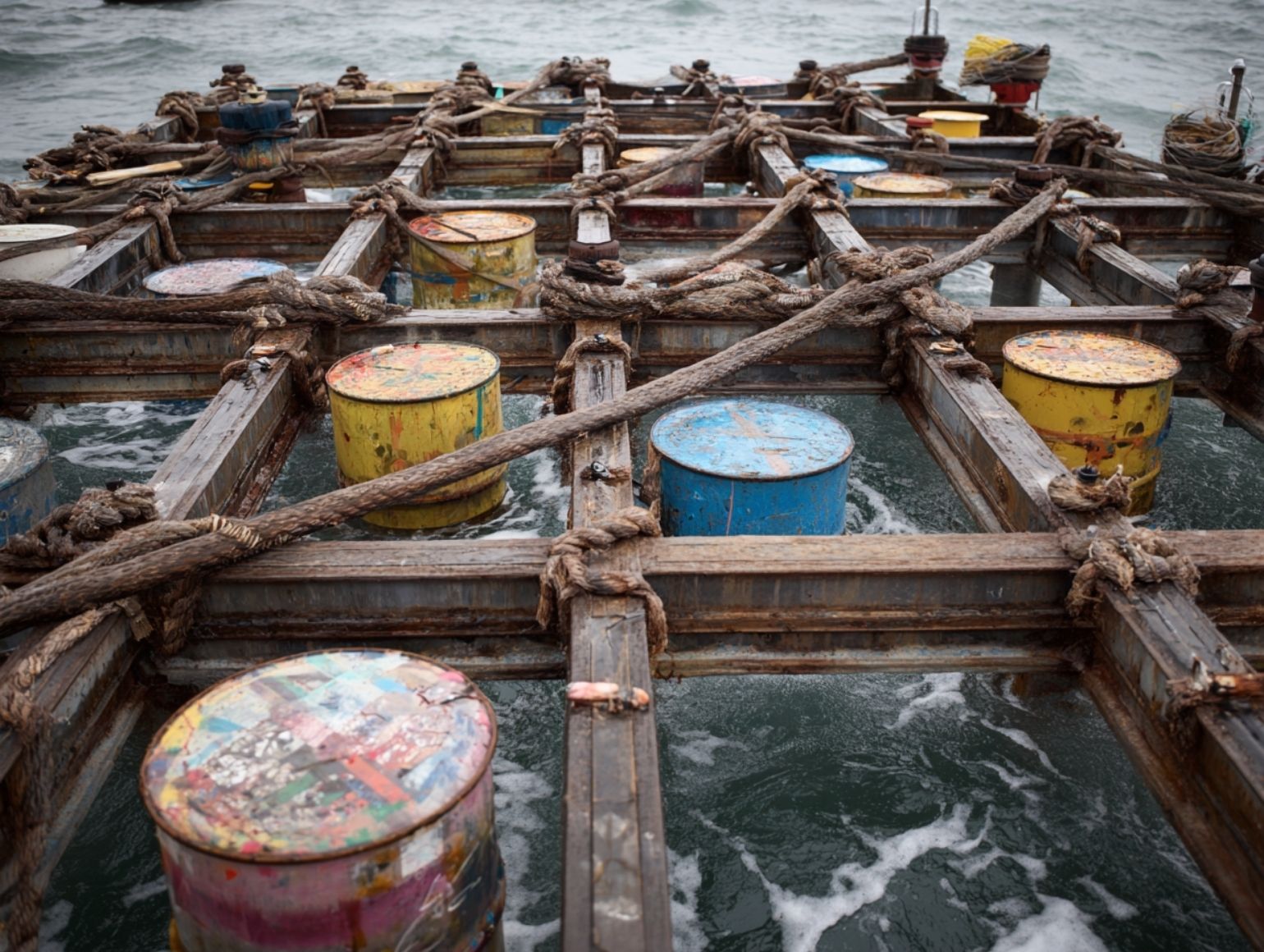
The clearest idea in the project is structural. A steel framework supports the floating platform, while recycled plastic barrels and salvaged marine waste containers serve as buoyancy elements. Material that once polluted the water becomes the system that keeps the building afloat. This closes a loop that most architecture only talks about: the waste is not a reference or a finish, it is load-bearing to the function of the structure.
This approach connects Ocean Vortex to a wider shift toward circular thinking in design, where discarded plastic is treated as a stock of usable material instead of a disposal problem. Recent work such as the circular design experiments with recycled plastic shows the same instinct at a furniture scale, while Ocean Vortex pushes it toward civic infrastructure. The scale of the source material is the point, and the numbers behind the Pacific crisis explain why a project like this exists.
🔢 Quick Numbers
- The Great Pacific Garbage Patch covers about 1.6 million square kilometers, roughly three times the size of France (The Ocean Cleanup, 2018)
- An estimated 1.8 trillion pieces of plastic float within the patch (The Ocean Cleanup, 2018)
- Between 1.15 and 2.41 million tonnes of plastic enter the ocean from rivers each year (The Ocean Cleanup)
Building with reclaimed marine plastic raises practical questions that a competition board can simplify but a real project cannot. The condition, polymer type, and contamination of salvaged material vary widely, which matters the moment that material has to carry weight or provide flotation.
💡 Pro Tip
When detailing structures that reuse marine plastic or salvaged barrels for flotation, treat material consistency as the main risk. Reclaimed ocean plastic differs in polymer type, UV degradation, and contamination from one source to the next, so specify testing and grading of each batch before it carries any structural or buoyancy load. Designers who skip this step often find that real performance drifts far from the spec sheet.
Inside the Floating Parliament: Program and Systems
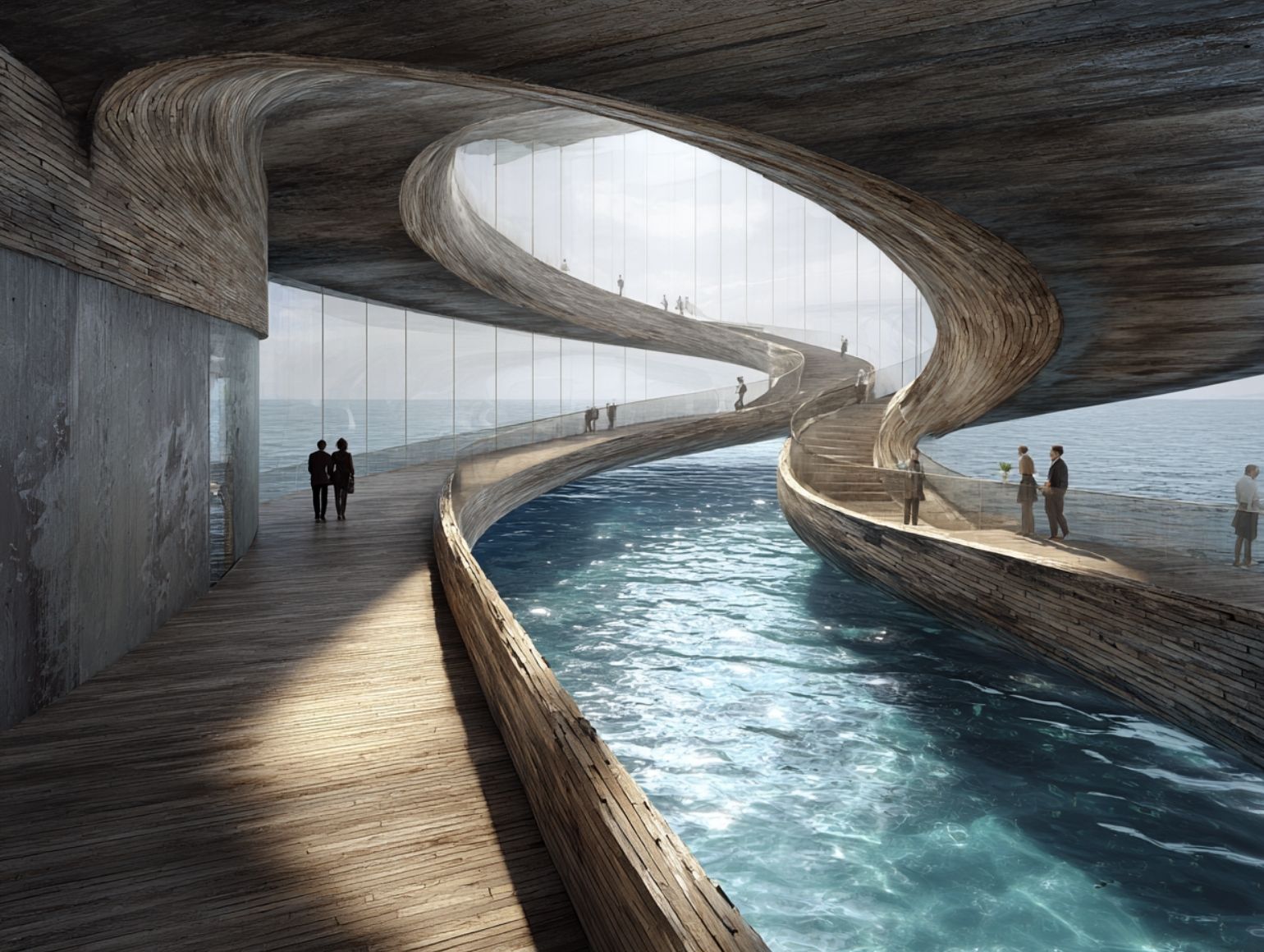
Ocean Vortex stacks public, governmental, and environmental functions onto one connected platform. Exhibition spaces and a museum teach visitors about marine pollution and ocean conservation, while parliamentary chambers and meeting rooms host civic dialogue and decision making. Separate circulation routes keep public visitors apart from parliament members and staff, so the educational and governmental sides can run at the same time without crossing paths.
The technical systems are placed where they can be seen rather than hidden. Solar panels on the roof generate energy for daily operations, while submerged levels hold hydroponic cultivation, desalination, and energy conversion equipment. A flexible seabed anchorage lets the platform move with tides and waves while staying stable. Exposing these systems is part of the teaching, making the building’s metabolism legible to the people inside it.
Program and Systems by Level
The table below outlines how the main functions are distributed across the structure.
| Level | Primary Function | Key Systems |
|---|---|---|
| Roof and upper deck | Energy generation | Solar panel arrays |
| Main platform | Museum, exhibitions, parliamentary chambers | Separated visitor and parliament circulation |
| Waterline structure | Flotation and stability | Steel frame, recycled barrels, marine waste containers |
| Submerged levels | Food, water, and energy support | Hydroponics, desalination, energy conversion |
| Seabed connection | Positioning | Flexible anchorage adapting to tides and waves |
Why Ocean Vortex Matters for Civic Architecture
What makes Yufeng Tu’s Floating Parliament worth attention is the role it gives architecture. Many sustainable buildings represent an environmental message through form, planting, or material choice. Ocean Vortex tries to participate in the problem instead, pulling waste out of the water and converting it into a working institution. The building is positioned as part of the remediation, not a comment on it.
Speculative work like this rarely gets built as drawn, and the engineering questions around open-ocean structures of this size are real. Its value is in the proposition. It suggests that future public buildings could be sited inside ecological crises and could earn their keep through resource recovery, energy generation, and food production, while still serving as places for people to gather and decide things together. That idea sits alongside other attempts to rethink civic and cultural space on water, such as proposals for a floating museum on the open sea, and it pushes the conversation toward governance rather than housing alone.
🏗️ Real-World Example
Makoko Floating School (Lagos, 2013): Designed by Kunlé Adeyemi’s studio NLE, this triangular floating structure served the lagoon community of Makoko as a school and gathering space, supported on a platform of recycled plastic barrels for buoyancy. It demonstrated that a floating civic building using salvaged flotation can work in real coastal conditions, a principle that Ocean Vortex extends to a far larger open-ocean scale.
✅ Key Takeaways
- Ocean Vortex is a speculative floating parliament by architect Yufeng Tu, recognized as a finalist in the 2026 YAC Ocean Parliament competition.
- Its spiraling form borrows the geometry of ocean gyres, the same currents that concentrate plastic into garbage patches.
- Recycled plastic barrels and salvaged marine waste containers act as buoyancy elements, making ocean pollution part of the load-bearing system.
- The platform combines a public museum, parliamentary chambers, and exposed environmental systems for energy, food, and freshwater.
- The project frames civic architecture as an active participant in ecological repair rather than a passive symbol of it.
Final Thoughts
Ocean Vortex will likely stay on paper, but it does what strong speculative architecture should do. It takes a problem that feels too large and abstract to picture and gives it a shape, a program, and a material logic. By turning the Pacific’s waste into the substance of a parliament, Yufeng Tu’s Floating Parliament asks whether the buildings of the future might be measured not only by what they consume, but by what they take back out of the world around them. For more on the materials side of this question, see how designers are rethinking sustainable architecture across the wider field.



Allies and Morrison Win Approval to Restore Barbican Sculpture Court
City of London Corporation approves Allies and Morrison's plan to restore the...
 illustrarch Editoral Team2 Mins read
Will Forma Replace Revit? Autodesk Finally Answers
Autodesk's own FAQ says Forma will replace Revit over time, as it...
illustrarch Editoral Team3 Mins read

How HKS Made Astra Tower, Utah’s Tallest Building, Feel Local
Astra Tower, Utah's tallest building since it opened in May 2025, takes...
illustrarch Editoral Team4 Mins read

Manipal University Team Turns Treated Sewage Into Stronger Biochar Concrete
Manipal University Jaipur researchers find biochar from treated sewage can strengthen concrete,...
illustrarch Editoral Team3 Mins read


Leave a comment