

Hagia Sophia Istanbul and the Mosques That Define Sacred Geometry
From the pendentive dome of Hagia Sophia Istanbul to the retractable roof of Hassan II Mosque in Casablanca, sacred geometry has guided mosque design for over a thousand years. This article examines seven landmark mosques whose proportions, patterns, and spatial planning reveal the mathematical principles at the core of Islamic architecture.
 Furkan Sen24 June 20265 Mins read1
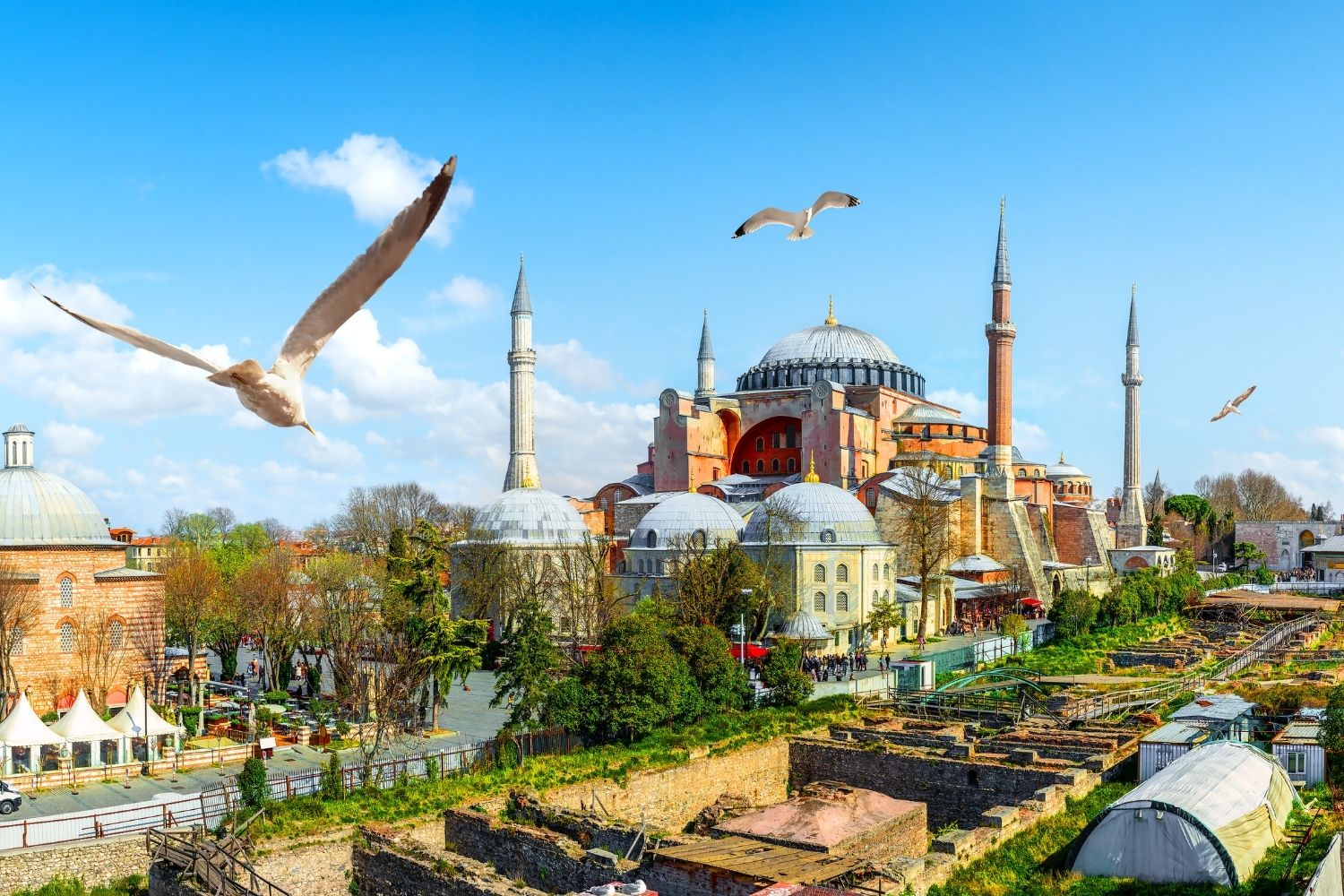
Table of Contents Show
Hagia Sophia Istanbul stands at the intersection of two architectural traditions, Byzantine and Ottoman, both shaped by sacred geometry. Across the Islamic world, mosques from Casablanca to Lahore apply geometric principles to organize space, direct light, and express spiritual meaning through physical form.
How Sacred Geometry Shapes Islamic Architecture
Sacred geometry in Islamic architecture works differently than in the Western tradition. Where Gothic cathedrals use geometry to push vertical space upward, mosque architecture uses it to create horizontal continuity, centering the worshipper within a field of pattern rather than directing them toward an elevated focal point. This distinction is critical for understanding why mosques feel so different from churches despite sharing geometric DNA.
The prohibition against figurative imagery in mosque interiors pushed architects and craftsmen toward abstract geometric systems. Star polygons, tessellations, and arabesques became the primary visual language. These patterns are not decorative afterthoughts. They encode mathematical relationships, from simple ratios to complex golden ratio proportions, that govern how surfaces, volumes, and light interact within the prayer hall.
Three geometric tools recur across nearly every major mosque: the circle (representing unity and infinity), the square (representing the earthly and material), and the octagon (mediating between the two). The transition from a square floor plan to a circular dome, achieved through pendentives or squinches, is one of Islamic architecture’s most elegant structural solutions, and it appears in buildings separated by centuries and thousands of kilometers.
🎓 Expert Insight
“Geometry is the language through which the Islamic world speaks of the infinite. Every pattern you see on a mosque wall is a meditation on the nature of God, expressed through pure mathematics.” — Issam El-Said, Author of “Islamic Art and Architecture: The System of Geometric Design”
El-Said’s research documented how apparently complex mosque surface patterns derive from surprisingly simple geometric constructions, connecting the work of medieval craftsmen to modern mathematical theory.
Hagia Sophia Istanbul: Where Byzantine Geometry Meets Ottoman Design
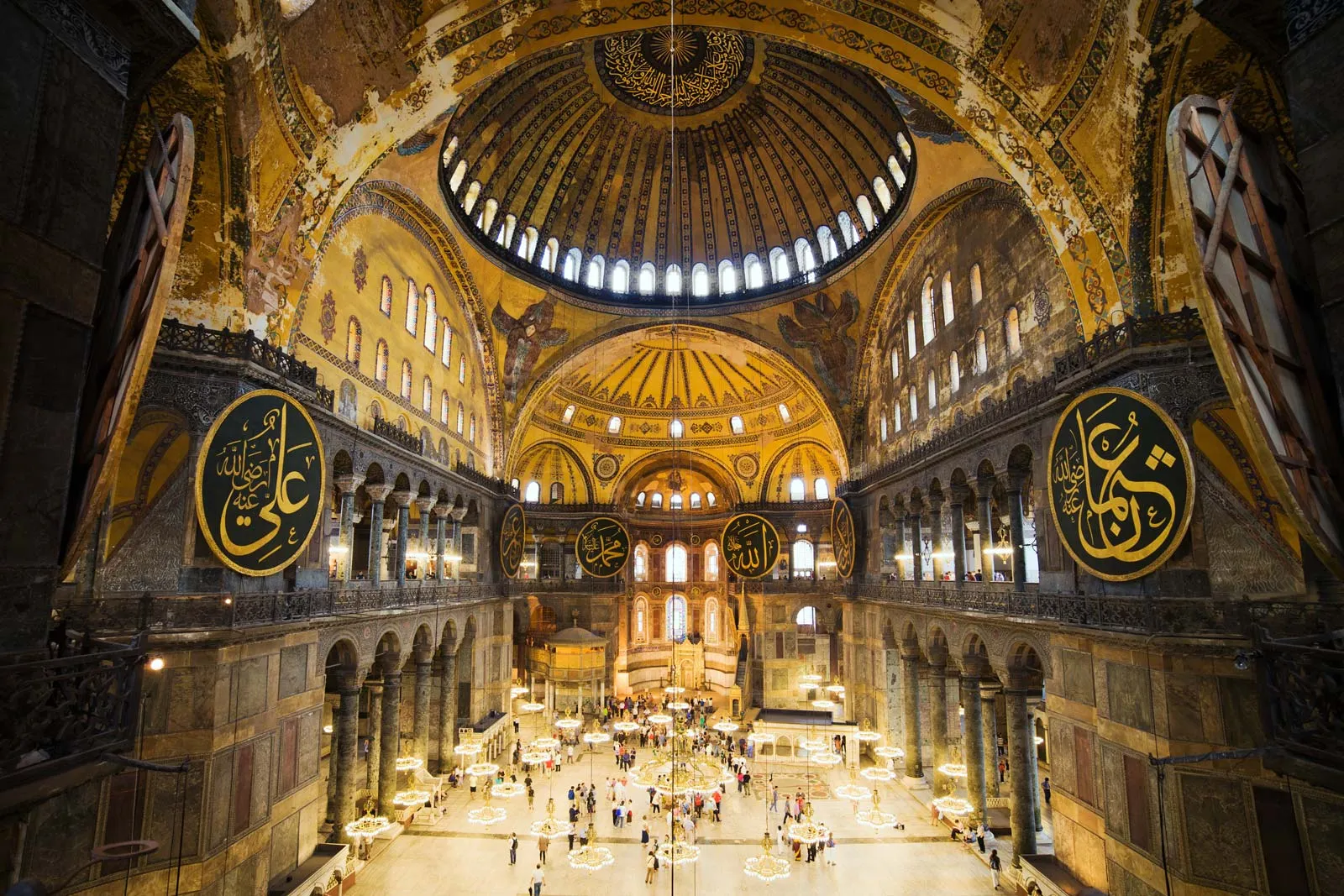
Hagia Sophia Istanbul is not a mosque in its original conception. Built in 537 CE as the principal church of the Byzantine Empire, its geometry belongs to a Christian spatial tradition, yet its influence on Ottoman mosque architecture is impossible to overstate. When Mehmed II converted it after the conquest of Constantinople in 1453, he inherited a building that had already solved the problem of placing a massive dome over a rectangular floor plan using pendentives, curved triangular sections that transfer the dome’s weight to four massive piers.
The central dome of Hagia Sophia spans 31 meters and rises 55 meters above the floor. Its geometry created an interior volume that Ottoman architect Mimar Sinan spent his entire career trying to surpass. Sinan’s progression from the Şehzade Mosque to the Süleymaniye and finally the Selimiye Mosque in Edirne traces a direct geometric dialogue with Hagia Sophia Istanbul, each building refining the relationship between dome, semi-dome, and supporting structure.
Why Does Hagia Sophia Still Influence Mosque Design?
The answer lies in its spatial logic. Hagia Sophia demonstrated that a single uninterrupted interior volume could produce an overwhelming sense of sacred space. Ottoman architects adopted this principle but reinterpreted it through Islamic spatial requirements: prayer rows oriented toward the qibla wall, ablution areas integrated into the courtyard, and minarets replacing bell towers as vertical markers. The geometry remained; the ritual program changed.
Sheikh Zayed Grand Mosque Abu Dhabi: Geometry Across Cultures
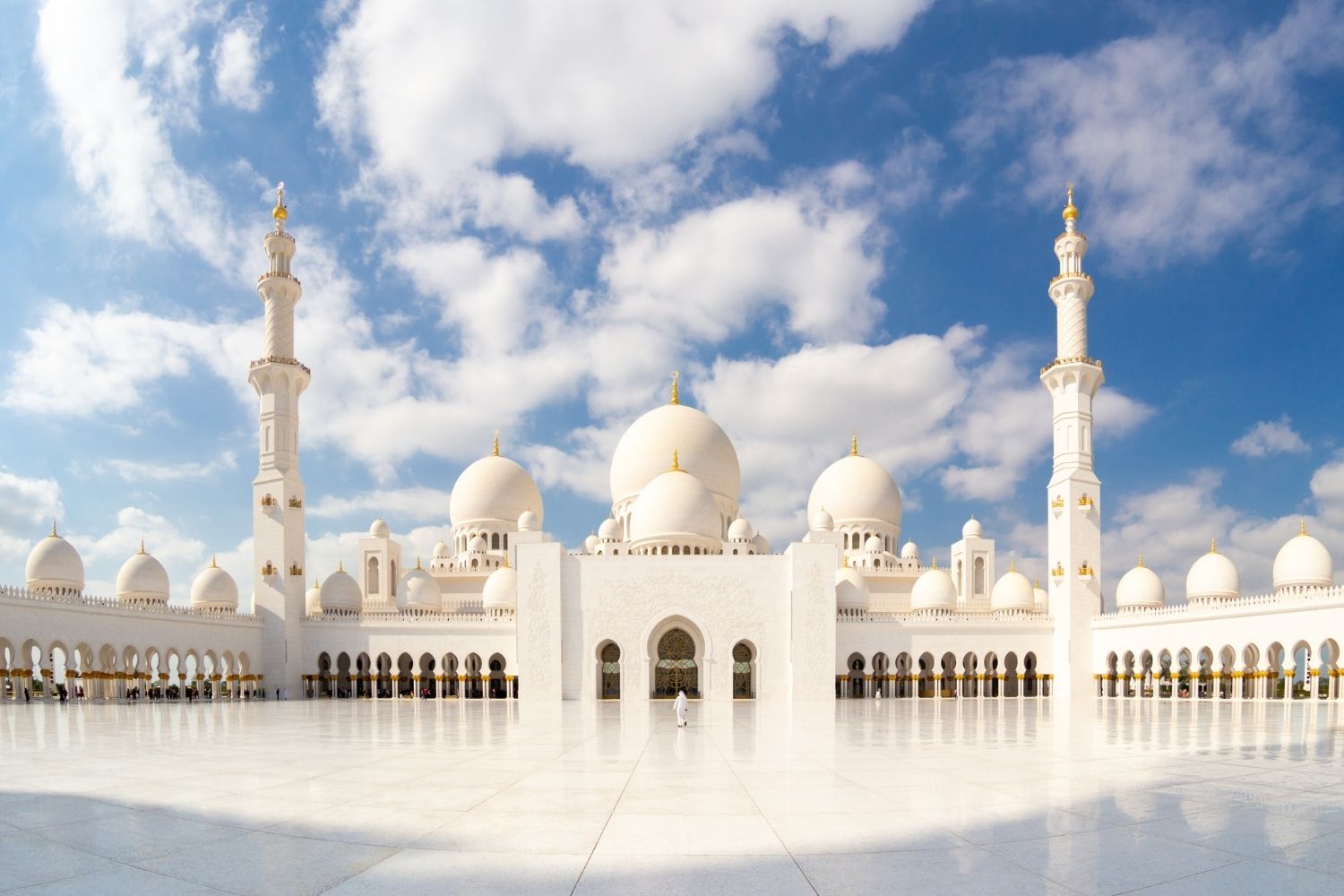
The Sheikh Zayed Grand Mosque in Abu Dhabi, completed in 2007, draws from Persian, Mughal, Moorish, and Ottoman geometric traditions simultaneously. Its 82 domes follow a cascading size hierarchy governed by proportional relationships, with the main prayer hall dome measuring 32.8 meters in diameter. The courtyard floor features one of the world’s largest marble mosaic designs, a floral pattern executed in 17 types of colored marble whose geometry references both Mughal garden layouts and Persian carpet proportions.
What makes this mosque architecturally significant from a geometric standpoint is its conscious synthesis. Rather than adhering to a single regional tradition, the design team studied proportional systems from across the Islamic world and combined them within a unified structural framework. The result is a building where Moroccan zellige tilework, Persian floral patterns, and Ottoman dome geometry coexist without visual contradiction.
Hassan II Mosque Casablanca: Sacred Proportions on the Atlantic
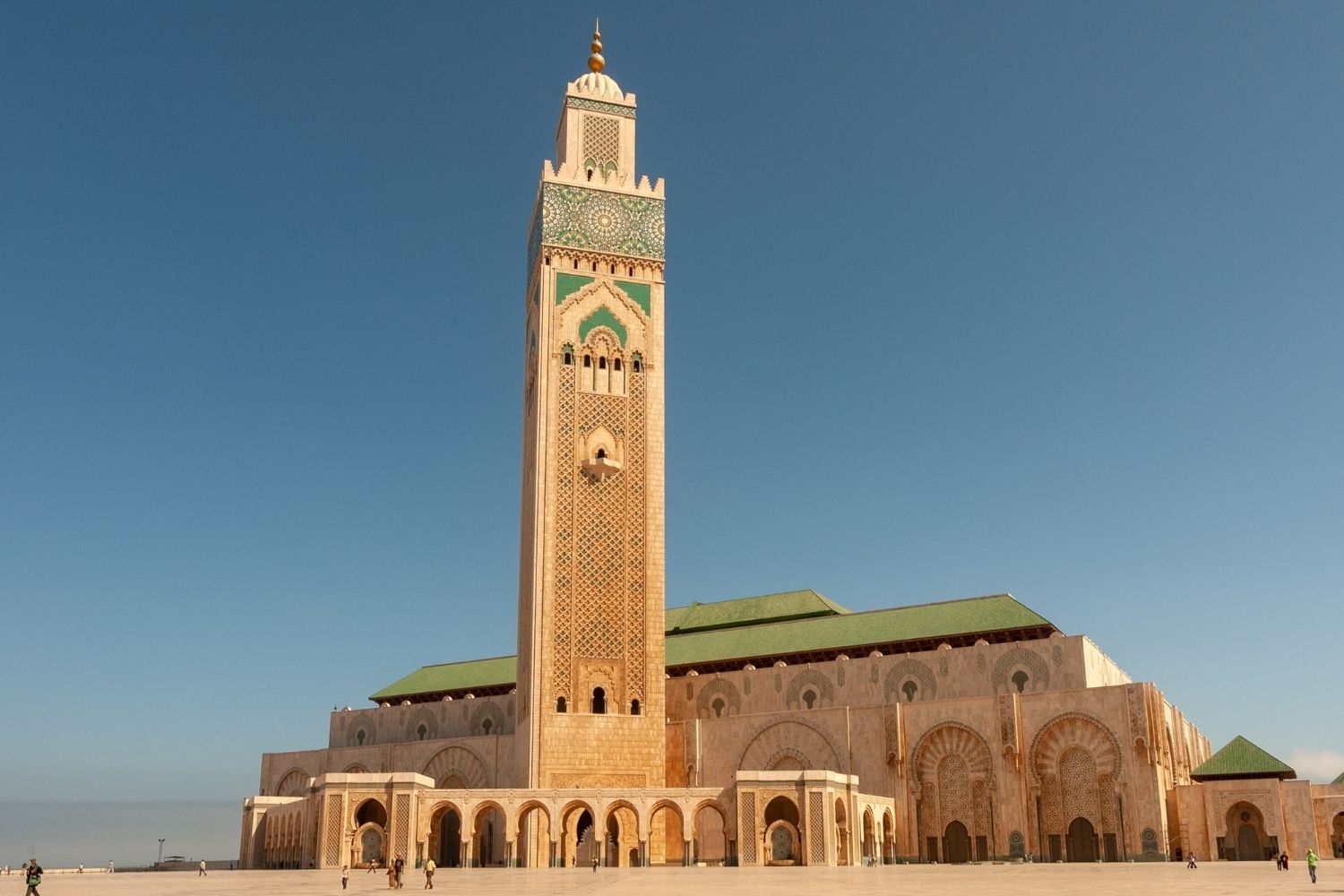
The Hassan II Mosque in Casablanca, designed by French architect Michel Pinseau and completed in 1993, holds a singular position in mosque architecture. Built partly over the Atlantic Ocean, its 210-meter minaret was the tallest religious structure in the world until 2019. The prayer hall accommodates 25,000 worshippers and features a retractable roof, an engineering feature unprecedented in mosque design.
The mosque’s geometry references Moroccan Moorish-Andalusian traditions. Its proportions follow ratios found in the Koutoubia Mosque in Marrakech and the Hassan Tower in Rabat, creating a geometric lineage that connects contemporary construction to 12th-century design principles. The interior surfaces are covered with hand-carved plaster, zellige mosaics, and painted cedar wood, all executed by Moroccan master craftsmen using geometric patterns passed down through guild systems for centuries.
📌 Did You Know?
The Hassan II Mosque’s 200-meter minaret projects a laser beam 30 kilometers toward Mecca, making it the only mosque in the world where a visible light beam permanently marks the qibla direction across open ocean (Source: Fondation de la Mosquée Hassan II).
Blue Mosque Istanbul and Badshahi Mosque Lahore
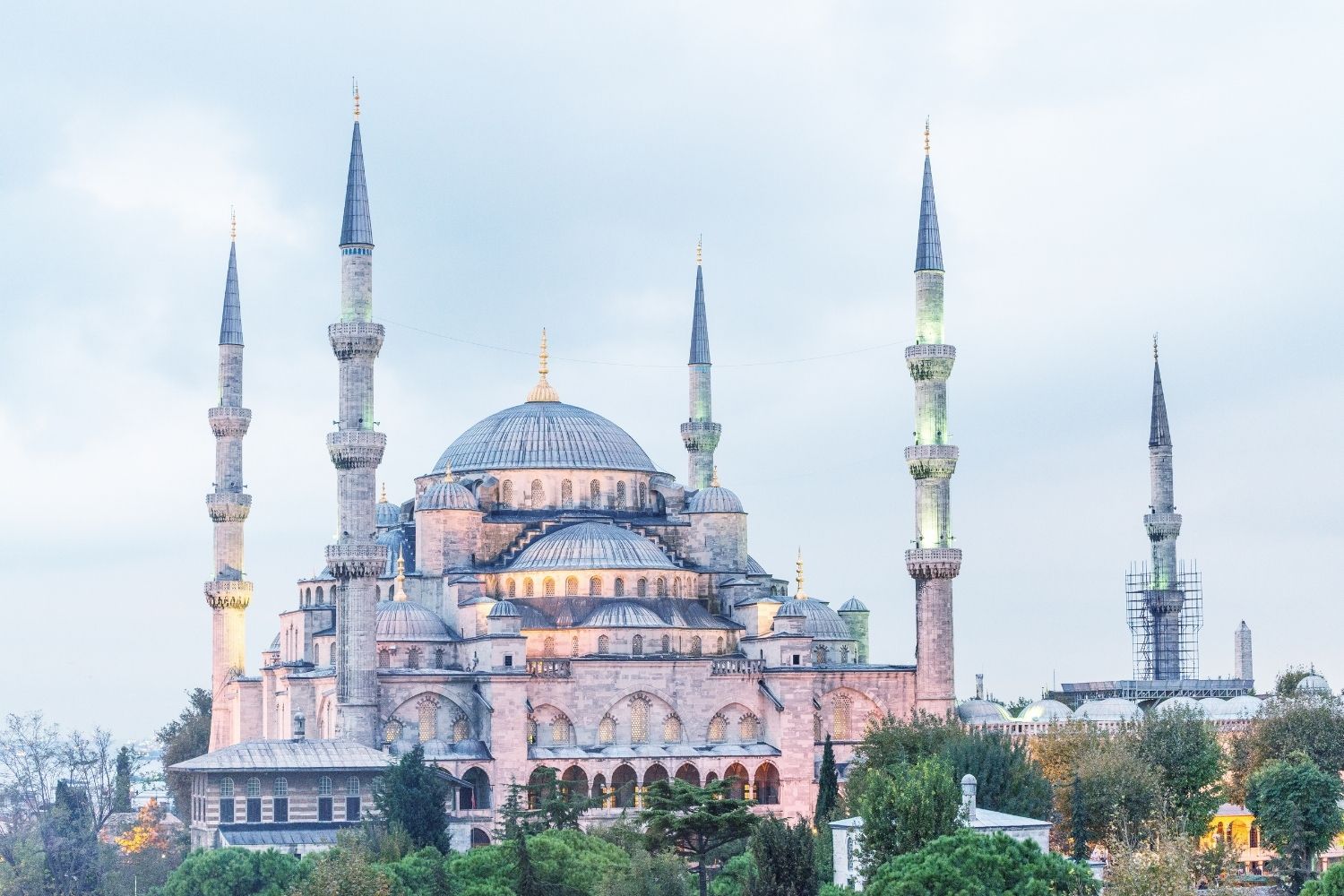
The Blue Mosque in Istanbul, completed in 1617 by architect Sedefkar Mehmed Agha, was designed to sit directly opposite Hagia Sophia, creating a visual and geometric dialogue between two buildings separated by over a thousand years. Its cascading dome system, where the central dome (23.5 meters in diameter) is flanked by four semi-domes and supported by four massive piers, refines the structural geometry that Sinan developed and that traces back to Hagia Sophia’s pendentive system.
Over 20,000 handmade Iznik tiles cover the interior, featuring geometric and floral patterns in cobalt blue, turquoise, and green. The tile patterns follow strict geometric constructions based on six-pointed and eight-pointed star polygons, creating surfaces that appear to extend infinitely, a deliberate visual effect tied to Islamic theological concepts of divine infinity.
The Badshahi Mosque in Lahore, completed in 1673 under Mughal Emperor Aurangzeb, applies a different geometric logic. Its square-based plan places four octagonal minarets at the corners of a vast courtyard (approximately 276 by 276 feet), establishing a geometry of bilateral symmetry along both axes. The three marble-clad domes of the prayer hall follow proportional ratios derived from earlier Mughal precedents, particularly the Jama Masjid in Delhi. Red sandstone with white marble inlay creates geometric surface patterns that achieve visual complexity through material contrast rather than painted decoration.
🏗️ Real-World Example
Badshahi Mosque (Lahore, 1673): The courtyard can hold over 55,000 worshippers and is one of the largest in South Asian mosque architecture. Its square geometry, with the prayer hall centered on the western qibla side, creates a spatial clarity that allows massive crowds to organize into prayer rows without barriers or physical guides, a practical result of geometric planning.
Al-Aqsa Mosque Jerusalem: Layered Geometry Across Centuries
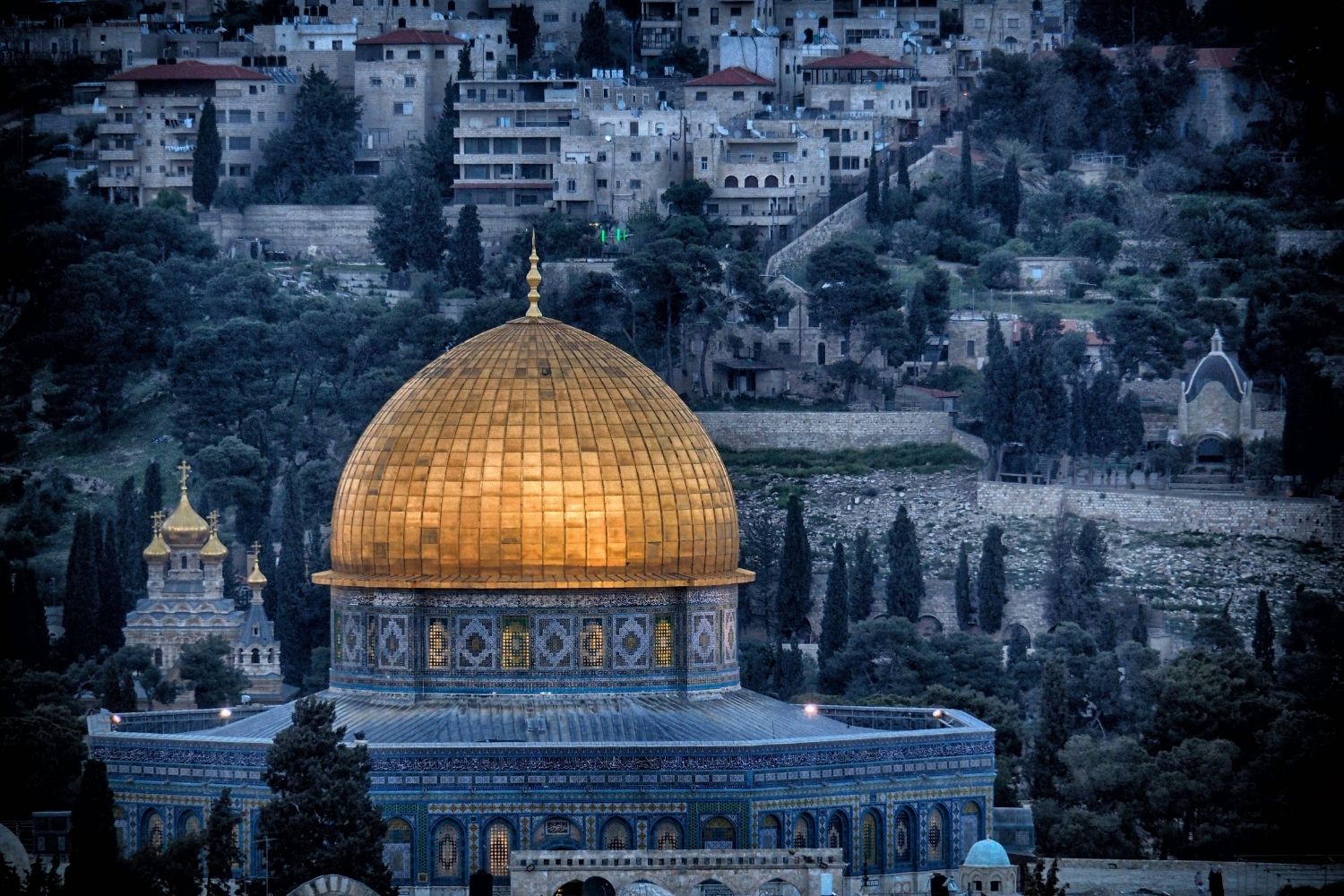
The al-Aqsa Mosque in Jerusalem occupies a compound of approximately 144,000 square meters, making it one of the largest sacred precincts in the Islamic world. Its architectural history spans Umayyad, Abbasid, Fatimid, Crusader, Ayyubid, Mamluk, and Ottoman interventions, each layer adding geometric elements that reflect the design principles of its era.
The Dome of the Rock, built in 691 CE within the same compound, is perhaps the clearest early example of sacred geometry in Islam architecture. Its octagonal plan, inscribed within a circle and containing an inner circle of columns, follows proportional rules that connect to both Roman and Byzantine geometric traditions. The ratio between the octagon’s diameter and the inner dome creates a proportional system that influenced mosque designers across the Middle East for centuries.
💡 Pro Tip
When studying mosque geometry on site, bring a tape measure and a sketchbook. Photographing patterns from directly above or straight on (rather than at an angle) makes it far easier to reconstruct the underlying geometric grid later. Many patterns that look impossibly complex in person resolve into simple constructions of circles and straight lines when drawn flat.
The Bigger Picture
The seven mosques examined here, from Hagia Sophia to the Badshahi Mosque in Lahore, span over 1,100 years and stretch across three continents. Their differences in material, climate response, and decorative tradition are enormous. Yet every one of them uses geometry not as ornament but as structure, as spatial logic, and as theological statement. The real lesson of islamic art and architecture may be that geometry is the one design language that does not require translation.




Curves of Genius: Oscar Niemeyer’s Brazilian Modernism and His Most Iconic Buildings
Oscar Niemeyer turned reinforced concrete into a sculptural language of sweeping curves,...
 Sinan Ozen5 Mins read
Museum of the Future: Dubai’s Torus of Tomorrow
A detailed look at the Museum of the Future in Dubai, covering...
Furkan Sen6 Mins read
Petronas Towers: Islamic Geometry Meets Modern Skyscraper Design
Designed by Cesar Pelli and completed in 1998, the Petronas Twin Towers...
Sinan Ozen5 Mins read
Fractals in Architecture: How Nature’s Patterns Shape Design<
Fractals appear everywhere in nature, from fern leaves to coastlines, and architects...
 Elif Ayse Sen9 Mins read


Leave a comment