

Alvar Aalto: Design Philosophy Behind His Most Famous Works
Trace Alvar Aalto's design philosophy through his most important buildings, furniture pieces, and objects. From the Paimio Sanatorium to Villa Mairea, this article explains his bent plywood innovations, his approach to natural light, and why his work remains a reference point for architects working with timber, regional materials, and sensory-driven design.
 Furkan Sen5 June 202611 Mins read243
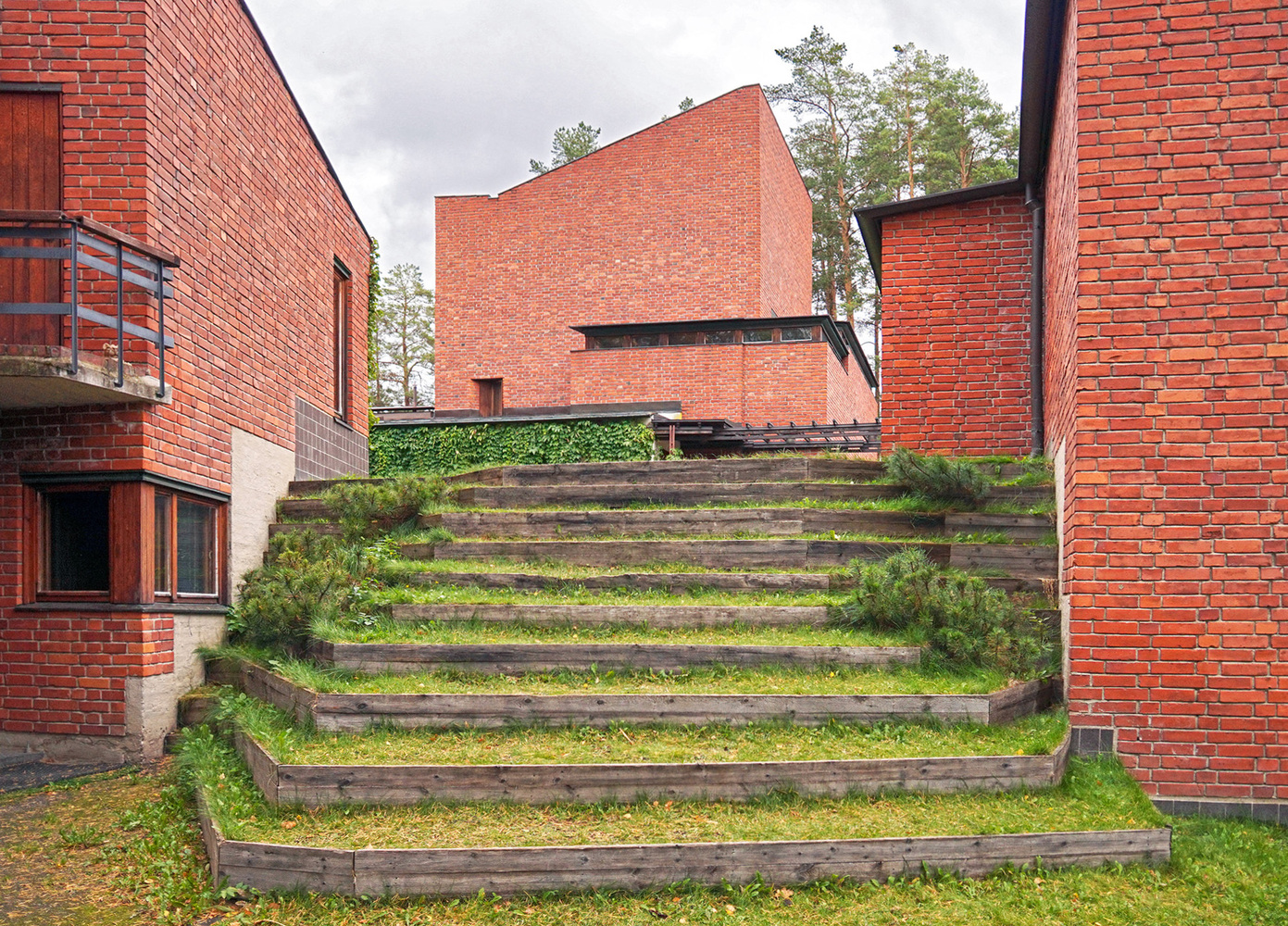
Table of Contents Show
Alvar Aalto was a Finnish architect and designer whose work bridged the gap between European modernism and organic, human-centered design. Known for bending plywood into furniture, flooding interiors with indirect light, and treating every building as a total work of art, Aalto left a body of work that continues to shape how architects think about materials, space, and the relationship between people and buildings.
Few architects have managed to be equally respected for their buildings, their furniture, and their glassware. Alvar Aalto did all three, and he did them with a consistency of thought that makes his career one of the most instructive in 20th-century design. His philosophy was not a manifesto pinned to a gallery wall. It was a working method, visible in the curve of a chair leg and the skylight of a library reading room alike. This article traces that philosophy through his most significant buildings and objects, explaining what made his approach distinct and why it still matters.
Who Was Alvar Aalto?
Hugo Alvar Henrik Aalto was born in 1898 in Kuortane, Finland, and grew up in Jyväskylä. He studied architecture at the Helsinki University of Technology, graduating in 1921, and opened his first practice in Jyväskylä two years later. His early career coincided with Finland’s rapid industrialization, and many of his most important commissions came from industrial clients, including the Ahlström-Gullichsen family.
Aalto married architect Aino Marsio in 1924. Their partnership was central to his output: Aino co-designed interiors, furniture, and glassware, and the couple founded the furniture company Artek in 1935 with art promoters Maire Gullichsen and Nils-Gustav Hahl. After Aino’s death in 1949, Aalto married architect Elissa Mäkiniemi, who continued the studio’s work after his death in 1976.
His career spanned roughly five decades, moving from Nordic Classicism in the 1920s to rationalist modernism in the 1930s and then to the organic, material-driven approach that defined his mature work from the 1940s onward. Through all these shifts, one principle held: architecture must serve the whole human being, not just the eye or the intellect.
The Core Design Philosophy of Alvar Aalto
Aalto admired the European modernists. He knew Le Corbusier, corresponded with Gropius, and visited the Bauhaus. But he found their machine-age aesthetic incomplete. Steel and glass worked in the mild climates of France and Germany, but in Finland, where winters are dark and temperatures drop below minus 30 degrees Celsius, architecture needed warmth, both thermal and psychological.
His response was not to reject modernism but to soften it. He replaced tubular steel with bent birch. He broke rigid floor plans with curving walls. He filtered harsh Nordic light through skylights and clerestory windows so that it arrived indoors as a gentle, diffused glow. The result was a form of modernism that felt lived-in rather than exhibited.
💡 Pro Tip
When studying Aalto’s buildings, pay close attention to the ceiling planes and light sources before anything else. His control of indirect natural light is the single most consistent design move across his career, from the Viipuri Library to Finlandia Hall, and it reveals his priorities faster than any floor plan.
Three ideas ran through nearly everything Aalto designed:
Gesamtkunstwerk (total work of art): Aalto did not stop at the building envelope. He designed the door handles, the light fixtures, the chairs, and sometimes the glassware for a dining table. This was not decorative indulgence. He believed that if the smallest object in a room contradicted the spatial logic of the building, the architecture failed.
Material honesty with regional roots: Aalto used Finnish birch, brick, copper, and ceramic tile not because they were cheap but because they connected the building to its landscape. He treated materials as participants in the design rather than surfaces to be covered.
Human scale and sensory experience: Where the International Style often prioritized visual clarity (flat roofs, ribbon windows, white walls), Aalto added acoustic texture, tactile warmth, and spatial variety. He thought about how a room sounded, how a handrail felt, and how light changed across a reading desk during the day.
Alvar Aalto Architecture: Key Buildings and Their Design Logic
Paimio Sanatorium (1933)
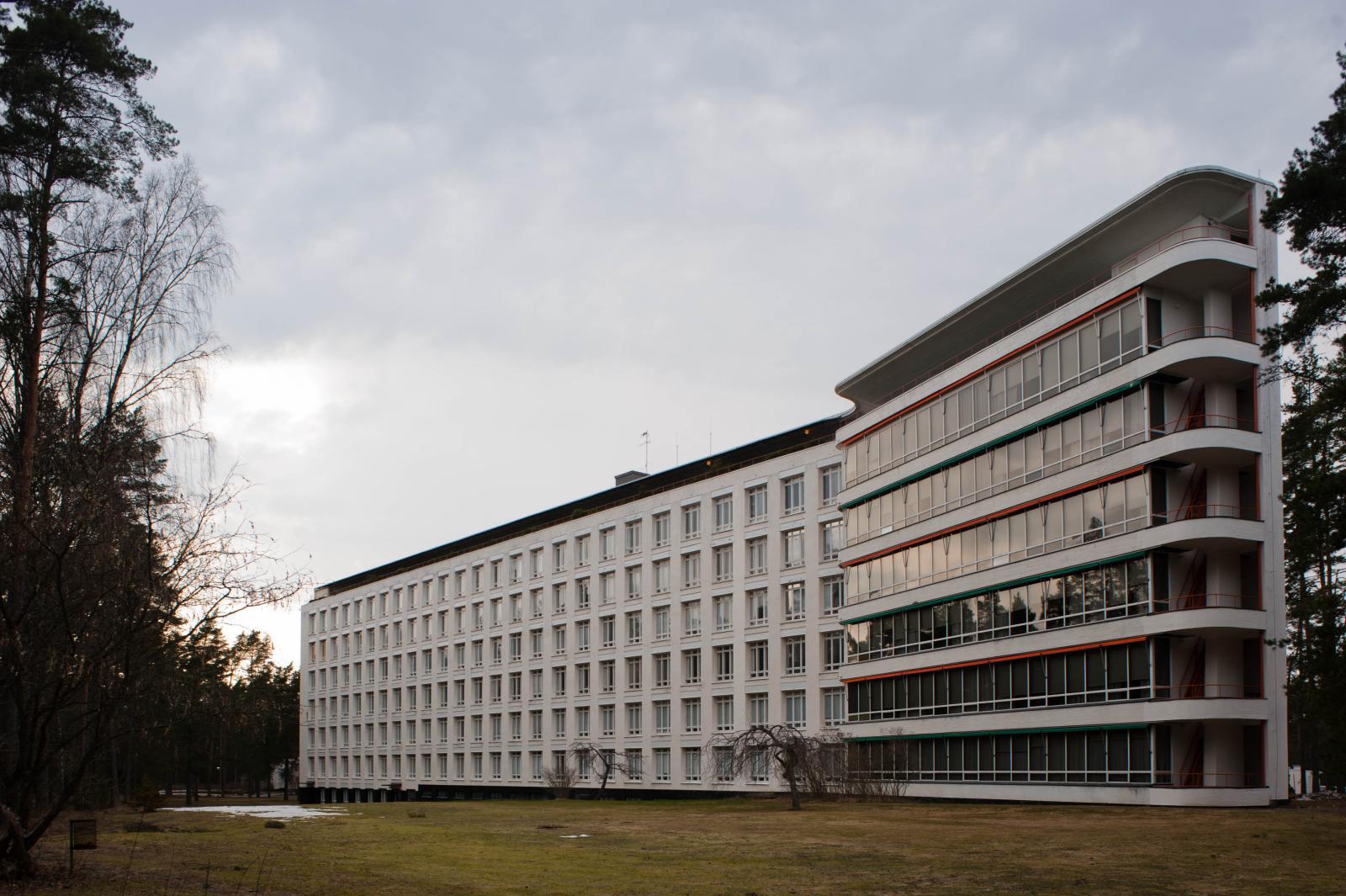
The Paimio Sanatorium, a tuberculosis hospital in southwestern Finland, was Aalto’s first major international project. The building’s plan separates patient wings, communal areas, and staff zones into distinct volumes connected at angles, a strategy that gives every patient room direct sunlight and views into the surrounding pine forest.
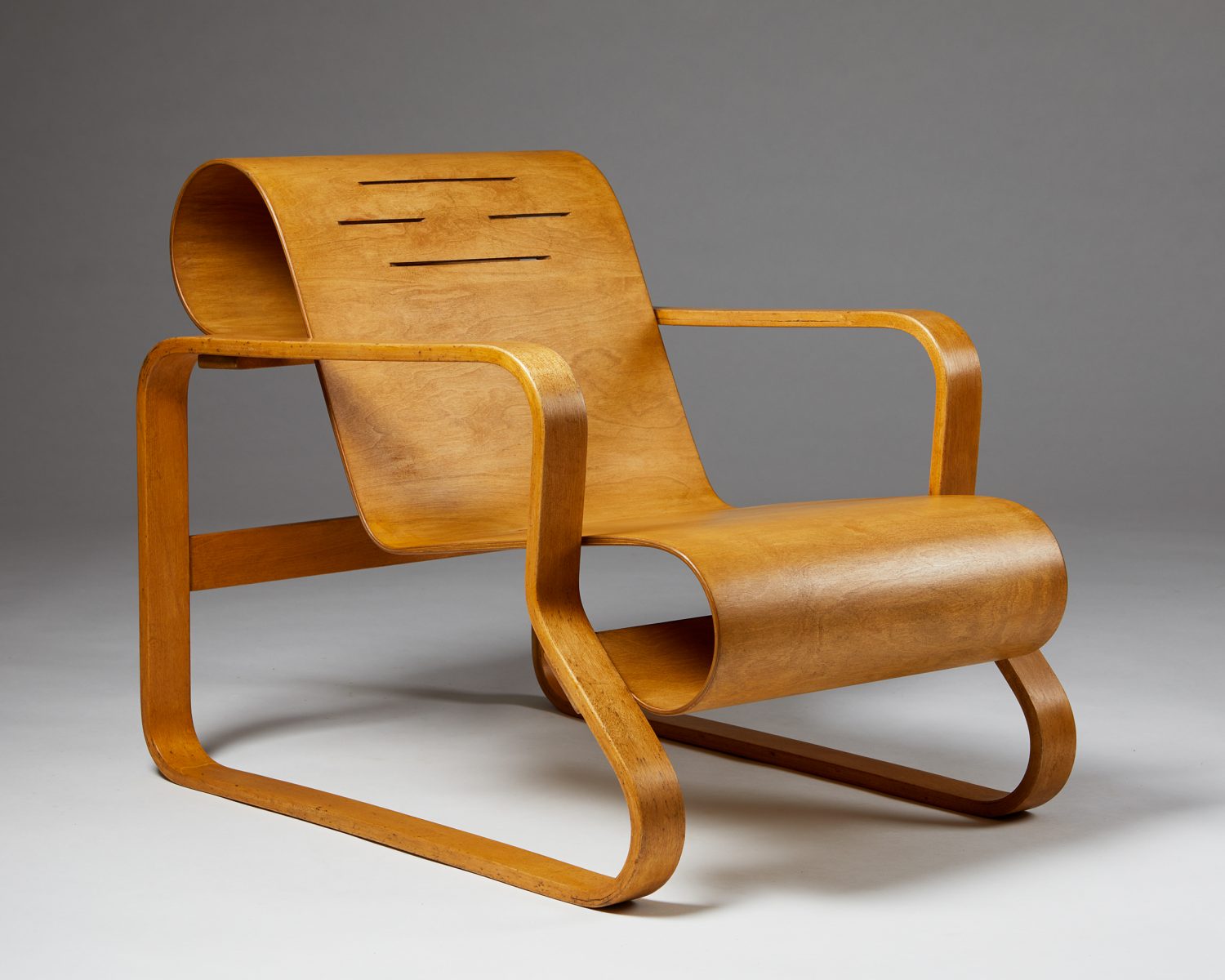
But the real innovation is in the details. Aalto designed the washbasins to be splashless and silent, so that one patient’s handwashing would not disturb another. Ceiling colors in patient rooms were chosen to be calming when viewed from a lying position. Door handles were shaped to prevent a sleeve from catching on them. Even the furniture designed for the building was therapeutic: the Paimio Chair (Model 41) used bent plywood curved at an angle that aided breathing for patients with respiratory illness.
Paimio showed that Alvar Aalto architecture was not about style. It was about performance measured in human comfort, down to the last hinge.
🎓 Expert Insight
“The best standardization committee in the world is nature herself, but in nature standardization occurs mainly in connection with the smallest possible unit, the cell.”
Alvar Aalto
This remark captures Aalto’s approach to industrial production. He believed in standardized components (like bent plywood panels) but insisted that they be assembled into varied, site-responsive compositions rather than uniform boxes.
Viipuri Library (1935)
The Viipuri Library (now in Vyborg, Russia) is often cited as one of the finest library buildings of the 20th century. Its most celebrated feature is the main reading room ceiling, pierced by 57 circular skylights that funnel daylight downward without casting direct shadows or glare on the pages below. Aalto tested this system extensively with scale models and artificial light sources before committing to the design.
The lecture hall uses a freely undulating wooden ceiling, not as decoration but as an acoustic device. The waves distribute sound evenly across the room, eliminating dead spots and harsh echoes. This ceiling became one of the most reproduced images in modern architecture and one of the earliest examples of Aalto’s signature use of organic curves in built form.
Viipuri also introduced Aalto’s approach to furniture within institutional spaces. The library’s stools, made from solid birch legs bent with the “L-leg” technique he patented, were stackable, lightweight, and warm to the touch. They remain in production through Artek nearly ninety years later.
Villa Mairea (1939)
Villa Mairea, built for industrialists Harry and Maire Gullichsen in Noormarkku, Finland, is Aalto’s residential masterpiece. The house combines modernist planning (open floor plan, flat roof, horizontal windows) with Japanese spatial sensibility and Finnish vernacular construction.
Steel columns in the living area are wrapped in rattan binding, softening the industrial material into something tactile. The entrance canopy is supported by a cluster of thin wooden poles deliberately arranged to echo the surrounding birch forest. A sauna and pool sit in the garden as a counterpoint to the main house, connecting domestic life to the Finnish tradition of outdoor bathing.
What makes Villa Mairea significant for understanding Alvar Aalto’s works is its refusal to choose between modernism and tradition. The house is both at once. It uses industrial glazing alongside handmade ceramic tiles. It references Japanese screens and Finnish log cabins in the same room. This was not eclecticism. It was Aalto’s argument that good architecture absorbs from many sources and produces something that feels inevitable rather than assembled.
📌 Did You Know?
Aalto originally envisioned Villa Mairea with a grass-covered roof to blend the house into the Finnish landscape. The idea was dropped during construction, but his sketches for the project show that the concept of “building as landscape” was present from the very first design phase, decades before green roofs became a mainstream sustainability strategy.
Säynätsalo Town Hall (1952)
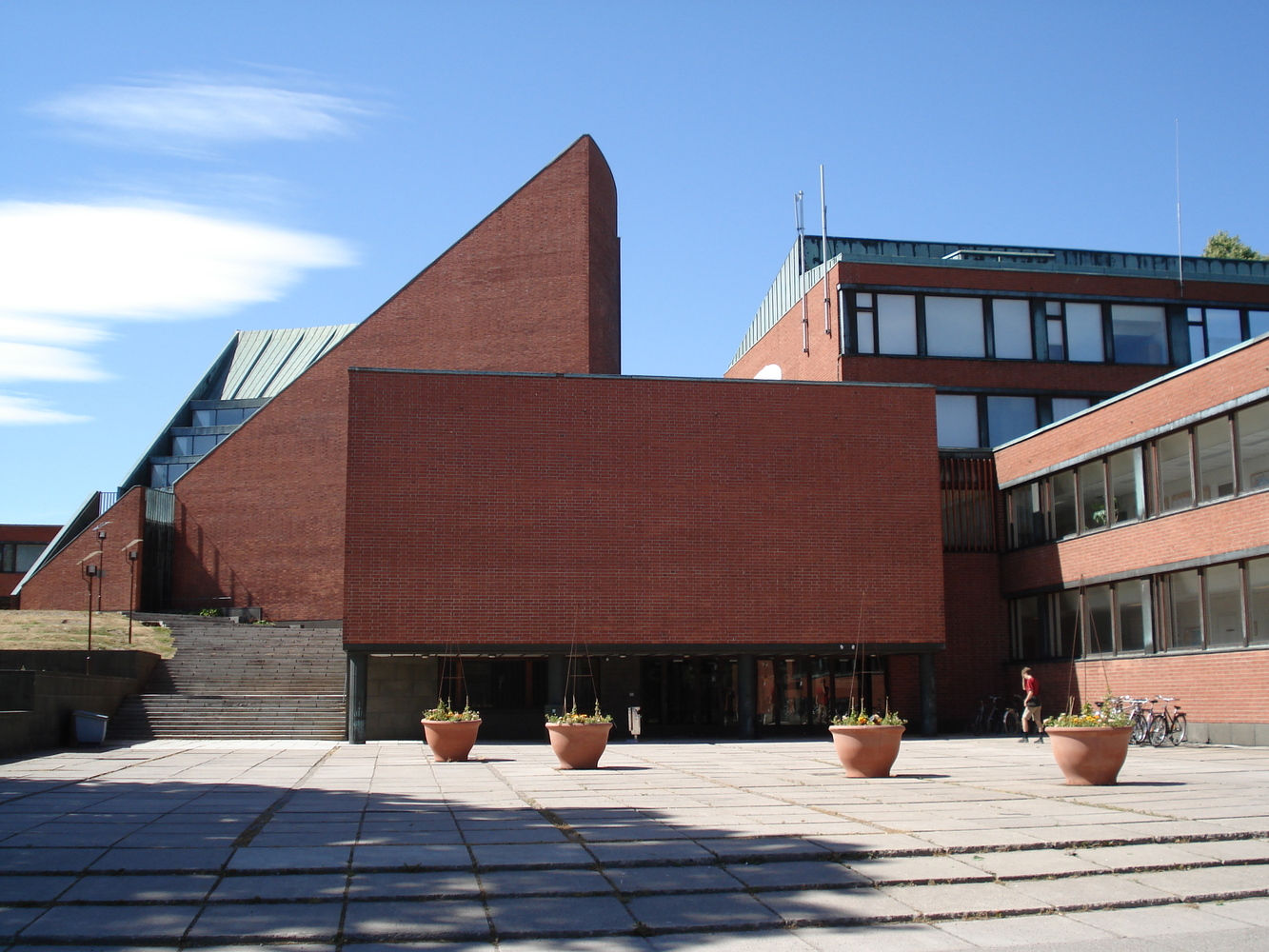
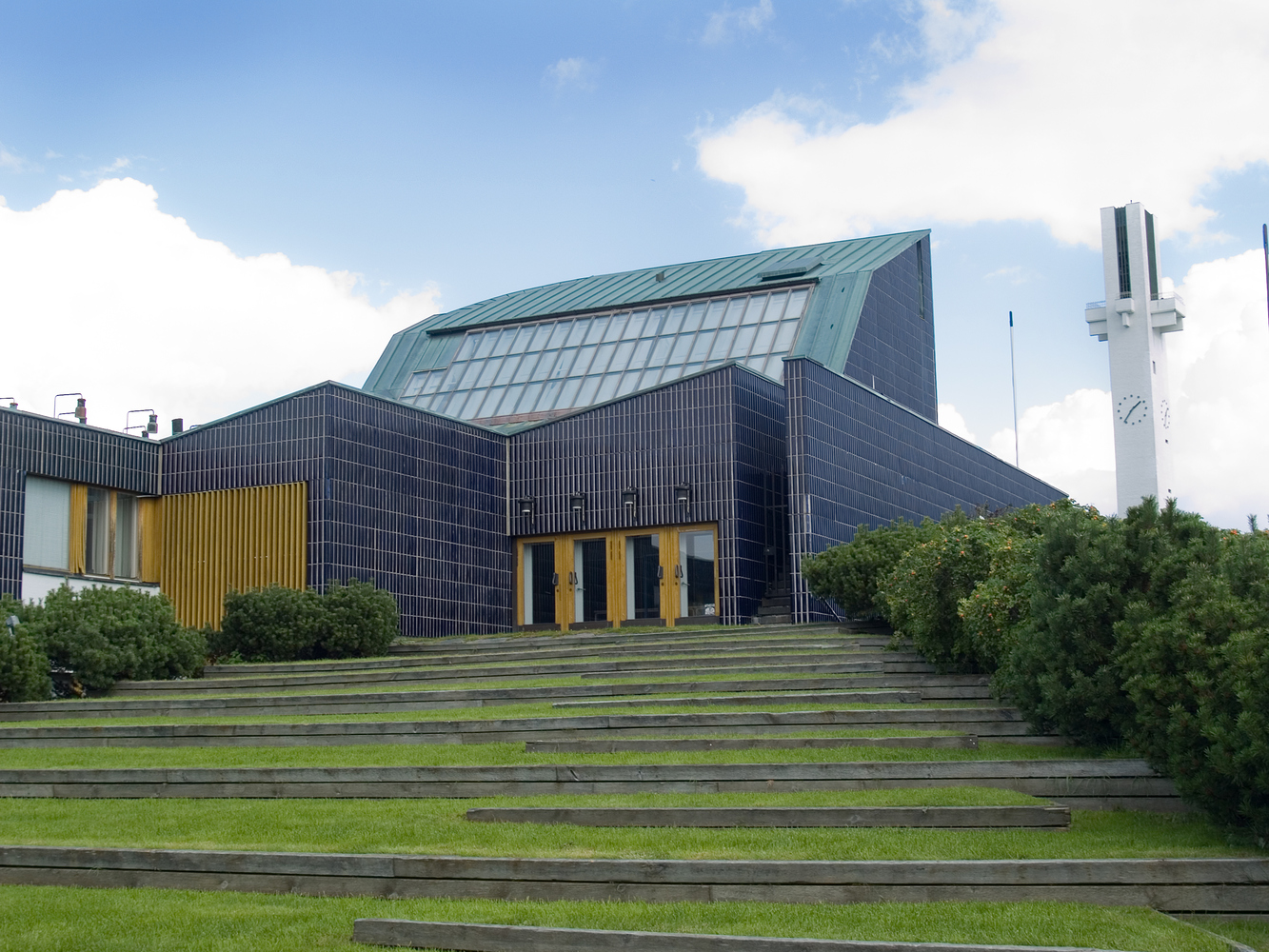
The Säynätsalo Town Hall, on a small island in central Finland, is Aalto’s purest civic building. Rather than projecting authority through monumental scale, it gathers its functions around a raised inner courtyard reached by a broad grass staircase. The effect is intimate. A town hall that feels like a village square.
The council chamber ceiling rises dramatically on a system of wooden fan trusses, giving the room a sense of occasion without resorting to marble or grandeur. Brick dominates the exterior and much of the interior. Aalto selected and specified the bricks himself, varying the firing temperatures to produce subtle color differences across the facade.
Säynätsalo is a key example of how organic architectural thinking can operate at a civic scale. It treats democracy not as a spectacle to be impressed by but as a community activity to be sheltered and supported.
Finlandia Hall (1971)
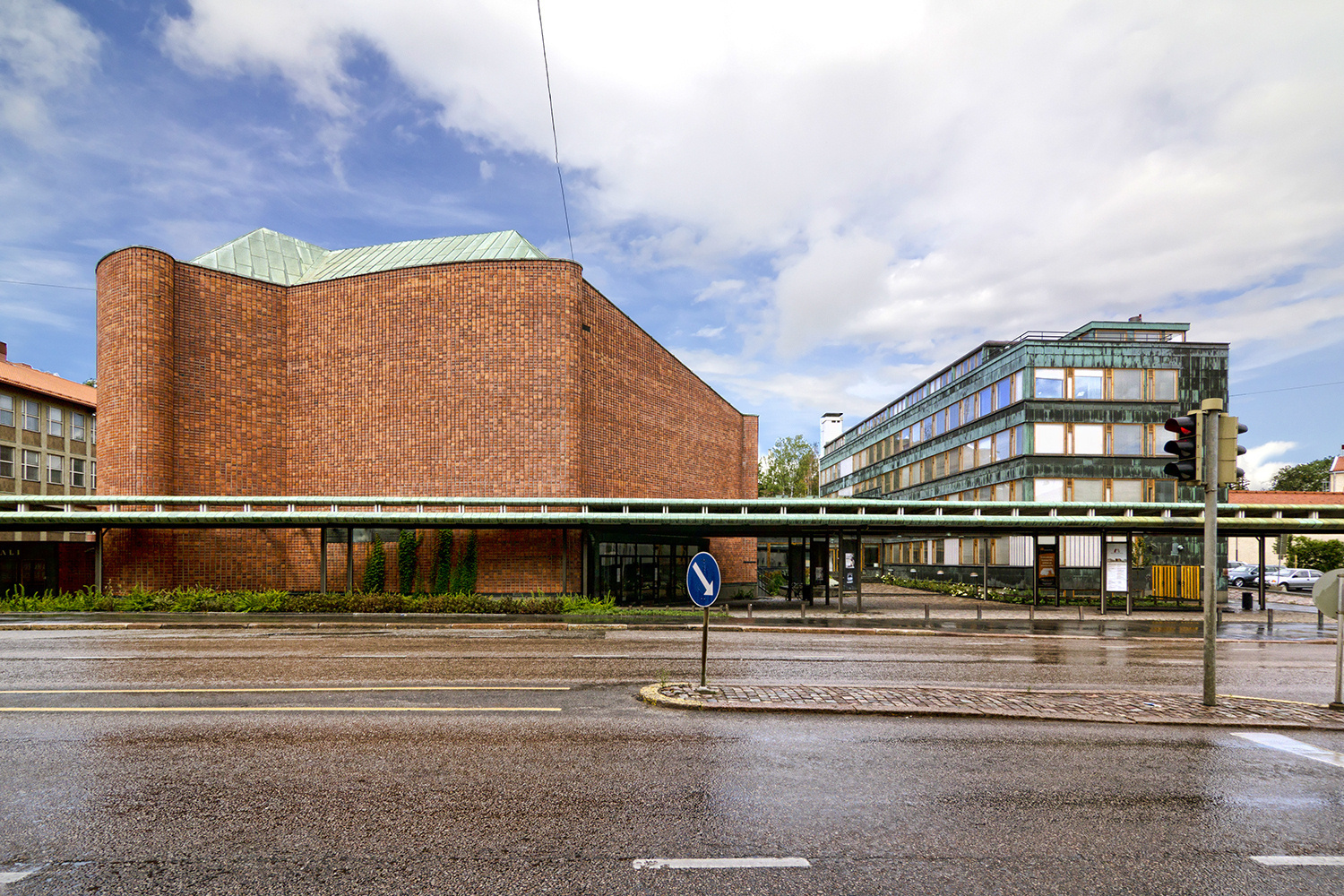
Finlandia Hall, a concert and congress venue on the shore of Töölö Bay in Helsinki, is Aalto’s largest public building and his most debated. The exterior is clad in Carrara marble, a material that has caused maintenance difficulties in the Finnish climate (the panels tend to bow outward due to temperature cycling). Despite this practical issue, the building’s interior acoustics and spatial sequence remain impressive.
The main auditorium ceiling is a sculptural landscape of asymmetric plaster forms designed to direct sound. Foyer spaces step upward from the lakefront, giving visitors a sense of procession from the waterfront park to the performance hall. The plan integrates conference rooms, restaurants, and exhibition spaces without the corridors feeling institutional.
Finlandia Hall shows both the strengths and the vulnerabilities of Aalto’s approach. His instinct for spatial drama and material beauty produced a genuinely memorable building, but his choice of cladding material was arguably poetic rather than practical, a rare case where the philosophy outran the engineering.
⚠️ Common Mistake to Avoid
A frequent error is describing Aalto simply as a “functionalist” or “modernist” architect. While his early work fits within functionalism, his mature output actively pushed against the movement’s rigidity. Calling him a functionalist ignores the organic, sensory, and regionally rooted qualities that define his most important buildings from the 1940s onward.
Alvar Aalto Furniture and Object Design
How Did Aalto Develop His Bent Plywood Technique?
Aalto’s furniture career began with a problem: steel-tube chairs, popular among European modernists, were cold to the touch in Finnish winters and expensive to import. He wanted a modern chair that used local materials and could be mass-produced without losing warmth.
Working with furniture maker Otto Korhonen in the early 1930s, Aalto developed a process for bending solid birch wood by cutting thin saw kerfs into the end grain and filling them with glue before clamping the piece into a curved form. This “L-leg” technique (patented in 1933) produced a 90-degree bend in solid wood without lamination. It became the structural basis for nearly all Artek furniture and remains in production today.
The technique had three consequences. First, it allowed chairs, stools, and tables to be flat-packed and shipped efficiently. Second, it kept manufacturing local, supporting Finnish forestry and craft industries. Third, it gave the furniture a visual softness that steel-tube designs lacked, matching the warmth of Aalto’s architectural interiors.
Iconic Alvar Aalto Chairs and Furniture Pieces
Several Alvar Aalto chairs remain in continuous production through Artek:
Paimio Chair (Model 41, 1932): A lounge chair with a continuous bent plywood seat suspended between two closed-loop armrest frames. Originally designed for tuberculosis patients at the Paimio Sanatorium, the seat angle aids open breathing. Its scrolled plywood form became an icon of Scandinavian modernism.
Stool 60 (1933): A three-legged stackable stool using the L-leg technique. It is possibly the most widely produced piece of modern furniture in history, with over eight million units sold. Its simplicity makes it equally at home in a gallery, a café, or a classroom.
Tea Trolley 901 (1936): A serving cart with a bent plywood frame, rattan basket, and white laminate shelves. It condenses Aalto’s material vocabulary into a single portable object: birch, rattan, and practical surface, all in flowing curves.
Armchair 400 (Tank Chair, 1936): A deeply cantilevered lounge chair with a bent laminated birch frame and upholstered seat. The nickname “Tank” refers to its solid, grounded proportions. It was originally designed for the Aaltos’ own home in Helsinki.
💡 Pro Tip
If you are studying Alvar Aalto furniture for a design course or portfolio project, focus on the L-leg joint detail rather than the overall silhouette. The joint is where the engineering innovation happens, and understanding it will help you grasp why Aalto’s designs could be mass-produced while retaining a handcrafted feel.
The Aalto Vase (Savoy Vase, 1936)
The Aalto Vase, originally designed for the Savoy restaurant in Helsinki, is one of the most recognized objects in Scandinavian design. Its freeform, wave-like profile has no precedent in the glass design of its period. The form is thought to reference the irregular shorelines of Finnish lakes, though Aalto himself never confirmed a single inspiration.
Produced by Iittala, the vase requires a team of glassblowers working in coordinated stages due to its asymmetric shape. It won the gold medal at the 1937 Paris World’s Fair and remains in production today, a rare case of a design object functioning simultaneously as a mass-market product and a museum piece.
Alvar Aalto Studio and Working Method
The Alvar Aalto Studio in Munkkiniemi, Helsinki, was built in 1954-56 as a purpose-designed office separate from the family home (which Aalto had designed in 1935-36 on the same street). The studio is organized around a sunken courtyard that brings natural light into the drafting spaces, and its white-painted brick walls, timber ceilings, and amphitheater-shaped main room reflect the same spatial ideas found in Aalto’s public buildings.
Aalto’s design process was notably physical. He worked through problems with sketches, clay models, and full-scale mock-ups rather than relying solely on technical drawings. His sketch archive at the Alvar Aalto Foundation in Jyväskylä contains thousands of freehand drawings, many on restaurant napkins and scraps of paper, that show ideas being tested and discarded rapidly.
This hands-on method explains the tactile quality of his buildings. Aalto’s architecture feels considered at every scale because he physically handled models at every scale, from urban planning layouts to door handle prototypes.
🏗️ Real-World Example
Baker House, MIT (Cambridge, MA, 1949): This student dormitory on the Charles River uses a serpentine plan to give every room an angled river view, a move that would have been far simpler with a straight slab. Aalto insisted on the curve because he believed student housing deserved the same spatial generosity as a private villa. The rough-textured brick exterior was achieved by deliberately including clinker bricks (over-fired rejects), creating a surface with depth and character that a uniform wall could not provide.
What Is the Legacy of Alvar Aalto’s Design Philosophy?
Aalto’s influence operates on several levels. His bent plywood techniques directly shaped the work of Charles and Ray Eames, who acknowledged his furniture as a key reference for their own molded plywood experiments in the 1940s. His approach to regional materials and climatic responsiveness anticipated the “critical regionalism” theorized by Kenneth Frampton decades later.
In Finland, his legacy is institutional. The Alvar Aalto Foundation maintains his buildings, archives, and intellectual property. The Alvar Aalto Medal, awarded by the Finnish Association of Architects, is one of the most prestigious prizes in global architecture. Recipients include Steven Holl (1998) and Tadao Ando (1985), architects whose work shares Aalto’s emphasis on light, material, and spatial experience.
More broadly, Aalto demonstrated that modernism did not have to choose between efficiency and warmth, between industrial production and craft, or between international ambition and local identity. Contemporary practices working with timber construction, biophilic design, and sensory-driven architecture are extending ideas that Aalto put into built form before the Second World War.
Alvar Aalto Buildings Still Open to Visitors
Several Alvar Aalto buildings are accessible as museums, cultural venues, or functioning civic structures:
| Building | Location | Year | Current Use |
|---|---|---|---|
| Paimio Sanatorium | Paimio, Finland | 1933 | Hospital (limited tours available) |
| Villa Mairea | Noormarkku, Finland | 1939 | Museum (open for guided tours) |
| Säynätsalo Town Hall | Jyväskylä, Finland | 1952 | Cultural center and guest accommodation |
| Alvar Aalto Museum | Jyväskylä, Finland | 1973 | Museum dedicated to Aalto’s work |
| Finlandia Hall | Helsinki, Finland | 1971 | Concert and congress venue |
| Baker House (MIT) | Cambridge, MA, USA | 1949 | Student dormitory (exterior viewable) |
Video: Alvar Aalto and the Humanization of Modernism
This video from the Design Docs channel examines how Aalto distinguished his practice from mainstream European modernism, covering his major buildings and his philosophy of designing for human comfort rather than abstract ideals.
✅ Key Takeaways
- Alvar Aalto’s design philosophy treated architecture as a total work of art, extending from urban planning down to door handles and glassware.
- His use of Finnish birch and bent plywood was both a material innovation and a cultural statement, connecting modern furniture to local forestry and craft traditions.
- Light control is the most consistent element across Aalto’s buildings, with skylights and clerestory windows engineered to eliminate glare while maximizing natural illumination.
- Unlike his European modernist contemporaries, Aalto prioritized sensory experience (warmth, acoustics, texture) alongside visual composition.
- His legacy extends through the Alvar Aalto Foundation, the Alvar Aalto Medal, and the continued production of his furniture and objects by Artek and Iittala.
Final Thoughts
Aalto’s career offers a corrective to the idea that modernism must be cold, abstract, or universal. He proved that an architect could accept industrialization, standardization, and functional planning while still producing buildings that feel warm, specific, and deeply connected to their place. His influence on Scandinavian design is visible in everything from contemporary Finnish timber architecture to the global popularity of birch plywood furniture.
For architects and designers studying his work today, the lesson is not to copy his curves or his materials. It is to adopt his method: start with the human body and its needs, choose materials that belong to the place, and never stop designing until the smallest object in the room agrees with the largest spatial idea in the plan.




Neoclassical Architecture: Features, History & Examples
Neoclassical architecture emerged in the mid-18th century, reviving Greek and Roman forms...
 illustrarch Editoral Team8 Mins read

Craftsman Architecture: Features, History & Examples
Craftsman architecture emerged in early 1900s America as a response to Victorian...
illustrarch Editoral Team10 Mins read

Florence Renaissance Architecture: How Building Became an Authored Art
Florence Renaissance architecture is usually told as a list of buildings. The...
Furkan Sen6 Mins read
Architectural Styles History: Why Some Styles Fail and Others Endure
A look at architectural styles history through the decisions that actually keep...
Furkan Sen6 Mins read


Leave a comment