

10 Iconic Furnitures by Famous Architects
A look at 10 iconic pieces of furniture by famous architects, including Mies van der Rohe's Barcelona Chair, Marcel Breuer's Wassily, Arne Jacobsen's Egg, and Frank Gehry's cardboard Wiggle, with the maker and history behind each design.
 Elif Ayse Sen16 January 20238 Mins read759
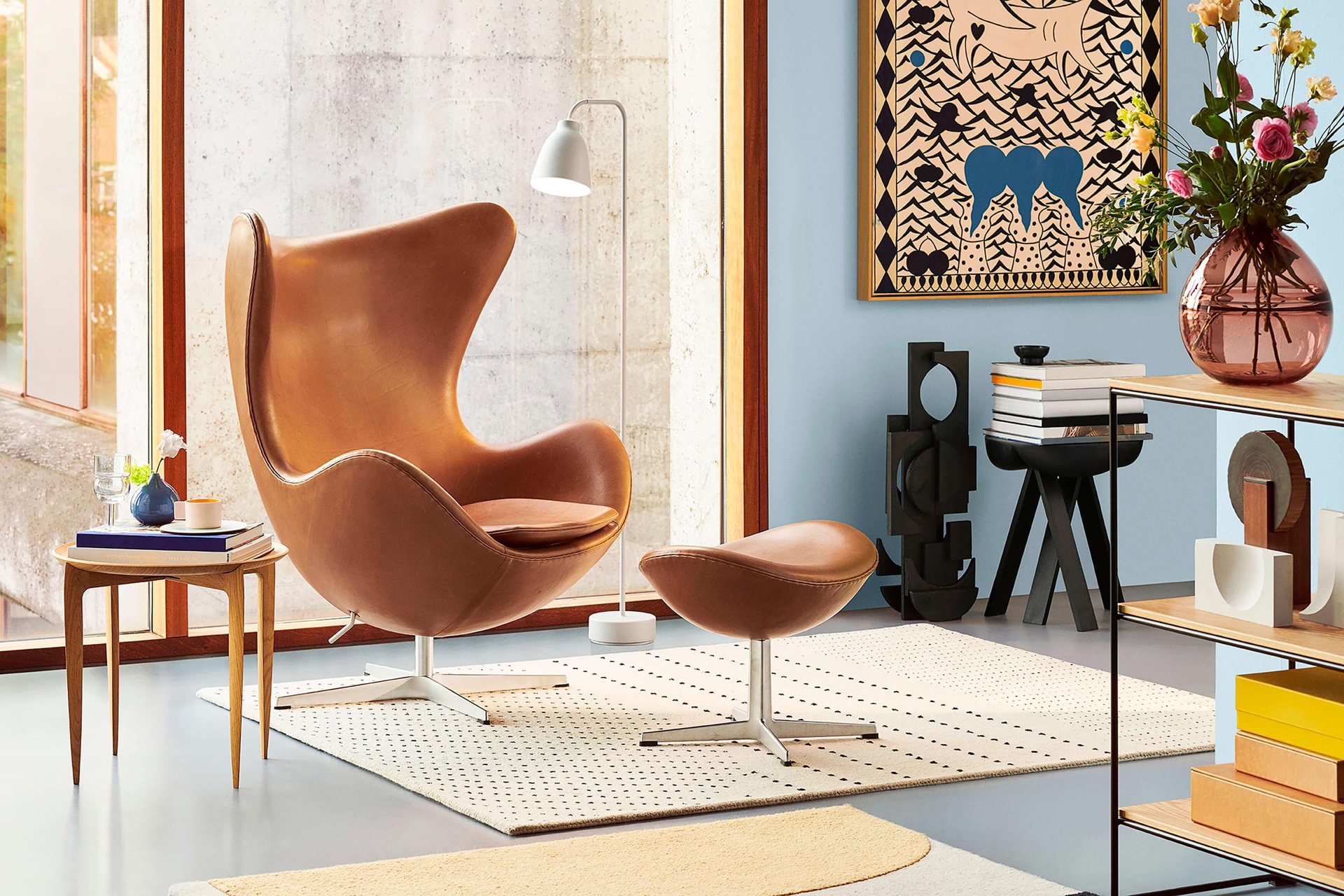
Table of Contents Show
Furniture by famous architects blends structural thinking with everyday function, turning chairs and tables into design landmarks. From Mies van der Rohe’s Barcelona Chair to Frank Gehry’s cardboard Wiggle, these pieces carry the same ideas their creators applied to buildings, which is why collectors and museums treat them as design history rather than simple seating.
Designing furniture is its own discipline. It asks for creativity, technical judgment, and a sharp eye for proportion. When a design gets all three right, it stops being a product and becomes a reference point that people recognize across decades and continents.
A good piece balances form and function so neither wins outright. It should feel comfortable and useful while still holding a clear point of view. The examples below show how architects carried the logic of their buildings into objects you can sit in, and why each one still sells today through the makers that license it.
Why is furniture by famous architects still so collectible?
Architect-designed furniture tends to outlast trends because it is built on principles rather than styling. The same rules that shape a facade, structure, material honesty, and the relationship between weight and support, translate directly into a chair or table. Many of these pieces were prototypes for ideas the architect could not yet build at full scale, which gives them a research value beyond their looks. That is also why so many are held in permanent museum collections and still produced by their original manufacturers.
💡 Pro Tip
When buying any of these designs, check whether the seller names the licensed maker, such as Knoll, Vitra, Cassina, or Fritz Hansen. Authorized versions carry a maker’s mark and hold their resale value, while unlicensed copies usually cut corners on frame welds, leather grade, and stitching that you only notice after a few years of use.
Quick comparison of the pieces
The table below groups each design with its architect and the year and manufacturer most associated with it.
| Piece | Architect / Designer | Year & Manufacturer |
|---|---|---|
| Barcelona Chair | Mies van der Rohe | 1929, Knoll |
| Ball Chair | Eero Aarnio | 1963, Eero Aarnio Originals |
| Wassily Chair (B3) | Marcel Breuer | 1925, Knoll |
| Mesa Table | Zaha Hadid | 2007, Zaha Hadid Design |
| Edge of the Seat | Rem Koolhaas / OMA | 2013, Knoll |
| Paradigm Shift | Rem Koolhaas / OMA | 2013, Knoll |
| Gemini Chaise | UNStudio | 2011, Artifort |
| Egg Chair | Arne Jacobsen | 1958, Fritz Hansen |
| Wiggle Chair | Frank Gehry | 1972, Vitra |
| Easy Edges Rocker | Frank Gehry | 1971, MoMA collection |
10 Iconic Pieces of Furniture by Famous Architects
1. Barcelona Chair by Mies van der Rohe

Mies van der Rohe, working with Lilly Reich, designed the Barcelona Chair in 1929 for the German Pavilion at the Barcelona International Exposition. The chromed steel frame forms a clean X-shape that echoes the pavilion’s precise geometry, while the hand-tufted leather cushions soften the industrial structure. It reads as a throne without ornament, which is exactly what the setting called for.
The design has stayed in continuous production, and today it is made under license by Knoll, which still hand-welds the frame and buttons each panel by hand. Few objects sum up the “less is more” attitude of the era as directly.
📌 Did You Know?
The Barcelona Chair was created for the visit of the Spanish royal family to the 1929 German Pavilion, so its proportions were meant to suit a ceremonial welcome rather than an office lobby. The single-piece frame we know today did not arrive until 1950, when stainless steel let Mies drop the earlier bolted joints.
2. Ball Chair by Eero Aarnio
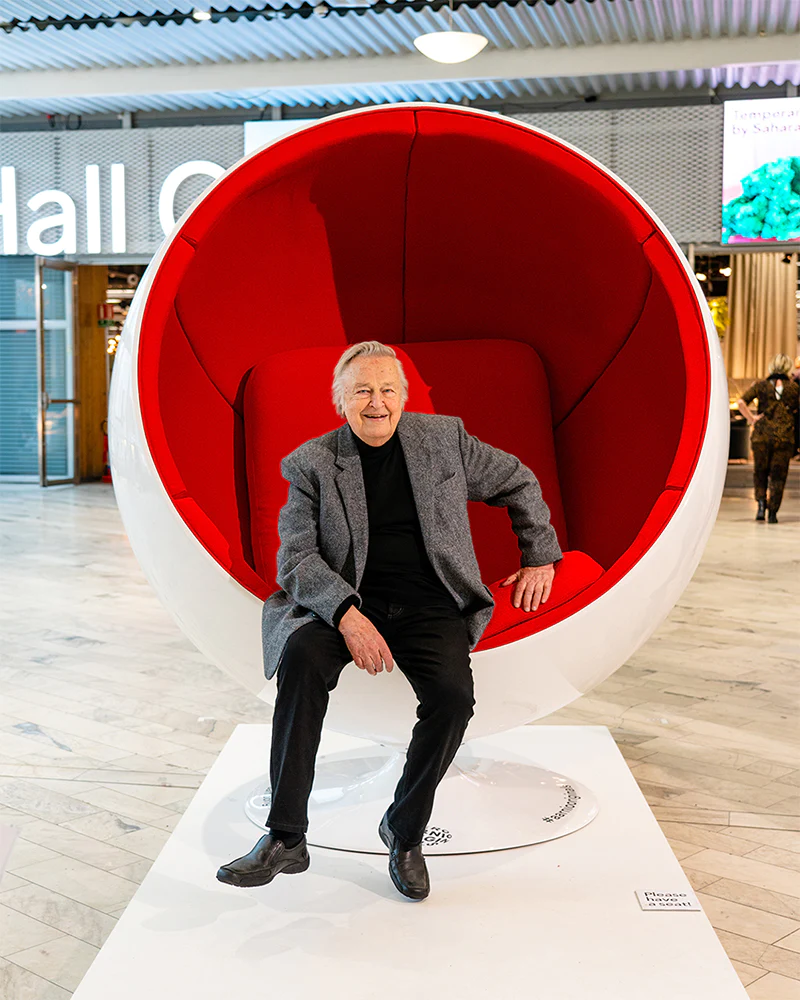
Finnish designer Eero Aarnio drew the Ball Chair in 1963 and built the first version in his own home. The fiberglass sphere sits on a swivel base and cuts the sitter off from the noise of the room, creating a small private space inside an open one. It became a symbol of 1960s optimism and appeared in films and magazines for years.
The piece is still produced by Eero Aarnio Originals, which keeps the original interior acoustics that first surprised visitors. Aarnio trained as a designer rather than an architect, but his spatial thinking about enclosure sits comfortably next to the architects on this list.
3. Wassily Chair by Marcel Breuer

Marcel Breuer designed the Wassily Chair, first called the Model B3, at the Bauhaus in 1925. He was reportedly inspired by the tubular steel handlebars of his Adler bicycle, which suggested a frame that could be both light and strong. Leather or fabric straps replace the solid seat and back, so the body of the sitter appears to float within the steel lines.
The chair got its familiar name decades later, after the painter Wassily Kandinsky, a Bauhaus colleague who admired the prototype. It is now produced by Knoll and remains a clear early example of mass-production thinking applied to a domestic object.
4. Mesa Table by Zaha Hadid

Zaha Hadid’s Mesa table shows the flowing, branching geometry that ran through all of her work. Rather than four legs, the fiberglass form grows out of the floor in curved supports that split and merge into the tabletop, so the whole object looks like a single continuous surface. It reads as a piece of landscape brought indoors.
The table extends the fluid language of Hadid’s buildings, such as the MAXXI museum in Rome, into a single object you can walk around. You can see how the studio frames these products through Zaha Hadid Design, where furniture is treated as small-scale architecture.
5. Edge of the Seat by Rem Koolhaas

Edge of the Seat comes from Tools for Life, a collection Rem Koolhaas and his firm OMA produced with Knoll in 2013. The piece plays with the idea that furniture should move and adapt rather than sit still. A motorized element lets parts of the seat shift, so the object behaves almost like a small machine for changing how you occupy a room.
The collection treated furniture as an argument about flexible living, which fits OMA’s interest in buildings that can change use over time. You can read the studio’s own description of the series on the OMA project page.
6. Paradigm Shift by Rem Koolhaas


Also part of the Tools for Life series, Paradigm Shift is a rotating cabinet and shelving unit that can pivot to divide or open up a space. Instead of a fixed storage wall, it acts as a moving partition, so a single object can reshape the plan of a room on demand. The name is a direct nod to the studio’s habit of questioning what a given object should do.
Koolhaas has argued that architecture and furniture share the same problem of organizing human activity, and this piece puts that idea to work at the scale of a room divider that you can turn by hand.
7. Gemini Chaise by UNStudio

Gemini is a lounge chaise designed by the Dutch architecture studio UNStudio, led by Ben van Berkel, for the manufacturer Artifort. Its double-curved shell was shaped so a single form supports the body in two different reclining positions, which is where the “Gemini” name comes from. The smooth, unbroken surface reflects the same continuous geometries UNStudio uses in projects like the Mercedes-Benz Museum.
The chaise translates the studio’s interest in twisting, looping surfaces into something the body reads through touch rather than sight. It is a clear case of an architect’s structural language shrinking down to the scale of a single seat.
8. Egg Chair by Arne Jacobsen

Arne Jacobsen designed the Egg Chair in 1958 as part of his total design for the SAS Royal Hotel in Copenhagen. He modeled the shape first in plaster in his own garage, chasing a curved shell that would give a hotel guest a pocket of privacy in a busy lobby. The high back wraps around the shoulders and blocks side views and sound.
The chair is still made by Fritz Hansen using the same shell-and-foam method Jacobsen developed. It stands as proof that a building’s architect can control every object inside it down to the seating.
🏗️ Real-World Example
SAS Royal Hotel (Copenhagen, 1960): Arne Jacobsen designed the entire building and nearly everything in it, including the Egg Chair, the Swan Chair, the cutlery, and the door handles. Room 606 is still kept in its original 1960 fit-out, which lets visitors see architect-designed furniture in the exact setting it was drawn for.
9. Wiggle Chair by Frank Gehry

Frank Gehry made the Wiggle Chair in 1972 as part of his Easy Edges line, built from layers of corrugated cardboard glued and cut into a curving S-profile. The humble material turned out to be surprisingly strong once stacked in cross-layers, and the ribbed edges give the surface a soft, textile-like feel. Gehry treated a throwaway material as something worth designing around.
The chair is produced today by Vitra, which reissued the Easy Edges pieces to their original specification. It anticipates the loose, sculptural forms Gehry later built in metal at the Guggenheim Bilbao.
10. Easy Edges Rocker by Frank Gehry

The Body Contour Rocker of 1971 is another Easy Edges piece, this time a rocking chaise cut so the cardboard follows the curve of a reclining body. It shows Gehry testing how far a single stacked material could be pushed toward a full lounge shape without any metal frame. The result is light enough to lift with one hand yet stable enough to rock.
The rocker is held in the collection of the Museum of Modern Art in New York, which places this experiment in cardboard alongside the design milestones of the twentieth century.
What Makes Furniture Design Work
Furniture shapes how a room feels as much as the walls do. A well-judged chair can make a space feel calm and inviting, while a poorly proportioned one throws the whole room off. The direction of much current furniture design now leans toward eco-friendly materials and longer product lifespans, so pieces are meant to be repaired rather than replaced.

Design styles shift with culture, but the working method behind a strong piece stays fairly stable. Designers have to understand the people who will use the object, not just draw an attractive silhouette. The steps below outline how most furniture moves from idea to finished object:
- The designer starts by learning the client’s needs, habits, and preferences.
- They map out the available materials, the budget, and the intended style before drawing anything final.
- Early sketches test how the piece might look and sit in a real room.
- A 3D model follows, which locks in accurate measurements and keeps every part in proportion.
- Adjustments continue until the client and the designer agree on a final version ready for production.

Anyone tracking these objects can also follow how the design press covers them, from auction results to reissues, through outlets like ArchDaily, which regularly documents architect-designed products.
The Bigger Picture
The best furniture by famous architects works because it treats a chair with the same seriousness as a building. Each piece here started as a question about structure, material, or how people occupy space, and the answer just happened to be small enough to sit on. That is why, decades later, they still hold their place in living rooms and museum galleries alike.








Curves of Genius: Oscar Niemeyer’s Brazilian Modernism and His Most Iconic Buildings
Oscar Niemeyer turned reinforced concrete into a sculptural language of sweeping curves,...
 Sinan Ozen5 Mins read

The 20 Best Architecture Firms in the World Right Now
A ranked look at the best architecture firms in the world right...
Sinan Ozen5 Mins read

The Most Iconic Houses Designed by World-Famous Architects
Seven of the most iconic houses designed by world-famous architects, from Frank...
Sinan Ozen6 Mins read

How Rem Koolhaas Blurred the Line Between Architecture and Research
Rem Koolhaas built a career where books, exhibitions, and buildings serve the...
Sinan Ozen6 Mins read


Leave a comment