

Layout for Kitchen: How to Choose the Right One for Your Space
Choosing the right layout for your kitchen affects how you cook, move, and live in the space. This guide breaks down every major kitchen layout type, from galley and L-shaped to U-shaped and island configurations, including which works best for small kitchens and open-plan homes.
 Elif Ayse Sen26 March 202615 Mins read218

Table of Contents Show
The layout for your kitchen is the single most important decision in any kitchen design project. It determines how you move through the space, how efficiently you cook, and how well the room works for your household. Whether you’re starting from scratch or reworking an existing space, understanding the main kitchen layout types before you commit to anything saves time, money, and frustration.
What Is a Kitchen Layout and Why Does It Matter?
A kitchen layout is the spatial arrangement of your cabinets, countertops, appliances, and key fixtures like the sink and stove. The layout governs traffic flow, storage efficiency, and how easily multiple people can use the kitchen at once. Get it right, and cooking feels intuitive. Get it wrong, and even a beautifully finished kitchen will feel awkward every time you use it.
There are six primary kitchen layouts commonly used in residential design: the single-wall, galley, L-shaped, U-shaped, G-shaped, and island configurations. Each suits a different room size, household routine, and design goal. Understanding what makes each one effective, and where each one struggles, is the foundation of any solid kitchen architectural modeling process.
💡 Pro Tip
Before you review layout options, spend two or three days paying attention to how you actually move in your current kitchen. Note which direction you face when chopping, where you set things down after pulling them from the fridge, and where congestion happens during meal prep. This behavioral audit tells you more about what layout you need than any floor plan software can.

The Kitchen Work Triangle: Still Relevant Today?
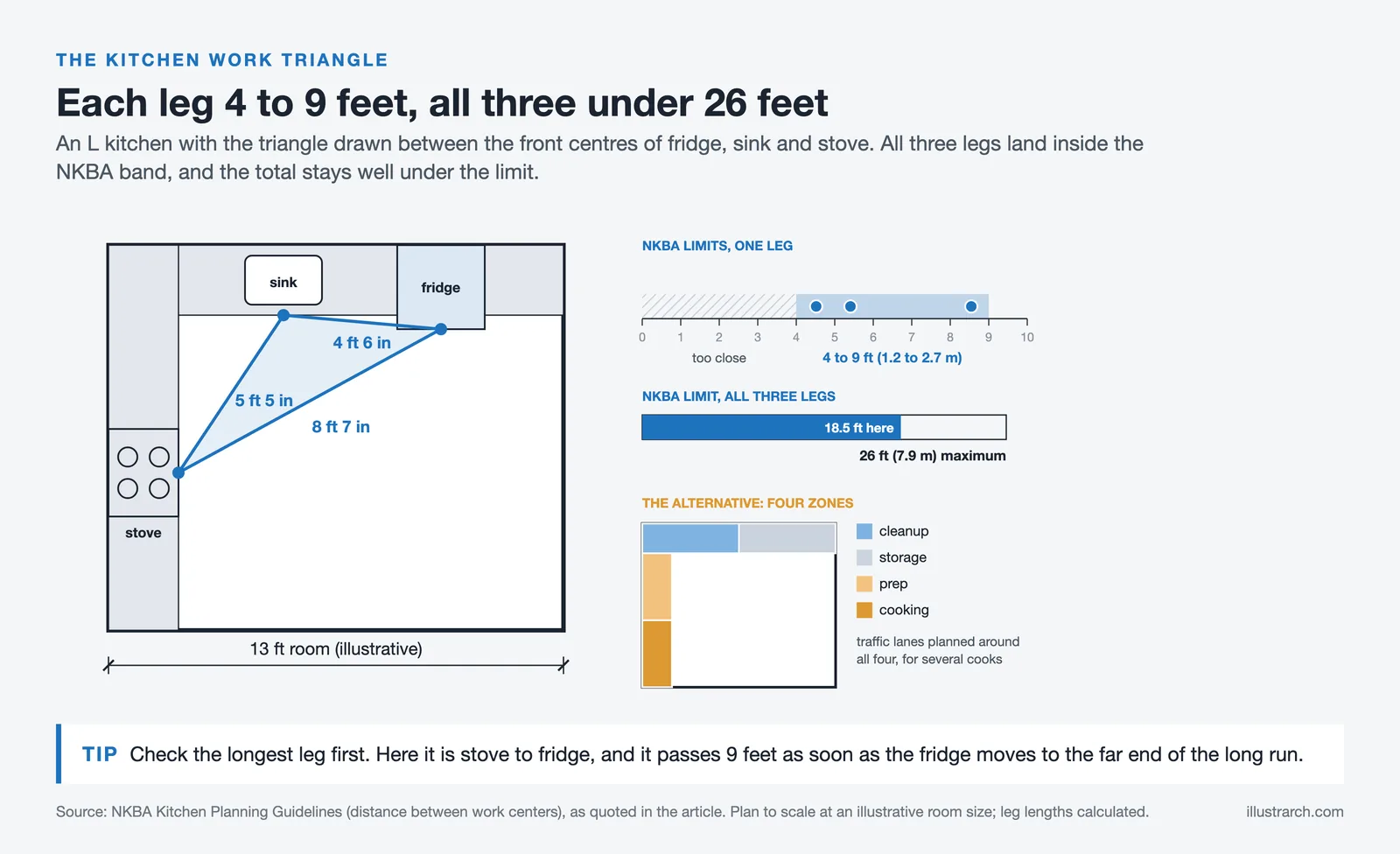
The kitchen work triangle is a planning principle developed in the 1940s at the University of Illinois. It connects the three primary work points in any kitchen: the sink, the stove, and the refrigerator. The idea is that keeping these three stations close together, with clear pathways between them, reduces unnecessary movement during cooking.
According to the National Kitchen and Bath Association (NKBA), no single leg of the work triangle should be shorter than 4 feet or longer than 9 feet, and the total perimeter of all three legs combined should not exceed 26 feet. These guidelines still hold up well for single-cook households.
That said, the triangle has its limits. Modern kitchens often involve multiple cooks working simultaneously, dedicated prep zones separate from cooking zones, and open-plan designs where the kitchen flows into a dining or living area. In these contexts, designers now often favor a zone-based approach: dividing the kitchen into defined areas for prep, cooking, cleanup, and storage, with traffic lanes planned around all four rather than a single triangular path.
📌 Did You Know?
The kitchen work triangle concept originated from time-motion studies of the 1940s, conducted as part of the Small Homes Council research program at the University of Illinois. Researchers found that most cooking tasks involved repeated movement between these three points, and optimizing the triangle reduced both physical fatigue and cooking time. Over 75 years later, it remains the foundational planning guideline published by the NKBA.

The 6 Main Kitchen Layout Ideas Explained
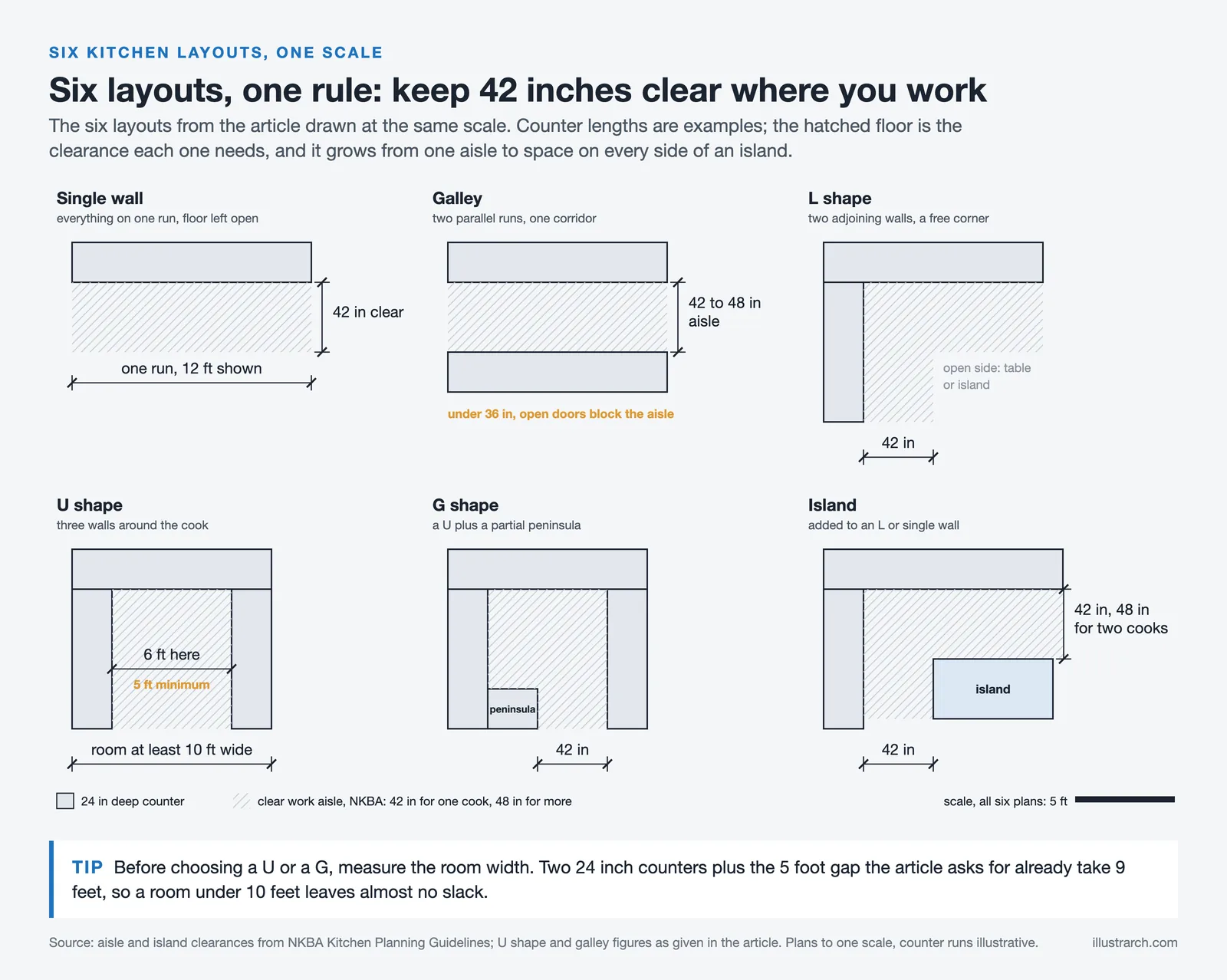
Each layout type has a specific set of conditions under which it performs best. Room dimensions, the number of doorways and windows, household size, and cooking habits all play into which configuration makes sense for your kitchen design layout.
Single-Wall Kitchen Layout
Everything runs along one wall: cabinets, countertops, sink, stove, and refrigerator. This layout appears most often in studio apartments, open-plan living spaces, and secondary kitchens within larger homes.
It’s the most space-efficient option of all small kitchen layouts because it occupies only one wall and leaves the rest of the floor plan open. The trade-off is limited counter space and minimal storage. If you cook frequently and own a lot of kitchen equipment, a single-wall configuration will feel cramped quickly.
One practical improvement: adding a freestanding island or a narrow rolling prep cart in front of the main wall creates a pseudo-two-sided layout and can dramatically increase the usable prep surface without any structural work.

Galley Kitchen Layout
Two parallel countertops face each other across a corridor, typically 42 to 48 inches wide. The galley is named after ship kitchens, where efficiency in a confined space was essential. Professional chefs often prefer galley-style configurations precisely because everything is within reach and the workflow runs in a straight line.
For residential use, galley kitchens work well in narrow rooms and older apartments. One common approach is to place all cooking and prep on one side and the sink, dishwasher, and refrigerator on the other. This creates a natural division of tasks and keeps the cooking zone clear during cleanup.
The main weakness is social isolation. A galley kitchen with closed ends has no natural gathering point, which can feel cut off in households where the kitchen is a social hub. Opening one end to an adjacent room or replacing a wall with a breakfast bar or peninsula partially solves this.
⚠️ Common Mistake to Avoid
Many people assume a galley kitchen automatically feels cramped. The actual problem is usually aisle width, not the layout itself. An aisle narrower than 36 inches creates genuine circulation issues, especially when appliance doors are open. Keep the corridor at 42 to 48 inches and a galley kitchen feels efficient rather than claustrophobic. In smaller spaces where you cannot achieve that width, consider removing upper cabinets on one side and replacing them with open shelving to reduce visual weight.
L-Shaped Kitchen Layout
Cabinets and appliances occupy two adjoining perpendicular walls, forming an L. This is consistently reported as the most popular kitchen layout in residential design, and for good reason: it adapts to a wide range of room sizes, supports an open-plan configuration, and leaves a natural corner for a dining table or island.
The L-shape works particularly well for households where cooking and entertaining happen simultaneously. One leg of the L handles cooking and prep while guests gather in the open area on the other side. Adding an island to an L-shaped kitchen design is a common upgrade that provides extra prep surface and informal seating without closing off the floor plan.
Corner storage is the most persistent challenge with this layout. Standard corner cabinets waste usable space unless fitted with a lazy Susan, pull-out drawer system, or a corner drawer unit. Budget for good corner storage hardware when planning an L-shaped kitchen, and you’ll use that space productively. For more ideas on maximizing cabinet storage in this type of layout, see this guide to maximising storage with kitchen cabinets.

U-Shaped Kitchen Layout
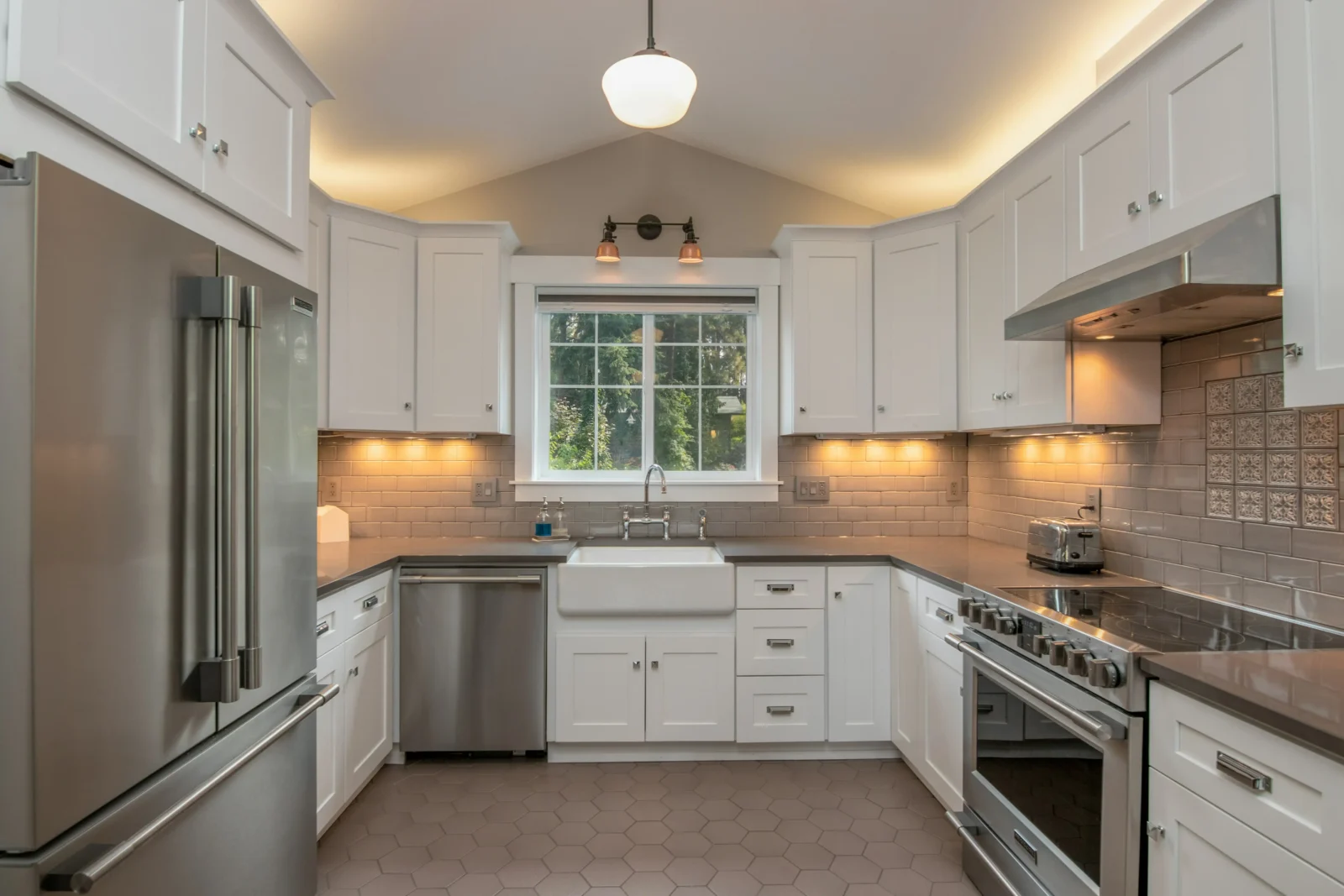
Three walls form a U, wrapping the cook on three sides. This is the layout that provides the most counter space and storage of any configuration, which makes it a strong choice for households that cook frequently, own a lot of equipment, or want separate zones for baking, prep, and cooking within a single kitchen.
U-shaped kitchens work best in rooms that are at least 10 feet wide. In narrower spaces, three walls of cabinetry create a corridor that feels confined rather than efficient. The ideal U-shape has a minimum of 5 feet between facing countertops so that two people can comfortably work and cabinet doors can open fully without obstruction.
One challenge with U-shaped kitchen layouts for small kitchens is that the layout can feel enclosed, especially in rooms with limited natural light. Keeping upper cabinets on just two of the three walls, or replacing them entirely with open shelving on the back wall, opens the space considerably without reducing overall storage.
🎓 Expert Insight
“The best kitchen layout is the one that matches the way the household actually cooks. Most remodeling mistakes happen when homeowners choose a layout based on how a kitchen looks in a showroom rather than how it functions during a real Tuesday evening dinner.”
NKBA Design Professional, Certified Kitchen and Bath Designer
This reflects a core principle in the NKBA’s kitchen planning guidelines: behavioral observation should precede layout selection. A layout that looks spacious in a staged setting may feel inefficient once it encounters actual household traffic patterns and cooking routines.

G-Shaped Kitchen Layout
The G-shape is essentially a U-shaped kitchen with an additional partial wall or peninsula extending from one end. It offers even more counter space and storage than a standard U, and the peninsula creates a natural boundary between the kitchen and an adjacent living or dining area without fully closing off the space.
This configuration is best suited to larger kitchens and households that genuinely need the extra surface area. In a room that isn’t large enough to comfortably support a full U-shape, adding a fourth partial counter will feel oppressive rather than functional. The minimum recommended floor area for a G-shaped kitchen is typically around 200 square feet of total room space including the adjacent area the peninsula borders.
Island Kitchen Layout
The island layout is not a standalone configuration but rather an addition to an existing layout, most commonly L-shaped or one-wall kitchens. A freestanding island in the center of the kitchen adds prep surface, storage, and often informal seating, and it creates a focal point that anchors open-plan spaces.
For an island to work, you need at minimum 42 inches of clearance on all sides, though 48 inches is a more comfortable standard. This is a firm constraint that eliminates island configurations from many kitchens that might otherwise seem large enough. Before committing to an island, tape out its footprint on your floor and walk through a full meal preparation to test whether the clearance genuinely works. For ideas on how the island fits within a broader modern kitchen design, see this overview of modern kitchen modeling architecture.

How to Choose the Best Kitchen Layout for Your Space
The right layout depends on four factors working together: the dimensions and shape of the room, the number of entrances and windows, your household’s cooking habits, and your budget for structural changes.
What Is the Best Layout for a Small Kitchen?
For genuinely small kitchens, the galley and single-wall layouts consistently outperform the alternatives. Both keep the footprint compact while maximizing the ratio of usable surface to floor area. The galley in particular is highly efficient because it eliminates wasted corner space entirely.
If you’re working with a small kitchen that opens into a living or dining area, an L-shaped layout with a compact peninsula can give you the open-plan feel of a larger kitchen without requiring significant additional square footage. Keep upper cabinets light or replace some with open shelving to prevent the walls from closing in visually.
For additional practical strategies on making a small kitchen work harder, the article on designing efficient kitchen spaces for quick meals covers zone planning in detail.
Kitchen Layout Comparison Table
The following table summarizes the key characteristics of each layout type to help you compare them at a glance:
| Layout | Best For | Min. Room Size | Counter Space | Social/Open Plan |
|---|---|---|---|---|
| Single-Wall | Studios, open-plan small spaces | ~80 sq ft | Low | Excellent |
| Galley | Narrow rooms, single cooks | ~100 sq ft | Medium | Low (closed) / Medium (open) |
| L-Shaped | Most households, entertaining | ~120 sq ft | Medium-High | Excellent |
| U-Shaped | Avid cooks, large households | ~150 sq ft | High | Low-Medium |
| G-Shaped | Large kitchens, multiple cooks | ~200 sq ft | Very High | Medium |
| Island | Larger open-plan kitchens | ~200 sq ft+ | High (with island) | Excellent |

Kitchen Cabinet Layout Considerations
The kitchen cabinet layout within any floor plan determines how practical the kitchen actually is to use day-to-day. A few principles apply regardless of which overall layout type you choose.
Place your most frequently used items closest to the point of use. Pots and pans belong near the stove, not in a cabinet on the opposite wall. Dishes and glasses belong near the dishwasher or sink so unloading is fast. Dry goods and pantry items should sit close to the prep counter where you’ll use them.
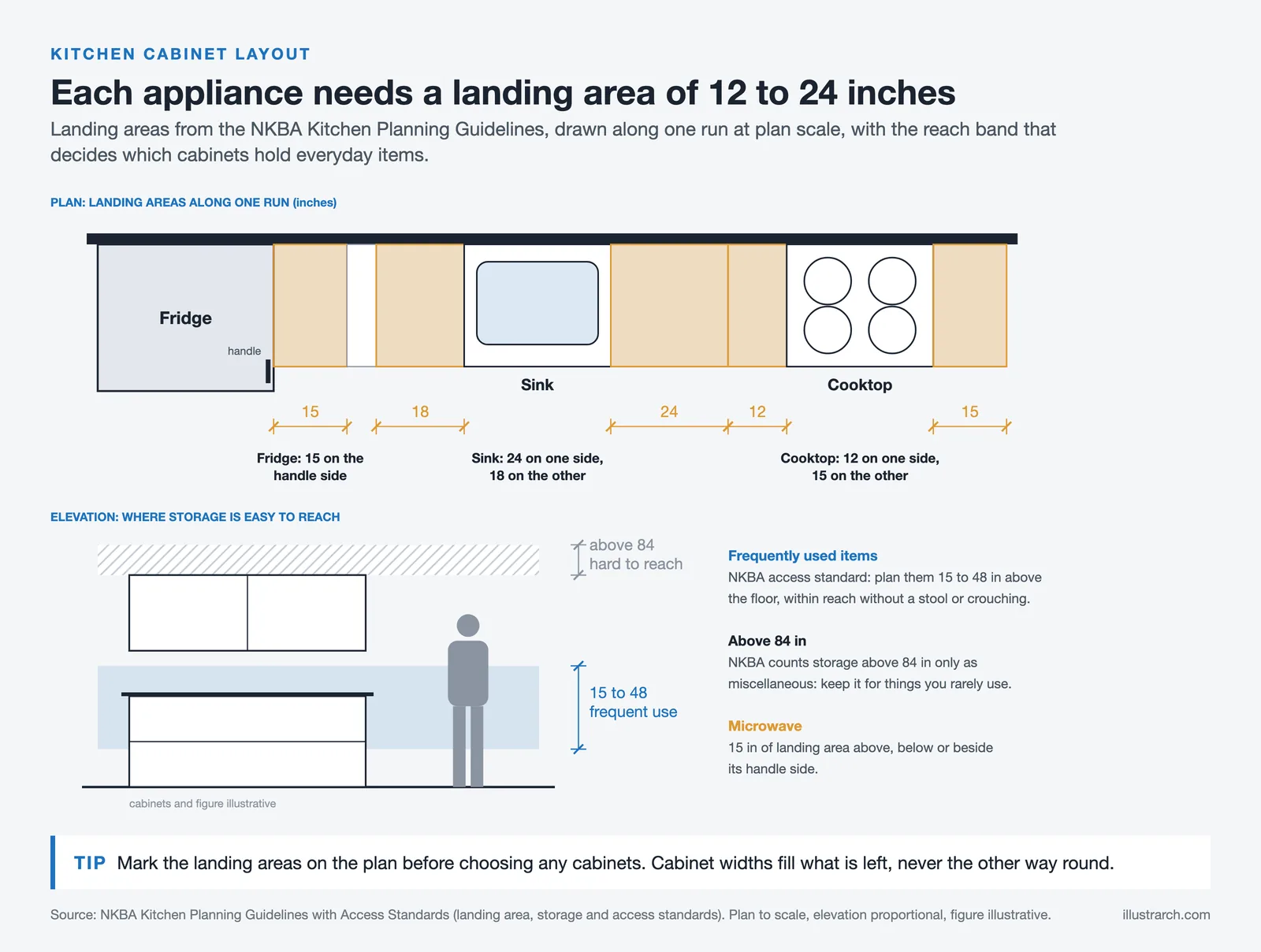
Frequently used items are easiest to reach when stored between 15 and 48 inches above the floor, the NKBA access range. Storage above about 84 inches from the floor needs a step stool for most adults and should be reserved for rarely used items. Lower cabinets with deep drawers are generally more functional than traditional hinged doors because everything inside is visible and reachable without crouching.
Corner storage, as mentioned above, requires deliberate hardware investment. A blind corner pull-out or a full lazy Susan mechanism converts what would otherwise be dead space into genuinely usable storage. For a detailed look at specific cabinet storage solutions, this guide to kitchen cabinet storage covers the most effective options.
💡 Pro Tip
When finalizing your kitchen cabinet layout, apply what designers call the “landing zone” rule: every major appliance needs an adjacent clear surface where you can set things down immediately. NKBA asks for 15 inches beside the refrigerator and the microwave, 12 inches on one side of the cooktop and 15 inches on the other, and 24 inches on one side of the sink and 18 inches on the other. The refrigerator needs a landing zone on the handle side. The stove needs counter space on both sides. The microwave needs a surface below or beside it. Missing even one landing zone creates daily frustration that no amount of beautiful cabinetry can fix.

Kitchen Layouts for Small Kitchens: Practical Adjustments
Small kitchen layouts operate on different constraints than standard-sized rooms. The priority shifts from maximizing storage to maximizing the sense of space and maintaining comfortable circulation.
Light colors on cabinets and walls reflect light and make a small kitchen feel larger. Reflective surfaces like glossy cabinet doors or a mirrored backsplash amplify this effect. Keeping upper cabinets on only one wall rather than two reduces visual weight substantially.
Compact appliances have improved significantly in recent years and can be worth the investment in a small kitchen. Slimline dishwashers, counter-depth refrigerators, and induction cooktops that sit flush with the counter all reduce the physical footprint of appliances without reducing functionality in a meaningful way for most households.
Vertical storage is underused in most small kitchens. Running cabinets all the way to the ceiling, even if the top section is only accessible with a step stool, captures a significant amount of storage that would otherwise be lost to the space above standard cabinet height. The approach also draws the eye upward, which makes the ceiling feel higher.
For a broader look at how small space design principles apply beyond the kitchen, illustrarch’s tiny house interior design tips covers the same maximization strategies in detail.

Kitchen Design Layout and the Role of Natural Light
Where your windows sit has a direct effect on which layout works best. A window above the sink is standard in many homes and works well with L-shaped, U-shaped, and galley configurations where the sink sits naturally against an exterior wall. But in open-plan homes or rooms where the kitchen shares interior walls on all sides, natural light becomes a more deliberate design decision.
Placing the primary work surface facing a window or a glass door significantly improves the quality of the cooking experience. It also affects how colors read in the kitchen: cabinet colors selected in showroom lighting often look quite different in the actual light conditions of the finished room. Always check paint and cabinet samples in your kitchen’s actual light before committing.
For kitchens with limited natural light, under-cabinet LED lighting is one of the highest-value additions available. It illuminates prep surfaces directly, reduces eye strain, and makes the kitchen feel larger by brightening the work surface independent of overhead light sources.
How Kitchen Layout Affects Resale Value
A well-chosen layout improves both how a kitchen functions and how it appeals to future buyers. According to Remodeling Magazine’s annual Cost vs. Value report, a minor kitchen remodel (updated finishes within an existing footprint) recoups approximately 96% of its cost at resale, while a major remodel that moves plumbing or changes the structural layout recoups around 38 to 52% depending on scope and market.
This data points to a clear strategy: work within your existing layout footprint whenever possible, and invest your budget in quality finishes, hardware, and appliances rather than structural reconfiguration. If your current layout is fundamentally inefficient, the investment in structural change can still be worthwhile, but the payback timeline is longer.
The L-shaped layout with or without an island is consistently the most appealing to buyers across North American and European markets, primarily because of its open-plan compatibility and social functionality. A galley kitchen in an otherwise open home can feel dated to buyers even when it’s well-executed, simply because of the market preference for visual openness. For context on how kitchen design fits within broader interior design trends, see illustrarch’s overview of modern kitchen design principles.
🔢 Quick Numbers
- A minor kitchen remodel recoups approximately 96% of its cost at resale (Remodeling Magazine Cost vs. Value Report, 2024)
- A major kitchen remodel that includes structural changes recoups 38-52% depending on market and scope (Remodeling Magazine, 2024)
- The NKBA recommends no work triangle leg shorter than 4 feet or longer than 9 feet, with a total perimeter not exceeding 26 feet (NKBA Kitchen Planning Guidelines, 2023)
- Island clearance minimum of 42 inches on all sides is required, with 48 inches recommended for households where two people cook simultaneously (NKBA, 2023)
✅ Key Takeaways
- The layout for your kitchen should be chosen based on room dimensions, the number of cooks, and actual cooking habits, not aesthetics alone.
- Galley and single-wall layouts are the best kitchen layouts for small kitchens because they maximize efficiency within a tight footprint.
- L-shaped kitchen layouts are the most versatile and the most popular for residential use, adapting well to both open-plan and enclosed rooms.
- U-shaped and G-shaped layouts provide the most counter space and suit households that cook frequently, but require larger rooms to avoid feeling cramped.
- Islands require a minimum of 42 inches of clearance on all sides; tape out the footprint before committing to confirm it genuinely fits your space.
- Working within an existing layout footprint and investing in quality finishes typically provides better resale returns than major structural reconfiguration.

Frequently Asked Questions About Kitchen Layouts
What is the most efficient kitchen layout?
The galley kitchen is generally considered the most efficient kitchen layout for single cooks. It places all work surfaces, appliances, and storage within a compact corridor, minimizing the steps between the sink, stove, and refrigerator. For households where two or more people cook at once, a U-shaped layout or a well-planned L-shaped design with an island distributes the workflow more effectively across multiple users.
How do I choose the right kitchen layout for a small space?
For small kitchens, prioritize layouts that minimize wasted corner space and keep traffic lanes clear. A galley or single-wall kitchen layout works well in narrow rooms because it uses space efficiently along one or two walls. If your small kitchen opens into a living area, an L-shape keeps the footprint compact while giving you the open-plan feel. Avoid U-shaped or G-shaped configurations in rooms narrower than 10 feet, as the reduced aisle width makes everyday use uncomfortable.
What kitchen layout is best for entertaining?
L-shaped kitchen layouts with an island are consistently the best choice for entertaining. The island creates a natural gathering point where guests can sit and interact with the cook, while the L configuration keeps the actual work area separate from the social zone. Open-plan designs that allow the kitchen to flow into a dining or living space enhance this effect further. Galley kitchens tend to isolate the cook during social events unless one end opens to the main living area.
How much space do you need for a kitchen island?
You need at least 42 inches of clear floor space on all sides of a kitchen island for comfortable single-person circulation. The NKBA recommends 48 inches of clearance for kitchens where two or more people will work around the island simultaneously. The island itself should be at least 40 inches long and 24 inches deep to provide useful prep space. Below these dimensions, an island adds visual interest but not meaningful functionality.
Is the kitchen work triangle still a useful planning tool?
Yes, the kitchen work triangle remains a useful starting point, particularly for single-cook households and traditional layouts like galley or L-shaped kitchens. However, for modern open-plan homes, larger kitchens with multiple cooks, or designs that incorporate dedicated baking stations or prep islands, a zone-based planning approach works better. The NKBA’s updated guidelines incorporate both the triangle and zone planning, allowing designers to apply whichever suits the household’s actual cooking patterns.
For further reading on kitchen design principles, the NKBA Kitchen Planning Guidelines provide the industry-standard reference for layout planning, clearances, and ergonomics. The KitchenAid kitchen layout guide offers a clear overview of layout types with visual examples. For professional design tools, Autodesk Revit and similar architectural software allow you to model and test layout options before committing to construction. Houzz also maintains an extensive collection of real kitchen layout examples organized by type and size for visual reference.





Spa-Like Serenity: 5 Accessible Luxury Upgrades to Transform Your Master Bathroom
Five accessible upgrades, from decluttering and layered lighting to plush textiles, natural...
 illustrarch Editoral Team3 Mins read

The 3D render revolution: how luxury kitchen design is changing the way we build homes
Photorealistic 3D rendering is changing the luxury kitchen design process, letting clients,...
illustrarch Editoral Team3 Mins read
How to Fill a Large TV Wall?
A broad living room wall poses an immediate spatial challenge the moment...
illustrarch Editoral Team4 Mins read
Why Custom Kitchens Are Becoming a Must-Have in Modern Homes
Custom kitchens in NYC are increasingly popular as they provide tailored designs...
illustrarch Editoral Team2 Mins read


Leave a comment