

The Dragon’s Lair
The Dragon's Lair is a conceptual residence designed by Rohit Dhote, inspired by a dragon's form, that addresses the challenges of building in Ladakh's extreme terrain.
 illustrarch Editoral Team28 December 20221 Mins read406


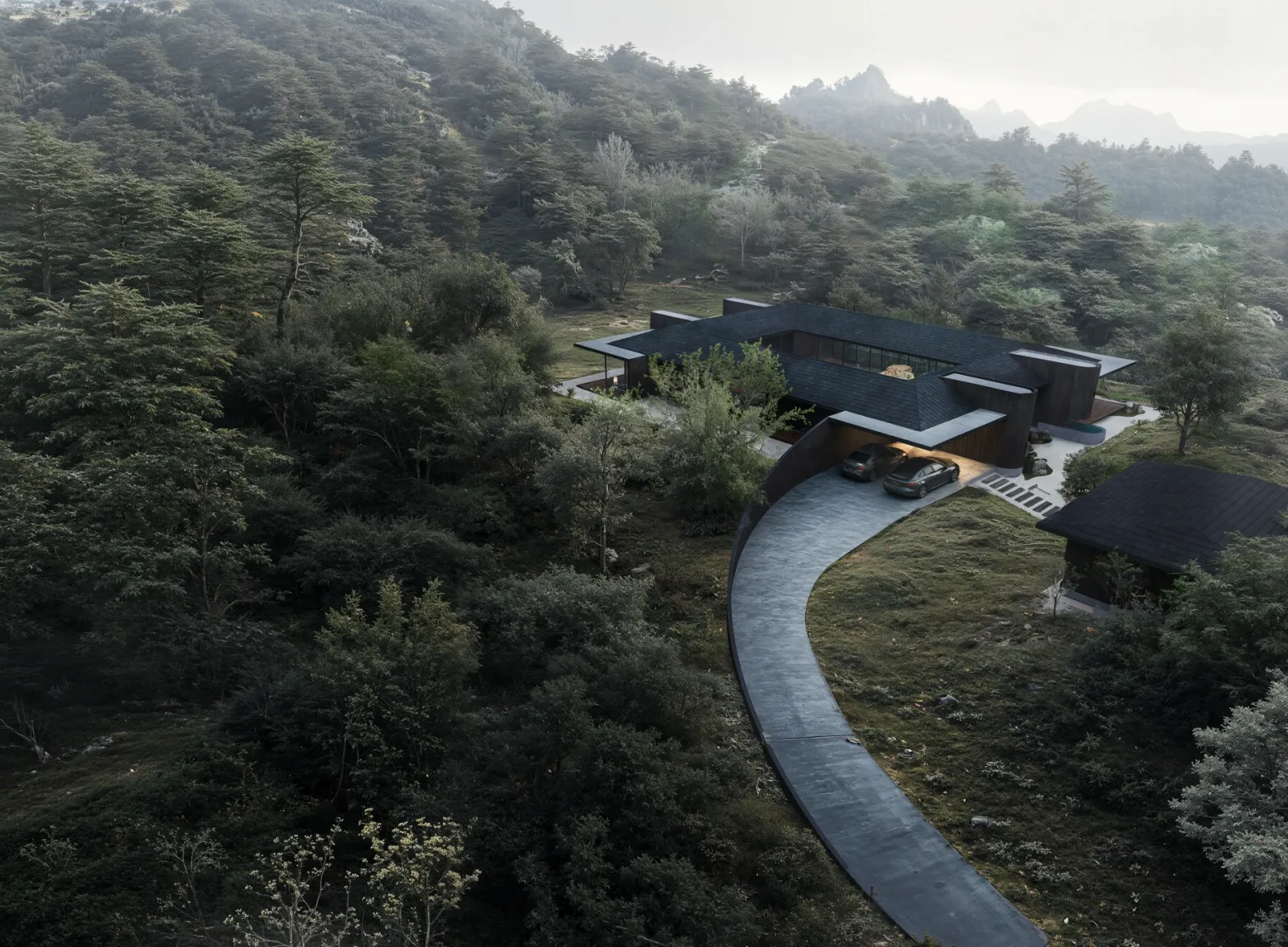
The Dragon’s Lair is a conceptual proposal by architect Rohit Dhote for an exotic, isolated residence nestled deep in the Himalayan Mountains of Ladakh, India. As the name symbolizes, the structure is inspired by the form of the mythical dragon and molded and minimalized in bold concrete. It depicts a peaceful and secluded habitat in the harsh mountainous terrain, signifying tranquility amidst the chaos. The form resembles a dragon’s head and neck, giving it an iconic shape and an aesthetically appealing look that pays tribute to the rich cultural heritage of the extreme North Indian inhabitants.
Building in Ladakh is a demanding exercise. The region sits at high altitude on the cold western edge of the Himalayas, where thin air, intense solar radiation, freezing winters and a short construction season test both material and method. Any architecture proposed for this setting has to reckon with steep, irregular slopes, scarce resources and long distances from supply chains. Dhote’s residence answers these conditions not by hiding from the landscape but by carving an emphatic figure into it, letting the raw geometry of the mountains frame the sculpted volume.
Form, Concept and Extreme Terrain
The decision to work in bold concrete suits a project that wants permanence and a single, unbroken silhouette. Concrete can be cast into the sweeping curves a dragon’s neck demands, and its mass holds heat through cold mountain nights, a useful trait in this climate. The minimal design language keeps the eye on the creature’s profile rather than on ornament, so the building reads clearly against rock and sky from a distance. This restraint is what allows a mythic idea to feel grounded rather than theatrical.
As a conceptual work, the project is less about a finished client house than about testing what human habitat can become in places usually considered uninhabitable. By drawing on the dragon, a figure woven through Himalayan and broader Asian myth, Dhote ties shelter to story, suggesting that even the most remote dwelling carries cultural memory. The aim is to visualize the possibilities of human habitat in extreme terrains, and the pairing of an exquisite architectural form with irregular, severe ground turns the structure into a genuine visual spectacle. Seen this way, The Dragon’s Lair reads as an invitation to imagine architecture that belongs to the wild rather than merely resisting it.




Modern Earthy Sanctuary House by PENTARCH designers
The Modern Earthy Sanctuary is a 10 Marla house in Sheikhupura, Pakistan,...
illustrarch Editoral Team2 Mins read

Zašová Health Center by AOSI
AOSI's winning competition design for a public health center in Zašová reinterprets...
illustrarch Editoral Team3 Mins read
Casa Paisaje by TAP Arquitectura
Casa Paisaje is TAP Arquitectura's unbuilt 2025 competition proposal for a 302...
illustrarch Editoral Team2 Mins read

SENA Tunja Training Center by TAP Arquitectura
TAP Arquitectura's unbuilt competition proposal for SENA in Tunja wraps a 4,400...
illustrarch Editoral Team2 Mins read


Leave a comment