

Elephant Tower Thailand: How Goya Rises From Elephant-Dung Bricks
At the gateway to the Matalay development in Khao Lak, Thailand, Goya Tower rises from sun-dried elephant-dung bricks. A look at how Boonserm Premthada and Bangkok Project Studio turned animal waste into a climbable landmark, and why it matters.
 Elif Ayse Sen25 July 20265 Mins read336
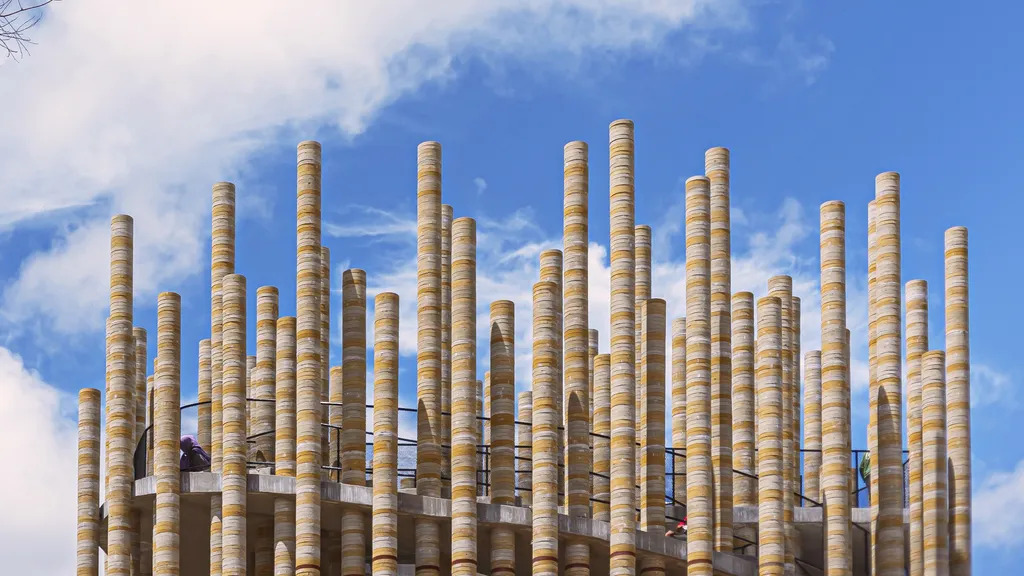
Table of Contents Show
The elephant tower in Thailand, named Goya, stands at the entrance of the Matalay development in Khao Lak, Phang Nga. Designed by Thai architect Boonserm Premthada and completed in 2026, it is built from hundreds of handmade circular bricks made mostly from elephant dung.
Most towers announce themselves through height or shine. Goya does it through material. Set along the Andaman coast of southern Thailand, this elephant tower turns a substance usually treated as waste into a public landmark you can climb. The project comes from Bangkok Project Studio, the practice led by Boonserm Premthada, and it caps roughly six years of research into building with elephant dung.
What Is the Goya Tower?

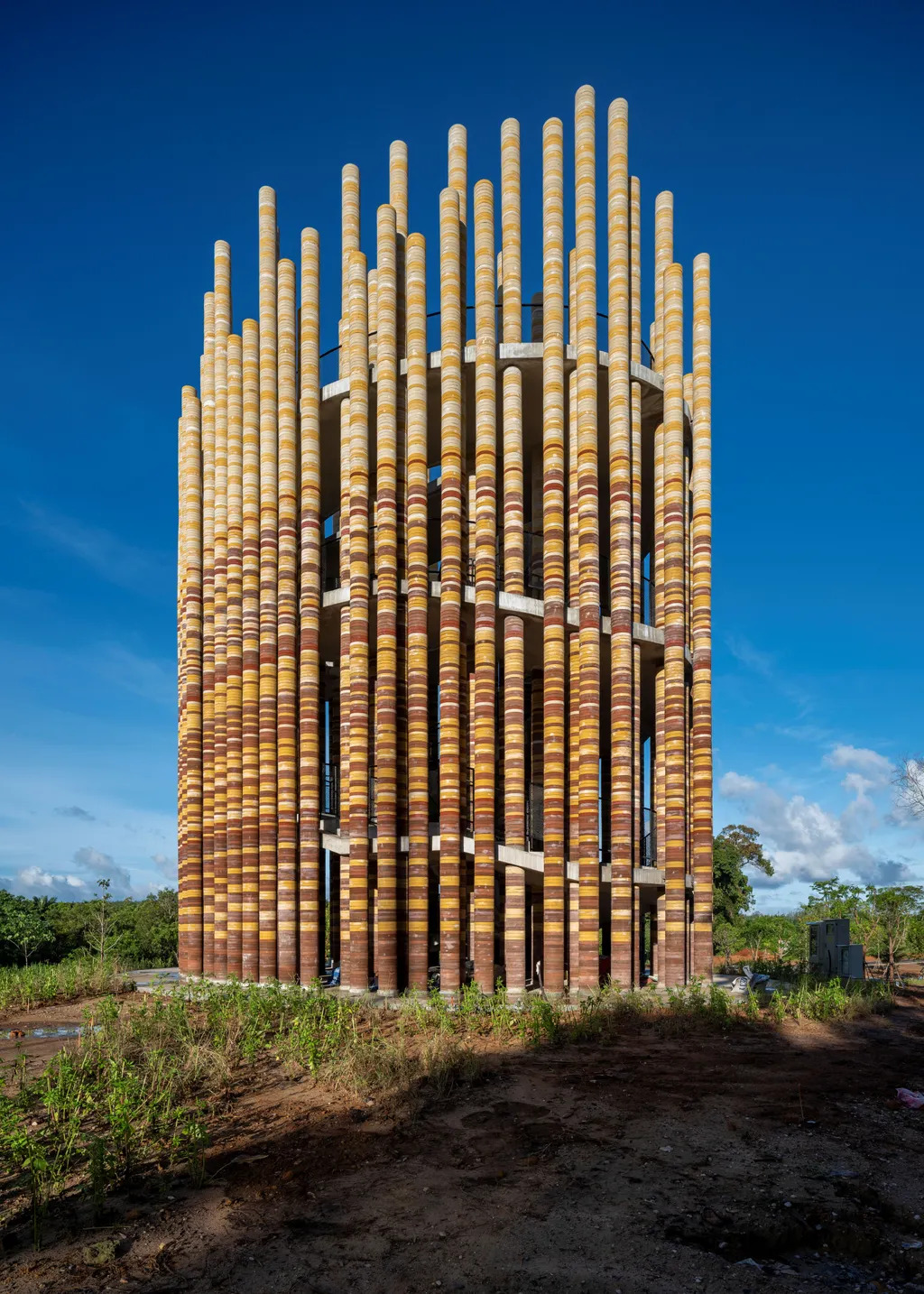
Goya is an observation tower at the gateway to the Matalay development in Khao Lak, Phang Nga. Its structure is a cluster of cylindrical columns that rise to different heights and carry walkways spiralling upward. What sets it apart is the building block itself, an unconventional building material pressed largely from elephant dung and dried in the sun. Premthada treats that material not as a novelty but as the tower’s whole architectural identity.
The name points to the source. Goya is a female elephant born in the region, and the tower reads as a tribute to the animals whose biology, quite literally, becomes part of the walls. That link between building and living creature runs through everything Premthada has made on this theme.
How Elephant Dung Becomes a Building Material
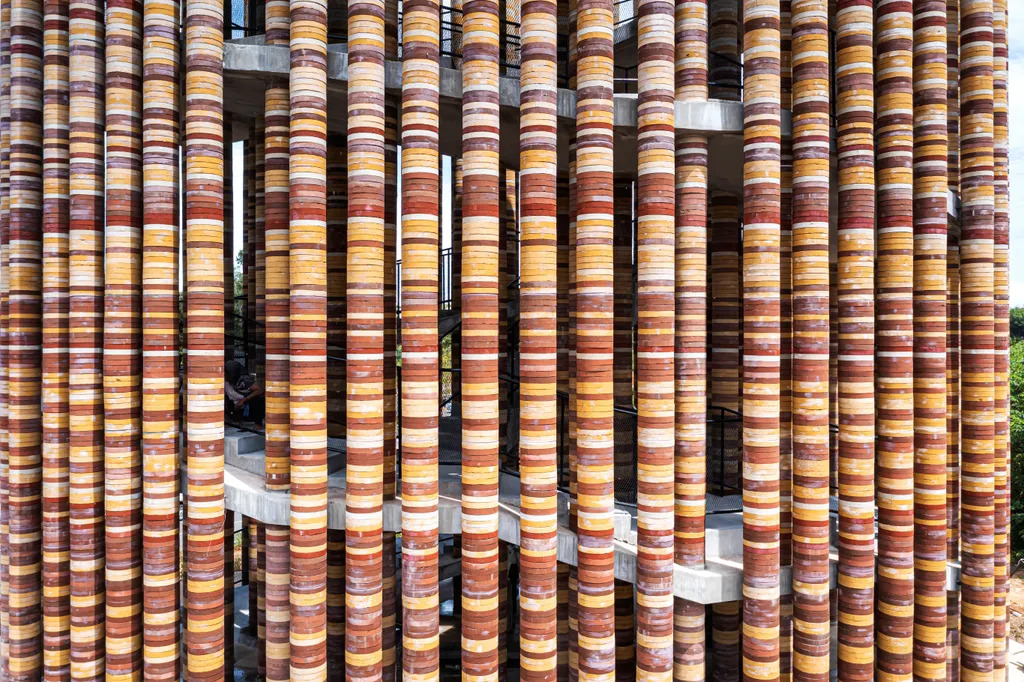
The process begins in Ban Ta Klang, a village in Surin province known for its long history with domesticated elephants. Because the animals graze on fibrous Napier grass, their dung is packed with plant fibre, which works as natural reinforcement. Alongside mahouts, the elephant caretakers, and local craftspeople, the team collects dried dung, blends it with a small amount of cement and water, presses it into round moulds, and leaves each piece to cure in sunlight. Skipping the kiln matters. Firing clay bricks burns a great deal of energy, so sun-curing keeps the embodied carbon of each brick low while holding onto the material’s raw, organic texture.
Before Goya, these bricks lived mostly as experiments and gallery pieces. Prototypes entered major museum collections, including New York’s Museum of Modern Art. Goya is the point where the research steps out of the vitrine and becomes a structure people can walk through.
📐 Technical Note
Each circular brick is roughly 330 mm across and 50 mm thick, with a central hole. During construction the discs are threaded onto vertical steel reinforcement rods and stacked, so every column acts as structure and finished surface at once. Because the bricks cure in the sun rather than a kiln, they avoid the high firing temperatures that give conventional fired brick much of its embodied carbon.
The appeal is not only ecological. Gathering and shaping the material on site keeps value inside the community instead of importing it. It also continues a much older conversation about eco-friendly materials that ask less of the planet than concrete or steel.
A Tower Named After an Elephant Called Goya

The tribute is not sentimental decoration. In this part of Thailand, elephants have shaped work, livelihoods, and local identity for generations. Nearby sits Khao Chang, or Elephant Mountain, a limestone ridge that reads like a reclining elephant on the horizon. Placing an elephant tower in Thailand at exactly this spot ties the building to both the animal and the landscape that echoes its form.
Naming the tower after a single elephant also reframes the material. The dung is not an anonymous by-product but something traceable to a specific creature and place. That is a deliberate move by Premthada, who tends to build outward from local relationships rather than impose a form on a site.
Inside the Design: Columns, Colour, and Movement
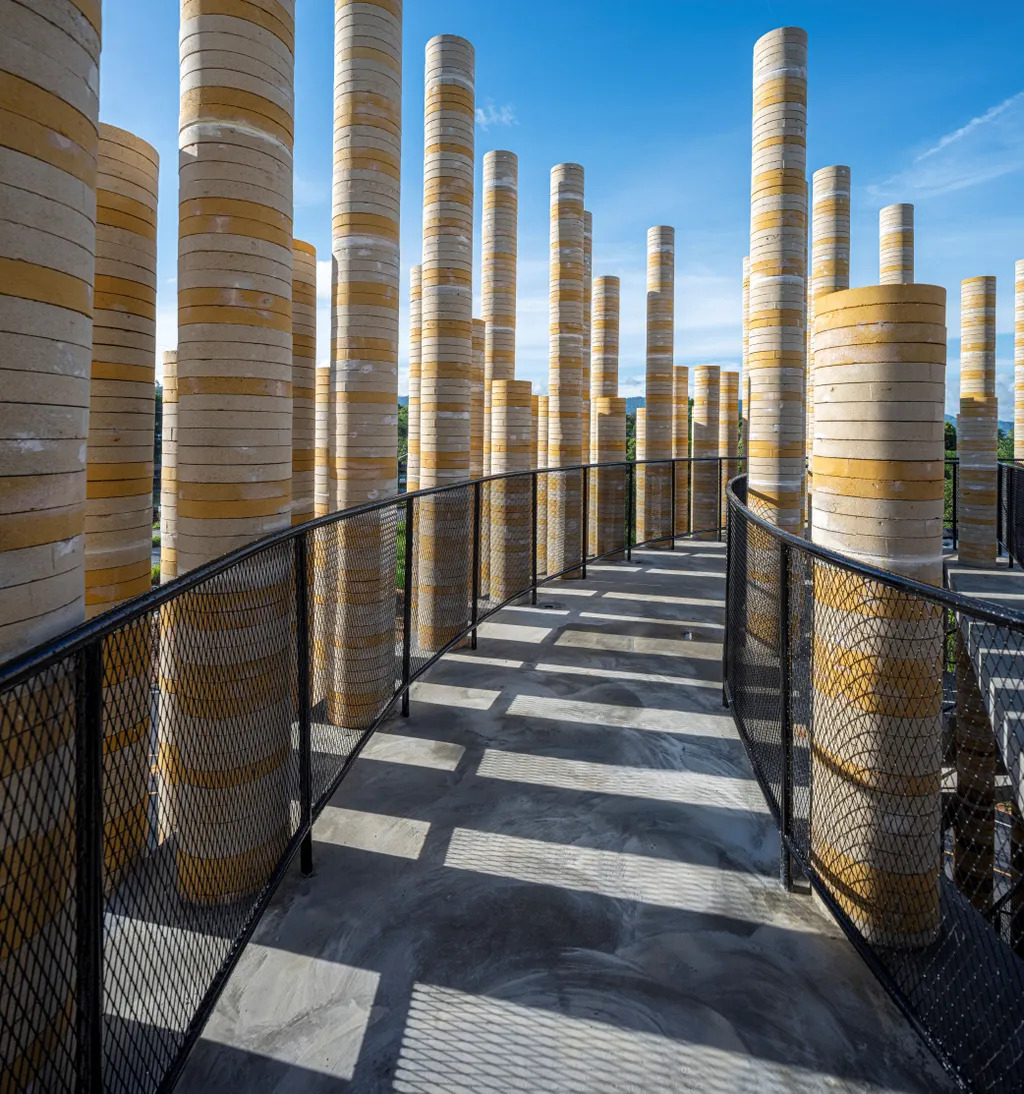
Rather than solid masonry walls, Goya is built as a forest of round columns. Each one is a stack of dung-brick discs held on a steel spine, and the repetition sets up both the tower’s rhythm and its texture. The bricks appear in five tones drawn from a sunset palette, arranged in a planned colour sequence so the whole structure moves through warm gradients that are strongest in the evening light.
Movement is the other half of the idea. Visitors climb through curved walkways that open, at each level, onto shifting views of gardens, forest, coastline, and sky. The columns cast alternating bands of sun and shadow across the path, and the handmade surface stays close enough to touch the entire way up. The design rewards a slow climb over a quick photo. This kind of expressive, tactile masonry sits comfortably beside the projects honoured in recent brick architecture awards, even though the material here is anything but conventional. The wider story of brick in contemporary architecture shows the same pull toward craft and expression, and Premthada’s earlier elephant work appears there too.
Goya Tower Project Details
The core facts of the project, as published by Bangkok Project Studio, are summarised below.
| Detail | Value |
|---|---|
| Project | Goya Tower |
| Location | Khao Lak, Phang Nga, Thailand |
| Architect | Boonserm Premthada |
| Studio | Bangkok Project Studio |
| Client | Matalay |
| Project Type | Observation tower |
| Gross Floor Area | 543 m² |
| Completion | 2026 |
| Primary Material | Handmade elephant-dung bricks with steel reinforcement |
| Brick Size | 330 mm diameter, 50 mm thick |
Craft, Community, and a Circular Economy
Premthada has long argued that sustainability has to pay off for the people nearest a project, not just the climate ledger. Using dung as a resource turns a daily by-product of elephant-keeping into a small new income stream, and it widens traditional craft into full building production. The work leans on hands, sunlight, and time far more than on industrial machinery, so each brick carries the mark of the person who made it.
🎓 Expert Insight
“Architecture is the physical creation of an atmosphere,” says Boonserm Premthada of Bangkok Project Studio.
At Goya, that atmosphere is built from colour, texture, smell, and the memory of the animals themselves, which is why the dung brick is handled as expression rather than gimmick.
That approach places Goya inside a broader move toward sustainable building materials that close loops rather than stretch supply chains. The tower does not hide where its bricks come from. It makes that origin the point.
Environmental claims here reflect the approach described by the project team and general research on low-fired materials, and may vary with local conditions and methods.
Who Is Boonserm Premthada?

Boonserm Premthada founded Bangkok Project Studio in 2013, after studying architecture at Chulalongkorn University. His reputation rests on building with local methods and local hands, usually far from big cities. In 2019 he won the Royal Academy’s Dorfman Award, and much of his best-known work sits under the Elephant World project in Surin.
🏗️ Real-World Example
Elephant World: Elephant Museum (Surin, 2020): Premthada’s earlier landmark in the same region used more than 480,000 handmade clay bricks shaped from local loam, according to ArchDaily. It set the pattern of local craft and local material that Goya now pushes further with dung.
Goya belongs to a run of projects where architecture and elephant life are inseparable. Works such as the Elephant Theatre, shown at the 2022 Biennale of Architecture and Landscape in Versailles, and an elephant-dung archway at the 2025 Venice Architecture Biennale carried the material well beyond Thailand. Across these projects, discarded matter keeps becoming architecture, which is a large part of why Premthada’s body of work reads as one long argument about value.
That argument has found a wide audience. Curators, juries, and museums have all taken an interest in the dung brick, treating it less as a curiosity than as a serious proposal for low-impact building.
🔢 Quick Numbers
- Premthada’s elephant-dung bricks and Brick Observation Tower entered MoMA’s collection, dated 2015 to 2020 (Museum of Modern Art)
- He won THE DESIGN PRIZE 2021 for social impact (The Design Prize, via designboom)
- Elephant World was named Best Sanctuary at the Wallpaper* Design Awards 2021 (Wallpaper*)
- He received the Royal Academy’s Dorfman Award in 2019 (Dezeen)
Goya reads as the built summary of that argument, the moment the elephant tower in Thailand moves from research and gallery pieces into something you can stand inside.
The Bigger Picture
Goya quietly flips a basic assumption. We tend to sort the world into resources and waste, then build only from the first pile. This tower takes something from the second pile, gives it colour and structure, and lets people climb it at sunset. The most radical part of the elephant tower in Thailand may not be the dung at all. It is the reminder that value is a decision, not a fixed property of the material.




Vitra Museum Stages First Major Geoffrey Bawa Retrospective in Decades
Vitra Design Museum opens the first major Geoffrey Bawa retrospective in 20...
 illustrarch Editoral Team2 Mins read
Ai Weiwei Installs 500 Cast-Iron Helmets Outside Sydney Museum
Ai Weiwei's 500 cast-iron helmets opened outside Sydney's MCA on 25 September,...
illustrarch Editoral Team2 Mins read
Isamu Noguchi at Lever House Traces Sculptor’s Decades-Long Collaboration with Bunshaft
Lever House's new exhibition pairs Noguchi sculptures with unbuilt garden designs made...
illustrarch Editoral Team2 Mins read

The Frida Kahlo Apartment Building in San Francisco Is Listed for $8 Million
The San Francisco apartment building where Frida Kahlo and Diego Rivera lived...
Elif Ayse Sen9 Mins read


Leave a comment