

Xinhepu Historical and Cultural Precinct Core Area Enhancement Project by Atelier cnS
The Xinhepu Historical and Cultural Precinct Core Area Enhancement Project by Atelier cnS adopts a strategy of micro-regeneration rather than large-scale reconstruction, focusing on reconnecting spatial networks, tailoring restoration to individual buildings, and improving everyday livability. Through careful urban stitching, architectural precision, and the integration of traditional craftsmanship with contemporary techniques, the project transforms a fragmented historic district into a cohesive, walkable, and vibrant civic environment where memory and modern life coexist.
 Begum Gumusel6 February 20264 Mins read211


Table of Contents Show
The Xinhepu Historical and Cultural Precinct is not a blank slate but a palimpsest of lived histories, layered architectures, and collective memory. Rather than pursuing large-scale demolition or cosmetic revitalization, Atelier cnS adopts a fundamentally different approach: micro-regeneration and refined enhancement. This strategy treats the district not as an object to redesign, but as a living environment to be carefully repaired, reconnected, and reactivated.
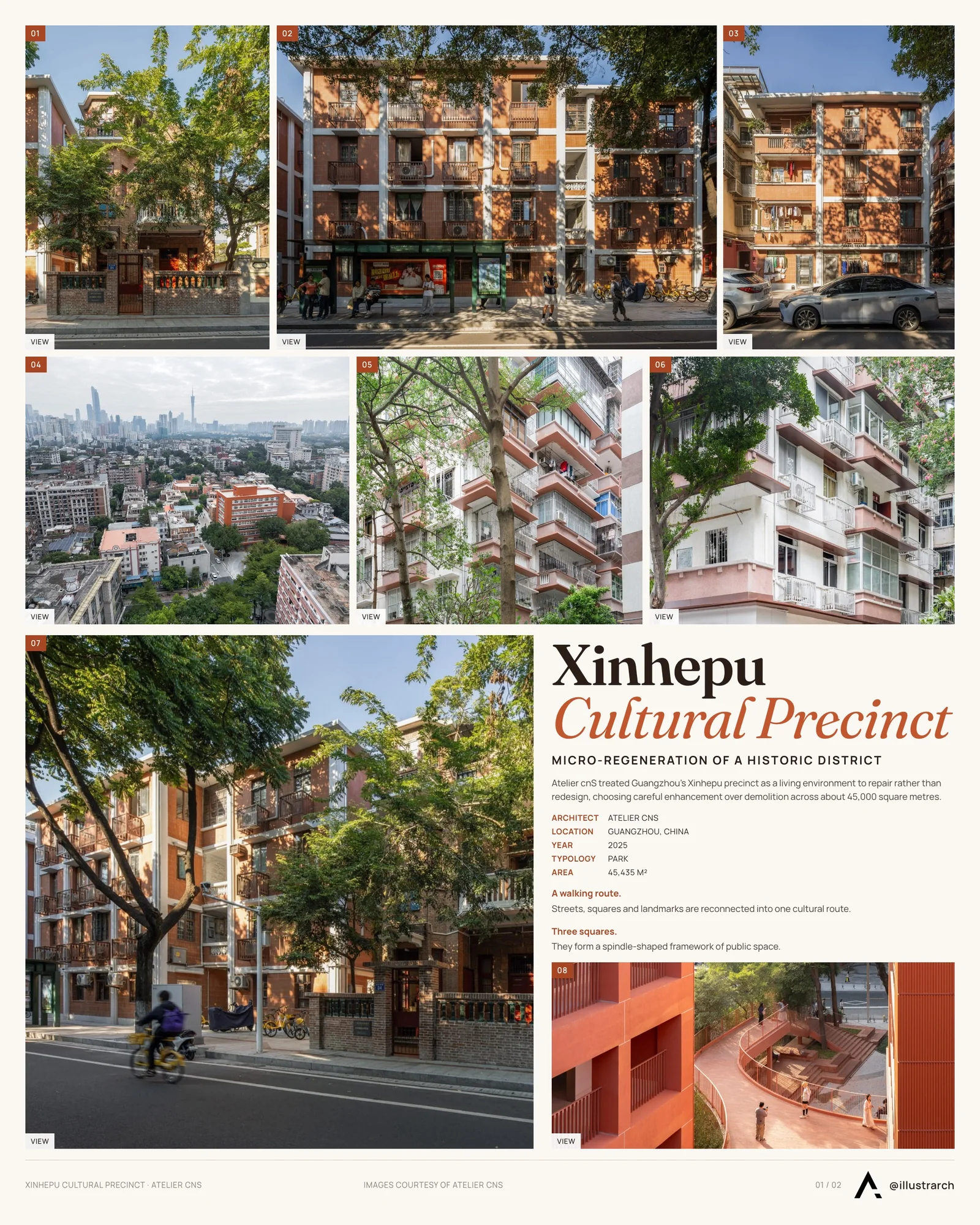
At the heart of the project lies a commitment to everyday life. The ambition is not only to protect heritage value but to improve livability, accessibility, and spatial clarity so that historical character and contemporary use can evolve together. Through meticulous design decisions, the precinct is reshaped into a place where memory, movement, and modern urban life coexist in balance.
Reconnecting the Spatial Network
The project begins at the scale of the urban fabric. Rather than treating individual buildings in isolation, the design team focuses on reconstructing relationships between streets, squares, and key cultural landmarks. Pedestrian flows along Dongshan Street, Xinhepu Road, and Xuguyuan Road are carefully reorganized to establish a coherent cultural walking route through the precinct.
This network links significant nodes such as the Memorial Hall of the Third National Congress of the CPC, the Jiandong Cluster, and the Xinhepu Northwest Corner Square with historically important buildings including Xinyuan and No. 4 Guangdongqian Street. What was previously experienced as fragmented pockets of heritage becomes a continuous spatial narrative, an immersive urban sequence that unfolds through walking.
Three major public squares are woven together into a spindle-shaped public space framework. This spatial structure reinforces both orientation and openness, transforming the district from a collection of disconnected sites into a legible and interconnected civic environment.
A Tailored Approach to Architectural Restoration
One of the project’s defining principles is “one building, one tailored solution.” Faced with a wide spectrum of architectural types, ages, and conditions, Atelier cnS avoids standardized renovation techniques in favor of a nuanced classification system.
For heritage-status buildings, restoration follows the principle of “repair the old as old.” Structural reinforcement, façade repair, revival of traditional craftsmanship, and conservation of material traces ensure that authenticity is preserved wherever possible. Rather than freezing buildings as museum objects, the interventions respect the patina of time while improving safety and usability.
For ordinary residential and commercial buildings, the approach is equally careful. Original massing and proportions are maintained, while colors, window rhythms, materials, and details are adjusted to harmonize the broader streetscape. Common issues such as leaking roofs, poor drainage, deteriorated façades, and lack of drying space are addressed through low-intervention yet effective techniques that directly improve residents’ daily comfort.
A particularly thoughtful intervention is the design of the so-called “fifth façade.” Rooftop systems integrate drying areas, rain protection, and greenery, turning overlooked surfaces into functional and visual assets that contribute to the precinct’s cohesion.
The Jiandong Cluster as a Bridge Between Eras
Within the broader regeneration, the Jiandong Cluster plays a pivotal role as an architectural mediator between old and new. The renovated Jiandong Building introduces contemporary layers through a composite terracotta, aluminum panel façade system and deep red interior finishes, subtly expanding the material language of the precinct without disrupting its identity.
A shaded corridor extends from the building’s southwest corner, linking multiple levels with the bus stop and adjacent public spaces. This gesture transforms circulation into social infrastructure, offering shelter, seating, and continuity between architecture and square.
Inside, the “Remembering the Source” atrium becomes a powerful spatial and symbolic core. Paved in terracotta brick and animated by water features, the space creates a sensory dialogue between light, sound, and preserved historical remnants. The second-floor exhibition space wraps around this void, guiding movement toward a balcony that functions as both viewpoint and rest area, reinforcing the dialogue between interior and exterior life.
Public Space as a Continuous System
Beyond individual buildings, the project understands public space as a connected ecosystem rather than isolated plazas. The Xinhepu Northwest Corner Square, Southwest Corner Square, and Jiandong Building entrance plaza are conceived as a unified landscape structure.
Subtle terrain modeling, consistent paving, integrated steps and ramps, and carefully placed seating enhance both accessibility and spatial continuity. Sponge city strategies, including rain gardens and permeable surfaces, introduce ecological performance alongside social function.
Edges are deliberately softened. Squares open toward residential areas, encouraging permeability and informal use. Urban furniture, lighting, signage, and railings are designed as multifunctional elements that guide movement, support rest, and gently define spatial boundaries without imposing rigidity.
The result is not monumental public space but habitable public space, spaces that invite everyday use rather than occasional spectacle.
Craft, Material, and Contemporary Technique
A significant dimension of the project lies in its technical and material intelligence. Traditional craftsmanship is not merely preserved but actively reintegrated into contemporary construction processes. Veteran artisans were engaged to restore brickwork, timber components, moldings, and water-washed stone finishes using historical techniques.
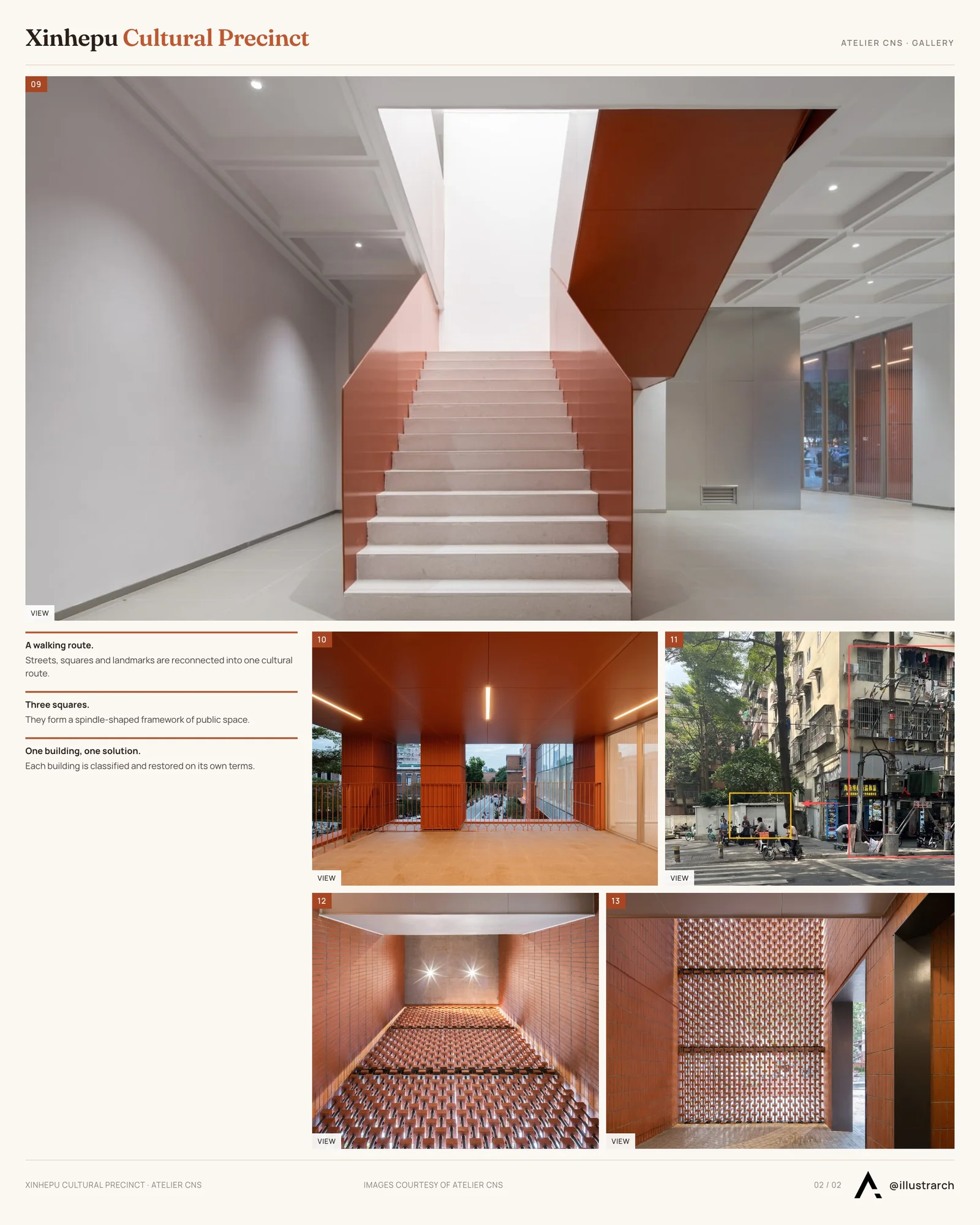
These methods are complemented by modern structural solutions such as carbon fiber reinforcement, allowing aging structures to meet contemporary performance standards without visual compromise. Innovations such as dry-hung perforated terracotta systems reinterpret traditional material culture in a contemporary architectural language, offering both aesthetic richness and technical replicability for future heritage projects.
The project also addresses infrastructure with the same level of care. Overhead wiring is rerouted underground. Visual clutter from external equipment is systematically consolidated and concealed. Smart poles integrate lighting, signage, surveillance, and technology into unified elements, simplifying the streetscape while improving functionality.
A Living District Rather Than a Preserved Artifact
What ultimately distinguishes the Xinhepu project is its refusal to treat heritage as static. Instead of producing a polished but lifeless historical stage set, Atelier cnS constructs a framework for ongoing everyday life. Memory is preserved not through nostalgia but through continued use, adaptation, and care.
The district emerges as a place where children play in renewed squares, residents dry laundry on redesigned rooftops, visitors move seamlessly between cultural landmarks, and old structures quietly support new patterns of life. It is a model of urban renewal rooted in patience, precision, and respect, demonstrating how heritage conservation can become a catalyst for contemporary civic vitality rather than an obstacle to it.


BIG Builds a Temporary City in Madrid Designed to Be Taken Apart
Bjarke Ingels Group turned a 185,000 square metre Madrid venue into Macondo...
 illustrarch Editoral Team2 Mins read
Basketball Court – Ralph C. Wilson Jr. Centennial Park by Adjaye Associates
Designed by Adjaye Associates, the basketball court at Ralph C. Wilson Jr....
Begum Gumusel4 Mins read
DC Alexander Park by Brooks + Scarpa Architects
Explore the redesign of DC Alexander Park by Brooks + Scarpa Architects,...
Begum Gumusel3 Mins read

Suan San Pocket Park by Shma Company Limited
Suan San Pocket Park in Bangkok transforms a derelict riverside site into...
Begum Gumusel3 Mins read


Leave a comment