

6 of the Best Concert Venue Architecture Marvels in the US
A tour of six standout US concert venues where architecture and acoustics work together, spanning Frank Gehry's Walt Disney Concert Hall, historic Boston Symphony Hall, and the shape-shifting Shed in New York.
 Furkan Sen30 October 20245 Mins read942
Table of Contents Show
Concert venue architecture blends acoustic science with bold structural design to shape how music sounds and feels inside a room. The best concert halls in the US, from Frank Gehry’s Walt Disney Concert Hall to New York’s movable Shed, prove that a building’s form can carry a performance as powerfully as the musicians on stage.
A great performance depends on more than talent. The room does half the work, bending sound toward the audience and setting the mood before the first note. American cities host some of the finest examples of concert venue architecture in the world, where engineers, acousticians, and designers work together so every seat hears the music clearly. Many of these buildings double as landmarks, and their history adds another layer of meaning for anyone stepping through the doors. If you follow how cultural buildings like concert halls are planned, the six venues below show the range of what the form can do.
1. Walt Disney Concert Hall, Los Angeles
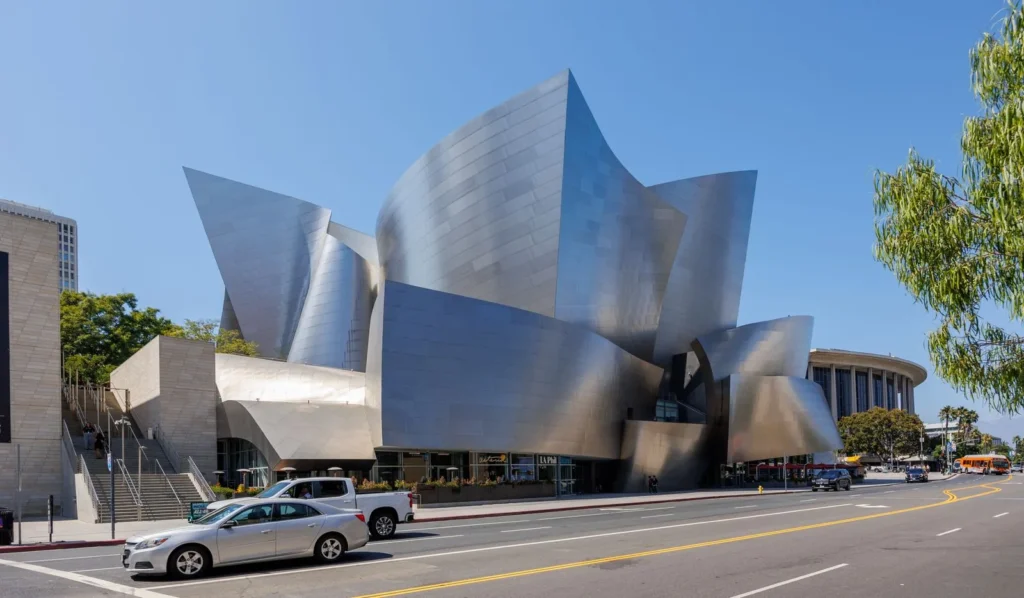
Designed by Frank Gehry and opened in 2003, the Walt Disney Concert Hall is the sculptural heart of downtown Los Angeles. Its billowing stainless steel exterior looks like sails caught mid-motion, and the curved panels catch daylight from every angle. Inside, the vineyard-style seating wraps around the stage so the audience surrounds the orchestra rather than facing it head on. Acoustician Yasuhisa Toyota tuned the Douglas fir interior until the sound reached all 2,265 seats with even clarity. The hall is home to the Los Angeles Philharmonic and stands as one of Gehry’s most studied works, documented in depth by Gehry Partners and covered across the architecture press.
💡 Pro Tip
When choosing seats in a vineyard-style hall like Disney Hall, the terraces beside and behind the stage often carry richer, more direct sound than the far rear of a traditional shoebox room. Acousticians design these tiers to reflect early sound back toward listeners, so a lower-priced side seat can beat a distant center seat for pure clarity.
2. Kauffman Center for the Performing Arts, Kansas City
Kansas City’s Kauffman Center, designed by Moshe Safdie and opened in 2011, is defined by two half-shells of steel and glass that lean back over a soaring lobby known as the Brandmeyer Great Hall. The building holds two separate rooms tuned for different purposes. Helzberg Hall is a shoebox space built for the Kansas City Symphony, while the larger Muriel Kauffman Theatre seats around 1,800 for opera and ballet. Separating the two lets each room chase its own acoustic target instead of compromising between them. Safdie’s design details are published by Safdie Architects, and the venue itself keeps a full program calendar on the Kauffman Center site.
3. Schermerhorn Symphony Center, Nashville
The Schermerhorn Symphony Center brings a neoclassical face to Nashville’s music scene. Architect David M. Schwarz completed it in 2006 for the Nashville Symphony, drawing on the proven geometry of the European shoebox hall. The Laura Turner Concert Hall seats about 1,844 and includes a rare feature for a symphony room: 30 soundproof windows that let in daylight during rehearsals, then close off for evening acoustics. The main floor seats can also retract into the basement, turning the space into a flat ballroom for events. That flexibility, described on the Nashville Symphony site, keeps the building working far beyond concert nights.
📌 Did You Know?
Boston Symphony Hall, opened in 1900, is widely credited as the first auditorium in the world designed using scientific acoustic principles. Harvard physicist Wallace Clement Sabine calculated reverberation times for the room before it was built, turning concert hall acoustics from guesswork into measurable engineering.
4. Boston Symphony Hall, Boston
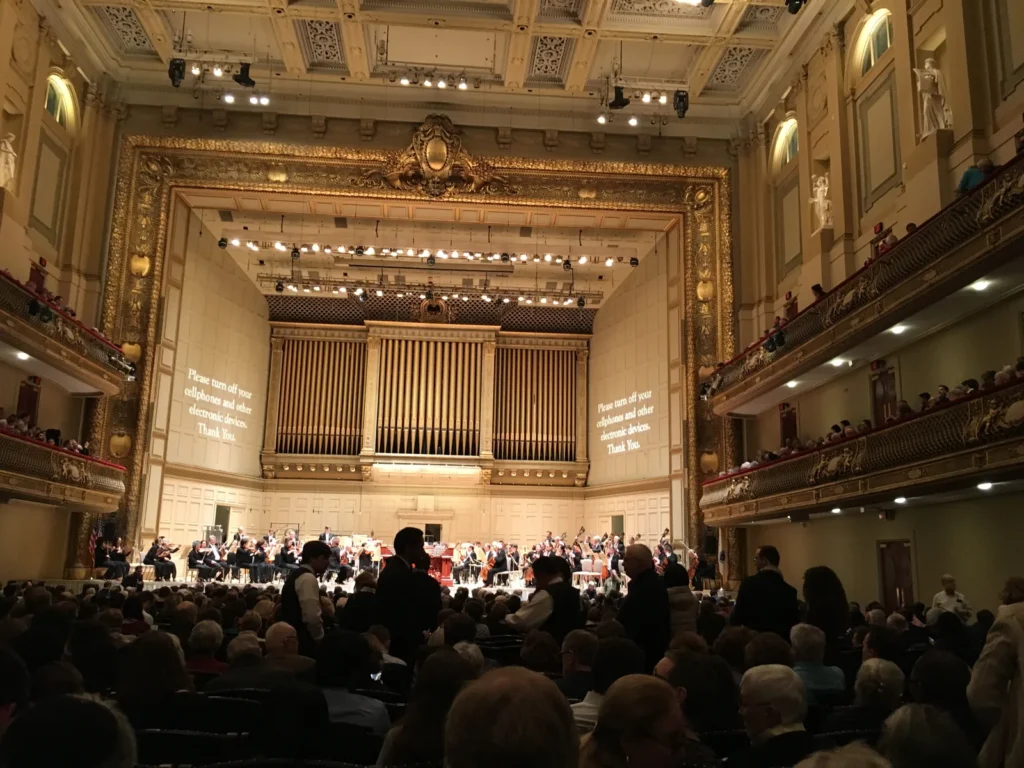
Boston Symphony Hall is the historical anchor of this list. Designed by the firm McKim, Mead & White and opened in 1900, it seats about 2,625 people and remains the home of the Boston Symphony Orchestra. Its long, narrow shoebox shape, high ceiling, and shallow side balconies were shaped by Sabine’s calculations, and the coffered ceiling with its recessed statue niches scatters sound evenly across the room. Musicians and critics still rank it among the three best-sounding concert halls anywhere. The orchestra keeps a detailed history of the room on the Boston Symphony Orchestra site, a reminder that older concert venue architecture can still outperform newer designs.
5. Hollywood Bowl, Los Angeles
Not every great venue sits indoors. The Hollywood Bowl is a natural amphitheater carved into the Hollywood Hills, and its concentric-arch band shell has become one of the most recognized silhouettes in American music. The original 1929 shell was designed by Lloyd Wright, son of Frank Lloyd Wright, and the current acoustic shell was rebuilt in 2004 to sharpen the sound for a crowd of roughly 17,500. As the summer home of the Los Angeles Philharmonic, the Bowl shows how open-air design can hold a symphony and a rock concert on back-to-back nights. Schedules and seating maps live on the Hollywood Bowl site.
🔢 Quick Numbers
- Walt Disney Concert Hall seats 2,265 for orchestral performances (Los Angeles Philharmonic, laphil.com).
- Boston Symphony Hall seats about 2,625 and opened in 1900 (Boston Symphony Orchestra, bso.org).
- The Hollywood Bowl holds roughly 17,500 people as an open-air amphitheater (Hollywood Bowl, hollywoodbowl.com).
6. The Shed, New York City
The Shed, opened in 2019 at Hudson Yards, is the boldest structural idea on this list. Designed by Diller Scofidio + Renfro with Rockwell Group, its outer shell is a telescoping steel frame clad in translucent ETFE cushions. The shell rolls on rails out over an adjoining plaza, doubling the usable space in minutes and turning the building into whatever the event needs. One night it hosts a chamber ensemble, the next a large-scale installation or pop concert. This movable approach to concert venue architecture treats the building itself as a machine for performance. The engineering story is documented by Diller Scofidio + Renfro, with programming on the official Shed site.

🏗️ Real-World Example
The Shed (New York City, 2019): Its 4,000-ton movable shell glides on wheels borrowed from gantry-crane technology, expanding the venue into the 17,000-square-foot McCourt hall for large concerts. When retracted, the same structure frees the plaza for open-air events, making a single footprint work for wildly different shows.
How These Venues Compare
The six buildings span more than a century of design thinking, from a 1900 shoebox to a 2019 shape-shifting shell. The table below lines up each venue with its city and the architect or signature feature that sets it apart.
| Venue | City | Architect / Signature Feature |
|---|---|---|
| Walt Disney Concert Hall | Los Angeles | Frank Gehry / stainless steel sails, vineyard seating |
| Kauffman Center | Kansas City | Moshe Safdie / twin half-shells, two tuned halls |
| Schermerhorn Symphony Center | Nashville | David M. Schwarz / daylight windows, convertible floor |
| Boston Symphony Hall | Boston | McKim, Mead & White / first scientifically tuned hall |
| Hollywood Bowl | Los Angeles | Lloyd Wright (original shell) / open-air arches |
| The Shed | New York City | Diller Scofidio + Renfro / telescoping movable shell |
Looked at together, these venues trace two parallel goals. Some, like Boston Symphony Hall and Schermerhorn, refine a classic room until the acoustics are close to perfect. Others, like Disney Hall and The Shed, rethink what a music building can look like and how it can move. For a sense of where the form is heading next, the wave of new timber concert halls shows designers chasing warmth and sustainability at the same time.
The Bigger Picture
The most memorable concert venue architecture disappears the moment the music starts. You stop noticing the steel, the timber, or the glass, and you simply hear the sound the way the designers intended. That is the quiet ambition behind every hall on this list, whether it opened in 1900 or rolled into place in 2019. The next time a room makes a familiar piece feel new, look up. The building is part of the performance, and the best ones earn their applause long before the encore.


3 Comments




Interior Design for Commercial Spaces: Enhancing Functionality and Brand Identity
Commercial interior design has to serve brand, function and regulation at once....
 Begum Gumusel4 Mins read

Famous Buildings in Los Angeles: Icons of LA Architecture
Nine of the most famous buildings in Los Angeles profiled: architect, year,...
 illustrarch Editoral Team9 Mins read
Futuro House Production Revived in Finland After Decades-Long Hiatus
A Facebook listing for abandoned moulds led to the first new Futuro...
illustrarch Editoral Team3 Mins read
Building Your Dream Home in NSW: What You Should Know About Montgomery Homes
Montgomery Homes has been building across Sydney, Newcastle, the Hunter, Wollongong and...
illustrarch Editoral Team4 Mins read


The venues mentioned seem interesting, especially the Red Rocks Amphitheatre.
I didn’t know about Tanglewood Music Center. It sounds like a nice place for concerts.
Carnegie Hall has a lot of history. It’s cool to see how these places combine music and architecture.