

Steinway Tower: Thinnest Skyscraper
Steinway Tower at 111 West 57th Street in Midtown Manhattan stands as the world's thinnest skyscraper, with a height-to-width ratio of 24:1. Designed by SHoP Architects and completed in 2022, this 84-story supertall combines a restored 1925 Steinway Hall landmark with 59 ultra-luxury residences priced from $7.75 million.
 Furkan Sen16 March 202611 Mins read537

Table of Contents Show
Steinway Tower, located at 111 West 57th Street in Midtown Manhattan, holds the title of the world’s thinnest skyscraper with a height-to-width ratio of approximately 24:1. Designed by SHoP Architects and completed in 2022, this 84-story supertall rises 1,428 feet above street level, making it the fourth-tallest building in the United States. The tower integrates the landmarked 1925 Steinway Hall at its base, combining historic preservation with cutting-edge structural engineering.
What Is Steinway Tower and Why Is It Famous?
Steinway Tower is a supertall residential skyscraper developed by JDS Development Group and Property Markets Group, sitting on what New York media have dubbed Billionaires’ Row — the stretch of 57th Street near Central Park where a cluster of ultra-luxury towers has reshaped the Manhattan skyline over the past decade. The building’s fame rests on a single extraordinary statistic: at just 60 feet (18 meters) wide, it stands 24 times taller than it is broad. For scale, that width is barely shorter than a regulation pitcher’s mound-to-home-plate distance in baseball.
Before the tower existed in its current form, the site was anchored by Steinway Hall, a 16-story Beaux-Arts building completed in 1925 and designed by the celebrated firm Warren and Wetmore, the same architects behind Grand Central Terminal. Steinway Hall served as the flagship showroom, recital space, and offices for the Steinway and Sons piano company for nearly nine decades. In 2013, developers JDS and Property Markets Group acquired the hall and its air rights for $217.5 million, setting the stage for one of the most technically ambitious residential projects in American architectural history.
📌 Did You Know?
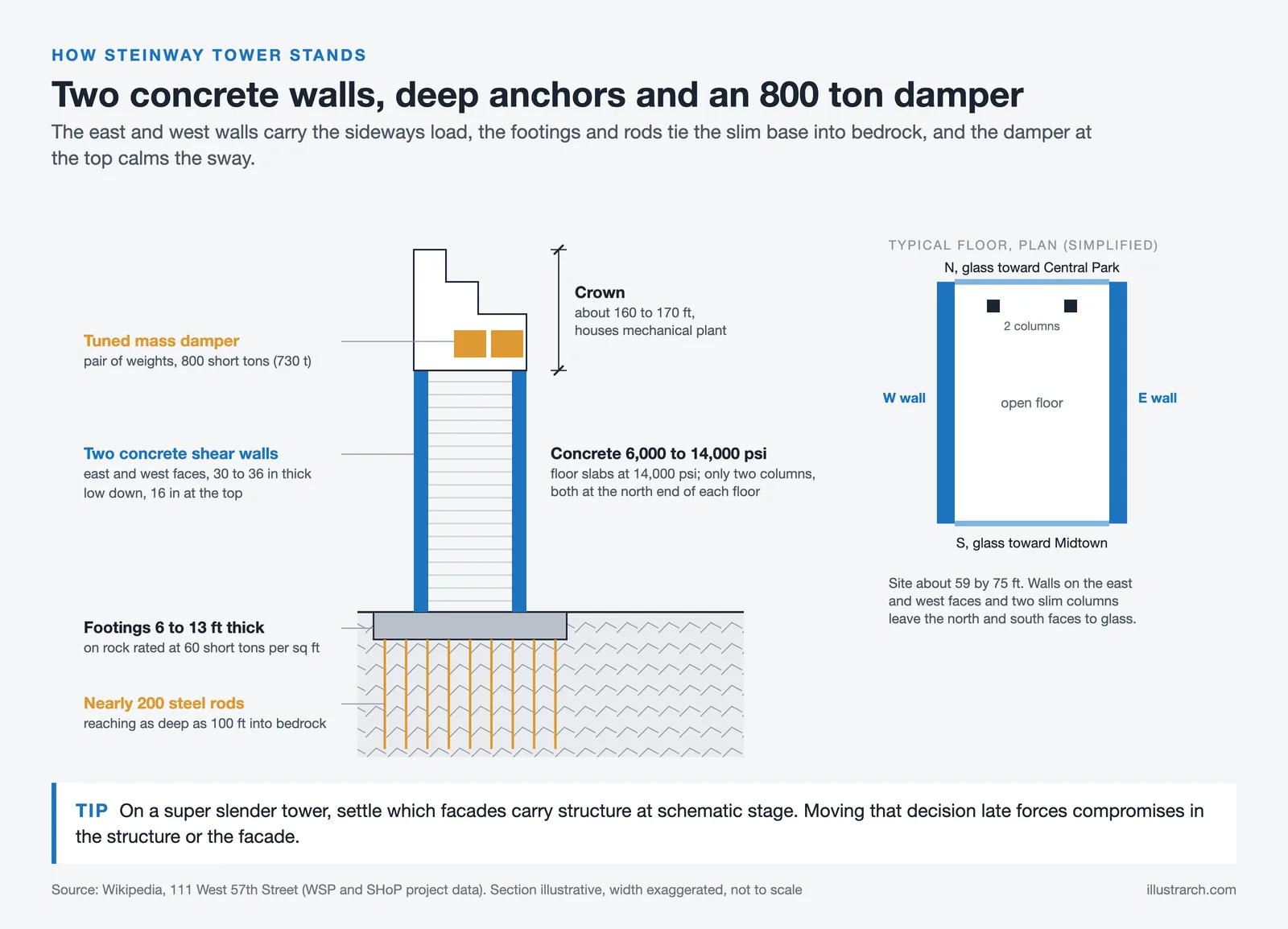
The construction of Steinway Tower required approximately 49,000 cubic yards of concrete and nearly 200 steel rods driven as far as 100 feet into bedrock to anchor the structure against lateral wind forces. The foundations alone had to support loads of up to 60 short tons per square foot — an extraordinary engineering requirement driven directly by the tower’s extreme slenderness.
Steinway Tower Height, Dimensions, and Key Facts

The steinway tower height of 1,428 feet (435 meters) positions it among the most prominent structures on the New York skyline. As of 2022, it ranks as the second-tallest residential building in the Western Hemisphere, surpassed only by Central Park Tower at 1,550 feet. The building contains 84 floors total, with the first five dedicated to amenity and retail spaces and the upper floors divided between 45 full-floor tower residences and 14 apartments within the restored Steinway Hall base, for a total of 59 units.
The footprint of the tower itself measures roughly 59 by 75 feet, a constraint that shaped every design decision SHoP Architects made. With so little floor area to work with at each level, structural walls had to do double duty: the east and west facade panels serve as the building’s primary shear walls, providing lateral stiffness while leaving the north and south elevations entirely open for glass. That arrangement gives every apartment unobstructed views of Central Park to the north and the Midtown and downtown Manhattan skyline to the south.
🔢 Quick Numbers
- 1,428 feet (435 m) — total architectural height (CTBUH / Skyscraper Center, 2022)
- 24:1 — height-to-width slenderness ratio, world record for a completed skyscraper (Council on Tall Buildings and Urban Habitat, 2022)
- $2 billion — estimated total construction cost (HowStuffWorks / multiple trade sources, 2022)
- 59 — total residential units across tower and Steinway Hall base
Steinway Tower Architecture Design: SHoP Architects and the Terracotta Facade
SHoP Architects, selected over firms including Gehry and HOK, approached the building with a clear design philosophy: to create a tower that felt genuinely rooted in the history of the Manhattan skyscraper rather than departing from it. Dana Getman, principal at SHoP, described the goal as producing something “immediately recognizable as a part of the city” despite its unprecedented dimensions.
The facade does much of the narrative work. Terracotta and bronze cover the east and west faces of the tower in a system of extruded, glazed blocks stacked into undulating pilasters. The staggered arrangement creates a subtle moiré pattern as light changes throughout the day. Between the terracotta bands, vertical strips of bronze-trimmed glass run the full height. This palette deliberately references New York’s pre-war architectural heritage, including the Art Deco tradition of the Empire State Building, the Chrysler Building, and the RCA Building, all of which used terracotta extensively. At the same time, the technical execution was entirely contemporary: BuroHappold Engineering served as the facade consultant, designing a system that could flex with the building’s structural movement without cracking.
🎓 Expert Insight
“Of all the new towers, it is the only one that gets even more delicate as it rises, ending not with a climactic crown but by almost disappearing into the sky.” — Paul Goldberger, Architectural Critic, New York Magazine
Goldberger’s observation captures what makes the design strategy unusual among Billionaires’ Row towers. Rather than capping the building with a dramatic statement crown, SHoP allowed the tower to taper and dematerialize upward, a consequence of multiplied zoning setbacks that creates the impression of the building dissolving into the sky.
The tower’s crown, rising approximately 160 to 170 feet above the uppermost occupied floor, was inspired in part by the tiered crown of the Chrysler Building. It houses mechanical equipment and is reinforced by steel beams, though its primary function is visual: to give the needle a finished silhouette that reads legibly from ground level, from Central Park, and from the wider Manhattan skyline. At the very top, an 800-ton tuned mass damper sits concealed within the structure, counteracting lateral sway caused by wind loads.
The evolution of skyscraper architecture has always involved negotiating between height ambition and structural constraint. At 111 West 57th Street, that negotiation produced one of the most formally distinctive results in the history of the type.
How Does Steinway Tower Stand Without Falling Over?

The structural logic of Steinway Tower begins underground. Nearly 200 steel rods descend as deep as 100 feet into the Manhattan bedrock, which can support loads of up to 60 short tons per square foot. The building’s footings range from 6 to 13 feet thick, an unusually substantial foundation for a residential tower. WSP served as the structural and mechanical engineer of record, working alongside SHoP to resolve the fundamental tension between the building’s extreme slenderness and the need for occupant comfort.
Above grade, the structural system relies on two concrete shear walls running the full height of the east and west facades. This arrangement stiffens the building in its narrower dimension without requiring interior columns, which would have blocked the panoramic views that justify the tower’s pricing. The concrete used in the superstructure varies in compressive strength from 6,000 to 14,000 pounds per square inch depending on the floor, with the strongest concrete concentrated in the lower portions where loads are greatest.
📐 Technical Note
The tuned mass damper at Steinway Tower’s crown consists of a pair of weights totaling approximately 800 short tons (730 metric tons), tuned via steel plates to counteract the building’s natural sway frequency. At a height-to-width ratio of 24:1, the upper floors can sway several feet during high winds — the damper reduces peak acceleration to levels that remain within recognized comfort thresholds for residential occupancy. For reference, the CTBUH standard for residential tower sway comfort is typically set at peak accelerations below 10 to 15 milli-g (thousandths of standard gravity) over a 10-year return period wind event.
The wind engineering aspect of the project involved detailed analysis by RWDI, who modeled wind behavior around the tower’s tapered form. The setbacks on the southern face, which give the building its asymmetrical profile, were not purely aesthetic choices. They help disrupt organized vortex shedding — a phenomenon where wind flowing around a slender structure creates periodic pressure pulses that can amplify sway if left unchecked. By breaking the building’s silhouette with staggered setbacks, the design reduces the coherence of those vortices and lowers peak lateral loads.
💡 Pro Tip
When designing super-slender towers, the structural-architectural coordination has to happen at the very earliest schematic stage. At 111 West 57th Street, WSP’s decision to use the east and west facade panels as shear walls was made before the facade design was finalized. Leaving that integration too late forces compromises in either structure or aesthetics that are extremely difficult to resolve once documentation begins.
Steinway Tower Apartments: Prices, Layouts, and Amenities

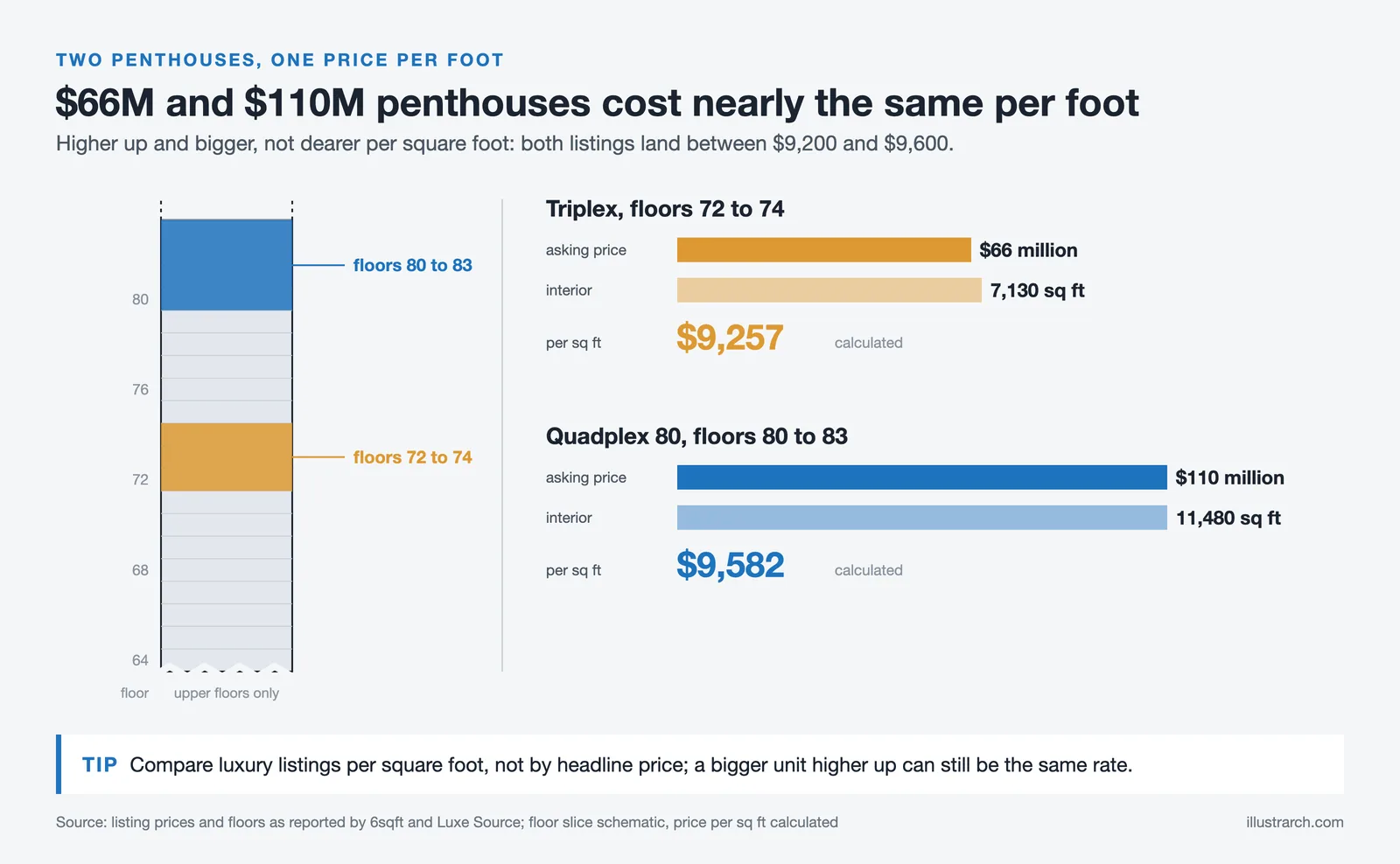
Steinway tower apartments price ranges reflect the building’s position at the top of the ultra-luxury market. Entry-level residences in the Steinway Hall base, which contain 14 units with more traditional prewar layouts, began at approximately $7.75 million for a studio configuration. Tower residences — each occupying a full floor or duplex — start at similar price points and rise sharply with elevation. A triplex penthouse on floors 72 through 74, spanning 7,130 square feet with 360-degree views roughly 979 feet above the ground, was listed at $66 million. The quadplex penthouse, measuring 11,480 square feet, was listed at $110 million, making it one of the most expensive publicly listed residential properties in New York City at the time of its listing.
Tower apartments feature ceiling heights up to 14 feet, floor-to-ceiling glass on the north and south faces, and custom interiors by Studio Sofield. Kitchens use Gaggenau appliances with bespoke cabinetry, and bathrooms are finished in hand-selected marble. Amenities for all residents include a private porte-cochère entrance on 58th Street, 24-hour staff and concierge, an 82-foot lap pool, sauna, steam rooms, a double-height fitness center, a golf simulator, a padel court, and Club 111, which offers daily complimentary breakfast catered by Le Bilboquet.
Note: Apartment prices listed reflect sale and listing prices reported at the time of completion in 2022 and subsequent years. Current availability and pricing should be verified directly with the building’s sales team or a licensed real estate broker.
Steinway Hall: The Historic Base of Steinway Tower New York

The relationship between the tower and Steinway Hall is one of the more architecturally complex aspects of the project. Steinway Hall was designated a New York City landmark in 2001, which meant any development on the site required approval from the Landmarks Preservation Commission. Rather than building directly alongside the hall, SHoP and JDS negotiated a more delicate arrangement: the tower was positioned within the hall’s rear light court, threading upward through the historic structure’s footprint with the hall’s facade and rotunda fully preserved. The result is a building that is technically an addition to Steinway Hall rather than a separate structure, a legal framing that enabled the transfer of air rights while respecting the landmark’s integrity.
Interior restoration of Steinway Hall was handled through time-honored craft techniques. The copper roof and lantern were replaced, limestone was cleaned, brickwork was repointed, and decorative elements on the 57th Street facade were regilded. Studio Sofield designed the new amenity and lobby spaces within the hall, drawing on the original Warren and Wetmore interiors for formal cues while introducing contemporary materials. Local New York artists contributed custom works for the lobby sequence, reinforcing the building’s positioning as a continuation of the city’s cultural history rather than a departure from it.
For anyone interested in the tallest skyscrapers in New York City, understanding Steinway Hall’s role at the base of 111 West 57th Street is essential context. Without the air rights transfer from the hall, the tower could not have reached its current height within the Midtown Manhattan zoning envelope.
🏗️ Real-World Example
432 Park Avenue (New York, 2015): Before Steinway Tower was completed, 432 Park Avenue held the title of the most slender supertall in New York, rising 1,396 feet with a slenderness ratio of approximately 15:1. Designed by Rafael Viñoly for developer Harry Macklowe, it established the commercial viability of the super-slender residential typology on Billionaires’ Row. Steinway Tower extended that precedent significantly, adding nine ratio points of slenderness while also integrating a preserved historic structure at the base — a challenge 432 Park Avenue did not have to navigate.
Skinny Skyscrapers: Steinway Tower and the Super-Slender Typology

Skinny skyscrapers — sometimes called pencil towers or needle towers — have existed for decades in markets like Hong Kong, where small footprints are an economic necessity on premium land. What changed in New York during the 2010s was the combination of engineering capability, extreme land values, and demand from globally mobile ultra-high-net-worth buyers who prioritized panoramic views above almost any other residential amenity. That confluence made super-slender towers commercially viable at price points that had previously seemed impossible.
Supertall skyscrapers NYC now includes a cluster of pencil towers along Billionaires’ Row: 432 Park Avenue, One57, Central Park Tower, 220 Central Park South, and 111 West 57th Street. Each pushed the slenderness ratio slightly further than its predecessor. At 24:1, Steinway Tower represents the current outer limit of what has been built, though proposals elsewhere in the world continue to test that boundary. The engineering literature on tuned mass dampers, high-strength concrete, and wind tunnel optimization has grown substantially as a direct result of these projects, and the lessons learned on Steinway Tower have informed supertall residential design globally.
⚠️ Common Mistake to Avoid
Many architecture enthusiasts confuse Steinway Tower’s title as the “world’s thinnest skyscraper” with being the world’s tallest. Steinway Tower is not the tallest skyscraper in the world — the Burj Khalifa in Dubai holds that record at 828 meters, while even within New York, One World Trade Center and Central Park Tower surpass it in height. What Steinway Tower holds is the record for slenderness ratio: the relationship between height and width. That distinction matters because it represents a structural and spatial achievement, not simply a construction ambition.
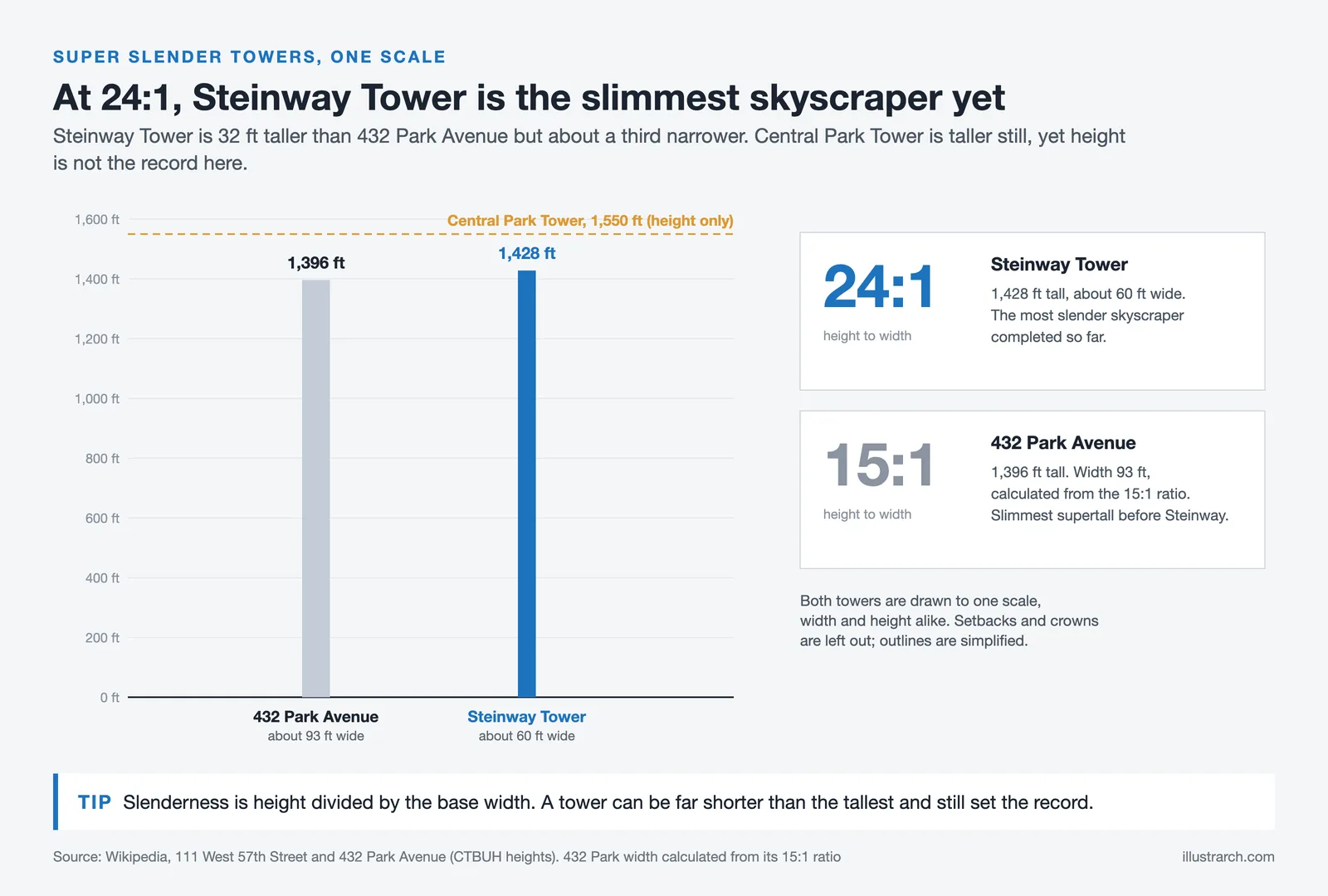
Looking at the world’s most iconic supertall towers as a group, Steinway Tower stands out not because of raw height but because of the specific engineering problem it solved. Every supertall requires managing wind loads and occupant comfort. At a 24:1 ratio, those problems are orders of magnitude harder than at the 7:1 or 8:1 ratios that characterized the previous generation of tall residential buildings. The solutions developed for this project — high-strength variable-density concrete, facade-as-structure, and the 800-ton tuned mass damper — represent genuine contributions to structural engineering knowledge.
💡 Pro Tip
For architects studying super-slender tower design, the relationship between setback geometry and wind behavior at Steinway Tower is one of the most instructive case studies available. The asymmetric setbacks on the southern face were shaped in close collaboration with wind tunnel consultants RWDI — treating the building’s form not as a sculptural decision but as an aerodynamic one. Reviewing the RWDI and WSP published notes on this project gives a clearer picture of how wind engineering and architecture co-determine form at extreme slenderness ratios.
Steinway Tower NYC: Location, Context, and Criticism
The building sits on the north side of West 57th Street near Sixth Avenue in Midtown Manhattan. Its position is precisely aligned with the central axis of Central Park, which means north-facing apartments have a symmetrical view of the park stretching from the southern reservoir toward Harlem. The 58th Street elevation provides a private porte-cochère entrance, keeping arrivals shielded from street-level visibility.
The project was not without controversy. Community groups protested as early as 2015 that Steinway Tower and its Billionaires’ Row neighbors would cast long shadows across Central Park during winter months. Those concerns were never successfully translated into regulatory restrictions because New York City’s zoning laws at the time did not include shadow impact as a reviewable criterion for as-of-right development. Financial Times critic Edwin Heathcote called the building a “skinnyscraper” and described it as the “purest illustration of architecture as an expression of surplus capital,” arguing that its residential exclusivity represented an inversion of the democratic social function that earlier New York skyscrapers were meant to serve.
Commercially, the project had a complicated trajectory. Construction was delayed repeatedly by lawsuits between investors, a crane collapse during the COVID-19 pandemic, and a 16-month pause on buyer tours due to public health restrictions. By August 2023, a mezzanine lender wrote off part of its loan on the project. Yet the building also recorded several major sales during that period, including a penthouse that went into contract at $50 million in late 2020 and a quadplex listed at $110 million, demonstrating that demand for the building’s specific product — floor-to-ceiling views from a 1,000-plus-foot elevation above Central Park — remained intact even through a disrupted market.
If you want to explore how these towers fit into the broader story of New York’s vertical ambition, the article on skyscrapers and urban identity provides useful context for understanding why cities build at such extremes. For a broader look at the supertall category globally, the tallest buildings in the world offers comparative data that puts Steinway Tower’s height in perspective.
✅ Key Takeaways
- Steinway Tower at 111 West 57th Street holds the world record for slenderness with a 24:1 height-to-width ratio, not for overall height.
- The building’s structural system uses the east and west terracotta facades as shear walls, enabling column-free interiors with panoramic views throughout.
- An 800-ton tuned mass damper at the crown counteracts sway caused by high winds, keeping acceleration within residential comfort standards.
- The project preserves the 1925 landmarked Steinway Hall at its base, using the hall’s air rights transfer to achieve its record height within Midtown zoning regulations.
- Apartment prices range from approximately $7.75 million for entry-level units to $110 million for the quadplex penthouse, reflecting its Billionaires’ Row positioning.
Further Reading and Official Resources
For primary design documentation, the SHoP Architects project page for 111 West 57th Street provides the firm’s own account of design intent and material strategy. The official building site at 111w57.com documents amenities and residences as marketed. For structural engineering context, WSP’s project profile offers technical detail on wind behavior, shear wall design, and the tuned mass damper. The CTBUH Skyscraper Center entry provides independently verified height and floor data. For historical context on Steinway Hall and the development timeline, the Wikipedia article on 111 West 57th Street is the most comprehensive publicly available secondary source.





Futuro House Production Revived in Finland After Decades-Long Hiatus
A Facebook listing for abandoned moulds led to the first new Futuro...
 illustrarch Editoral Team3 Mins read

Building Your Dream Home in NSW: What You Should Know About Montgomery Homes
Montgomery Homes has been building across Sydney, Newcastle, the Hunter, Wollongong and...
illustrarch Editoral Team4 Mins read

Designing a Home Theater: Where Drapery Fits Into the Plan
In a media room the curtains are a performance layer, not decoration....
illustrarch Editoral Team3 Mins read

Oscar Niemeyer’s Cathedral of Brasília: The Hyperboloid Concrete Hymn
The Cathedral of Brasília reads as a single gesture, yet it stood...
Furkan Sen7 Mins read


Leave a comment