

How to Get Architecture Clients: Competition vs Direct Commission for Young Firms
Repeat business and referrals account for most architectural commissions, and a new studio has neither. This breakdown sets open competitions against direct commissions as client channels, with a runway rule for choosing between them.
 Furkan Sen14 August 20266 Mins read223

Table of Contents Show
How to get architecture clients as a new practice comes down to two routes. Open competitions cost unpaid design hours and pay almost nobody. Direct commissions pay from the first invoice but ask for a track record you have not built yet. Most young studios need both, in a ratio set by their cash runway.
Two studios open in the same month. One spends its first year on open calls and ends up with a portfolio, one publication and no invoices. The other takes shop fit-outs and rear extensions, banks the fees, and has nothing anyone would photograph. Neither founder made a mistake. They simply solved for different shortages, and the good ones knew which shortage they had.
Before choosing between an entry deadline and a week of client outreach, it helps to see where paid architectural work actually originates. The answer is less romantic than the profession likes to admit, and it is the reason the competition versus direct commission decision looks so different at year one than it does at year ten.
Where Do Architecture Clients Actually Come From?

They come from people who have already worked with you, or from people who trust someone who has. Practices surveyed for RIBA Business Benchmarking 2023 reported that repeat business accounts for 38% of new commissions, with client referrals and word of mouth at 24%, while advertising and web presence together deliver 10%. The RIBA Journal published the breakdown in April 2024.
Read that from the position of a two-year-old studio and the problem becomes concrete. The 38% is closed to you, because you have no past clients to return. You are competing inside the remaining slice, against practices that also have referral networks. This is why architecture business development for a young firm is not a marketing exercise. It is the work of manufacturing a referral network before you have earned one.
🔢 Quick Numbers
- Repeat business generates 38% of new commissions, referrals and word of mouth 24%, advertising and web presence 10% (RIBA Business Benchmarking 2023, reported by RIBA Journal, April 2024)
- 70% of architecture practices now hold three months or less of secured work, up from 48% a year earlier, and more than a third hold less than one month (Total Synergy, 2026 Architecture Industry Benchmark Report)
- At US firms billing under $250,000 a year, average backlog fell from 4.9 months to 3.1 months during the second quarter of 2026 (AIA/Deltek Architecture Billings Index, July 2026)
The market conditions behind those figures matter for the decision. The AIA reported an Architecture Billings Index score of 47.3 for June 2026, extending a run of 41 months without a majority of firms reporting billings growth, and the sharpest backlog drop hit the smallest practices. Total Synergy’s 2026 survey found 60% of firms naming fee pressure as their biggest obstacle to winning work. A quarter of unpaid entry drawings lands differently in that climate than it did in 2021.
Competition vs Direct Commission: What Each Route Buys a Young Firm

Both routes end in a project, so studios treat them as alternatives. They are not. They pay out in different currencies, on different schedules, to different audiences. Setting them side by side as client channels rather than as design opportunities makes the trade visible.
Competition and Commission Compared as Client Channels
| Factor | Open Competition | Direct Commission |
|---|---|---|
| Way in | Registration fee, entries usually anonymous | Referral, reputation or prequalification |
| Real cost | Studio hours nobody invoices | Relationship time before the brief exists |
| Time to first payment | Months, and only if you place | Weeks, staged by work phase |
| Who sees your name | Juries, editors, other architects | The client and everyone they talk to |
| What you keep | Images, a line on the profile, design freedom | Fee income, a reference, a possible repeat client |
| Risk of nothing being built | High, funding often follows the jury | Low, the client committed before hiring you |
| Best used when | You have runway and a portfolio gap | You have payroll and no time to gamble |
The row that decides most cases is who sees your name. A competition shortlist circulates among people who do not commission buildings. A completed extension circulates among the neighbours who might. Hundreds of open calls launch every year, and the ones worth a month of studio capacity name their client and their post-jury contract in the brief. The rest are portfolio exercises with a fee attached, which is fine as long as you know that is what you bought. Our breakdown of the platforms that host these competitions is a useful filter before you register.
How to Get Architecture Clients Without a Track Record
You borrow other people’s track records, and you shrink the scope until proof is not the deciding factor. Four moves do most of the work, and none of them require a built portfolio.
Start by selling the smallest paid version of your service. Feasibility appraisals, planning strategy reviews, measured surveys and permit sets are decisions a client will hand to an unknown studio because the exposure is small. They also generate the thing you actually lack: a satisfied client with a reason to call again.
Second, get in front of the people who learn about a project before the client starts searching. Contractors, structural engineers, planning consultants and commercial agents hear about a scheme months ahead of any architect. Five real relationships in that group outperform a year of posting finished renders.
Third, publish reasoning rather than images. Clients cannot judge a facade, but they can judge whether you understood a constraint. This is the mechanism behind firms that attract work without chasing leads, and it compounds when the same thinking is structured for search, as our guide to SEO for architecture firms sets out. The wider framework sits in our overview of marketing for architects.
Fourth, solve prequalification with a partner. Public frameworks ask for turnover, insurance levels and comparable completed projects. A collaboration agreement with an established practice, where you deliver a defined package under their qualification, converts a closed door into named experience you can cite next time.
⚠️ Common Mistake to Avoid
Treating a competition entry as marketing spend. Open entries are typically anonymous, losing schemes are rarely published under the practice name, and the people reading the results are other architects rather than the developers, institutions and homeowners who sign contracts. Count competitions as portfolio investment, not client acquisition, and budget them from a separate line. When the goal is genuinely a paying client this quarter, the same hours spent on referral relationships and published thinking reach the people with a budget.
Which Route Fits Your Firm This Quarter?
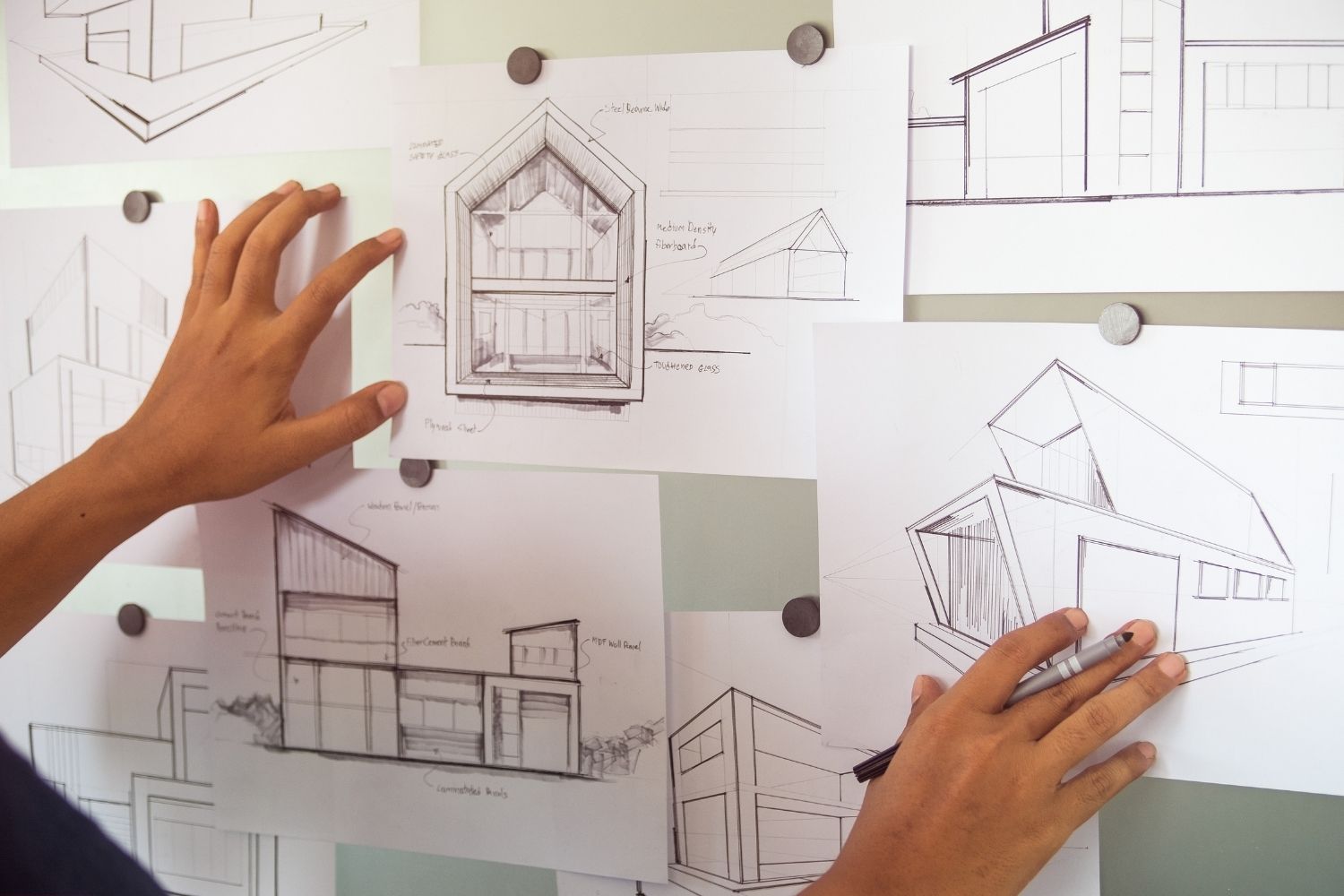
Stop asking which route is better in principle. Count the weeks of fee income already under contract, then apply a rule.
- Under eight weeks secured: no unpaid entries at all. Every spare hour goes to business development, small paid scopes and follow-up calls.
- Eight weeks to three months: one entry per quarter, capped at a fixed hour budget agreed before anyone opens the site plan.
- Beyond three months: entries become a legitimate portfolio strategy, chosen for the building type you cannot otherwise show.
Apply a second filter to any brief that passes the first. Does it name the client? Does it publish an honorarium for shortlisted teams? Does it promise a design contract rather than a prize and an exhibition? Is the building type one your portfolio genuinely lacks? Most open calls fail at least two of those questions.
Scale matters here too. The AIA 2024 Firm Survey Report counted more than 19,000 architecture firms in the United States, around three quarters of them with fewer than ten employees. Almost everyone reading this is deciding how to spend a handful of people for a handful of weeks, which is exactly why the arithmetic beats the philosophy. If the legal and financial groundwork is still in progress, our guide to setting up an architecture practice covers what belongs in place before either route pays off.
Wrapping Up
Your Next Step: Open your accounts and count the weeks of fee income already under contract. If the number is under eight, close the competition tab and spend this week on the five contractors, engineers and consultants nearest your last project. If it is over twelve, pick one open call whose brief names both the client and the commission that follows, and fix its hour budget before you start drawing.
Fee levels, entry costs and market conditions vary by country, project type and year. The figures here describe survey averages rather than what any individual practice should expect.
Frequently Asked Questions
How long does it take a new architecture firm to win its first client?
Most practices land a first paid appointment within three to six months, and it usually arrives through a personal contact rather than a public channel. The first commission is also typically small: an appraisal, an extension or a fit-out. Founders who plan for a small first job get paid sooner than those holding out for a signature project.
Are architecture competitions worth entering for a small practice?
They are worth it when the brief names a committed client, publishes an honorarium for shortlisted teams and promises a design contract to the winner. They are rarely worth it as a way to find clients, because the audience reading competition results is mostly other architects. Treat an entry as a portfolio purchase priced in unpaid hours.
How much should a young firm spend on business development?
Industry benchmarking commonly places marketing and business development at roughly 5% to 6% of net service revenue for established practices. A new studio without revenue to allocate should budget in hours instead, protecting a fixed block each week for outreach, follow-up and published work rather than fitting it around project deadlines.
Can you win a direct commission without any built work?
Yes, and it happens more often than the profession suggests. Clients buying small scopes are assessing communication, process and risk rather than a back catalogue. Detailed process descriptions, a clear fee proposal and references from consultants who have worked with you can substitute for completed buildings on projects of that size.








Can You Become a Licensed Architect Through Experience Only?
Twenty-one US jurisdictions let candidates qualify for licensure with documented experience instead...
 Sinan Ozen5 Mins read

InDesign Alternatives for Architects: 6 Tools That Handle Portfolios and Boards
Adobe InDesign is still the default layout tool in architecture, but the...
Furkan Sen7 Mins read
What It’s Like Working as an Architect: 5 Things Architecture School Doesn’t Teach You
Architecture school teaches design. Practice runs on construction documents, fee phases, consultant...
Furkan Sen7 Mins read
Architecture Competitions for Students: Are They Worth Your Time?
A practical look at whether architecture competitions are worth a student's time,...
Sinan Ozen6 Mins read


Leave a comment