

St Paul’s Cathedral: Christopher Wren’s Baroque Triumph in London
A focused look at St Paul's Cathedral in London, covering Christopher Wren's design evolution, the triple-dome engineering solution, English Baroque architectural features, and the cathedral's lasting role in London's skyline and cultural identity since its completion in 1710.
 Furkan Sen21 June 20266 Mins read217
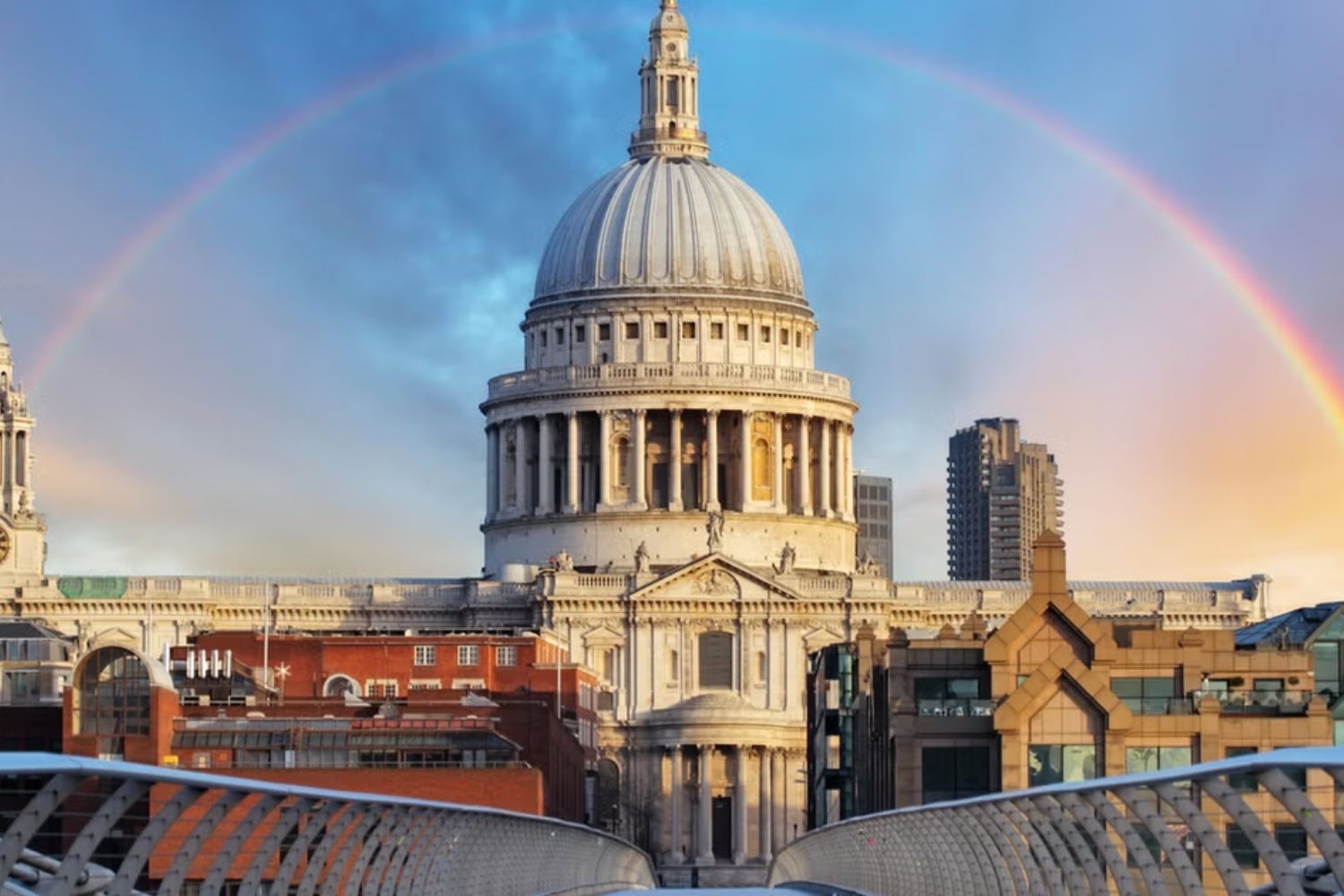
Table of Contents Show
St Paul’s Cathedral is an Anglican cathedral on Ludgate Hill in the City of London, designed by Sir Christopher Wren in the English Baroque style and built between 1675 and 1710. Rising 111 metres at its cross, the cathedral replaced a medieval Gothic predecessor destroyed in the Great Fire of 1666 and remains one of the largest church domes in the world.
Few buildings carry as much architectural weight as St Paul’s Cathedral London. For over three centuries, its dome has anchored the city’s skyline, survived the Blitz, hosted state funerals and royal weddings, and served as a working parish church. But the building we see today almost never existed. Christopher Wren’s path from astronomer-turned-architect to the designer of England’s most recognisable Baroque church was marked by rejected plans, political compromise, and a 35-year construction effort that tested both engineering knowledge and personal patience. What emerged is a cathedral that balances classical restraint with Baroque drama in a way that remains distinctly English.
The Great Fire and a New Beginning
On 2 September 1666, a fire broke out in a bakery on Pudding Lane. Over four days, it consumed roughly 13,200 houses and 87 parish churches, including the medieval Old St Paul’s Cathedral. The Gothic structure had already been in poor condition before the fire. Its spire had been struck by lightning in 1561 and never replaced, and parts of the building were being used as a marketplace. By the time the flames reached it, Old St Paul’s was more ruin than cathedral.
Wren had actually been surveying the old building just days before the fire, considering how to repair its crumbling walls. The destruction cleared the slate entirely. King Charles II appointed Wren to oversee the rebuilding of London’s churches, and St Paul’s Cathedral England became the centrepiece of that effort. Wren eventually designed or contributed to 51 new churches across London, but the cathedral consumed the bulk of his professional life.
📌 Did You Know?
The site on Ludgate Hill has hosted a cathedral dedicated to St Paul since AD 604, making it one of the oldest continuously used religious sites in London. The present building is the fifth cathedral to stand on this spot, according to the London Museum.
Wren’s Design Journey: From Rejection to Masterpiece
Wren did not arrive at the final design quickly. His first proposal, known as the First Model (1669), featured a simple domed vestibule attached to the surviving nave walls. The Commission for Rebuilding accepted it, but Wren himself considered it too modest. He then produced the Great Model (1673), a grand centrally-planned church based on a Greek cross with a large dome. A 1:25 scale wooden model of this design still survives inside the cathedral. Church authorities rejected it. They argued the Greek cross plan was too Catholic in feel and did not suit Anglican liturgical processions, which required a long nave.
Wren’s third attempt, the Warrant Design (1675), was a compromise: a Latin cross plan with a smaller dome and a tall steeple. Charles II approved it but granted Wren permission to make “ornamental changes” as construction progressed. Wren interpreted this liberally. Over the next 35 years, he quietly transformed the approved plan into something far closer to his original Greek-cross vision, enlarging the dome and eliminating the steeple entirely.
🎓 Expert Insight
“Wren’s enormous dome was the first of its kind in England.” — Dr. Beth Harris & Dr. Steven Zucker, Smarthistory
Before St Paul’s, no English architect had attempted a large-scale dome. Wren studied St Peter’s Basilica in Rome, the Pantheon, and Jules Hardouin-Mansart’s dome at Les Invalides in Paris before arriving at his own structural solution.
The Triple Dome: Engineering Behind the Icon
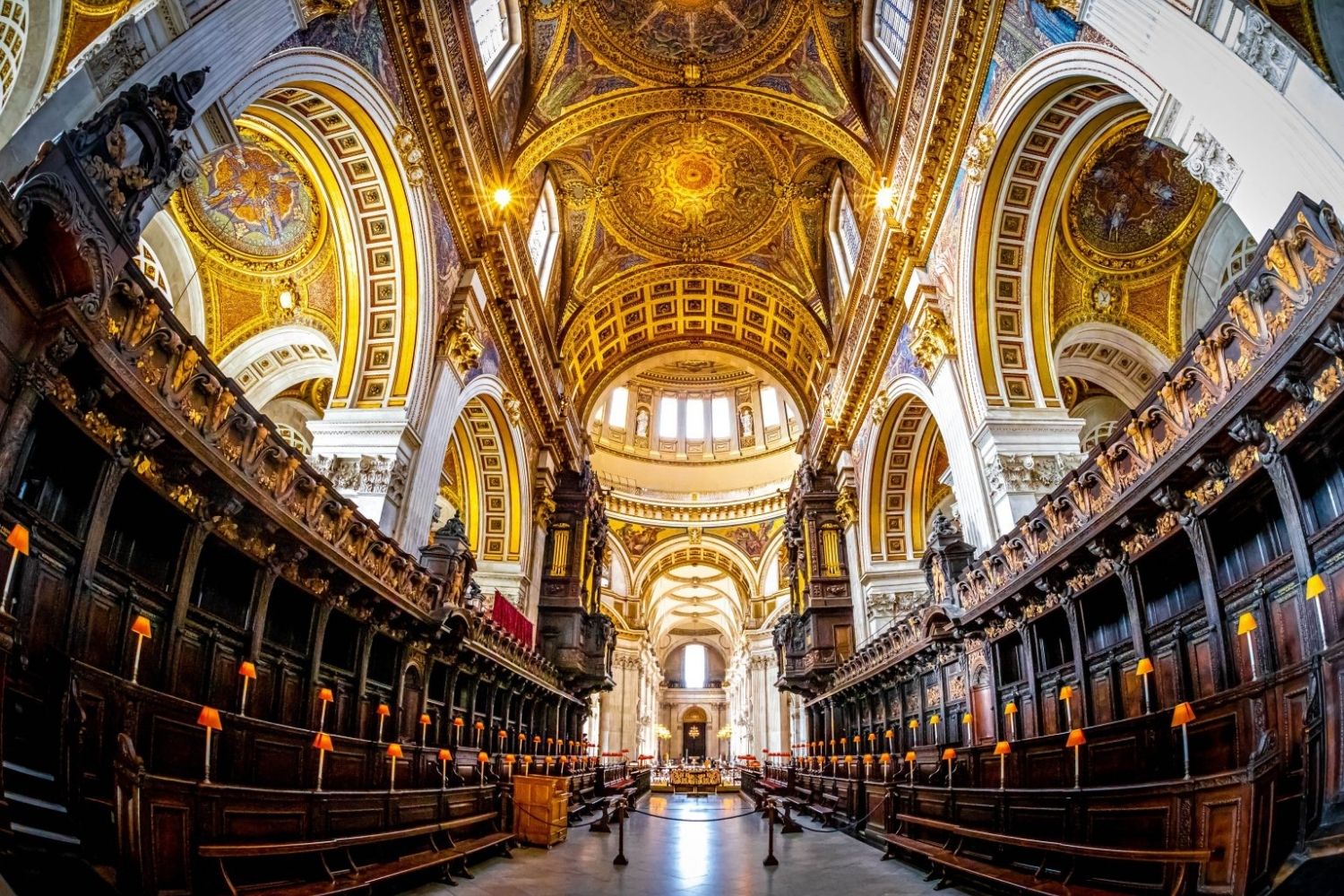
The dome of St Paul’s Cathedral is not a single structure but three nested shells working together. From inside, visitors look up at a painted inner dome made of plastered brick. This inner dome has an opening (oculus) at the top, through which a higher lantern is visible. Between the inner dome and the lead-covered outer dome sits a hidden structural cone of brick, 18 inches thick, that carries the weight of the stone lantern, ball, and cross above. The outer dome is non-structural, essentially a decorative timber-and-lead shell shaped to look impressive from the street.
This three-layer approach solved a problem that had troubled dome builders for centuries: a dome that looks good from outside (tall and prominent) does not look good from inside (too high and hollow), and vice versa. Wren’s solution gave him independent control over the interior and exterior proportions while hiding the structural work between the two. The cross at the top of the outer dome sits approximately 111 metres (365 feet) above ground level.
📐 Technical Note
The structural brick cone between the inner and outer domes supports an 850-ton lantern. The cone transfers weight down to eight piers at the crossing. Wren also used iron chain reinforcement at the base of the cone to resist outward thrust, a technique that anticipated modern tension ring design. The cathedral’s total length is 158 metres (518 feet), making it one of the longest churches in England.
Architectural Style of St Paul’s Cathedral
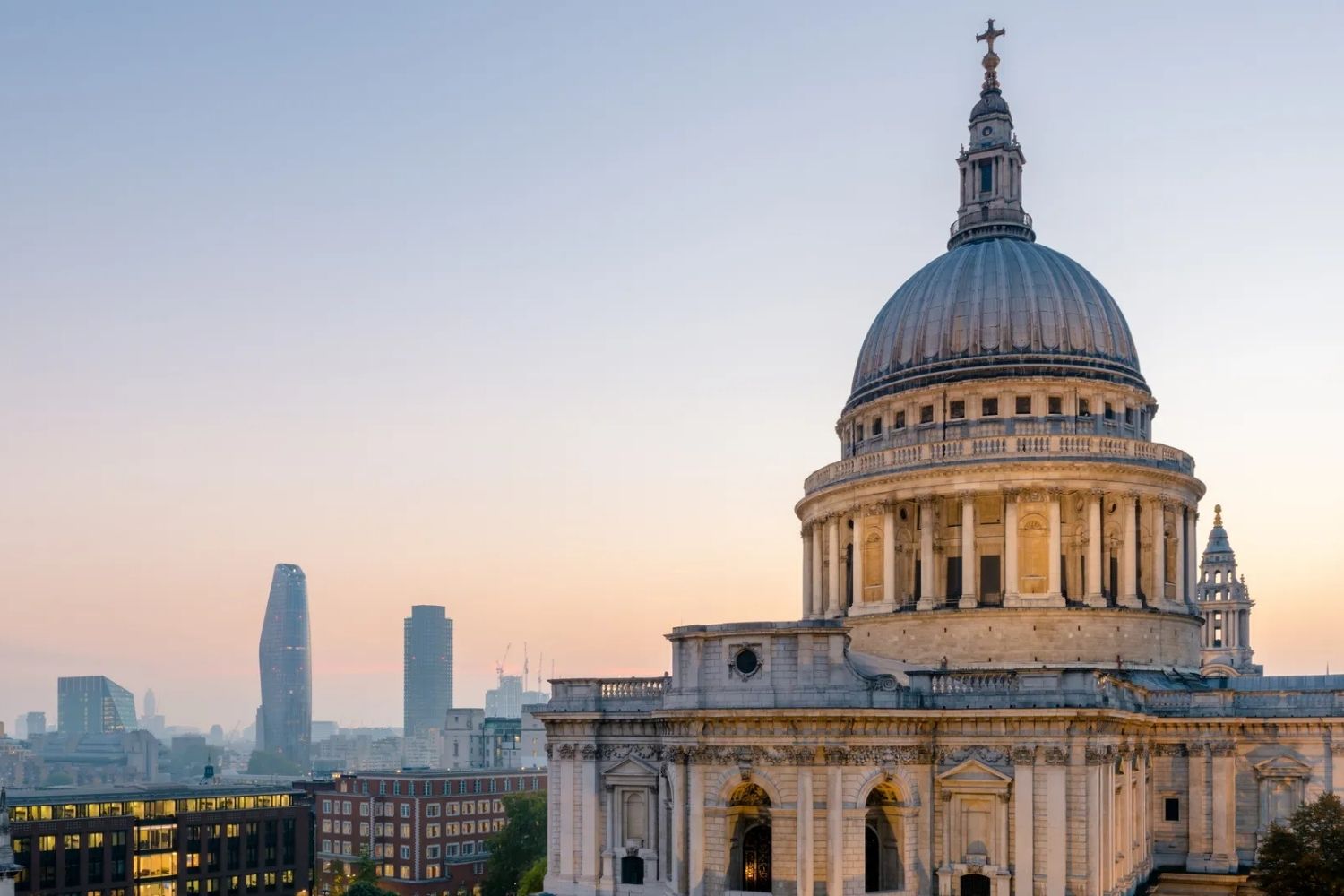
St. Paul’s Cathedral London is classified as English Baroque, a style that differs from its Continental European counterparts. Where Italian Baroque churches by Borromini and Bernini favoured curving walls, dramatic spatial illusions, and heavy ornamentation, English Baroque kept a stronger connection to classical proportions and restraint. Wren, along with contemporaries Nicholas Hawksmoor and John Vanbrugh, developed a specifically English approach that combined classical order with selective Baroque gestures.
The west front of St Paul’s Cathedral UK demonstrates this balance. A two-storey portico with paired Corinthian and composite columns frames the entrance, flanked by two Baroque clock towers added late in the construction process. The towers borrow from Baroque theatrical traditions with their concave-convex walls and decorative urns, but the overall composition remains symmetrical and controlled. The result feels less exuberant than Roman churches of the same era but carries more visual energy than the strict Palladian buildings that would dominate English architecture a generation later.
Around the exterior, Wren used a clever illusion: a false upper storey along the nave walls. From the outside, St Paul’s appears to be a two-storey building, matching the height of the portico. In reality, the upper level is a screen wall hiding the flying buttresses that support the nave vault. Wren considered exposed buttresses a Gothic feature unworthy of a classical building and preferred to conceal the structural logic behind an elegant facade.
Inside St Paul’s Cathedral England
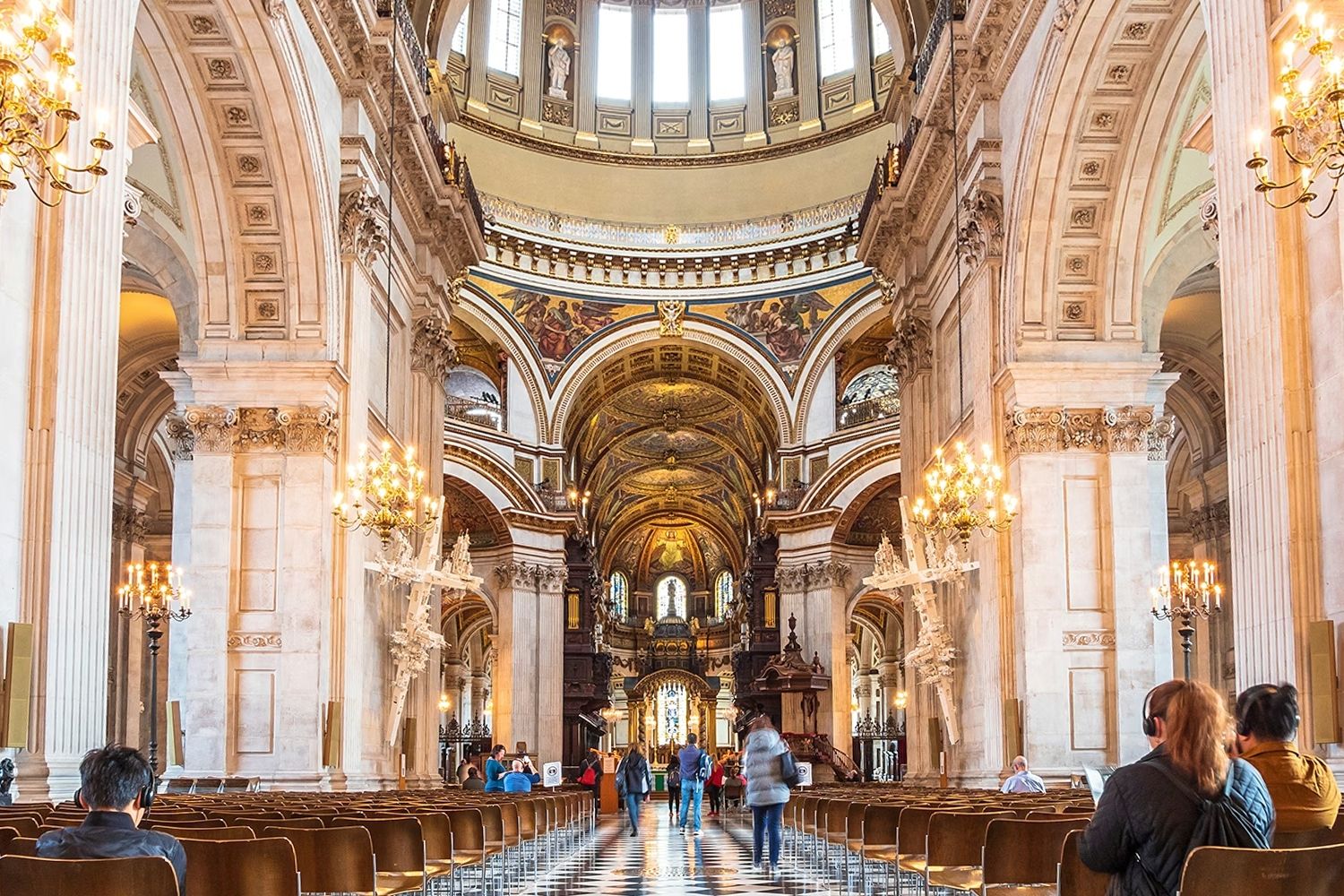
The interior follows a Latin cross plan, with a long nave leading to the crossing beneath the dome, short transepts to the north and south, and a choir extending east toward the apse. Compared to the richly painted interiors of Continental Baroque churches, Wren’s original interior was relatively austere, relying on the geometry of the space and the quality of Portland stone for its effect.
Much of the decoration visitors see today was added later. The mosaics in the dome, quire ceiling, and apse were installed between 1864 and 1912, well after Wren’s death in 1723. The Whispering Gallery, located at the base of the inner dome 30 metres above the cathedral floor, is famous for its acoustic properties. A whisper against the wall on one side can be heard clearly on the opposite side, 34 metres away, due to the smooth, concave stone surface guiding sound waves around the circumference.
🏗️ Real-World Example
St Paul’s Cathedral Crypt (London, 1710): The crypt beneath the cathedral contains memorials to over 300 notable figures, including the Duke of Wellington and Admiral Horatio Nelson. Wren himself is buried here. His tomb bears the Latin inscription “Lector, si monumentum requiris, circumspice” (“Reader, if you seek his monument, look around you”), composed by his son. The crypt also houses the cathedral’s treasury and the Order of the British Empire chapel.
The crypt extends beneath the entire footprint of the cathedral and is the largest in Europe. Above ground, the quire stalls carved by Grinling Gibbons represent some of the finest woodwork of the late 17th century. Gibbons also created the organ case, which originally housed an instrument built by “Father” Bernard Smith in 1694.
How Does St Paul’s Cathedral Compare to Other Baroque Churches?
St. Paul’s Cathedral London United Kingdom sits within a broader European tradition of large Baroque domed churches, but it charts its own course. Versailles and French Baroque prioritised symmetry and political grandeur. Italian Baroque churches by Borromini emphasised spatial complexity and curving surfaces. St Paul’s draws from both traditions but adds a layer of English empiricism. Wren was a mathematician and astronomer before he was an architect, and his approach to design was rooted in geometry and structural problem-solving rather than pure artistic expression.
Video: St Paul’s Cathedral Architecture Explained
This Smarthistory video by Dr. Beth Harris and Dr. Steven Zucker examines the interior and exterior of Wren’s cathedral, discussing the dome’s construction and the English Baroque context.
The cathedral also played a different cultural role than its counterparts. While St Peter’s Basilica in Rome served the papacy and Les Invalides in Paris glorified the French monarchy, St Paul’s Cathedral St Paul functioned as an Anglican parish church tied to civic identity. It hosted national events of mourning and celebration, from Nelson’s funeral in 1806 to the wedding of Prince Charles and Lady Diana Spencer in 1981. During the Blitz, the photograph of the dome standing intact amid smoke and fire became one of the most reproduced images of the Second World War.
Today, St Paul’s Cathedral London England remains a Grade I listed building and an active place of worship. The view of the dome is protected by London’s strategic viewing corridors, a set of planning regulations that restrict building heights along certain sightlines. These protections ensure that Wren’s silhouette, designed to dominate Ludgate Hill, continues to hold its place above the city.
The Bigger Picture
St Paul’s Cathedral endures not because it is the biggest dome or the most decorated interior, but because it solved a set of real problems with intelligence and restraint. Wren built a church that satisfied Anglican liturgy, survived political interference, introduced a structural innovation to England, and did it all in Portland stone on a tight London hilltop. Three hundred years later, the dome still works as both an engineering solution and a civic symbol. If architecture is the art of turning constraints into form, St Paul’s is one of the clearest examples on any skyline.
- Baroque Architecture
- baroque architecture examples
- baroque architecture features
- baroque style architecture
- notre dame cathedral
- st paul's cathedral
- st paul's cathedral england
- st paul's cathedral london
- st paul's cathedral london england
- st paul's cathedral st paul
- st paul's cathedral uk
- st paul's episcopal cathedral
- st. paul's cathedral
- st. paul's cathedral london
- st. paul's cathedral london united kingdom






Relocated Maya Structures at Mexico’s Balam Tun Memory Park Face Legal Challenge
INAH archaeologists have filed a complaint against 26 officials over Balam Tun...
 illustrarch Editoral Team2 Mins read
Allies and Morrison Win Approval to Restore Barbican Sculpture Court
City of London Corporation approves Allies and Morrison's plan to restore the...
illustrarch Editoral Team2 Mins read

The Great Wall of China: History, Architecture, and Enduring Legacy
A detailed architectural exploration of the Great Wall of China covering its...
Furkan Sen7 Mins read
Prague Architecture: How Charles Bridge and Prague Castle Built Bohemian Gothic
Charles Bridge and Prague Castle explained as architecture: the 1357 bridge under...
Furkan Sen6 Mins read


Leave a comment