

Off-Grid Tiny House Living: Complete Setup Guide for Beginners
This guide walks you through every stage of setting up an off-grid tiny house, from sizing solar panels and designing rainwater collection systems to navigating zoning laws and managing realistic budgets for self-sufficient living.
 Bahattin Duran11 June 202615 Mins read248
Table of Contents Show
Going off-grid in a tiny house means generating your own electricity, sourcing your own water, and handling waste without relying on municipal utilities. It sounds like a radical lifestyle shift, and it is. But thousands of people across the United States and beyond are making it work every year, spending less on monthly bills and gaining a level of self-sufficiency that traditional homeowners rarely experience. If you have been considering an off-grid tiny house as your path to financial freedom and sustainable living, this guide breaks down exactly what you need to plan, build, and maintain one.
A typical off-grid tiny house ranges from 100 to 400 square feet and operates independently from electrical grids, city water lines, and sewer systems. The upfront investment for the complete off-grid infrastructure (solar, water, and waste systems) falls between $15,000 and $35,000 on top of the structure itself, according to data compiled by Little Houses for Sale in their 2025 off-grid living report. That initial cost pays for itself within 5 to 15 years through eliminated utility bills, and the core systems last decades with basic maintenance.
This guide covers the six essential areas you need to address: choosing the right land and understanding legal requirements, designing your solar power system, setting up water collection and filtration, managing waste responsibly, budgeting realistically, and preparing for the daily realities of self-sufficient living. Each section includes specific costs, component recommendations, and practical advice drawn from real off-grid builds.
Understanding Off-Grid Tiny House Living
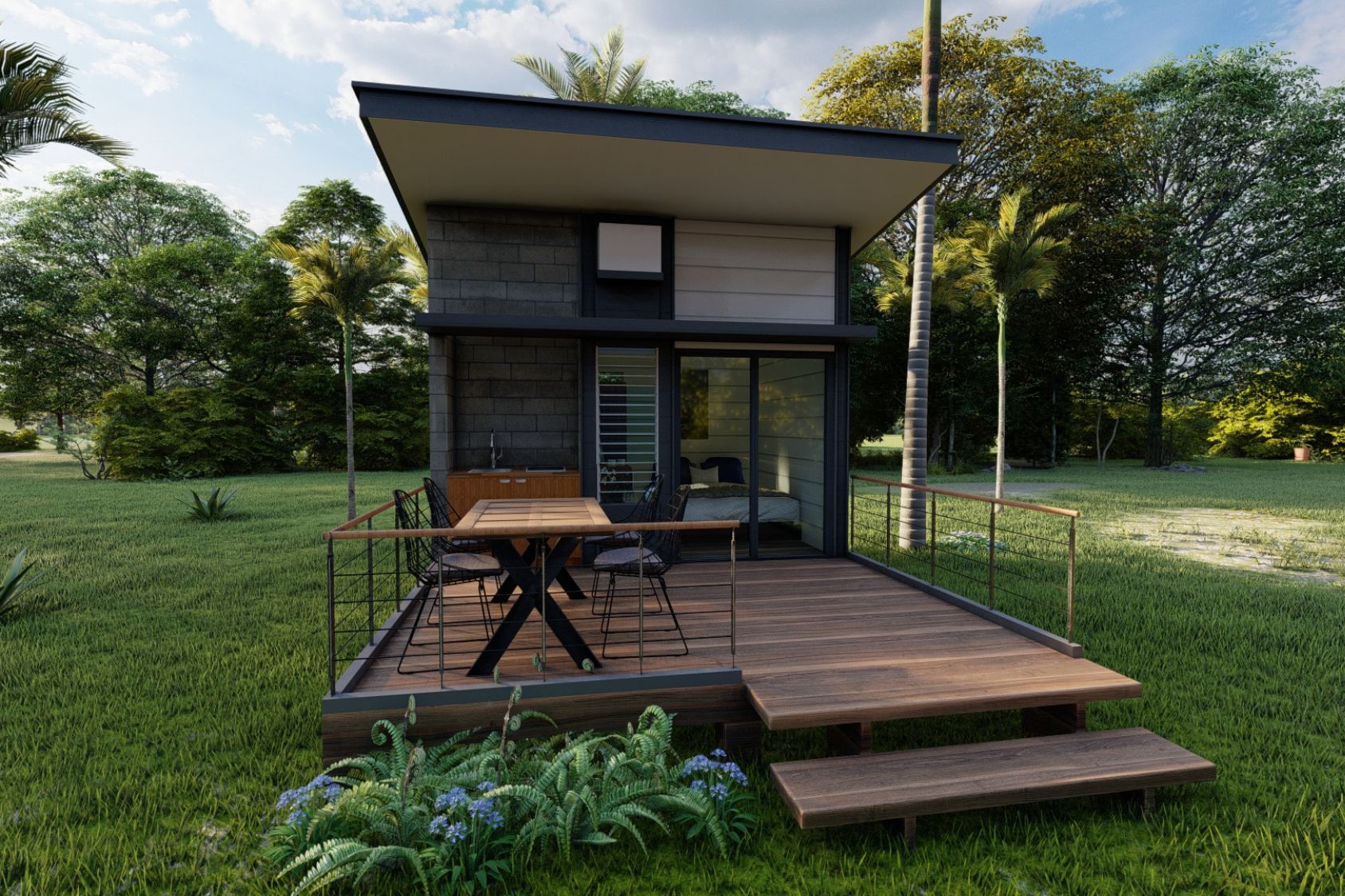
Before diving into systems and specifications, it helps to clarify what “off-grid” actually means in the context of a tiny house. Off-grid living eliminates your dependence on three public utility connections: electricity from the power grid, water from municipal supply lines, and waste disposal through city sewer systems. A tiny house off grid replaces each of these with self-contained alternatives. Solar panels generate your electricity. Rainwater harvesting or a private well supplies your water. Composting toilets and greywater systems handle your waste.
The appeal goes beyond environmental idealism. Many people pursue off-grid tiny living because grid connection fees in rural areas can be staggering. Running a new power line to a remote property can cost $10,000 to $15,000 or more just for the hookup, with monthly bills stacking on top of that indefinitely. When a complete solar system for a tiny house costs roughly the same amount and eliminates ongoing bills entirely, the math becomes compelling.
Off-grid tiny living also requires a mental shift. You become your own utility company. When something breaks at 2 AM, there is no dispatch number to call. You need to understand your systems, keep spare parts on hand, and develop troubleshooting skills. This is not a warning meant to discourage you. It is a reality check that separates successful off-grid dwellers from those who give up within the first year.
Choosing Land and Navigating Zoning Laws
Your off-grid tiny house project starts with land, and land selection is more complicated than finding an affordable rural lot. Zoning laws, building codes, and utility regulations vary dramatically by state, county, and even municipality. What is perfectly legal in one county can be prohibited in the next one over.
States with Favorable Off-Grid Regulations
According to a 2025 analysis by Little Houses for Sale, the most off-grid friendly states include Alaska, Tennessee, Texas, Missouri, Arizona, Montana, Maine, Vermont, Oregon, and Idaho. These states generally allow solar and alternative power systems, have fewer restrictions on rainwater harvesting, and offer more flexibility for composting toilets and alternative waste systems. Most western and southern states fall into a moderate category, allowing off-grid living with varying county-level restrictions.
The International Residential Code (IRC) now includes Appendix Q, which establishes building standards specifically for homes under 400 square feet. States that have adopted this appendix provide a clearer legal pathway for tiny house construction, covering safety standards for loft areas, reduced electrical circuit requirements, and alternative staircase options.
Key Questions to Ask Before Buying Land
Contact your local zoning and planning department before purchasing property. Ask whether the land is zoned for residential use, what the minimum dwelling size requirements are, whether off-grid power systems are permitted, if rainwater collection is legal in your jurisdiction, and whether composting toilets or alternative waste systems are allowed. Some counties require all dwellings to connect to approved septic systems even if you plan to use a composting toilet. Others mandate grid electrical connections for any permanent residence.
For tiny houses on wheels (THOWs), the legal landscape gets more complex. Many jurisdictions classify THOWs as recreational vehicles, which may restrict them to RV parks or limit full-time occupancy. Foundation-built tiny homes typically fall under standard residential building codes, which can work in your favor if you meet the local requirements. Related: Architecture guides and resources
Solar Power Systems for Off-Grid Tiny Houses
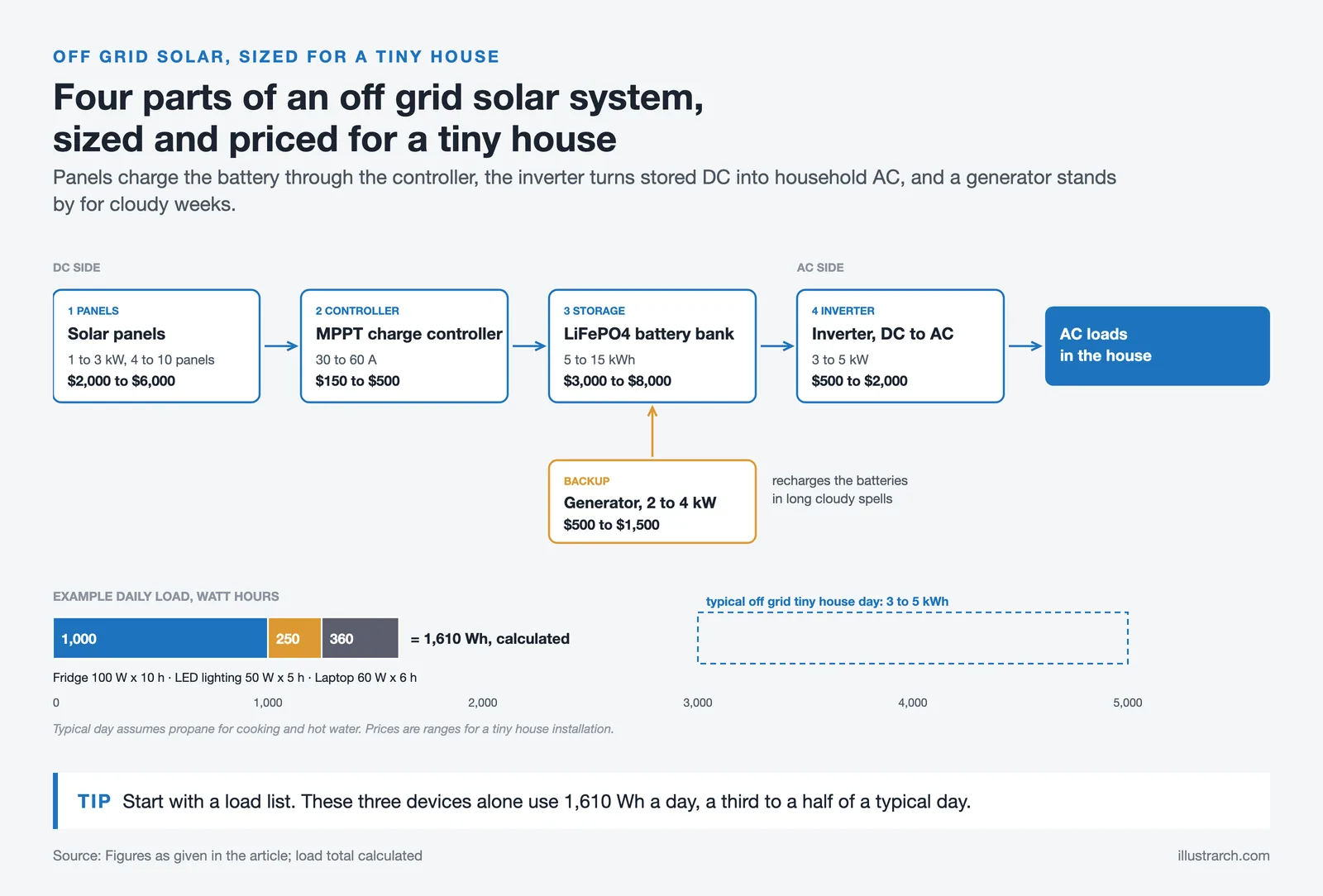
Solar energy is the backbone of nearly every off-grid tiny house. A well-designed solar system is silent, requires minimal maintenance, and provides free electricity for 25 to 30 years after the initial investment. The system consists of four core components: solar panels, a charge controller, a battery bank, and an inverter.
How to Size Your Solar System
Sizing starts with a load analysis, which means calculating your total daily energy consumption in watt-hours. A typical off-grid tiny house uses approximately 3 to 5 kWh (kilowatt-hours) per day, assuming you cook and heat water with propane and use energy-efficient appliances throughout. If you run air conditioning or electric heating, that figure climbs significantly.
To perform a basic load analysis, list every electrical device in your home alongside its wattage and the number of hours you use it daily. Multiply watts by hours to get watt-hours for each device, then add them all together. For example, a 100-watt refrigerator running 10 hours per day equals 1,000 watt-hours. LED lighting at 50 watts for 5 hours equals 250 watt-hours. A laptop at 60 watts for 6 hours equals 360 watt-hours. A small system between 1 kW and 3 kW is typically sufficient to power most tiny homes, according to SolarReviews.
Core Components and Estimated Costs
The following table provides a breakdown of the primary solar system components, their function, and typical price ranges for a tiny house installation.
Solar System Components for Off-Grid Tiny Houses
This table outlines the four essential components, their roles, and realistic budget ranges.
| Component | Function | Typical Size for Tiny House | Estimated Cost |
|---|---|---|---|
| Solar Panels | Convert sunlight to DC electricity | 1 kW to 3 kW (4 to 10 panels) | $2,000 to $6,000 |
| Charge Controller | Regulates voltage to protect batteries | MPPT, 30A to 60A | $150 to $500 |
| Battery Bank | Stores energy for nighttime and cloudy days | 5 kWh to 15 kWh (LiFePO4) | $3,000 to $8,000 |
| Inverter | Converts DC to AC for household appliances | 3 kW to 5 kW | $500 to $2,000 |
Monocrystalline panels offer the best efficiency per square foot, which matters when roof space is limited. For battery storage, lithium iron phosphate (LiFePO4) batteries have become the standard for off-grid tiny homes because they handle deeper discharge cycles (up to 80% to 90% depth of discharge) compared to lead-acid batteries (50% maximum), last 10 to 15 years versus 3 to 5 years for lead-acid, and take up significantly less space. The 30% U.S. federal residential solar tax credit is not available for systems placed in service after December 31, 2025, so as of October 2026 it no longer reduces the cost of a new installation. Learn more about solar incentives at the U.S. Department of Energy website.
Backup Power Considerations
No solar system is foolproof. Extended cloudy periods, higher-than-expected energy use, or equipment failure can leave you without power. Most off-grid tiny house owners keep a propane or gasoline generator as a backup. A quality portable generator in the 2,000 to 4,000 watt range costs $500 to $1,500 and can recharge your battery bank during prolonged bad weather. Size your battery bank with at least 2 to 3 days of autonomous power to minimize generator dependence.
Water Systems for Self-Sufficient Tiny Living
After power, water is the most critical system in any self-sufficient tiny house. Off-grid water solutions fall into three main categories: rainwater harvesting, private wells, and hauled water stored in holding tanks. Your choice depends on your location, budget, local rainfall patterns, and legal restrictions.
Rainwater Harvesting Systems
Rainwater harvesting is the most popular water source for off-grid tiny homes. The system is relatively simple: rain falls on your roof, flows through gutters into downspouts, passes through a pre-filter to remove debris, and collects in a storage cistern. A pump pressurizes the water and pushes it through a multi-stage filtration system before it reaches your taps.
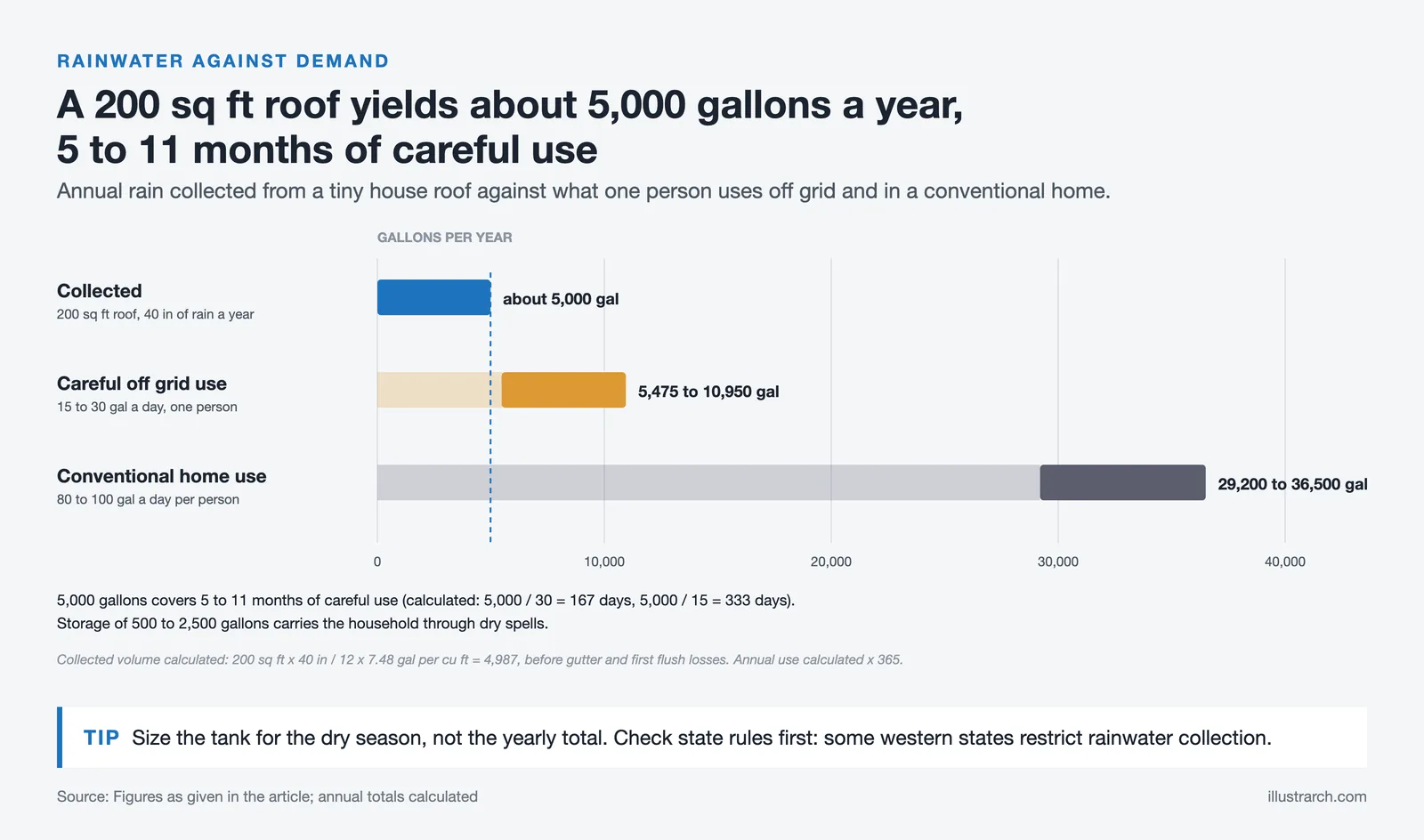
Your collection capacity depends on roof size and local rainfall. A 200-square-foot roof in an area receiving 40 inches of annual rainfall can collect approximately 5,000 gallons per year. A careful off-grid resident typically uses 15 to 30 gallons per day (compared to 80 to 100 gallons per person in a conventional home), so a roof this size covers only part of the demand and storage tank sizing becomes critical for getting through dry spells.
A complete rainwater collection and filtration package for a tiny house costs between $2,000 and $8,000, depending on tank size and filtration quality. Essential components include a first-flush diverter (which discards the first few gallons of rain that wash debris off your roof), a storage tank (500 to 2,500 gallons depending on climate), a 12V or 110V water pump, and a multi-stage filtration system with sediment filter, carbon filter, and UV sterilization for potable water. Be aware that rainwater collection is not legal in all states. Western states with prior appropriation water rights may restrict or regulate collection. Colorado, for example, only recently legalized limited residential rainwater harvesting. Always verify your state and county regulations before investing in a system.
Wells and Holding Tanks
If your property has groundwater access, drilling a private well provides the most reliable year-round water supply. Well drilling costs vary enormously by region and depth, ranging from $5,000 to $15,000 or more. Once operational, a well connected to a submersible pump and pressure tank delivers water just like a conventional home.
Freshwater holding tanks offer a simpler alternative. Many off-grid tiny house owners install 200 to 1,200 gallon tanks and refill them periodically by hauling water themselves or hiring a water delivery service. This approach has the lowest upfront cost but requires ongoing effort and expense. Budget $50 to $150 per month for water delivery depending on your location and usage.
Waste Management: Toilets, Greywater, and Sewage
Waste management is the system most people find least glamorous but arguably most important to get right. Poor waste handling creates health hazards, environmental damage, and legal problems. Off-grid tiny houses typically use composting toilets for human waste and greywater systems for water from sinks and showers.
Composting Toilets
Composting toilets decompose human waste into compost through aerobic biological processes. They require no water, no sewer connection, and no septic tank. Commercial units range from $900 to $2,500 and include a ventilation fan that eliminates odors when properly installed. Popular models include the Nature’s Head and the Sun-Mar, both designed specifically for small-space applications.
These toilets separate liquids from solids. The solids chamber contains a bulking agent (coconut coir or peat moss) that absorbs moisture and facilitates decomposition. You empty the solids chamber every few weeks to few months depending on usage, and the resulting material can be composted further before being used in non-food gardens. Composting toilet legality varies significantly by jurisdiction. Some counties explicitly permit certified models, while others prohibit any toilet that does not connect to a septic or sewer system. The NSF International certifies composting toilets to ANSI/NSF Standard 41, and using a certified unit strengthens your legal position in most areas.
Greywater Systems
Greywater is wastewater from sinks, showers, and washing machines (not toilets). In a self-sufficient tiny house, greywater can be filtered and reused for irrigation, significantly reducing your overall water consumption. A basic greywater system routes water through a series of filters and into a subsurface irrigation field or constructed wetland.
Always use biodegradable, phosphate-free soaps and cleaning products in an off-grid tiny house. Conventional detergents contain chemicals that damage soil ecology and can contaminate groundwater. Greywater regulations also vary by location, so check with your county health department before installing a system. Related: Sustainable architecture resources
Budgeting Your Off-Grid Tiny House Project
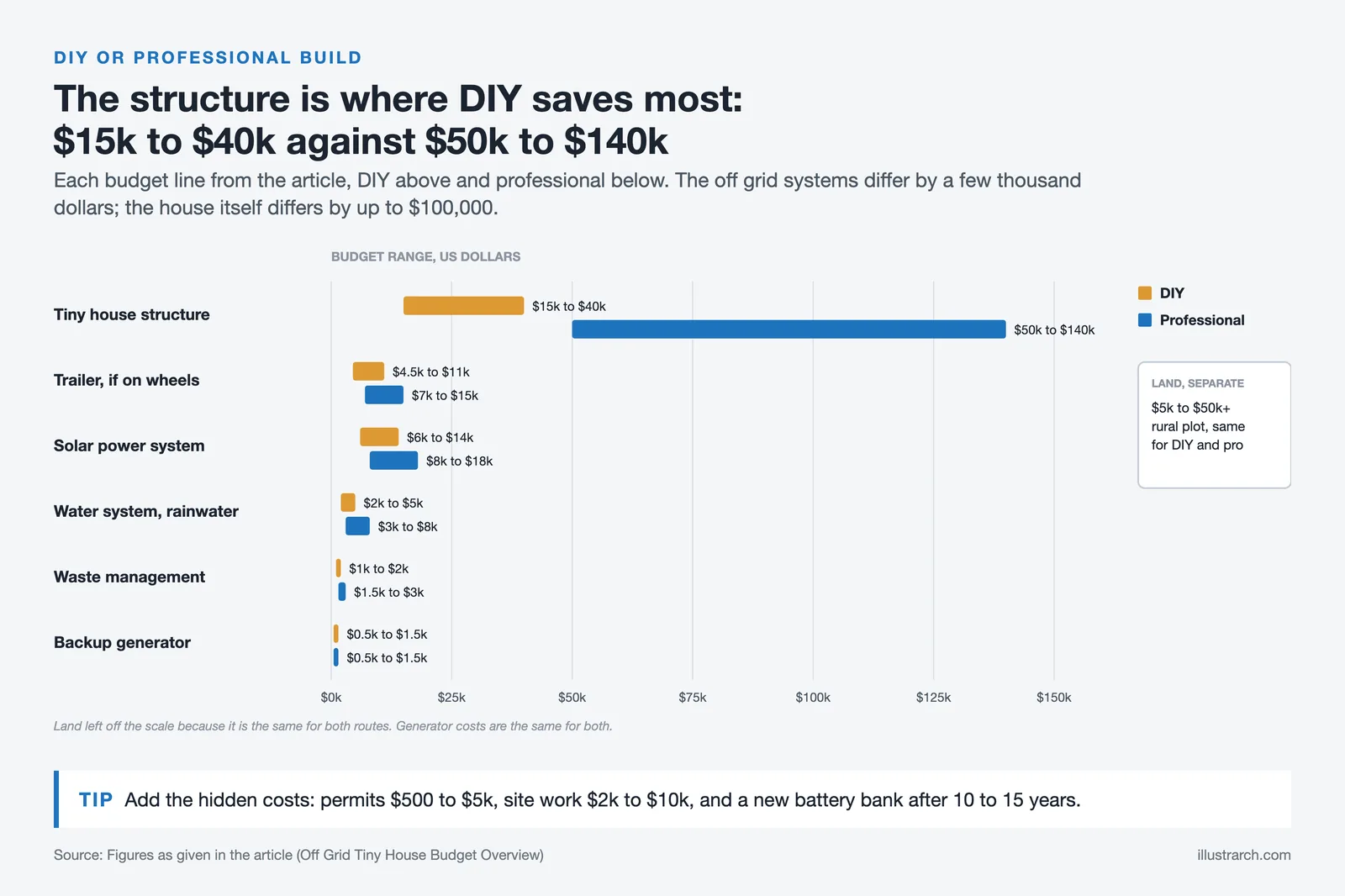
Realistic budgeting is where many off-grid tiny house dreams either solidify or collapse. The romanticized version of tiny living overlooks the true costs of going self-sufficient. Here is what you can actually expect to spend.
Cost Breakdown: Structure and Off-Grid Systems
According to HomeAdvisor’s 2025 data, building a tiny home costs between $30,000 and $60,000 on average, with the national average around $45,000. That figure covers the structure, interior finishes, and basic mechanical systems. Off-grid systems add another layer of cost.
Off-Grid Tiny House Budget Overview
The table below summarizes typical costs for each major component of an off-grid tiny house build.
| Category | Budget Range (DIY) | Budget Range (Professional) |
|---|---|---|
| Tiny House Structure | $15,000 to $40,000 | $50,000 to $140,000 |
| Trailer (if on wheels) | $4,500 to $11,000 | $7,000 to $15,000 |
| Solar Power System | $6,000 to $14,000 | $8,000 to $18,000 |
| Water System (Rainwater) | $2,000 to $5,000 | $3,000 to $8,000 |
| Waste Management | $1,000 to $2,000 | $1,500 to $3,000 |
| Land (Rural) | $5,000 to $50,000+ | $5,000 to $50,000+ |
| Backup Generator | $500 to $1,500 | $500 to $1,500 |
DIY builders who handle most of the construction themselves can complete an off-grid tiny house for $30,000 to $80,000 total. Hiring professionals for everything pushes the budget to $70,000 to $180,000 or more depending on finishes, location, and system complexity. The 30% federal residential solar tax credit ended for systems placed in service after December 31, 2025 (as of October 2026).
Hidden Costs to Plan For
Beyond the main systems, several expenses catch first-time builders off guard. Permits and inspections can run $500 to $5,000 depending on your jurisdiction. Site preparation, including clearing, grading, and access road work, adds $2,000 to $10,000 for raw land. Tools and equipment rental cost $2,000 to $5,000 for a DIY build. Ongoing maintenance includes replacement filters for water systems (approximately $100 to $300 per year), bulking material for composting toilets ($50 to $100 per year), and eventual battery replacement ($3,000 to $8,000 after 10 to 15 years).
Designing for Off-Grid Efficiency
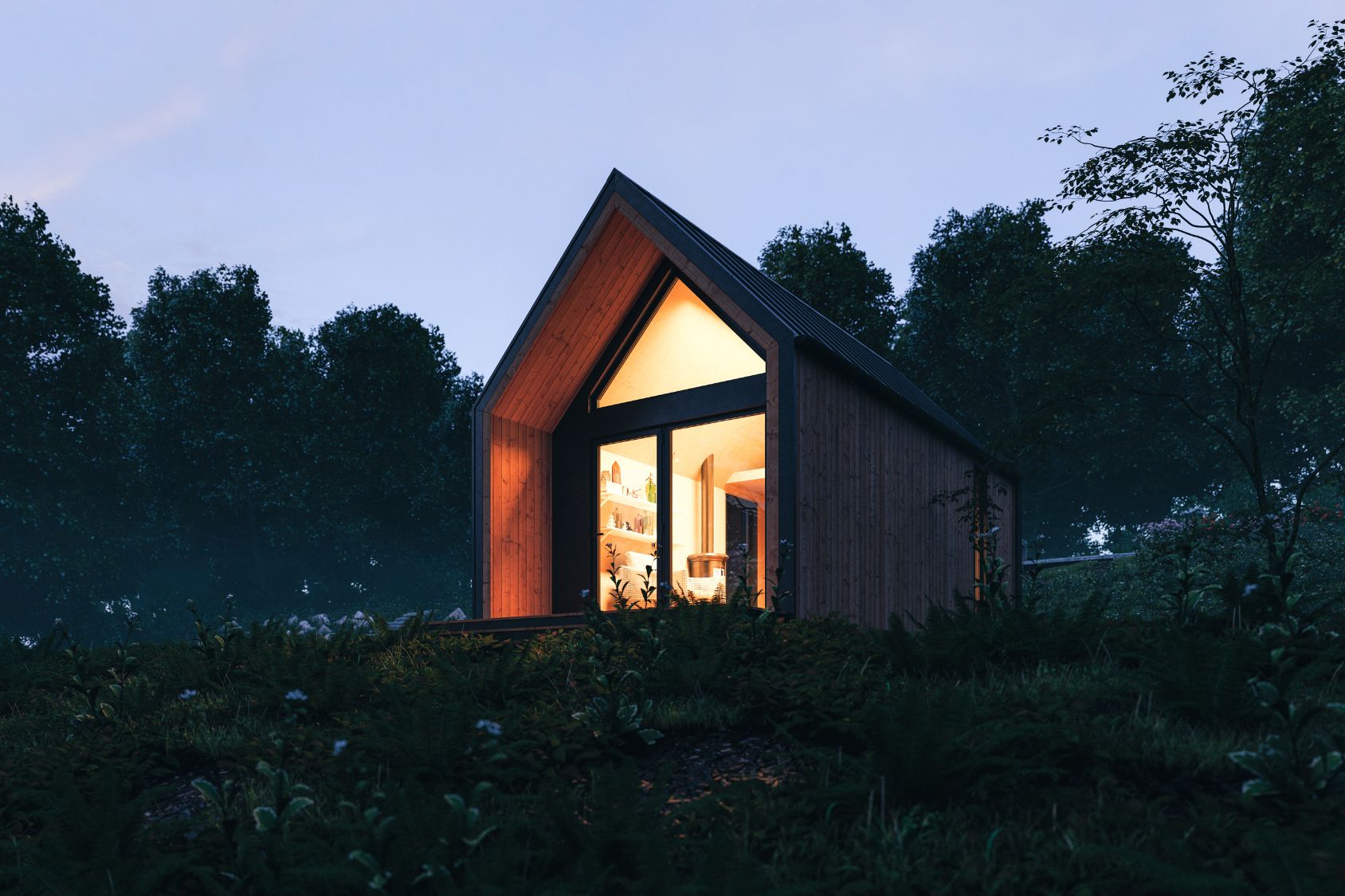
The choices you make during the design phase directly impact how much energy, water, and resources your tiny house consumes daily. An efficiently designed off-grid tiny house needs smaller, cheaper systems to operate comfortably.
Insulation and Climate Control
Insulation is your first line of defense against energy waste. Space heating and air conditioning account for roughly half of household energy use in the United States, according to the U.S. Energy Information Administration, and climate control is a similarly large share in tiny houses. Spray foam insulation provides the highest R-value per inch and also serves as an air barrier, reducing drafts. For climate control, a mini-split heat pump is the most efficient option available. Modern mini-splits operate at a coefficient of performance (COP) of 3 to 4, meaning they produce 3 to 4 units of heat for every unit of electricity consumed. A propane-powered heating option serves as an effective backup and reduces your electrical demand during the coldest months. Related: Energy efficient design strategies
Energy-Efficient Appliances and Lighting
Every appliance in an off-grid tiny house should earn its place. Choose ENERGY STAR certified appliances wherever possible. Use LED lighting exclusively, which consumes 75% less energy than incandescent bulbs. Consider propane for cooking and water heating to reduce your electrical load. An on-demand (tankless) propane water heater eliminates the standby energy loss of tank-style heaters and provides hot water only when needed.
Positioning also matters. Orient your tiny house to maximize passive solar gain during winter months (south-facing windows in the Northern Hemisphere) and minimize direct sun exposure during summer. Strategic window placement can reduce your lighting needs during daylight hours and cut heating costs without consuming a single watt. The Passive House Institute publishes detailed guidelines on building envelope performance that apply even to very small structures.
Daily Life in an Off-Grid Tiny House
Off grid tiny living requires a different relationship with resources than most people are accustomed to. You become acutely aware of how much electricity you consume, how much water you use, and how much waste you generate. This awareness is one of the most rewarding aspects of the lifestyle, but it also comes with a learning curve.
Energy Management Habits
Monitor your battery state of charge daily. Most modern inverter/charger systems include built-in monitoring that shows your energy production, consumption, and battery levels. Run high-draw appliances (vacuum, blender, power tools) during peak sun hours when your panels are producing maximum power. Avoid running multiple heavy loads simultaneously. A battery monitor is not optional; it is essential equipment that protects your investment and prevents unexpected blackouts.
Water Conservation Practices
In a conventional home, water flows freely with little thought. Off-grid, every gallon matters. Install low-flow fixtures throughout your tiny house (1.5 GPM or less for faucets, 2.0 GPM or less for showerheads). Take shorter showers. Capture and reuse cooking water for plants. Fix any leaks immediately since even a small drip wastes gallons per day. Many off-grid tiny house residents report using 15 to 30 gallons per day per person, roughly one-third of the conventional household average.
Seasonal Adjustments
Off-grid systems perform differently across seasons. Winter brings shorter days and less solar production, while summer can stress your water supply in dry climates. Plan for these variations by sizing your battery bank for winter production levels, not summer peaks. Keep extra water storage for drought periods. Stock firewood or propane before winter arrives. The most successful off-grid tiny house owners think at least one season ahead.
Common Mistakes and How to Avoid Them
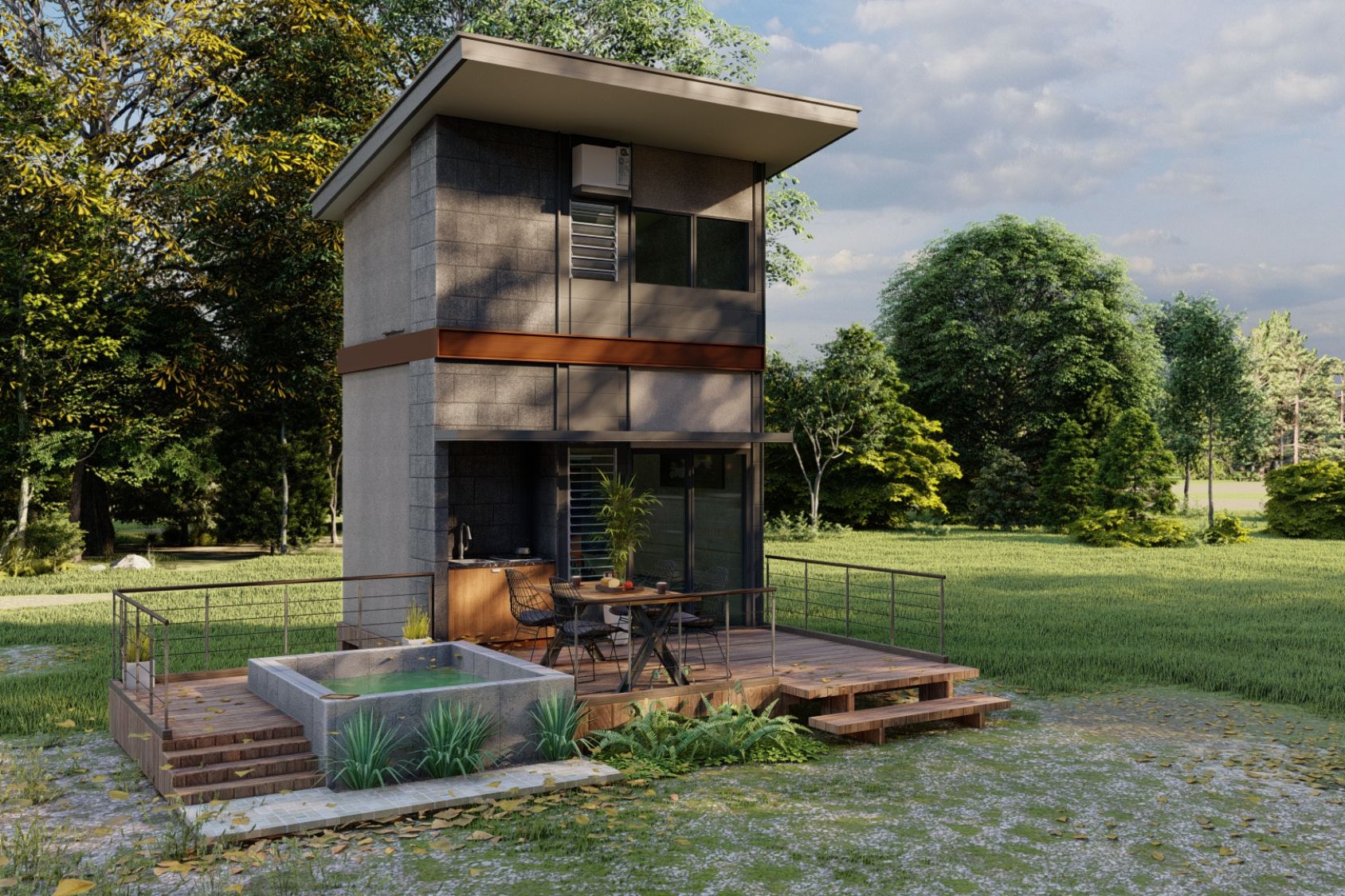
Learning from others who have already navigated the off-grid tiny house journey saves you time, money, and frustration. These are the most frequent mistakes beginners make.
Undersizing the battery bank is the single most common error. People calculate their daily energy needs and buy just enough battery capacity to cover one day. This leaves zero margin for cloudy weather, unexpected loads, or battery degradation over time. Size your battery bank for at least 2 to 3 days of autonomous operation, and never discharge lithium batteries below 20% state of charge regularly.
Ignoring local regulations before building is the second most costly mistake. People purchase land, build their tiny house, and then discover they cannot legally live in it because of zoning restrictions, minimum dwelling size requirements, or prohibited waste systems. Always do your legal homework first.
Skipping the load analysis leads to either an underpowered system that cannot keep up with your needs or an oversized system that wastes money. Take the time to list every appliance, estimate daily usage, and calculate your total watt-hours before purchasing a single solar panel. The National Renewable Energy Laboratory’s PVWatts Calculator is a free tool that estimates solar energy production based on your specific location and system size.
Neglecting backup systems creates single points of failure. Your off-grid tiny house should never depend on just one system for any critical need. Have a generator for power backup, extra water storage or an alternative water source, and spare parts for pumps, filters, and other wear items. Redundancy is not luxury; it is insurance.
Cost figures referenced in this guide are approximate and vary by region, material supplier, project scope, and market conditions. Building codes and regulations vary by jurisdiction. Always consult local authorities and licensed professionals for your specific project.
Frequently Asked Questions
How much does a complete off-grid tiny house cost?
A complete off-grid tiny house, including the structure and all self-sufficiency systems, typically costs between $30,000 and $80,000 for a DIY build and $70,000 to $180,000 or more for a professionally built home. The off-grid systems alone (solar, water, and waste) add $15,000 to $35,000 to the base cost of the structure.
Can I legally live in an off-grid tiny house full time?
Yes, in many jurisdictions. States like Alaska, Tennessee, Texas, Missouri, and Arizona are among the most off-grid friendly. However, legality depends on your specific county and municipality. Always verify zoning laws, minimum dwelling size requirements, and utility regulations with your local planning department before committing to a location.
How many solar panels do I need for a tiny house?
Most off-grid tiny houses need between 4 and 10 solar panels, depending on energy consumption and panel wattage. A system between 1 kW and 3 kW covers the needs of a typical tiny home that uses propane for cooking and water heating. Homes running electric heating or air conditioning require larger systems.
Is rainwater harvesting legal?
Rainwater harvesting is legal in most U.S. states, but regulations vary. Western states with prior appropriation water rights (like Colorado and Utah) have historically restricted collection, though many have recently loosened rules for residential use. Eastern states generally allow rainwater harvesting with fewer restrictions. Always check your specific state and local laws before installing a collection system.
What happens during extended cloudy weather?
A properly sized battery bank provides 2 to 3 days of autonomous power without any solar input. Beyond that, a backup generator (propane or gasoline, 2,000 to 4,000 watts) can recharge your batteries and keep essential systems running. Reducing your energy consumption during cloudy stretches by turning off non-essential loads also extends your battery reserves significantly.







Tiny House Water Systems: Your Complete Guide to Plumbing, Rainwater Harvesting and Off-Grid Solutions
A practical guide to designing a tiny house water system, covering PEX...
Bahattin Duran14 Mins read
Tiny House with Loft: Design Ideas, Plans and Building Tips for Vertical Living
A complete guide to designing and building a tiny house with loft,...
Bahattin Duran15 Mins read
8+ Best Tiny Home Communities in Michigan: Great Lakes Tiny Living Guide
Explore tiny home communities in Michigan. Great Lakes lifestyle, affordable land, and...
Bahattin Duran18 Mins read
8+ Best Tiny Home Communities in South Carolina
Find tiny home communities in South Carolina. Affordable living, coastal charm, and...
Bahattin Duran20 Mins read


Leave a comment