

Non-Co Mixing High School
The Non-Co Mixing High School in Tehran is designed to accommodate separate educational experiences for boys and girls while sharing workshops through a time-sharing system.
 illustrarch Editoral Team31 July 20191 Mins read339
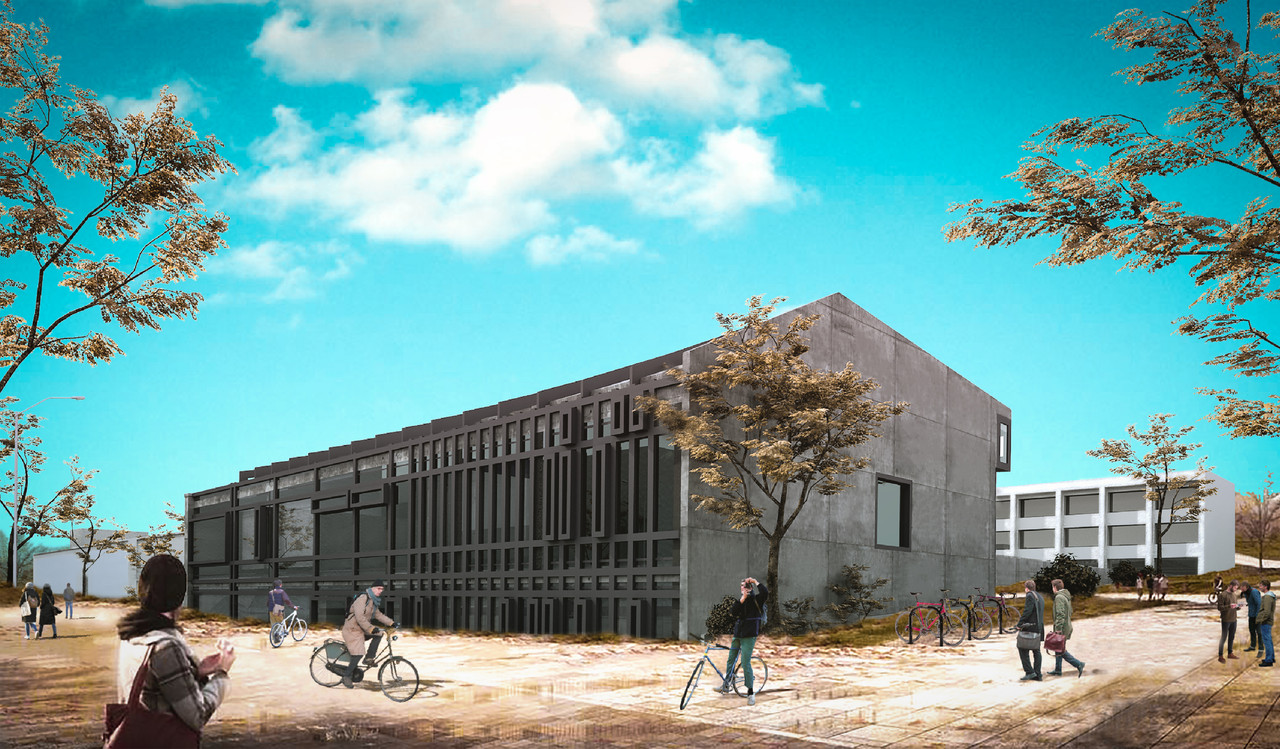


The Non-Co Mixing High School by Niyousha Zaribaf in Tehran, Iran, treats a single educational building as both shared and separate, serving students of both sexes without ever mixing them in the same instant. Defined as a Technical and Vocational High School, the project sits within an educational district already populated with boys high schools and indoor sports halls, and it answers a deliberately contradictory brief: keep the genders apart while letting them use the same workshops and workspaces through a time-sharing system.
Zaribaf builds the design around the idea that space itself can induce a dynamical bifurcation. The correlation between a gender gradient, read as content, and a privacy gradient, read as context, is represented by superimposing content-cut and context-flow. Within this dialectic the gender zoning is set, the spatial configuration is developed, and the morph is generated and regenerated. Rather than drawing a hard line between two halves, the plan lets common rooms such as workshops and workspaces toggle between user groups across the timetable, so the same square meters carry different occupants at different hours.
A vocational school as a shared timetable
Educational architecture has long wrestled with how form follows the schedule. A school is not occupied uniformly: classrooms, labs, and circulation fill and empty in waves, and a vocational school adds heavy workshop spaces that are costly to duplicate. Sharing those rooms on a rotation is an efficient response, and it places the timetable at the center of the plan. The privacy gradient that organizes this project echoes a wider concern in school design, where supervision, daylight, and acoustic separation all shape where walls and thresholds fall.
Integration with the surrounding high schools and sports halls is the main theme, pursued either through topological form or through shared techniques and materials, and held together by a flexible program. The developable surface technique runs through the roofs and facades as a method of development and redevelopment, giving the envelope a geometry that can be unrolled and rebuilt. Set within the dense educational fabric of Tehran, the school reads as a study in how educational architecture can hold opposing requirements in one continuous form. Zaribaf leaves the building as a working argument that separation and sharing can be designed as two readings of the same space.



Herzog & de Meuron Builds Amherst College Student Center Atop Old Foundations
Herzog & de Meuron built a mass-timber student center at Amherst College...
illustrarch Editoral Team2 Mins read
MIT Architecture School Moves Into DS+R-Converted Metropolitan Storage Warehouse
MIT's architecture school has moved into a DS+R-converted 1894 warehouse in Cambridge,...
illustrarch Editoral Team3 Mins read

SENA Tunja Training Center by TAP Arquitectura
TAP Arquitectura's unbuilt competition proposal for SENA in Tunja wraps a 4,400...
illustrarch Editoral Team2 Mins read
Best Software in Architecture School: 8 Tools to Learn First
A practical look at the best software to learn in architecture school,...
 Elif Ayse Sen6 Mins read


Leave a comment