

La Casa Milà Barcelona: Gaudí’s Stone Quarry Turned Architectural Icon
Casa Milà, nicknamed La Pedrera for its rough stone exterior, stands on Passeig de Gràcia as Gaudí's most radical residential project. This guide covers the building's structural innovations, its controversial reception in 1912, the iconic warrior chimneys on the rooftop, and practical details for visiting today.
 Furkan Sen22 June 20266 Mins read212
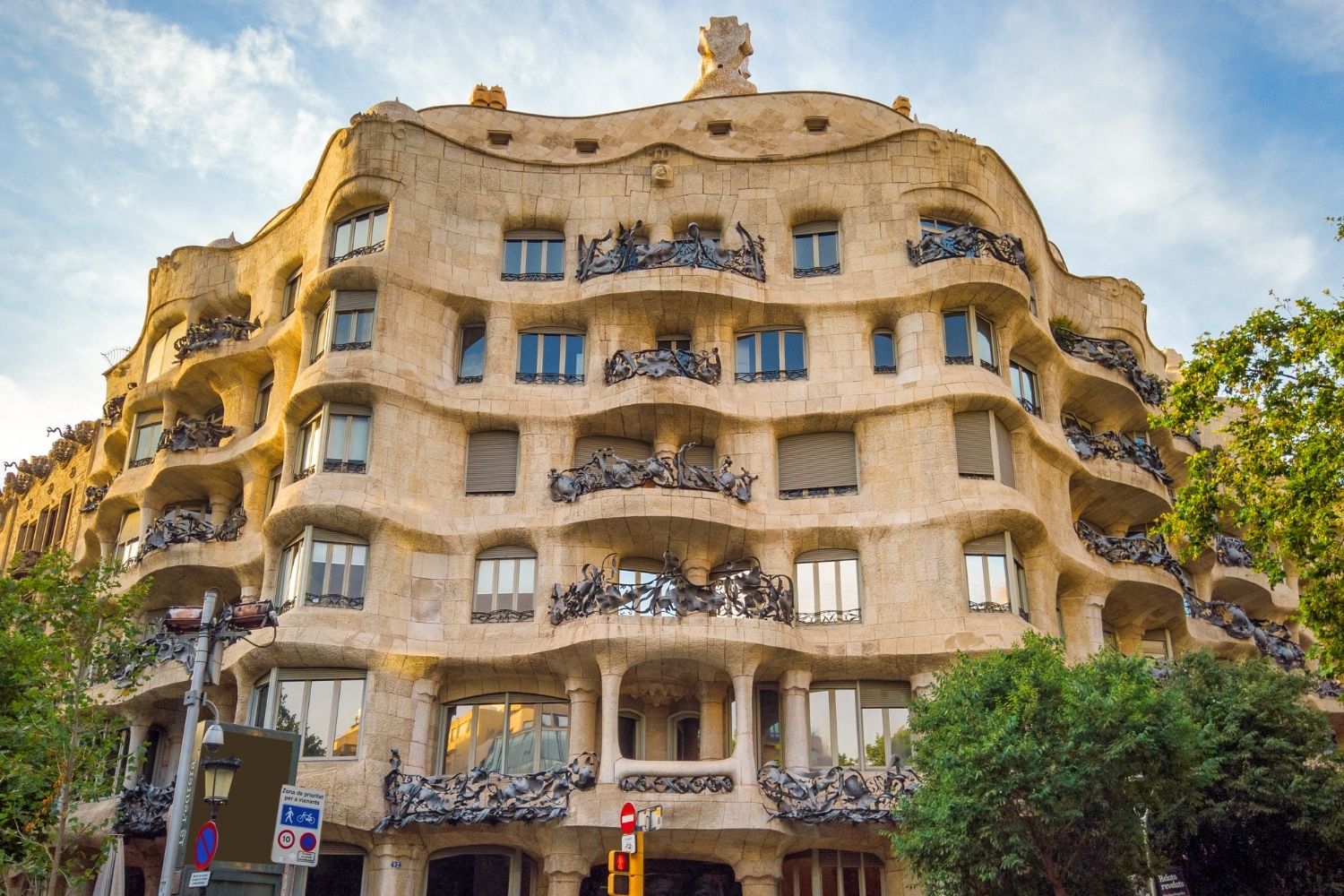
Table of Contents Show
La Casa Milà Barcelona, commonly called La Pedrera, is a residential building designed by Antoni Gaudí between 1906 and 1912 on Passeig de Gràcia. Known for its undulating limestone facade, open-plan interiors, and sculptural rooftop chimneys, it was Gaudí’s last civil work before he devoted himself entirely to the Sagrada Família. UNESCO designated it a World Heritage Site in 1984.
Stand at the corner of Passeig de Gràcia and Carrer de Provença, and you are looking at a building that caused public outrage when it was completed. Residents of Barcelona’s fashionable Eixample district called it “La Pedrera,” meaning “The Quarry,” mocking its rough, cliff-like exterior. Over a century later, that insult has become a badge of honor. Casa Milà now draws over a million visitors annually and ranks among the most significant residential buildings in European architecture.
Commissioned by the wealthy businessman Pere Milà and his wife Roser Segimon, the project was meant to be a luxury apartment block. Gaudí, already famous for the Sagrada Família and Park Güell, accepted the commission and produced something nobody expected. Instead of a conventional facade with load-bearing walls, he created a self-supporting stone skin draped over a steel and iron skeleton. Apartments inside could be arranged freely because no interior wall carried structural weight.
How Did Gaudí Design the Facade of La Pedrera?
The facade of Casa Milà Barcelona looks like a weathered seaside cliff. Gaudí achieved this effect by cutting limestone blocks from the Garraf and Vilafranca quarries, then shaping each piece to fit the building’s curves. No two blocks are identical. The entire surface rises and falls in continuous waves, broken only by wrought-iron balconies that resemble tangled seaweed or organic vines.
What makes this possible is the structure behind the stone. Gaudí separated the facade from the building’s frame, making the exterior a curtain wall rather than a load-bearing element. This was a radical departure from Barcelona’s traditional Eixample buildings, where thick masonry walls dictated room sizes and window placement. With the structural frame carrying all loads, Gaudí could punch windows wherever natural light demanded them and curve the facade without structural compromise.
📐 Technical Note
Casa Milà’s structure relies on steel columns and iron beams that allow a free floor plan on every level. The facade acts as a non-load-bearing curtain wall, a concept that would only become standard in commercial architecture decades later with the steel-and-glass towers of Mies van der Rohe. Gaudí achieved this in 1906 using hand-cut stone rather than industrialized glass panels.
The wrought-iron balcony railings were designed by Josep Maria Jujol, Gaudí’s close collaborator. Each balcony piece was forged from recycled scrap metal, twisted and shaped to resemble natural growth patterns. Jujol’s work on La Pedrera, Casa Milà parallels what he did with the trencadís mosaic bench at Park Güell: turning discarded materials into sculptural art.
Casa Milà Interior: Rooms Without Straight Lines
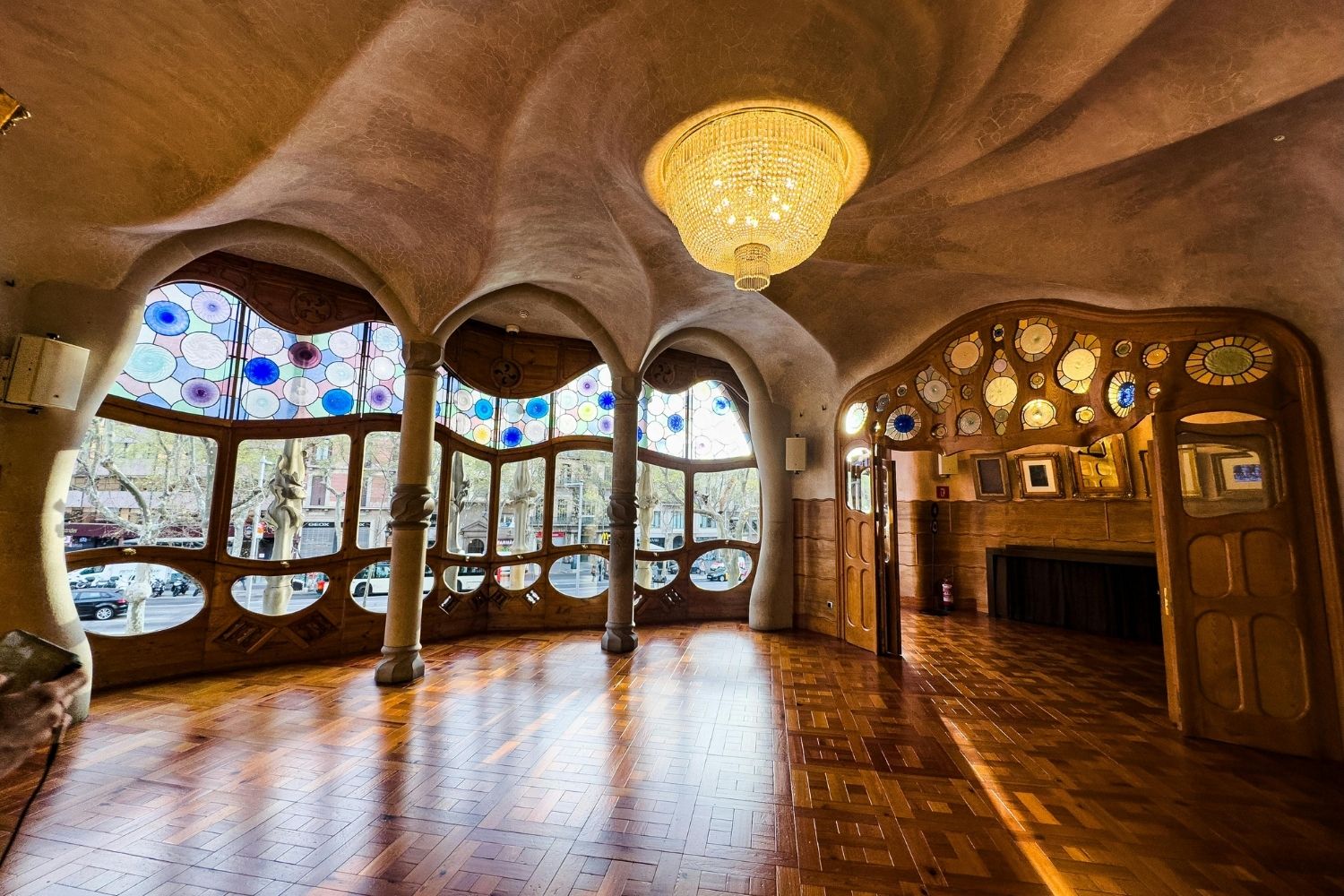
Step inside the building and the innovation becomes even clearer. Because the steel frame carries all structural loads, the interior walls of Casa Milà serve only as partitions. Tenants could rearrange room layouts to suit their needs, a flexibility that residential buildings in 1912 Barcelona simply did not offer. Gaudí designed two large interior courtyards, one circular and one oval, to bring natural light and ventilation deep into the floor plan.
The courtyards are painted in gradients of color that grow lighter toward the top, amplifying the sense of natural light as it filters down. Gaudí studied how sunlight entered at different times of day and adjusted window sizes floor by floor. Lower levels have larger openings to capture more light, while upper floors, already bathed in direct sun, use smaller windows. This calibration makes every apartment feel bright without relying on artificial lighting during daytime hours.
One apartment on the fourth floor has been restored with period furniture and decorative arts from the early twentieth century. Walking through its curved doorways and irregularly shaped rooms, visitors can see how Gaudí carried the organic language of the facade into handles, ceiling moldings, and floor tiles. Even the door hardware follows flowing, asymmetric lines.
🎓 Expert Insight
“The straight line belongs to men, the curved one to God.”
Antoni Gaudí
This well-documented statement captures the philosophy that shaped every element of Casa Milà. Gaudí believed that nature never produces perfectly straight lines, and architecture should follow the same principle. The casa milà interior reflects this conviction in every wall, ceiling, and floor surface.
The Rooftop: Warrior Chimneys Above Barcelona
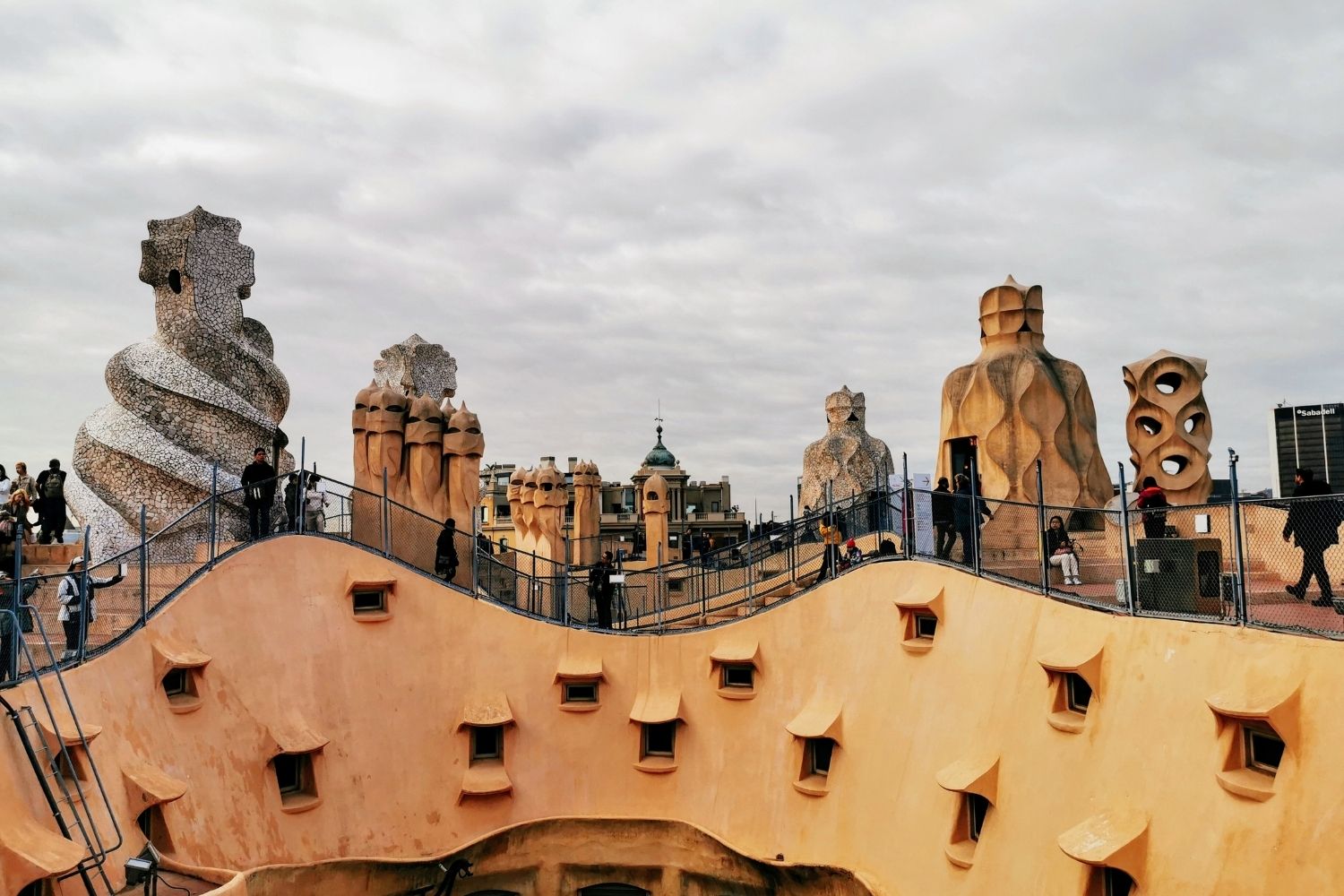
The rooftop of La Pedrera, Casa Milà is where the building’s character reaches its most theatrical expression. Thirty chimney stacks rise from the undulating terrace, each one sculpted into a form that resembles a helmeted soldier, a hooded figure, or an abstract totem. Locals and guidebooks call them “the warriors.” Some are covered in broken ceramic tile (trencadís), others in marble fragments, and a few are left in bare rendered plaster.
These chimneys are not decoration. They function as ventilation shafts and fireplace flues, pulling smoke and stale air out of the apartments below. Gaudí shaped them to optimize airflow while turning a mundane rooftop utility into sculpture. From the terrace, visitors also get panoramic views of Barcelona’s grid, with the towers of the Sagrada Família visible to the northeast and the Mediterranean Sea to the south.
Video: Walking Through Casa Milà’s Interior and Rooftop
This 4K tour covers the building’s entrance, the attic exhibition space known as the Whale Attic, and the full warrior rooftop terrace.
The Whale Attic and Gaudí’s Structural Logic
Below the rooftop sits the attic, a space defined by 270 catenary arches built from thin bricks. These arches, shaped like inverted hanging chains, distribute weight efficiently without requiring thick walls or buttresses. The result is a long, open gallery that demonstrates Gaudí’s approach to structure in its purest form. Because the arches handle all loads, the attic has no internal columns or partitions.
Originally, this space served as a communal laundry and storage area for tenants. Today it houses the Espai Gaudí exhibition, displaying models, drawings, and photographs that explain the structural principles behind Gaudí’s major works. The attic earned its nickname, “The Whale,” because walking through the repeated arches feels like standing inside the ribcage of a massive sea creature.
🏗️ Real-World Example
Casa Milà Attic (Barcelona, 1912): The 270 catenary brick arches spanning the attic level carry the roof load without any columns. Each arch follows the natural compression curve of a hanging chain flipped upside down, eliminating the need for reinforcement. This technique predates the shell structures that engineers like Félix Candela would popularize forty years later.
Why Was Casa Milà So Controversial?
When Pedrera Casa Milà was completed in 1912, Barcelona’s city council fined Gaudí for exceeding the approved building volume. One pillar on the ground floor projected beyond the official street line, and the overall height surpassed the Eixample district’s regulations. The dispute dragged on for years. Meanwhile, satirical magazines published cartoons mocking the building’s organic forms, suggesting it looked like a parking garage for airships or a quarry accidentally left standing.
Pere Milà himself grew frustrated with rising construction costs and clashed with Gaudí over design decisions. The relationship soured so badly that Gaudí reportedly sued the Milà family for unpaid fees. Despite the controversy, the building attracted attention from architects and critics who recognized its structural originality. Le Corbusier visited Barcelona in 1928 and sketched Casa Milà in his notebook, noting how the free plan anticipated ideas he was developing for his own projects.
Visiting La Pedrera – Casa Milà Today
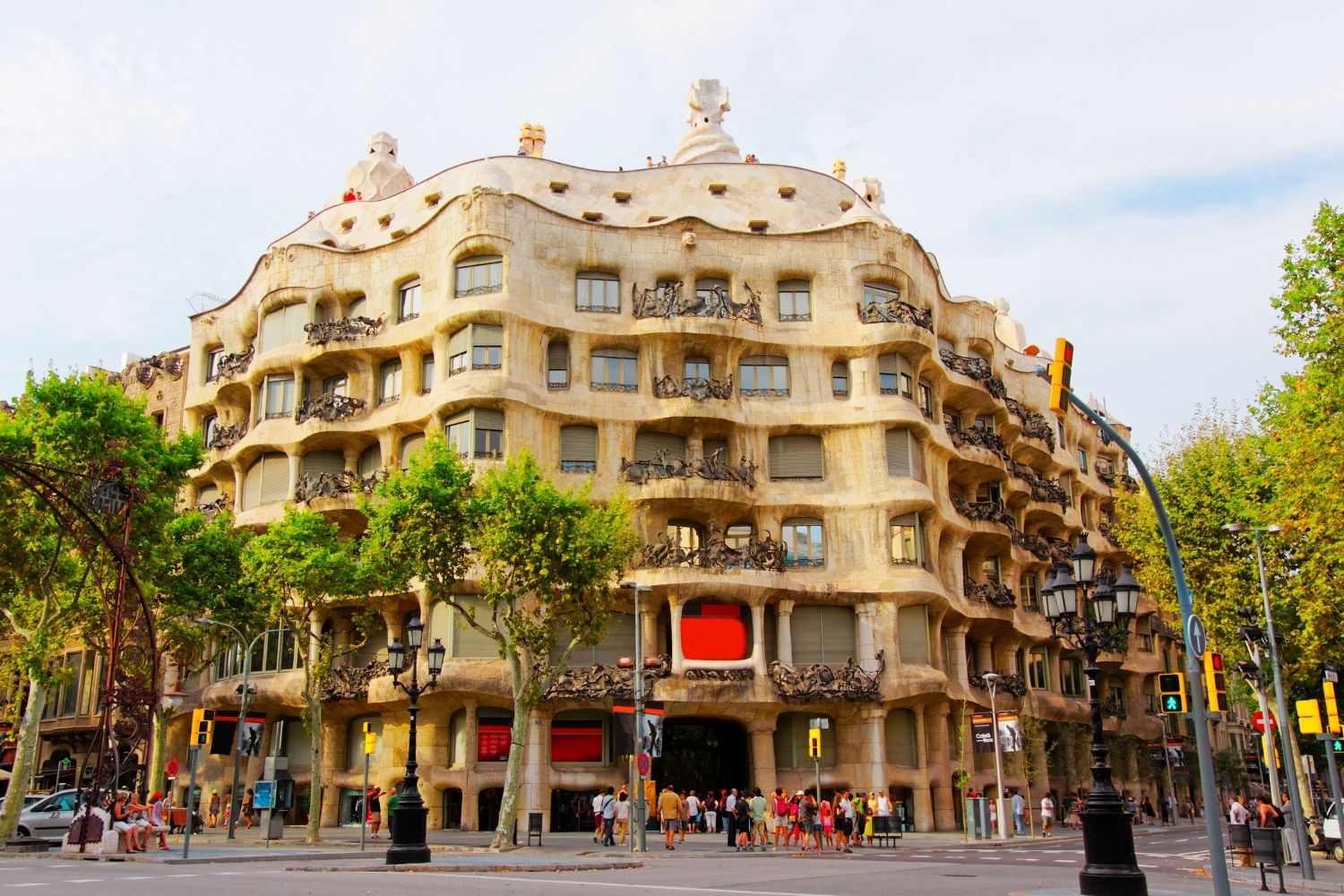
Casa Milà Gaudi Barcelona operates as a museum and cultural center managed by the Fundació Catalunya La Pedrera. The standard daytime visit includes access to the rooftop terrace, the Whale Attic, a restored early twentieth-century apartment, and the ground-floor exhibition hall. Audio guides are included with every ticket.
The building sits at Passeig de Gràcia 92, within walking distance of Casa Batlló and several other landmarks of Catalan Modernisme listed by UNESCO. A night experience called “La Pedrera: The Origins” offers a rooftop light-and-music show projected onto the warrior chimneys. Buying tickets through the official website avoids the surcharge applied at the door, and advance booking is strongly recommended during peak season.
For those interested in Gaudí’s broader legacy, combining a visit to Casa Milà with stops at the Sagrada Família and Park Güell covers the three UNESCO-listed works that best represent his evolution from historicist beginnings to fully organic architecture.
The Bigger Picture
Most early twentieth-century architects chased new materials: glass, reinforced concrete, steel frames. Gaudí did something different at Casa Milà Barcellona. He took the oldest building material available, hand-cut limestone, and used a modern structural skeleton to free it from every conventional constraint. The building does not look forward or backward. It looks sideways, toward biology, geology, and the sea, and asks whether a city block can grow the way a cliff face does. More than a hundred years later, no one has tried to answer that question quite the same way.


Interior Design for Commercial Spaces: Enhancing Functionality and Brand Identity
Commercial interior design has to serve brand, function and regulation at once....
 Begum Gumusel4 Mins read

Famous Buildings in Los Angeles: Icons of LA Architecture
Nine of the most famous buildings in Los Angeles profiled: architect, year,...
 illustrarch Editoral Team9 Mins read
Futuro House Production Revived in Finland After Decades-Long Hiatus
A Facebook listing for abandoned moulds led to the first new Futuro...
illustrarch Editoral Team3 Mins read
Building Your Dream Home in NSW: What You Should Know About Montgomery Homes
Montgomery Homes has been building across Sydney, Newcastle, the Hunter, Wollongong and...
illustrarch Editoral Team4 Mins read


Leave a comment