

Teotihuacan: Monumental Urbanism of a Lost Civilization
Explore the monumental urbanism of Teotihuacan, from the Pyramid of the Sun and Moon to the Avenue of the Dead. Learn how this ancient Mexican city pioneered grid planning, talud-tablero architecture, and multi-family housing compounds that shaped Mesoamerican civilization for over 700 years.
 Sinan Ozen5 June 20268 Mins read188
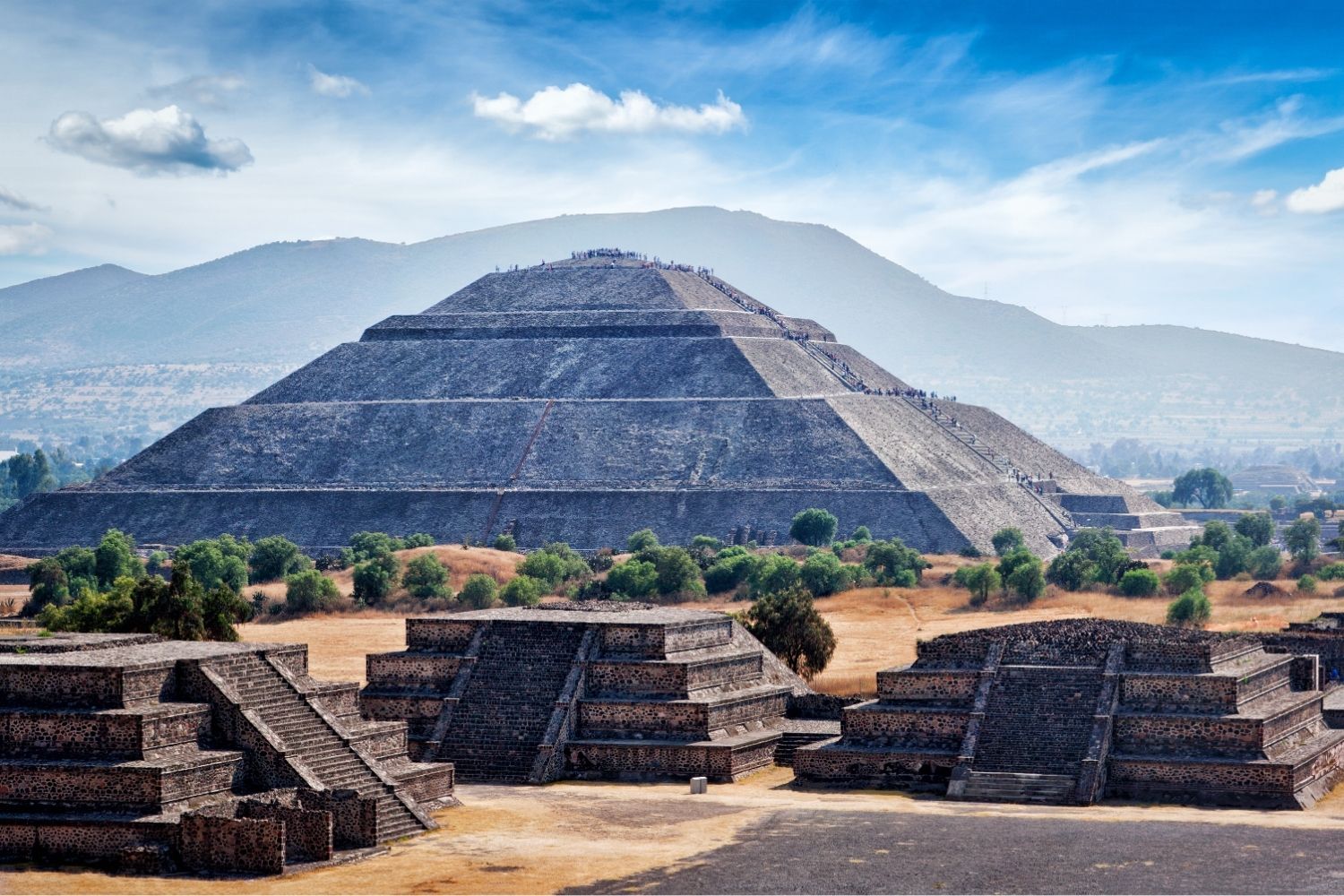
Table of Contents Show
Teotihuacan was the largest city in the pre-Columbian Americas, a planned urban center in central Mexico that housed up to 125,000 residents at its peak around 450 CE. Its pyramids, grid-aligned streets, and standardized residential compounds represent one of the earliest and most ambitious examples of monumental urbanism in world history, influencing Mesoamerican architecture and city design for centuries after its decline.
Located roughly 40 kilometers northeast of modern Mexico City in the Valley of Mexico, Teotihuacan rose from a modest settlement around 100 BCE into a sprawling metropolis that covered more than 20 square kilometers by the fifth century CE. Unlike many ancient cities that grew organically around a single palace or temple, Teotihuacan was deliberately planned. Its builders laid out a central axis, constructed massive pyramids of stone and earth, and organized the population into apartment-like compounds that had no real parallel anywhere else in the ancient world. The city’s name, given by the Aztecs centuries after its collapse, translates roughly to “the place where the gods were created.” The Aztecs themselves did not build it. They found its ruins and assumed only divine forces could have produced structures on such a scale. Within the broader timeline of architectural history, Teotihuacan occupies a unique position as a pre-industrial megacity with no clear precedent.
The Avenue of the Dead and the City Grid
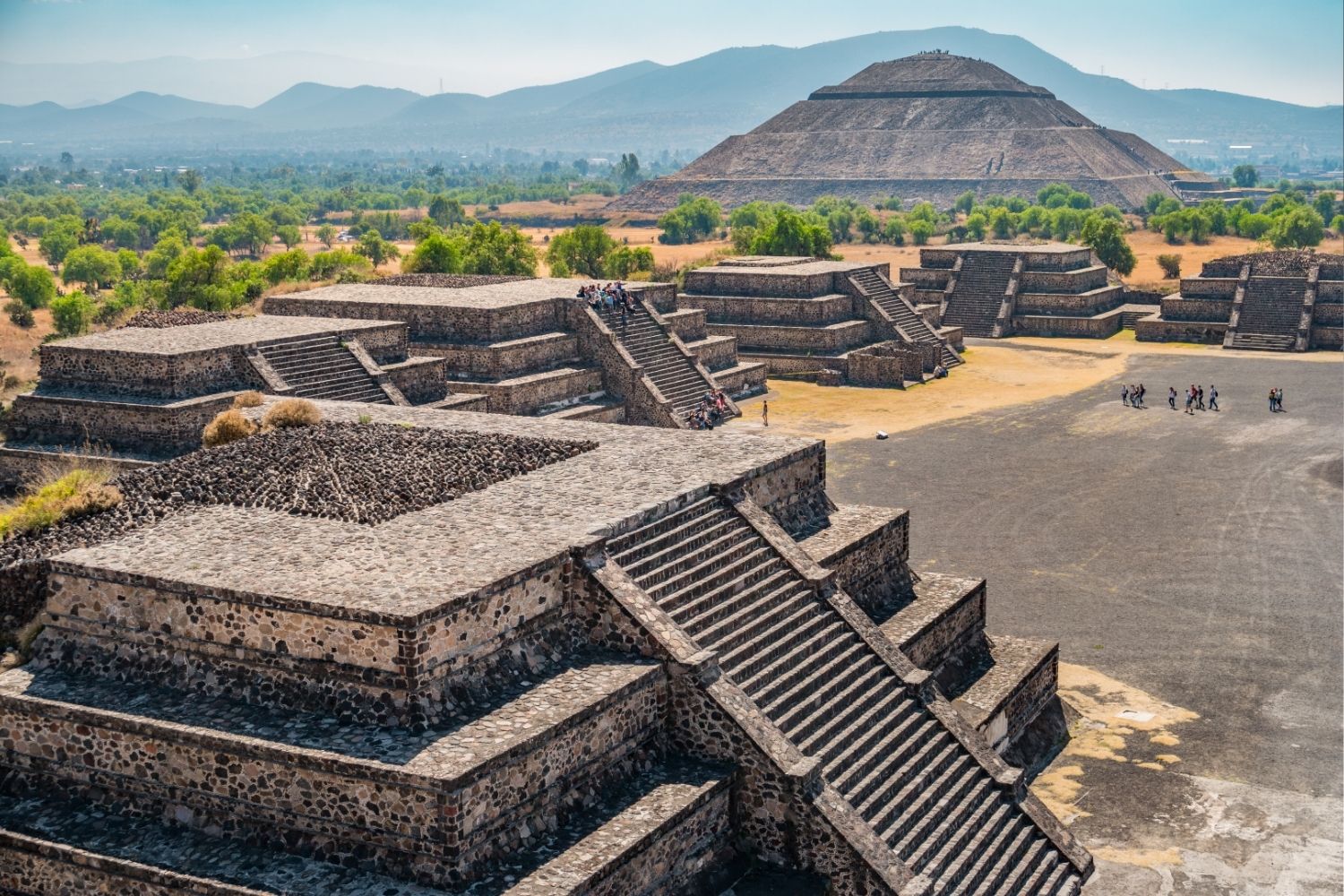
The spine of Teotihuacan is the Avenue of the Dead, a broad ceremonial boulevard stretching approximately 2.4 kilometers from the Pyramid of the Moon in the north to the Ciudadela complex in the south. This avenue was not a road for daily traffic. It functioned as a processional corridor, flanked by platforms, temples, and elite residences that reinforced the city’s political and religious hierarchy. Many of the building techniques used at the site relied on locally sourced volcanic stone and earth, materials that allowed rapid construction at enormous scale. The entire urban layout radiates from this axis, with streets crossing it at roughly perpendicular angles to create a grid pattern that predates comparable European examples by over a thousand years.
📌 Did You Know?
The Avenue of the Dead was not named by the people who built it. The Aztecs, arriving at the abandoned city centuries later, mistook the platform mounds lining the avenue for burial tombs and called it “Miccaotli,” meaning Street of the Dead. Archaeological evidence suggests these structures were actually ceremonial platforms and elite residences.
Archaeologists have identified that the city’s grid was oriented approximately 15.5 degrees east of true north. This alignment was not accidental. Researchers from the Instituto Nacional de Antropología e Historia (INAH) have proposed that it corresponds to astronomical events, possibly the setting point of the Pleiades star cluster, which held deep significance in Mesoamerican cosmology. The grid extended well beyond the monumental core, organizing residential neighborhoods across the entire city. Streets, drainage channels, and compound walls all followed this orientation, creating an urban fabric with a consistency that rivals planned cities from later periods in architectural history.
Pyramids of Teotihuacan: Scale and Construction
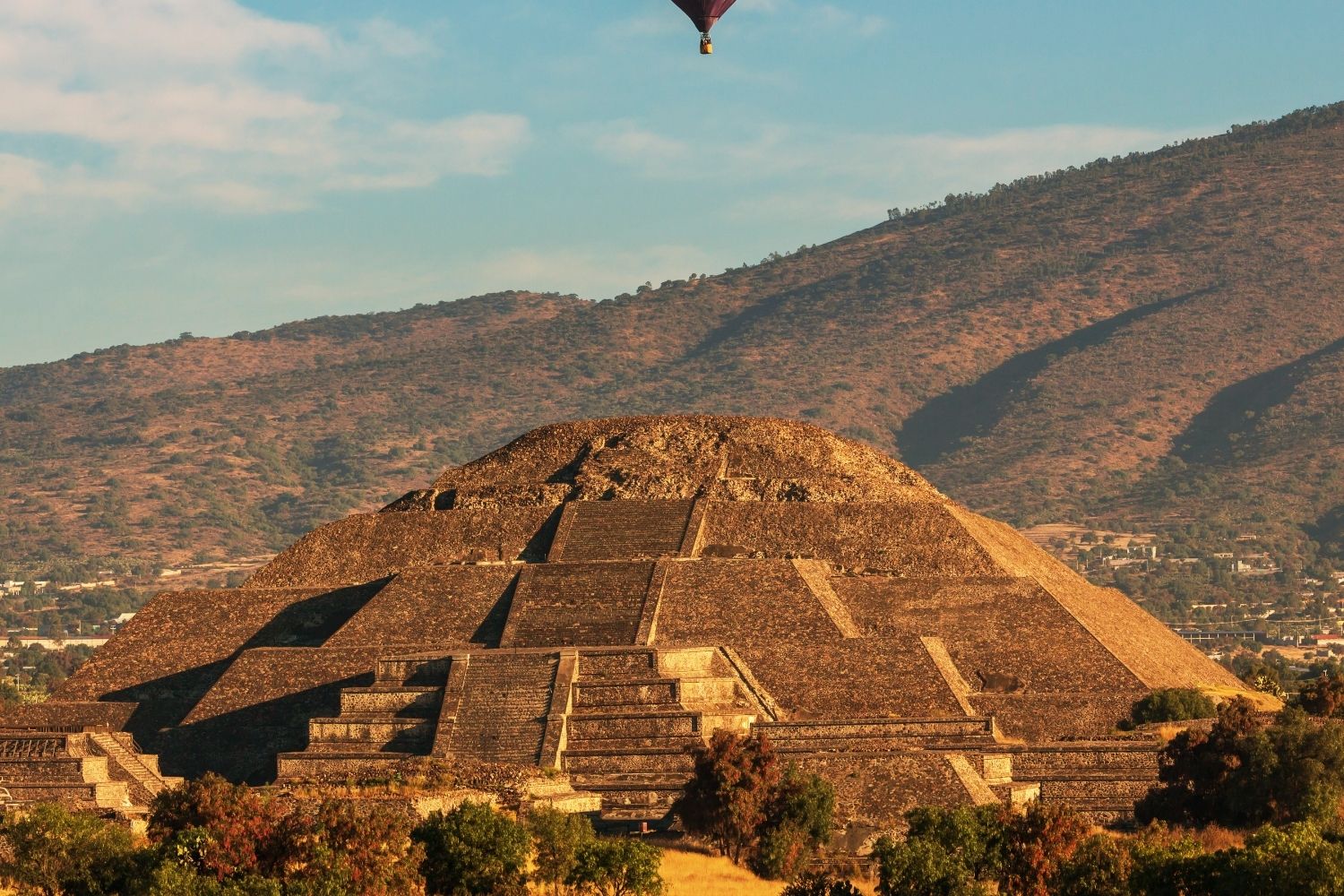
The pyramids of Teotihuacan remain among the most impressive structures ever built in the ancient Americas. Recognized as a UNESCO World Heritage Site since 1987, the site’s monumental core centers on two dominant structures. The Pyramid of the Sun, the city’s largest monument, stands approximately 65 meters tall with a base measuring roughly 225 by 222 meters. That base footprint is nearly identical in size to the Great Pyramid of Giza, though Teotihuacan’s pyramid is about half as tall. Construction involved an estimated 1.2 million cubic meters of fill material, including volcanic rock (tezontle), adobe, and rubble, stabilized by stone retaining walls. The entire structure was completed in a single building phase around 100 CE, which implies a massive, coordinated labor force working over several decades.
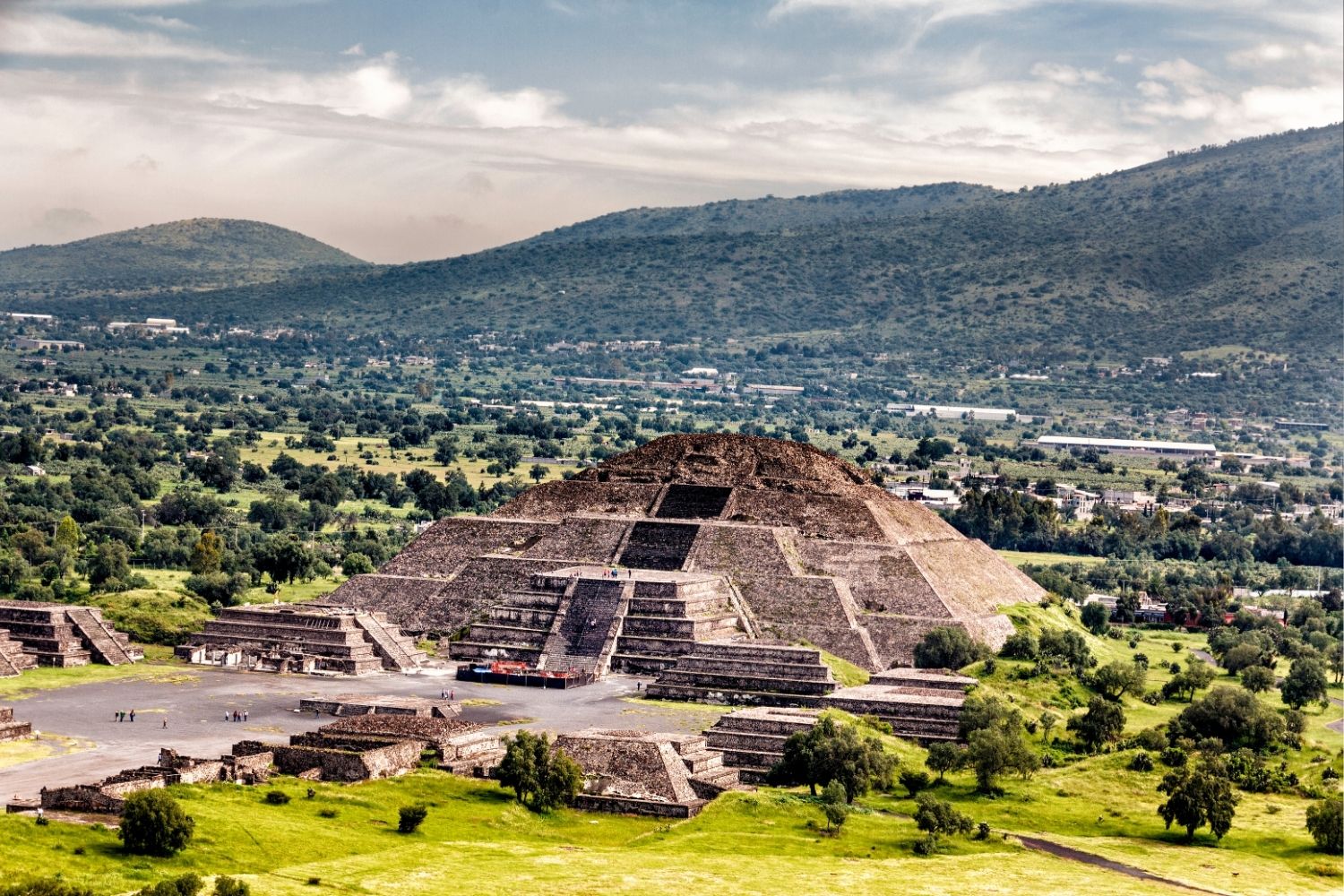
The Pyramid of the Moon, positioned at the northern end of the Avenue of the Dead, is smaller but arguably more refined. It was built in at least six construction phases between approximately 100 and 350 CE, each phase enlarging the structure and adding new layers over the previous one. Excavations led by Saburo Sugiyama and Rubén Cabrera Castro in the early 2000s uncovered sacrificial burials, animal remains, and greenstone figurines within the pyramid’s interior, evidence that each construction phase was marked by elaborate dedicatory rituals.
💡 Pro Tip
When studying the pyramids of Teotihuacan, pay attention to how each structure relates to its surrounding plaza rather than viewing it in isolation. Mesoamerican pyramids were designed as part of plaza-pyramid complexes where the open space was just as important as the built mass. The plaza in front of the Pyramid of the Moon, for example, was carefully graded to create a stage-like setting for public ceremony visible to thousands of spectators.
Talud-Tablero: The Signature Architectural Style
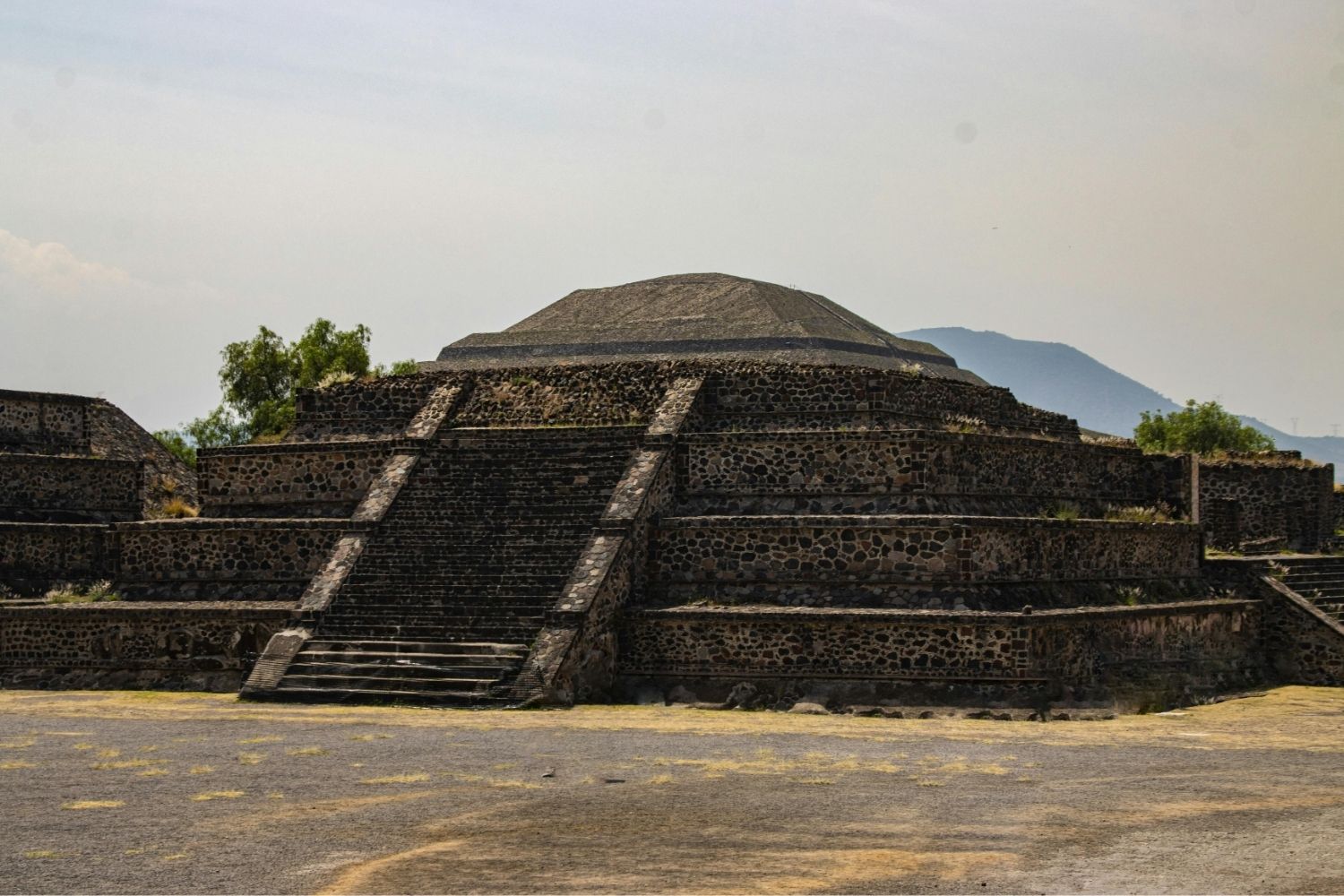
The most distinctive architectural feature of Teotihuacan is the talud-tablero profile, a two-part wall system consisting of a sloping lower panel (talud) topped by a rectangular framed panel (tablero) that projects outward. This motif appears on virtually every major platform and pyramid at Teotihuacan, repeated in stacked tiers to create the stepped profiles visible today. The tablero panels were often finished with painted stucco, sometimes in vivid reds, greens, and blues, giving the buildings a dramatically different appearance from the weathered stone visitors see now.
The talud-tablero system was not purely decorative. The sloping talud helped shed rainwater away from the structure’s core, while the projecting tablero created strong horizontal shadow lines that accentuated the building’s mass and visual rhythm. This style became so closely associated with Teotihuacan that its appearance at distant sites across Mesoamerica, from Kaminaljuyú in highland Guatemala to Monte Albán in Oaxaca, is considered strong evidence of the city’s political and cultural influence. For context on how ancient architectural styles spread across civilizations, the talud-tablero’s reach was exceptional.
The Feathered Serpent Pyramid and Its Sculptural Program
The Temple of the Feathered Serpent, located within the Ciudadela compound at the southern end of the Avenue of the Dead, is the most elaborately decorated structure at Teotihuacan. Its facades carry large-scale stone carvings of feathered serpent heads alternating with a second figure, often interpreted as a storm deity or war serpent. These sculptures were originally painted and fitted with obsidian eyes, producing an effect that must have been visually striking under direct sunlight.
Excavations beneath the pyramid revealed over 200 sacrificial burials arranged in patterns that correspond to the building’s geometry. Individuals were found with their hands bound behind their backs, accompanied by obsidian projectile points, shell ornaments, and carved jawbones. According to research published by Arizona State University’s Teotihuacan Research Laboratory, these burials appear to have been part of the pyramid’s foundation ritual, intended to consecrate the structure at the time of its construction around 200 CE.
🎓 Expert Insight
“Teotihuacan was not simply a religious center with a few monumental buildings. It was a true city, with a planned layout, a diverse population drawn from across Mesoamerica, and an economy based on craft production and long-distance trade.” — George Cowgill, Arizona State University
Cowgill’s decades of fieldwork at the site helped establish that Teotihuacan’s urbanism was as significant as its monumental architecture, shifting scholarly focus from pyramids alone to the broader fabric of the city.
Residential Compounds: Housing a Mesoamerican Metropolis
What makes Teotihuacan genuinely unusual among ancient cities is its residential architecture. Rather than the huts, shanties, or loosely clustered houses typical of preindustrial urbanism, Teotihuacan’s population lived in standardized, walled apartment compounds. Archaeologists have identified over 2,000 of these compounds across the city. Each one was a self-contained unit enclosed by high exterior walls, containing multiple rooms arranged around open courtyards with central drainage systems. A single compound could house between 60 and 100 people, likely organized by kinship, occupation, or ethnic affiliation.
The compounds varied in quality and elaboration. Elite compounds near the Avenue of the Dead featured plastered walls with polychrome murals depicting religious scenes, processions, and mythological figures. Working-class compounds on the city’s periphery were simpler but still followed the same basic layout. This standardization suggests strong centralized planning and a degree of social organization that goes beyond what most ancient states achieved. Anyone interested in studying ancient architecture will find that Teotihuacan’s compound system is one of the best-documented examples of pre-industrial mass housing.
⚠️ Common Mistake to Avoid
Many sources describe Teotihuacan as an “Aztec city.” This is incorrect. Teotihuacan was already abandoned and in ruins for roughly 700 years before the Aztec Empire arose in the 14th century. The Aztecs visited the site as a place of pilgrimage and named it, but they had no role in building it. The identity of Teotihuacan’s original builders remains debated among archaeologists.
Why Did Teotihuacan Collapse?
Teotihuacan experienced a dramatic decline around 550 to 650 CE. Evidence of widespread burning, particularly along the Avenue of the Dead, suggests that the city’s monumental core was deliberately destroyed. Whether this destruction was caused by an internal revolt, an invasion, or a combination of social and environmental pressures remains one of Mesoamerican archaeology’s open questions.
What is clear is that the collapse was not sudden. Population had already begun declining in some neighborhoods before the burning events. INAH researchers have pointed to possible environmental degradation, including deforestation of the surrounding valley needed to produce the lime plaster that coated the city’s buildings. The demand for fuel and construction materials may have slowly undermined the agricultural base that sustained such a large urban population. After the collapse, the site was never reoccupied at scale, but its architectural legacy continued to shape building traditions across the region.
Teotihuacan’s Influence on Later Mesoamerican Architecture
The architectural vocabulary developed at Teotihuacan, particularly the talud-tablero profile, the plaza-pyramid complex, and the concept of a gridded ceremonial city, spread across Mesoamerica during the city’s centuries of dominance. Sites in the Maya lowlands, the Oaxaca valley, and along the Gulf Coast adopted elements of Teotihuacan’s building style, sometimes through direct political contact and sometimes through cultural emulation.
The Aztecs, who encountered the ruins centuries later, incorporated Teotihuacan into their own origin mythology. They believed it was the place where the current cosmic age began and where the sun and moon were born. This sacred status influenced Aztec architectural practice: the Templo Mayor in Tenochtitlán (modern Mexico City) echoed Teotihuacan’s twin-pyramid arrangement and processional axiality. For those studying influential ancient buildings from other traditions, the transmission of Teotihuacan’s ideas offers a parallel to how Greek and Roman forms spread through the Mediterranean world.
Video: Teotihuacan Origins, Urbanism, and Daily Life
This lecture by David M. Carballo from Boston University, delivered as the 2025 Gordon R. Willey Lecture, covers the origins, urban development, and daily life at Teotihuacan from an archaeological perspective.
Visiting Teotihuacan Today
The archaeological site of Teotihuacan receives over 2.6 million visitors annually, making it the most visited archaeological site in Mexico. It is managed by INAH and protected under criteria that recognize its outstanding universal value as a pre-Hispanic city.
The excavated area covers only a fraction of the original city. Ongoing research continues to reveal new findings: in 2003, a tunnel was discovered beneath the Temple of the Feathered Serpent, and its full excavation, completed around 2015, uncovered thousands of artifacts including pyrite mirrors, rubber balls, and greenstone sculptures. These discoveries, led by archaeologist Sergio Gómez Chávez, have reshaped understanding of the city’s ritual practices and political organization.
🏗️ Real-World Example
Teotihuacan Site Museum (Mexico, 2018 renovation): The on-site museum, located between the Pyramid of the Sun and the Ciudadela, was renovated to display artifacts in context with the city’s architectural development. Its exhibition design follows the chronological sequence of construction phases, allowing visitors to connect specific objects, such as mural fragments and obsidian tools, to the buildings and compounds where they were originally found.
Final Thoughts
Teotihuacan stands apart from other ancient sites because it was not just a collection of monuments but a fully planned city. Its grid layout, standardized housing, and monumental architecture together represent an approach to urbanism that was centuries ahead of comparable developments elsewhere. The pyramids of Teotihuacan draw the most attention, and rightly so, but the residential compounds, drainage infrastructure, and mural programs tell an equally important story about how tens of thousands of people organized their daily lives within a single, deliberately structured urban environment. For architects, historians, and urban planners, the site remains one of the most instructive examples of cultural architecture as a living record of human ambition and organization.
A site engineered as a single continuous artefact of land, water and settlement is what heritage practice now calls a cultural landscape.






Relocated Maya Structures at Mexico’s Balam Tun Memory Park Face Legal Challenge
INAH archaeologists have filed a complaint against 26 officials over Balam Tun...
 illustrarch Editoral Team2 Mins read
Allies and Morrison Win Approval to Restore Barbican Sculpture Court
City of London Corporation approves Allies and Morrison's plan to restore the...
illustrarch Editoral Team2 Mins read
The Great Wall of China: History, Architecture, and Enduring Legacy
A detailed architectural exploration of the Great Wall of China covering its...
 Furkan Sen7 Mins read
Prague Architecture: How Charles Bridge and Prague Castle Built Bohemian Gothic
Charles Bridge and Prague Castle explained as architecture: the 1357 bridge under...
Furkan Sen6 Mins read


Leave a comment