

Floor Plans of Most Known TV Series, Friends, Big Bang Theory
 Begüm Şardan1 February 20193 Mins read446
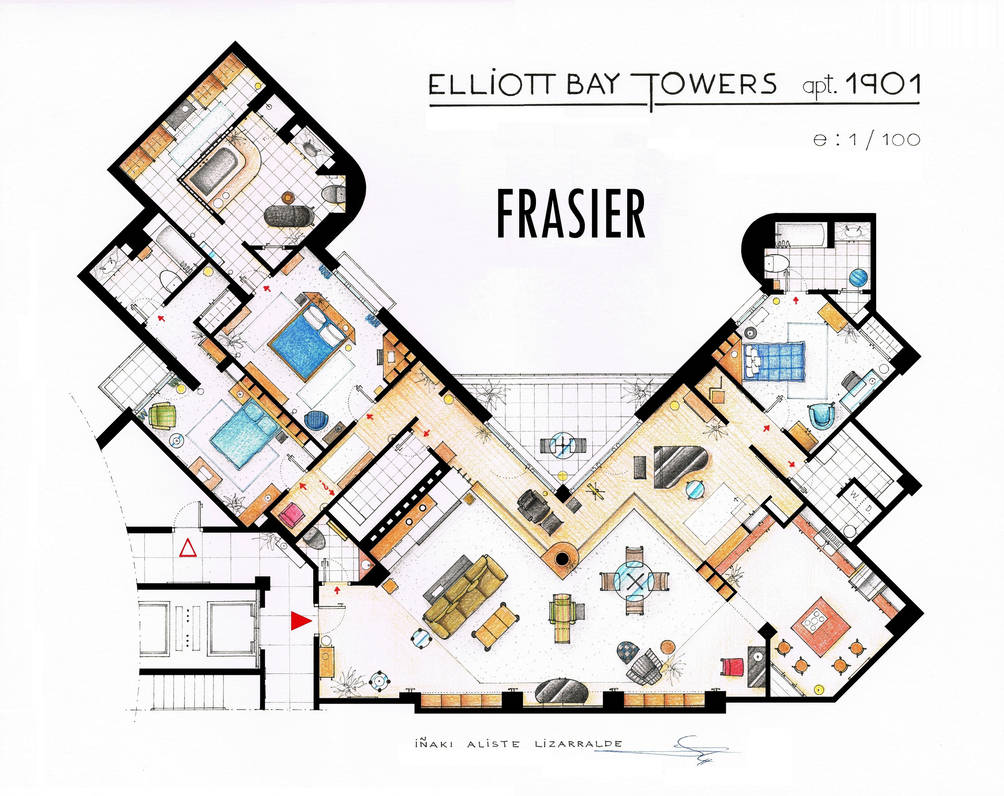
Table of Contents Show


Why Fictional Floor Plans Resonate With Architects
A sitcom set is built for camera angles, not for people to live in, yet fans rarely notice the contradictions until someone draws the plan. Reconstructing an apartment from a TV series forces the illustrator to reconcile dozens of separate shots filmed across many seasons, often on sets that were quietly remodeled between episodes. The result is part architecture and part detective work. For designers, these drawings are a reminder that spatial memory is built from fragments, and that a believable interior depends on consistency the audience feels rather than measures.
How a Set Differs From a Real Apartment
Television interiors break several rules that govern real residential design. Walls are removable so cameras and lighting rigs can move freely, ceilings are frequently missing to allow overhead equipment, and rooms are made oversized so a crew can work around the actors. The famous Friends apartment, for instance, would be implausibly large and well lit for its rent in real Manhattan. When an illustrator like Lizarralde redraws these spaces, the hardest task is choosing which version of reality to honor: the impossible on-screen geometry or a plausible plan a person could actually inhabit.
The Case for Hand Drawing
Choosing pencil and watercolor over CAD is a deliberate communication strategy. Hand-drawn plans read as warm and approachable, which matters when the audience is the general public rather than a building department. Soft linework and color let the illustrator emphasize the rooms people remember while quietly simplifying the parts that were never shown on screen. CAD would demand precision the source material cannot supply, so the analog approach is both an aesthetic choice and a practical one. It is a useful lesson for any architect preparing presentation drawings for non-specialist clients.
Try It Yourself: Mapping a Space From Memory
You can practice the same skill on any show you know well. Start by listing every room you have seen, then sketch the adjacencies, noting which doorways characters walk through and where windows appear. Establish a rough scale using a known object such as a sofa or refrigerator, then test your plan against tricky shots that reveal sightlines across multiple rooms. Where the footage contradicts itself, make a reasoned choice and move on. This exercise sharpens the ability to translate scattered visual information into a coherent plan, a core skill in survey and renovation work.
Key Takeaways
Lizarralde’s series shows that floor plans can be popular culture, not just technical documents. They invite non-architects to think spatially, they expose the gap between staged sets and livable homes, and they prove that clear communication often beats technical precision when the goal is to help people understand a space. For students and professionals alike, studying these illustrations is a low-stakes way to practice reading and representing interiors.





Open Plan vs Closed Plan: Which Layout Works Better for Modern Living?
Open plan and closed plan layouts each bring distinct advantages to modern...
 Sinan Ozen6 Mins read

AI Floor Plan Generator: Top 8 Tools for Architects & Designers
This guide compares the top AI floor plan generators available in 2026,...
 Furkan Sen11 Mins read

Architecture Plan: Tips for Creating & Presenting Plans
Learn how to create and present professional architectural plans with this comprehensive...
 Elif Ayse Sen11 Mins read

Federico Babina Archiplan: Floor Plans of Famous Architects
Federico Babina's ARCHIPLAN series transforms the floor plans of 25 master architects...
 İrem Uluışık3 Mins read


Leave a comment