

Architecture Paper Sizes For Architects And Students
Understanding architectural paper sizes is essential for architects and students. This guide covers ARCH, ANSI, and ISO paper size series with complete dimension charts, blueprint standards, and practical tips for choosing the right drawing size for your project.
 Furkan Sen6 June 202210 Mins read969

Table of Contents Show
Quick answer: Architectural paper sizes are the standard sheet formats used for drawings. The ISO A series runs from A4 up to A0, while the North American ARCH series ranges from ARCH A at 9 by 12 inches to ARCH E at 36 by 48 inches. Larger sheets suit site plans and detailed construction drawings.
Whether it is a sketch or a CAD drawing or an illustration, architects always present their work on paper. Even if it is a digital format, the extent of the paper is essential to determine the composition of the content and font size. Understanding architectural paper sizes is fundamental for anyone working in the architecture and construction industry. In this comprehensive guide, we cover every standard architecture paper size—from ANSI and ARCH series to ISO formats—so you can choose the right drawing size for your next project.
What Are Architectural Paper Sizes?

Standards in architectural paper sizes have existed for over a century, originating from the need for consistency across the drafting and printing industries. In most cases, the choices on the size of the paper are not decided arbitrarily. Aspect ratios and dimensions are highly impactful decisions that affect the design, readability, and scalability of architectural drawings.
Similar to the metric and the imperial measurement system, paper sizes are classified into two primary systems: the ANSI paper size series (American National Standards Institute) and the ISO paper series (International Organization for Standardization). These standards ensure consistency and precision in architectural drawing sizes and construction documents across different countries, firms, and printing services. Today, the ANSI and ISO 216 standards are used worldwide, with North America favoring ANSI/ARCH and the rest of the world primarily using ISO A-series.
Apart from the two main types, there are some loose paper sizes commonly encountered in everyday use: Letter (8.5″×11″), Legal (8.5″×14″), Tabloid (11″×17″), and Ledger (17″×11″). If you have ever wondered what paper size is 8.5×11, it is the standard US Letter size, also classified as ANSI A. Similarly, the 8.5×14 paper size name is Legal.
ANSI Paper Size Series: Dimensions and Uses
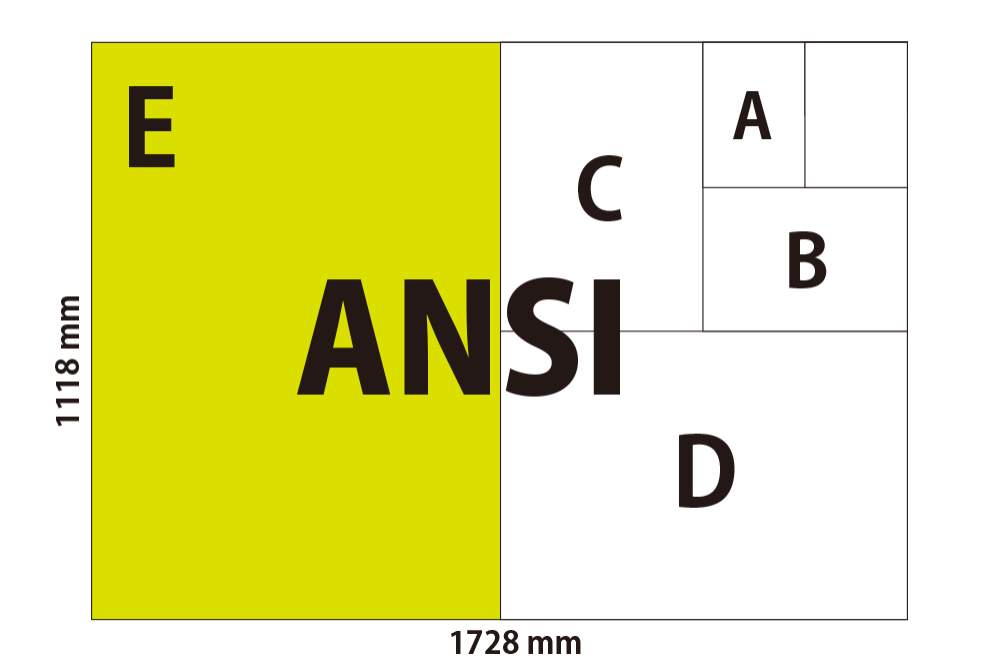
The ANSI paper size series is based on the standard Letter size of 8.5″×11″. Two sheets of each size make up the next larger sheet. The full series is classified as follows:
ANSI A – 8.5″ × 11″ (216 × 279 mm)
ANSI B (ANSI B size paper) – 11″ × 17″ (279 × 432 mm)
ANSI C (ANSI C paper size) – 17″ × 22″ (432 × 559 mm)
ANSI D (paper size ANSI D / ANSI size D) – 22″ × 34″ (559 × 864 mm)
ANSI E (ANSI E size dimensions / ANSI E size paper) – 34″ × 44″ (864 × 1118 mm)
ANSI was mostly used in North America since 1995 and remains the standard for engineering and technical drawing sizes ANSI formats. Note that the ANSI E dimensions (34″ × 44″) make it the largest standard engineering sheet and is commonly used for large-scale civil and structural plans. For a deeper understanding of how these sizes relate to your architectural scale, choosing the correct paper format is critical.
ANSI vs. ARCH: Key Differences
A common source of confusion is the difference between ANSI D and ARCH D. ANSI D measures 22″ × 34″, while ARCH D measures 24″ × 36″. This 2-inch difference in both dimensions can significantly affect scaling, binding margins, and printer settings. In CAD software like AutoCAD and Revit, the default paper size for CAD drawing may vary—Revit defaults to ANSI D (22″×34″), while AutoCAD often defaults to ARCH D (24″×36″). Always verify your different paper size for CAD drawing settings before plotting.
ANSI ARCH Paper Size Series: The Architect’s Standard
ANSI ARCH is an updated version of the ANSI series and is defined as a subset of the ANSI standard. Similar to ANSI, two sheets make up the next sheet size in the ARCH series too, but this format has whole number ratios of 4:3 and 3:2. These ratios are similar to computer screen ratios and so they are easier to work with for digital presentations and scaling.
Here are the complete arch paper sizes with dimensions:
Arch A (arch A size paper / arch A size) – 9″ × 12″ (229 × 305 mm)
Arch B (arch B size paper / arch B paper size / arch B size) – 12″ × 18″ (305 × 457 mm)
Arch C (paper size Arch C / what size is Arch C) – 18″ × 24″ (457 × 610 mm)
Arch D (arch D paper size / arch D size / arch D sheet size / paper size Arch D) – 24″ × 36″ (610 × 914 mm)
Arch E (arch E size paper / what size is Arch E) – 36″ × 48″ (914 × 1219 mm)
Arch E1 (arch E1 paper size / arch E1 size) – 30″ × 42″ (762 × 1067 mm)
The arch sheet sizes are the preferred choice for North American architects. These paper sizes arch formats are specifically designed for architectural drawing paper sizes and construction documentation. The 4:3 and 3:2 aspect ratios allow for easy scaling between sizes and make digital presentations more straightforward, since most monitors share similar proportions.
What Is Arch D Paper Size?
Arch D (24″ × 36″) is the most commonly used architectural size paper in North America. When professionals ask “what is Arch D paper size” or “what size is Arch D,” they are referring to the 24″ × 36″ format—the industry standard for house plans, construction drawings, and blueprint sets. The arch D dimensions (610 × 914 mm) provide ample space for detailed floor plans while remaining manageable for transport and office handling. The size of Arch D is equivalent to two Arch C sheets side by side.
What Is Arch B Paper Size?
Arch B is 12 by 18 inches, or 305 by 457 millimetres. It is exactly twice Arch A and exactly half Arch C, which is what makes the series scale cleanly. In practice it is the study drawing and handout size: large enough to read a small plan at 1:100, small enough to print on a desktop A3+ (13 by 19 inch) printer without a plotter.
What Is Arch E and Arch E1 Paper Size?
Arch E is 36 by 48 inches (914 by 1219 mm) and Arch E1 is 30 by 42 inches (762 by 1067 mm). E1 exists for a practical reason rather than a geometric one: many plotters take a 36 inch roll but cannot handle a 36 inch sheet width with margins, so E1 gives most of the area within a size the machine will actually print. If a set is specified at Arch E and the office plotter is a 36 inch roll, E1 is the size that gets used.
ISO-216 A Series: The Global Standard for Architecture Paper
The ISO-216 A series is the most widely used architecture paper size series globally and is especially popular among architecture students. Its defining feature is that all papers share the same aspect ratio of 1:√2 (approximately 1:1.414), making content easily scalable from one paper size to another. This consistent ratio means any ISO A-series sheet can be folded in half to produce the next smaller size while maintaining the same proportions—ideal for folded brochures and scaled drawings.
ISO series, in particular, has differences at a regional level. For example, the ISO B series in Japan is a few millimeters larger, and the actual ISO B series which matches other countries is named Semi B in Japan.

Here are the most relevant ISO A sizes for architectural work:
A0 – 841 × 1189 mm (33.1″ × 46.8″)
A1 – 594 × 841 mm (23.4″ × 33.1″)
A2 – 420 × 594 mm (16.5″ × 23.4″)
A3 – 297 × 420 mm (11.7″ × 16.5″)
A4 – 210 × 297 mm (8.3″ × 11.7″)
The ISO 216 standard is officially adopted in every country except the United States and Canada. Architecture students worldwide—particularly in Europe, Asia, and the Middle East—rely on the A series for everything from concept sketches to final presentation boards.
Complete Architectural Paper Sizes Chart
For a quick reference, here is a combined arch paper sizes chart covering all three major systems used in architectural and construction drawing sizes:
| Size | Inches | Millimetres | Series | Typical use |
|---|---|---|---|---|
| Arch A | 9 × 12 | 229 × 305 | ARCH | Sketches, small details |
| Arch B | 12 × 18 | 305 × 457 | ARCH | Study drawings, presentation handouts |
| Arch C | 18 × 24 | 457 × 610 | ARCH | Small project plans, details |
| Arch D | 24 × 36 | 610 × 914 | ARCH | The standard working drawing sheet |
| Arch E1 | 30 × 42 | 762 × 1067 | ARCH | Large plans where Arch E will not fit the printer |
| Arch E | 36 × 48 | 914 × 1219 | ARCH | Full construction document sets |
| ANSI A | 8.5 × 11 | 216 × 279 | ANSI | Letter, correspondence and schedules |
| ANSI B | 11 × 17 | 279 × 432 | ANSI | Tabloid, half-size check sets |
| ANSI C | 17 × 22 | 432 × 559 | ANSI | Small engineering drawings |
| ANSI D | 22 × 34 | 559 × 864 | ANSI | Engineering plans |
| ANSI E | 34 × 44 | 864 × 1118 | ANSI | Large engineering plans |
| A0 | 33.1 × 46.8 | 841 × 1189 | ISO 216 | Large presentation and competition boards |
| A1 | 23.4 × 33.1 | 594 × 841 | ISO 216 | Standard UK and EU working drawing sheet |
| A2 | 16.5 × 23.4 | 420 × 594 | ISO 216 | Detail sheets, small plans |
| A3 | 11.7 × 16.5 | 297 × 420 | ISO 216 | Half-size check prints, portfolios |
| A4 | 8.3 × 11.7 | 210 × 297 | ISO 216 | Schedules, reports, correspondence |
This arch paper sizes chart serves as a handy reference for architects, engineers, and students when selecting the right drawing page sizes for their projects.
Difference Between ANSI, ARCH, and ISO Paper Sizes
The major difference between the paper size systems lies in aspect ratio and measurement units. The ratio of the ANSI paper series alternates between approximately 1:1.29 and 1:1.55, the ARCH series uses clean ratios of 4:3 and 3:2, whereas ISO maintains a single consistent aspect ratio of 1:√2 across all sizes. Another difference is that ANSI and ARCH paper sizes are defined in imperial measurements (inches), whereas ISO papers are precisely measured in millimeters.
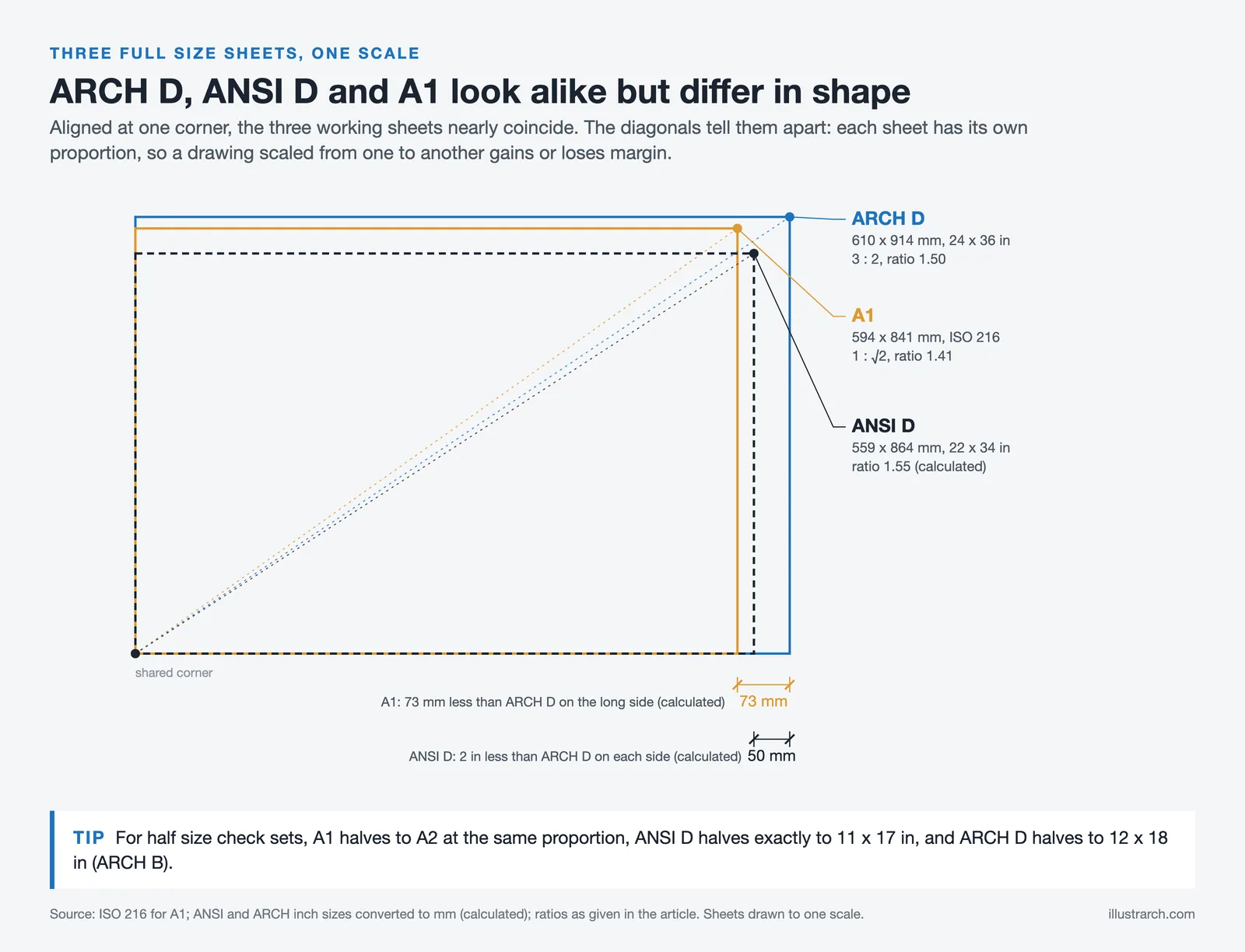
This distinction matters significantly when scaling drawings. With ISO sizes, you can enlarge or reduce a drawing to any other size in the series without changing the aspect ratio. With ANSI and ARCH, the alternating ratios mean that scaling between sizes may leave uneven margins or require cropping. For architects working on international projects, understanding both systems is essential for producing accurate standard size for architectural drawings that can be printed correctly anywhere in the world.
Common Blueprint Sizes and Paper Size for Blueprints
When asking “what size is a blueprint,” the answer depends on the region and project type. Architects generally use ARCH C (18″ × 24″) and ARCH D (24″ × 36″) for blueprint printing of house plans in North America. The Arch E1 (30″ × 42″) size is also gaining popularity for larger residential and commercial projects. However, A1 (594 × 841 mm) is the standard blueprint size in most other countries. A1 and ARCH D are similar in size and are the most commonly used, as they provide adequate space to compose drawings while remaining efficient for transport, viewing, and handling in the office.


Here are the most common blueprint sizes used in practice:
Half-size blueprints: 11″ × 17″ (ANSI B, half of ANSI D), 12″ × 18″ (Arch B, half of Arch D) or 18″ × 24″ (Arch C, half of Arch E) — used for field copies, mark-ups, and review sets
Full-size blueprints: 24″ × 36″ (Arch D) or 22″ × 34″ (ANSI D) — the standard blueprint size for residential and commercial construction documents
Large-format blueprints: 30″ × 42″ (Arch E1) or 36″ × 48″ (Arch E) — used for large commercial, institutional, and infrastructure projects
Understanding blueprint paper sizes helps ensure your CAD drawings are plotted correctly and that construction drawing paper size selections match the project requirements and the capabilities of your printing service.
Standard Size of Architectural Drawings by Project Type
The standard size of architectural drawings varies depending on the project scope and regional norms. Here is a general guide for selecting the right architect drawing sizes:
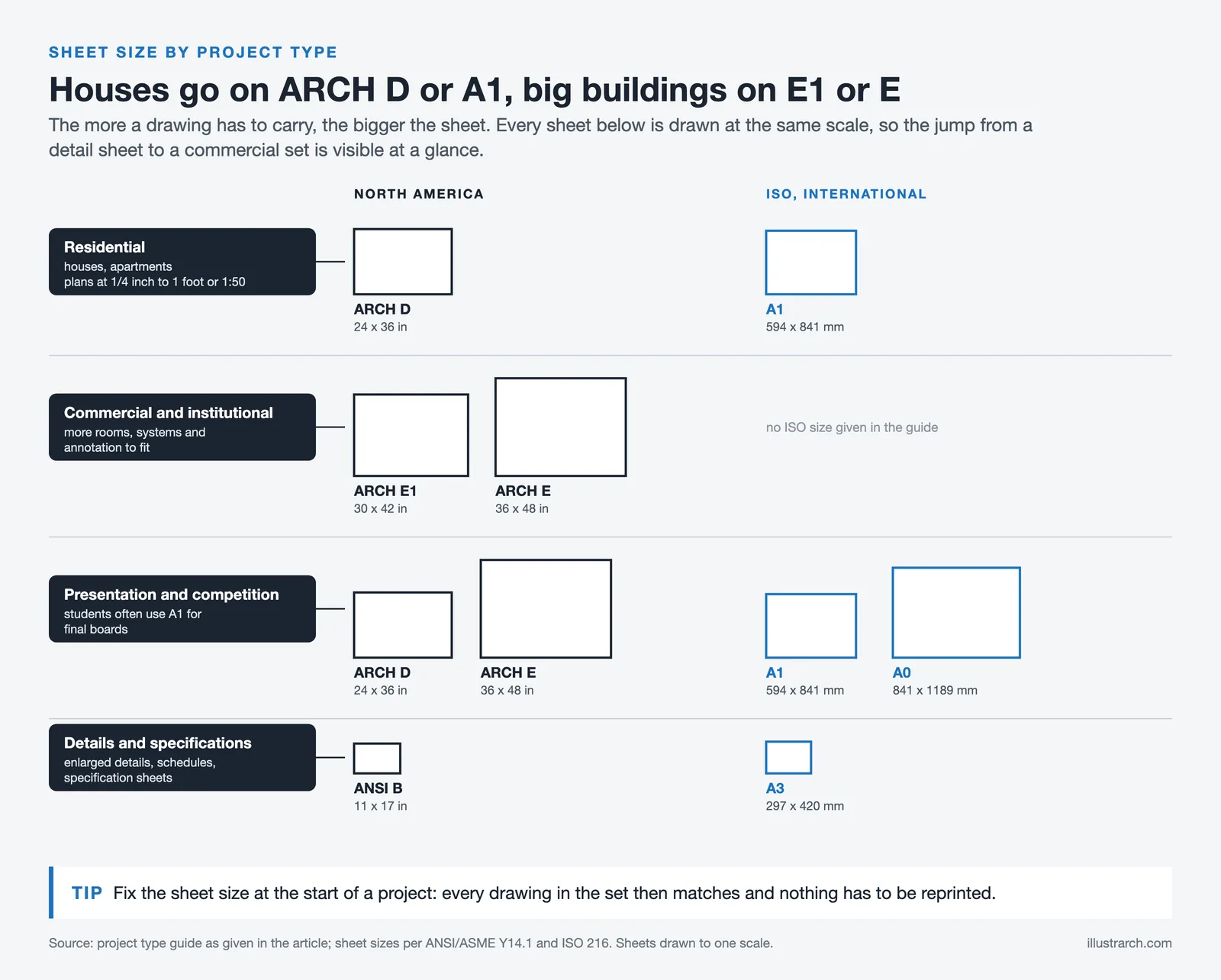
Residential projects (houses, apartments): ARCH D (24″ × 36″) or A1 (594 × 841 mm) — provides enough detail for floor plans, elevations, and sections at common architectural scales like 1/4″ = 1′-0″ or 1:50.
Commercial and institutional projects: ARCH E1 (30″ × 42″) or ARCH E (36″ × 48″) — larger sheets accommodate complex plans with more rooms, systems, and annotations.
Presentation boards and competition entries: A1 or A0 for international submissions; ARCH D or ARCH E for North American presentations. Architecture students often use A1 for final presentation boards.
Detail drawings and specifications: ANSI B (11″ × 17″) or A3 (297 × 420 mm) — suitable for enlarged details, schedules, and specification sheets.
Choosing the right architectural print sizes at the start of a project ensures consistency across all drawings in a set and avoids costly reprinting.
Drafting Paper Sizes for CAD and Digital Workflows
In modern architectural practice, drafting paper sizes are configured digitally within CAD software long before any physical printing occurs. Understanding how paper size for architectural drawings translates from screen to print is crucial for avoiding common scaling errors.
Most CAD programs, including AutoCAD and Revit, allow you to set up paper sizes in your plot or print settings. The CAD symbol for D size paper typically appears in the title block configuration and page setup manager. When setting up different paper size for CAD drawing outputs, always ensure your viewport scale matches the intended sheet size.
Key tips for managing architectural drawing paper size in digital workflows:
Always define your sheet size in your CAD template before starting a project. Verify that your viewport scale and paper size are correctly matched before plotting. When sharing files internationally, include both imperial and metric dimensions in your title block. Use the standard paper size for architectural drawings that your local printing service supports to avoid unexpected cropping or scaling.
For more on optimizing your digital design workflow, explore our guides on architectural design software and graphic tablets for architecture students.
Using Non-Standard Paper Sizes in Architecture
The large differential between the A0 and A1 has led to the use of non-standard paper sizes in some architectural offices. These intermediate paper sizes between A0 and A1 may be used for specialized presentations or competition boards. However, non-standard papers have to be cut from the original paper sizes and are generally not desirable to use. These papers are also not comfortable to fold, store, or handle in standard filing systems.
There are cases where non-standard sizes are acceptable—such as square-format presentation boards or extra-wide panoramic renders. The key is to limit non-standard sizes to special use cases while keeping the majority of your architectural plan sizes within standard dimensions.
Paper Size Management for Architecture Firms
In the architecture industry, many projects require different paper sizes which may not fit the standard formats, and it can be tempting to use unique sizes for every sheet. However, maintaining consistency in size is essential for better presentation, readability, and efficient document management. It is good practice to choose a single set of standard architectural drawing sizes in your firm and use them throughout every project.
If a situation arises requiring intermediate paper sizes, the ISO B series can serve as a bridge between A-series sizes. It is always essential to plan the project requirements and arch drawing sizes before the commencement of the work, to save time in choosing the appropriate paper size. Setting up firm-wide templates with predefined architecture sheet sizes in your CAD software ensures that all team members produce consistent documentation.
For firms producing both architectural size drawings and engineering documentation, maintaining a clear standard—such as using ARCH sizes for architectural plans and ANSI sizes for engineering drawings—prevents confusion during printing and distribution.
Choosing the Right Paper Size: A Quick Summary
Selecting the correct paper size for blueprints and architectural documents comes down to project type, regional standards, and practical considerations. North American architects should default to the ARCH series for arch print sizes and construction documentation, while international practitioners should use the ISO A series. The ANSI series remains relevant for engineering drawings and is particularly useful when producing half-size print sets.
Whether you are a practicing architect choosing blueprint size paper for a construction set or a student selecting paper for a design presentation, understanding these standards will improve the quality and professionalism of your work. For more resources on architectural practice, visit the American Institute of Architects (AIA) or the Royal Institute of British Architects (RIBA).


1 Comment





Futuro House Production Revived in Finland After Decades-Long Hiatus
A Facebook listing for abandoned moulds led to the first new Futuro...
 illustrarch Editoral Team3 Mins read

Building Your Dream Home in NSW: What You Should Know About Montgomery Homes
Montgomery Homes has been building across Sydney, Newcastle, the Hunter, Wollongong and...
illustrarch Editoral Team4 Mins read

Designing a Home Theater: Where Drapery Fits Into the Plan
In a media room the curtains are a performance layer, not decoration....
illustrarch Editoral Team3 Mins read

Oscar Niemeyer’s Cathedral of Brasília: The Hyperboloid Concrete Hymn
The Cathedral of Brasília reads as a single gesture, yet it stood...
Furkan Sen7 Mins read


This article talks about paper sizes for architects. It explains different types like ANSI and ISO. It’s okay to know about these things.