

Concept Development in Architecture: A Beginner’s Guide
A beginner-friendly look at concept development in architecture, covering how architects move from site analysis and project goals to form, light, and a clear guiding idea.
 Elif Ayse Sen6 June 20246 Mins read680
Table of Contents Show
Concept development in architecture is the early design stage where an architect turns a brief, a site, and a set of goals into one clear organizing idea. This idea, usually a sketch or a short written statement, then guides every later decision about form, space, light, materials, and structure.
Most beginners assume design starts by drawing a floor plan. In practice, strong projects start earlier, with an idea that explains why a building looks and works the way it does. Learning concept development in architecture from the beginning gives your drawings direction and saves you from redesigning the same scheme again and again. The sections below break the process into stages you can follow on your first real project.
What Is Concept Development in Architecture?
Conceptual development in architecture is the act of shaping a single guiding idea before detailed drawing begins. That idea answers a basic question: what is this building really about? It might respond to the site, to how people will move through the space, to a material, or to the client’s purpose. A clear concept keeps a project consistent, so a window, a roofline, and a staircase all support the same intention instead of pulling in different directions.
For beginners, the useful distinction is between a concept and a plan. A plan shows where things go. A concept explains why they go there. You can change a plan many times while keeping the same concept, and that stability is what separates considered architecture from a collection of rooms.
🎓 Expert Insight
“A great building must begin with the unmeasurable, must go through measurable means when it is being designed, and in the end must be unmeasurable.”, Louis Kahn, architect
Kahn’s point captures why concept work comes first. The idea (the unmeasurable) sets the intent, and the technical drawings (the measurable) translate it into something buildable.
Why Concept Development Matters in Architecture
A defined concept does three practical jobs. It gives the design a direction, so you can judge whether a new idea fits or distracts. It helps you explain your reasoning to clients, tutors, and consultants in plain language, often with nothing more than a simple concept diagram. And it makes the building memorable, because spaces built around a clear idea tend to feel intentional rather than accidental.
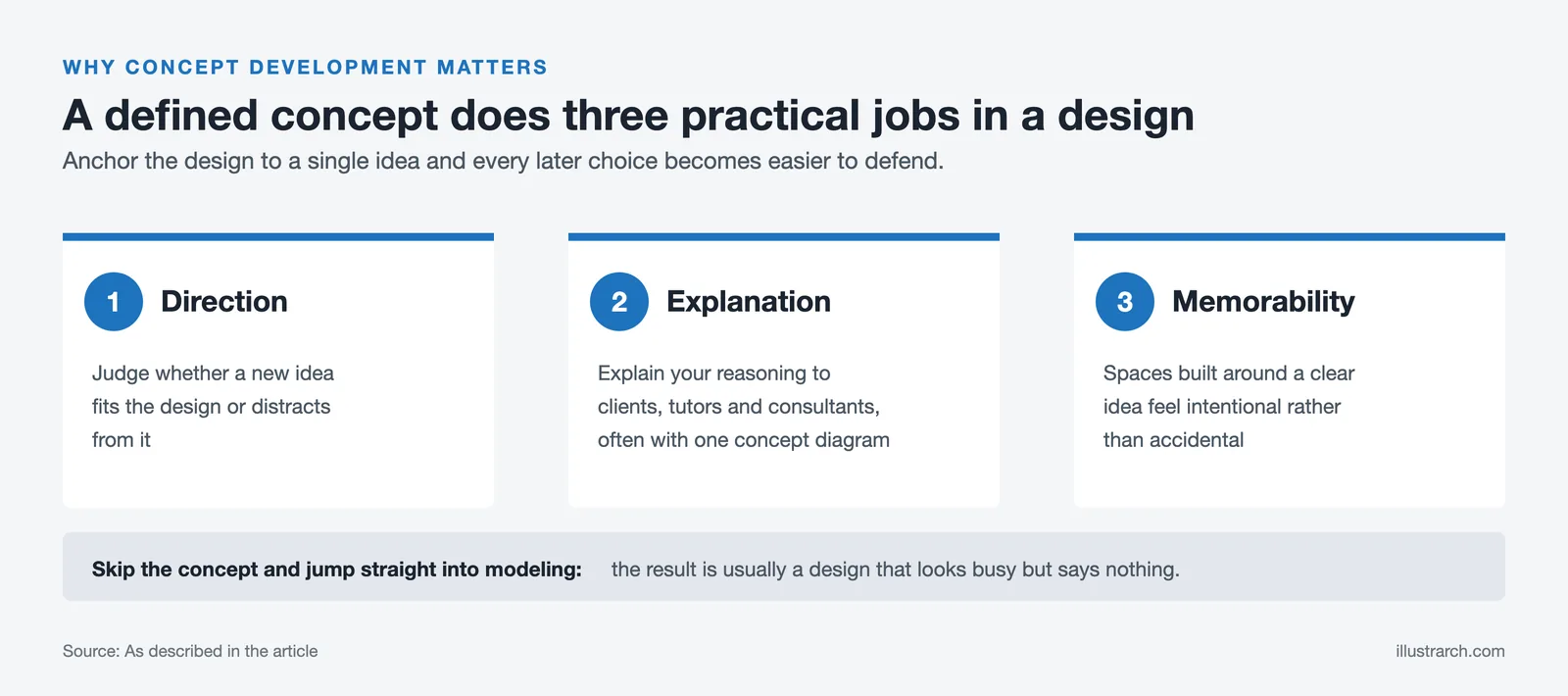
Beginners often skip this step and jump straight into modeling. The result is usually a design that looks busy but says nothing. When you anchor a design to a single idea, every later choice becomes easier to defend, and reviews stop feeling like guesswork.
📌 Did You Know?
The word architects use for a building’s core organizing idea, the “parti,” comes from the French phrase “parti pris,” meaning a decision taken. It dates to the École des Beaux-Arts teaching tradition in 19th century Paris, where students were expected to fix the main idea of a scheme before developing any detail.
The Stages of Concept Development
Concept work is not a single moment of inspiration. It moves through stages, and each one produces something you can show and test. The table below maps the typical flow from a blank brief to a resolved scheme.
| Stage | What Happens | Output |
|---|---|---|
| Brief and goals | Define client needs, budget, and how the building will be used | Written project brief |
| Site analysis | Study context, climate, access, views, and topography | Site analysis diagrams |
| Idea generation | Sketch the organizing idea, or parti, in several variations | Concept sketches |
| Concept testing | Model form, light, and circulation to see if the idea holds | 3D massing model |
| Refinement | Align the concept with code, structure, and budget reality | Resolved scheme design |
Notice that site analysis sits near the front of the process. A good concept usually grows out of what you learn about the place, which is why a careful study of the ground comes before the first real sketch. If you want a closer look at that step, see this guide on how to create site analysis as an architect.
Core Elements That Shape an Architectural Concept
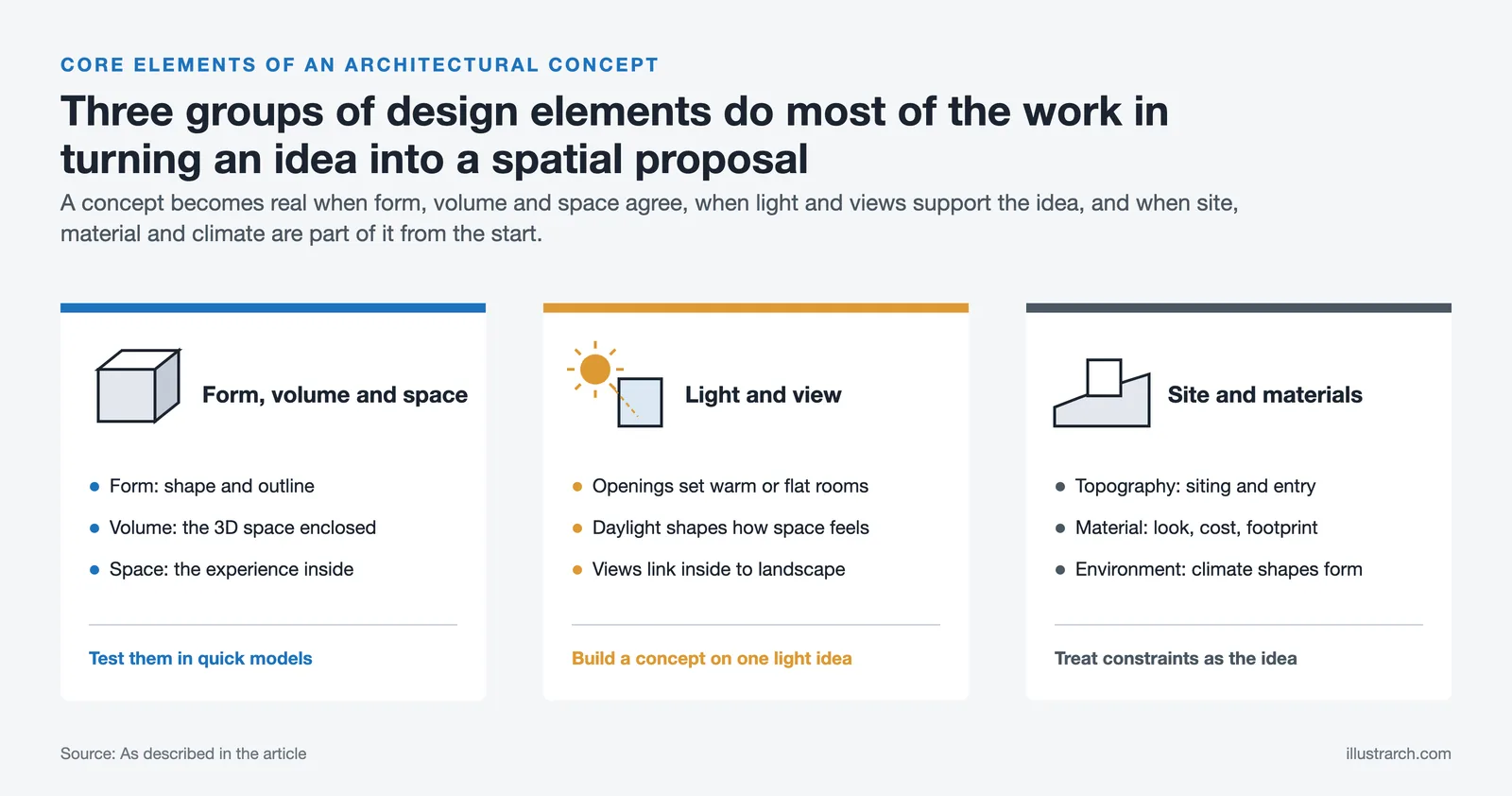
A few design elements do most of the work in any concept. Learning to read and control them gives beginners a practical way to turn a vague idea into a spatial proposal.
Form, Volume, and Space
Form is the shape and outline of the building. Volume is the three dimensional space it encloses. Space is the experience inside, the size and feel of each room and the way they connect. A concept becomes real when these three start to agree, so a compact massing reads as compact rooms and a tall volume reads as a generous interior. Beginners get the fastest progress by testing form and volume in quick physical or digital models rather than arguing about them on paper.
Light and View
Daylight changes how a space feels more than almost any other factor. Where you place windows, skylights, and openings decides whether a room feels warm and open or flat and closed. Views work in the same way, linking the inside to the landscape and stretching the sense of space beyond the walls. Many strong concepts are built around a single idea about light, such as pulling sun deep into a plan or framing one specific view.
💡 Pro Tip
Try to state your concept in one sentence you can explain in under a minute. Experienced architects use this test constantly. If the idea needs a paragraph to make sense, it is usually two ideas competing, and sharpening it now will save you days of redesign later.
Site, Materials, and Environment
Topography shapes where a building sits, how you enter it, and how it meets the ground. Material choice carries the look, the cost, and the environmental footprint of the project, so picking timber, brick, or concrete is a concept decision as much as a technical one. Climate and local weather push the design toward orientations and forms that stay comfortable with less energy. Treating these constraints as part of the idea, rather than problems to fix later, leads to designs that sit naturally in their place.
🏗️ Real-World Example
Sydney Opera House (Sydney, 1973): Jørn Utzon won the design competition with a concept of white shell roofs rising over the harbour like sails. Almost every later engineering decision, including the famous solution that derived all shells from the surface of a single sphere, traced back to that one organizing idea.
How Beginners Generate Design Concepts
Generating ideas feels mysterious until you give it a method. The approach below works for student projects and small real commissions alike, and it keeps concept development in architecture grounded in evidence rather than guesswork.
Start With Site and Context
Read the site before you draw anything. Map the sun path, the noise, the access points, the slope, and the buildings next door. Note the cultural and historical setting too, since these often suggest an idea no blank page can. A careful site reading turns up both opportunities and limits, and those limits are frequently the seed of a good concept.
Turn Requirements Into Ideas
List what the building must do, from the number of rooms to needs like daylight, privacy, or energy performance. Then ask how a single spatial idea could answer several of those needs at once. A courtyard, for example, can bring light into deep rooms, give privacy, and organize circulation, all from one move. Sketching those needs as a bubble diagram that later becomes a floor plan shows which rooms belong together. Concepts that solve more than one problem with a single idea tend to be the strongest.
Sketch, Then Model in 3D
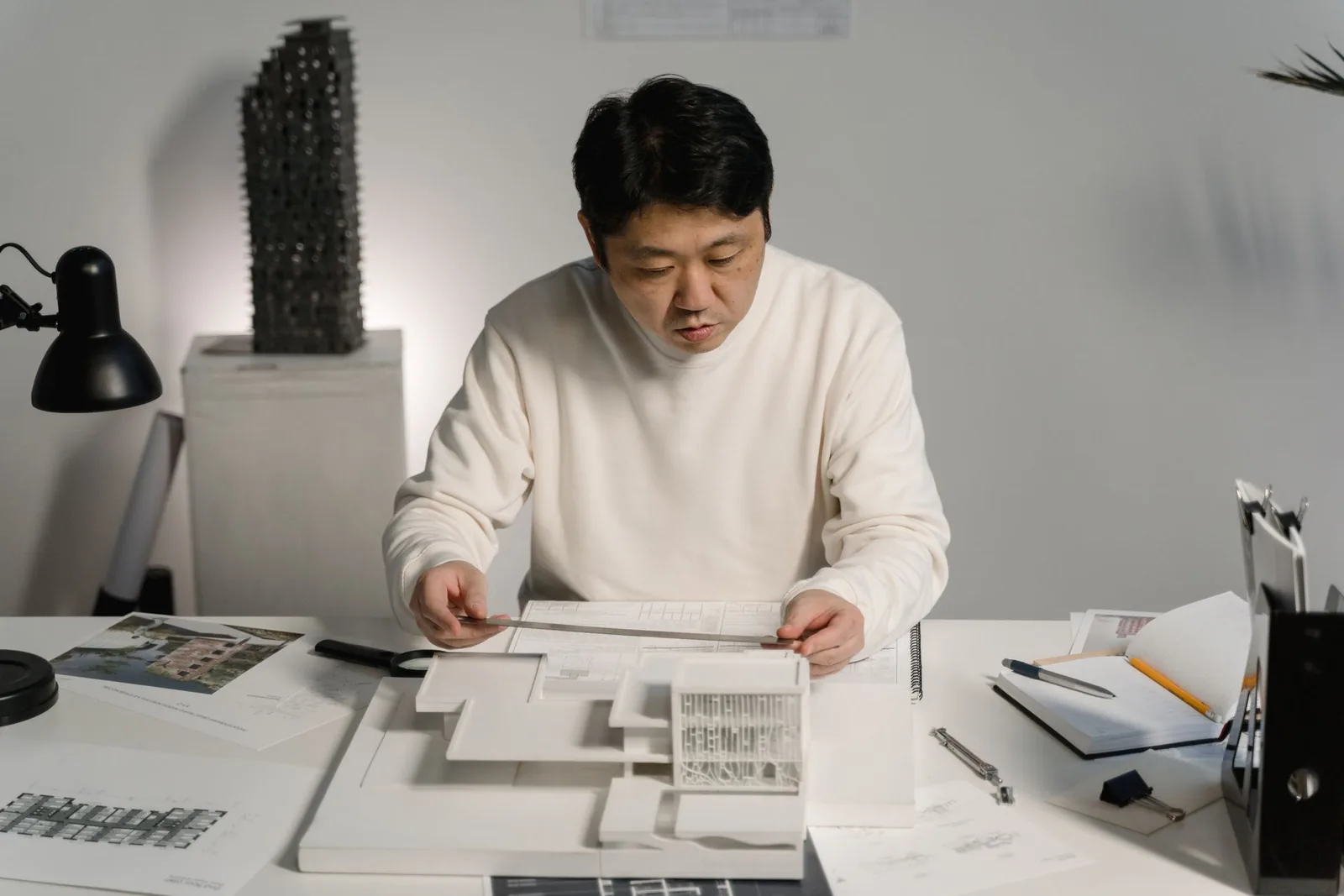
Hand sketching is fast and forgiving, which makes it ideal for the messy first stage where you want to try and reject ideas quickly. Once a sketch feels promising, move it into a 3D model to test form, light, and the relationships between spaces. Building up the idea this way, from loose sketch to tested model, helps beginners grow real confidence. The same path is covered for working architects in this guide to architectural concept development for professionals.
Tools That Support Concept Development
Software does not create the idea, but it helps you test one quickly. SketchUp is a common starting point because its push and pull modeling suits fast massing studies. As a scheme firms up, building information modeling tools such as Autodesk Revit let you carry spatial, material, and structural information together from the concept stage forward. Virtual and augmented reality add another way to check scale and spatial feel before anything is built.
Pick one modeling tool and learn it well rather than collecting many. For a wider view of how software fits into early design, see this overview of the benefits of architectural design software and this look at the digital tools independent architects rely on. To study built work and how other designers explain their thinking, the concept design archive on ArchDaily and the design research published by the Harvard Graduate School of Design are useful references.
Where to Go From Here
A clear idea is worth more than a polished drawing of a weak one. Concept development in architecture is the habit that protects your time, your reasoning, and the quality of the final building, and it improves every time you practice it on a real site.
Your next step: take a site you know, spend an hour mapping its sun, access, and views, then write a one sentence concept for a small building there before you draw a single plan. That single discipline will change how you design.





How to Write an Architecture Concept Statement for Any Project
A practical guide to writing an architecture concept statement, covering what it...
 Sinan Ozen8 Mins read
Architectural Programming: From Brief to Spatial Needs
A practical look at architectural programming, the pre-design phase where architects gather...
Elif Ayse Sen6 Mins read
Parametric Architecture Design with Grasshopper for Rhino: 2026 Review
A focused 2026 review of Grasshopper for Rhino for parametric architecture design,...
 Furkan Sen7 Mins read

The World’s Most Iconic Supertall Towers: Engineering, Design, and Skyline
From the record-breaking Burj Khalifa to the spiraling Shanghai Tower and the...
Furkan Sen8 Mins read


Leave a comment