

Museum of the Future: Dubai’s Torus of Tomorrow
A detailed look at the Museum of the Future in Dubai, covering architect Shaun Killa's torus concept, the 2,400-member diagrid structure engineered by Buro Happold, the robotic-fabricated calligraphy facade with 14 km of LED lighting, sustainability strategies behind its LEED Platinum certification, and how the building became one of the most recognized cultural landmarks in the UAE.
 Furkan Sen23 June 20266 Mins read167
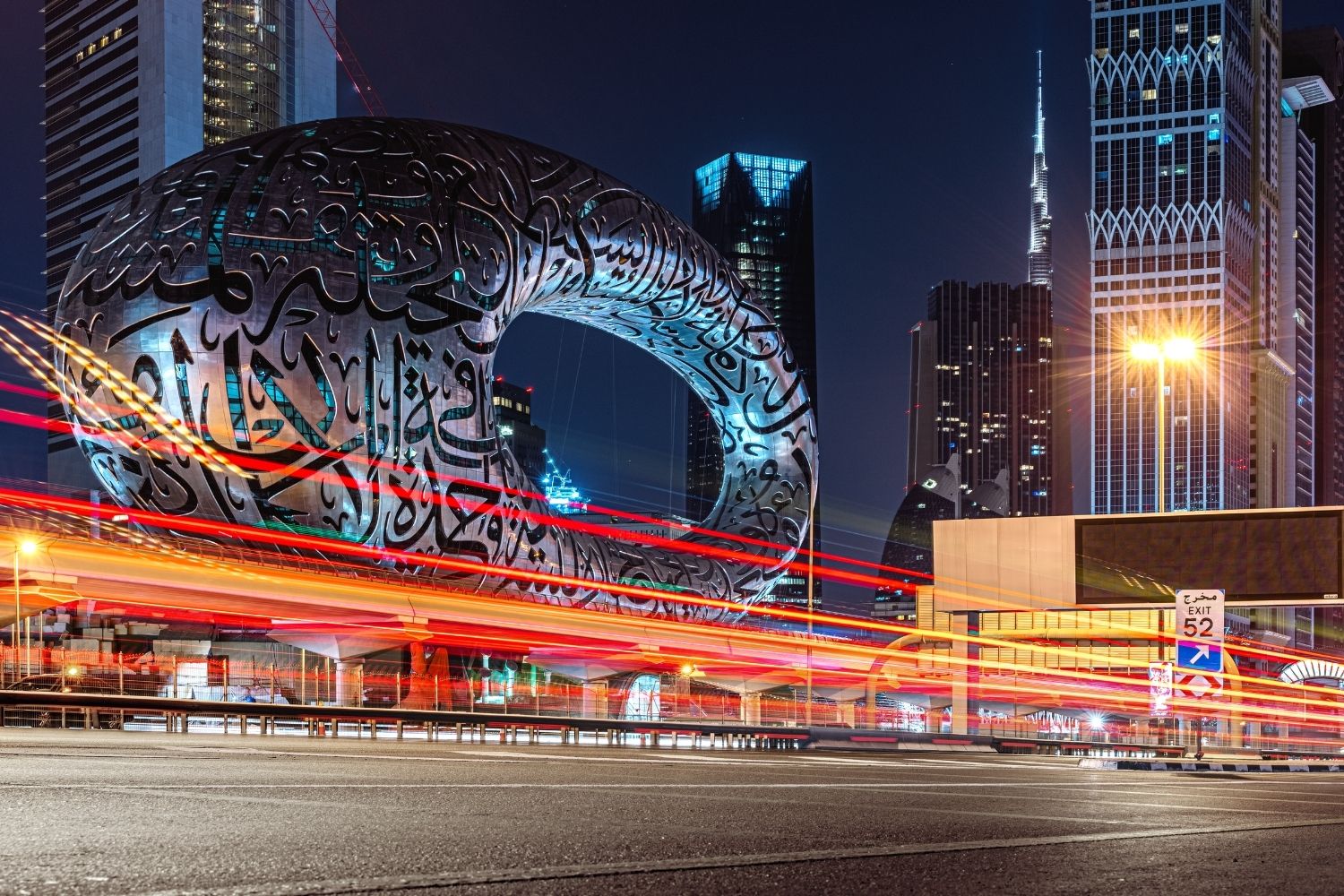
Table of Contents Show
The Dubai Museum of the Future is a 78-meter-tall, torus-shaped cultural landmark on Sheikh Zayed Road designed by Killa Design and engineered by Buro Happold. Opened on 22 February 2022, its column-free interior spans 30,000 square meters, wrapped in a stainless steel facade inscribed with Arabic calligraphy that doubles as the building’s window system.
Some buildings define a street corner. A few define a city. Dubai’s Museum of the Future does something rarer: it defines an idea. Sitting on a landscaped green hill above the Dubai Metro line, this silver torus has become the city’s most photographed structure after the Burj Khalifa, and it earned that status not through height but through sheer architectural nerve. National Geographic included it among the 14 most beautiful museums on the planet, and from any angle it is easy to see why. The building does not just house exhibitions about the future; it physically embodies one possible version of it.
What Makes the Museum of the Future in Dubai So Unique?
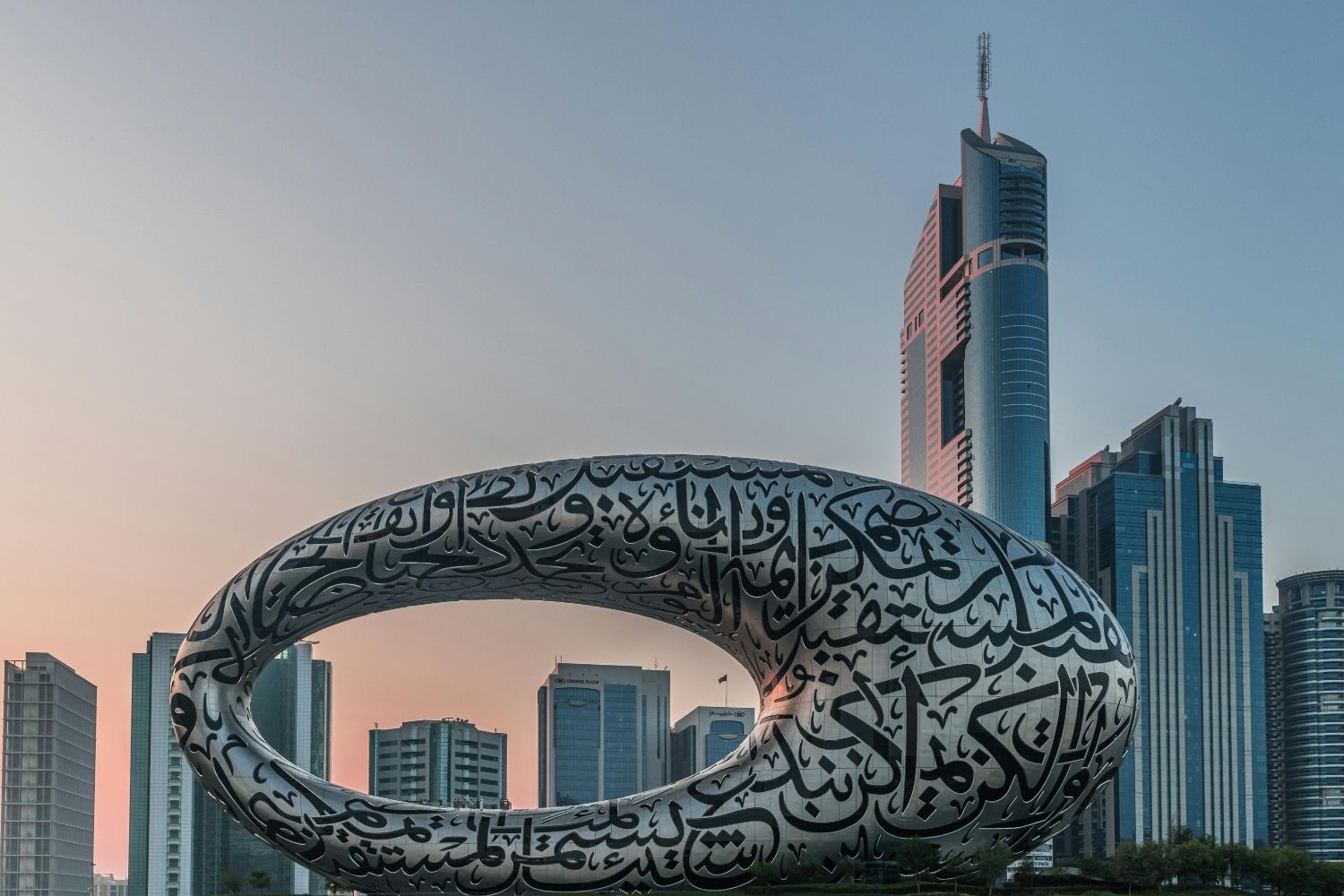
Three elements compose the design. The green hill at the base represents the earth and the UAE’s cultural roots. The gleaming torus above it symbolizes humanity’s creative ability. And the elliptical void at the center stands for what we do not yet know. According to Killa Design’s own project statement, that void is meant to represent “the unwritten future into which humanity can symbolically look towards.” Those three layers turn the Museum of the Future in Dubai into a single architectural metaphor readable at a glance, even at highway speed on Sheikh Zayed Road.
Unlike most museums, which look backward, this one points forward. The seven interior floors transport visitors to the year 2071 through immersive theater, speculative technology displays, and a children’s lab encouraging young visitors to think as inventors. The architecture itself is part of that story: every panel, beam, and calligraphic letter reinforces the idea that Dubai’s architectural ambitions are inseparable from its vision of progress.
The Architect Behind Dubai’s Museum of the Future
Shaun Killa, the South African-born architect who founded Killa Design in Dubai in 2015, won the Museum of the Future competition in the same year his studio opened. Before starting his own firm, Killa spent 16 years at Atkins, where he led the design of the Bahrain World Trade Center, the first skyscraper to integrate wind turbines into its structure. That project signaled his interest in buildings that merge engineering performance with symbolic form, a thread that runs directly into the museum.
Killa’s concept started with a question: how do you give physical shape to something as abstract as “the future”? His answer was the torus, a donut-like geometry that has no clear beginning or end, suggesting continuity and the cyclical nature of innovation. The choice was also structural. A torus distributes loads radially, reducing the need for internal columns. That decision gave the interior design team open floor plates to work with, which they filled with immersive exhibition spaces that flow from one level to the next without rigid partitions.
🎓 Expert Insight
“Because this building was so innovative and we are using technologies that were almost never used in the building industry before, right down from technologies from the aviation industry, there was a huge amount of interaction between the architects and engineers, contractors, subcontractors during the process.”, Shaun Killa, Design Partner, Killa Design
This cross-industry borrowing, particularly from aerospace manufacturing, was essential to realizing the museum’s curved, column-free shell.
Structural Engineering and the Diagrid Framework
The torus shape created an immediate engineering puzzle. A curved, hollow form 78 meters tall, sitting on a hill, with no internal columns, cannot rely on conventional framing. Buro Happold, the project’s structural engineers, solved it with a diagrid: a lattice of 2,400 diagonally intersecting steel members that wraps the torus like a net. Diagrid systems are not new, but in most buildings they serve as facade elements or secondary structure. Here, the diagrid is the primary structure.
Buro Happold’s team developed a custom meshing algorithm to optimize the placement and sizing of each steel member. Parametric modeling allowed them to keep every steel tube at the same diameter, which dramatically simplified procurement and sped up construction. Once the reinforced concrete ring beam and central tower were poured, the entire steelwork package was completed in just 14 months. For those interested in how parametric architecture translates from screen to site, this project is one of the clearest real-world demonstrations available.
📐 Technical Note
The diagrid framework supports 1,024 unique facade panels made from stainless-steel-clad glass fibre reinforced polymer (GFRP). Each panel was CNC-milled from a unique 3D mold and then 3D-scanned to verify dimensional accuracy against its digital twin before the stainless steel finish was applied (Buro Happold, 2022).
The entire design and coordination process relied on Building Information Modeling (BIM). Every discipline, from structural steel to MEP systems to facade engineering, worked within a shared digital model. That model also fed directly into the environmental analysis needed for the building’s sustainability targets.
Video: Tour the Museum of the Future with Its Architect
In this CNBC segment, journalist Dan Murphy walks through the museum with Shaun Killa, who explains the design intent, the structural challenges, and how aviation-industry techniques shaped the building’s construction.
The Calligraphy Facade: Where Language Meets Architecture
The museum’s most visible feature is the Arabic script that wraps its entire surface. These are not decorative appliques. The calligraphy, composed of quotes by Sheikh Mohammed bin Rashid Al Maktoum about innovation and the future, is cut directly into the facade panels to serve as the building’s windows. During the day, the letterforms filter natural light into the interior. At night, 14 kilometers of integrated LED lighting illuminate the script against the Dubai skyline.
Achieving this required an unusual level of coordination between architecture and engineering. Parametric modeling determined the exact size, position, and orientation of each letter on every curved panel, balancing three competing demands: natural daylight penetration, solar heat gain control, and air conditioning load. The digital model also ensured that none of the diagrid’s structural nodes were visible through the glazed letters, preserving the visual purity of the calligraphy from the outside. This integration of facade design with environmental performance remains one of the project’s most technically impressive achievements.
UAE-based manufacturer Affan Innovative Structures fabricated the panels using robotic processes borrowed from aerospace manufacturing. Each panel is a unique 3D shape, and each was milled from an individual CNC mold. This was the first time composite panels had been used to integrate multiple building functions, including weatherproofing, insulation, and fenestration, through such complex curved geometry.
How Does the Museum of the Future Architecture Address Sustainability?
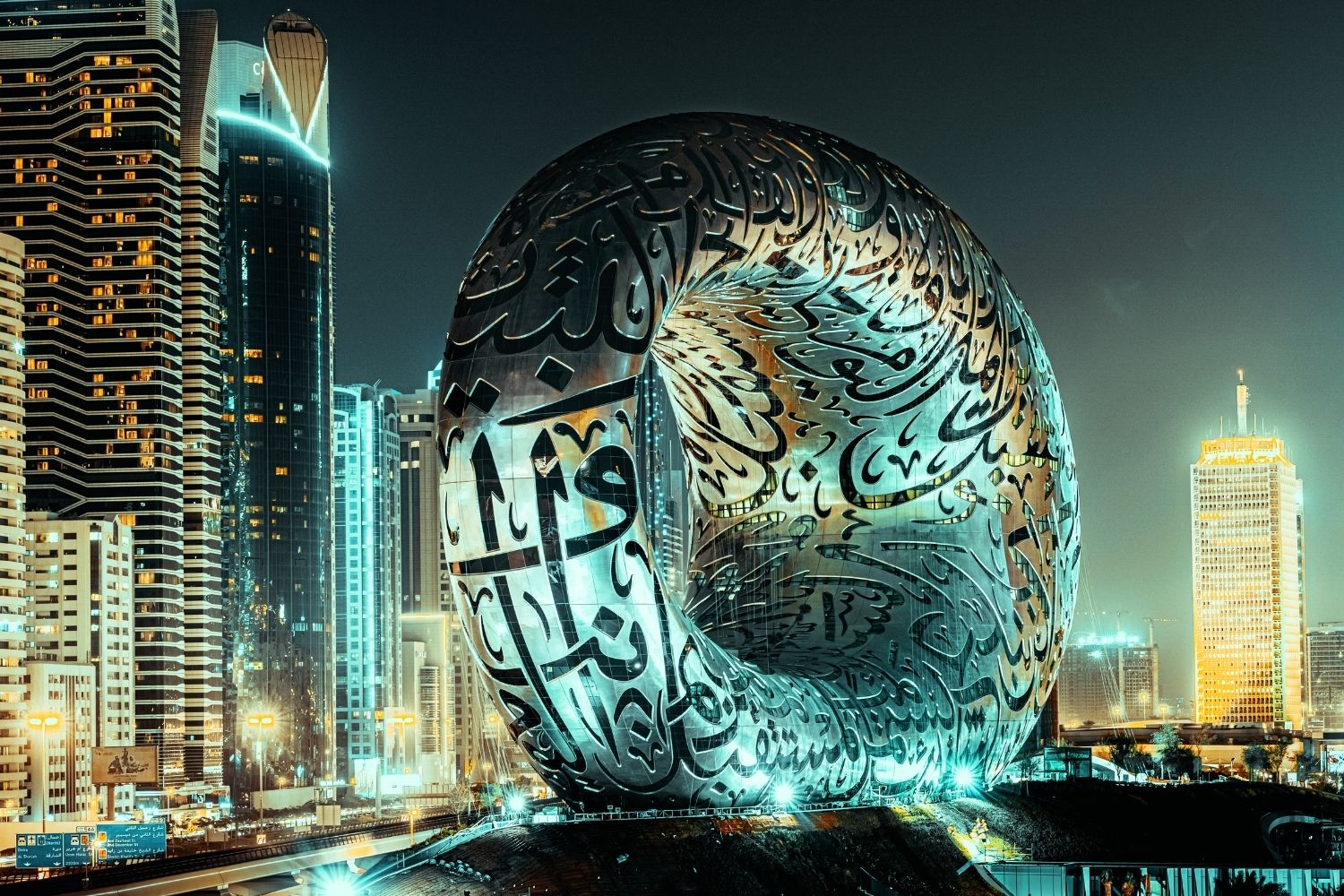
The Museum of the Future Dubai UAE was designed to achieve LEED Platinum certification, the highest tier in the U.S. Green Building Council’s rating system. Several strategies contributed to that goal. The calligraphy facade itself acts as a passive solar device: the size and density of the letterforms were calibrated zone by zone to limit solar heat gain while maximizing usable daylight, reducing the load on mechanical cooling systems.
Beyond the facade, the building integrates low-energy HVAC solutions, water-efficient fixtures, and building-integrated renewable energy systems. The landscaped green hill at the base does more than symbolize the earth. It provides thermal mass, stormwater management, and a rare patch of elevated green space in a city where ground-level planting struggles with extreme heat. For a broader view of how green certification shapes contemporary projects, the comparison between Passive House and LEED standards offers useful context.
🏗️ Real-World Example
Bee’ah Headquarters (Sharjah, 2022): Another UAE project that paired parametric form with aggressive sustainability targets, Zaha Hadid Architects’ Bee’ah HQ achieved LEED Platinum by combining curvilinear sand-dune geometry with on-site solar generation and AI-managed building systems. Together with the Museum of the Future, it signals a regional shift from iconic form for its own sake toward iconic form backed by measurable environmental performance.
Key Specifications at a Glance
The table below summarizes the museum’s core technical data:
| Specification | Detail |
|---|---|
| Architect | Killa Design (Shaun Killa) |
| Structural Engineer | Buro Happold |
| Height | 78 meters |
| Total Built-Up Area | 30,000 sq m |
| Facade Panels | 1,024 unique stainless-steel-clad GFRP panels |
| Diagrid Members | 2,400 diagonally intersecting steel beams |
| LED Lighting | 14 km of integrated LED strips |
| Sustainability Rating | LEED Platinum (targeted) |
| Opened | 22 February 2022 |
The Bigger Picture
Most landmark buildings age into their surroundings. The Burj Al Arab looked alien in 1999; today it reads as part of Dubai’s DNA. The Museum of the Future may follow the same path, but its deeper contribution is harder to absorb into a skyline. It proved that a building’s structural skeleton, its environmental skin, and its cultural message can be designed as a single, indivisible system rather than as separate layers stacked on top of each other. If the next generation of parametric buildings takes that lesson seriously, the torus on Sheikh Zayed Road will have done its real job long before 2071.
- Contemporary museum design
- dubai museum of the future
- dubai's museum of the future
- future museum architecture
- Future of Architecture
- Museum Design
- museum of the futur dubai
- museum of the future architecture
- museum of the future dubai
- museum of the future dubai uae
- museum of the future in dubai
- museum of tomorrow
- the museum of the future dubai



Sky Habitat Singapore: Moshe Safdie’s Vertical Garden Towers
Two stepped towers in Bishan, three steel garden bridges at levels 14,...
Furkan Sen6 Mins read
Peter Zumthor Therme Vals: Inside the Stone and Water Sanctuary
Peter Zumthor's thermal baths in Vals are usually described through atmosphere alone....
Furkan Sen8 Mins read

Flooring Rentals Los Angeles vs Permanent Event Flooring When a Flooring Rental in Los Angeles Makes More Sense
Creating a memorable event starts from the ground up—literally. Whether you're planning...
 illustrarch Editoral Team3 Mins read
Sustainable Landscape Design Balancing Artificial Turf Cost, Artificial Grass in Los Angeles, and Turf Installation for Modern Outdoor Spaces
Artificial grass in Los Angeles has become a practical part of sustainable...
illustrarch Editoral Team6 Mins read




Leave a comment