

A Wave in Paris: How Pharrell Williams Expanded the Louis Vuitton Runway
Pharrell Williams turned the Louis Vuitton SS27 menswear show in Paris into a coastline, building an eight metre breaking wave, cascading water and a sand floor that read as temporary architecture for a single evening.
 Elif Ayse Sen30 June 20266 Mins read168
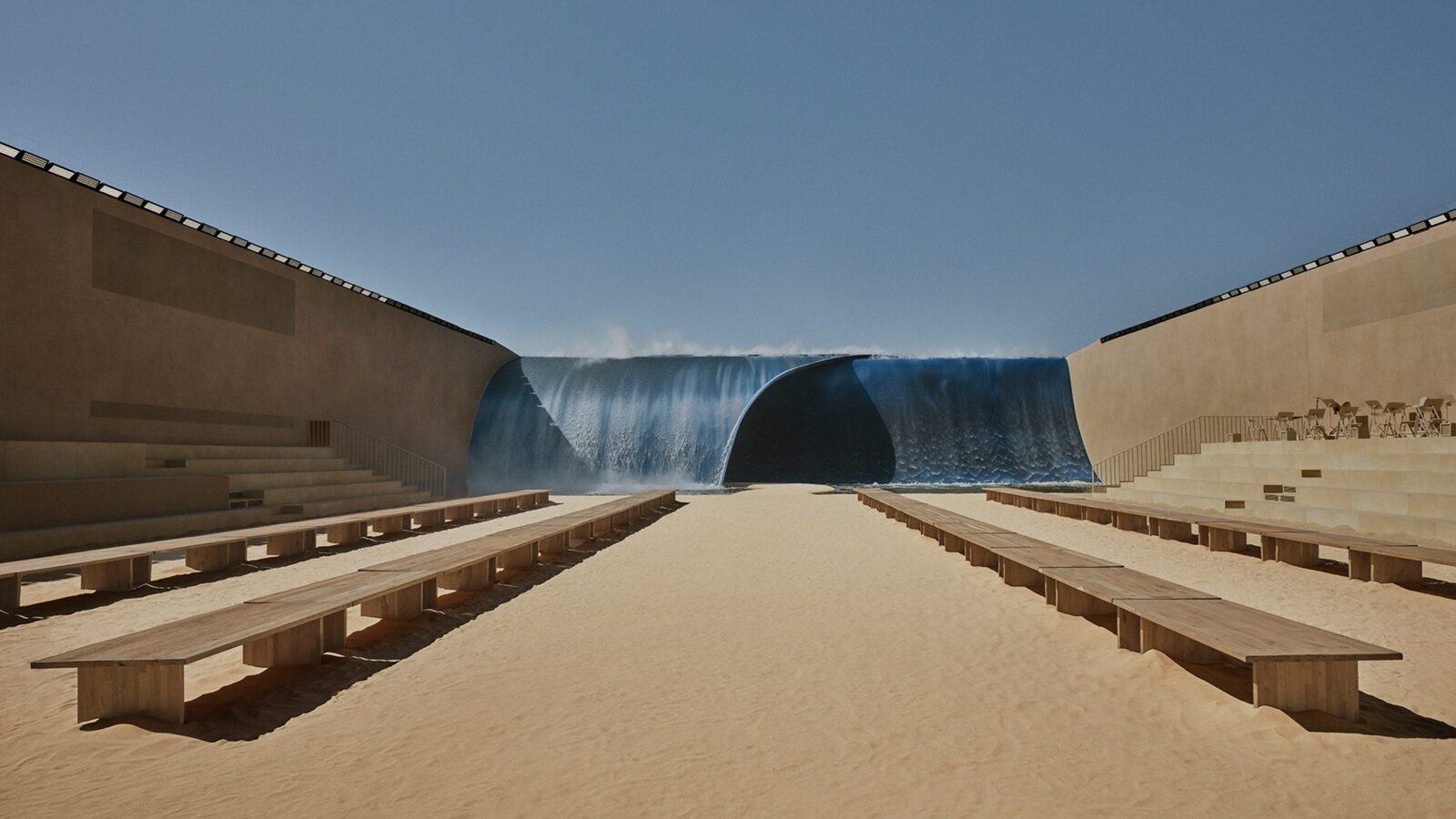
Table of Contents Show
The louis vuitton runway for Spring/Summer 2027 became a coastline. For the June 2026 menswear show in Paris, Pharrell Williams designed a scenography built around an eight metre high breaking wave, real cascading water, and a sand covered floor, turning a fashion presentation into a piece of temporary architecture.
Fashion shows usually borrow a building and dress it up. Pharrell Williams did the opposite. He treated the venue as raw site and built a landscape inside it, complete with a curving water structure, a boardwalk, and a beach. The result read less like a catwalk and more like a stage set engineered for a single evening, then taken apart. For anyone who studies how space shapes experience, the show offered a clear case of set design crossing into spatial design.
How Pharrell Williams Turned the Louis Vuitton Runway Into a Coastline
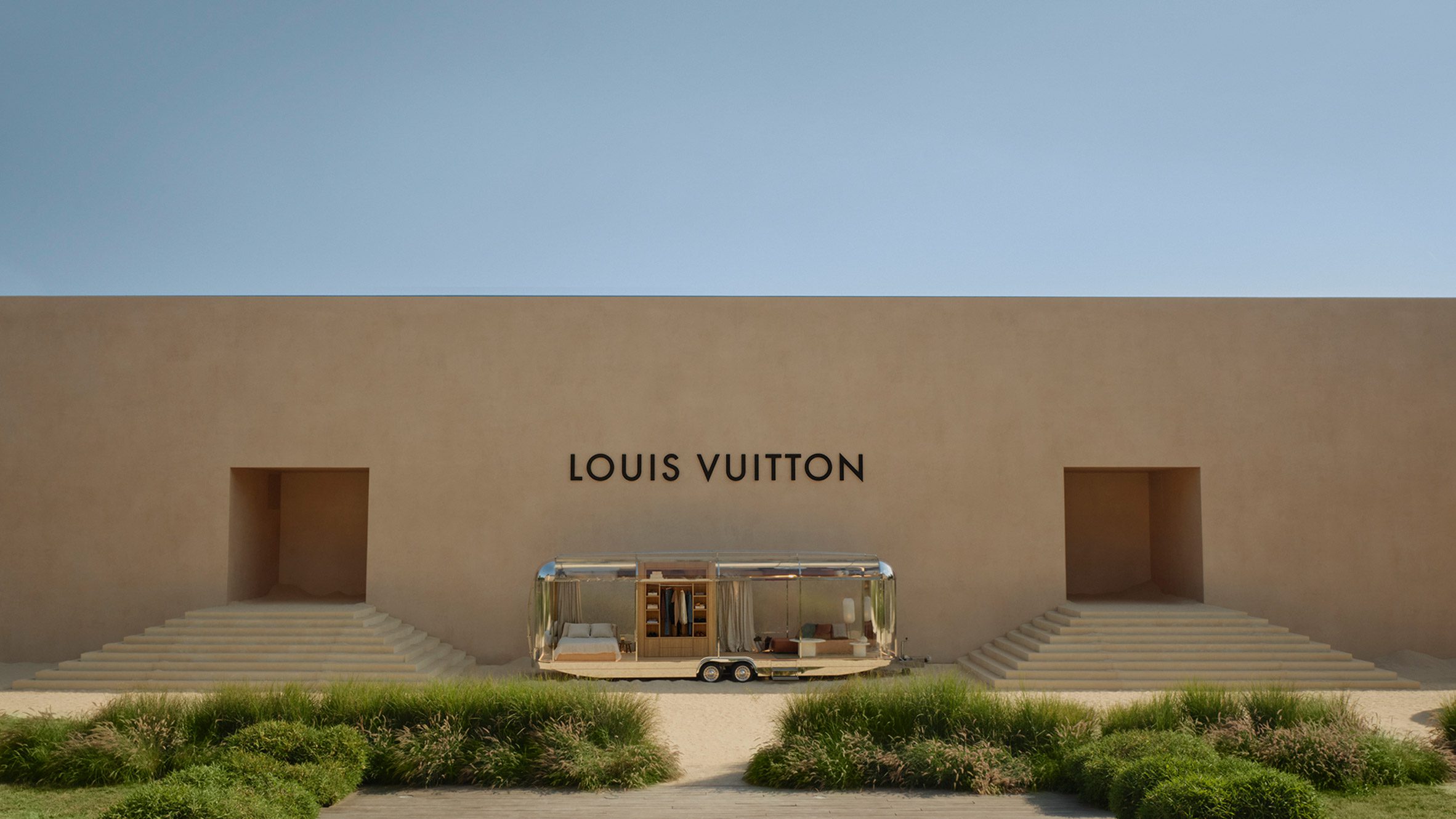
The Spring/Summer 2027 menswear collection drew on international surfing communities, and the set followed that idea straight through to the floor plan. Pharrell Williams, the house’s men’s creative director, designed the scenography himself rather than handing it to an outside studio. The open air show took place at the Cité Internationale Universitaire de Paris, a campus of student residences and gardens on the southern edge of the city, where Pharrell Williams designed the scenography himself. The crew covered the ground in fine sand and ran a wooden, boardwalk style path through the middle of it. A Louis Vuitton camper van parked at the entrance set the tone before anyone reached the sand, reading the arrival sequence as part of the design rather than an afterthought.
Guests did not sit in front of a wall. They sat around a coast. The louis vuitton runway became the seam between two conditions, the dry boardwalk on one side and the moving water on the other. That single decision, placing the audience inside the scene rather than across from it, is what separated this set from a standard backdrop. The approach has clear roots in the longer history of crossovers between architecture and fashion, where designers from both fields keep borrowing each other’s tools.
🏗️ Real-World Example
Louis Vuitton SS27 Wave (Paris, 2026): A curved structure eight metres high and 37 metres wide carried a continuous sheet of real water, framing a sand floor and a boardwalk runway at the Cité Internationale Universitaire de Paris. The whole landscape existed for one show before being dismantled.
What Made the Wave Installation Work as Architecture?
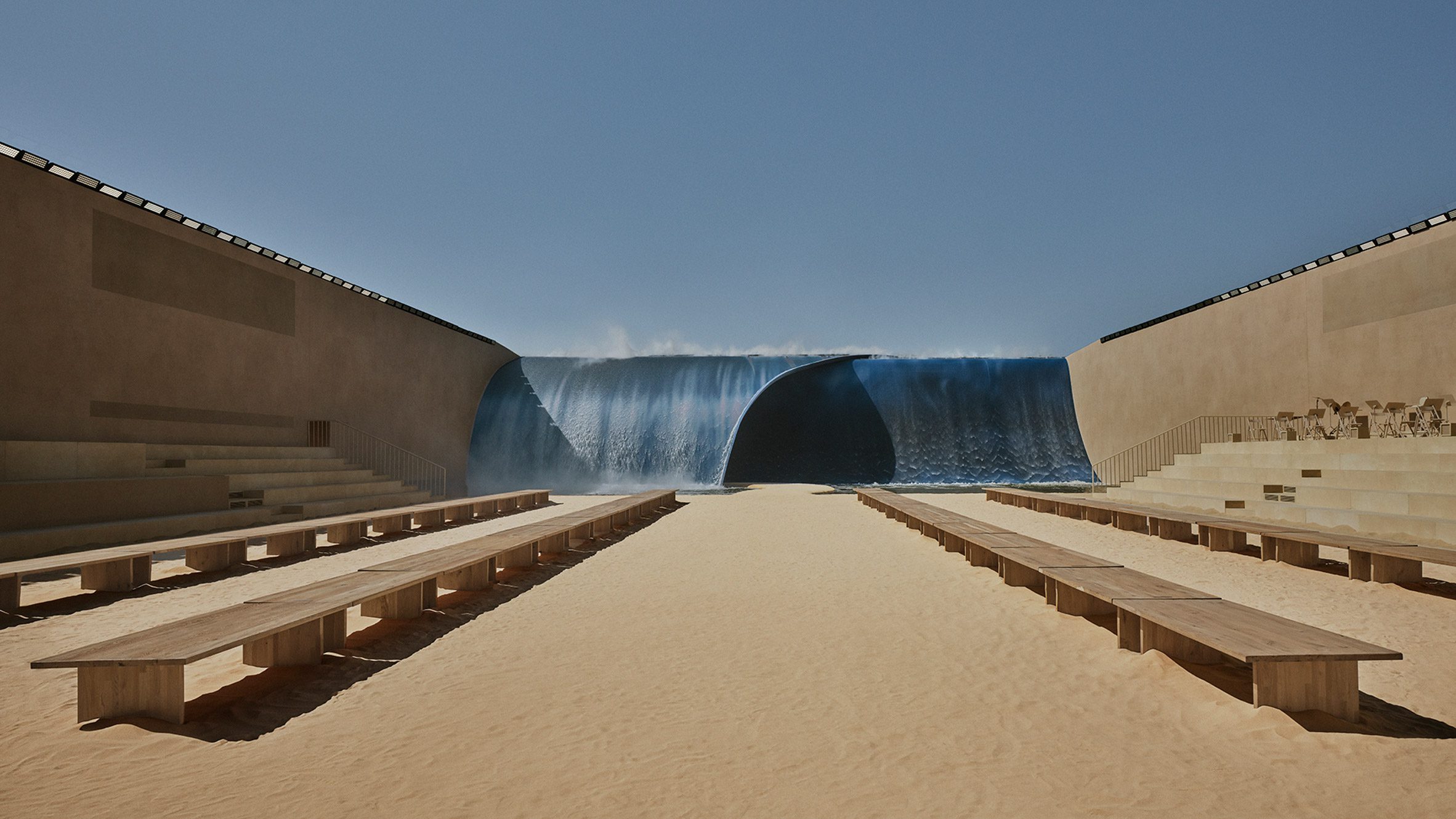
The wave installation in Paris worked as architecture because it solved a structural problem in plain sight: how to hold a permanent looking curve of falling water in a temporary frame. The form measured eight metres high by 37 metres wide, large enough to act as a horizon line for the entire seating area. Water ran over a curved surface in a steady sheet, giving the impression of a wave caught at the moment it breaks and never finishes.
That frozen motion is the trick. A real wave lasts a second or two. This one had to hold the same shape for the length of a show while staying safe above an audience. The curved profile did double duty, reading as surf to the eye while channeling the flow of water down into pools at the base. The principle is close to how a shell or vault carries load through its geometry, the same logic that lets a thin curved form behave far more strongly than a flat one.
📐 Technical Note
The water for the wave was supplied by Eau de Paris, the public body that manages the city’s water network. It ran through a closed circuit during the show and was returned to the municipal system afterward, so the installation cycled water rather than consuming a fixed volume.
Designers who build sculptural objects at this scale face a familiar set of constraints, from anchoring to weight distribution to how a curved skin meets its support. A permanent example of the same family of problems is a large computational sculpture like The Orb, where a complex outer form has to resolve cleanly into a hidden structure underneath.
How big was the Louis Vuitton wave set?
The wave set measured eight metres high and 37 metres wide. For scale, eight metres is roughly the height of a two and a half storey building, and 37 metres is longer than a competition swimming pool. Those proportions let the structure fill the field of view from almost every seat, which is exactly what a backdrop on this kind of louis vuitton runway needs to do.
Sand, Water, and the Sensory Logic of the Set
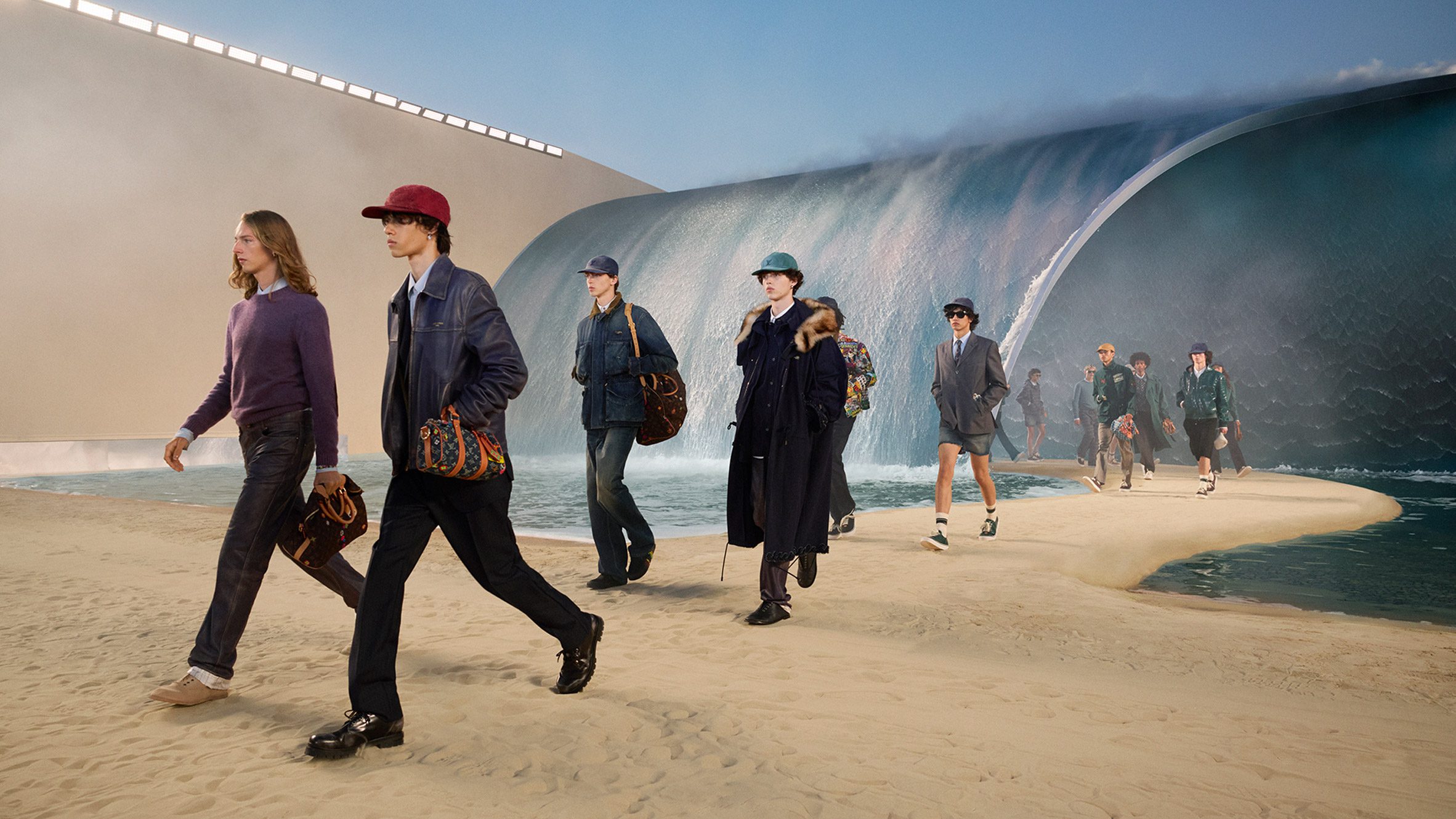
The set engaged more than sight. Sand underfoot changed how people moved and where they could sit. The falling water produced constant sound and a fine mist that drifted over guests during the evening, so the audience felt the coast as much as they watched it. This is a designer using material to set a mood, the same instinct behind biophilic design in architecture, where water, light, and natural texture are used to shape how a space feels rather than only how it looks.
The boardwalk runway gave the show its circulation. A raised wooden path is a precise spatial cue, telling everyone where the models walk and where the audience stays. It also lifted the procession slightly above the sand, keeping the clothes clean while letting the beach read as a continuous surface beneath. Small moves like this are the working language of turning a concept into a built installation, where the path a visitor takes carries as much meaning as the objects on display.
📌 Did You Know?
The fine sand spread across the Cité Internationale Universitaire de Paris was not thrown away after the show. It was repurposed for beach volleyball courts on the same campus, giving the set’s main material a second life on site.
A Runway Built on Reuse and Closed-Loop Water
The environmental side of the set was not an afterthought bolted on for a press release. The wooden seating came straight from the previous season’s show, reused rather than rebuilt. The water moved through a closed loop tied to the city’s own network. The sand went on to a second use as sports courts. Louis Vuitton framed the production within its Regeneration 2030 roadmap and used the show to highlight its support of Coral Gardeners, a reef restoration group, which connected the surf theme back to the health of real coastlines.
Temporary architecture has a built in waste problem, since most of what gets built for an event is gone within days. Treating the set as a kit of borrowed and returnable parts is one honest answer to that problem. The thinking lines up with broader sustainable architecture trends that push reuse and material recovery ahead of single use construction.
Where Fashion Scenography Meets Architecture
Set design for a runway and architecture share the same core questions: how to organize space, route movement, and control what a person sees and feels at each step. A fashion show simply compresses the timeline to a single night. The Paris wave is a clear example of scenography reaching the scale of a building, even if it stood for only a few hours.
Louis Vuitton already owns a serious piece of permanent architecture in the city, so the contrast is sharp. Frank Gehry’s Fondation Louis Vuitton in the Bois de Boulogne, completed in 2014, wraps a museum in twelve curved glass sails meant to read like a vessel. You can see the same appetite for sculptural curves across the house, from Gehry’s permanent building to a runway wave that lasts one evening. Major exhibitions follow the same path, as the spatial planning behind the 2026 Venice Biennale shows, where scenography carries the argument of the whole event.
For students and practitioners, the takeaway is practical. A set this size is a fast, low stakes place to test ideas about structure, water, and circulation that would take years to realize in a permanent project. The discipline of designing for a single use, on a fixed deadline, with a real audience, sharpens the same skills any building demands.
The Bigger Picture
A breaking wave never holds still, and neither does a fashion show. Both exist for a moment and then release. By building a coastline that stood just long enough to be walked through, Pharrell Williams made the most honest kind of architecture there is, the kind that admits it is temporary and plans for its own ending. The next time a runway looks like a building, the real question is not how it was made, but where its parts go once the lights come down.
For the official account of the collection and the show, see the Louis Vuitton website. Independent design coverage of the set is documented by Wallpaper magazine, while the reef restoration partner appears on the Coral Gardeners site, and the venue is detailed by the Cité Internationale Universitaire de Paris.
- centre pompidou paris
- fashion runway architecture
- louis vuitton runway
- louis vuitton runway show
- louis vuitton ss27 runway
- louis vuitton surf runway 2026
- louis vuitton wave installation paris
- Notre-Dame de Paris
- ocean wave architecture
- Paris architecture
- Paris museum renovation
- pharrell williams louis vuitton wave paris
- pharrell williams runway design



Groupwork Completes 10-Storey Loadbearing Granite Flats in London
Groupwork's Petra Heights on Finchley Road is a 10-storey block of 22...
 illustrarch Editoral Team2 Mins read
Ai Weiwei Installs 500 Cast-Iron Helmets Outside Sydney Museum
Ai Weiwei's 500 cast-iron helmets opened outside Sydney's MCA on 25 September,...
illustrarch Editoral Team2 Mins read
Isamu Noguchi at Lever House Traces Sculptor’s Decades-Long Collaboration with Bunshaft
Lever House's new exhibition pairs Noguchi sculptures with unbuilt garden designs made...
illustrarch Editoral Team2 Mins read
Relocated Maya Structures at Mexico’s Balam Tun Memory Park Face Legal Challenge
INAH archaeologists have filed a complaint against 26 officials over Balam Tun...
illustrarch Editoral Team2 Mins read


Leave a comment