

15 Wellness Essentials to Survive Architecture School Stress
Architecture school is physically and mentally demanding, with long studio hours, constant critiques, and tight deadlines. These 15 wellness essentials cover sleep protection, nutrition, movement, workspace ergonomics, and mental health strategies that help architecture students manage stress without sacrificing creative output or academic performance.
 Furkan Sen8 June 202615 Mins read147

Table of Contents Show
Wellness essentials for architecture students include sleep protection, proper nutrition, regular movement, ergonomic workspace setup, and mental health strategies. These fundamentals help students manage the physical and psychological demands of studio culture, reduce burnout risk, and maintain the creative energy needed for design work across long semesters.
Architecture school pushes students harder than most academic programs. Between overnight studio sessions, back-to-back critiques, and the constant pressure to produce original design work, stress becomes a background condition rather than an occasional spike. A 2025 systematic review published in TPM journal found that 83.91% of architecture students in one study identified overwork as the primary factor hurting their mental health. The Healthy Minds Survey (2021-2022), covering nearly 96,000 students across 373 institutions, reported that only 32% of all college students described their overall mental health as positive. For architecture students facing longer hours and more intense workloads than average, those numbers are likely worse.
The good news: small, consistent wellness habits make a measurable difference. You do not need to overhaul your entire life. You need a set of reliable wellness essentials that fit into the reality of studio schedules, tight budgets, and unpredictable deadlines. The following 15 strategies are built around that reality.
Sleep Protection: The Foundation of Every Wellness Plan

Sleep is not optional in architecture school, even though the culture often treats it that way. Chronic sleep deprivation reduces spatial reasoning, decision-making speed, and the kind of lateral thinking that produces strong design concepts. Students who track their mood and output across a semester consistently find that their worst work happens during periods of accumulated sleep debt.
Protecting two full nights of sleep per week, even during project sprints, produces better cognitive output than pulling consecutive all-nighters. This does not mean sleeping eight hours every night is realistic during finals. It means building recovery into your schedule the same way you schedule studio hours. Set a “sleep floor” of at least six hours on most nights and protect two nights per week at seven to eight hours.
A few practical tools help enforce this: a consistent wind-down routine (even 15 minutes), blue-light filtering on screens after 9 PM, and a firm rule about leaving studio by a set time on your recovery nights. These small boundaries add up over a 15-week semester.
💡 Pro Tip
Architecture students who protect two non-negotiable recovery nights per week report measurably better design output than those who distribute the same total sleep across seven nights of short rest. The brain consolidates spatial memory and creative problem-solving during deep sleep stages, so concentrated recovery blocks outperform scattered naps.
Nutrition That Supports Long Studio Hours
The architecture student diet stereotype (energy drinks, vending machine snacks, and late-night pizza) exists because it describes real behavior. But nutrition directly affects concentration, mood stability, and the stamina needed for 8- to 12-hour studio sessions.
You do not need a complicated meal plan. Focus on three principles: eat protein at every meal to stabilize blood sugar, keep portable snacks in your studio bag (nuts, fruit, granola bars, cheese sticks), and hydrate consistently rather than relying on caffeine alone. Dehydration reduces cognitive performance faster than most students realize.
Meal prepping on Sunday for three to four days of lunches saves both money and decision-making energy during the week. A batch of rice, roasted vegetables, and a protein source takes under an hour and eliminates the daily “what should I eat” problem that often ends in skipping meals entirely.
How to Build Movement Into a Studio Schedule
Architecture students sit or stand at desks for hours at a time, often hunched over models or leaning into screens. This creates chronic tension in the neck, shoulders, and lower back that compounds over semesters. Regular movement is one of the most effective wellness essentials for managing both physical discomfort and stress hormones.
You do not need a gym membership or a structured workout program (although both help). The minimum effective dose is a 20-minute walk outside every day and a 5-minute stretch break every 90 minutes during studio work. Walking outside is particularly effective because it combines movement with daylight exposure and a change of visual environment, all of which reset attention and reduce cortisol levels.
If you have time for structured exercise, prioritize activities that counteract studio posture: yoga, swimming, or bodyweight exercises that open the chest and strengthen the posterior chain. Even two sessions per week produce noticeable improvements in energy, sleep quality, and stress tolerance.
📌 Did You Know?
A study by the University of Michigan found that just a 10-minute walk in a natural setting can improve cognitive function and reduce symptoms of depression. For architecture students working in windowless studios for extended periods, even a brief outdoor break between work sessions can restore the focus needed for design tasks.
Ergonomic Workspace Setup for Studio and Home

Spending 40 to 60 hours per week at a workstation without ergonomic awareness leads to repetitive strain injuries, chronic pain, and fatigue that accumulates across an entire degree program. Many architecture graduates report lasting wrist, neck, or back issues that started during school.
Basic ergonomic adjustments cost little and prevent a lot of damage. Your screen should sit at eye level (a stack of books works as a monitor riser). Your chair height should allow your thighs to be parallel to the floor with feet flat. When working on physical models, raise your work surface or stand periodically rather than hunching over a low table for hours.
For digital work, an external mouse and keyboard reduce wrist strain compared to a laptop trackpad, especially during long CAD or modeling sessions. If you use a laptop in studio, a portable laptop stand and a compact external keyboard are worth the small investment.
Managing Critique Anxiety
Design critiques are among the most stressful experiences in architecture school. The combination of public evaluation, subjective feedback, and personal attachment to your work creates anxiety that many students never learn to manage well. Understanding that critique stress is a normal response, not a sign of weakness, is the first step.
Preparation reduces anxiety more than any breathing technique. Know your project’s strengths, weaknesses, and the decisions you made deliberately. Write down one genuine question about your work before each review, something you actually want feedback on. This shifts your mindset from “defending” to “learning,” which changes how you process what reviewers say.
After a difficult critique, give yourself a 24-hour buffer before making major changes to your project. Emotional reactions to feedback are strongest immediately after the review and fade quickly. The edits you make after sleeping on it are almost always better than the ones you make in a reactive state at 11 PM the same night.
🎓 Expert Insight
“Institutions perpetuating exhaustion in any student bring shame on our industry.”
Deborah Dawton, Chief Executive, Design Business Association
This statement, made during a Dezeen-led industry discussion in 2019, reframed the mental health conversation in architecture education by placing responsibility on institutions rather than individual students. It remains one of the clearest calls for structural change in studio culture.
Digital Detox and Screen Boundaries
Architecture students spend enormous amounts of time on screens for CAD, rendering, research, and communication. Adding social media and entertainment on top of that creates a total screen exposure that leaves the nervous system chronically overstimulated. Setting intentional screen boundaries is a wellness essential that most students overlook.
Practical boundaries include: turning off non-essential notifications during studio hours, keeping your phone in your bag during focused work blocks, and designating at least one hour before bed as screen-free time. The last point is especially important because screen exposure before sleep disrupts melatonin production and reduces sleep quality even when you get enough hours.
For social media specifically, consider unfollowing accounts that trigger comparison anxiety about other students’ work or lifestyles. Architecture Instagram can be inspiring, but it can also create unrealistic expectations about what student work “should” look like. Be selective about what you consume during an already stressful semester.
Why Time Management Matters More Than Talent
One of the most common sources of stress in architecture school is not the difficulty of the work itself but the failure to manage time around it. Students who plan their weeks in advance, break large projects into daily tasks, and set intermediate deadlines for themselves consistently report lower stress levels than equally talented peers who work reactively.
A simple weekly planning session of 15 to 20 minutes on Sunday evening, where you map out the week’s deadlines, block studio time, and identify your top three priorities for the week, reduces the chronic low-level anxiety that comes from feeling like you are always behind. This is not about rigid scheduling. It is about giving yourself a clear picture of what needs to happen and when.
The Pomodoro technique (25 minutes of focused work followed by a 5-minute break, with a longer break every four cycles) works particularly well for design tasks because it prevents the marathon work sessions that lead to diminishing returns and physical strain. Architecture students often resist time-boxing because design “cannot be forced,” but structured intervals actually improve creative output by preventing cognitive fatigue.
Building a Support Network in Studio
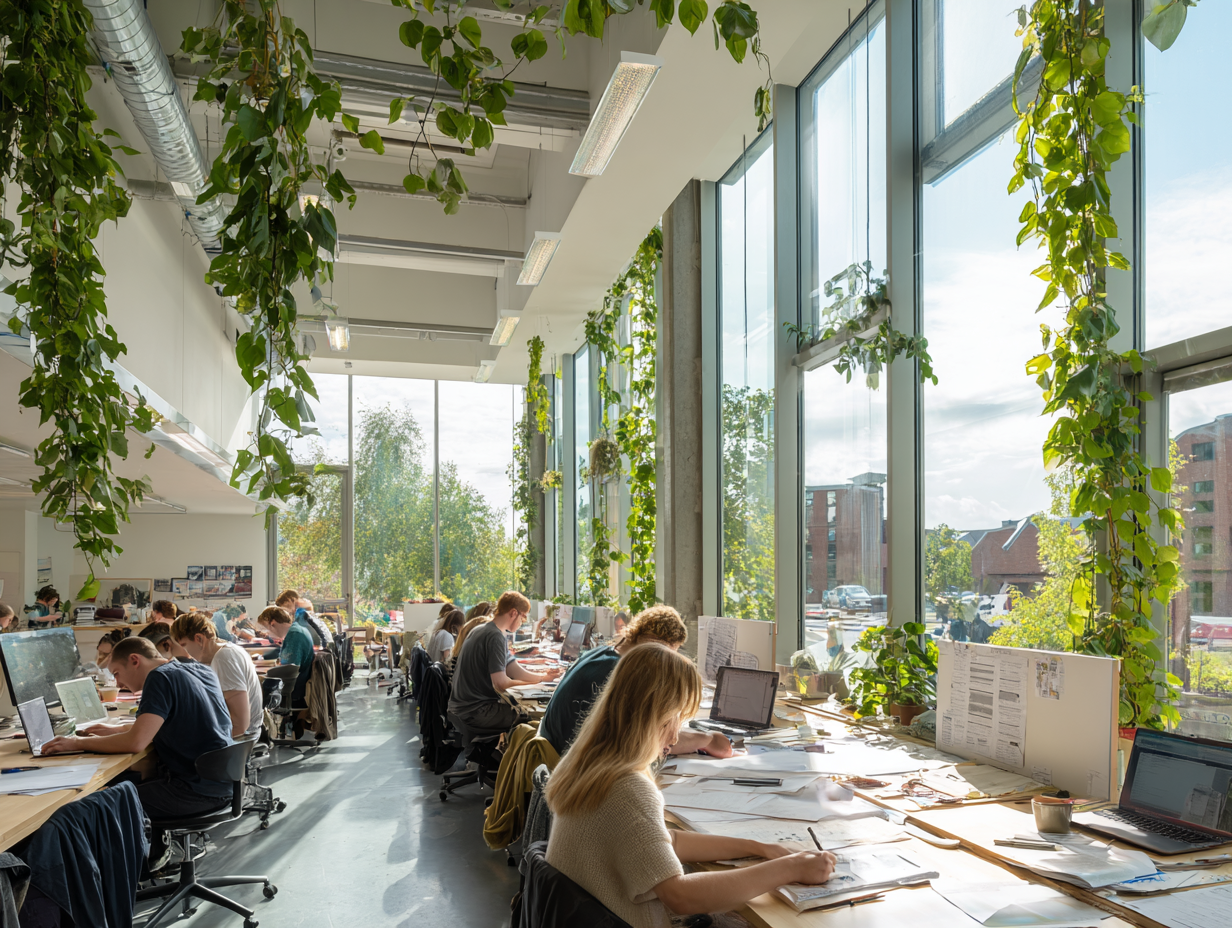
Studio culture can feel intensely competitive, but the students who perform best academically and manage stress most effectively are usually those with strong peer relationships. A support network does not need to be large. Two or three classmates you trust, people who will share honest feedback, lend supplies, and check in during tough weeks, make a significant difference in how you experience the program.
The social dimension of studio, when it is healthy, is one of the genuine strengths of architectural education. Programs that structure collaborative breaks and collective problem-solving report better student cohesion without sacrificing output quality. If your studio culture feels isolating, start small: offer to help a classmate with a model, ask someone for a coffee break, or organize a casual pin-up session outside of formal reviews.
Mentorship from upper-year students is also valuable. They have navigated the same professors, deadlines, and review formats. Their practical advice often carries more weight than official guidance because it comes from recent, firsthand experience. Reach out to students one or two years ahead of you; most are willing to share what they have learned.
Using Your Physical Environment as a Wellness Tool
Architecture students study how built environments affect human well-being, but they rarely apply those principles to their own workspaces. There is a certain irony in this: the discipline increasingly focused on designing for health has been slow to apply those ideas to its own educational settings.
You can change this at a personal level. If your studio desk is near a window, face it toward the light. If it is not, take your reading and research tasks to a space with better daylight. Add a small plant to your desk (even a low-maintenance succulent counts). Keep your workspace organized enough that you can find what you need without frustration, because visual clutter contributes to cognitive overload.
For students working from home, dedicate a specific area for studio work and keep it separate from where you sleep and relax. This spatial boundary helps your brain distinguish between “work mode” and “rest mode,” which improves both productivity during work hours and relaxation during off hours. The principles of biophilic design that you study in class, natural light, greenery, natural materials, apply just as well to your personal workspace.
⚠️ Common Mistake to Avoid
Many architecture students treat all-nighters as a badge of honor and a necessary part of studio culture. Research consistently shows that extended sleep deprivation degrades exactly the cognitive skills needed for design: spatial reasoning, creative problem-solving, and emotional regulation during critiques. Working through the night occasionally is sometimes unavoidable, but normalizing it as a strategy leads to worse work and worse health outcomes over time.
Caffeine Management (Not Elimination)
Caffeine is deeply embedded in architecture school culture, and telling students to quit coffee is unrealistic and unnecessary. The issue is not caffeine itself but how students use it. Drinking coffee or energy drinks late in the afternoon or evening disrupts sleep architecture even when you fall asleep on time, reducing the restorative deep sleep stages your brain needs to consolidate learning and creative thinking.
A practical caffeine strategy: keep your intake to the first half of the day (before 2 PM), limit yourself to two to three servings, and avoid energy drinks with high sugar content that cause energy crashes within a few hours. If you need an afternoon boost, green tea provides a lower and more sustained caffeine release than coffee, along with L-theanine, which promotes calm focus rather than jittery alertness.
Mental Health Resources and When to Use Them
Architecture school stress exists on a spectrum, and it is important to recognize when normal academic pressure crosses into something that needs professional support. Persistent feelings of hopelessness, loss of interest in design work you used to enjoy, chronic insomnia, or difficulty functioning in daily activities are signs that you may benefit from talking to a counselor.
Most universities offer free or low-cost counseling services, and many architecture programs now have anonymous referral pathways. Using these resources early, before stress escalates into a crisis, produces significantly better outcomes than waiting until you are already struggling to function. There is no minimum threshold of suffering required to justify seeking help.
If you are not ready for formal counseling, peer support can also be meaningful. Many students find that simply talking to a classmate who understands the pressures of studio culture provides genuine relief. The documented challenges around architecture student mental health confirm that what you are experiencing is common and recognized, not a personal failing.
Creative Recovery: Protecting Your Inspiration

Burnout in architecture school is not just physical exhaustion. It is creative depletion, the feeling that you have nothing left to give to your design work. Protecting your creative energy requires deliberate recovery, and that means engaging with design and art on your own terms rather than only when it is assigned.
Visit buildings, walk through neighborhoods, photograph details that catch your eye, read about architects whose work excites you, sketch without any project goal. These activities refill the well that studio work draws from. Students who maintain an independent creative practice alongside their coursework, even a small one, consistently report higher satisfaction and lower burnout rates.
Building daily habits that support design thinking does not require adding hours to your schedule. It means reframing some of the activities you already do (walking, eating, commuting) as opportunities to observe and absorb the built environment. Treat your commute as a study of urban form. Notice material transitions, spatial sequences, and lighting conditions. This kind of passive observation feeds your design vocabulary without consuming additional time or energy.
Financial Stress and How to Reduce It
Architecture school is expensive, and financial stress amplifies every other source of pressure. Materials, printing, software licenses, and field trips add up quickly on top of tuition. Students who do not address financial anxiety directly often find it leaking into their academic performance and mental health.
Practical steps: create a semester materials budget at the start of each term, ask upper-year students which supplies are worth investing in and which can be borrowed or substituted, take advantage of student discounts on software (most major architecture software offers free educational licenses), and explore departmental funding for materials or conferences.
If financial pressure is severe, talk to your program’s academic advisor or financial aid office. Many schools have emergency funds for students facing unexpected costs, and some architecture programs maintain materials libraries where students can borrow tools and equipment rather than purchasing them individually.
🔢 Quick Numbers
- 83.91% of architecture students identified overwork as the top factor hurting their mental well-being (Gil-Mastalerczyk and Jagieła, 2023)
- Only 32% of college students reported overall positive mental health (Healthy Minds Survey, 2021-2022)
- Over 30,000 students were enrolled in NAAB-accredited architecture programs in the 2022-2023 school year (NCARB, 2024)
Setting Boundaries With Professors and Peers
Architecture education often blurs the line between academic life and personal life, especially in studio environments where students and faculty spend long hours together. Learning to set boundaries, saying no to optional commitments during high-workload periods, communicating clearly about deadlines you cannot meet, and protecting your off-hours, is a skill that serves you throughout your career.
Boundary-setting is not about being difficult or uncommitted. It is about sustainability. A student who sets clear limits and delivers consistent quality is more reliable and more respected than one who says yes to everything and burns out halfway through the semester. Practice communicating your limits early, before they are tested by a crisis.
This also applies to peer relationships. Healthy studio friendships include the ability to say “I need to work alone tonight” or “I cannot help with your model right now” without guilt. Mutual respect for boundaries is a sign of a mature and supportive studio culture.
Building a Semester-Long Wellness Routine
Individual wellness habits are valuable, but they become powerful when integrated into a consistent routine that runs across the entire semester. The students who handle architecture school best are not the ones who sprint and crash. They are the ones who pace themselves with reliable daily and weekly patterns.
A sustainable semester routine includes: a consistent wake-up time (even on weekends, within one hour of variation), at least one full rest day per week, a weekly planning session, regular meals at predictable times, and a baseline exercise habit you can maintain even during crunch periods. None of these need to be rigid. The goal is a structure that prevents the gradual erosion of health that happens when students let their routines collapse under workload pressure.
Review your routine at mid-semester and adjust. The strategies that work during the first six weeks may need modification as deadlines intensify. Build in flexibility, but keep the non-negotiables (sleep floor, rest day, movement) intact. These are the anchors that prevent the downward spiral that many architecture students experience in the second half of each semester.
For a broader look at preparing for the academic year, the back-to-school tips for architecture students on illustrarch cover additional strategies for starting each semester with intention and resilience. Students entering their first year can also find guidance in the tips for first-year architecture students, which address the transition into studio culture specifically.
✅ Key Takeaways
- Protect at least two full recovery nights per week, even during project sprints, to maintain the spatial reasoning and creative thinking that design work demands.
- Build movement into your studio schedule with daily walks and regular stretch breaks rather than waiting for “free time” that never arrives.
- Manage critique anxiety through preparation (knowing your project’s strengths and weaknesses) rather than avoidance, and give yourself a 24-hour buffer before acting on feedback.
- Apply the biophilic design principles you study in class to your own workspace: daylight, plants, organization, and spatial separation between work and rest areas.
- Use campus mental health resources early, before stress becomes a crisis, and recognize that seeking support is a professional skill, not a sign of failure.
Final Thoughts
Architecture school will always be demanding. The workload, the critiques, the long hours, these are structural features of the discipline that are unlikely to disappear. What can change is how you respond to those demands. The wellness essentials outlined here are not about making architecture school easy. They are about making it sustainable.
Every strategy in this list has one thing in common: it treats your health and creative energy as finite resources that need to be managed, not burned through. Students who approach their education with this mindset do not just survive architecture school. They produce better work, build stronger professional habits, and graduate with their passion for design intact.
The way architects are educated shapes the way they practice. By taking care of yourself now, you are also building the habits that will sustain a 40-year career in a profession that rewards endurance, clarity, and consistent creative output. Start with one or two changes from this list. Build from there. The compound effect of small, daily wellness choices is far more powerful than any single dramatic intervention.
For more on how the built environment affects psychological well-being, including principles you can apply to your own living and working spaces, see our detailed guides on how architecture can improve mental health and wellness design in architecture.
The mental health statistics cited in this article reflect general student populations and available architecture-specific research. If you are experiencing mental health difficulties, your university’s counseling services can provide personalized support.
FAQ
What are the most important wellness essentials for architecture students?
The most important wellness essentials for architecture students are consistent sleep, regular movement, proper nutrition, ergonomic workspace setup, and access to mental health support. Sleep and movement have the largest measurable impact on cognitive performance and stress management, which directly affect design quality and academic results.
How can architecture students manage stress during reviews and critiques?
Architecture students can manage critique stress by preparing thoroughly, knowing their project’s intentional decisions and open questions before the review. Writing down one genuine question you want answered shifts the experience from a defense to a learning opportunity. Giving yourself a 24-hour buffer before acting on feedback also prevents reactive decisions driven by post-critique emotion.
Is it possible to avoid burnout in architecture school?
Complete burnout prevention is difficult given the intensity of architecture programs, but the risk drops significantly with consistent wellness habits. Protecting sleep, maintaining a weekly rest day, building social support in studio, and using counseling resources early are the most effective strategies for keeping stress manageable across a full semester.
How much sleep do architecture students actually need?
Most adults need seven to nine hours per night for optimal cognitive function. Architecture students may not hit this target every night during project weeks, but protecting a minimum “sleep floor” of six hours on most nights and scheduling two full recovery nights per week at seven to eight hours maintains baseline performance and prevents cumulative sleep debt from degrading design output.
Where can architecture students find mental health support?
Most universities offer free or subsidized counseling services, and many architecture programs now include anonymous referral pathways and peer support initiatives. The American Institute of Architecture Students (AIAS) and organizations like the American Institute of Architects (AIA) have also published resources addressing mental health in architectural education and practice.






What Architecture Students Should Know About Structural Glass and Guardrail Code
Glass guards look minimal, but structural behavior, safety glazing, connections and guardrail...
 illustrarch Editoral Team6 Mins read

Why Do Architecture Students Struggle With Time Management?
Architecture students rarely run out of discipline. They run out of schedule....
 Sinan Ozen6 Mins read

Core Modules in an Architecture Degree: What You Actually Study
Design studio, history and theory, building technology, structures, environmental design, representation and...
Sinan Ozen6 Mins read
Why Is the Architecture Physical Model Still Taught in Schools?
Digital tools run modern architecture, yet schools still put students at the...
Furkan Sen6 Mins read


Leave a comment