

Tour Triangle Paris: How Herzog de Meuron’s 180-Meter Tower
Tour Triangle Paris is a 42-story glass skyscraper designed by Herzog de Meuron at Porte de Versailles. After nearly two decades of legal battles and public debate, the 180-meter tower topped out in 2026, bringing offices, a hotel, restaurants, cultural spaces, and an observation deck to the 15th arrondissement.
 Elif Ayse Sen24 May 202610 Mins read1
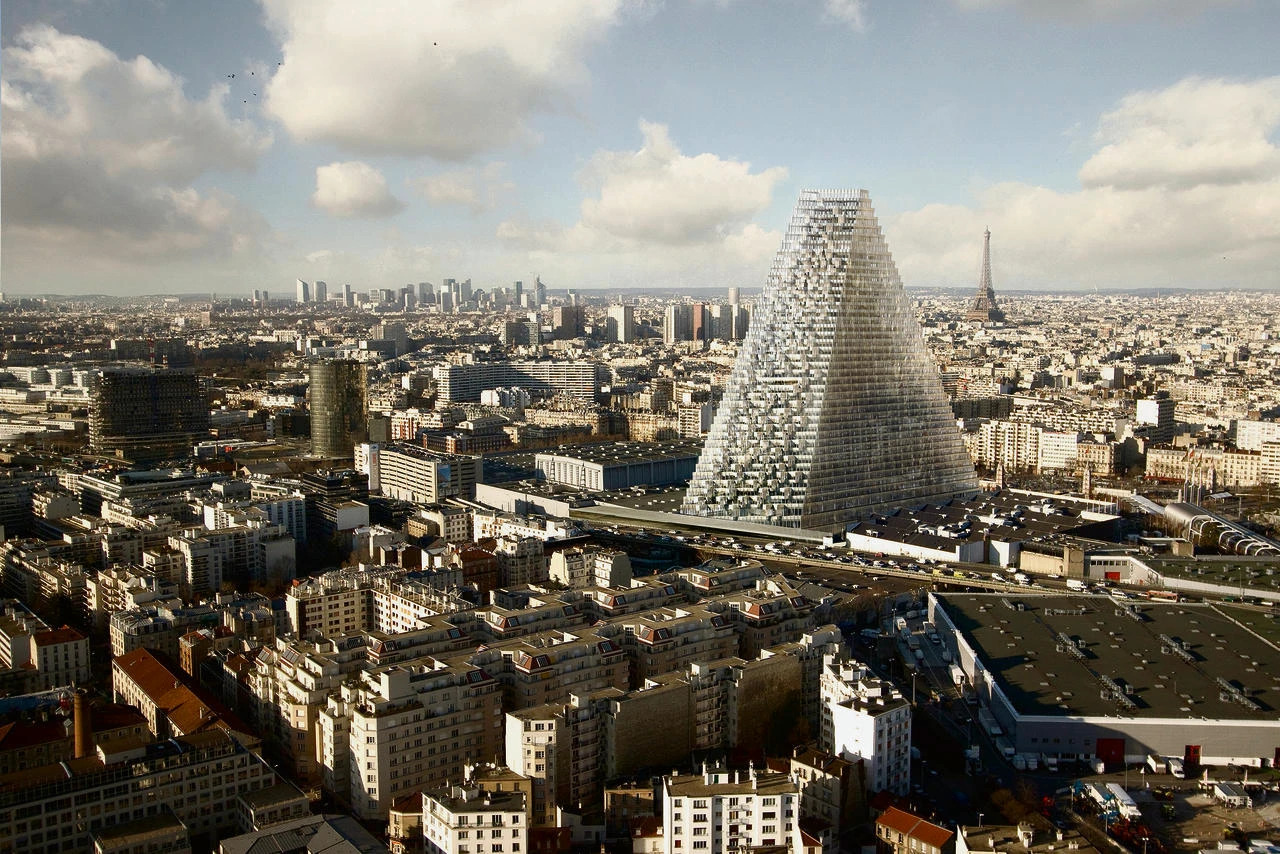
Table of Contents Show
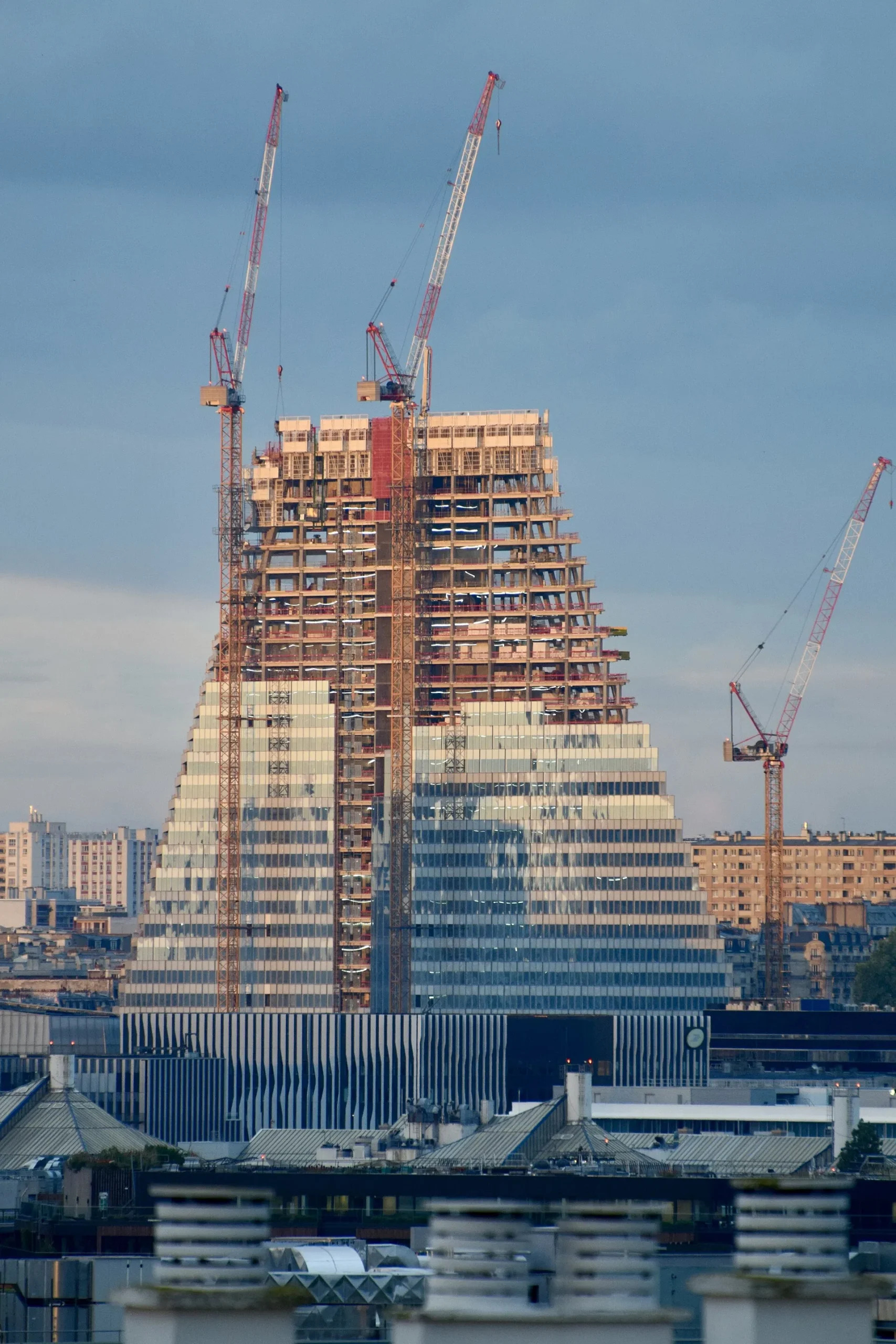
The Tour Triangle tower in Paris is a 180-meter glass skyscraper designed by Swiss architects Herzog de Meuron at Porte de Versailles. After nearly 20 years of political opposition, legal challenges, and public debate, the 42-story tower topped out in May 2026, making it the first major skyscraper built within central Paris since the Tour Montparnasse was completed in 1973.
Paris has always had a complicated relationship with tall buildings. The city’s famous low-rise skyline, shaped by centuries of Haussmann-era planning rules and strict height limits, became part of its global identity. So when Herzog de Meuron first proposed a triangular glass tower near the Parc des Expositions in 2006, the reaction was immediate and polarizing. Supporters called it a long-overdue sign of progress. Critics called it an insult to the cityscape. Two decades later, the Tour Triangle Paris tower stands at its full height, and that debate is far from settled.
Tour Triangle Tower: Design and Architectural Concept
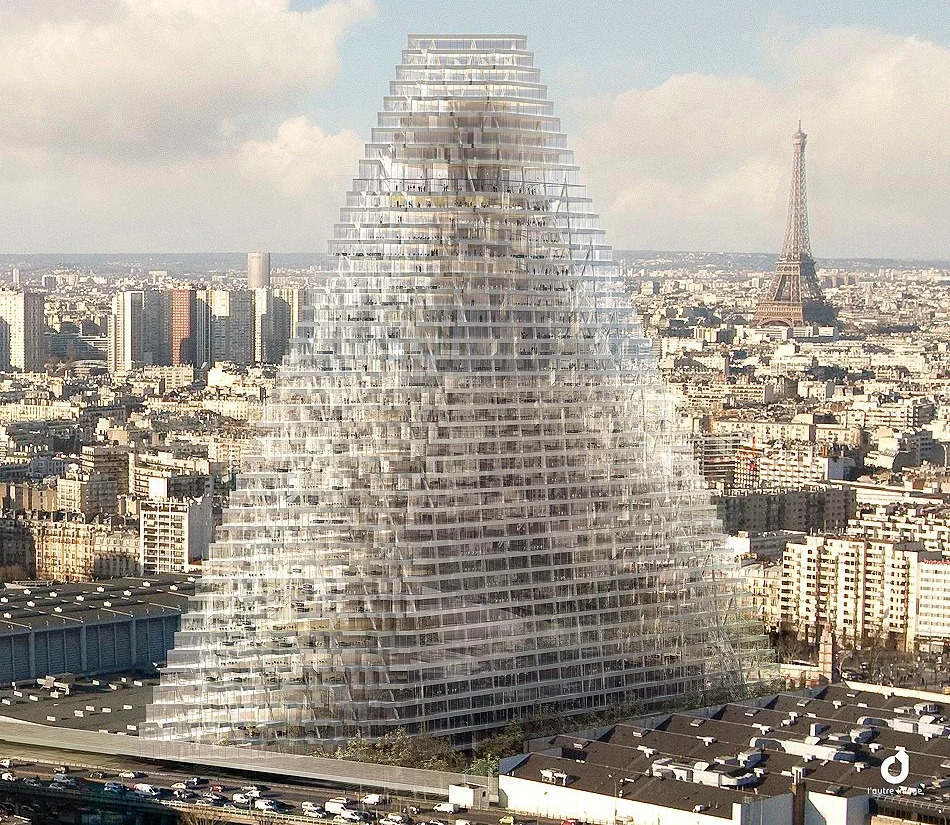
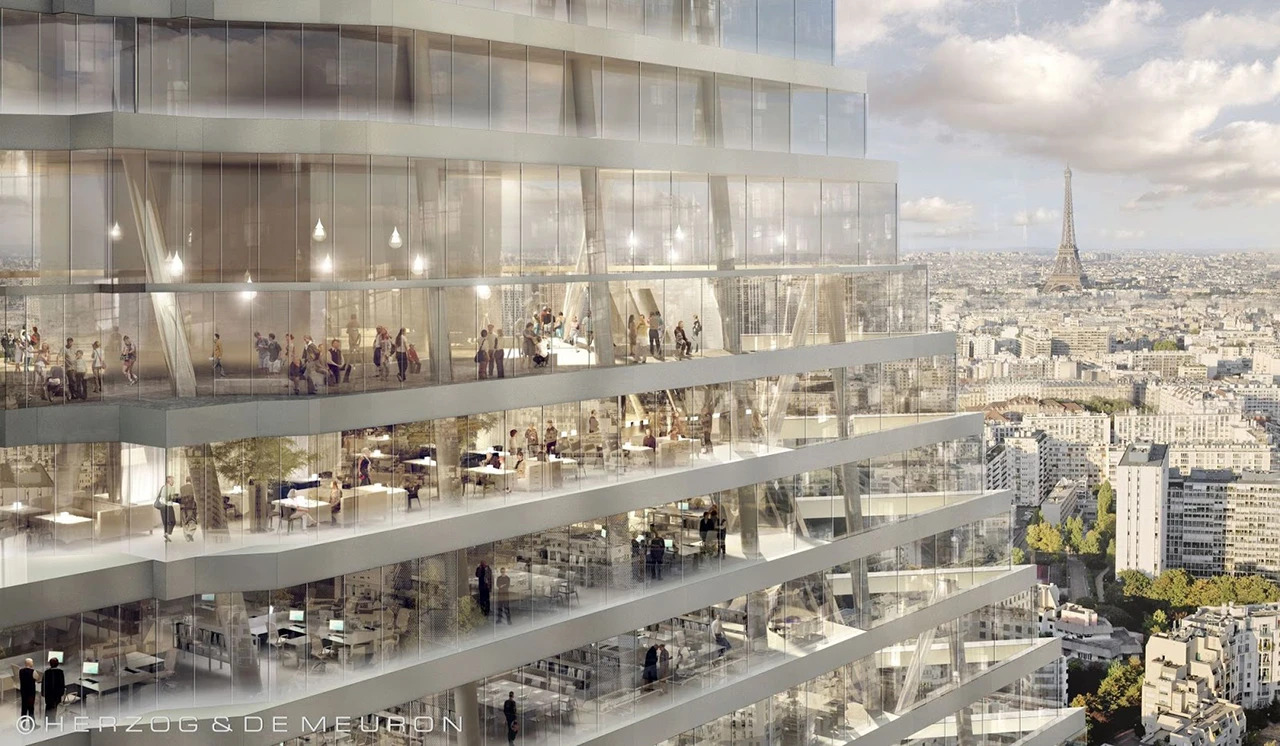
The Tour Triangle tower takes its name from its most obvious feature: a triangular floor plan that produces dramatically different profiles depending on where you stand. Viewed from central Paris, the building reads as a slim glass blade, almost disappearing against the sky. From the east or west, the full triangular width opens up, revealing a structure closer to a massive glass pyramid. Herzog de Meuron designed this geometry deliberately. The narrow profile reduces the building’s visual impact when seen from the historic core, while the wider faces maximize interior daylight and panoramic views for occupants.
The tower rises 42 stories and reaches approximately 180 meters, placing it behind only the Eiffel Tower (330 meters) and Tour Montparnasse (210 meters) among structures within the Paris city limits. The building’s glass facade is designed to change character throughout the day as light conditions shift. High-performance glazing panels cover the exterior, with photovoltaic panels installed across the entire south-facing side of the facade to generate on-site renewable energy.
💡 Pro Tip
When studying the Tour Triangle’s design, pay attention to how the triangular plan reduces shadow casting on neighboring low-rise buildings. This was a key strategy by Herzog de Meuron to address one of the most common objections to tall buildings in dense European cities, where shadow impact on adjacent properties can delay or block planning approval.
The stepped setbacks and large terraces on the facade break up the tower’s mass and give it a lighter profile compared to a conventional rectangular high-rise. Two terraces alone provide 2,600 square meters of outdoor greenery above street level. The design approach reflects Herzog de Meuron’s broader philosophy of creating buildings that respond to their immediate context rather than imposing a single form on it.
What Is Inside the Tour Triangle? A Mixed-Use Program
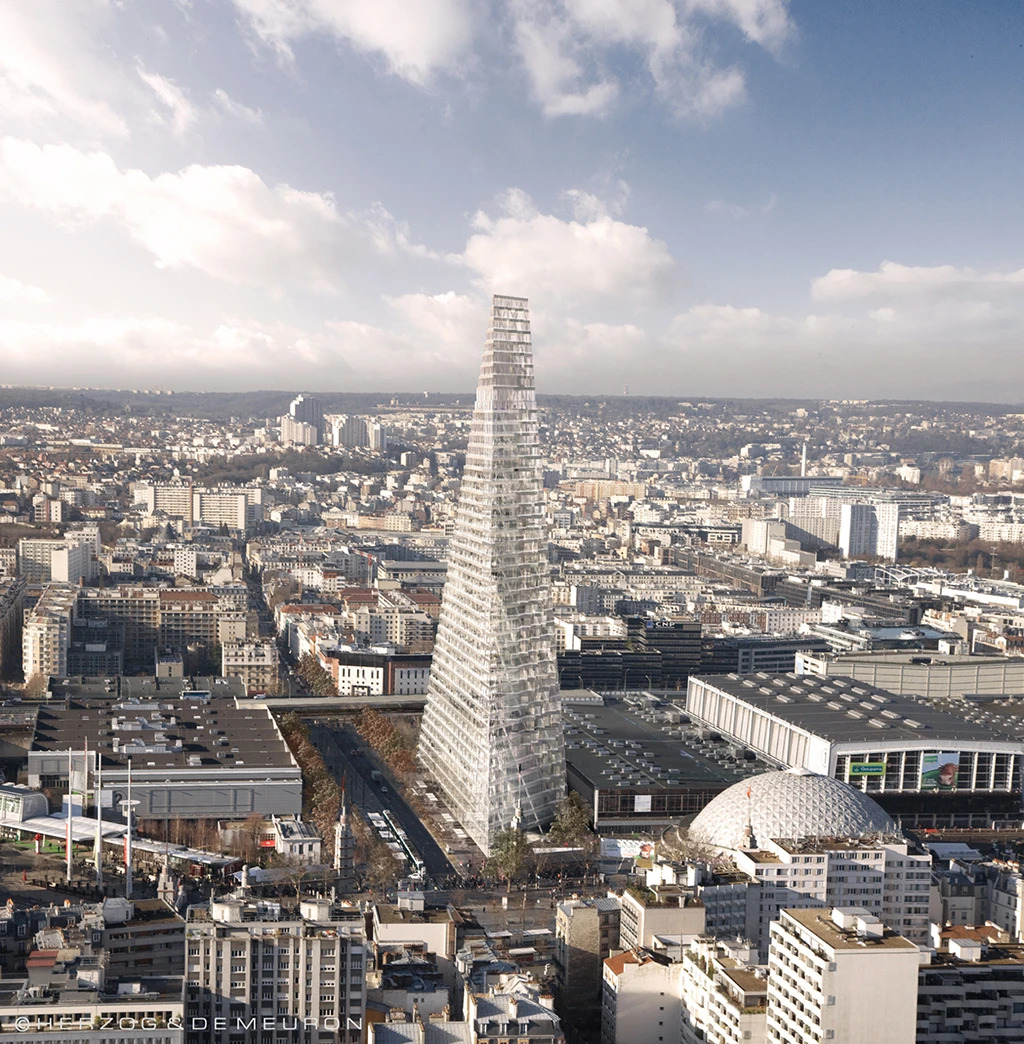
The Tour Triangle is not a single-purpose office block. Its 42 floors accommodate a dense mix of functions designed to keep the building active throughout the day and across seasons. The program includes roughly 70,000 square meters of office space (enough for approximately 5,000 workers), a Radisson Blu hotel with 128 rooms, a panoramic restaurant near the top, conference facilities, retail spaces, a cultural center, a creche, and health and wellness facilities.
At the summit, an observation deck open to the public will offer views across Paris. Reports from Architectural Record suggest that the upper floors may include an immersive panoramic attraction similar to SUMMIT One Vanderbilt in New York, where visitors experience the city from glass-floored skyboxes and mirrored rooms. If realized, this would make the Tour Triangle Porte de Versailles location a significant tourist draw, not just a business address.
🎓 Expert Insight
“We designed Triangle for Paris and Parisians.” — Jacques Herzog and Pierre de Meuron, founding partners, Herzog de Meuron
This statement, made during the project’s financing announcement, reflects the architects’ intent to position the tower as a public amenity rather than a purely commercial development. The inclusion of open terraces, a cultural center, and a publicly accessible observation deck supports that framing.
Tour Triangle Paris 2026: Timeline and Construction History
Few buildings in recent European history have taken as long to move from concept to completion as the Tour Triangle. The project’s timeline spans almost the entire first quarter of the 21st century, marked by repeated stops, restarts, and legal interventions.
Herzog de Meuron began designing the tower in 2006. Former Paris mayor Bertrand Delanoe introduced the project publicly in September 2008, declaring it would be “exceptional” and “beautiful.” That optimism met fierce resistance almost immediately. In 2014, the Paris city council voted against the project, driven by concerns about the tower’s height, its impact on the historic skyline, and broader opposition to high-rise development within the city.
A revised proposal was approved in 2015, but opponents launched multiple legal challenges. Developer Unibail-Rodamco-Westfield spent years in administrative courts defending the building permit, which was originally issued in April 2015. In 2019, an administrative court finally upheld the permit’s legality, rejecting two separate appeals. Financial backing from insurance giant AXA followed, and full construction began in 2022.
The original plan had targeted completion ahead of the 2024 Paris Summer Olympics, since the nearby Parc des Expositions at Porte de Versailles served as a venue for the Games. That deadline was missed. The tower topped out in spring 2026 and is expected to open by early 2027.
📌 Did You Know?
The Tour Triangle is not the only controversial tall building to rise in Paris in recent years. The Tours Duo by Jean Nouvel, a pair of towers reaching 180 and 125 meters in the 13th arrondissement, was completed around the same period. Together, these projects contributed to Paris Mayor Anne Hidalgo reinstating strict height limits across the city in 2023, making the Tour Triangle likely the last skyscraper to be built within central Paris for the foreseeable future.
Tour Triangle 180 Meters: How It Ranks Among Paris’s Tallest Structures
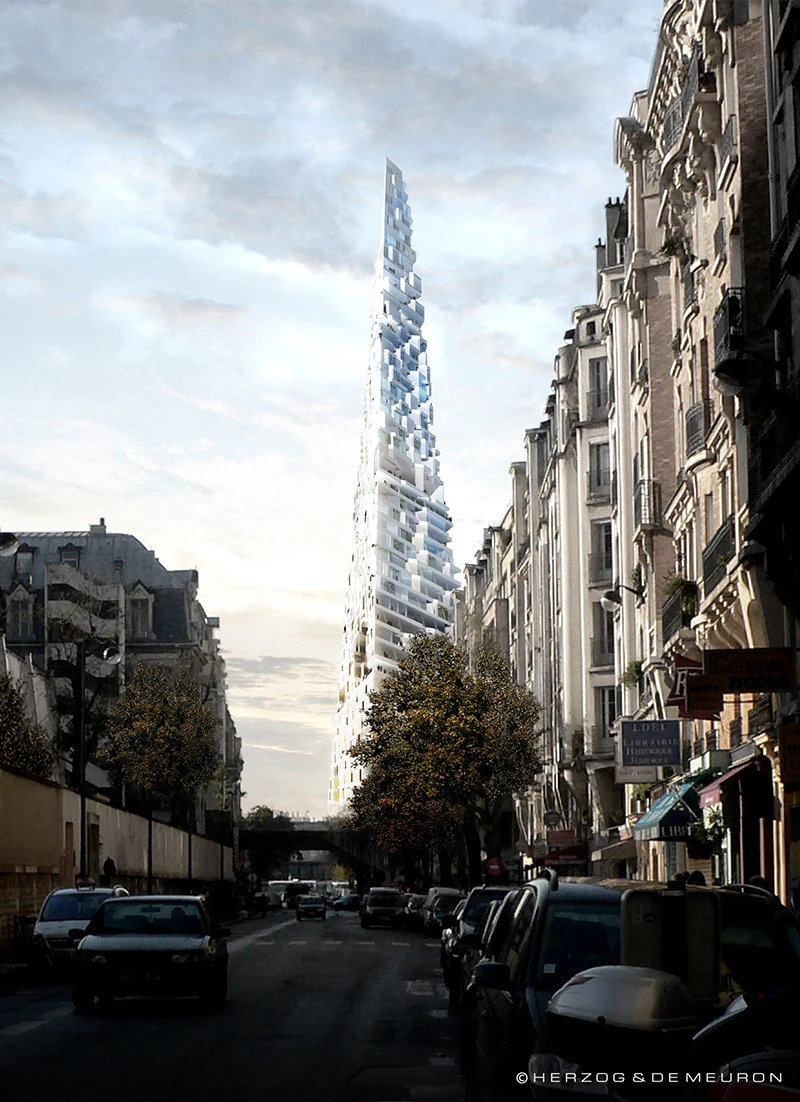
At 180 meters, the Tour Triangle tower becomes the third-tallest structure within the Paris city limits. The Eiffel Tower remains the tallest at approximately 330 meters (including its antenna). The Eiffel Tower, originally built for the 1889 World’s Fair, was itself deeply controversial when it first appeared, a parallel that Tour Triangle supporters have been quick to point out.
Tour Montparnasse, completed in 1973 at 210 meters, holds second place. That tower’s reception was so negative that it directly triggered the building height restrictions that kept Paris’s skyline low for the next five decades. It also prompted the famous joke that the best view in Paris is from the top of Tour Montparnasse, because it is the one place in the city where you cannot see Tour Montparnasse.
Beyond the city borders, the La Defense business district hosts several taller towers, including the 231-meter Tour First. But La Defense operates under different planning rules. Within Paris proper, the Tour Triangle’s 180 meters represent a significant vertical statement, and possibly the last one the city will allow.
Comparison of Paris’s Tallest Structures
The table below puts the Tour Triangle in context alongside the other major vertical landmarks in and around Paris.
| Structure | Height | Year Completed | Architect | Primary Function |
|---|---|---|---|---|
| Eiffel Tower | 330 m | 1889 | Gustave Eiffel | Observation / Monument |
| Tour Montparnasse | 210 m | 1973 | Beaudouin, Cassan, de Marien, Saubot | Office |
| Tour Triangle | 180 m | 2026 | Herzog de Meuron | Mixed-Use |
| Tours Duo (taller tower) | 180 m | 2024 | Jean Nouvel | Office / Hotel |
| Tour First (La Defense) | 231 m | 2011 (renovation) | Kohn Pedersen Fox | Office |
Tour Triangle Porte de Versailles: Location and Urban Impact
The Tour Triangle sits at the edge of the Parc des Expositions de la Porte de Versailles, a 220,000 square meter exhibition and conference center originally built in 1923 in the 15th arrondissement of Paris. The exact address is 1 Place de la Porte de Versailles. The site occupies a narrow strip of land along the avenue Ernest-Renan, right next to the city’s ring road (the Boulevard Peripherique).
This peripheral location was deliberate. By placing the tower at the edge of the city rather than in its historic core, planners hoped to reduce its visual intrusion on the traditional Parisian streetscape. The building is owned by Viparis, the operator of the exhibition complex, and was developed by Unibail-Rodamco-Westfield with reported construction costs of approximately $820 million (according to Architectural Record).
For the surrounding neighborhood, the tower promises to bring new commercial and cultural activity to an area that has historically functioned as a trade-fair venue rather than a residential or leisure destination. The ground-level retail, cultural spaces, and public terraces are intended to draw foot traffic beyond the existing conference and exhibition crowds.
💡 Pro Tip
If you are researching mixed-use high-rise projects in heritage-sensitive cities, the Tour Triangle offers a useful case study in how peripheral siting, reduced visual bulk through geometric design, and a dense program of public amenities can be used to build political and public support for tall buildings in otherwise hostile planning environments.
Sustainability Features of the Tour Triangle Paris Skyscraper
The Tour Triangle is designed to produce roughly one quarter of the CO2 emissions that a conventional building of the same size would generate. Several systems contribute to this target. The facade’s south-facing photovoltaic panels generate renewable electricity on-site. High-performance glass across the building’s exterior maximizes natural daylight penetration, reducing the demand for artificial lighting. Geothermal technology is also part of the energy strategy.
The project targets certification under both the French HQE (Haute Qualite Environnementale) standard and the international BREEAM environmental assessment framework. These certifications evaluate energy performance, water efficiency, indoor environmental quality, material selection, and ecological impact. Achieving both demonstrates a commitment to sustainability beyond the minimum required by French building regulations.
The 2,600 square meters of green terraces also serve an environmental function. Planted outdoor spaces at height help reduce the urban heat island effect, manage stormwater runoff, and provide insulation benefits that complement the building’s mechanical systems. For a tower in a dense urban setting, these terraces represent a significant investment in occupant wellbeing and environmental performance.
🏗️ Real-World Example
The Edge (Amsterdam, 2015): Often cited as one of the greenest office buildings in the world, The Edge achieved an outstanding BREEAM score of 98.36%. It uses 28,000 sensors, solar panels covering a surface area larger than the building’s footprint, and an aquifer thermal energy system. The Tour Triangle’s sustainability strategy draws on similar principles, combining on-site renewable energy generation with high-performance glazing and smart building systems to reduce operational carbon.
Tour Triangle Herzog de Meuron: The Architects Behind the Tower
Jacques Herzog and Pierre de Meuron founded their practice in Basel, Switzerland, in 1978. The firm has produced some of the most recognized buildings of the past four decades, including the Tate Modern in London (a conversion of the former Bankside Power Station), the Beijing National Stadium (the “Bird’s Nest” for the 2008 Olympics), and the Calder Gardens Museum in Philadelphia. They received the Pritzker Architecture Prize in 2001.
The Tour Triangle represents something unusual for the firm: a project that required not just architectural skill but nearly two decades of political endurance. Herzog de Meuron began the design in 2006, weathered a council rejection in 2014, navigated multiple legal challenges, and persisted through financing delays. Few major architectural commissions demand this kind of sustained commitment from their designers.
The firm’s approach to the Tour Triangle follows their broader pattern of creating forms that respond directly to site conditions and programmatic requirements. The triangular plan was not chosen for its symbolic value but for its practical ability to manage shadow impact, maximize views, and present a minimal profile from the city center. This logic-driven design process is consistent with how they approached the evolution of skyscraper design more broadly.
Why Is the Paris Skyscraper Tour Triangle So Controversial?
Paris’s resistance to tall buildings runs deep. After Tour Montparnasse opened in 1973 to widespread criticism, the city imposed a 37-meter height limit that effectively banned new skyscrapers within its borders. That restriction held until 2010, when the city council voted to relax it. The relaxation opened the door for projects like Tour Triangle and Tours Duo, but it also triggered a backlash that culminated in Mayor Anne Hidalgo reinstating strict height controls in 2023 as part of a broader bioclimatic urban plan.
The objections to the Tour Triangle fall into several categories. Preservationists argue that any tall building disrupts the visual harmony of Paris’s famously uniform Haussmann-era roofline. Environmental groups initially described the project as an “ecological aberration,” though the building’s sustainability features have softened some of that criticism. Others point to the practical issue of office oversupply: Architectural Record reported that Paris currently has approximately 64.5 million square feet of vacant office space, raising questions about whether the city needs another 70,000 square meters of commercial floor area.
⚠️ Common Mistake to Avoid
Many people assume that Parisians have always opposed all tall buildings. The reality is more specific. The backlash is primarily directed at towers within the city’s historic limits. The La Defense business district, just outside Paris proper, has hosted dozens of skyscrapers since the 1960s without generating the same level of controversy. The debate is about where tall buildings belong, not whether they should exist at all.
Supporters, on the other hand, see the Tour Triangle as evidence that Paris can accept carefully designed vertical development without losing its character. They point to the building’s peripheral location, its mixed-use program, and its sustainability credentials as proof that the project was planned with sensitivity to the city’s identity. The fact that the Eiffel Tower itself was once loathed by Parisian intellectuals and is now the city’s most beloved landmark adds a historical layer to the argument.
What the Tour Triangle Means for the Future of Paris Architecture
With height restrictions now back in place, the Tour Triangle will almost certainly be the last skyscraper approved for construction within central Paris for a long time. That gives it a unique position in the city’s architectural history. It is not just a building; it is the closing chapter of a brief period when Paris flirted with vertical expansion.
The tower’s performance over the coming years will be closely watched. If it successfully attracts tenants, draws visitors to its observation deck and cultural spaces, and integrates into the surrounding neighborhood, it could gradually win over skeptics in the way that many controversial buildings eventually do. If it struggles with occupancy or fails to deliver on its sustainability promises, critics will point to it as proof that tall buildings do not belong in Paris.
For architects and urban planners working in other heritage-sensitive cities, the Tour Triangle offers practical lessons. Geometric strategies can reduce visual bulk. Peripheral siting can manage political opposition. Dense mixed-use programming can make a tall building serve its community rather than dominate it. And sometimes, getting a building built requires as much patience and legal stamina as it does design talent.
Video: Tour Triangle Paris by Herzog de Meuron
This video from Unibail-Rodamco-Westfield presents the Tour Triangle project, showing the building’s triangular form, interior program, and its relationship to the surrounding Porte de Versailles district.
✅ Key Takeaways
- The Tour Triangle Paris is a 180-meter, 42-story glass skyscraper by Herzog de Meuron, now the third-tallest structure within Paris city limits.
- The building’s triangular plan was designed to appear as a thin blade from central Paris while maximizing views and daylight from its wider faces.
- Its mixed-use program includes 70,000 sqm of offices, a 128-room hotel, restaurants, cultural spaces, retail, and a public observation deck.
- The project took nearly 20 years from initial design (2006) to topping out (2026), surviving a council rejection, multiple court cases, and financing delays.
- With Paris’s skyscraper ban reinstated in 2023, the Tour Triangle is likely the last tall building to be built within the city’s historic limits for the foreseeable future.
Final Thoughts
The Tour Triangle Paris tower is not just a glass skyscraper at the edge of an exhibition center. It is the product of two decades of ambition, resistance, compromise, and persistence. Whether you see it as a bold step forward for Paris or an unwelcome intrusion into a treasured skyline depends largely on your view of what cities owe to their past and what they owe to their future. What is harder to argue against is the quality of its design, the breadth of its program, and the determination it took to build it. Paris now has a new landmark. The question is whether it will come to love it.
Cost figures referenced in this article are approximate and may vary based on source and exchange rates. Building specifications are based on publicly available project data as of May 2026.







Antoni Gaudí’s Last Original Residence at Casa Batlló: Inside the 2026 Restoration
Casa Batlló has opened its restored Third Floor to the public for...
Elif Ayse Sen12 Mins read
MVRDV and OODA’s Marvila Masterplan: Reconnecting Lisbon to the Tagus River
MVRDV and OODA's Marvila Masterplan transforms 28 hectares of fragmented industrial land...
Elif Ayse Sen10 Mins read
Studio Gang Architecture: Curved Timber Theater for Hudson Valley Shakespeare
Studio Gang's Samuel H. Scripps Theater Center gives Hudson Valley Shakespeare its...
Elif Ayse Sen12 Mins read
Most Beautiful Museums in the World 2026: The Prix Versailles Selection
The Prix Versailles has announced its 2026 list of the world's most...
Elif Ayse Sen11 Mins read


Leave a comment