

Parafin 3D Review: AI-Driven Site Acquisition That Generates Budgets and Proformas Instantly
Parafin 3D now trades as Parafin and sells only to hotel developers. This review covers the generate, underwrite and submit workflow, brand coverage, 2026 subscription pricing, and how it stacks up against TestFit and Autodesk Forma.
 Elif Ayse Sen12 August 20267 Mins read189

Table of Contents Show
Parafin 3D, now trading simply as Parafin, is a generative feasibility platform for hotel developers. It turns a site boundary and a chosen hotel brand into thousands of brand-compliant design variants, each tied to a development budget and an investment summary, in minutes instead of the weeks an architect-led study normally takes.
This Parafin 3D review covers what the platform does today, how the acquisition workflow runs from site to submission package, what it costs, and where it stops being useful. One thing to settle first: most search results for the old name describe a general commercial real estate development software product from 2019. The company has since narrowed hard into hospitality, and that shift changes who should be looking at it.
What Is Parafin and Who Is It Built For?

Parafin is development feasibility software aimed at one specific buyer: the hotel developer deciding whether a parcel is worth pursuing. You enter a location, set the site boundaries, pick a brand, and the engine generates brand-compliant layouts along with the numbers a deal committee actually reads. Architects can use it, but they are not the customer. The company was founded by Adam Hengels, who spent over a decade in real estate development, and Brian Ahmes, who co-founded LINE, the computational design studio inside HKS Architects.
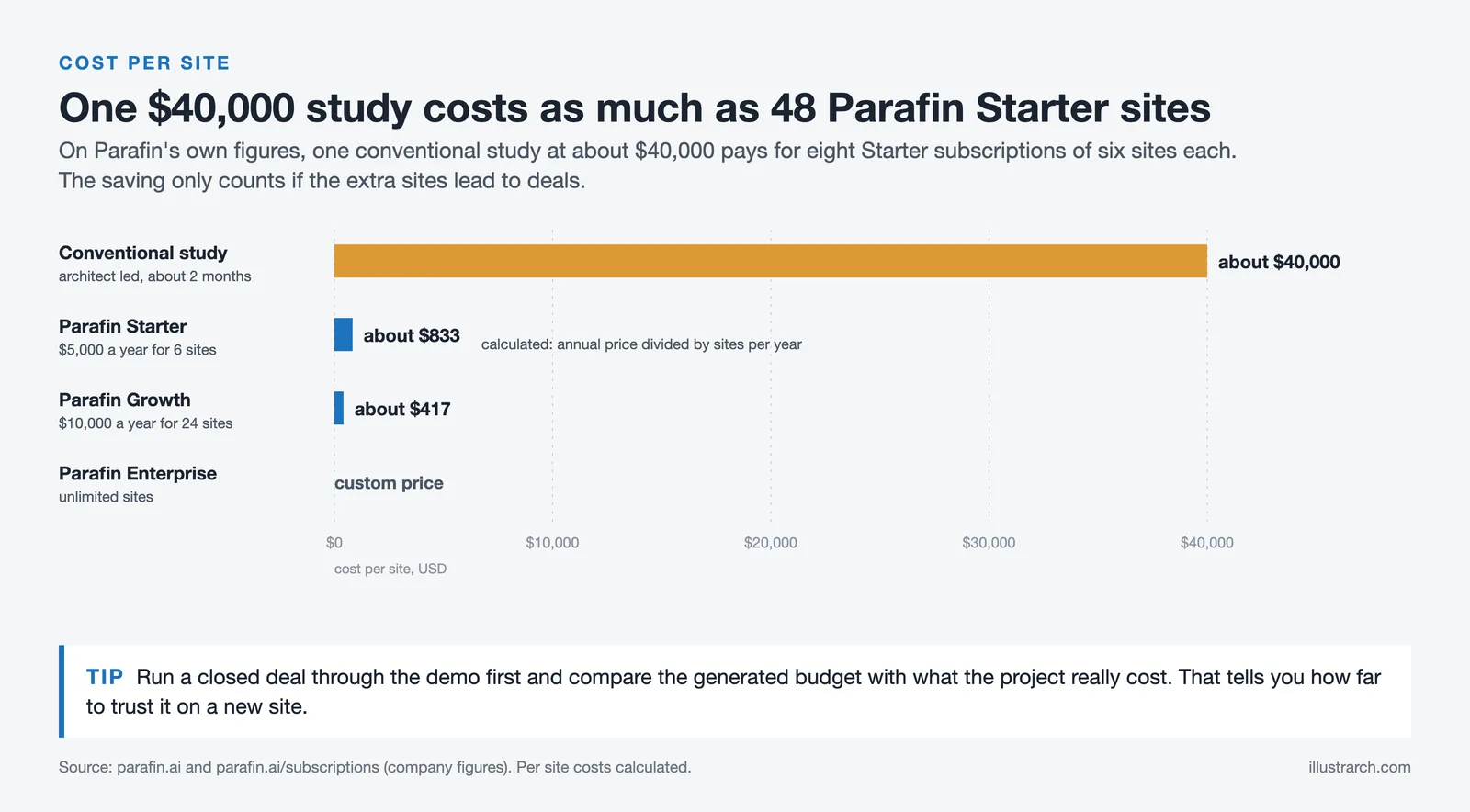
The problem it targets is triage. A developer might look at ten or twenty sites for every one that moves forward, and paying an architect to study each one is not realistic. So sites get judged on instinct, and buildable deals quietly get walked away from. Parafin puts the traditional route at roughly two months and about $40,000 per site, against a workflow it measures in minutes. That framing is the company’s own, and it is worth testing against your own last three architecture feasibility studies rather than accepting at face value.
🔢 Quick Numbers
- The U.S. hotel construction pipeline held 6,020 projects and 705,825 rooms at the close of Q1 2026, with 2,785 of those projects still sitting in early planning (Lodging Econometrics, Q1 2026 U.S. Construction Pipeline Trend Report)
- Parafin puts conventional architect-led site feasibility at roughly two months and about $40,000 per site (Parafin company website, 2026)
- TestFit’s 2026 customer survey reports more than $4,000 saved per feasibility study and 650 or more deals evaluated per week across its platform (TestFit 2026 pricing materials and ROI report)
That early planning number is the market Parafin is chasing. Nearly half the U.S. pipeline sits at the stage where nothing has been drawn, nothing has been underwritten properly, and the decision to spend real money has not been made. Anyone selecting hotel design and program priorities at that stage is working from assumptions, not documents.
From Parafin 3D to Parafin: What Actually Changed
The original Parafin 3D pitched itself around a proprietary method called Value-Integrated Parametric Design, generating thousands of options for a site and using a selection process to surface the best performers. Its earlier positioning line was that the software “designs like an architect and thinks like a developer.” The product was described as serving commercial real estate acquisition and development broadly.
Today’s product is narrower and, on the evidence, sharper. Parafin runs at parafin.ai, sells to hotel developers, and has trained its engine on the branded prototypes those developers build. The founders describe hospitality as a starting point chosen because the strongest brands in real estate sit there, which makes brand approval the fastest path to adoption. If you arrived looking for general land acquisition software for industrial or multifamily work, this is not that tool anymore.
⚠️ Common Mistake to Avoid
Two mix-ups cost people time here. First, there is an unrelated fintech company also called Parafin that provides embedded business lending, and it dominates a lot of generic search results. Second, the 2019 press coverage of Parafin 3D describes a broad commercial real estate product that no longer reflects what the platform sells. Check parafin.ai directly rather than working from directory listings or older articles.
How the Generate, Underwrite, Submit Workflow Runs
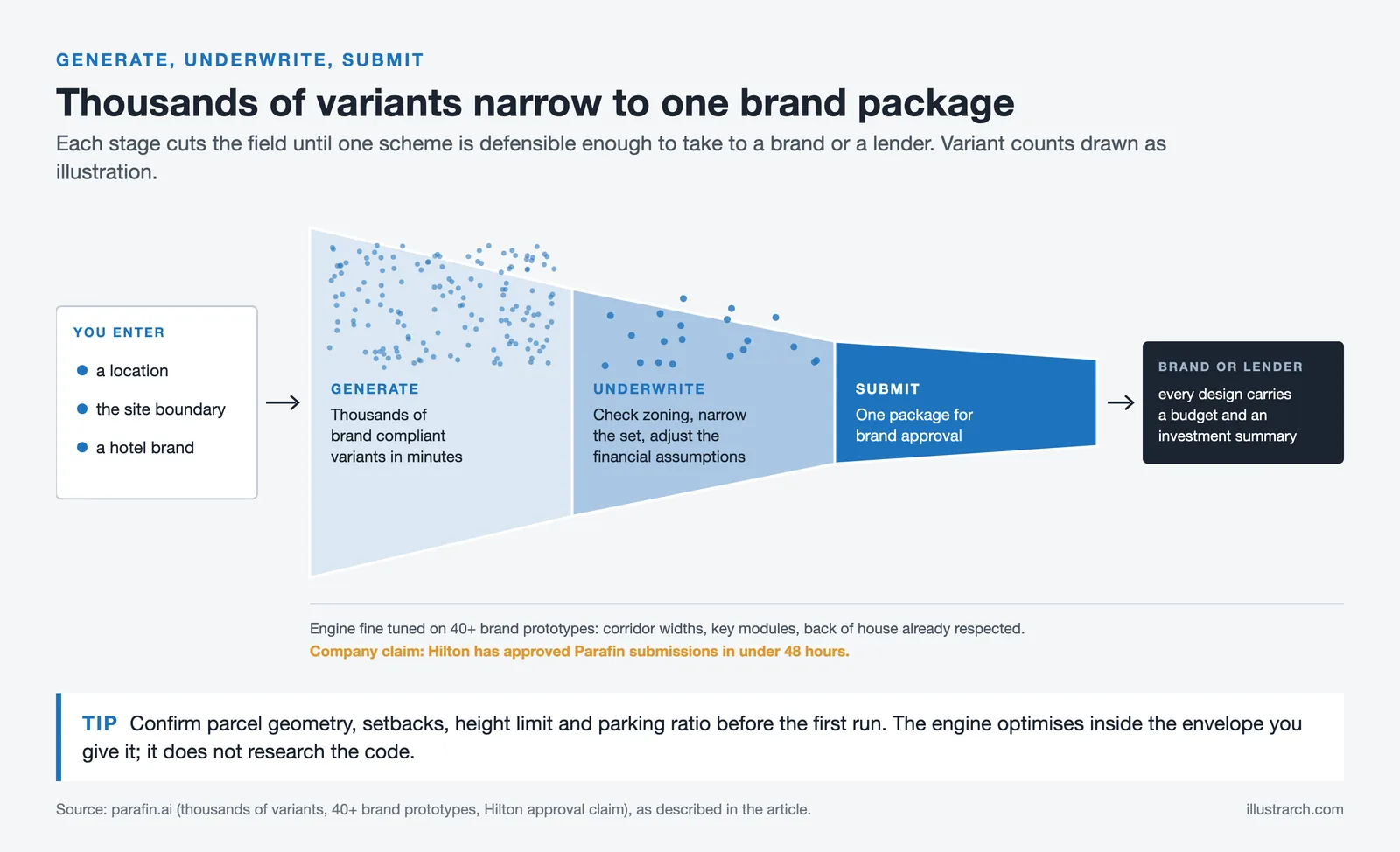
Parafin structures the process in three steps, and the sequence matters more than any single feature. Each stage narrows the field until one variant is defensible enough to take to a brand or a lender.
Generate
You enter a location, draw or select the site boundaries, and choose a brand. The engine produces thousands of brand-compliant design variants in minutes. This is the part that looks like conventional generative design, and it depends entirely on the quality of the site geometry you feed it. Good site analysis still governs the output, since a wrong boundary or a missed easement produces confident nonsense.
Underwrite
The second stage is where this differs from most tools in the category. You check zoning, narrow the variant set, and adjust financial assumptions until a scheme pencils. Every design carries a development budget and an investment summary, which makes this closer to real estate proforma software than to a massing tool. The design and the numbers move together, so changing key count or parking immediately shows up in returns.
Submit
The output is a submission-ready package for fast-tracked brand approval. Parafin states that Hilton has approved its submissions in under 48 hours. That claim is the strongest argument for the product, because approval speed is where hotel deals usually stall, and it is also the claim most worth verifying against your own franchise contacts before you subscribe.
📐 Technical Note
The engine is fine-tuned on more than 40 brand prototypes, which means the geometry it produces already respects brand-mandated corridor widths, key modules, public area programs, and back-of-house allocations. That constraint set is what separates a brand-compliant variant from a generic massing block. Before running a site, have the parcel geometry, applicable setbacks, height limit, and required parking ratio confirmed, since the platform optimizes inside whatever envelope you give it rather than researching the code for you.
Brand Coverage: Which Flags Are Supported

Coverage runs across the major select-service and extended-stay families where most U.S. pipeline volume sits. Hilton brands include Home2 Suites, Hampton, Tru, Homewood Suites, Hilton Garden Inn, and LivSmart Studios. From Marriott there are Residence Inn, TownePlace Suites, Fairfield, SpringHill Suites, Courtyard, AC Hotels, Aloft, Element, Four Points, and StudioRes. Hyatt is represented by Hyatt Studios, Hyatt Place, Hyatt House, and Hyatt Select. IHG, Choice, Sonesta, Extended Stay America, and My Place round out the list.
The practical value of that spread shows up when a franchise opportunity falls through. A developer whose site was already modeled in Parafin can switch the brand and regenerate rather than restart, which is the scenario the company’s own customer testimonials keep returning to. For a developer holding land while waiting on a franchise decision, that flexibility is the feature.
How Much Does Parafin Cost?
Parafin prices by site volume rather than by seat, and every plan includes unlimited team members on a 12-month contract. Published tiers as of 2026 are set out below.
Parafin Subscription Tiers in 2026
| Plan | Sites per year | Annual price | Built for |
|---|---|---|---|
| Starter | 6 | $5,000 | Small independent developers |
| Growth | 24 | $10,000 | Fast-growing developers |
| Enterprise | Unlimited | Custom | National developers and chains |
Run the arithmetic against the company’s own comparison and the pitch becomes clear. At $5,000 for six sites, a Starter subscription costs less per site than a fifth of one conventional feasibility study by Parafin’s own $40,000 estimate. The counter-argument is equally clear: six studies you never would have commissioned are not a saving, they are a new line item. The tool pays for itself only if the extra sites you evaluate produce deals you would otherwise have skipped.
💡 Pro Tip
Book the demo with a deal you have already closed, not a site you are chasing. Run the parcel through the platform and compare the generated budget line by line against what the project actually cost you. If the model lands within a range you can work with on a project whose real numbers you know, its output on an unknown site is worth something. If it does not, you have learned that in 30 minutes instead of after a year of subscription.
Parafin vs TestFit vs Autodesk Forma
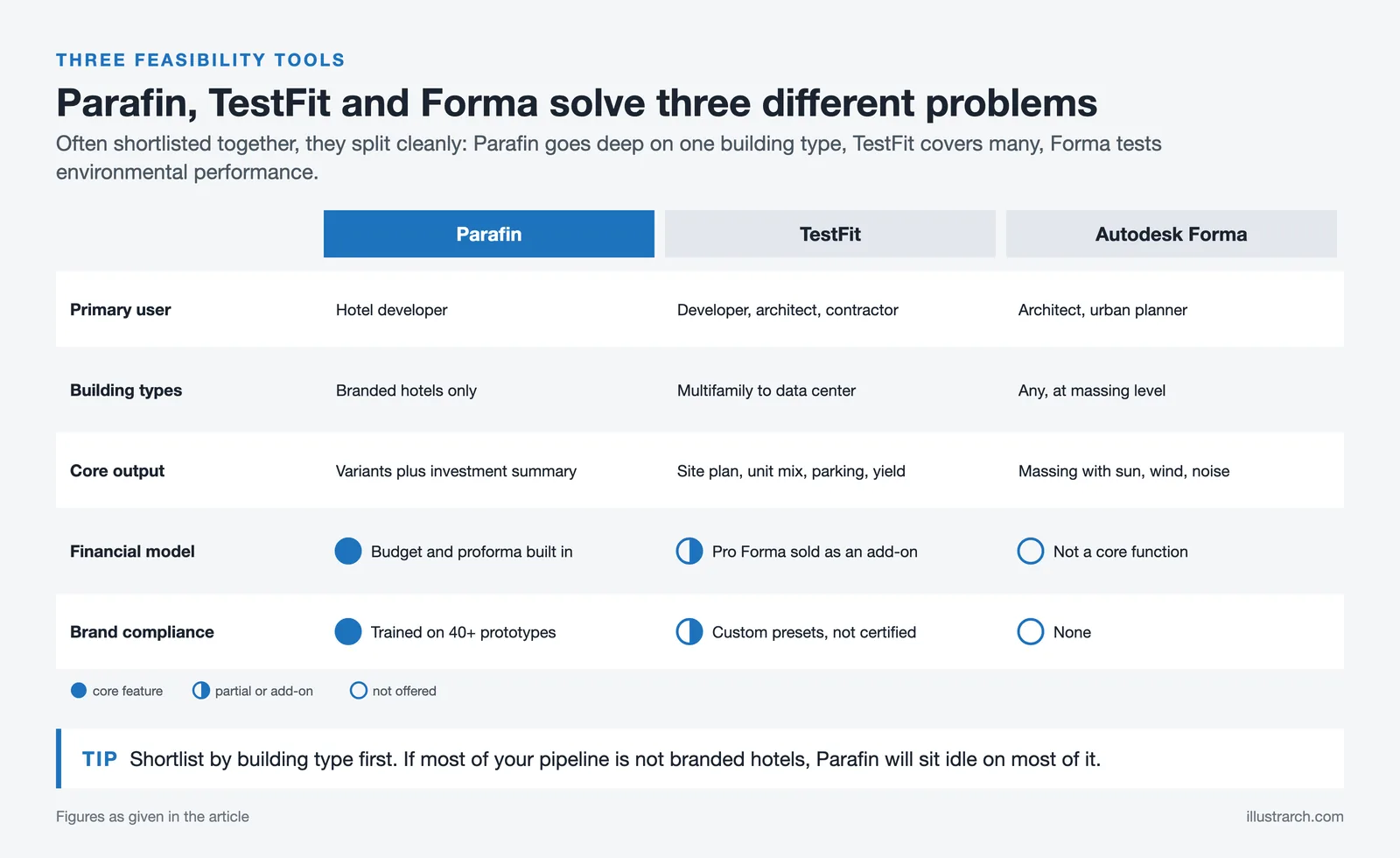
These three tools are often shortlisted together and are frequently mistaken for competitors. They solve different problems, and the table below sets out where each one sits.
Feature and Positioning Comparison
| Feature | Parafin | TestFit | Autodesk Forma |
|---|---|---|---|
| Primary user | Hotel developer | Developer, architect, contractor | Architect, urban planner |
| Building types | Branded hotels only | Multifamily, industrial, retail, hotel, data center | Any, at massing level |
| Core output | Brand-compliant variants plus investment summary | Site plan, unit mix, parking, yield | Massing with sun, wind, noise analysis |
| Financial modeling | Budget and proforma built in | Pro Forma sold as an add-on | Not a core function |
| Brand compliance | Trained on 40+ prototypes | Custom presets, not brand-certified | None |
| Entry pricing | $5,000 per year | $195 per month, Site Solver from $15,000 per year | $85 a month or $700 a year (Forma Site Design), as of October 2026 |
| Delivery | Browser, demo-gated | Browser, with Revit and SketchUp export | Browser, Revit and Rhino connected |
TestFit pricing comes from its published plan page, and the Forma figure reflects publicly listed Autodesk pricing as of October 2026. Read across the rows and the split is obvious. Our TestFit review covers a platform built for typology breadth, and the Autodesk Forma review covers one built for environmental performance. Parafin trades both away for depth in a single vertical, and gains a brand approval advantage that neither of the others can offer.
Where Parafin Falls Short
The vertical focus cuts both ways. If your pipeline is mixed, you are buying a tool that goes dark on most of it, and you will still need something else for multifamily or industrial sites. Coverage is also U.S.-brand centric, which limits it for developers working outside North America.
There is no self-serve trial. Starter and Growth plans are purchasable directly, but seeing the product first means booking a 30-minute demo, and the checkout page does not preview the interface. For a $5,000 annual commitment on a 12-month contract, that is a real friction point compared with tools you can test before paying.
The output is also early-stage by design. It is a go or no-go instrument and a brand submission aid, not a substitute for design development, entitlements, or construction documents. One firm quoted on the company’s site frames it as a head start their architects then build on, which is the accurate reading. Developers who treat a generated variant as a finished scheme will find the gap between it and permit-ready drawings expensive.
Finally, most of the performance evidence available publicly comes from the vendor and its named customers. Independent benchmarking of generative feasibility accuracy barely exists across this whole category, whether you are looking at Parafin, at Finch3D, or at any of the other AI tools reshaping early-stage design work.
Pricing and cost figures cited here are drawn from publicly published 2026 vendor materials and are approximate. They vary by contract terms, region, and project scope, so confirm current pricing with each vendor before committing.
Looking Ahead
The interesting question this Parafin 3D review raises is not whether the software works. It is what happens to the economics of early-stage architecture when feasibility stops being billable. Hotel developers commissioned those studies because they had no alternative, and a subscription priced below the cost of a single study removes the reason to commission them at all. Firms like CSHQA appear to be reading the shift correctly, using the platform to arrive at the table with a head start rather than defending the hours it eliminates. Development activity is holding steady while capital stays cautious, which is exactly the environment where the developer who can price twenty sites in a week beats the one who can price two.






Python or Grasshopper: Which Should Architecture Students Learn First?
Grasshopper teaches parametric logic through visual feedback, while Python handles data, repetition,...
 Sinan Ozen6 Mins read
Twinmotion Render: Free Downloadable Assets and PBR Materials for Simpler 3D Workflows
A practical guide to producing architectural visualizations with Twinmotion using its built-in...
Elif Ayse Sen14 Mins read
Cloud Rendering vs Local Rendering: What Actually Costs Less for Architects?
Architects weighing cloud rendering vs local rendering face a real tradeoff between...
Sinan Ozen9 Mins read

AI Render Tools vs Traditional Rendering: Speed, Cost, and Quality Compared
This article compares AI render tools with traditional architectural rendering engines like...
Sinan Ozen6 Mins read


Leave a comment