

Planimetric Diagram in Architecture: A Complete Guide to Top-Down Design and Planimetry
Learn what a planimetric diagram is and why it matters in architecture. This guide covers the planimetry definition, planimetric map types, house planimetry essentials, and practical tips for creating clear top-down architectural designs.
 Furkan Sen9 June 202413 Mins read693

Table of Contents Show
A planimetric diagram is one of the most essential tools in architectural visualization. It provides a bird’s eye view of a project, detailing the layout without the distraction of elevation or depth and allowing for a clear comprehension of spatial relationships and traffic flow within the design. Among the various tools at an architect’s disposal, planimetric diagrams stand out as fundamental elements that break down complex designs into understandable visuals. Whether you are working on programme and function diagrams or refining a house planimetry layout, these top-down representations are where most projects begin to take shape.
Architects and designers often encounter planimetric diagrams in the early stages of design, where the focus is on the arrangement of spaces and the interaction between different areas of a building or site. They serve as a guide for developing more detailed plans and are essential for visualizing the overall organization of spaces. By simplifying the complexity of architectural designs, planimetric diagrams enable us to make informed decisions about space utilization, circulation, and the integration of structural elements.

Understanding the Planimetric Diagram in Architecture
Planimetry Definition and Origins
Before exploring specific diagram types, it is helpful to clarify the planimetry definition. Planimetry is the branch of measurement concerned with representing three-dimensional objects and spaces on a flat, two-dimensional plane. The term comes from the Latin “planum” (flat surface) and the Greek “metron” (measure). According to Wikipedia’s entry on planimetrics, the discipline deals with plane measurements including angles, distances, and areas. In architecture, planimetry refers specifically to the graphic representation of a building, site, or landscape as seen from directly above. A planimetric drawing is therefore any representation that omits elevation data and focuses entirely on horizontal relationships.
You may also see the term “planometric” used in some references. While planometric and planimetric are sometimes used interchangeably in casual discussion, the planimetric definition specifically describes representations that are measured and projected onto a horizontal plane without perspective distortion. Understanding this distinction helps architects choose the right representation method for each project stage.
The Essence of Planimetric Representation
Planimetric diagrams serve as the foundation of architectural visualization, providing a top-down view that captures the layout of spaces in a clear and simplified manner. At its core, a planimetric representation strips away the complexities of elevation and perspective, focusing solely on the horizontal plane. This approach allows us to grasp the spatial organization and relationships between various elements of a project quickly. Whether it’s determining the flow through a building or understanding the arrangement of outdoor spaces, planimetric diagrams offer an invaluable tool for architects, designers, and stakeholders. Their utility extends beyond mere layout planning; they are instrumental in the conceptual phase, where the spatial logic and functional distribution of a project are determined.
Key Characteristics of Planimetric Diagrams
Planimetric diagrams distinguish themselves through several key features that make them indispensable in the field of architecture. These diagrams are defined by their clarity and simplicity. By eliminating the third dimension, they present a straightforward depiction of a site or a building’s footprint, making it easier to communicate ideas and make informed decisions. Another characteristic is their focus on spatial relationships and functional zones. Planimetric diagrams excel at showing how different areas of a project interact with each other, highlighting connections and separation between spaces. This is crucial for effective circulation planning and ensuring that the layout aligns with the intended use of each space.
Moreover, planimetric diagrams often incorporate annotations and symbols to convey additional information about the project, such as entrances, pathways, and significant landscape features. This added layer of detail enhances the diagram’s utility as a tool for discussion and analysis during the planning stages. Lastly, these diagrams are versatile; they can be adapted to various scales and contexts, from detailed site plans to broader master planning efforts. This flexibility ensures that planimetric diagrams remain an essential part of the architect’s toolkit, adaptable to the unique needs of each project.

What Is a Planimetric Map?
A planimetric map is a type of map that represents features on the earth’s surface (or within a building) without showing elevation or topographic relief. In geographic contexts, planimetric maps display roads, building footprints, rivers, and property boundaries as viewed from above. In architecture, the concept translates directly to floor plans, site plans, and any drawing that shows the horizontal layout of spaces without vertical dimension data.
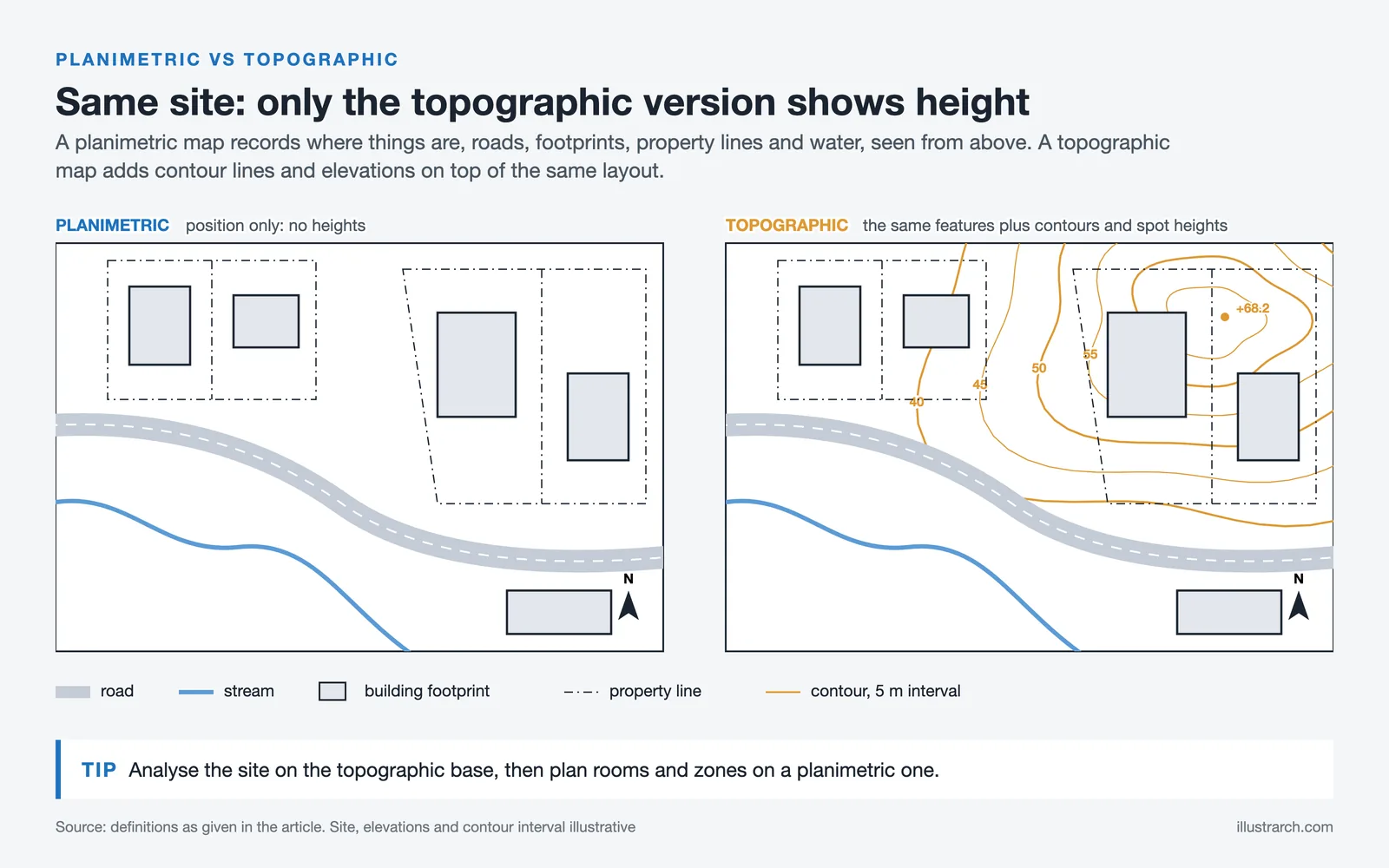
The difference between a planimetric map and a topographic map is straightforward: a topographic map includes contour lines and elevation data, while a planimetric map does not. For architects, this distinction matters when transitioning from site analysis (where topography is relevant) to spatial planning (where the horizontal arrangement of rooms and zones takes priority). Floor plans, which are the most common type of planimetric drawing in architecture, show wall positions, door swings, window locations, and room labels on a single horizontal cut through the building. Site plans, another form of planimetric map, show the building’s footprint in relation to property lines, access roads, and neighboring structures. Both are planimetric because they focus on position and relationship rather than height.
House Planimetry: Applying Planimetric Diagrams to Residential Design
House planimetry is one of the most common and practical applications of planimetric representation. When designing a residential project, the floor plan is the first deliverable that communicates the spatial arrangement to clients, builders, and local authorities. A well-executed house planimetry drawing shows how living spaces, bedrooms, kitchens, and bathrooms connect to each other. It reveals circulation paths, highlights natural light opportunities, and exposes potential bottlenecks in daily movement patterns.
For homeowners and developers, house planimetry provides several direct benefits. First, it lets you evaluate room adjacencies: is the kitchen close enough to the dining area? Can you reach the bathroom from the master bedroom without crossing a public zone? Second, it supports zoning decisions by clearly separating private areas (bedrooms, studies) from communal spaces (living rooms, kitchens). Third, house planimetry drawings serve as legal documents when submitted for planning permission and site analysis applications. Architects working on residential projects typically start with a bubble diagram to explore spatial relationships, then refine that into a planimetric diagram with measured walls, accurate dimensions, and furniture layouts. You can read more about this process in our guide to creating architecture diagrams.
A planimetric reading gets sharper when the plan is coloured by use. Our free zoning diagram maker does that and reports what share of the floor each zone takes.
Purpose and Functionality of Planimetric Diagrams
Design Concept Communication
Planimetric diagrams excel in articulating design concepts. They convert complex spatial arrangements into understandable visuals, making it easier for architects, clients, and stakeholders to grasp the initial vision of a project. By stripping away the third dimension, these diagrams focus attention on the layout and flow of spaces. This allows for a straightforward presentation of how different areas of a project relate to each other, effectively communicating the core concept of the design. Through planimetric diagrams, we convey not just the physical layout but also hint at the functional zoning and the intended use of each space, ensuring that the design concept is clearly understood by all parties involved.
Spatial Organization and Analysis
The essence of planimetric diagrams lies in their ability to organize and analyze spatial relationships. They serve as a tool for architects to dissect and examine the layout of spaces, offering insights into the efficiency of the design. By providing a bird’s-eye view, these diagrams facilitate an understanding of the spatial dynamics within a project, including circulation patterns, adjacency requirements, and the integration of outdoor and indoor spaces. The clarity offered by planimetric diagrams enables us to optimize space utilization, enhance functionality, and create environments that are cohesive and aligned with the project’s goals.
Collaborative Tools for Design Teams
In the realm of architectural design, collaboration is key. Planimetric diagrams act as a common language among design team members, bridging the gap between different disciplines involved in a project. These diagrams allow for effective teamwork by presenting a unified vision of the spatial layout that can be analyzed, critiqued, and refined collaboratively. They facilitate discussions around spatial strategies, encourage the exchange of ideas, and support consensus-building among architects, engineers, landscape designers, and clients. As the American Institute of Architects (AIA) emphasizes, diagrammatic thinking is a fundamental skill in design education and practice. By using planimetric diagrams as collaborative tools, design teams ensure that all members have a clear understanding of the project, leading to more cohesive and integrated design solutions.

Creating an Effective Planimetric Diagram
Crafting an effective planimetric diagram requires focus on the right components and visualization methods. These diagrams serve as the backbone for understanding spatial relationships and configurations in architecture. By paying attention to essential elements and using techniques that enhance clarity and aesthetics, architects can produce diagrams that are both informative and visually compelling.
Essential Elements to Include
The key to an impactful planimetric diagram lies in the inclusion of specific elements that convey the necessary information about the space.
- Scale and North Arrow: Indicators such as scale and a north arrow provide viewers with a sense of orientation and size, essential for comprehending the layout accurately.
- Defined Spaces: Clearly delineating each area, whether it’s rooms in a building or different zones in a landscape, ensures that the purpose and boundaries of spaces are understood at a glance.
- Annotations and Labels: Incorporating annotations and labels helps in demystifying complex elements, making technical details accessible to all stakeholders.
- Dimension Lines: Including dimension lines can offer precise measurements of spaces and distances, facilitating a deeper understanding of the layout.
- Pathways and Circulation: Showing pathways and circulation routes aids in visualizing how users will navigate the space, highlighting interactions between different areas.
Techniques for Enhanced Clarity and Aesthetics
Beyond the inclusion of key elements, the ways in which these components are visualized can dramatically affect the diagram’s effectiveness.
- Contrast and Color Coding: Using contrast and color coding can draw attention to different areas or aspects of the diagram, making it easier to distinguish between various elements.
- Simplified Icons and Symbols: Employing simplified icons and symbols for furniture, landscaping, and architectural features reduces clutter, enabling viewers to focus on the spatial layout.
- Hierarchy Through Text Size and Weight: Differentiating information through variations in text size and weight can create a clear hierarchy, guiding the viewer’s eye to the most critical details first.
- Consistent Line Weights: The application of consistent line weights across the diagram contributes to a cohesive and polished look, enhancing the overall aesthetic appeal.
- Strategic Shading and Textures: Applying shading and textures selectively can convey additional information such as materiality or the use of space without overwhelming the diagram.
By integrating these essential elements and techniques, planimetric diagrams can transform from mere technical drawings to invaluable tools in the design process. They not only facilitate a deeper understanding of the project among team members and stakeholders but also assist in identifying potential design opportunities and challenges early on. Through careful consideration of clarity and aesthetics, architects can elevate planimetric diagrams into powerful instruments for communication and collaboration.

Comparing Planimetric Diagrams with Other Architectural Diagram Types
In the realm of architectural visualization, understanding the different diagram types and their unique contributions to the design process is important. Planimetric diagrams, with their distinctive focus on spatial layouts from a bird’s-eye view, offer a clear contrast to other architectural diagram types such as sectional and axonometric diagrams. You can explore a broader overview of all architectural diagram types in our dedicated article. Below, we compare these diagram types to highlight how each serves its purpose in architectural planning and design.
Comparison of Planimetric, Sectional, and Axonometric Diagrams
The following table summarizes the key differences between the three most common architectural diagram types:
| Feature | Planimetric Diagram | Sectional Diagram | Axonometric Diagram |
|---|---|---|---|
| View Perspective | Top-down (bird’s eye) | Vertical cut-through (side view) | 3D parallel projection (skewed angle) |
| Dimensions Shown | 2D horizontal plane only | 2D vertical plane | 3D without perspective distortion |
| Best Used For | Spatial layout, zoning, circulation | Vertical relationships, building systems | Overall form, volume, and structure |
| Design Stage | Early conceptual and schematic | Design development | Presentation and communication |
| Shows Elevation Data | No | Yes | Yes (parallel projection) |
| Complexity Level | Low to medium | Medium | Medium to high |
Sectional Versus Planimetric Diagrams
When comparing sectional to planimetric diagrams, it’s essential to recognize the different perspectives and insights they provide in architectural design. Sectional diagrams cut through the structure vertically, offering a side view that reveals the internal distribution of spaces across different levels. This type of diagram excels in showcasing the relationships between various floors, the height of spaces, and the integration of building systems like staircases and elevators. It offers insights into the vertical dimension of a space that planimetric diagrams cannot, making it invaluable for understanding the three-dimensional aspect of buildings.
On the other hand, planimetric diagrams provide a top-down view, focusing on the layout of spaces on a single level without the influence of elevation or perspective. This clarity and simplicity make planimetric diagrams especially effective in the early stages of design, allowing for easy manipulation of spatial arrangements and clear communication of the ground plan layout to both design teams and clients. While sectional diagrams detail vertical relationships and structural elements, planimetric diagrams excel in spatial organization, functional zoning, and circulation planning on a horizontal plane.

The Role of Axonometric Diagrams alongside Planimetrics
Axonometric diagrams present yet another valuable perspective, combining elements of both planimetric and sectional diagrams but with distinct advantages. These diagrams project the image of an object (such as a building) as viewed from a skew direction in order to reveal multiple facets of the object simultaneously. This means axonometric diagrams can show a building’s layout (like planimetric diagrams) while also depicting its three-dimensional aspects (similar to sectional diagrams), but without the distortion of perspective.
Integrating axonometric diagrams alongside planimetrics expands an architect’s toolbox by providing a visualization that includes both the precise organization of spaces and a clear sense of form and volume. Axonometric diagrams reinforce the spatial relationships highlighted in planimetric diagrams with the added benefit of three-dimensional understanding, enhancing communication about complex spatial and structural concepts. They serve as a bridge between the abstract, top-down view of planimetrics and the more detailed, specific perspectives offered by sectional diagrams. For a deeper look at the full range of diagrams available, see our article on the 10 best architectural diagram examples.
The Digital Evolution of Architectural Diagrams
The Impact of Digitalization on Planimetric Diagram Creation
The digitalization of architectural drawing and diagram creation has had a profound impact on planimetric diagrams, specifically in how they are conceived, iterated, and communicated. Digital tools have democratized the creation of these diagrams, making them more accessible to architects and designers at any skill level. Software platforms like AutoCAD, Revit, SketchUp, and Rhino allow architects to generate accurate planimetric drawings in minutes rather than hours. BIM (Building Information Modeling) tools go further by linking planimetric views to 3D models, so changes in one view automatically update the other.
As a result, the experimentation and iteration process has become more dynamic and nuanced, empowering architects to explore a broader range of spatial scenarios before settling on a final design. The ability to easily modify and adjust diagrams without the need to start from scratch each time facilitates a more inventive and exploratory design process. Resources like ArchDaily regularly feature projects where digital planimetric diagrams played a central role in communicating the design intent.
Moreover, digitalization has enhanced the communicative value of planimetric diagrams. Architects can produce diagrams that are not only more accurate but also visually compelling, making it easier to convey complex design intents to clients, contractors, and stakeholders. Digital diagrams can also be shared more widely and efficiently, whether through cloud-based platforms or via digital presentations, ensuring that all parties involved in a project have up-to-date information. This level of accessibility and clarity in communication helps in aligning expectations and streamlining the decision-making process.
Together, these advancements in architecture software tools and the impact of digitalization on diagram creation mark a significant shift in the way architectural designs are initiated, developed, and communicated. The digital evolution of architectural diagrams has not only enhanced the efficiency and precision of architectural planning but also expanded the possibilities for creative expression in the early stages of design.
Frequently Asked Questions about Planimetric Diagrams
What is a planimetric diagram in architecture?
A planimetric diagram is a simplified top-down representation of a building or site that shows the arrangement of spaces, walls, openings, and circulation paths on a horizontal plane. Unlike technical floor plans, planimetric diagrams focus on communicating spatial relationships and design concepts rather than precise construction details. They are widely used in the early stages of architectural design to organize functional zones and evaluate layout options.
What is the difference between a planimetric map and a topographic map?
A planimetric map shows only the horizontal positions of features (roads, building footprints, boundaries) without any elevation or contour data. A topographic map includes contour lines that indicate terrain height and slope. In architectural practice, planimetric maps are used for spatial layout and planning, while topographic surveys inform site grading and drainage decisions.
How is house planimetry used in residential design?
House planimetry involves creating floor plans and layout drawings that show how rooms, corridors, and outdoor areas connect within a residential project. Architects use house planimetry to evaluate room adjacencies, ensure proper circulation between private and communal spaces, and present design options to homeowners. These drawings also serve as the basis for construction documentation and building permit applications.
What is the planimetry definition?
Planimetry is the study and practice of measuring and representing features on a flat, two-dimensional plane. In architecture, the planimetry definition refers specifically to the process of depicting a building’s spatial layout from a top-down perspective, omitting vertical dimensions such as height and depth. The term derives from Latin and Greek roots meaning “flat surface measurement.”
What software tools are best for creating planimetric diagrams?
Architects commonly use AutoCAD for precise 2D planimetric drawings, Revit for BIM-integrated floor plans, and SketchUp for quick conceptual layouts. For presentation-quality planimetric diagrams with color coding and graphics, Adobe Illustrator and Photoshop are popular choices. Many architecture students also use free tools like Figma or online diagram makers to produce clean, shareable planimetric layouts.


5 Comments





Stacking Diagram: How to Allocate Uses Floor by Floor
A stacking diagram assigns each use in a brief to a level,...
 Sinan Ozen6 Mins read
Figure-Ground Diagram: How to Draw and Read Urban Fabric
A figure-ground diagram reduces a city to built mass against open space....
Sinan Ozen7 Mins read
Sun Path Diagram: How to Read One and Use It in Design
A sun path diagram shows where the sun sits all year for...
Sinan Ozen8 Mins read
Matrix Diagram in Architecture: How to Map Space Adjacencies
A matrix diagram, or adjacency matrix, maps how every space in a...
Sinan Ozen8 Mins read


This article talks about planimetric diagrams in architecture. It seems useful for architects to understand designs better. I didn’t know much about this before.
I really liked this article! The way it explains planimetric diagrams made it so easy to understand. I never knew they were so important in architecture. Thanks for sharing!
This article explains the importance of planimetric diagrams in architecture. They help architects and clients understand building designs by providing a clear top-down view. The diagrams simplify complex layouts, showing how different spaces connect and function together. This makes it easier to make decisions during the design process.
This article explains how important planimetric diagrams are in architecture. They help architects and clients understand building designs from a top view. It makes it easier to see how different spaces connect and how people will move around. This is helpful when planning a project.
I found the explanation of planimetric diagrams really interesting. It’s helpful to see how they focus on spatial organization without the distraction of elevation. I wonder how often architects use these in practice compared to sectional diagrams. Do they prefer one over the other for certain projects?