

The Great Mosque of Cordoba: Layers of Faith in Architectural Form
Explore the architectural layers of the great mosque of Cordoba, from Abd al-Rahman I's 8th-century hypostyle hall and its iconic double-tiered horseshoe arches to the mihrab mosaics of al-Hakam II and the 16th-century cathedral insertion. A detailed look at each construction phase and the structural logic behind this UNESCO World Heritage Site.
 Furkan Sen27 June 20267 Mins read184
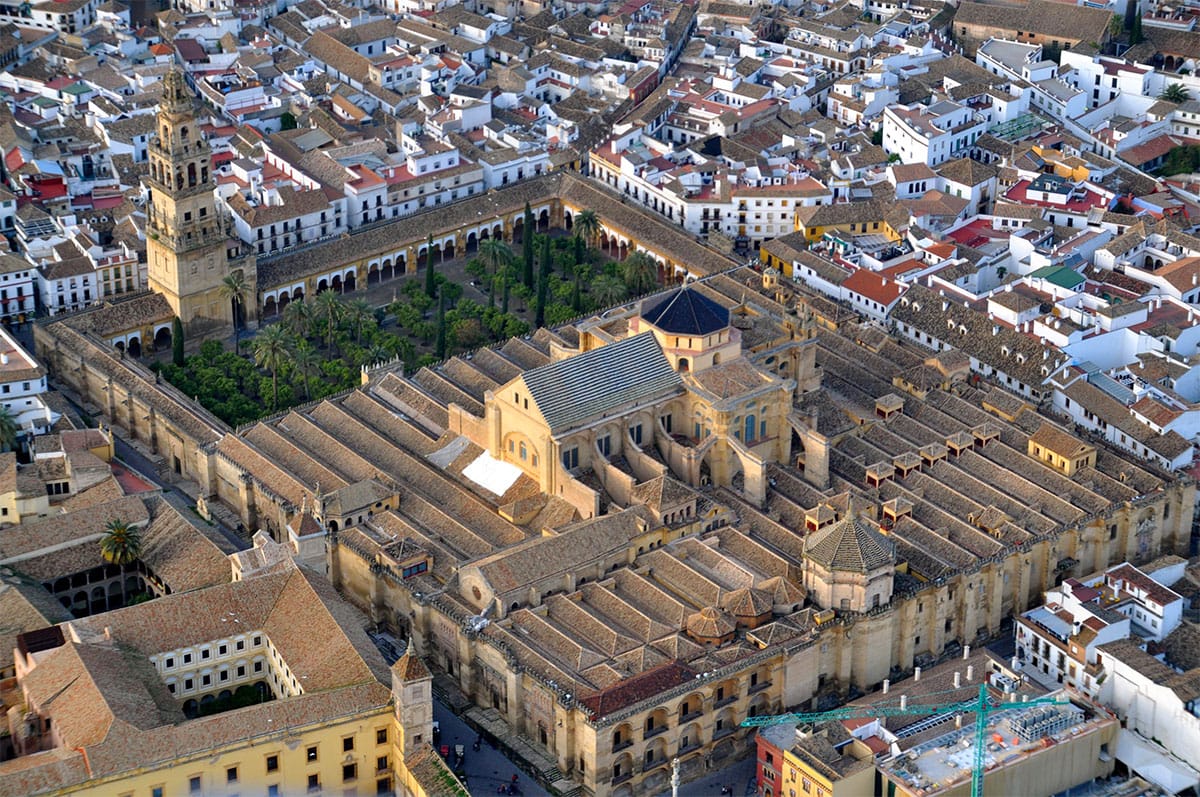
Table of Contents Show
The great mosque of Cordoba, known in Spanish as the Mezquita, is a building where Umayyad Islamic, Visigothic, Roman, and Christian architectural traditions exist within the same walls. Built in 785 CE and expanded three times over the next two centuries, this UNESCO World Heritage Site in Andalusia, Spain, holds roughly 1,250 columns, a forest of double-tiered horseshoe arches, and a 16th-century cathedral placed directly inside its prayer hall.
Origins of the Great Mosque of Córdoba
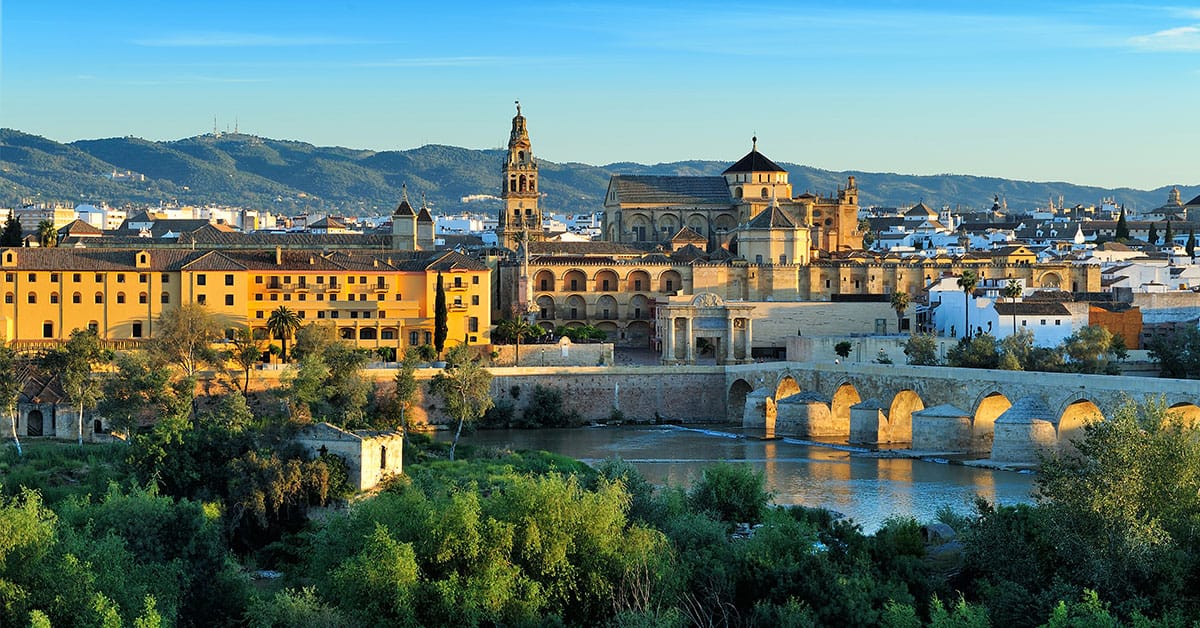
The story of the great mosque of Cordoba begins with displacement. In 750 CE, the Abbasid dynasty overthrew the Umayyads in Damascus, and a young prince named Abd al-Rahman fled across North Africa to the Iberian Peninsula. By 756 he had established himself as the independent Emir of Córdoba, founding a new Umayyad state in a region the Arabs called al-Andalus. His political ambitions needed an architectural anchor, and that anchor would be a congregational mosque at the heart of his new capital.
The site he chose was not empty. A Visigothic Christian basilica dedicated to Saint Vincent occupied the ground. According to Arab chroniclers, Abd al-Rahman initially shared the basilica with the city’s Christian population before purchasing the remaining half and demolishing it in 784. Construction of the mosque began that year and was largely complete by 786. He recycled columns from Roman ruins and Visigothic structures across the region, a practical decision that also served as a statement: the new order was built, literally, on the foundations of those that came before.
The Double Arches: Structural Innovation in the Hypostyle Hall
The most recognizable feature of the great mosque of Cordoba interior is its hypostyle hall, a vast grid of columns supporting two tiers of arches. The lower arches are horseshoe-shaped, drawn from Visigothic architectural precedent. The upper arches are semicircular, a form rooted in Roman engineering. Together they create an effect often compared to a stone palm forest, where sightlines stretch in every direction without a single dominant axis.
This double-arch system was not purely aesthetic. The recycled columns Abd al-Rahman used were short, most of them under three meters tall. To reach the ceiling height needed for a monumental prayer hall, his builders stacked a second tier of arches on masonry piers above the column capitals. The lower horseshoe arches act as structural ties between columns, while the upper semicircular arches carry the actual roof load. Alternating voussoirs of red brick and white limestone give the arches in the great mosque of Cordoba their famous striped appearance, a visual rhythm that multiplies as you look down the aisles.
📐 Technical Note
The original prayer hall consisted of eleven aisles of twelve bays each. The columns are approximately 3 meters tall, and the double-arch system raises the total interior height to roughly 11.5 meters. According to research published through the CUNY Great Mosque of Cordoba project, the approximately 1,250 columns vary in material (granite, jasper, marble, onyx) and were individually adjusted with different base and capital sizes to compensate for height differences in the salvaged pieces.
The horseshoe arch itself was not an Islamic invention. It appeared in Visigothic churches across the peninsula well before the Muslim conquest. What the builders of the great mosque of Cordoba in Spain did was adopt this regional form and give it new structural purpose, setting it within a modular system that could be repeated and extended almost indefinitely. That extensibility proved essential, because the mosque would be enlarged three more times over the next two centuries.
Four Phases of Expansion
The great mosque cathedral of Cordoba as it stands today is the product of four distinct building campaigns, each reflecting the political ambitions and growing population of Umayyad Córdoba.
Construction Timeline of the Mosque
The table below summarizes the major phases:
| Phase | Ruler | Date | Key Addition |
|---|---|---|---|
| Original construction | Abd al-Rahman I | 784–786 CE | 11-aisle hypostyle hall, courtyard |
| First expansion | Abd al-Rahman II | 833–848 CE | Eight new bays extending southward |
| Second expansion | Al-Hakam II | 961–976 CE | New mihrab, maqsura, ribbed domes |
| Third expansion | Al-Mansur | 987–988 CE | Eight new aisles to the east, nearly doubling floor area |
Abd al-Rahman II’s extension in the 9th century pushed the prayer hall further south, adding eight bays while maintaining the original column-and-arch vocabulary. The population of Córdoba was growing rapidly, and the mosque needed room. By the mid-10th century, Abd al-Rahman III added a new minaret and rebuilt the courtyard facade, though he left the prayer hall untouched. His minaret, later encased in a Baroque bell tower, established the vertical marker that still anchors the building’s silhouette today.
The Mihrab and Maqsura of Al-Hakam II
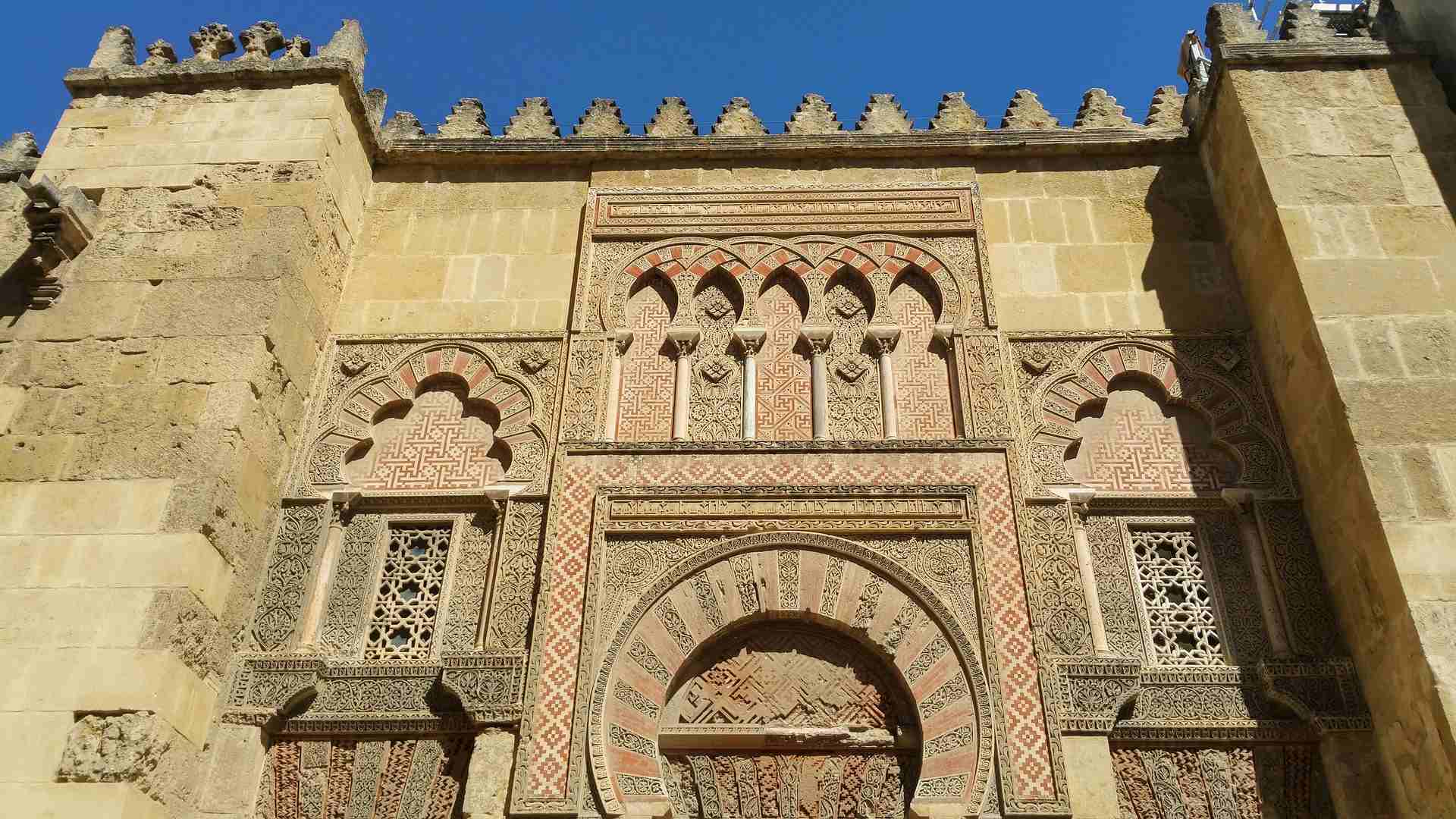
The most architecturally significant expansion came under al-Hakam II between 961 and 976 CE. He extended the prayer hall twelve bays to the south and commissioned a new mihrab, the niche in the qibla wall indicating the direction of Mecca. The mihrab of the great mosque of Córdoba is not a simple recess: it is an octagonal room topped with a scallop-shell dome, framed by a horseshoe arch enclosed within an alfiz (rectangular frame). Gold and colored glass mosaic tesserae cover the arch and surrounding surfaces, a gift sent by the Byzantine Emperor Nikephoros II Phokas along with a team of mosaic specialists.
🎓 Expert Insight
“The Great Mosque of Córdoba was considered a wonder of the medieval world by both Muslims and Christians.” / K.A.C. Creswell, A Short Account of Early Muslim Architecture
Creswell’s assessment reflects a rare consensus across centuries and cultures. The building was admired not as a relic but as a living benchmark of what architecture could achieve when engineering served spatial experience.
In front of the mihrab, al-Hakam II built a maqsura, a screened enclosure reserved for the caliph during prayer. The maqsura area features some of the most sophisticated arch work in the entire building. Here the simple alternating red-and-white pattern gives way to interlacing polylobed arches, where different arch profiles cross and overlap to form complex geometric compositions. Above the maqsura, ribbed domes distribute structural loads through a system of intersecting ribs that leave the center open for a small, light-filled cupola. These ribbed vaults predate the ribbed vaulting of Gothic cathedrals by at least a century.
Al-Mansur’s Final Expansion and the Shift in Symmetry
The last major Islamic addition came under the powerful minister al-Mansur in 987–988 CE. Rather than extending the hall further south (the Guadalquivir River blocked that direction), al-Mansur added eight entirely new aisles to the east, nearly doubling the mosque’s floor area. The completed building measured roughly 180 by 130 meters, making the great mosque of Cordoba Spain one of the largest religious structures in the medieval world. According to Britannica, the footprint was only slightly smaller than St. Peter’s Basilica in Rome.
Al-Mansur’s expansion had an important spatial consequence: it shifted the mihrab off the building’s central axis. The prayer niche, which had been carefully positioned at the midpoint of the qibla wall, now sat to the west of center. This asymmetry is still visible today and reveals how the mosque grew according to practical constraints rather than a fixed master plan. Each ruler worked with the land, the river, and the existing structure as they found it.
💡 Pro Tip
If you visit, enter from the Puerta del Perdón into the Patio de los Naranjos and look through the arched openings into the prayer hall before going inside. The rows of orange trees in the courtyard were originally aligned with the column rows of the interior, creating a continuous spatial grid from open air to covered hall. That connection has been partly walled off, but the alignment is still readable.
What Happened After the Christian Reconquest?
In 1236, King Ferdinand III of Castile captured Córdoba and converted the mosque into a Christian cathedral. For almost three centuries the conversion was relatively restrained: chapels were inserted along the outer walls, and the minaret was adapted, but the hypostyle hall remained largely intact. That changed in 1523 when the cathedral chapter decided to build a full-scale Renaissance nave and transept directly in the center of the prayer hall.
The insertion was controversial even at the time. King Charles V, who had initially approved the project, reportedly said upon seeing the result that they had destroyed something unique to build something ordinary. Whether or not that story is apocryphal, it captures the tension that defines the building today. A Gothic and Renaissance cathedral sits inside a medieval Islamic mosque, with soaring vaults rising above the low, horizontal rhythm of the arches. The two architectural languages clash visually but coexist physically, bound by shared walls and columns.
🏗️ Real-World Example
The Villaviciosa Chapel (Córdoba, c. 1371): One of the earliest Christian additions to the mosque, this chapel occupies the space where al-Hakam II’s first mihrab once stood. Its pointed Gothic arches sit directly next to Umayyad polylobed arches, creating one of the clearest visible junctions between the two building traditions within the same structure.
How Did the Arches in the Great Mosque of Cordoba Influence Later Architecture?
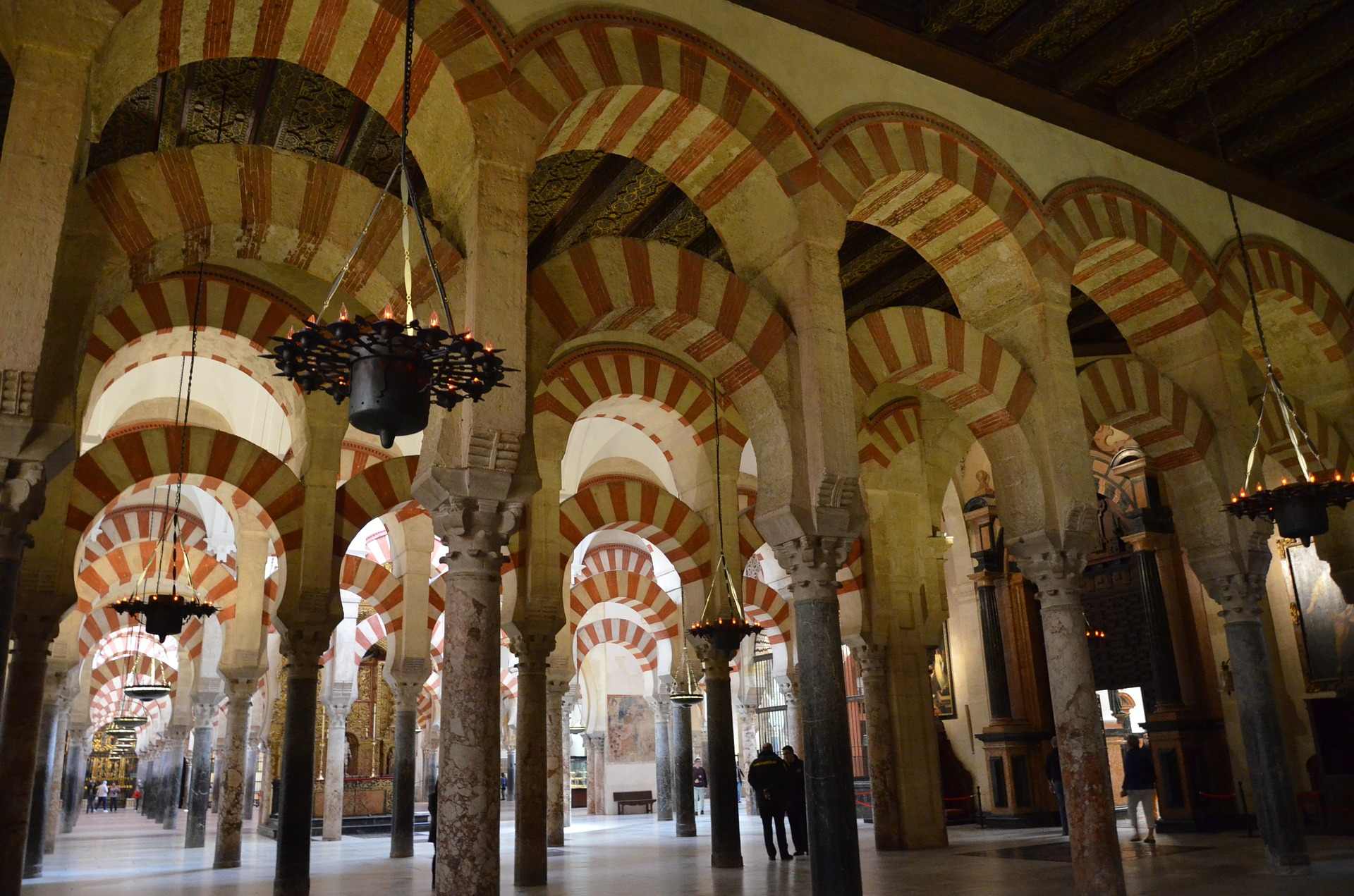
The arches in the great mosque of Cordoba did not stay in Córdoba. The alternating red-and-white voussoir pattern reappeared in the caliphal palace city of Madinat al-Zahra, built just outside Córdoba in 936 CE. The horseshoe arch, popularized by this mosque, became a defining marker of Western Islamic architecture across North Africa and into the Sahel. You can trace its presence in buildings from the Great Mosque of Djenné to the gates of Fez.
The ribbed domes above al-Hakam II’s maqsura are equally significant. Architectural historians have noted that intersecting rib vaulting appeared in Córdoba a full century before it became standard in European Gothic construction. While a direct transmission line is debated, the presence of similar techniques in Islamic Spain and later in Norman Sicily and southern France suggests at least indirect influence. The architectural legacy of Islamic Spain extended far beyond its borders.
The Building as a Document of Time
What makes the great mosque cathedral of Córdoba exceptional is not a single feature but the accumulation of features across twelve centuries. A Roman column base supports a Visigothic capital, which carries an Islamic horseshoe arch, which stands next to a Gothic chapel window. Each layer is visible, none fully erased. The UNESCO World Heritage designation, first granted in 1984 and extended in 1994 to include the surrounding historic center, recognizes precisely this layered quality.
The Patio de los Naranjos, the courtyard of orange trees at the north end, still occupies the footprint of the original ablution courtyard. The bell tower wraps around the stump of Abd al-Rahman III’s 10th-century minaret. The gold mosaics of the mihrab shimmer with the same Byzantine glass that was shipped from Constantinople over a thousand years ago. Meanwhile, the mahogany choir stalls of the cathedral sit barely 50 meters from the qibla wall. Each element belongs to a different century, a different faith, a different set of structural assumptions, yet all of them share the same roof.
For architects and designers studying how buildings accumulate meaning over time, the relationship between structure and spiritual space is nowhere more visible than here. The great mosque of Cordoba is not a frozen monument. It is a record of decisions, each one responding to the one before it.
The Bigger Picture
Most celebrated buildings survive by staying the same. The Mezquita survived by changing. Its power comes not from purity of style but from the visible tension between styles, where a horseshoe arch meets a pointed Gothic vault and neither gives way. For anyone working with existing structures or layered sites, Córdoba offers the strongest possible argument that architectural value is not fixed at a single point in time but grows through accumulation, contradiction, and the refusal to erase what came before.
- arches in great mosque of cordoba
- great mosque cathedral of córdoba
- great mosque cathedral of cordoba
- great mosque of cordoba
- great mosque of córdoba
- great mosque of cordoba in spain
- great mosque of cordoba interior
- great mosque of cordoba spain
- the great mosque of córdoba
- the great mosque of cordoba
- the great mosque of cordoba spain




The Great Wall of China: History, Architecture, and Enduring Legacy
A detailed architectural exploration of the Great Wall of China covering its...
Furkan Sen7 Mins read
Prague Architecture: How Charles Bridge and Prague Castle Built Bohemian Gothic
Charles Bridge and Prague Castle explained as architecture: the 1357 bridge under...
Furkan Sen6 Mins read

Sultan Ahmed Blue Mosque: Ottoman Architecture’s Six Minarets
Six minarets made the Sultan Ahmed Mosque famous and controversial, but the...
 Elif Ayse Sen9 Mins read
Mimar Sinan and the Suleymaniye Mosque: Inside an Ottoman Masterpiece
Mimar Sinan built the Suleymaniye Mosque between 1550 and 1557 and called...
Furkan Sen7 Mins read


Leave a comment