

The Evolution of Modern Architecture: From Bauhaus to Brutalism
Modern architecture is a term used to describe the architectural style that emerged in the 20th century. This style is characterized by an emphasis on function, simplicity, and a rejection of historical styles and ornamentation.
 Elif Ayse Sen25 January 202612 Mins read1.6k

Table of Contents Show
Quick Answer: Modern architecture evolved through several movements between the early 1900s and the late twentieth century, from the clean, functional lines of the Bauhaus to the raw concrete forms of Brutalism. Each movement reacted to the one before, reshaping how buildings looked, worked and expressed the ideas of their time.
The journey from Bauhaus to Brutalism defines how modern architecture shed ornament, embraced raw materials, and turned buildings into social statements. Bauhaus, founded in 1919 Germany, championed clean lines, industrial materials, and mass-producible design. Brutalism, rising from post-war rubble in the 1950s, took those honest-material principles further with raw exposed concrete and monumental form. Together they remain the backbone of modern architecture as we know it today.

What Is the Bauhaus Movement? Origins and Core Principles
The Bauhaus movement emerged in Germany in the early 20th century, establishing the foundation for what we now recognize as modern design. Founded by Walter Gropius in 1919, the Bauhaus school sought to bring together art and technology, creating a fresh aesthetic for the machine age. Bauhaus architecture emphasized simplicity, functionalism, and the use of modern materials such as steel and glass. Bauhaus buildings featured clean lines, white surfaces, and large windows that pulled natural light deep into interior spaces. The school’s influence on interior design principles remains profound, as documented by MoMA’s Bauhaus collection.
The Bauhaus philosophy extended beyond aesthetics. It represented a full reimagining of design education. Students learned craftsmanship alongside theory, preparing them to create works that balanced beauty with utility. This approach directly influenced later movements, including the development of minimalist brutalist interior design and contemporary interior styles. The Bauhaus Dessau Foundation continues to preserve this legacy, while art and culture institutions worldwide celebrate its reach. For those who want to trace this lineage, several books about brutalism follow the thread directly, including Reyner Banham’s seminal “The New Brutalism” and Phaidon’s Atlas of Brutalist Architecture.
💡 Pro Tip
For the full picture, see our complete guide to architectural styles that shaped history.
When studying Bauhaus buildings on site, pay attention to how each wing reveals its programmatic function from the exterior. Gropius deliberately made internal organisation readable through the facade, a principle still directly useful today when clarity of circulation is a primary design goal. The Dessau campus remains the clearest living textbook for this approach.

📌 Did You Know?
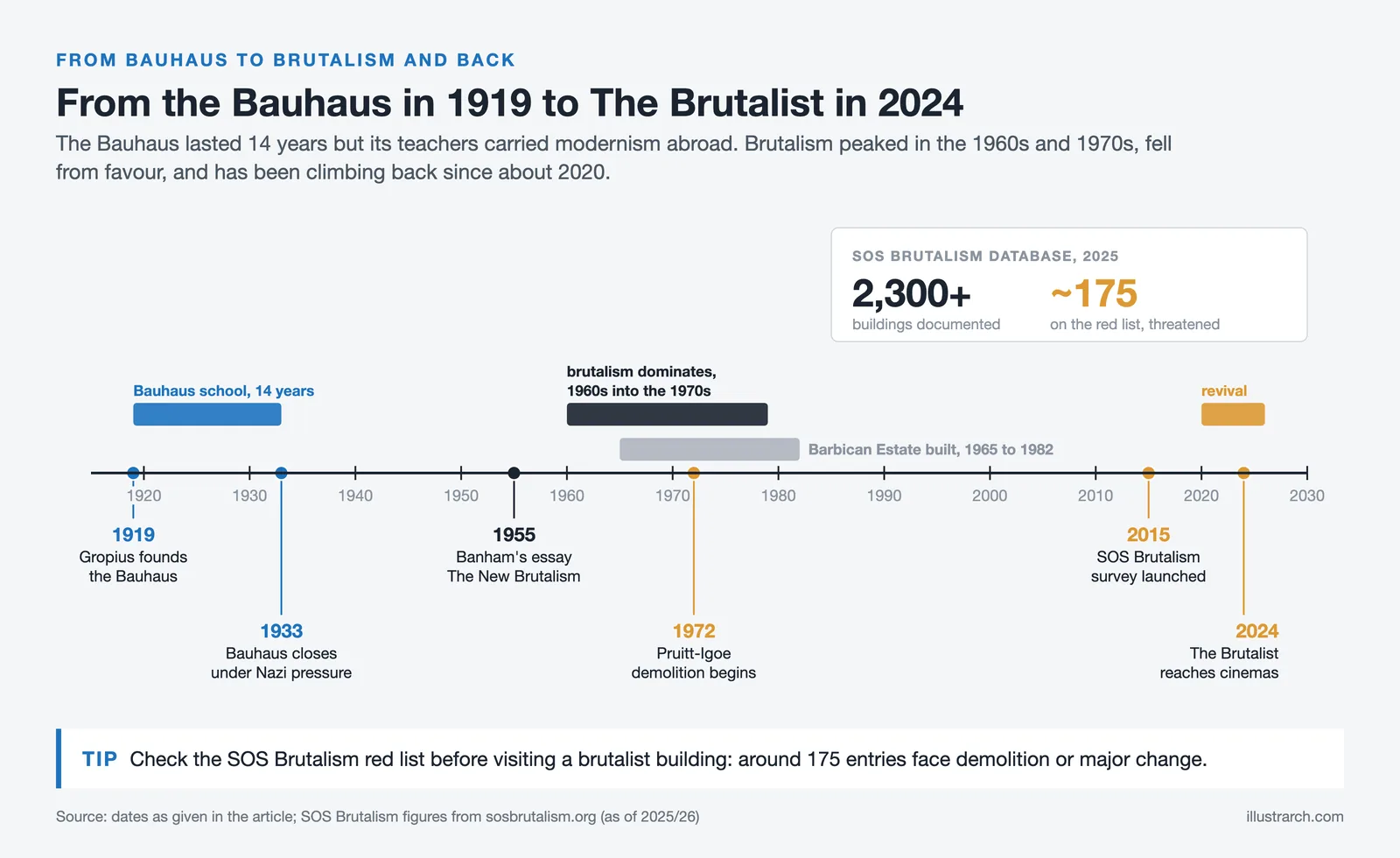
The Bauhaus school operated for only 14 years before the Nazi government forced it to close in 1933. Yet its influence proved impossible to contain: Gropius, Mies van der Rohe, Marcel Breuer, and László Moholy-Nagy all emigrated to the United States, seeding American modernism and, indirectly, the later brutalist movement at institutions like Harvard’s Graduate School of Design.

The Rise of Brutalism and Concrete Brutalism
Brutalism emerged in the mid-20th century as a reaction to the perceived coldness of earlier modern architecture. Concrete brutalism placed raw concrete (béton brut in French, the phrase that gave the movement its name) at the centre of both structure and expression. Brutalist buildings were often monumental in scale, and their rough surfaces and strong geometric forms gave them a powerful, almost aggressive presence. The Royal Institute of British Architects (RIBA) has extensively documented this movement’s significance in architectural history.
The term “new brutalism” was first used by British architects Alison and Peter Smithson and further established by critic Reyner Banham’s 1955 essay. From the UK, the movement spread globally with notable regional character. Russian brutalism emerged as a particularly distinctive strand, seen in massive housing blocks and civic buildings that carried Soviet ideological weight across Moscow, Tbilisi, and Yerevan, where industrial brutalism merged with socialist realism to produce truly distinctive structures. Similarly, German brutalist architecture developed its own voice in post-war reconstruction, where architects chose concrete as both an economical and aesthetically bold material. You can explore the full scope of the movement in our dedicated article on brutalist architecture.
🏗️ Real-World Example
Barbican Estate (London, 1965-1982): One of the most ambitious brutalist projects ever completed, the Barbican houses over 4,000 residents across 2,000 flats, three tower blocks, and a major arts centre. Originally controversial for its scale and raw concrete, it is now a Grade II listed complex and one of the most sought-after addresses in the city. Its long-term success demonstrates that high-density brutalist design can work when community amenities are genuinely integrated from day one.
Why Did Brutalism Fall From Favour?
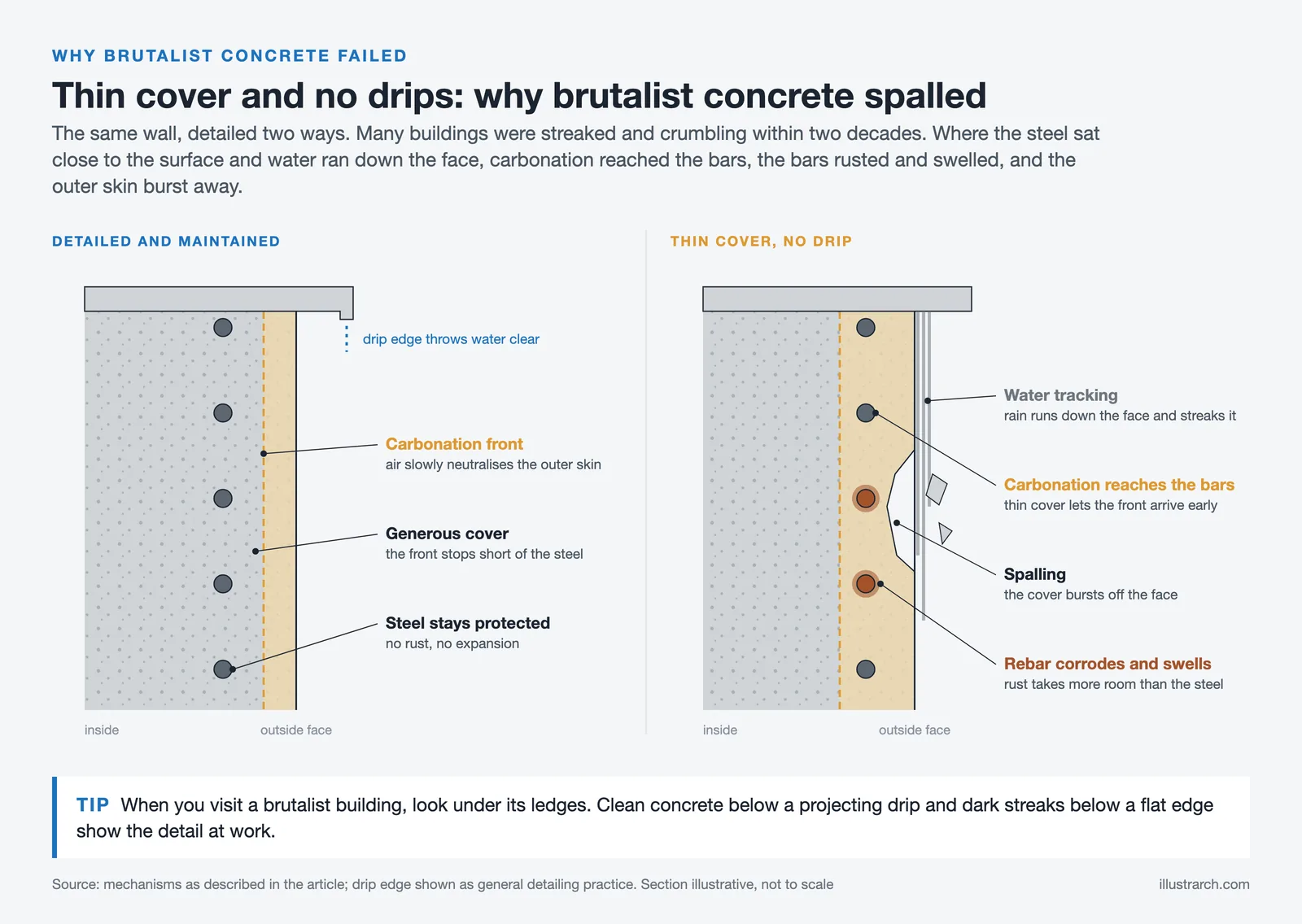
Brutalism dominated public and institutional architecture through the 1960s and into the 1970s, then fell sharply from favour for several overlapping reasons. Concrete weathers poorly when detailing and maintenance are neglected: carbonation, spalling, water tracking, and thin rebar cover left many buildings streaked and crumbling within two decades of completion. Cost-cutting in system-built social housing compounded the issue.
Critics also pointed to scale. Windswept plazas, blank podiums, and deep building plans can deaden street life. When retail and community services left megastructures, the remaining residents found them hard to navigate and harder to love. High-profile demolitions, most famously Pruitt-Igoe in St. Louis in 1972, hardened a narrative linking raw concrete with social failure, even where the real causes were policy neglect rather than design. The contrast with our article on brutalism vs modernism makes clear how much these perceptions shaped the subsequent shift toward postmodern and high-tech styles.
⚠️ Common Mistake to Avoid
Many people conflate “brutalism” with “bad social housing.” The reality is more specific: the failures were concentrated in cheap, system-built panel construction that shared only the material (concrete) with genuine brutalist architecture. High-quality brutalist buildings such as the Barbican Estate, the National Theatre, and the Salk Institute have aged well precisely because they were detailed and maintained properly. Blaming brutalism for housing policy failures misreads both the history and the architecture.
Brutalist Architecture Interiors and Design Philosophy
While brutalism is often associated with imposing exteriors, brutalist architecture interiors reveal a more considered design philosophy. Brutalism interior spaces typically feature exposed concrete ceilings and walls, minimal ornamentation, and a focus on spatial volume rather than decorative elements. This approach has experienced a real revival in contemporary design, with minimalist brutalist interior design attracting architects and homeowners who want authentic, textured spaces. Leading design publications like Dezeen’s brutalism section regularly feature home interior projects that embrace this aesthetic.
The appeal of brutalist interiors lies in their honesty. Materials appear without concealment, and structural elements become decorative features in their own right. Designers in this space often pair industrial lighting, raw metal fixtures, and furniture with strong geometric forms. The result is spaces that feel simultaneously monumental and intimate, challenging conventional ideas of domestic comfort while creating environments with striking visual power. Construction techniques have evolved considerably, allowing modern interpretations to achieve thermal comfort without sacrificing the raw aesthetic. Resources like The Architectural Review provide ongoing analysis of these approaches.

Post-Apocalyptic Brutalist Interior Design
Post apocalyptic brutalist interior design represents a contemporary interpretation that merges brutalist principles with dystopian aesthetics. This style embraces weathered concrete, industrial decay, and a sense of sublime abandonment while remaining functional and habitable. Designers draw from science fiction, video games, and photography of abandoned brutalist structures to create interiors that feel simultaneously ancient and futuristic. Platforms like Designboom frequently cover these commercial interior innovations, while photographers document architectural photography of these striking spaces.

Gothic Brutalism and Futuristic Variations
Gothic brutalism combines the vertical emphasis and dramatic presence of Gothic architecture with brutalist materials and forms. The result is buildings that evoke both medieval cathedrals and science fiction megastructures, with soaring concrete forms, dramatic shadows, and a sense of sublime weight. Academic institutions like Harvard Graduate School of Design have examined these architectural styles in depth.
Futuristic brutalist architecture takes the movement in a different direction, imagining how brutalist principles might shape buildings of tomorrow. Architects working in this vein incorporate parametric design, unusual cantilevers, and complex geometric forms while maintaining the material honesty and monumental scale of traditional brutalism. Our comparison of futuristic brutalist architecture and neo-futurism explores where these two strands diverge in practice. These designs appear frequently in concept art, film, and speculative architectural proposals. Publications like Domus regularly feature such concept architecture projects from around the world.

Bio Brutalism: Nature Meets Concrete
Bio brutalism is one of the most actively developing contemporary variations in this lineage. This style integrates living systems, plants, water features, and natural materials, with the raw concrete forms of traditional brutalism. The result is architecture that retains brutalism’s sculptural power while softening its edges through biophilic design. The World Green Building Council recognises such approaches as central to sustainable architecture.
Architects exploring bio brutalism design buildings where vertical gardens cascade down concrete facades, interior spaces carry living walls, and water elements reflect and animate rigid geometric forms. This direction addresses one of brutalism’s traditional criticisms, its perceived coldness, while honouring its core principles. Projects with bio brutalist elements are found from Singapore to São Paulo, showing the global reach of this synthesis between the built and natural worlds. Studios like Heatherwick Studio have pioneered such landscape architecture integrations globally.

Industrial Brutalism in Contemporary Context
Industrial brutalism connects brutalist architecture with industrial heritage, creating spaces that celebrate manufacturing history while serving contemporary uses. Converted factories, warehouses, and power stations often carry this aesthetic, with original concrete structures preserved and presented rather than hidden. The Tate Modern in London, converted from the Bankside Power Station, demonstrates how industrial brutalist spaces can become world-class cultural institutions.
While Bauhaus and Brutalism were distinct movements with different approaches to modern architecture, they both had a profound impact on how the style evolved. The Bauhaus prioritised function and simplicity, while Brutalism prioritised expression and raw materials. Both rejected historical ornamentation and sought a new aesthetic for the modern age. The International Confederation of Architectural Museums preserves this architectural history for future generations.
Is Brutalism Making a Comeback? Neobrutalism in 2026
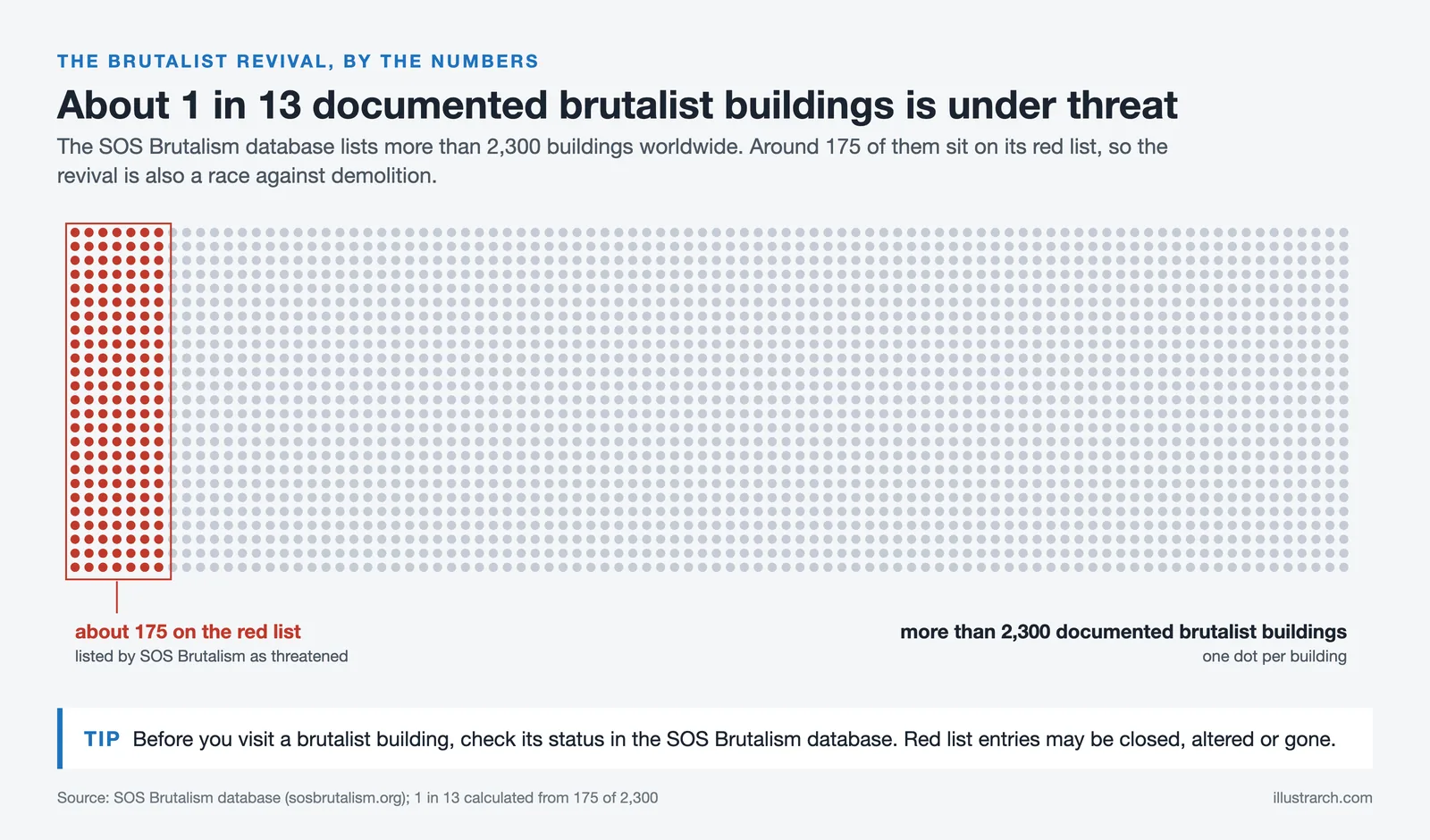
Since roughly 2020, brutalism has experienced a genuine cultural revival, and in 2026 that momentum shows no sign of slowing. Social media communities, preservation campaigns, and a wave of photography books have brought renewed attention to buildings that were widely dismissed as eyesores a generation ago. The SOS Brutalism database now documents more than 2,300 brutalist buildings worldwide, with around 175 on its red list of threatened structures, a figure that has itself galvanised preservation advocacy globally.
Neobrutalism takes the movement’s core ideas into new territory. Contemporary architects draw on brutalism’s material honesty while integrating sustainable technologies, mixed materials, and human-centred planning. Projects by studios like Herzog & de Meuron and Tadao Ando show that brutalist modern architecture can feel warm and contemplative when combined with careful attention to light, landscape, and spatial flow. The Oscar-nominated film “The Brutalist” (2024) brought fresh mainstream attention to the movement’s history, sparking debate among architects and historians alike. For a deeper look at how this compares with minimalist approaches, see our analysis of brutalism vs minimalism in contemporary architecture.
💡 Pro Tip
When visiting a brutalist building for the first time, resist the impulse to read it from a distance. The real experience is tactile: the grain of board-marked concrete, the weight of a solid door, the temperature shift between sun-warmed facade and shaded colonnade. Brutalism rewards physical proximity in a way few other architectural movements do. Most photography, however skilled, misses this dimension entirely.
Contemporary Evolution: From Brutalism to New Directions
In the decades since the emergence of Bauhaus and Brutalism, modern architecture has continued to evolve. Today it covers a wide range of styles, from the lean, minimalist work of architects such as Tadao Ando and Richard Meier, to the expressive sculptural forms of Frank Gehry and Zaha Hadid Architects. These famous architects continue to redefine what buildings can do.
The evolution of modern architecture from Bauhaus to Brutalism represents a pivotal chapter in the history of architecture. These movements helped define the aesthetic of the modern built environment, and their influence is still visible in the work of architects today. The emphasis on function, simplicity, and honest use of materials remains a defining thread. Organisations like Docomomo International work to protect this architectural heritage. For a broader view of how modern architecture developed across all its sub-movements, our ultimate modern architecture guide covers the full trajectory.

Bauhaus vs Brutalism: Key Similarities and Differences
Bauhaus and Brutalism are two cornerstone movements in the history of brutalist modern architecture. Understanding where they overlap and where they diverge is essential for anyone studying architectural history or contemporary design practice. Our dedicated article on Bauhaus architecture vs Brutalism goes deeper into these contrasts.
| Aspect | Bauhaus | Brutalism |
|---|---|---|
| Period | 1919-1933 (school); influence continues | 1950s-1970s; revival from 2020s |
| Primary material | Steel, glass, smooth concrete | Raw exposed concrete (béton brut) |
| Aesthetic | Clean lines, light, geometric clarity | Monumental, sculptural, textured |
| Colour use | Bold accents, bright primary colours | Monochromatic; texture over colour |
| Social mission | Mass production, accessible design | Democratic public housing, civic buildings |
| Legacy today | Minimalism, product design, typography | Neobrutalism, bio brutalism, preservation |
Similarities
- Function first: Both movements believed that buildings should serve a specific purpose rather than exist as decoration. This principle remains central to contemporary architectural practice.
- Modern materials: Both used concrete, steel, and glass to express ideas about form, structure, and function. Today’s building materials innovation continues this tradition.
- Rejection of ornament: Both movements stepped away from historical styles and decorative excess, seeking an aesthetic grounded in the needs of the contemporary world.

Differences
- Form: Bauhaus favoured simplicity and geometric abstraction with minimal ornament. Concrete brutalism favoured raw, sculptural forms that made the materiality of a building central to its presence. Architectural design courses frequently compare these approaches as two sides of the same modernist coin.
- Colour: Bauhaus architecture used bright colours and bold contrasts. Brutalist buildings stayed monochromatic, letting texture and material carry the visual weight. Colour theory in architecture theory traces these distinctions clearly.
- Social vision: Bauhaus prioritised social equality through mass production and affordability. Brutalism carried a more utopian civic ambition, aiming to create buildings as symbols of a collective, egalitarian society. The International Union of Architects continues to explore social housing innovations rooted in both legacies.
 Credit: Metabolism (architecture) – Wikipedia
Essential Books About Brutalism
For deeper understanding of these movements, a focused reading list rewards the effort. Academic publishers like MIT Press and Yale University Press have contributed significantly to architecture books in this field. Essential titles include:
- “The New Brutalism” by Reyner Banham, the foundational text that defined the movement, available through major architecture resources
- “SOS Brutalism” edited by Oliver Elser, a global survey of endangered brutalist buildings supported by the German Architecture Museum
- “Atlas of Brutalist Architecture” by Phaidon, visual documentation of over 850 brutalist buildings worldwide
- “Brutal London” by Simon Phipps, a photographic exploration of London’s brutalist heritage, complementing UK architecture studies
The SOS Brutalism online database offers an interactive, continually updated resource that now covers more than 2,300 buildings globally, making it the most comprehensive single reference point for anyone researching brutalist modern architecture today.

✅ Key Takeaways
- Bauhaus (1919) established clean lines, functional design, and mass-producible aesthetics; Brutalism (1950s) extended material honesty into raw concrete and monumental form.
- Both movements rejected ornamentation and prioritised function, yet diverged sharply in materials, colour, and social philosophy.
- Regional variants, including Russian brutalism, German brutalist architecture, and industrial brutalism, each brought distinct character to the wider movement.
- Contemporary offshoots, such as bio brutalism, minimalist brutalist interior design, and futuristic brutalist architecture, show how the original ideas continue evolving today.
- As of 2025/26, the SOS Brutalism database tracks more than 2,300 buildings globally, with around 175 under active preservation threat.
- Neobrutalism in the 2020s blends concrete honesty with sustainable materials and human-centred design, proving the movement’s relevance well into the 21st century.
Frequently Asked Questions
What is the difference between Bauhaus and Brutalism?
Bauhaus architecture emphasises clean lines, bright colours, and designs suited to mass production, while brutalism focuses on raw concrete, monumental scale, and sculptural expression. Bauhaus emerged in 1919 Germany as a design school philosophy; brutalism developed in the 1950s as a post-war architectural response. The Encyclopaedia Britannica provides solid historical context, while our architecture glossary explains key terminology clearly.
What is bio brutalism in architecture?
Bio brutalism integrates living systems with brutalist concrete forms, incorporating vertical gardens, living walls, and natural elements into raw concrete structures. This contemporary approach softens traditional brutalism while maintaining its sculptural power and material honesty. Leading practitioners appear in Wallpaper* Magazine, with project examples across green architecture portfolios.

How do you achieve minimalist brutalist interior design?
Minimalist brutalist interior design combines exposed concrete surfaces, industrial materials, and spare furnishing. Key elements include raw concrete walls or panels, metal fixtures, minimal decoration, and furniture with strong geometric forms. Start with material honesty: concrete countertops, unfinished timber, or stone surfaces give the signature raw texture. Layer in soft natural elements such as wool rugs or linen to balance the starkness. The style prioritises spatial volume over decorative elements. Design platforms like Yellowtrace regularly publish home interior inspiration in this direction.
What characterises Russian brutalism?
Russian brutalism features massive housing blocks and civic buildings reflecting Soviet ideology, often incorporating monumental scale, bold geometric forms, and distinctive regional interpretations of concrete construction. Notable examples exist in Moscow, Tbilisi, and Yerevan. The Architectural Review’s USSR coverage documents these structures in detail, with more examples in our Eastern European architecture collections.
What are the best books about brutalism for beginners?
Essential books about brutalism for newcomers include Reyner Banham’s “The New Brutalism,” Phaidon’s “Atlas of Brutalist Architecture,” and “SOS Brutalism” edited by Oliver Elser. These provide historical context alongside rich visual documentation. The SOS Brutalism website also serves as a free, searchable starting point before committing to printed references. Our curated architecture bookstore lists further reading options by topic.
What is neobrutalism and how does it differ from classic brutalism?
Neobrutalism adapts brutalism’s core principles, material honesty, structural visibility, and rejection of superficial ornament, to 21st-century conditions. Where classic brutalism used raw concrete almost exclusively, neobrutalist buildings combine concrete with sustainable materials, green roofs, and energy-efficient systems. The social ambition also shifts: rather than mass public housing, neobrutalism often appears in cultural buildings, universities, and mixed-use developments designed for long-term community use. Our piece comparing futuristic brutalist architecture and neo-futurism explores where these strands overlap and diverge.
Is brutalism making a comeback in 2026?
Yes, and the revival has moved well beyond niche appreciation. Preservation campaigns, architecture photography communities, and exhibitions have brought brutalist buildings back into mainstream cultural conversation since around 2020. The SOS Brutalism database grew to over 2,300 documented buildings by 2025/26, and threatened buildings on its red list have attracted international advocacy. The 2024 film “The Brutalist,” while debated among architecture critics, introduced the movement’s history to a broad general audience. New construction drawing on brutalist principles, sometimes called neobrutalism, is actively appearing in projects across Europe, Asia, and Latin America. For more context, our article on brutalism revisited traces both the fall and the return in detail.
Frequently Asked Questions
Bauhaus favoured clean lines, function and lightness, while Brutalism used heavy, exposed concrete and bold geometric forms.
Bauhaus influenced the International Style and later movements, and Brutalism emerged mid-century as a bolder, more monumental direction.
It shaped how we build today, prioritising function, new materials and an honest expression of structure.
Last updated:




Interior Design for Commercial Spaces: Enhancing Functionality and Brand Identity
Commercial interior design has to serve brand, function and regulation at once....
 Begum Gumusel4 Mins read

Georgian Architecture: Features, History & Examples
Georgian architecture (1714-1830) is defined by strict symmetry, classical proportion, sash windows...
 illustrarch Editoral Team9 Mins read
Neoclassical Architecture: Features, History & Examples
Neoclassical architecture emerged in the mid-18th century, reviving Greek and Roman forms...
illustrarch Editoral Team8 Mins read

Craftsman Architecture: Features, History & Examples
Craftsman architecture emerged in early 1900s America as a response to Victorian...
illustrarch Editoral Team10 Mins read


Leave a comment