

6 Top-Rated Storm Damage Roof Repair Services in Papillion Before You File a Claim
Six Papillion roofers reviewed for storm damage roof repair, with a side-by-side comparison, emergency leak steps, a pre-claim checklist and a filter for comparing bids, warranties and permits before you file a roof claim.
 illustrarch Editoral Team5 November 202611 Mins read1
Table of Contents Show
Severe hail and straight-line wind hit Papillion often, and large stones can punch through shingles and skylights. If bruised tabs or damp decking still greet you today, the insurance clock is already ticking. Before you file, photograph every scar, tarp what’s leaking, and line up Papillion’s leading storm-damage roof crews. We’ve reviewed licenses, tarp response, claim documentation, and workmanship warranties to spotlight six teams you can trust before the sirens wail again.
If your roof is leaking right now
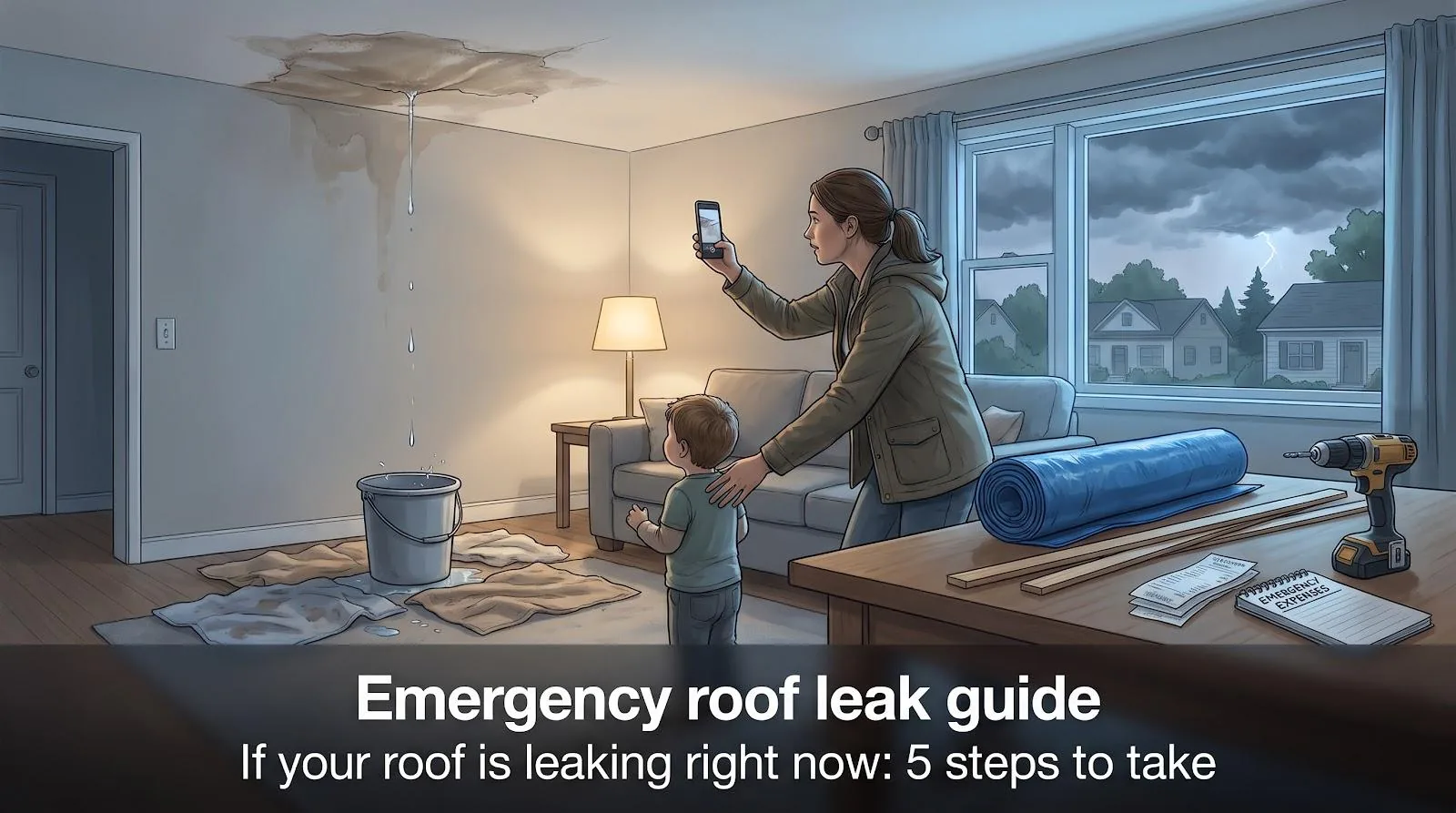
Water on the floor means the storm isn’t finished; it has simply moved indoors. Act in this order:
- Protect people, not drywall. Keep everyone clear of wet floors and sagging ceilings, and never climb a slick roof.
- Document the scene. From ground level or an attic hatch, photograph torn shingles, dented vents, and stained ceilings, anything the adjuster needs to see later.
- Cover the opening. A pro-installed tarp is ideal, but a heavy plastic sheet secured with furring strips can buy 24 to 48 hours (the window before mold typically takes hold, per EPA mold guidance).
- Track every dollar. Save receipts and photos for emergency costs; the Nebraska Department of Insurance guide explains how temporary repairs are treated.
- Notify your carrier once water is contained. Policies require prompt notice, and an early claim number starts the adjuster’s clock.
Call for written estimates only after the roof is safe and documented; jumping into permanent repairs too soon can undercut your claim.
How we selected Papillion’s storm-ready roofers
Stars alone don’t dry a hallway, so we began with an eight-point checklist focused on storm claims, not marketing:
- Papillion presence. Verified through service maps or a staffed local office.
- Legal standing. Active Nebraska contractor registration and a clean complaint history.
- Storm inspections. Published process for hail or wind photos and adjuster-ready reports.
- Rapid mitigation. Emergency tarping or a written plan for same-day leak control.
- Manufacturer credentials. Current directory listing for impact-rated or code-compliant systems.
- Written workmanship warranty. Specific years, not vague “lifetime” promises.
- Public track record. Reviews strong enough to validate service.
- Multi-trade follow-through. Proof they finish gutters, siding, or interior repairs that storms often bundle with a roof claim.
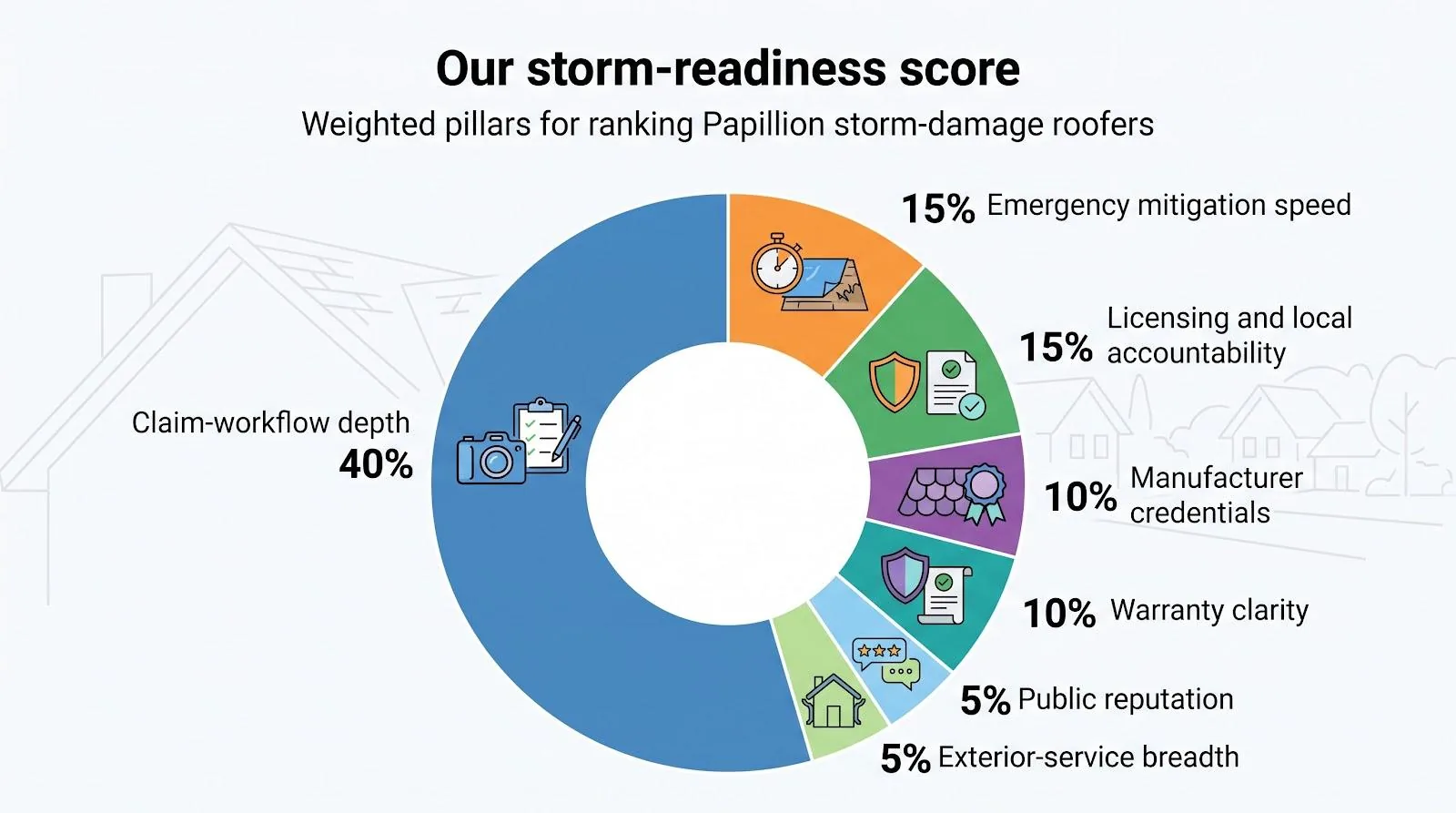
We weighted claim workflow most heavily (40 percent), then emergency speed and licensing (15 percent each), material credentials and warranty clarity (10 percent each), and reputation and exterior breadth (5 percent each). Unknown details scored low. Six firms cleared the bar.
Papillion’s storm-savvy roofers, side by side
Compare the essentials first, then read the profiles for nuance. Services and terms change, so confirm them before you call.
| Company | Best fit | Claim-help highlight |
|---|---|---|
| ReThink Construction & Claims | Roof, siding, and gutters on one claim | Insurance claim assistance start to finish |
| Hometown Roofing | Repair-first, veteran crew | Meets adjuster, updates scope |
| Moose Roofing | Emergency tarping and drone photos | Walk-through of loss statement |
| McCoy Roofing | Impact-rated roofing options | PM on-site with adjuster |
| White Castle Roofing | Long-running roof specialist | Publishes insurance FAQs |
| Monarch Siding, Windows & Roofing | Papillion showroom, full exterior | Storm-date review and docs |
Short-list two or three names, confirm any unknowns, and ensure each written bid matches the claim scope line for line.
1. ReThink Construction & Claims: best when the whole exterior is on the line
When golf-ball hail dents shingles, siding, and gutters in one hit, ReThink brings a City of Omaha Class A contractor license and crews that can repair every item on the claim: roofing, siding, gutters, metal wraps, windows, drywall, and painting. The company is local, not a storm chaser, serves Papillion along with the rest of the metro, and offers free storm inspections. Before the truck pulls up, their online Rethink Omaha storm damage repair guide walks you through the emergency tarping, comprehensive damage assessment, and claim assistance you will see in the field.
After a storm, ReThink starts with temporary repairs to prevent further damage, then runs a full inspection for missing shingles, leaks, and structural weaknesses caused by wind, hail, or heavy rain. Keep the receipts for that emergency work with your claim file.
Claim help is ReThink’s strongest lane. The team specializes in tough insurance claims and stays with homeowners from the first inspection to a fully repaired home, aiming to make sure everything that should be covered is covered.
One contract, one schedule, and one phone number if a warranty issue pops up later. The company is BBB accredited with an A+ rating.
Before you sign
- Ask the office for the exact workmanship-warranty term in writing.
- Compare its line-item bid with at least two others of the same scope.
2. Hometown Roofing: best when you want a repair-first veteran on speed dial
Hometown is a long-running local roofer with a repair-first approach. That mindset matters when a wind-hail deductible already stings the budget.
Hometown advertises storm response for urgent leaks, and the office can send photos plus an itemized cost sheet.
Hometown promotes manufacturer certifications that can unlock enhanced system warranties; ask for the workmanship guarantee in writing.
Project leads meet the adjuster, walk slopes together, and update quantities line for line. If the carrier approves only a patch, Hometown prices the difference so you can weigh out-of-pocket cost against a supplement.
Ask before you sign
- Is the overnight number a live dispatcher or voicemail callback?
- Does the workmanship guarantee apply to repair-only jobs?
3. Moose Roofing: best when you want fast tarping and thorough documentation

Storms do not keep office hours, and Moose markets emergency storm response, with an online form for requesting tarping help.
Documentation is Moose’s second gear. Inspectors fly drones, capture close-ups of vents and gutters, and deliver a labeled report so the adjuster clock keeps moving.
Moose promotes manufacturer-backed warranty options; confirm in writing whether a given warranty covers workmanship, materials, or both.
Ask before signing
- Will an emergency fee still apply if tarping must wait until daylight?
- Which warranty tier (materials only, or materials plus workmanship) shows on the proposal?
When dark clouds build over Sarpy County, Moose is worth a call for quick tarping and a clear paper trail.
4. McCoy Roofing: best when you want impact-rated systems that stay put
McCoy blends boutique service with an emphasis on impact-rated systems. Ask to see its current manufacturer directory listings and whether it can pair Class 4 shingles with upgrades such as a sealed deck and reinforced edges.
Inspections start with measurement, not marketing. Technicians photograph every code item from drip edge to ridge vent, and a McCoy project manager meets the adjuster on site.
Ask about emergency tarping availability during storm season, and have McCoy walk through its warranty options with the workmanship term in writing.
Before you sign
- Does the quote list impact-rated upgrades or standard shingles?
- Which warranty tier and workmanship term appear on page one?
5. White Castle Roofing: best when you want a pure-play roofer with decades in the saddle
White Castle has focused on roofing, not a dozen side trades, for decades. Specialists trace hail impacts by shingle layer, probe attic moisture, and photograph flashing many adjusters overlook, then turn the images into an estimate and a claim packet you can forward.
The company lists manufacturer shingle credentials; ask which impact-rated systems it is certified to install, and get the workmanship warranty term in writing.
Confirm emergency availability and arrival times before you need them, especially if water is pouring in tonight.
Ask before committing
- Will crews tarp outside business hours if needed?
- What workmanship term applies, and does it change on repair jobs?
6. Monarch Siding, Windows & Roofing: best when you want a Papillion neighbor handling every exterior detail
Some firms only service Papillion; Monarch plants roots here. Its Papillion showroom lets you compare shingle colors, siding profiles, and window glass in person, handy when hail damages more than the roof.
Technicians flag siding cracks, dented gutter aprons, and window-wrap tears that adjusters often overlook, which is why Monarch makes the cut even though its roofing division is smaller than Omaha’s largest crews. A permanent local address adds accountability; ask for the labor warranty term in writing.
Emergency help is worth confirming up front. Ask whether after-hours tarping is available; if not, line up a temporary tarp from another vendor if rain pours at 2 am.
Ask before you commit
- Will the proposal bundle roof, siding, gutters, and windows under one permit?
- Can they promise a tarp within one business day if the adjuster is delayed?
What to do before you file a roof claim
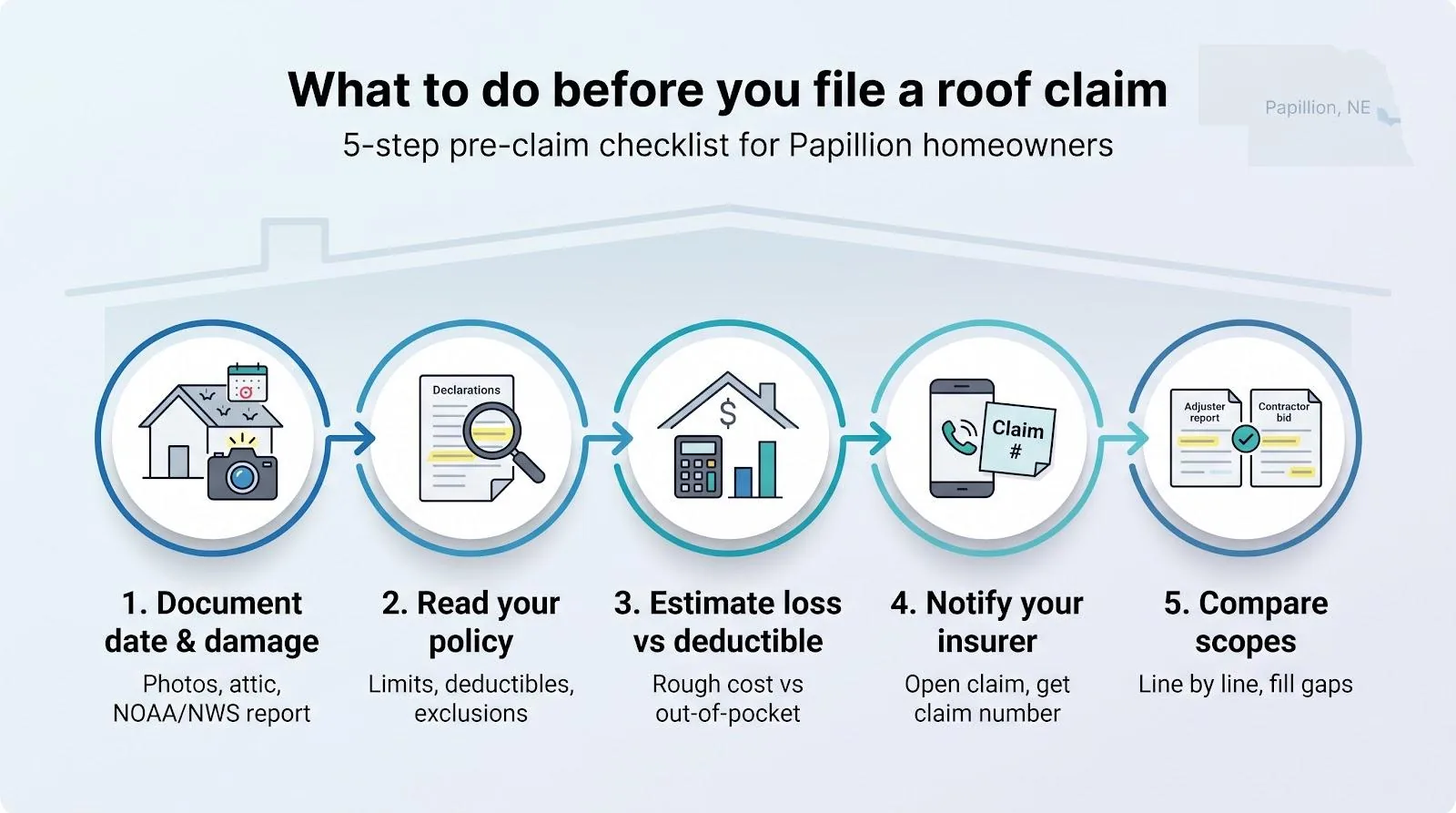
1. Document the date and visible evidence
Snap proof while clues are fresh, because hail melts fast and wind-torn shingles can blow away. Photograph wide shots of each elevation, then zoom in on dented gutters, bruised shingles, and granules beneath downspouts. Check the attic for wet decking or stained drywall, and save a National Weather Service hail report that matches your date and address. Photograph any buckets, plastic, or tarp you set, and save every receipt.
2. Read your policy declarations and endorsements
The declarations page lists limits and deductibles. Many homeowners carry a percentage wind-hail deductible; at one to two percent on a $450,000 dwelling, that is $4,500 to $9,000 out of pocket. Endorsements such as “roof surfacing ACV,” “cosmetic damage exclusion,” and “matching limitation” dictate how much the carrier pays after hail.
3. Estimate whether damage tops your deductible
Get a written repair estimate and compare it to your deductible. If probable loss minus deductible is negative, fix essentials out of pocket and protect your claim history; if clearly positive, move to the next step.
4. Notify your insurer and lock in the claim clock
Call or file online once you know the loss exceeds your deductible. Record the claim number, adjuster’s name, and promised callback. If the carrier cannot inspect promptly, ask permission to proceed with temporary repairs and submit receipts. Ask about the deadline for submitting paid invoices to recover depreciation.
5. Compare the adjuster’s scope with two contractor estimates
Treat the adjuster’s report as a draft. Lay it beside two detailed contractor scopes and circle gaps: missing starter strips, short ridge-vent totals, no decking allowance, or zero drip edge. Send clear deltas back with photos; most insurers correct obvious misses quickly.
How to choose a storm-damage roof repair service in Papillion
The best roofer after hail understands paperwork as well as shingles. Use this filter, starting with documents, not sales pitches.
- Confirm registration and permit know-how. Match the contractor’s number to the Nebraska registry; no number, no deal. Ask who pulls the Papillion permit and uploads final photos, and require proof of general liability and workers’ compensation.
- Treat a Class A badge as a plus, not a pass. It still needs state registration, local permits, and current manufacturer training.
- Verify manufacturer credentials the day you sign. Run the roofer’s name through GAF, CertainTeed, Malarkey, IKO, or Owens Corning contractor locators and screenshot the listing.
- Demand a line-item scope. A solid bid reads like a grocery receipt: tear-off, ice barrier, drip edge, vents, decking, permit, and cleanup.
- Keep claim fluency out of claim control. Contractors may document damage and discuss code items; negotiating policy language is the work of a licensed public adjuster. Ask, “Will you negotiate my settlement or just explain construction?”
- Handle assignments of benefits with caution. Signing one hands the claim to the contractor. If all you need is construction, keep the policy in your name.
- Compare warranties line by line. Separate workmanship from material coverage and note transfer rules.
- Ask about ice-dam defense and attic ventilation. Have the estimator walk the attic and quote any needed air-sealing.
- Test whether the crew is truly repair first. Request a repair quote for a single slope.
Papillion roof design and material considerations
1. Hail and wind are the baseline threats
Papillion sees severe hailstorms and straight-line wind events regularly. Those threats drive two core specs:
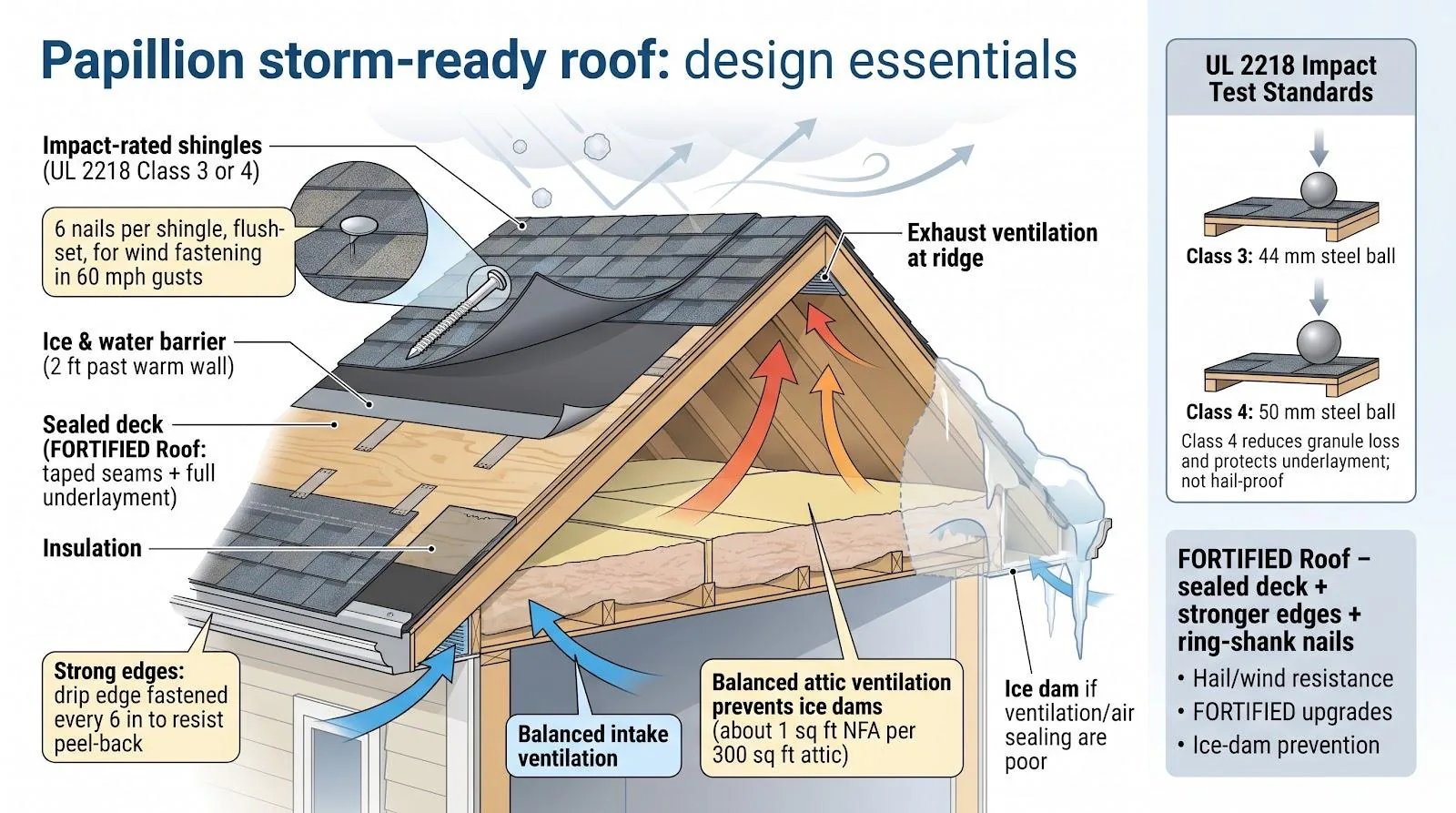
- Impact rating. Ask for UL 2218 Class 3 or Class 4 shingles (or metal panels) and insist on the manufacturer’s test sheet.
- Wind fastening. Correct nailing, starter strips, and sealed edges keep tabs down in strong gusts.
2. What Class 3 and Class 4 shingles really do
UL 2218 drops steel balls of increasing size onto mounted shingles, then checks for cracks. Class 4 is not hail proof, but it holds up better and can earn a premium discount from some insurers. Confirm the exact model and ask your agent what discount applies.
3. Why FORTIFIED upgrades matter
A FORTIFIED Roof adds a sealed deck, stronger edges, and ring-shank nails, so water stays out even if shingles blow off. Ask any contractor on your shortlist whether it can install to FORTIFIED standards, and ask your insurer whether an IBHS certificate lowers your premium.
4. Freeze-thaw, ice dams, and ventilation
Warm attic air melts rooftop snow that then refreezes at cold eaves, forming ice dams that force water under shingles. Prevention belongs in the reroof plan: air-seal the attic floor, balance intake and exhaust vents, install self-adhered ice barrier past the warm wall, and vent bath or dryer fans outdoors.
5. Know Papillion’s permit rules
A reroof in Papillion typically needs a permit, and extensive damage can require full replacement rather than a patch. Ask your contractor for the current requirements and the permit number, and keep it with your claim file; many insurers ask for it before releasing depreciation.
Frequently asked storm-roof questions in Papillion
Should I call a roofer or my insurance company first?
If water is pouring in, hire a roofer to tarp immediately and keep the receipts. Then alert your insurer; most policies require prompt notice. For non-urgent damage, a documented inspection first helps you decide whether the loss exceeds your deductible.
Does hail damage always mean a full replacement?
Not always. If hits are isolated and shingles stay pliable, a slope-specific repair may satisfy both code and insurer.
Can a roofer waive my deductible?
No reputable roofer will. Treat any offer to absorb your deductible as a red flag and ask your insurer about it.
Are Class 4 shingles hail-proof?
No. They pass a UL 2218 Class 4 impact test but can still dent or lose granules in real-world storms. Think “more durable,” not “invincible.”
How long do I have to finish repairs and claim depreciation?
It depends on the policy; confirm your exact deadline with the adjuster when the claim opens.
What if the contractor’s estimate is higher than the adjuster’s?
Compare line items. Send clear, documented gaps back to the adjuster. Most carriers issue a supplemental payment when evidence is solid.
What should a workmanship warranty cover?
Leaks caused by installation errors: tear-off, flashing, ventilation, and cleanup. Demand the term in writing, note transfer rules, and keep a service phone number on file.
Conclusion
Storm damage strikes fast, but a plan beats panic. You now have:
- A six-company shortlist vetted for claim help, credentials, and emergency response.
- A step-by-step photo and policy checklist.
- A filter for comparing bids, warranties, and permits.
Collect two or three written bids and line each item up against the insurer’s scope. Confirm registration, permit, and warranty terms before the first bundle lands on the driveway. Do that, and your roof goes on once, stays dry, and greets the next hailstorm without a leak.






EPDM Roofing: Rubber Roof Pros, Cons and Cost
EPDM roofing material is a synthetic rubber membrane used on flat and...
illustrarch Editoral Team8 Mins read
How to Match Your Roofing Style With Your Home’s Architecture
Your roof protects the house and shapes its curb appeal. These tips...
illustrarch Editoral Team2 Mins read
TPO Roofing: Membrane Pros, Cons and Cost
TPO roofing material is a single-ply thermoplastic polyolefin membrane widely used on...
illustrarch Editoral Team7 Mins read

Types of Roofs: The Complete Guide to Shapes, Styles and Materials
An overview of the most common roof shapes (gable, hip, flat, mansard,...
illustrarch Editoral Team12 Mins read


Leave a comment