

How Venice Residents Can Identify AI-Generated Content and Stay Informed Online
AI can now produce articles, reviews and images in seconds. These habits help Venice, California residents check local details, use AI detectors with care and verify information before sharing it.
 illustrarch Editorial Team29 November 20263 Mins read1
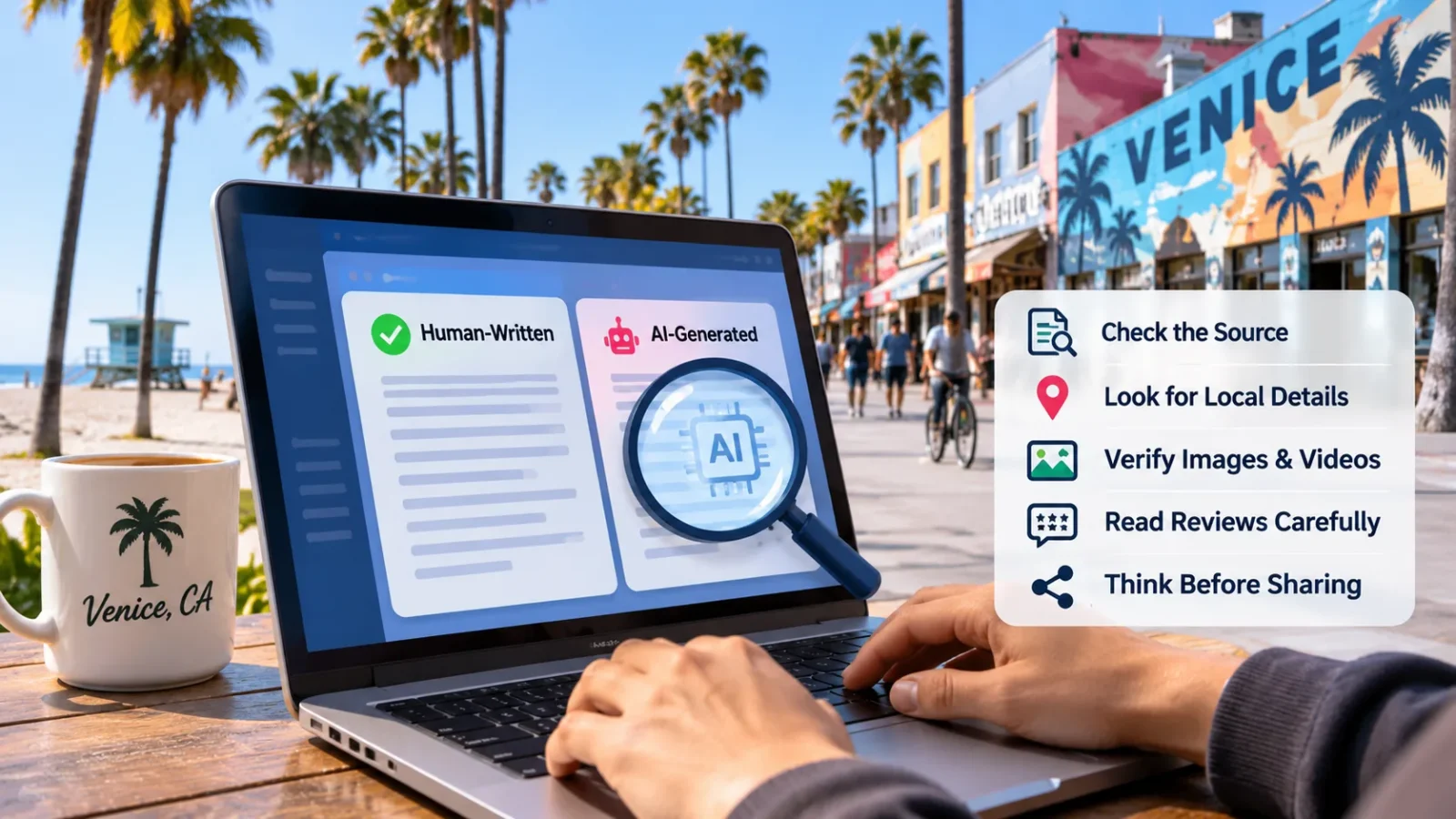
Table of Contents Show
From neighborhood updates and local business announcements to community events and entertainment recommendations, digital platforms have become an important part of everyday life in Venice, California. Residents frequently turn to social media, online publications, and community forums to stay connected with their surroundings.
However, artificial intelligence is changing how online content is created and distributed. Articles, social media posts, photographs, and reviews can now be generated with minimal human involvement, making it more difficult to distinguish reliable information from misleading content.
For Venice residents, developing better digital literacy habits can help them make informed decisions and participate more confidently in online community discussions.
Why Digital Content Authenticity Matters to Local Communities
Local communities depend on accurate information. Residents use digital platforms to learn about neighborhood developments, road closures, upcoming events, public services, and local businesses.
When misleading information circulates online, it can create unnecessary confusion. An inaccurate announcement about a community event, for example, could lead residents to arrive at the wrong location or make unnecessary travel arrangements.
AI-generated content is not automatically unreliable. The main concern arises when automated information is published without proper verification or presented as factual despite containing inaccuracies.
Taking a few moments to evaluate information before sharing it can help maintain trust within the community.
Recognizing Potential Signs of AI-Generated Writing
Artificial intelligence can produce polished and convincing written content. However, some generated material may contain repetitive sentences, vague explanations, inconsistent details, or information that lacks meaningful context.
Readers who are uncertain about the authenticity of an online article can use a free AI detector as an additional tool for evaluating written content. Such tools examine linguistic patterns that may be associated with automated writing, although their results should not be considered definitive evidence.
Human-written content can sometimes receive inaccurate detection results. Similarly, AI-generated writing may go undetected. Readers should combine technological assistance with independent judgment, factual verification, and careful consideration of the publisher’s credibility.
Pay Attention to Local Details and Context
One practical way to evaluate online information is to examine whether it accurately reflects local surroundings and circumstances.
Venice has a distinct community identity, with its beachfront attractions, independent businesses, artistic culture, and residential neighborhoods. Content discussing the area should provide relevant and accurate details rather than broad descriptions that could apply to almost any coastal destination.
For example, an article recommending a neighborhood event should provide clear information about its location, schedule, and organizer. When these details are missing or inconsistent, readers should verify the information before making plans or sharing it with others.

Be Careful With AI-Generated Images and Videos
Written content is not the only material affected by artificial intelligence. Digital tools can also produce realistic photographs, videos, and illustrations that depict situations that never occurred.
A convincing image of a crowded Venice Beach event or a damaged local building may appear authentic at first glance. However, visual content can be manipulated or generated without documenting an actual occurrence.
Readers should examine unusual visual inconsistencies, consider where the image originated, and look for independent confirmation when necessary.
Visual clues alone cannot reliably establish whether an image is authentic. Understanding its context is often more useful than focusing entirely on its appearance.
Evaluate Online Reviews Before Supporting Local Businesses
Online reviews influence where people eat, shop, and spend their leisure time. For independent restaurants, retailers, and service providers in Venice, customer feedback can play an important role in attracting visitors.
However, automatically generated or fabricated reviews can make it difficult to assess genuine customer experiences.
Readers should look for reviews that describe specific experiences rather than relying entirely on generic praise or criticism. Comparing feedback across multiple customers can provide a more balanced understanding of a business.
Residents can also support their local community by sharing accurate, experience-based reviews of businesses they have personally visited.
Think Before Sharing Information on Social Media
Social media allows neighborhood news to circulate quickly. Unfortunately, misleading information can spread just as easily as accurate updates. Before sharing a post about public safety, community developments, or local events, residents should consider whether its claims have been verified.
Checking publication dates is particularly useful because outdated announcements can sometimes circulate as current information. Reading the complete article instead of relying solely on its headline can also prevent misunderstandings.
Develop Responsible Digital Habits
Artificial intelligence can be useful for organizing information, generating ideas, and simplifying everyday tasks. The objective is not to avoid technology but to understand where human judgment remains necessary.
Residents should approach online information with curiosity, evaluate unfamiliar claims carefully, and remain open to correcting misunderstandings. Encouraging these habits among family members and friends can also contribute to a more informed and responsible digital community.

Conclusion
As artificial intelligence becomes more common in everyday digital communication, identifying trustworthy information is an increasingly valuable skill. For Venice residents, thoughtful reading, independent verification, and responsible sharing can help protect the quality of local conversations. By combining useful digital tools with critical thinking, community members can stay informed while maintaining trust in the information they consume and share.







How AI Is Reshaping Audio and Visual Content: From Voice Changers to Image Enhancement
Voice changers and AI image enhancement rely on the same pattern-learning models....
illustrarch Editorial Team4 Mins read

Seedance 3.0 for Home and Garden Concepts: Making a Renovation Story Easier to Discuss
Seedance 3.0 can turn a renovation idea into a short concept video....
illustrarch Editorial Team5 Mins read

Best AI Interview Assistant for Architects: 10 Tools Compared
We compare nine AI interview assistants for architects on speed, drawing awareness,...
illustrarch Editorial Team14 Mins read

The Nano Banana Prompt: Mastering Micro-Bionic Architecture in Midjourney v6
Nano Banana Prompt explores the innovative fusion of biomimicry and architectural design...
 Bahattin Duran3 Mins read






Leave a comment