
Free Online Paint Calculator
Calculate the amount of paint needed for your project.
Enter each wall: width and height. Good for L-shaped rooms, accent walls and stairwells.
Trim and woodwork
Trim enamel, semi-gloss or satin: 400-450 sq ft/gal (middle used).
Colors and preview
Your prices and labor (optional)
Calculation Results
Fix the highlighted fields to see the results.
Area Summary
- Gross Area
- - sq ft
- Openings
- - sq ft
- Net Area
- - sq ft
Paint Needed
10% waste included
Primer Needed
Can Recommendation
Cost Estimate
Show calculation
Project
Tips
- Color Change
- Drying Time
- 2-4 hours (touch dry), 24 hours (recoat)
- Application Tip
- Ensure surfaces are clean, dry, and dust-free before painting.
Assumptions: coverage, texture, siding, stain and sprayer figures are the middle of the ranges in our paint guide below; they are typical values for one coat. The label on your paint can is the best guide, since brands differ.
Next steps
Paint Calculator: Estimate Paint Coverage, Costs & Gallons Needed
A reliable paint calculator saves you from buying too much or too little paint for any project. Whether you’re refreshing a single room or tackling a whole-house painting project, knowing exactly how much paint to buy keeps you on budget and cuts down on extra trips to the store. This free paint calculator guide helps you estimate the gallons needed for interior design projects, exterior painting, ceilings, trim, and more.
Just as architects carefully plan every element of a space, from bubble diagrams for spatial planning to final finishes, calculating paint quantities accurately ensures professional results without waste. This guide covers everything from basic formulas to cost estimates for DIY and professional painting projects. You’ll find interior paint calculator square feet breakdowns, an exterior paint estimator section, trim paint calculator tips, and much more.
How to Calculate How Much Paint You Need
The fundamental principle behind paint calculation is simple: measure the surface area you want to paint, then divide by the paint’s coverage rate. Accurate estimation requires accounting for doors, windows, number of coats, and surface texture. Tools like the Lowe’s paint estimator and the Sherwin-Williams paint calculator can help, but understanding the math yourself gives you a reliable backup.

The Basic Paint Calculation Formula
Gallons Needed = (Total Square Feet ÷ Coverage per Gallon) × Number of CoatsWhere:
- Total Square Feet = Area to be painted minus doors and windows
- Coverage per Gallon = Typically 350-400 sq ft for quality latex paint
- Number of Coats = Usually 2 for best results
Step-by-Step Paint Calculation
Measure the length and height of each wall in feet. Multiply length × height to get the square footage of each wall. Add all walls together for total wall area.
Subtract non-paintable areas: Standard door ≈ 20 sq ft, Standard window ≈ 15 sq ft. This gives you the actual paintable surface area.
Divide the total paintable area by the paint’s coverage rate (check the can, typically 350-400 sq ft/gallon), then multiply by the number of coats.
Always round up and add a buffer for touch-ups, uneven surfaces, and small errors. It’s better to have a little extra than to run short mid-project.
Example: Calculating Paint for a 12′ × 14′ Room
• Room perimeter: (12 + 14) × 2 = 52 feet
• Wall height: 8 feet
• Total wall area: 52 × 8 = 416 sq ft
• Subtract 1 door (20 sq ft) + 2 windows (30 sq ft) = 50 sq ft
• Paintable area: 416 − 50 = 366 sq ft
• At 375 sq ft/gallon coverage: 366 ÷ 375 = 0.98 gallons
• For 2 coats: 0.98 × 2 = 1.96 gallons
• Purchase: 2 gallons (accounts for touch-ups)

Paint Coverage by Type
| Paint Type | Coverage (sq ft/gallon) | Best For |
|---|---|---|
| Interior Latex Paint | 350-400 | Walls, ceilings, most interior surfaces |
| Interior Primer | 200-300 | New drywall, color changes, stain blocking |
| Exterior Latex Paint | 250-350 | Siding, trim, outdoor surfaces |
| Exterior Primer | 200-300 | Bare wood, weathered surfaces |
| Ceiling Paint | 350-400 | Ceilings, overhead surfaces |
| Trim/Semi-Gloss | 400-450 | Baseboards, doors, molding |
| Textured Paint | 150-200 | Texture finishes, specialty coatings |
Coverage rates vary by brand. Always check the manufacturer’s specifications. Premium paints from brands like Sherwin-Williams, Benjamin Moore, and Behr often provide better coverage than economy paints.

Lowe’s Paint Estimator vs. Brand Calculators
Several retailers and manufacturers offer their own online paint estimators. The Lowe’s paint estimator is popular because it includes man-hours estimation alongside gallons needed. The Sherwin-Williams paint calculator lets you input custom room dimensions and offers quick presets. The Behr paint calculator covers interior, exterior, and stain estimates in one tool. Each calculator uses slightly different coverage assumptions, so cross-referencing two or three tools gives you a more reliable estimate. For the most accurate results, measure your rooms yourself and apply the formula above.
Interior Paint Calculator
Interior painting projects require careful planning to achieve professional results. Whether you’re beginning a home renovation or simply refreshing a room’s color palette, an accurate interior paint calculator saves both time and money. The key is measuring your walls in square feet and factoring in doors, windows, and coat count before heading to the store.
Room-by-Room Paint Estimates
| Room Type | Average Size | Walls Only | Walls + Ceiling |
|---|---|---|---|
| Small Bathroom | 40 sq ft floor | 1 gallon | 1.5 gallons |
| Standard Bathroom | 60 sq ft floor | 1.5 gallons | 2 gallons |
| Small Bedroom | 10′ × 10′ | 1.5 gallons | 2 gallons |
| Standard Bedroom | 12′ × 12′ | 2 gallons | 2.5 gallons |
| Master Bedroom | 14′ × 16′ | 2.5 gallons | 3.5 gallons |
| Living Room | 16′ × 20′ | 3 gallons | 4 gallons |
| Kitchen | 12′ × 14′ | 2 gallons | 2.5 gallons |
*Estimates assume 8-foot ceilings, 2 coats, and standard door/window deductions
Interior Paint Calculator: Square Feet Breakdown
To use an interior paint calculator based on square feet, follow this approach for any room shape. For a rectangular room, multiply the perimeter (sum of all wall lengths) by the ceiling height to get total wall square footage. Then subtract roughly 20 sq ft per door and 15 sq ft per window. A 10′ × 10′ room with 8-foot ceilings, one door, and one window works out to about 285 paintable square feet, requiring roughly 1.5 gallons for two coats. For L-shaped or irregular rooms, measure each wall segment individually, calculate them separately, and add the results together.
Ceiling Paint Calculator
Ceiling painting is straightforward since there are no doors or windows to subtract. Simply calculate the floor area:
Ceiling Gallons = (Length × Width) ÷ Coverage × Coats• Area: 14 × 16 = 224 sq ft
• At 400 sq ft/gallon: 224 ÷ 400 = 0.56 gallons
• For 2 coats: 0.56 × 2 = 1.12 gallons
• Purchase: 1.5 gallons or 1 gallon + 2 quarts
In the calculator, tick Include ceiling on the Room tab. The ceiling gets its own paint type, with ceiling paint (350 to 400 sq ft per gallon, calculated at 375) as the default, its own surface condition, and its own line under Paint Needed. For the same 14 × 16 ft room with 8 ft walls, two coats and the default 10% waste, the ceiling line is 1.32 gallons, bought as one gallon and two quarts, next to 2.47 gallons for the walls.
Trim Paint Calculator
Trim is measured in linear feet rather than square footage. A typical room has trim around the perimeter plus door and window casings. A dedicated trim paint calculator helps you avoid over- or under-buying.
• Calculate total linear feet of trim
• Multiply by trim width (typically 4-6 inches = 0.33-0.5 feet)
• Add door casing area (approximately 17 sq ft per standard door)
• Add window casing area (approximately 10 sq ft per standard window)
• 1 gallon of trim paint covers approximately 150-200 linear feet
The calculator above works trim out by area rather than by linear feet. Open Trim and woodwork and tick Calculate trim paint: it multiplies the baseboard and crown molding length by the trim width (5 inches unless you change it), adds about 17 sq ft per door casing and 10 sq ft per window casing, counts both faces of any door leaves you enter, and divides by 425 sq ft per gallon for semi-gloss or satin trim enamel, with your number of coats and waste allowance. Leave the baseboard length empty and it uses the room perimeter minus the door widths.
For a standard 12′ × 14′ room with baseboards, crown molding, one door, and two windows, expect to need roughly 1 quart to 1 gallon of trim paint depending on trim width and number of coats. Semi-gloss or satin finishes are preferred for trim because they resist scuffs and wipe clean easily.

Exterior Paint Calculator
Exterior painting requires different considerations than interior work. Weather exposure, surface porosity, and architectural details all affect paint needs. A good exterior paint estimator accounts for siding type, gable areas, and window/door deductions. Proper planning is essential, just as understanding renovation costs helps budget effectively.
Calculating Exterior Wall Area
For exterior painting, measure each wall separately and account for gables, dormers, and other architectural features:
Length × Height for each wall section. For two-story homes, measure each floor separately.
For triangular gables: (Base × Height) ÷ 2. Add this to your wall measurements.
Subtract windows (15-20 sq ft each), doors (20 sq ft each), and garage doors (120-160 sq ft).

Exterior Paint Coverage by Siding Type
| Siding Type | Coverage (sq ft/gal) | Notes |
|---|---|---|
| Smooth Wood | 350-400 | Standard coverage, may need primer |
| Rough-Cut Wood/Cedar | 200-300 | Absorbs more paint, extra coats often needed |
| Vinyl Siding | 300-400 | Requires special vinyl-safe paint |
| Aluminum Siding | 300-350 | Needs proper primer for adhesion |
| Stucco | 150-250 | Very porous, requires more paint |
| Brick | 100-150 | Highly porous, requires primer and extra coats |
| Concrete/Masonry | 150-200 | Requires masonry primer |
House Size Paint Estimates
| Home Size | Exterior Sq Ft* | Body Paint (gal) | Trim Paint (gal) |
|---|---|---|---|
| 1,000 sq ft (1 story) | ~1,200 | 6-8 | 1-2 |
| 1,500 sq ft (1 story) | ~1,600 | 8-10 | 2 |
| 2,000 sq ft (2 story) | ~2,200 | 12-15 | 2-3 |
| 2,500 sq ft (2 story) | ~2,800 | 15-18 | 3-4 |
| 3,000 sq ft (2 story) | ~3,400 | 18-22 | 4-5 |
*Estimates assume standard window/door deductions and 2 coats
Exterior Paint Calculator: Worked Example
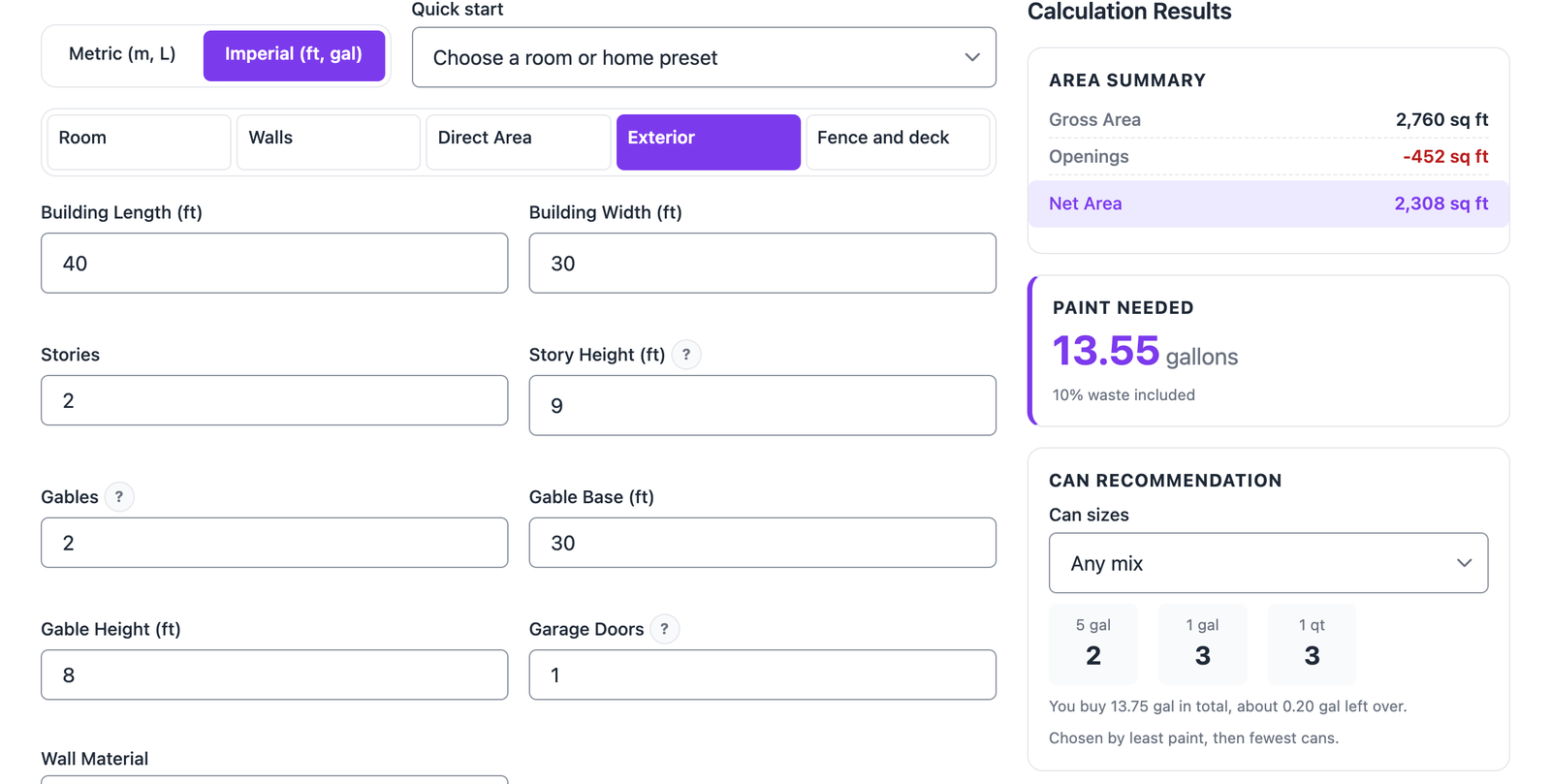
The Exterior tab of the calculator above works from the building footprint instead of wall by wall: enter the building length and width, the number of stories and the story height, the gables (number, base and height) and the garage doors, then the doors and windows as on the interior tabs. The wall material sets the coverage, from smooth wood siding (350 to 400 sq ft per gallon) and vinyl (300 to 400) down to stucco (150 to 250) and brick (100 to 150), the same ranges as the siding table above.
For a two story house of 40 × 30 ft with 9 ft stories, two gables 30 ft wide and 8 ft high, one garage door, two doors and 14 medium windows, the calculator finds 2,760 sq ft of wall, takes off 452 sq ft of openings and paints 2,308 sq ft. In smooth wood siding with two coats and 10% waste that is 13.55 gallons, bought as two 5 gal cans, three 1 gal cans and three quarts. Primer has its own tick box, for bare or patched siding. The cost card prices the paint at economy, mid-range and premium rates, $275 to $413, $413 to $619 and $619 to $894 for this house, from the per gallon prices in the paint cost table below, and a labor rate per square foot can be added for a contractor estimate.
Fence and Deck Stain Calculator
For fences, calculate the total surface area of both sides if painting the entire fence:
Fence Sq Ft = Length × Height × 2 (for both sides)• One side: 100 × 6 = 600 sq ft
• Both sides: 600 × 2 = 1,200 sq ft
• At 300 sq ft/gallon (rough wood): 1,200 ÷ 300 = 4 gallons
• For 2 coats: 4 × 2 = 8 gallons
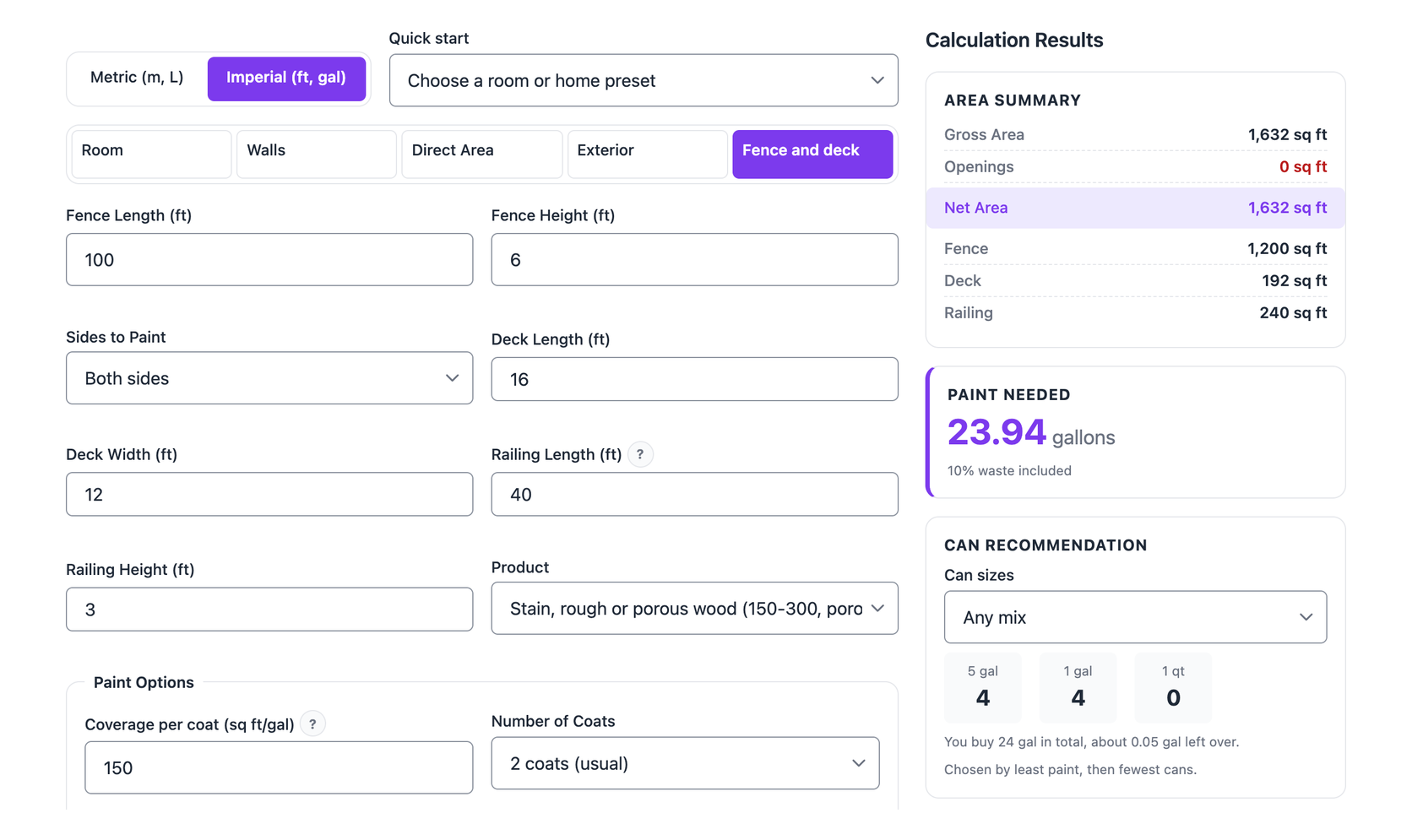
The calculator above has its own Fence and deck tab for this. Enter the fence length and height, choose one side or both, add a deck (length × width) and any railing, then pick the product. Railings are counted as a flat surface, length × height on both sides. Choosing a stain switches the primer off, since stain needs none.
Stain and Paint Coverage in the Calculator
Each product carries one coverage figure per coat, taken from the ranges in this guide. The label on your can is still the best guide, since brands differ.
| Product | Typical range (sq ft/gal) | Value used (sq ft/gal) |
|---|---|---|
| Exterior paint, smooth wood | 350 to 400 | 375 |
| Exterior paint, rough wood | 200 to 300 | 250 |
| Stain, smooth or planed wood | 150 to 300, smooth end | 300 |
| Stain, rough or porous wood | 150 to 300, porous end | 150 |
• Fence: 100 × 6 × 2 = 1,200 sq ft
• Deck: 16 × 12 = 192 sq ft
• Railing: 40 × 3 × 2 = 240 sq ft
• Total: 1,632 sq ft
• Rough or porous wood stain at 150 sq ft/gallon, 2 coats, 10% waste: 1,632 ÷ 150 × 2 × 1.1 = 23.94 gallons
• Cans suggested by the calculator: four 5 gal and four 1 gal
Interior & Exterior Painting Cost Calculator
Understanding painting costs helps you budget accurately whether you’re doing it yourself or hiring professionals. Costs vary significantly based on paint quality, surface preparation, and your location, similar to how home renovation costs vary by project scope. Use this section as an interior painting estimate calculator to plan your budget.
Paint Prices by Quality (2026 Averages)
| Paint Quality | Price/Gallon | Coverage | Durability |
|---|---|---|---|
| Economy (store brands) | $20-30 | 300-350 sq ft | 3-5 years |
| Mid-Range (Behr Premium Plus, Valspar) | $30-45 | 350-400 sq ft | 5-8 years |
| Premium (Behr Marquee, SW SuperPaint) | $45-65 | 400-450 sq ft | 8-12 years |
| Ultra-Premium (BM Aura, SW Emerald) | $65-100+ | 400-450 sq ft | 10-15+ years |
Paint Cost Comparison by Brand (2026)
Paint prices have risen over the past few years. Here is a quick comparison of current pricing across popular brands to help your interior painting estimate calculator:
| Brand | Budget Line (per gal) | Mid-Range (per gal) | Premium (per gal) | Where to Buy |
|---|---|---|---|---|
| Behr | $28-35 | $38-45 | $48-55 | Home Depot |
| Sherwin-Williams | $35-45 | $45-55 | $60-80 | SW Stores |
| Benjamin Moore | $45-50 | $55-65 | $70-80+ | BM Retailers |
| Valspar | $25-35 | $35-50 | $50-60 | Lowe’s |
| PPG/Glidden | $25-30 | $30-45 | $45-55 | Home Depot, PPG Stores |
Sherwin-Williams frequently runs 30-40% off sales, which can bring their premium lines closer to mid-range pricing. Watch for seasonal promotions at all retailers.
DIY vs Professional Painting Costs
DIY Interior Painting Costs
- Paint: $30-55 per gallon (mid-range to premium)
- Primer: $20-40 per gallon
- Supplies: $50-150 (brushes, rollers, tape, drop cloths, trays)
- Total for average room: $100-350
- Total per sq ft: $0.50-1.50
Professional Interior Painting Costs
- Walls only: $1-3 per square foot
- Walls + ceiling + trim: $3-6 per square foot
- Average room: $350-900
- Whole house (2,000 sq ft): $4,000-12,000
- Labor accounts for: 70-85% of total cost

Professional Exterior Painting Costs
- Per square foot: $1.50-5.00
- 1,500 sq ft home: $2,500-5,500
- 2,500 sq ft home: $4,000-9,000
- Fence painting: $2-4 per square foot
- Trim only: $1-3 per linear foot
Painting Cost by Room
| Room | DIY Cost | Professional Cost |
|---|---|---|
| Bathroom | $75-175 | $300-600 |
| Small Bedroom | $100-225 | $350-700 |
| Master Bedroom | $150-350 | $650-1,500 |
| Living Room | $200-450 | $1,000-2,200 |
| Kitchen | $150-350 | $800-1,600 |
| Whole House Interior | $1,000-3,000 | $4,000-12,000 |
For more detailed guidance on planning renovation budgets, see our guide to expert architectural tips for home renovation.

How to Save Money on Paint Without Sacrificing Quality
Paint can be one of the most cost-effective home improvements when you buy smart. Here are practical ways to keep your paint budget in check:
- Wait for seasonal sales. Sherwin-Williams runs multiple 30-40% off events each year, and Behr often offers rebates at Home Depot during spring and fall.
- Buy in 5-gallon buckets when painting multiple rooms the same color. The per-gallon price drops by roughly 10-15%.
- Use the Lowe’s paint estimator or the Sherwin-Williams paint calculator before shopping, then compare prices online and in-store.
- Choose a paint-and-primer-in-one product for repainting similar colors. It saves the cost of a separate primer gallon.
- Ask for mistints. Most paint stores sell returned or mis-mixed paint at 50-75% off. These work well for closets, garages, and utility rooms.
- Invest in quality paint for high-traffic areas (kitchen, hallways, bathrooms) and use mid-range paint for bedrooms and guest rooms where wear is lighter.
Choosing Paint Finishes
The right paint finish affects both appearance and durability. Consider the room’s function, lighting, and traffic when selecting finishes. This is an important aspect of interior design trends.
Interior Paint Finishes Guide
| Finish | Sheen Level | Durability | Best Uses |
|---|---|---|---|
| Flat/Matte | 0-10% | Low | Ceilings, low-traffic rooms, hides imperfections |
| Eggshell | 10-25% | Medium | Living rooms, bedrooms, dining rooms |
| Satin | 25-35% | Medium-High | Kitchens, bathrooms, hallways, family rooms |
| Semi-Gloss | 35-70% | High | Trim, doors, cabinets, high-moisture areas |
| High-Gloss | 70-100% | Very High | Accent trim, furniture, cabinets |
Exterior Paint Finishes
- Flat: Best for siding with imperfections; harder to clean
- Low-Sheen/Satin: Popular choice balancing appearance and cleanability
- Semi-Gloss: Ideal for trim, shutters, doors; very durable
- Gloss: Maximum durability for doors and high-wear areas

Surface Preparation Tips
Proper surface preparation is crucial for paint adhesion and longevity. According to Sherwin-Williams, surface prep accounts for up to 80% of a successful paint job.
Interior Preparation Checklist
- Remove furniture or move to center of room and cover
- Remove outlet covers and light switch plates
- Fill holes and cracks with spackling compound
- Sand patched areas smooth when dry
- Clean walls to remove dust, grease, and cobwebs
- Apply painter’s tape to trim, windows, and ceiling edges
- Prime bare drywall, stains, or when making dramatic color changes
- Lay drop cloths to protect floors
Exterior Preparation Checklist
- Pressure wash to remove dirt, mildew, and loose paint
- Scrape and sand peeling or flaking paint
- Repair or replace damaged siding, trim, or caulk
- Prime bare wood and any repairs
- Cover landscaping, windows, and fixtures
- Check weather forecast. Avoid painting in extreme heat, cold, or high humidity
- Allow surfaces to dry completely after washing (24-48 hours)

Factors Affecting Paint Coverage
Several variables can increase or decrease the amount of paint needed beyond basic square footage calculations:
Surface Texture
- Smooth drywall: Standard coverage (350-400 sq ft/gal)
- Orange peel texture: 10-20% more paint needed
- Knockdown texture: 20-30% more paint needed
- Heavy texture/popcorn: 30-50% more paint needed
- Brick/masonry: 50-100% more paint needed
Color Changes
- Similar colors: 2 coats typically sufficient
- Light to dark: 2-3 coats with tinted primer
- Dark to light: 3+ coats or primer + 2 coats
- Covering bright colors (red, orange, yellow): Always use gray-tinted primer
Application Method
- Brush: Uses less paint but slower; best for detail work
- Roller: Standard coverage; most efficient for large areas
- Sprayer: Uses 20-40% more paint but fastest application; requires more masking

Common Paint Calculation Mistakes to Avoid
Even with a paint calculator, these errors can throw off your estimate:
- Forgetting to double for two coats. Most surfaces need two coats for even coverage, so always multiply your base gallon number by two.
- Not accounting for surface texture. A knockdown or popcorn ceiling can absorb 30-50% more paint than smooth drywall.
- Using interior coverage rates for exterior surfaces. Exterior siding (especially stucco and brick) absorbs significantly more paint per gallon.
- Skipping primer when changing colors drastically. Going from dark to light without primer wastes paint on extra coats.
- Spraying without adjusting your estimate. Spray application wastes 20-40% more paint than rolling, so increase your gallon count accordingly.
- Measuring floor area instead of wall area. Your walls have a much larger surface area than your floor. Always calculate perimeter × height.
Frequently Asked Questions
How much paint do I need for a 12×12 room?
For a 12′ × 12′ room with 8-foot ceilings, you’ll need approximately 1.5-2 gallons for the walls (with 2 coats) after subtracting doors and windows. If painting the ceiling too, add another gallon. This assumes standard latex paint with 350-400 sq ft/gallon coverage.
How many square feet does a gallon of paint cover?
A gallon of quality interior latex paint typically covers 350-400 square feet per coat on smooth surfaces. Exterior paint covers slightly less (250-350 sq ft) due to surface porosity. Primer covers approximately 200-300 sq ft per gallon. Always check the paint can for specific coverage rates.
How much does it cost to paint the interior of a house?
Professional interior painting costs $2-6 per square foot, or $4,000-$12,000 for an average 2,000 sq ft home. DIY costs are significantly lower at $0.50-1.50 per square foot. Costs vary based on paint quality, surface condition, ceiling height, and geographic location. Use an interior painting estimate calculator to get a number tailored to your project.
Do I need primer before painting?
Primer is recommended for: new drywall, bare wood, stained surfaces, when making dramatic color changes, over glossy surfaces, and on porous surfaces. Many premium paints now include primer (paint-and-primer-in-one), which works well for repainting similar colors on previously painted surfaces.
How do I calculate paint for walls with high ceilings?
Use the same formula: perimeter × height = wall square footage. A room with 10-foot ceilings has 25% more wall area than one with 8-foot ceilings. For vaulted or cathedral ceilings, break the wall into rectangular and triangular sections, calculate each separately, and add together.

How much paint do I need for a fence?
For a 6-foot privacy fence, calculate: length × height × 2 (for both sides) = total square feet. A 100-foot fence needs approximately 8 gallons for two coats. Wood fences are porous and absorb more paint, so use coverage rates of 200-300 sq ft/gallon.
How much stain do I need for a deck?
Multiply the deck length by its width, divide by the stain’s coverage per gallon and multiply by the number of coats. A 16 × 12 ft deck is 192 sq ft: at 150 sq ft per gallon for rough or porous wood, two coats take about 2.6 gallons, or about 2.8 gallons with 10% waste. Add railings separately as length × height × 2. The Fence and deck tab of the calculator works this out for the fence, the deck and the railing in one go.
What’s the difference between interior and exterior paint?
Exterior paint contains additives for UV resistance, mildew prevention, and flexibility for temperature changes. Interior paint focuses on washability, low VOCs, and stain resistance. Never use interior paint outside because it won’t withstand weather exposure. Exterior paint can sometimes be used indoors but may have stronger odors.
How long does paint last once opened?
Properly sealed latex paint lasts 2-10 years once opened. Store in a cool, dry place with the lid tightly sealed. Never freeze latex paint. Oil-based paints can last up to 15 years. Check for foul odors, lumps, or separation before using stored paint because these indicate spoilage.
Should I buy a quart or gallon of paint?
A quart covers approximately 100 square feet, which is enough for an accent wall, door, or small touch-up project. For anything larger, gallons are more cost-effective. Calculate your exact needs first, then round up to the nearest container size, keeping extra for touch-ups.
How do I estimate paint for exterior trim?
As a rule of thumb, budget 1 gallon of trim paint for every 8 gallons of body paint. For precise estimation, measure total linear feet of trim, multiply by the average width (6 inches = 0.5 feet), and divide by coverage rate (approximately 400-450 sq ft/gallon for semi-gloss). Using a trim paint calculator simplifies this process.
How accurate is the Lowe’s paint estimator?
The Lowe’s paint estimator provides a solid starting point, especially for standard rectangular rooms. It uses average coverage rates of 350-400 sq ft per gallon and includes man-hours estimation. For the most accurate result, measure your walls yourself and compare estimates from two or three different paint calculators. Adjust for textured walls, dramatic color changes, or porous surfaces, as online tools typically assume smooth, previously painted drywall.
How do I use the Sherwin-Williams paint calculator?
Visit the Sherwin-Williams paint calculator page and choose between the “Quick Calculator” (select a preset room size) or the “Custom Calculator” (enter exact wall dimensions). Input the number of doors and windows, ceiling height, and number of coats. The tool outputs the estimated gallons for your project based on Sherwin-Williams coverage specs.

Additional Resources
Sherwin-Williams Paint CalculatorOfficial calculator with custom and quick options
Benjamin Moore Paint CalculatorSimple calculator for walls and trim
Behr Paint CalculatorInterior, exterior, and stain estimates
KILZ Primer CalculatorPrimer and paint needs estimator
Lowe’s Paint CalculatorIncludes man-hours estimation
HomeAdvisor Paint CalculatorDIY and professional cost estimates
EPA Lead Paint InformationSafety guidelines for older homes
PPG Paint CalculatorProfessional-grade paint estimates
Glidden Paint CalculatorQuick room-size presets with gallon estimates
This Old House: How Much Paint Do I Need?Step-by-step calculation guide with examples
Related Articles on Illustrarch
- How to Begin a Home Renovation Plan
- How to Plan a Successful Home Renovation
- Understanding Home Renovation Costs: A Comprehensive Guide
- Expert Architectural Tips for Home Renovation
- Top Architectural Concept Ideas for Interior Design
- Concept Ideas for Interior Design
- Future Trends in Interior Design
- Best Design Ideas for Your New House
- How to Draw a House Blueprint with Software
- How to Draft a Property You Plan to Remodel
- Top Building Materials for Sustainable Construction
- Top 10 Essential Building Materials
Tools on Illustrarch
- Bubble Diagram Maker: Create spatial relationship diagrams
- All Architecture Tools: Browse our complete collection
Rate this tool
Was Free Online Paint Calculator useful? One tap, no sign-up.